In the Extracts from Inese’s letters and cards sent to Erna from Europe and Russia, the section on Russia is limited, as we were warned [by our Embassy in Moscow, right] that we should be careful about what we said in letters home. That was partly because 3 of us were born in Latvia and even though we were Australian citizens, Russia did not necessarily recognize that citizenship and could treat us as citizens of the Soviet Union, if it so decided. For example, someone who was born elsewhere might be expelled from the Soviet Union for trying to smuggle out a Russian icon — we could end up in jail. Therefore, Ian, became our note-taker, but he too was told not to identify any people we met, since locals were officially discouraged from talking to foreigners and they could be traced, if we were too specific.
Ian took more complete notes of our time in Russia and typed them up later into the following report. Back in England, he too was advised not to try to publish his report at that time, because the people we met could still be identified, even by time and place, and there could be unpleasant consequences for them in Russia. The world has changed somewhat, so here is his report:
Russia Notes — Write-up of notes from a trip to the USSR, June and July 1968.
by Ian Hart
[Photographs added by Inese]
I. Entering the country, Customs, etc.
The Soviet border point at Brest is a bleak place at 6 am. We had camped in a mosquito-ridden forest and arrived early. But unfortunately the Polish side did not begin work until 7 am. The barrier was closed and the guard on the bridge regarded us suspiciously, slinging his machine gun from one shoulder to the other and stamping backwards and forwards to keep warm and awake. From somewhere across the fields the crisp morning air amplifies the occasional sound of shots. Hunters, we thought, until several bursts of firing revealed it to be machine guns.
The border officials arrived on bicycles, the guard was changed and it was not until 7.30 that our passports were stamped and the barrier lifted to allow us to drive onto the bridge. And on the bridge we stayed, covered by a second machine gun on the Soviet side, for another half-hour, presumably until the Russians came to work at 8 am. We drove down the twisting road and parked in front of the Customs house. A dour guard with red and gold epaulettes took our passports and visas and asked us to take a seat in the waiting room — bright and cheerful, with books on Lenin, Intourist pamphlets and posters on the wall. One poster represented a nice conflict: “Visitez l’USSR en Auto” it said and showed a happy couple in a Volkswagen 1500 with a West German “z” number-plate (the plate issued to non-residents who buy a car in the Federal Republic to export it). We waited for an hour.
The Intourist representative came to work at 9 am. and began bustling about, asking questions and checking our itinerary (arranged and pre-paid in Western currency before we left London — which is obligatory). He issues our camping vouchers and calculated our petrol coupons; it is impossible to buy petrol for cash, he told us. A second English-speaker arrived and explained that the Green card was not valid in the USSR and offered to sell insurance which is not compulsory anyway. We wanted it however, and after showing disbelief that a VW Kombie could have only a 1200 cc motor, he calculated it to be $26 for forty days.
And then things began to happen. After having waited for 1 1/2 hrs, everyone wanted us at once. People kept wanting the driver and taking him out of the room to sign pledges to take the car out of the USSR and to drive carefully on the Soviet roads. One notice he had to read and sign went:
“Many accident have been caused by tourists not observing the USSR road rules… If you see a truck driver open his door, you must on no account overtake. The driver may be about to do something…”
Now, with our hindsight, we no longer laugh. This is an understatement.
After several such excursions into the back rooms, the big moment arrived: the driver was asked to open the car. It was driven up to an inspection pit and the team gathered around for the first vehicle of the day — the Inspector himself, resplendent in uniform and epaulettes; his assistant, small and agile in a boiler suit with electric torch and all-purpose screwdriver kit (he kept walking nervously about the car, clicking hi tongue and noting panels and screws obviously concealing opium or inflammatory literature); and a uniformed woman, an ex-athlete of s woman, whose job was to confiscate our vegetables and obviously, if necessary, take the ladies into the back room and search them for illegally imported roubles.
The first thing to be pounced upon was our tape recorder. It was wrapped in self-disintegrating Russian paper, tied with string and sealed, so that we could not use it in the USSR. They ignored our tapes; they ignored the fact that we could have bought a new recorder in Moscow for 10 dollars; they ignored the fact that the lead seal slipped up and down on the string and could easily be taken off and put back on at will. It was the law. Our vegetables were next — some potatoes, a few onions and a bunch of greens. They may not be taken into the country, but, we elicited, they may be eaten here and now. So, not having eaten since 5 am, we sliced some bread and began cutting up the greens to eat on it. Three times she tried to take the vegetables while our backs were turned; three times we rescued them. But the fourth time we were too late: she had thrown them in the garbage and was striding across the tar, back to her interrupted cup of tea when we discovered the loss.
The inspection of the luggage was, I suppose, quite reasonable. All printed matter was closely inspected, all written material had to be explained, Russian grammars and dictionaries drew guffaws of amusement and were treated to public recital, all suitcases were opened and disarrayed. The only bag not inspected contained 30 rolls of film (20 over the limit). And then, with ceremony, the Inspector stepped back and the fretting Assistant was soloed onto the panelling. Every seat was inspected, every door panel was unscrewed, the roof was tapped and poked, the engine compartment was measured, the hub-caps kicked. Until, with some show of disappointment, our passports were returned and we were allowed to leave. All that remained was to exchange our money and try to reach Minsk by dusk.
A group of Australians stood in the queue, returning from a bus tour and trying to exchange roubles for dollars. This proved more difficult than they had expected, it seemed. Some did not have the correct documents, some were foolish enough to want to exchange kopeks. No, the lady was saying, you may buy souvenirs, cigarettes with the money. We do not exchange it for you. Later, we saw one of the unhappy lot counting his money and pointing to the confectionary despondently. Those chocolates must be good, we joked, if they cost 60 kopeks each! He turned on us with a snarl: I’ve had them before. They’re horse shit.

The “Commonwealth Trading Bank of Australia” travellers’ cheques [right] confounded them. The teller looked through her picture book three times and could not find a picture of one. At length she called our friend the Intourist man. No, he said, assuming an air of confident refusal we were soon to learn so well, we do not accept these. But by a stroke of fortune, we were so angry at having been around for four hours we refused to go away. They are the only cheques we had, we told him, and we must have money. In any case, we have signed them, they are no use to us any more and he must take them. Such a line of reasoning had its effect. Six telephone calls were made and in each one every piece of printing on the now crumpled and sorry cheques were read off at length, prompted by either despair or the sarcastic comments of the queue of Australians, they gave in and changed £10 into roubles for us.
Meanwhile, our car was still at the inspection pit and the Russians wanted it to move off. Several uniformed officials had mimed this to our wives and they had mimed back that the driver was inside. At length a jolly little gentleman leaned in the window and honked the horn. The girls were in a similar temper to us by that stage and turned on him: You must be joking! snapped Inese. He smiled benignly. What is dis “Jumski jomski”? he enquired. It is new to me. They were taken aback a little that he could speak English. He was an Intourist guide. Well, it’s time you damn well learned! retorted the rude Inese and he slunk away, apologetic.
Our first two victories against the legendary official Russian rudeness. We were quite proud of ourselves.
And then, 20 kilometers away from the border we discovered that in our bad temper and haste we had left the folder behind containing our camping vouchers, passports and travellers’ cheques. And, shamefaced, we had to slink back and ask whether they had been found. It was the Intourist representative who had found them. I telephoned immediately to the policeman on the highway, he said. I am glad that he stopped you. You might have reached Minsk without discovering your loss. We slunk out again, negotiating the sandpit trap and the iron gates for a second time and were stopped twice by militiamen who were waiting for us at road junctions to send us back. There is only one road we could have travelled on and had they not stopped us we would have been spying: travelling on a non-tourist road.
II. Minsk; Conversations: (a) Three workers (b) Two engineers (c) Sportswomen
Before being allowed to drive through the USSR for a camping tour, one has to present an itinerary of the places one is staying at and the time to be spent at each camp, then to pay for the camping area in advance in Western currency. It costs approximately 7/6 stg. per person and 5/- per car per night. The actual route presents little difficulty as only certain major roads are open to tourist traffic, though it usually means one must travel several roads twice. Our route was to take us on the road from Brest to Moscow, camping at Minsk and Smolensk, then north to Leningrad, pausing at Novgorod, back again to Moscow via Novgorod again and south to Yalta, stopping at Orel, Kharkov, and Zaporozhe. From Yalta we must go back to Kharkov, stopping again at Zaporozhe, to Kiev, Lvov and exit into Czechoslovakia at Uzhgorod. The only tourist road we would not have covered runs from Kharkov, through Rostov-on-Don and around the Caucasian circle via Sochi, Tblisi and Pyatigorsk. The difficulty in planning the itinerary rests in the ludicrous information given about the cities in Intourist pamphlets and the fact that there are only camping areas in major cities which often have nothing to offer the tourist at all.

Such a city is Minsk [left]. Completely destroyed in the war it has been rebuilt into a “charming industrial town”, but tempted by the prospect of the “old capital of Byelorussia, founded in the 12th century” and its “famous examples of folk art and handicraft” we had elected to stay for four nights.
The camp is some 18 km out of the city (all the better to be out of the industrial smoke), set in a forest. The omnipresent little lady in a scarf, sitting in a chair was at the gate to receive us, another was at the door of the administrator’s room, a third sat all day at the locked door of the shower room. Since having presented our itinerary in London, we had had second thoughts and we decided that if it was possible we would stay only a couple of days at places which did not appeal to us and longer in towns where we discovered something to see, and there was no trouble. With all the mythology surrounding Soviet beaurocracy they had no record whatsoever of our latent movements, so we began by cutting a day off Minsk. Subsequently, we were to find that almost every tourist was trying to cut his tour by several days, paying willingly the 10% which Intourist required for this service.

We were prepared for the vagaries of camping with a methylated spirit stove and 20 litres of spirits (having sampled the prices in the other communist countries) but it was a pleasant surprise to find that every camp contained a “self-cooking” kitchen with gas or electricity free of charge. We were not, however, prepared for the price of food — sausage 3 roubles per kilo, cheese and butter even more expensive. We were almost reconciled to living for 40 days on bread and kvass until we heard rumours of a foreign currency shop in Moscow which sold food at buyable prices. [Photo: Austra near street-seller of kvass — sold by the glass. A very common sight in cities]
We were cooking dinner that evening when we had the first of many experiences which made the trip worthwhile and which are the reason for the existence of these note: conversations with ordinary Soviet citizens. Some were short, being nothing more than a few words passed at a petrol station; some lasted for six or seven hours and were conducted in hushed tones and furtive glances, quite as melodramatic as it sounds. The first was quite innocent but for us proved so interesting that it served as a stimulus for us to grab the opportunity whenever it arose.
Three jolly workers rolled into the kitchen, surrounding an open tin can of what seemed to be pork — there was a picture of a pig on the tin. We lent them a match and they balanced the can on a gas jet then turned to us. Where were we from? they asked. And then almost a learned response to our answer (a common response every time we replies to the question): “Avstralia!” (and a long, drawn-out whistle).
They were workers on a “Komanderovka”, a very common occurrence in the USSR, when workers are sent across the country to another factory to exchange views and pick up any new techniques, lasting from a few days to several months. The first and most literate of them owned a Moscvich 107 car and was intensely interested in where we had been and where we were going and how we managed to do it if our parents had not given us the money. He was very impressed that Austra could speak Russian after only one year of night school and told us that his daughter was at the university studying languages. The second was a tall, quiet, ultra-polite Estonian, thrilled to discover that three of us had been born in Latvia and sorry that we were not allowed to drive to Riga, which, he assured us, was very beautiful. The third, as the others explained quietly, was weak minded and cornered each of us in turn and explained how he had captured Berlin and was forced to shoot the Nazis and only wanted peace.
I had my guitar and we sang them Waltzing Matilda because they insisted we sing a song about peace. Number three miraculously produced a bottle of vodka from beneath his coat and we had to drink to peace in the Russian manner — half an inch in the bottom of an enamel mug thrown down in one gulp/ Under cover of the general hilarity the first drew Austra aside and began to ask about “This man Petrov…” but he was interrupted by number three who wanted a translator to ask Laimons about Berlin and the conversation never developed.
When it neared the time to go to bed, they insisted on giving us a present to remember them by and the first brought out a pair of vernier calipers. The third was going to give us his war ribbons, which he had pinned to his coat, but we would not take them, so he found a metal tape measure and made us accept it. In return we searched hard and I found a spare camera brush which we gave to the one with a camera. And at last a well-dressed, discreet young man came and took them away, returning to say “I am sorry.”
We had only reached the steps when we were approached again, this time by an earnest, young-looking engineer from Archangel, that most northerly of cities. “Avstralia!” he whistled. A friend arrived, and then two more, and so, for another two hours we sat on the steps and talked, drinking their wine and smoking their cigarettes. They wanted to know everything about Australia — it is a place they cannot conceive of, and the one thing they want to do is to leave the USSR for their holidays, just to look at some Western countries. Did we have rich parents? How could we afford the trip then? Are we going to work in the USSR? They were surprised at our laughter and an argument developed: they were sure that we could work and we were equally certain that we could not work. At least, one made a philosophical conclusion: what you say is probably true, but we are told you are welcome to come and work. (And leave?)
But there was a great difference between talking to the “authentic Soviet workers”, as we were continuously reminded; caricatures of soviet workers almost; but immensely likeable, and the young men — interested and intense, aware of the necessity for duplicity in what one knows and what one may believe. They want desperately to speak to people in the West, to see for themselves and to judge for themselves It seemed to us that we were humans their own age first of all, and bourgeois and capitalist are words referring to there, not to us.
The first two invited us to their “home” (a rented tent) at 9 am the next day for a talk, but we had forgotten to put our watches forward and arrived at 11 am. They had gone for a swim, after waiting for an hour for us. But by midday they had found us and had come to our “home” for a talk, bearing vodka, wine and beer. We sat, cross-legged in the sun, throwing done huge dollops of vodka because they insisted they would be offended if we didn’t, trying to eat something, but only managing a herring and a slice of bread during the whole afternoon. We played and sang a few songs, and Sergei completely re-tuned the guitar and sang some Russian songs. In our state we pooh-pooh’d the customs officials and undid the tape-recorder and carefully place the seal on the grass (it took us hours to find it again) and recorded the songs, and I took a photograph of us all “enjoying ourselves”.
Until then the talk had been most superficial and jolly, but they obviously seemed worried about being taped and photographed. Only one photograph, said Boris. I don’t mind if you tape the songs, but please don’t tape anything we say, asked Sergei. Why? we asked, emboldened by vodka. What is there to be worried about?

Boris and Sergei [left] were “special workers”: Engineers in a large shipbuilding factory in Archangel, doing high priority and presumably secret work. At the moment they were on one week’s Komanderovka to Minsk to look at a trade exhibition. There was no choice about it — the boss just said: You two will go. Because of their special status as “special workers” they are not allowed to travel out of the Soviet Union; not even to Czechoslovakia, they said (which might sound understandable now). They are not allowed to receive mail from outside the USSR. And least of all, could it be known that they were talking to Capitalists! In Archangel they were certainly not allowed to be seen drinking in public; they have to “set an example”. If they were seen drinking with workers on the shop floor, social inferiors, they would be told: If you want to drink with them, you can work with them too. And they would be demoted.
Sergei was becoming quite drunk and telling us these things. Boris — tall, dour and quiet — kept drawing him aside and stopping him from going on. Many more things were said, but they were lost on us. I passed out twice and Laimons was sick. They did no think much of our drinking ability. In Archangel, they told us, where they are icebound for eight months of the year, they work hare and drink hard. Because we couldn’t drink hare, they reasoned we mustn’t work hard.
They left at about midnight and we collapsed into bed. But we were not to escape so easily. Next morning they were around, inviting us to their “home” once again, and we could not refuse, though this time we successfully refused to drink. We had collected up seven empty vodka bottles and six wine bottles that morning. We determined to make the conversation all-important and to clear up some of the dimly-remembered topics from the previous, disastrous day.
We asked them about the military aircraft we had seen flying over that morning. They looked something like the “Mirage” jet, we said. They looked very good aircraft. The conversation was quickly steered to the newest “Illusion” jet, the largest supersonic plane in the world.
Sergei, though he could speak no more than five words of English, insisted that one of his jobs was translating technical material from English and he seemed most interested in the Soviet authors we had read. Tolstoy, Dostoievski, Chekhov, Turgenev, Gogol, we said. The only modern writer we knew was Sholokov and Quiet Flows the Don and a few poems by Yevtushenko. We didn’t mention Pasternak or Sinyavsky, though I wish we had. Sergei had read all the great English authors: Dickens, Frank Hardy, Katherine Susanna Pritchard, Jack London… Western people, they told us, read no Russian authors, know nothing about the USSR and don’t want to know. (This conversation was being held in Russian, occasionally hindered by Sergei composing a sentence in broken English).
We facetiously asked why they will not come to Australia in order to make sure we had the story right. They have two reasons: (1) They cannot leave the USSR (2) They have to “build Communism” (standing with fist in the air). We answered that we have to “build Australia”, giving the same gestures, but I don’t think they understood. Anyway, they said, three of you were born in Latvia. Why don’t you go and work in Latvia where there is a great shortage of schoolteachers? We did not answer the question again.
It is perhaps interesting to note that when we first met them they were disbelieving that we could be ordinary “workers” whose parents ha quite ordinary jobs in Australia, but by this time we were accepted quite as equals and workers of the same status. Even Boris had stopped digging Sergei in the ribs and only occasionally were the eyelids lowered and the sentence stopped midway through.
Boris, maker of huge diesel engines, with “the best qualifications available in the USSR” insisted on looking at our engine and checking the oil for us. When — horrors — he discovered that the oil was low! And from that moment on, much that could have been interesting was not able to be said. Boris was going to fix it for us. There was a small amount of seepage underneath the car and he insisted that the whole engine needed to be dismantled and carefully cleaned with kerosene, else our car would catch on fire. It could not be driven even 50 meters in this condition! He was quite certain that we did not understand the seriousness of the situation. Even though Laimons was by trade a motor mechanic, we were lectured to what amounted to several hours on how Westerners do not look after their machines. He was certain that if he did not do it for us, we would leave without doing the job and our car would burst into flames as soon as we got out the gate. Eventually Laimons topped up the oil in his presence and promised to clear off the oil.
And the last, safe, topic of conversation was, naturally football. Here, they would agree, England was very good. They know the names of the England World Cup team and all Russia had cheered for England against West Germany in the final game. The Russian team had been having a bad time, it seemed. In their last game the unsporting Czechs had deliberately incapacitated their five best players. I revealed that in my student days I had played in goal and was immediately set several tactical problems with matches and cigarette packets. I think I failed.
Boris and Sergei had mentioned that a Latvian basketball team was training in the camp and we had been looking out for them as Laimons was both a Latvian and a basketballer, but they appeared to have left. We did, however, find the Byelorussian women’s rowing team in camp and one of the rowers was a Latvian. She did everything possible to avoid us and the only way we did eventually meet her was by the persistence of one of her friends who hauled her out of bed after we had been brought around to their hut. Having been forced to meet us eventually, she became very friendly, overwhelmingly so.
We sat in their room, the Latvian girl and three Byelorussians, talking about the West, pleasantly surprised by their insatiable curiosity. Their one dream, they said, was to be able to visit France or Sweden or England, to see for themselves. They were quite ingenuous about it. The Latvian girl spoke in Latvian, though she was shy about it, saying that she never spoke it any more as she lived in Minsk and wrote her parents in Polish, but Austra tried to ask her some questions about their situation today. The conversation usually ended up in the air:
— But why can’t you go to the West? Is it money?
— No it is not money.
— Is it the country’s economics?
— No, it is not economics.
— Do you know the reason?
— Yes. I know the reason… I would like to tell you but I won’t.
The coach came into the room, gave out their meal coupons and told them to go to bed, and they laughed when he left. They are not professional sportsmen, but they have a one month training camp, fully paid, apart from their holidays and they are paid when they go away for competitions. The Latvian girl is a sister in the hospital. It was with them that we did show our ignorance about Soviet nationalism. This is only our second day in Russia, we said. With one voice they rebuked us: You are not in Russia! You are in Byelorussia, a republic of the USSR!
When we left they insisted on giving us mementos, which was most embarrassing, as we had nothing whatsoever to give them. We took away two badges of Minsk, a signed photograph of the rowing team and a film magazine.
The Soviet system of giving presents can be quite embarrassing if, as we did, you come unprepared for it. Most young people carry a badge of their city which they are eager to swap for any small western token. The next morning we exchanged the few Australian coins we had for a badge, but anything will do — a picture, a postcard, a book, a biro. It is a practice common all over the USSR.
III. Minsk to Smolensk: strange sights and petrol stations

On the road from Minsk to Smolensk we had to smile at Boris’ eulogies of “good Soviet engineers”. The trucks are a major road hazard [right]. Endless streams of them bump and swing along, pulling trailers, often on a dangerous list owing to the broken springs and lack of shock absorbers. On hills the drivers have the doors open or stand on the running boards to escape from the petrol fumes in the cabins and when there are rear-vision mirrors they are set so close in that it is impossible for the driver to see anything behind him. Indicators and stop lights, when they are fitted, work at random. More than half of them would not be allowed on British roads under safety regulations. The tyres are bald or hanging in tatters and the roadsides are littered with machines broken down. Every fifth truck is towing another one. And yet they are carrying nothing at all… or scrap iron and rubbish… or soldiers…

The road itself [left] is of a straightness only equalled by the Nullabor Plain highway, but consists of a series of steady undulations, every kilometer or so. The only trees have obviously been recently planted and run along the side of the road, shielding the fields or lack of them from the motorist’s sight. The ground does not look particularly fertile in this region and afforestation programmes seem to be having the most success.
The road surface is notable for its lack of success — almost every unsuccessful surfacing seems to have been tried and given up. Huge potholes lurk in the shadows of the older sections and the newly-made sections are hazardous to drive on hot days — they are a mirror-surface of melted tar. [below: road repairs, mostly by women, in town and out in the coutryside]

Uneventful as the scenery might be, there is plenty to look at along the way and the driver certainly never has a chance to get bored — every side-road hides a potential suicidal cyclist who has never looked to the left at a crossroad in his life. But a petrol company in the West could devise the most interesting motoring game of all time with a competition to see who was doing the most unusual and useless job by the road. The people are the scenery. The following is a select list from my notebook:
— A woman, miles from nowhere, in the middle of a perfectly flat plain, sweeping the road with a birch broom.
— A man in the forest with a scythe, who would find a clearing, take three swings at the grass and walk on to the next.
— Another man, in the same type of scenery as the woman, raking uncut grass.
— In the most remote areas one would come across one person, or a couple, or a whole family, dressed in bikini swimmers, the men with knotted handkerchieves on their heads… sunbathing. There is no settlement in sight and no vehicle.

— And of course, mention must be made of the statues [above]. Every village has its statue of a peasant (usually a woman) and/or factory worker (a man) in a heroic pose. Every pioneer camp has its statues of precocious-looking children blowing bugles.

Every crossroad has its war memorial [left] (usually a tank with red star) and several times we saw “spontaneous demonstrations” before them — the policeman, collective farm director, a few children, peasants and army men, all with their hair done, clutching armsful of flowers, being photographed as they reverently placed them beneath the tank treadle.

The statues are in gold or silver frost, mass-produced and indescribably ugly. They litter the sides of the road, gesturing dramatically or launching white doves over the rank undergrowth. The only thing which can rival them is the signs. They are everywhere [left] — Western advertising billboards are things of restraint and beauty beside them. They split up into three definite groups:

(1) The inspirations to further production — pictures of the best workers in the village, statistics on how much the village produced last year and will produce next year and quotations from Lenin on “work”. They are always gaudy, large and red [right].
(3) Simple instructions, almost Religious in their authority. always on the top or along the face of the tallest building — “Praise…” to anything at all — to the Communist Party, to Soviet Youth, to Peace…
(2) Inspirations to national unity, slashed across the sides of buildings or on banners across the road: The country and party are one; The press is the mighty organ of the Lenin party: Communism is the forerunner of world peace!; or a sign simply giving the word “peace” in fifteen languages. (Yet in no country we visited was there so much military activity and constant awareness of war. But this is topic better treated later.)
A fourth, rather ironical sub-group is the signs on the backs of the green trucks, giving advice on road safety. A full list of the signs we collected will be included in a supplement.
And getting petrol deserves a few paragraphs still in these days when we are plagued by petrol stations on each corner. The stations are still far enough apart, so that if one misses one it is quite possible to run out before the next. Petrol comes in four octane grades 66, 72, 76 and 98. Standard petrol as we know it, about 86 octane, does not exist. Petrol is sold by coupon, not for money, and in lots of five litres — one guesses at how much the tank will hold. The system is as follows:
One waits in the queue, often several hundred meters long, choking in the petrol and diesel fumes, until the car gets to the pump required. Then the driver hands over as many coupons as he thinks he needs to the office, rushes back, opens the tank and puts in the hose before the manager (in his office) turns on the petrol. When the 15 or 20 litres is run through, the petrol stops, the driver replaces the hose and leaves.

Probably the most sensible rule in the whole of the USSR is that one is forbidden to smoke in a petrol station — petrol is often running inches deep on the ground due to: (a) Faulty equipment: split hoses and pumps which do not turn off. (b) Inexpert hosemanship on the part of the drivers, who sometimes do not get the hose in the tank on time or miss altogether or alternate the nozzle between the tank and a spare can, and (c) The fact that petrol is put in in 5 litre lots, so that if someone has bought say, 20 litres and his tank holds 17, three litres are spilt on the ground [left]. Many hoses cannot be turned off at the nozzle.
We were about to run out of petrol near the town of Mazhaisk, about 50 kilometers from Moscow, so we drove off the highway (forbidden) in the hope of finding a pump. In the town we asked a family — mother, father and daughter, walking along the road. At first they refused to even acknowledge our presence and then the daughter suggested we try the centre, a few blocks away. In the centre we were directed back to the outskirts — under the railway and to the left, where we had already been. At length we found it, hidden amongst the trees. There was no queue and at least ten pumps. The 98 octane pump was bright and new and shiny with both litre and tenth-litre and price indicators, rather than the usual clock-face dial. And the face itself had been newly painted in Russian with “KOPEK” beside the price dial. We got our petrol by normal means, via the twin hoses and shiny regulating nozzle with automatic stop, but as were preparing to leave, we noticed the price which had come up: 26.70. (The indicator said 0.89 per litre). Now, was it 26.70 kopeks for 30 litres (i.e. 2/6 stg,) or 26.70 roubles (i.e. £13)? Neither seemed possible. We asked the attendant out of interest… No, she said. She did not know what it meant either. Perhaps it meant nothing at all. It was a new Austrian machine, transported to this obscure little town to measure 98 octane petrol (which nobody used), and to measure a fictitious price, which doesn’t matter anyway, because nobody pays for their petrol in money.
Fooled again by the guide book, we stayed the night at Smolensk, an “old Russian city, mentioned in chronicles as far back as the 9th century… with ancient 12th century churches, the Smolensk kremlin and the imposing 17th century Cathedral of the Assumption (which) will give you a good notion of the many charms of old Russian art and architecture.” We missed the relevant qualifying sentence: “Today it is a big industrial centre with the Soviet Union’s biggest linen mills…” The Kremlin and the cathedrals were there, of course, but the daunting prospect of the cobbled streets and the tram lines, raised six inches above the road, and the thick grime covering every post and railing encouraged us to turn back to the camping area and brave the mosquitoes and the flush toilets which the Russians still haven’t learned about.
What perversity has persuaded the Russians to build nearly half their camping areas on or next to swamps? Of course when we complain about mosquitoes they laugh. “Moskit” in Russian refers to the huge, man-eating monsters of the arctic circle. You have seen nothing, they say, they are just our little “kamar”! But at times there are so many of these “little kamar” that it is impossible to use the lavatory or the washbasin. People with converted vans and built-in cooking facilities locked their windows, stuffed up all the holes with rags and did not step out of their vehicles the whole time they were there. Even the prospect of luke-warm showers was not enough to persuade us to take of the clothes we had pulled up and down to cover our legs, hands and half our faces. We ate dinner walking around — not staying in one place long enough for a cloud to gather — and we went to bed early and zipped up the tent.
IV. Moscow

We drove into Moscow [“Mocow — Hero City” right] in the late afternoon along the perfectly straight road, having seen the tower of the university from ten kilometers out and watched for it, on the advice of the guide book. The camping area, we knew, was somewhere to our left before the city, but we were lost in the desert of Kutuzov Prospect and almost at the Kremlin before we managed to ask directions and get back again. This time we tried turning off at a clover-leaf junction onto the outer ring which marks the city limits and makes it the biggest city in the world (although the dwellings do not begin for another ten kilometers). This time we asked a militiaman who was sitting on his motorcycle keeping an eye on the junction. Oh yes, he said, the camp is just 50 meters away, up the hill. And then he proceeded to explain clearly and concisely how we should get to it — by backing up the motorway and making the remaining three turns of the clover-leaf in order to go in the same direction we had been going before we foolishly turned off, driving past the entrance and doing a “U” turn further down the road in order to come back to the gate. This small baptism gave us much more confidence in the legendary Moscow traffic for the remainder of our stay.

We had missed the camp because the international camping sign had been replaced by a billboard which looked like an advertisement for a futuristic Cadillac with “Camping: in four languages, in small print, underneath. The unsmiling, bescarfed lady on the chair at the gate grudgingly raised the barrier for us and we drove into the most modern camping area in the USSR; Moscow’s second camp, only open a year [left]. It is a large, spacious, well-grassed area with no swamps in sight. All the buildings made of light coloured brick in an austere modern style. There are continuous hot showers, flush toilets with seats to sit on (rather than the French version, the hole in the ground), a shop, albeit containing no more than ten tins of meat and a dozen bottles of beer and a large, efficient kitchen with four huge electric stoves, an electric samovar, tables and wash basin.
Unfortunately a good section of the verandah is about to collapse. Russians have no respect for drainage, so that even in the city the highest, most modern buildings simply shed their water onto the footpath when it rains, and the water escapes down the road into the nearest available river as best it can. In this building the roof ends short of the edge of the balcony of the verandah and the rain water falls onto the cement, forming pools and seeping through the cracks and after one year the foundations in this area have sunk six inches, the outer wall bulges, and if one is not careful walking across the cement to the steps one trips and goes down the steps head-first. A small detail perhaps, but there are so many such small details. We have met an architect convinced that modern Moscow will stay up for a maximum of ten years.
A jolly article in a recent issue of the Daily Worker by their Moscow correspondent explains how: “At regular intervals I hear friends moan with anguish and exclaim ‘we’re having a “remont”‘ a Russian word covering everything from minor repair to major refit… “A full-scale ‘remont’ can put a shop or office out of commission for anything up to a year: cracked or loose plaster on walls and ceilings is removed and replaced, windows and doors rehung, floors taken up and relaid.” In some buildings, we were told, there is major repair work going on at one end while the other end is still being built.
While we were cooking dinner that evening, exchanging groans with a New-Zealand couple an American came into the kitchen and said: WE must form a club of people who have been to the USSR — nobody else will believe us! This is a major problem. It is impossible to express in words the sense of incredulity, anger, frustration or vacant disbelief at times, that tourists should be encouraged to come and look. There is no more insane way, he said, to show off the country than to let people drive through it!
The New Zealanders had been trying to get ballet tickets and had gone to the Bolshoi and left 10 roubles in the hope of getting tickets the next day. They arrived at the appointed time, but were met at the box office with: I am afraid it seems to me we can do nothing for you. All the tickets are sold. They offered to exchange the roubles for dollars and she said she would see what could be done. She went out the back and returned a few minutes later with two tickets. It is very lucky you came so early, she said.
An old Dutch carpenter who had had all his vegetables confiscated on the border — 10 kilos of potatoes, carrots, onions and marrow said: Not only that! I look at these buildings, and I look… I can’t believe. The worst carpenter in Holland could do better than the best Russian architect.

On our first day we visited the university to try to find a professor of philology whom I had met in Sydney. The huge Lomonsov University in the “wedding cake” style [right] of Stalin’s period was finished in 1952 and is nothing if not impressive, towering over Moscow from the height of the Lenin hills. We entered through the one swing door for 20,000 students and were met immediately by a fat little lady with a scowl and a scarf. “Passa” she demanded. We explained our mission politely, but to no avail, the department of Philology was in the old university in the city and he would not let us in. Could we just have a look around the building? we asked. Not without a pass. Meanwhile students were slipping in behind her back while her attention was diverted with us or with another student who fumbled for an exaggerated amount of time with his bag or wallet.
The students whom she did catch without a pass were treated to a most abusive lecture and they cringed before this little demi-god. We consoled ourselves with the thought that in Australia at least she would have been trampled underfoot.
We were saved at last by a German lecturer who though we seemed to be in trouble. She summoned one of her students, telephoned for permission and arranged for us to go around the university with a group of sight-seeing Hungarians and the student as Russian-German translator (there was already a Russian-Hungarian translator, which made things complicated at times!)

Inside, the university is like a huge version of the Metro, with chandeliers, marble columns, marble stairs, even news stands. We were shown first to the assembly hall, vast and marbled with a red, pop-art mural at the end behind the inevitable bust of Lenin [above left]. We saw the indoor swimming pool [above right — banner on the wall: “Glory to the Soviet athlete”] and the gymnasium and a “typical student’s room” — very elegant: two bedrooms, cum study, bathroom and WC. We took the lift to the 24th floor as the observation platform on the 28th was closed for the day, but we weren’t allowed on the balcony there either as there was danger of falling stones… It is true. Moscow’s largest, most prestige building is slowly crumbling. The balcony was littered with pieces of masonry from the floors above.
Later, parked in the city beside a four-storey apartment house about fifteen years old (in style at least), we were startled by a resounding crash and a group of ladies passing the car scattered for fright. At least six or seven kilos of plaster had fallen onto the roof of the car from the third floor. We drove across the road and looked up — nearly half the facing of the building had disappeared and the exposed bricks seemed to have no cement between them at all.

I have mentioned the price of food and will probably do so again. But to really sample Russian life, one has to go through the full process of buying it in an ordinary Gastronom [left]. To actually buy anything it is necessary to queue three times: (1) One queue to ask if the product is available, or even on sale if it is on the shelves — it could be for display only — and to find out the price. (2) This queue is at the “Kasse” where one pays and receives a docket for the total sum of all purchases at one counter, say dairy products. (3) One then rejoins the first queue, hands over the docket and collects purchases. They are very seldom wrapped and paper bags are unknown. One may even be forced to carry eggs in the hand or in a hat if one is thoughtless enough not to have brought a container. This process is repeated with every type of product — vegetables, meat and fish, tinned food, bread… even clothes, stationery, toys and to a much more refined extent motor cars, though the queue here lasts for years, not minutes.
It may be appropriate to quote a whimsical and well-informed book on the subject here: “Moscow for Beginners” (in German) by Jurij Cramer and Paul Flora, Diogenes Tabu:
“The heart and soul of all trade is the abacus — that very instrument which our kindergartens use with such success — even in the most modern glass and neon business houses. The cash register is there primarily to give the Kassierka confirmation that she has hit upon the right price with the shuttling balls. Customers who are able to calculate the price of three purchases in their heads are either mathematics professors, or spies.”
The foreign currency food store, or The Gastronom below] (Australian girls pronounce it as a combination of gastric and gnome) represents something of an improvement. There, they have electric adding machines and miraculous devices which whiz and click and convert roubles into any convertible currency one wished to pay in. Here is the only place in the USSR where, by dexterous changing of travellers’ cheques, one can receive US dollars in change (anywhere else cheques can only be exchanged for roubles, and what can one buy for roubles?).

It is the continual source of amazement to us that the Russians do not storm the Gastronom! It is the only shop in Moscow where one can have, under one roof, a reasonable selection of food, from potatoes to caviar, from sardines to Scotch whiskey, at prices less than half of what one pays in an ordinary shop. In Bulgaria it was not possible to buy many of the Bulgarian jams and preserves on sale here and imported items from Western countries are often cheaper than in their country of origin.
Of course the exchange one is offered here is only realistic. When the rouble was devalued (or “revalued” as they like to call it) in the early sixties, the one factor which influenced the new value was that it had to be more than the US dollar, so that now US $1 is equal to 90 kopeks. Anywhere on the street one can exchange a dollar for four or six roubles with the “Partsofshchiki” — the young men, often in organised groups of foreign language speakers who pester the tourist for dollars, ball-points, chewing gum or clothes — anything Western. And the tourists’ eyes boggle at the prices they are willing to pay — 70 roubles for a plastic raincoat, 40 roubles for a pair of shoes, 2 roubles for a clicking ball-point, 1 rouble for a packet of chewing gum. But when they are available the clothes cost this much in an ordinary Russian shop, and they can get more than twice this on the black market. Perhaps the Gastronom is a device to try and channel some of these much needed dollars into the public coffers.
The tourist is encouraged only to shop in the “Berioska” foreign currency shops, and the bargains offered make it hard to brave the church bazaar atmosphere of GUM and the other Russian shops. Watches cost 2-£6stg, cameras up to £60. Amber, gold, furs, records and souvenirs are all cheap. The State Bank competes against the citizens for foreign exchange. “Com,” said the American, “but bring your dollars with you! That should be Intourist’s motto.”
Much of our time in Moscow was spent finding locations and shooting footage for a series of educational films to be used for the teaching of Russian and we were naturally interested to see what was happening with the Soviet film — we always seem several years behind with the Russian films Sovexportfilm allows us to see. We visited the Moscow Film Institute, next to Gorki Studios and the Exhibition of Economic Achievement.
At first we were not allowed to go in as the Institute was having examinations, but by dint of persistence we at last found a student who had no examinations and was willing to show us around the school. He even spoke passable English. He was a third year student in the Faculty of Theory (studying History, Criticism and Writing) but at times seemed lost in the building — their studies are so compartmentalised that he had not even been along some of the corridors — perhaps due to the “classical” methods still employed in film making. “It seems to me,” he would say, “that we are on the third floor…” (Many Russians begin sentences with this phrase. It sounds funny to our ears, but it is the only equivalent phrase for the Russian expression).
There are five major faculties in the school: Photography, Sound, Production, Acting and Direction, Painting and Design, and Theory. Theorists may become film editors (Heaven help us!). The school had its own photographic laboratories run by professional technicians and a new extension housing two large and three or four small studios, dressing rooms and a carpentry shop. The newest development will be a television studio and a new faculty or set of faculties to match.

Students specialise from the first year and stay for a varying number of years, e.g. Art, six years; Theory, five years; Camera, four years. And the various faculties hardly seem to liaise at all. During their time, students study other subjects but film — in some faculties a foreign language is compulsory and we heard one nervous girl being quizzed on her knowledge of an English detective story. Such is the specialisation that it is inconceivable that a person could “go and make a film”. I am sure they did not understand when I told them about the film I was making with a camera, two actors and Moscow. [Photo: Ian, Inese, Laimons]
Later in the afternoon we were invited to watch the Drama students acting “The Marriage” (a 1920s farce cum satire on the bourgeoisie) before the head of the faculty, Babischkin, star of “Chapayev“. It was very enjoyable and quite understandable with a minimum of translation by our guide and so well-known that the examiners were prompting from memory when one of the cast “dried”. Babischkin was most charming and spoke to us in beautiful French. He hoped we had enjoyed the play and recited the familiar: “Australie! (Whistle) a long way to have come!”
Our guide began to thaw by the end of the tour and we exchanged addresses and we asked a few, more interesting, questions. He is hopeful that he will one day travel to an English-speaking country, and we expressed our amazement that he could speak English so well without ever having been outside the USSR. We were surprised that with 1,000 students at the school everyone could be assured of a job on graduation. He replied, with what might have been a wry smile: As you know there is no unemployment in the Soviet Union. He may have to go to Vladivostok to work, but he will be given a job.

We called in on the Exhibition over the road on our way home and looked aghast at the golden statues and the Greek and Romanesque decadence of the buildings. An archeologist is going to have a fine time working this out in 1,000 years. We filmed our actor getting off a plane parked in the Exhibition [left], as it is forbidden to film at Moscow airport, admired the famous space ship statue outside [below right] — it must be the one piece of tasteful, post-revolutionary statuary in the USSR — and were conventionally appalled at the huge “Factory Worker and Collective Farm Worker” [below left].


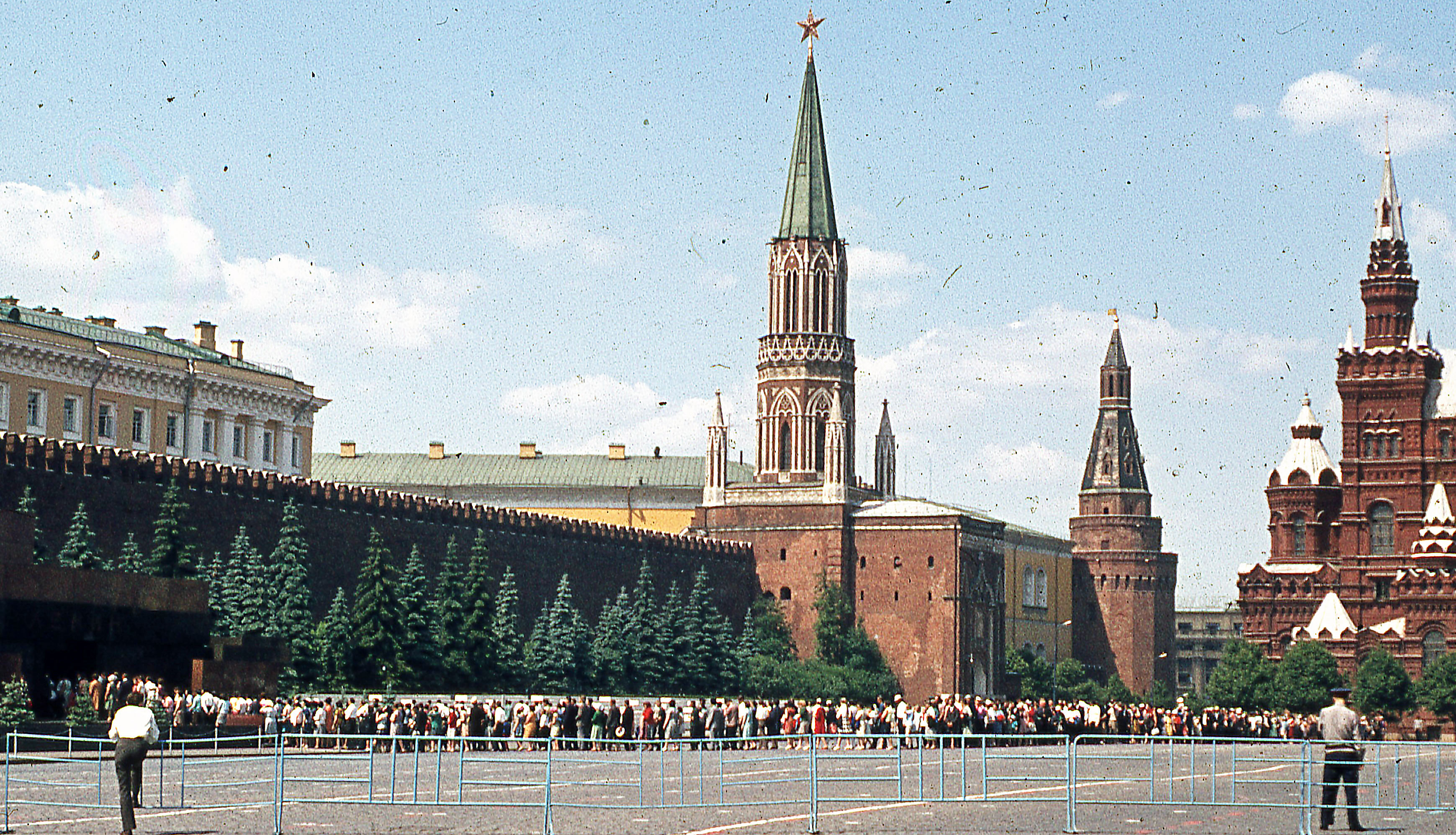
And naturally we visited the Kremlin and the monastery where Stalin’s wife is buried, though we could not face queueing for Lenin, even though tourists can get in at the head of the two or three kilometer queue [right]. The changing of the guards on the tomb is quite perfect in its quiet way, though nothing as pompous and splendid as Buckingham Palace.

The guard of two and its officer [left] leave the Kremlin a few minutes before the hour and goose-step with no accompaniment of military band across Red Square, coming to attention in front of the old guard right on the first stroke of the bell in the Kremlin tower. At the end of the peal they march back to the barracks and it is all over before one has time to focus one’s camera.
Our second contact in the film industry was at “Cinema Art“, the Soviet Film Magazine. They offered us all the facilities of a professional unit to help us with the film — lights, sound recordist, actors… but it would have taken us weeks longer to finish had we accepted. Deciding that they must do something for us as we had come all the way from Australia, they offered to show us some representative, modern Soviet films and we accepted eagerly. We carried on most of the conversation in French with an Armenian film critic who was amazed at Austra who was Latvian and could speak as many languages as he could and “looked so young!”
The film was one showing in Moscow at the moment: To Speak Again About Love. It was a very mediocre film really, in the style of the French cinema of the early fifties. It concerns the love between an air-hostess (played by the first lady of the Moscow theatre) and a scientist, engaged upon mysteriously dangerous work. An on-off affair. She: You don’t need anybody else — you are strong enough. He, coming to a realisation of how much he needs her but never able to express his feelings. The story is filled with unattached threads. In the end her job proves more dangerous — the plane crashes and she lives only long enough to ask a friend to meet him and tell hi and he walks off kicking the leaves on the footpath. The photography is ordinary but competent, the editing is classical but the style is uneven. The direction and photography of the actress gives the impression that the director was rather overawed by her. Her performance is interesting.
The second film was an editing exercise by film students, made from cuttings of the film “Simple Fascism“. It is completely Nazi-shot footage, used to make a film concerning the German soldiers at the siege of Leningrad and the last letters they wrote home, which Hitler was going to make into a book to inspire others with patriotism. Unfortunately, most of the letters were not patriotic and the project was abandoned. The film, called “The Last Letters” lasts 10 minutes and uses ten of these letters, illustrating them with this Nazi footage and music. A pointed, anti-Bavarian film. but no so Russia-oriented as one might expect. Again the editing is in the Eisenstein school, with freeze frames abounding and close-ups of faces most important.
The translator who had been recruited from an “Institute” especially for the purpose spoke English so fluently and with an American accent, that we thought he must have been a defector. Are you Russian? we asked him. Of course, he replied. You speak English so fluently you must have lived in the West for some time, we said. No, he replied, I lived in England for a few years when I was a boy, but since then I have not left the USSR. We could not believe it and we said so. It is my job, he said, simply.
It is something which must strike every foreign tourist: the standard of language teaching in the USSR. Those who do speak foreign languages are amazingly fluent without ever having been to a country which speaks the language.
The only other topic which is obligatory for the Moscow tourist is the traffic. They are amazed that in a city with so little traffic (comparatively) and such wide streets it can be such a problem. In the main streets one may see a huge transporter towing a whole house, or an aeroplane or another transporter and travelling at walking pace. Seeing one coming, one should not be too hasty to cross the road, estimating its speed sufficiently slow to allow one to traverse the 70 or 80 yards in safety, for at any moment a huge official “Chaika” is likely to whip around it at 100 km/hr. Driving is another problem as cars and trucks pass on both sides at breakneck speed, cross over in front to left and right and then 50 yds further on, turn to right and left. Truck drivers hanging out their doors are a signal that they are about to change direction. A truck stopped dead in the middle of the road simply means that the driver is carrying out some minor repairs, like dismantling the engine, or has abandoned it for the afternoon while he goes to one of the three or four garages in the city for spare parts or a mechanic or a tow.
Of course, it is impossible to do a left turn at an intersection. One has one of two alternatives: (1) One turns right and then does a “U” turn further along the road and continues down the originally-intended road, or (2) One continues past the intersections and then does a “U” turn, cutting across the traffic to turn right at the lights.
But the most famous turn of all, in the whole of Moscow, is a forbidden right-hand turn. It can really only be described by diagram (see supplement) but here is an attempt: (1) One stops at the traffic lights in the right-hand lane and when the light changes to green, does a half right then left turn to stop with the traffic going to the left. (2) When these lights change one proceeds along in the centre of the road (there are no marked lanes) and prepares for a “U” turn at the first opportunity. (3) “U” turn when the traffic allows and go back to the traffic lights. (4) When the lights turn green, go on. You have now turned to the right!

The militiamen [left] are on every corner, sometimes practising incomprehensible, virtuoso baton movements in the middle of the intersection, sometimes standing on the kerb, blowing a whistle occasionally, or just watching the cars. In any case they completely ignore the pedestrians, who wander across the roads, surviving miraculously, either ignoring the lights altogether or seeing the red light, and believing it to be the “glorious colour of Communism” cross in the assurance of absolute invulnerability.
A Dutch lady in the camping area, who told us how she had knocked down two pedestrians — one on a wobbly bicycle, one drunk — and had had “an experience” with a drunken militiaman who hitched a lift, recounted her experience crossing Moscow from the garage. She got lost, and after driving around in circles for hours, drove up to a militiaman on duty and stopped to ask him directions. He was so angry he fined her on the spot. In the end she had to hire a taxi to drive to the camp so that she could follow him.
And there is hardly one tourist who, in desperation, had not driven to the outer ring road and driven 50 to 100 kilometers around it as the simplest way to get home.
V. Conversations: (a) Old man (b) Student in Gorki Park (c) Latvian family (d) Latvian woman (Party member) (e) Tourists in the camping area
The first, short, conversation which we thought of recording was one of Austra’s attempts to hold “one conversation in Russian per day”. We chose for her the old, white-bearded Russian who sometimes worked the gate to the entrance to the camping area. He had come up onto the balcony, looked closely at my typewriter, admired my beard and had made the international borrowing sign for a cigarette from Laimons. When Austra trapped him, he was sitting on a chair, watching the sky, exhaling great wisps of American tobacco through his moustache.
— Hello, said Austra. Moscow is a beautiful city.
— Those buildings, he replied, after a long pause and pointing to a clot of new, five storey, white monstrosities on the opposite hill… Those buildings are for workers, not rich people. Five years ago there were only wooden huts. (He then pointed to the new motel, under construction). In one year that will be finished.
— Really?
— The Metro is better than anything you have in America.
— We have heard…
— The university… very big.
— Yes. We have heard it has 22,000 students.
— Very big. (Then a long pause. Topics of conversation seemed to be exhausted.)
— This camping area, he said, nodding to the tents, has only been open for one year.
— Really? What did you do before?
— I worked.
— Where did you work?
— In Moscow. (Silence. Then… ) In winter — it is very cold.
— Do you have snow?
— This camp is closed for six months.
— Yes? What do you do for a living then?
— I work.
— What do you do?
— In Moscow.
And this terminated this very dangerous conversation. The last words were said almost over his shoulder as he fled from this espionage interrogation.
————————
We had to shoot some film in Gorki Park and arrived early on Sunday to begin. By midday the grounds were crowded with a carnival atmosphere: ferris wheels, boats on the lake, ice-cream sellers, men and women crowded around the domino table, paper hats and loud-speakers blaring music and political slogans. At one o’clock there was a variety concert in a music shell which faced onto a hot dusty square and we joined the crowd in the shade of the trees beside the square.

It was a performance by dancers and singers [above] from the farms and factories in the Moscow area and Austra was trying to write down the essence of the introductory speech by the compere. A citizen behind her, who was looking over her shoulder, offered a few corrections and a young man on the other side assisted with some spelling mistakes. The middle-aged citizen was saying: Australia is a long way away! and began repeating, louder and louder, as though this would solve the problem, that these performers were amateurs, “self-doers”! And then he began shouting, the young man asked him to speak more quietly as his shouting seemed unnecessary. The citizen turned upon him:
— You are not a Russian, he accused.
— No, said the young man. I am Ukrainian. A Soviet.
Soon the citizen grew tired of us and left, but the young man introduced himself to us. He was a medical student at the Moscow Medical School and was very interested to be able to speak to students, or ex-students, from the West.
The talk wandered along on general topics for a while, to the accompaniment of accordion music and national dancing. What does he know about the West? we asked him. Several people we had talked to had some rather strange ideas, we said.
Yes, he knew about them. They are all “told” about the West at regular intervals and they all solemnly take note and agree, but the Ukrainian students, at least, have other information. Every evening they listen to a midnight broadcast in Ukrainian from Canada. Students know, though they don’t go around shouting it. He had heard, for example, about the recent wave of student unrest all over the world. We think there is no student unrest in the USSR, but it is just that we don’t hear about it. In the Ukraine lately there have been several marches and demonstrations. Perhaps they have been photographed and published as pictures of patriotic parades. In any case, they are very quickly suppressed.
He was the first of the man bitter patriots from the “republics” that we were to meet and in the Ukraine the sense of injustice at Russian exploitation runs very high. Russia can grow one potato for itself, he said, and all the food from the Ukrainian food basin goes straight to Moscow. The Ukrainians never have enough to eat even though they grow everything. It could be one of the richest agricultural countries in the world. Ukrainians are very patriotic and very bitter towards Russia and the Russians.
This is not all that he was bitter about. He was training to be a doctor for six years, on a scholarship of 35 roubles per month, which meant that his family had to support him. The only luxuries he could afford were occasional sweets. His entertainment was Gorki Park at the weekend. When he graduated as a doctor his wage would be 90 roubles per month. This is not his starting wage; he remains on it until he is promoted to head of a hospital or polyclinic. That ice cream seller, he said, pointing to the lady with her trolley, earns 140 roubles per month.
How can he be a student, knowing this? we asked. What is the use of studying? He shrugged his shoulders. For the soul? It is the policy of the state to pay “real workers” better than professionally qualified people, so that an engineer in a factory will always earn less that the worker on the floor. Some professions are better paid than others: engineers begin on about 120 roubles per month, schoolteachers on about 130. Doctors are the lowest paid profession in the USSR.

And these “amateurs” up on the stage… he gestured. Don’t think they are doing this for nothing! On a farm or in a factory one is supposed to do something extra, outside of working hours for the prestige of the establishment. If you dance or sing and show enthusiasm you might get to the head of a queue for an apartment or take your vacation when and where you like or get a promotion or a bonus on your wage. And see those men sitting at the side of the stage [above left] ? They are the judges. If they see someone with real talent he is whipped off to the dancing school or the circus school and if he succeeds there he never has to worry about anything again. The Soviet amateurs — sportsmen and performers are a joke even in the USSR.
Completely unprompted by us, the talk switched to Vietnam. He accepted that there was a great deal of opposition to American and Australian involvement in America and Australia and everywhere else. And he told us a few “anti-Vietnam” jokes or rude stories about the Imperialist Johnson; jokes about the USSR’s involvement directly in the war. Unfortunately they do not translate into English very humorously, but they are a scream in Russian!
(1) An American pilot, shot down over North Vietnam is interviewed about how he thinks the war is going. Well, he says, it wasn’t too bad at first — they just shot at us with pistols… now they have developed anti-aircraft guns! (i.e. Where did they get the guns?)
(2) And what is the first thing you heard when you landed? the pilot was asked. Well, I heard one North Vietnamese turn to another and say: (an untranslatable Russian idiom, roughly: “Give it to ‘im Ivan!”)
(3) Two North Vietnamese swimming in a swamp. One splashes up some water and says: Isn’t this just like home, on the Volga?
We offered him a cigarette, but he refused. I am not allowed to smoke, he said with a smile; medical students have to set an example. This sounded familiar, with Boris’ and Sergei’s story about drinking in public, so we asked him about this — is it a common rule? Yes, that’s what it is, he said. The Young Pioneers set an example to the young children; the Komsomol sets an example to the Young Pioneers; the Party sets an example to the Komsomol; and the Government sets an example to the Party. I shall smoke when I leave the school.
We told him we thought he had been rather frank, and we wondered how he could do it. Wasn’t he worried? (The conversation had been carried on, we noticed, only when there was music blaring out — between items he pretended he did not notice us. Even with the music he was always looking over his shoulder to see who might be listening in.) No, he was not worried. Nobody had been taking any notice. And even if someone noticed, he would only be warned not to do it again.
We parted with him offering to show us where we could eat for one rouble each and he could not believe that we could go back to our tents and have a meal for one rouble for the four of us. How he affords it we do not know; one of his shoes was falling apart at the seams.
——————
Austra, Inese and Laimons had heard some Latvians talking in the camp and summoned up the courage to speak to some women on a bus tour who were staying in the cabins. They had to leave, but were very disappointed we had not spoken to them earlier, and so, hearing a family later who were speaking Latvian together, we approached them and introduced ourselves. The first talk we had was with the husband on the steps and he did not seem very happy about being seen speaking with us. His wife refused to be introduced and would not even approach us while we were talking, so after this we did not try to get them into conversation again. However, the next nigh they came up and invited us to their tent where “we can have some privacy”. This time the wife sat with us and, although she was obviously still worried, joined in the conversation. We had been watched on both occasions, by one of the English-speaking Intourist guides from the office who kept walking past and trying to listen in or standing on the hill, some 50 meters away, and all but observing through binoculars.
All our conversations were noted in the camping areas, even when we began talking loudly with other Western campers — there was always the Intourist representative, trying to be inconspicuous, coming into the kitchen to wash a bottle or to pick up a piece of paper on the floor. Who knows whether they heard anything? But it was a sufficient constant reminder that if we ever did get into trouble, the authorities would never be short of evidence of one sort or another. Only recently a pair of young Americans had been brought before the head of Intourist for talking rather loudly and outspokenly to some Russian students. The things you are telling them, they were told, can do them no good at all.
But sometimes it is too hard to keep one’s voice down and the daredevil “What can they do to me for saying what I think!” attitude is difficult to resist.
This Latvian family had driven from Riga to Gorki and Moscow on a motorcycle with a sidecar for their holidays. It had not been entirely holiday: one of the main objects had been to try to get some spare tyres for the bike — completely unobtainable legally in Riga and Moscow at least. In Gorki a Jewish friend had spent the day telephoning his friends and had at last managed to get two spare tyres for them. He didn’t know, though, whether the bike would get them home — the generator was almost worn out and nowhere had he been able to get a new one. Without it, his bike was useless and he would have to put it up on blocks in the garage when he got home. They had saved for over a year for this trip and their friends had considered them very lucky to be able to go on such a “luxury” vacation. One son was with them; the other had to be left at home because he wouldn’t fit on the motor bike.
The first time they arrived in Moscow (on the way to Gorki) they tried to get into the Motel (50 meters away) but is was full. They tried the camping area, to see if they could hire a tent for the night and were refused again. This camping area is for foreigners and citizens on organised tours only, and what’s more they were rather dirty from the road. But they had nowhere to go, they told the administrator, and it was late. He relented a little. What time would they be leaving? Five o’clock. Very well, on the condition they left at five o’clock he would allow them to sleep on some open duckboards in the furthest corner of the camp. They had to pay the normal 90 kopeks each and 50 for the bike for the privilege.
This time, they looked a little more respectable and had been given a tent for a few days.
He was fascinated by our car and found it difficult to accept that we had paid only 400 roubles for it second-hand. His motor bike had cost 1,600 roubles. In the Baltic countries motorcycles are the main means of private transport, apart from a few pre-war German “Opel“, as he puts it “Raised from the dead”. Parts are virtually unobtainable, even for new cars, if one can afford them. A “Moscvich” costs 4,500 roubles and a new “Volga” costs nearly 7,000 roubles, and there is a two to six year waiting list for them. All through the conversation he kept coming back to this:
— And if you wanted a spare part, he would ask, what would you have to do?
— Why, we replied, just walk into the shop and ask for it. If you wanted a new or second-hand car, the main difficulty would be to fight off the salesman!
He kept asking to hear this like a child who wants to hear the same fairy story again and again. He would go home and tell his mates, he said, but they would not believe him.
He has a good job. He is a highly skilled mechanic in a small factory which is also an academy; perhaps a research institute. In any case, there is some security surrounding the work done there. When he applied for the job, his mail was checked for several years back, and if he had received any letters from outside the USSR he would not have got the job. If he received letters now, he would lose the job. He used to correspond with his wife’s cousin in Melbourne, but he has not done so for years.
He earns 130 roubles per month, 10 roubles more than the engineer he works with, but not as much as many of the ordinary “workers”. What did this represent? we wanted to know. Wages are meaningless unless they can be compared to the cost of living. A day’s wage would buy him a kilo of butter (about 5 roubles). For the three of them to go to a restaurant and buy a meal consisting of soup, a main course and desert, it would cost about 6 roubles, in any case more than most men could earn in a day. His wife also works and earns 90 roubles. An average wage is 110 to 120 roubles. A pair of ordinary shoes cost 40 roubles (and in Riga there is rarely any choice of styles), an ordinary, nylon raincoat, such as we buy in Woolworth’s for about £2, costs 70 roubles. Food is so expensive that even with their combined wage it is impossible to make ends meet by the end of the month if they want to buy any clothes at all or to save anything towards a holiday.
Traditional Latvian delicacies and cooking are unknown. Smoked eel has not been seen for years, and fish (which is one of Latvia’s main products) is too expensive to buy, when it is obtainable. Only five years ago the only bread available was heavy, black bread.
If a fisherman catches more than his quota, he cannot keep the fish or eels. He may be paid a bonus, but the fish must go to the factory. Blackmarketing of fish is looked upon as a very serious crime. Once, he had visited a fisherman friend and had been given a bucket of fish to take home and he knew that if he was stopped at one of the many checkpoints along the road and the fish were found, both he and the fisherman would get into trouble. He wrapped them in a blanket and sat the boy on them. He was stopped; he was searched, but the fish was not found. There might have been very serious consequences from this little escapade… “Serious consequences” seems inevitably to mean at least losing one’s job.
There are other, more simple ways of losing one’s job. A few years ago, for example, it was frowned upon for a married couple to wear wedding rings — “bourgeois sentimentality”. A Komsomol member who wore a ring to work was dismissed from the Komsomol and told that if he did it again he would be dismissed from his job. Today, rings are officially recognised and one month before marriage, the couple is given a form which allows them to buy the rings — gold is normally unobtainable. But two friends of his, recently married in the local “Palace of Weddings” drove 100 kilometers to have a secret wedding in a locked church. They wanted to keep their jobs.
There are no christenings. Several times every year the parents bring new children to a “party” with presents, where the children are all given names. There is a similar party when the children reach sixteen, a “coming of age”, where they all receive their identity cards.
All over the Soviet Union, housing is still a great problem, even though “The Book” tells us that, in Moscow, “some 400-500 housewarmings are celebrated every day”. In Riga the queue for apartments is from six to ten years long. If one considers that one’s quarters are too cramped, an inspector comes to measure the space, and if there is more than three square meters per person, the application is dismissed. Housing co-operatives are allowed, and one can pay 2,500 roubles down to join and 15 roubles per month for 20 years for an apartment, after which one owns it, and can re-sell. He described the apartments that were being put up — in huge, pre-fabricated slabs, crumbling as the crane lifted them up…
There are other ways to get an apartment, of course. One can be a member of the Party, or a “good worker”, or do extra outside Party work, then the queue is shortened for houses and cars. This is excused, the people are told, because these people are working for you and they deserve it.
All the top jobs in Latvia are held by Russians, although some Latvians are working their way up these days. We had heard, we said, that Latvians are getting to the top by co-operating with the system and once there trying to help the mass of people. He laughed. Those who get to the top do so for their own gain. We hate them more than the Russians. And they hate the Russians. They come here in the army, he says, get a cushy job and stay. They seem to have no home.
He was very proud of the nationalism of some of the other republics like Estonia and Georgia, where there are very few Russians because they have such a hard time. In these republics, shop assistants refuse to speak Russian to the Russians, although it is the official lingua franca. (If a Latvian first speaks his own language and then changes to Russian he will be served. If he speaks Russian first he will be ignored.) And in other ways there is a steady resistance. In Georgia there are always cases of Russian soldiers, out alone at night, disappearing and in the morning nobody has heard about anything.
Under the 1936 constitution (Article 17) there is provision for any republic to secede from the Union. In 1949 in Estonia a petition was signed by 80% of the population for the secession and presented to Moscow. It was followed by mass-arrests and deportations and the petition was never acknowledged.
After Stalin’s death the Georgians got up a petition which demanded more freedom of speech and the running of their own affairs. The petition was presented in Georgia, accompanied by a mass-demonstration in the square. After several hours, when those who presented the petition had not reappeared, the crowd began to get restless. Soldiers were called up and they fired into the crowd to disperse it. The petition was never mentioned again. But the Georgians still drink to Stalin, who at least looked after Georgia and the Soviet Union first, and his picture is on the wall where Lenin’s ought to be.
He is depressed about the Latvians and their way of making the best of the situation. The novelist Vilis Lacis, well-known before the war, saw the light after the revolution and re-wrote many of his earlier books. In one semi-autobiographical novel he had described how his father had been battered to death in Siberia and thrown into an ice-hole. In the rewritten version he is bringing home a cart through the forest on a stormy night and is crushed by a falling tree.

[above: bus from Latvia, with rear compartment kept open to cool the engine]
Any resistance that is offered is in a small humorous way. On annual festivals of traditional singing and dancing, when Latvians come to Riga from all over the country, pamphlets are circulated saying that a revolution is brewing and the Russians leave for their holidays… Out on a bus trip, when they pass a huge, patriotic sign, covered with an essay on Communism, they stage a well-rehearsed scene:

— Driver, stop the bus! did you read the sign?
— No, replies the driver. I was watching the road, like a driver should.
— Well then, the sign must have been for us to read. Back up the bus!
And they back up the bus and read the sign. While the traffic honks behind them.

On days of national celebration, when it is compulsory to march to the statue of Lenin and the Russian tank with the red star and lay wreaths of flowers [right], a bunch of red and white flowers (the old national colours) always appears surreptitiously under the one “pre-revolutionary” statue that is left standing and they nudge one another and point to it as they march past. This statue, a woman holding aloft a handful of stars, is the monument to the creation of Latvia as an independent state after the First World War. In 1945 the Russians pulled all the old statues down, except this one, because they feared a national uprising had they done so. It was excused because “the stars have five points, and can be thought of as stars of Lenin“.
He is depressed that the children get nothing but the straight party line at school and it is left to the parents to tell their children about the other side of the case. His sons know what is going on, he says, and his son was sitting with us throughout the conversation.
Do Latvians in Australia drink? he asked. And we, remembering the huge parties with the kegs on the back steps and the visitors remaining for the whole weekend, replied in the forceful affirmative. This is not what he meant. In some factories after pay day, work stops for a few days. The whole factory is too drunk to work. Wives who can, come to the factory to meet their husbands and rescue the pay packets if they want to live for the next month. Drunkenness is a huge problem. (Almost every other person we spoke to said the same thing. It is impossible to drive down some streets at night for the drunks wandering along the road or jumping out in front of the car to hitch a lift.) They are told that in the West things are ten times worse, and they can’t believe it — this was his question. To curb this most restaurants do not sell anything stronger than beer, if they sell it at all, and it is impossible to get a second glass. There are no “pubs” in the Soviet Union. But this does not stop them, he says. The Russians are the worst, they drink like animals, they drink anything — brew it themselves or water down methylated spirits or pure alcohol. This is why unsupervised Russians are not allowed into these camps — they would disgrace themselves.
The other great problem is theft. As so many things are unobtainable, the only way to get them is to steal. On their way they stopped the bike in front of a restaurant and were about to go in when a militiaman stopped them. He told them not to leave their bicycle unattended — when they came back it would be stripped bare. From no on one of them always stays with it. A friend’s daughter had the valve stolen from her bicycle. It was a major tragedy — to get a new valve, one must buy a complete new wheel. And bicycles are always being stolen. Any Russian lucky enough to have windscreen wipers on his car, takes them off when he parks and locks them in the car.
The official side of the story is hilarious, if one has a warped sense of humour. Several years ago a ferry-boat overturned in the Bay of Riga. Half the passengers were drowned and the other half struggled ashore, losing everything they had with then, including, in many cases, their papers. After a few days they went to the police station to get new papers, were given a form and told to state what had happened to them.
— Papers lost in recent ferry-boat disaster in the Bay of Riga, they wrote. The militiaman tore the forms up.
— No such thing happened, he said. They thought a bit.
— Could they have been stolen, perhaps? they asked.
— Of course not! (There is no theft, murder, rape, extortion, or any other kind of crime in the Soviet Union.) This went on.
At last it was decided that the papers had been “negligently lost” and they all had to pay a fine of 10 roubles.
Neither are there any natural disasters in the USSR. In the recent “little” Tashkent earthquake, no lives were lost; nobody was around at the time.
This Latvian, like the Ukrainian student expressed the same type of resentment which we are expressing at the spendthrift policies of the government — pouring arms into Vietnam and the UAR, expending a fortune on countries like China who then turn and spit in our faces, putting all their energies into a stupid race or the moon… When it is home which needs the money. A few years ago, they say, wherever you looked there were Chinese. You’d think we would have learned our lesson. Now wherever you look you see Africans and Arabs. Who will we have when they have taken all they can get from us?
We asked him about personal freedoms within the USSR. He is naturally not allowed to travel outside or to have dealings with the West, but where can he go within the country? Anywhere, naturally, he replied. We are constantly being told that this is our country. In 1969 identity cards would no longer say “Born in Latvia/Lithuania/Kazakhstan…” They would simply state “Soviet Citizen”. (Lenin’s theories of national identity take another beating?) But within Latvia itself there are many places they cannot visit. The whole town of Liepaja (a Baltic port) is a prohibited area. The train stops outside the city, passes are examined, non-residents must have a special “visa” to get in, like entering a foreign country, and the journey is continued by bus. All the beaches on the Baltic are closed at 8 pm and after that a machine comes along and ploughs them, presumably to show whether anyone has tried to escape by sea, or perhaps to keep the Westerners out.
He had many questions about the West and I must admit that we were cruel, often returning (under his questioning) to the ease with which one can get a motor car or medicines. In Riga, medicines are almost unobtainable and there is a special pharmacy for the Russians, as there is a special set of restaurants and shops, where things are available which cannot be bought in ordinary stores. We criticise South Africa all the time, he said, but there is racial discrimination here which could teach them a few things.
He knew that in the West there were no pensions and that old people were left to starve on the streets. The pension scheme in the USSR (a comparatively recent scheme in parts of Latvia — 1965) is the only such scheme in the world. At 60 years of age, if a person has worked for 30 years he or she is given a pension of half his wage. His father, retired, gets 20% extra as his wife has never worked. Should his father die first, the wife will receive a steady pension of 15 roubles per month.
If he were to go to the West could he get work? They were continually barraged by frightening unemployment figures and statistics on the number of people who starved to death. He knew that the worker could not afford to go to the doctor or to hospital in any Western country and that the child of a worker was denied anything but an elementary education. He had heard about the English universities (he even knew their names — Oxford and Cambridge) where the only students were the sons of Lords and millionaires. He was most surprised when we told him about our parents and the scholarships we had to the university.
He expressed frank incredulity about the letters his wife’s cousin used to send them from Australia. He had once sent them a photograph of himself out hunting with a bag or “at least seven rabbits”. And he was always telling then about the motor cars and the wages. Friends said, he is forced to tell you things like this — they aren’t true. Before the Melbourne and Tokyo Olympics the teams were told — Take no notice of all the motor cars, they have been brought from all over the country for show, they are not there all the time. The roads have been specially built for the games.
He was amazed at the low clearance of some of the Western cars he had seen. How can they manage the roads? Of course, he said, the main roads you travel on in the USSR are magnificent. We perhaps laughed to rudely at this. We can understand and believe things we are told like this, he said. So much here is only for show. The books we are allowed to send to relative in the West are printed on good, glossy paper and are only picture books of the beautiful countryside. The huge wedding-cakes of buildings are nothing more than show-pieces. One was built in Riga after the war to be used as a Palace of Culture — “A gift from the Russian People”. We refused to accept it — major restoration work was being carried on while it was being built. It is now an academy of sciences.
When we parted he did not tell us his name or anything about himself. He asked us not to write home saying we had met him: he was certain that all our mail would be read. His last comment was the most depressing of all: It has been an interesting conversation, he said, but it probably won’t do me any good. With a glance up the hill at the young man leaning against the wall.
————————-
This conversation was followed the next evening by a meeting with another Latvian, a woman and a Party member. She is on holidays with her family, on a bus tour to Moscow and she had to get to bed early because next morning they were all going into Red Square at 5 am to queue for Lenin’s tomb. They do it every time they come to Moscow.
She was trained as a schoolteacher but works at an institute of metallurgy for 100 roubles per month. In the evenings she lectures on Political Economics at an institute. This extra work, she insists, brings her no extra money.
It is the obligation of every Soviet citizen to take on some kind of patriotic activity. Folk dancing or sport did not appeal to her, so she lectures. How can she lecture on Political Economics when she has never seen any of the countries which she so blithely talks about? we wondered. We have textbooks, she replied.
Life is not too bad, she says. We have enough money to live on, we have an apartment and we only had to wait for it for a year. By 1971 we will have a 4,000 rouble car. We have holidays all over the USSR and every year we get a bonus of one month’s wage. At the moment they have a motorcycle and sidecar and have no trouble travelling.

We did not get the chance to ask anything else. The rest of the conversation was spent in eulogies over beautiful Moscow and the fantastic Exhibition of Economic Achievement [right]. They go there every year and stay until evening, when the lights make it look “just like a fairyland”. And the most beautiful area of Moscow, the Arbat district — all new, towering skyscrapers, all glass and aluminium!
—————————
The tourists in the camping areas are a mixed lot: innumerable family groups of Canadians in huge vans with camping bodies, doing Europe; groups of Americans, seemingly come to atone in public for Vietnam; young Swedes, travelling in couples, referring to one-another as “my fiancé”; the Dutch, travelling in convoy with the most elaborate camping gear, sitting in the area all day talking to their next-door neighbour from Amsterdam; people like us,, small groups in the inevitable VW Kombie van with tents; groups of 10-20 US students, in semi-organised tours, but completely disorganised as far as camping goes; young Czechs, anxious only to get into Red Square as quickly as possible and sell a few clothes; East Germans who talk to nobody and sun tan all day; Poles who seem to drive all the time, only over staying for one night.
Most of them you can talk to. Most have an interesting opinion to offer, though usually the talk is completely one-sided — incredulous at what they have seen. The young Americans and Swedes, much to their credit, seem to have made an effort to learn some Russian and are always anxious to talk to people. They don’t get their ballet tickets through Intourist, they queue for them at a kiosk, they go to the ordinary Russian cinema, they keep their eyes open and they get into trouble. They are just the type of tourist the Russians don’t want.
The type they welcome are the mini-bus tours of Australian girls, recruited in London on the back page of the “Times“. “See Europe for $70. 10 countries in 10 wks.” They are organised trips, nine to a mini-bus, with a driver who works for the company. They stay in Youth Hostels when they are available and camp in camping areas when they are not. They seem to be all the misfits of England, Australia, New Zealand and the USA, usually girls, collected together with their enormous Corn Flakes to keep them regular. They form a little ethnic group, with their own jokes, etiquette and mode of conversation. In a crowded camp kitchen they can take up three quarters of the cooking appliances without noticing the queue for the other quarter. Everyone else is “a local” or a Communist they assume, and cannot speak English anyway, so they talk at a shout, about the Berioska store and the price of American cigarettes at “the Gastronome”. they are surprised and distrustful if you speak to then in English, perhaps to tell them that they have just turned off the stove rather than on, and they quickly try to forget this piece of, possibly dangerous, contact with the world outside the group. Their Intourist guide, whom they picked up at one border and will leave at their point of exit, shepherds them through the dangerous waters, takes their cigarettes, makes sure what they don’t see and tries to blend into the merry group. He/she is often successful — such are they all misfits.
At the end of the trip they know three things about the USSR: the bad roads, the rude shop assistants, and “Nee Pannimayer” (That means “I don’t understand” they will tell you, “in Russian”.) which they use for chasing off the wolves, the militiamen, the drunks and the money-changers.
It is this type of tourist which Intourist loves. The organised tours of idiots with their guide and the good Communists whose first stop is at Friendship House and from there the guided tour all the way. The most lucrative, presumably most loved type we had little to do with — the well off American or British capitalist, despised but fêted in the luxury hotel and driven around by a chauffeur in a Chaika. We saw some of them in the hotels when we went to change a traveller’s cheque or, out of desperation, to buy a copy of the “Daily Worker”. They were sitting in the foyer or the bar, picking through the Berioska shop, waiting for their taxi, like prisoners, afraid to move outside.
Or am I being cruel? We decided in a kitchen conference that when we got home we would advise everyone to visit the USSR. Especially every little “textbook Communist”. Tell him only to bring roubles, make sure his car has a minor breakdown, make him find his way around on his own — no guides. Encourage everybody, to come and see for himself.
VI. Moscow to Leningrad

We had heard such horrific tales of Novgorod camping area that we set out early on the road to Leningrad to drive the whole 700 km. rather than stop there, with the mosquitoes and the toilets, which had been spoken about in hushed tones. It is a much more eventful road than the one from Minsk to Moscow, there is a little agriculture and some dairy industry on a small scale. The houses along the road are in traditional styles, made from logs, with carving around the windows and roofs [above]. But even if the scenery becomes boring, the road itself offered constant diversion: tempting one up to 100 km/hr and then forcing one to either slam on the brakes or break an axle.

Road works [right] were going on over the whole length at sporadic intervals, though more often than not nobody was in sight. Huge heaps of gravel stood in piles down the centre of the road at intervals of 20 meters, pots of smoking tar stood by the side of the road… When we came back along the road a fortnight later, the gravel was somewhat dispersed by the cars running over it, and the tar was no longer smoking.
100 kilometers short of Novgorod we were about to run out of petrol, so we stopped at a crossroad to ask some locals what we could do. Novgorod is the next, they said. But we did not have enough petrol to get there. Well, there is one in the village here, said an old citizen and he tried to explain how to get to it. It was too difficult: he said he would come with us and we could bring him back here. Accordingly, in he got and of we went, bumping up and down the streets of this village, through potholes feet deep that we drove into and out of, turning left and right and back upon ourselves until we reached the petrol station on the other side of the village. It was simply a fence with two pumps and a tank on the other side [below].

Our guide explained things to the lady attendant and a few locals came across to look at us. They were always interested, these old fellows who came up to have a few words — where were we from? Avstralia! We like your car. Where have you been? A few simple questions and a toothless smile, just to assure themselves that, probably, for the first time in their lives they had talked to foreigners. Talking to these people was always most gratifying for the sheer disinterested interest they showed. Our guide was the same: he asked where we had been and where we were going. The south of the USSR is very beautiful, he said. We asked: Do you go there for your holidays? Who, me? he looked at us in amazement. I am just a farm worker. I only earn 90 roubles per month…

On the way back from the petrol station, a motor scooter whizzed out from a side street with a militiaman on the back. It cut us off, like they do in the movies, and the militiaman leapt off and waved us to stop. Where were we going, he wanted to know. To get petrol, we told him. How did we know where to find it? His eyes were almost popping out as he peered suspiciously inside our car. Our Tavarisch here was kind enough to show us, we said, putting in our friend. Right, he said, follow me. And he leapt back onto the motorscooter, like Hopalong Cassidy, and it took off in a cloud of thick dust. We bumped along behind as he took us back to the road leading from the highway to the village [right, but rider is a local man]. We apologised to this little worker we seemed to have got into trouble. Will he do anything? we asked. He shrugged his shoulders as if to indicate that he had never heard of such a thing.
At the outskirts of the village, the militiaman was stopped and lying in wait for us (he had kept a good eye on us from the back of the motorcycle as we went along). He flagged us down again and hauled our friend from the car. That is the road, he said, pointing, then forgot us and began lecturing the old man. He was fully 20 years old with a brand new, bristling moustache and a shiny pistol holster. The man was sixty, bent and lined with work. The policeman was lecturing him like a kindergarten teacher lectures a child who has just pulled all the flowers out of the entire school garden, and the old man stood there and listened. We all got out of the car and shook his hand: “Bolshoi spaseba!” we said, and looked as evilly as we could on the militiaman.
It seems a little gauche, drawing morals from our little encounters, but this one was constantly with us: It is never we who get into serious trouble (all that can happen to us is that we get deported, we thought); it is always potentially the person we are talking to.
On every crossroad there is a militiaman, on every bridge there is a half-witted looking guard with a rifle and fixed bayonet — we always wave to him and he never know whether to wave back or shoot us straight out. The second time we were stopped by the militia was in a speed trap. We came over the hill at 80 km/hr and did not see the sign, on a perfectly straight, flat piece of road, 40 km for 1 km. We were stopped by a red-faced militiaman who began shouting louder and louder, when he discovered that we did not have a guide/translator. We understood that we were exceeding the speed limit; we think he said that if we did it again he would take our car away; then he said a word which Austra had never heard before, so she began leafing through the dictionary… You won’t find it in there! he choked, then waved us on and stalked back to his post behind the bushes.

We drove into Leningrad at 8 pm and began looking for the road to the camp. We knew that the camping area was at Repino, 40 km along the road to Viborg. There are no signs in Leningrad, hardly even street signs, and only one camping sign, which we missed. For two hours we drove around, finding likely-looking streets, asking likely-looking people the way [left]. They had never heard of Repino, so we asked for Viborg, and after this time, we found ourselves on a likely-looking road which headed out of the city. Just to make sure we asked an army officer. Yes, this was the Viborg road.
At about 20 km we saw our first sign — to Viborg — and our first militiaman, who, naturally, flagged us down. He came up, writing down our number-plate as he walked. Where were we going? To the camping area. This is not the way to the camping area! Isn’t this the Viborg road? This is not the way to the camping area. We were told this was the Viborg road. Who told you? An army officer… and it went on. This is not a tourist road, he told us. We apologised and said that we did not know, we were only trying to find the camp. You knew very well that this is not a tourist road! he said. Give me your passports.
[Below: inside capmpground, map of road to Viborg on billboard at left]

We felt impotent. Austra did not know enough Russian to be rude to him, though we made it very obvious that we were very angry. But what can you do when he has your passports and visas, and is carefully writing down all the information? We brought out our map (printed in the USSR) and asked him to show us where we were. He refused. He told us how to get to the correct road with impossible directions, and sent us off, not saying another word. At times like this one gets so screwed up with impotent fury one is shaking an hour afterwards. I wonder what would happen if one punched a militiaman?
Militiamen don’t wear numbers, or any means of identification, though one polite one who stopped us for a similar offence (being on a non-tourist road) saluted, smiled and gave his name and district. The locals seem to hate them — thugs, they say, recruited in the country. One can’t honestly say though, that our cross section was any worse than a cross section of Australian policemen I have met in my life.

VII. Leningrad

We had been corresponding with two schoolteachers [right] in Leningrad, whose address was given to us by a professor in Australia. In the first letter, we told them approximately when we were coming and they had replied. We had written two more letters from England but they had not replied and from Moscow we wrote again, giving definite dates — this was the next letter they receiver from us. The other two letters had “disappeared” in the mail.
Alex is an amazing fellow. An ex sailor, now a teacher of English, with post-graduate qualifications in navigation and engineering, and he has taught marine engineering, navigation and metallurgy at special schools during the day and at Pulkovo Observatory and at the airport at night. His wife, Tanya, teaches English and Geography (in English) at an “English school”, where all subjects are taught in English. Alex is also a climbing instructor, tennis player, skier, walker… an all-in enthusiast and admirer of Francis Chichester (he even looks like Chichester!) .
He corresponds with about half a dozen people in England and Australia — it is his major hobby — and for the third yea they have applied for permission to travel to England for their holidays. They apply at the first opportunity and at the last minute they are always refused. Alex thinks that perhaps it is because of his foreign correspondence, but hi won’t give it up. He was offered a lucrative teaching post at the naval academy, but to accept it he would have had to give up writing to his friends. He prefers to keep going as he is.
When we arrived, Alex had everything planned. First we would go to Pulkovo, where a “pupil” would show us around, then we would look at the things to see outside Leningrad — the famous summer palaces — then we would look at the things to see in the city — Peter and Paul Fortress, the museums, the Hermitage, the churches… it was all timetabled. We found later that they had postponed their holidays in the south so that they could meet us. Alex had returned their railway ticket and later would queue for another one (“Two or three hours, no more.”).
That afternoon we went to the observatory where we were met by Alex’s “pupil”, second-in-charge of Pulkovo, a brilliant astro-physicist who spoke English better than Alex. He took us around for two hours, showing us the museum, the old and new telescopes, the radio astronomy department and their newest “baby”, a huge interferometer. Pulkovo is the oldest observatory in the USSR and the headquarters of astronomy in the Soviet Union, though it only does photographic and astro-physical work and can only be used in the winter (the “white nights” make it impossible for observation in the summer). He described graphically the way the telescope housings must be the same temperature inside as outside and how the observer has to sit all night in his overcoat keeping an eye on things with the temperature around -20°C. As we parted, he invited us to dinner with him the next evening, where we would have some “real Russian food”.

Alex next rushed us off to Pushkin palace and inside the museum found us a guide who could speak French. The palace is nearly half restored after being nearly completely destroyed in the war. The Nazis, we were told in every room, stole even the wallpaper, used the furniture for firewood and stabled their horses in the chapel. In every room of every palace under restoration visitors were continuously reminded of the Fascists and the atrocities they perpetrated during the siege of Leningrad. And the Russians are slowly restoring the palaces to their former splendour, with woodcarving, silk painting, sculpting, gilding going on all the time. Many of the unique parquet floors [right] remain or are being restored with rosewood, walnut, ebony, teak, cedar… several complete floors were stolen by the Fascists.
The Germans are much more hated than the czars. In fact several czars are openly loved, especially Peter I, and they reconstruct his palaces with loving care, from old photographs and drawings. What a time these selected Russian craftsmen must be having! Being encouraged to practise these old “bourgeois” arts officially. One of the nice little contradictions of Russian life is the loving reconstruction which will only be used to demonstrate to the people the decadence of the royal house. These days, the intricate sculpture in semi-precious stone, the iron work, the woodcarving, are exhibited as the work of Russian craftsmen… workers.
The palace of Peterhof was again almost completely destroyed in the war. The Fascists dug trenches through the gardens and set up their guns on the shore to cover Leningrad and Kronstadt. It is Peter the Great‘s most famous palace and garden. Today it is like Gorki Park — Russians can come and tread the paths once trodden by the foreign ambassadors and the elegant ladies of the court, for 30 kopeks. Music shells blare out songs and by the lake we watched a ballet given by a local, amateur company. (Part of “Swan Lake“, naturally.)

The gardens are famed for their fountains[above and below] which are fed from a series of lakes up in the hills. The central complex is resplendent in gold — hundreds of gold figures and statues [above right: L to R in centre group Ian, Austra, Inese & Tanya, Alex bottom right], grouped around “Samson” in the centre. (The original Samson was stolen by the Fascists and the one there now is a copy. Nobody likes it very much — the original one, they say, was magnificent and is now gracing some German palace.)

From this complex, a canal leads down to the Gulf of Leningrad, lined with fountains [right]. It was one of Peter’s little jokes to let the barges come half way up the canal and then turn on the fountains! He seems to have had an unfortunate sense of humour about wetting people. There must be six or seven trick fountains, looking like innocent park benches or rotundas or trees, which tempt one to approach and then erupt into a shower of spray when one treads on a concealed device. The Russians go wild over them! Every second person in the park is dripping wet. “They are from the country,” said Alex, disapprovingly, “not Leningraders”.
We had lunch in a self-serve “Stolovaya” in the park — borscht, meatballs & potatoes and compote (a glass of weak fruit juice with a few pieces of stewed fruit in the bottom). Russians do not eat at home very much and are encouraged to eat in these places where such a meal costs about one rouble. I do not like them very much, says Alex, the menu has been the same since the war. I feel hungry, I walk into one and look at the menu and my appetite disappears. All the meals we did have in Stolovayas confirmed his opinion, I must say, though at the beginning they were sufficiently novel to be reasonably enjoyable.
Alex wanted to take us to a wonderful Chinese palace at Lomonsov, but we were stopped on the road by the polite policeman that I mentioned — it was not a tourist road, though we could have walked, or taken the train.
We then tried for the Pavlovska Gardens, but about two kilometers short the road was impassable, with a huge ditch right across it. We went back and found a clearly marked prohibited road through the trees and across the fields, and, as there were no militiamen in sight, we tried it. Miraculously, it took us to Pavlovsk without a sight of a tank, a missile base or even a soldier guarding a bridge.
We walked through the gardens a little, though it was beginning to rain, talking about the aristocracy and the palaces. Then the talk quietly changed. One never sees our new aristocracy here, we were told. They have their palaces out near Repino and in the trees beside the Neva and they go to them in their chauffeur-driven Chaikas. Last year the palaces were yellow; this year they are all painted green so that they are hard to distinguish. We pressed Alex on this: did he think it right to have such obvious privilege in evidence? No, he did not. If you are going to be a communist you must be a communist all the way.
This from a man with very high qualifications and 20 years teaching experience who earns 150 roubles per week (with extra work) and lives with his wife in a four room flat, shared with three other families.
In London their flat, like the scientist’s, which we visited the next night, would be considered almost a slum. They like it though, as it is near a park. They share the kitchen and toilet with the other families (one to a room), the lavatory looks like a converted cupboard, and was certainly added after the flats were built. There is no bathroom and no washing facilities other than a sink in the kitchen. But they consider themselves lucky to have it. Why, they have three rooms in one! says Alex: A bedroom, a study and a dining room.
The next day we slept in and arrived at our friends’ flat an hour late. They were worried. They thought the militia had been out to the camp checking up on us after yesterday’s adventures on non-tourist roads. They were serious.
It was Saturday, and as we drove into the city we passed a wedding party getting into taxis. That is our palace of weddings, said Alex. Would you like to see a wedding? We went into the spacious, marbled building and up the wide, impressive staircase, managing to get into the “Wedding room” just in time, behind a small wedding party. The bride in a simple, white dress with a veil, the groom in a suit, the relatives with hair slicked down, ties too tight on their necks, carrying bunches of flowers. We sat at the back on seats reserved for those who have come to watch, in the large, light, baroque room, designed a century ago. The only new piece of decoration was a huge bust of V.I. Lenin at the end, behind the desk.

The couple enters through the rear door, along the once-plush carpet, and into the room, to stand on a well-worn carpet in the centre of the room, in front of the carved desk at which sits the female registrar. A bored or sleeping photographer slouches on the chair in the corner, his Leica and flash hanging beside him. When everything is ready, the registrar pushes a button on her desk to stop the Wurlitzer music. She stands and begins her peroration, bored but smiling. She mentions Lenin, communism, Lenin, Leningrad, Lenin,… then asks the usual: Do you take…? and they reply: Da, in hushed whispers. The registrar pushes the button and the organ starts again mid-bar. She comes out from behind her desk and gives them the rings. The photographer checks that there is any film left in his camera, levers himself off the chair and flashes off a few photos as they exchange rings. The relatives come forward and give the flowers, flash, flash goes the photographer, then the music stops with a jolt. The registrar then gives a well-rehearsed, four minute sermon, reciting the duties of one to the other and both to the state, then presses the button again and the voice of a bass (with Wurlitzer accompaniment) blares out from the concealed speakers. The couple leave by the front door, followed by the scuttling photographer, while another couple are waiting at the rear door.

In the same pink, blue, gold and white interior of the building there is a reception room for those who can afford them, with an oak table, cut crystal, caviar and champagne [left]. Next to it is another room where wedding presents can be bought — amber, dolls and practical alarm clocks. Outside the building wait the “wedding taxis” — ordinary Leningrad taxis, newly washed with a red flag on the front.

Was it as a deliberate contrast that Alex took us next to a practising Orthodox church? There is no comparison between the simple tastelessness of the wedding ceremony and the mediaeval splendour of the service. The church was St. Nicholas‘ [right], the patron saint of seamen, Alex told us. It was dark and crowded and the smell of incense caught in the back of the throat. All around us were the shadowy figures of old ladies, bent double to cross themselves or lying prostrate on the marble floor. The priest in the sanctuary, dressed in an emerald green cloak, chanted an endless list of names of those to be remembered. At the other side of the church stood four open coffins where another priest swung a censer and intoned a funeral service. A choir to the side of the sanctuary made responses pure, timeless, stirring, Russian harmonies — singing it is a lifetime’s experience to hear! It is the beauty of the service and the purity of the singing which attracts even non-believing Russians and makes them stand quietly at the rear. Alex loves the church for the singing — “The most pure Russian!” Alex is a great respecter of pure Russian.

The great churches, like St. Isaac’s [left, L to R: Ian, Alex, Austra, Tanya, Inese, aunt Austra], the Kremlin churches and the Kiev monastery, have been turned into museums. Now, apart from the days that they are “closed for cleaning”, they are filled with endless tours of Russians from the country, off buses with their guides. Some churches bear huge signs: “The church is the enemy of science!” and have lurid documentation of the persecutions of the Inquisition and “hero portraits” of Galileo. To get their own back on the churches, those with magnificent domes are used for the demonstration of scientific principles — such is St. Isaac’s. From the centre of the dome is suspended a free-swinging pendulum and on the floor beneath is marked a large circle marked in degrees. The tourists huddle around as the guide explains the rotation of the earth, sets up a block of wood six inches from where he starts the pendulum, lets it go and they watch until, with a gesture of triumph from the guide, it knocks over the wood. Galileo was right! But in spite of everything, Isaac’s remains a splendid church and even they can’t resist showing off its treasures to the best advantage.

The Hermitage [right] is huge and rich and impressive as everyone knows and its collection is said to be unrivalled anywhere. This may be so — it was too huge for us to see anything but a fraction and we certainly were impressed. One grumble worth recording though, is the insane way in which so many of the treasures are displayed. Glass-covered pictures are hung facing a row of windows, so that it is impossible to see them from any angle whatsoever, and tiny, intricate brasses and carvings are mounted on pedestals in front of a window — the silhouettes are beautiful! But we can’t complain. The gallery is public property and the public certainly do visit it — by the busload, hauled from eh Renoirs to the Rembrants to the Vincis and out again, knocking down anyone who gets in their way…

The Peter and Paul fortress [left]is the same — one can look at nothing in peace and quiet. Tours are everywhere, everything has a slogan and a motto, the Fascists had something to do with its destruction. Outside, hundreds of people were swimming in the Neva and a sixteen stone woman changed out of her swimmers on the grass. “They are like that,” said Alex.
That evening we went to supper with the scientist. He has a small flat to himself which one approaches via backyards and up a set of grimy stairs with broken windows. He has been to Africa, China and the USA and he showed us his set of mementos, which came to life with his enthusiasm. We saw two home movies of the trip he had made on skis to a famous island with unique wooden churches and some transparencies on horrible ORWO colour of Tashkent and Soviet Asia. We managed to find some pictures of Sydney and they were as much impressed by the Kodachrome as by Sydney Harbour. Alex did not like the Opera House.
Dinner was, as promised, Russian. Spiced meatballs with peas, cucumber and dill salad and “pilmeni“, a Siberian specialty made of meat in a pastry case, something like ravioli or Chinese short soup. A huge plate of sour cream accompanied the meal, with kvass and vodka. We could be accused of being ungrateful, but one should mention that everything we ate could be bought pre-frozen in the shop around the corner, Russians just do not eat at home, and with his wife working too (she is a scientist) she has no time to cook. But the meal was delicious, helped along by the company ant the sense of humour of our host.
We arrived at the camping area very late, but it is still light in summer until after midnight. A busload of Finns had arrived and by this time they were all roaring drunk. We were told later that they all come to the USSR on bus trips to drink — alcohol is much cheaper in Leningrad than in Finland. The next morning, while we were sitting outside the tents we were witness to a strange sight: a woman, dressed in a black uniform was going through the garbage can. She pulled the papers out one by one, looked at them and put them in one of three piles. She even unwrapped the garbage to inspect it and pulled scraps out of boxes of Corn Flakes which people had used as a receptacle. Eventually she put one pile back into the can, burnt a second and carried off the third. Very sinister, we thought. The same evening we told an Australian couple with a small baby about it. I hope she didn’t get any of my Corn Flakes packet, said the mother. All the baby’s used paper nappies were in it!

Inese had written to her aunt [left] in Latvia when she was in Moscow, suggesting that she should reply care of Alex and Tanya. The aunt did not reply: she got on the first train available and came straight to Leningrad. Thank the lord she knocked on Alex’s door at 7.30 am and no-one else’s. We arrived at 11 and there was a tearful reunion — Inese had never seen her aunt before. In 1941 she had been deported to Siberia and remained there until 1956.
We spent the day out at Repino, Laimons and I swimming with Alex and Tanya, the aunt keeping Inese in tears at the tents. That night she stayed with us in the tent (quite illegally) and Alex was worried — If there is any trouble, he said, come to us straight away… at three o’clock in the morning if necessary. But there was no trouble and we got her onto the train the next evening loaded down with whatever we had with us that might have been useful. Of course, the only really useful thing is American dollars — with them they can buy decent clothes, otherwise unobtainable, medicines, food, in the foreign currency shops. It is even quite legal.
On our last night with Alex and Tanya we had dinner in their flat, toasted everything we could think of with vodka and Scotch and had a tearful parting. We made them a present of y 8mm movie camera which was “Even better than Dimitri’s!” (the scientist). But as we began to explain how it worked to Alex he found a Russian proverb to fit the situation: There was a woman who had no troubles; then she bought a pig.
VIII. Conversations: (a) Two schoolteachers (b) Inese’s aunt (Latvian) — Siberia and Riga today
(1) Alex and Tanya
This represents a summary, under subjects, of ten or more conversations we had with this couple over the ten days we were in Leningrad.
Alex’s first question, after five minutes’ acquaintance, took us off guard: And how do you find us? No shops, no businesses privately owned. Do you like Russia? How do you find the people? We smiled a few generalities. When in Amsterdam in 1936, he told us, it was as though he had come to the moon: everyone brightly dressed and bustling about — so much life; at home everyone was dressed in black. Are we still like this? We tried to answer politely and untruthfully, but the question kept recurring and on better acquaintance we became more frank and he wasn’t offended. To every question Alex asked, he wanted the truth.
He was by no means as naive as many of the Russians we met and in fact had very accurate views about the West on many subjects. Alex’s full-time hobby is meeting people. He had picked up our professor of education while he was in a group visiting the school and he knew several Western teachers. Last year an Englishman and his wife and daughter had come and stayed with them for a fortnight and Alex referred to him as “our Communist friend”. I have already mentioned his drawers full of correspondence.
Tanya, I have mentioned, is a teacher in an “English school”, where she works extremely hard, running an International Club and a puppet theatre (in English). She is applying for a transfer because of the pressure of work and the headmistress. Alex has no regard for the headmistress’ qualifications. She is a fool, he said, only there because she is a Party member. We couldn’t believe this. Was she a teacher? No, not a teacher certainly, a stupid woman. What is her educational background, then? we asked. Probably none. Then Tanya, luckily, came in. How can you say such a thing, Alex! Of course she is educated! Well, yes, she is probably educated… a concession.
Both of them have been in the type of selective school which is continuously visited by foreign delegations and both have found the strain too heavy. A teacher has a reasonably high status amongst the professions, but Alex’s normal teaching wage (without his extra work) is still lower than that of the woman across the corridor who works a lathe in a factory. Tanya has been offered work in an Institute, but she would get less there than she does at present — 130 roubles per month,
When she told the headmistress she was leaving, the woman took her aside and tried to persuade her against it: If you leave I will have to take on another Jew to replace you and half the staff are Jewish already. And there is an unofficial discrimination against Jews in education: only a certain percentage are allowed into special schools and universities. We would be swamped by them if we let them all in, Alex says.
Alex enjoys his extra work at the observatory, teaching the children of the employees, but before this he taught at a night school. The system is that if a child finished the eight year school and leaves at 15, not having been up to a satisfactory standard in some of his subjects, his employer may require him to continue his education at night school. If one is a conscientious teacher like Alex, one has to keep a roll, give continuous work and tests and keep up the reports on the pupils so that they can be presented to the factory at any time. But most teachers keep fictitious rolls, give fictitious examinations and present fictitious reports at the end of the year on fictitious pupils. Any other way is too hard. Alex found himself finishing work at 10 pm, then having to go by public transport to call on all the pupils who had been absent that evening and find the explanations. More often than not the pupil was not at home and father was interrupted from his television and abused Alex all the way down the stairs. And on the way home, dressed in a suit and carrying a briefcase, he had to suffer the insults of the “workers” on the street corners. He gave up night school after one year.
Hooliganism, crime and drunkenness were problems which Alex had a fixation about. Ten years ago, he said, the worker was invulnerable. There were cases of workers’ children bashing up pilots only a few years ago and nothing was done by the authorities. The only time they really acted was when a militiaman was killed by hooligans who were after his pistol. He knew about the problem with firearms in the USA but his only comment was: If we were allowed guns there would be civil war! Never, he stressed, pick up a hitch hiker. There have been cases recently of people being battered to death in their cars, for no reason whatsoever.
He was very scathing about the much-publicised, new ten-year education. It will just keep the hooligans at school for another two years, he says. It is just for Western consumption anyway. In the USSR children start school at the age of seven and stay for eight years (soon for ten). This is unique in the world, they are told. In no other country are children given such a free education. But they still buy their own text books and clothes for school. The bill for fountain pens alone is a problem, said another friend. They are not allowed to write with ball-points and Russian fountain pens might last for a day or a month — rarely longer!
But the Russians stress that they have free education and expect us to say that we have not. In secondary grades there are five 45 minute lessons with a ten-minute break between each (longer for lunch) per day, six days per week. Alex tells horrific stories of how he has to fight his way to the tuck shop and eat his lunch in ten minutes over the heads of the children. He talks about his schools full of thugs, which sound as bad as anything one could find in England or America.
Alex fought in the siege of Leningrad and almost starved to death. He was taken out to convalesce in Siberia, across the ice. He still cannot eat sale. His war stories would curdle the blood and tells them like a buccaneer — how he commanded a squad of cut-throats in the Ukraine after the war and the locals wrote to Kruschev saying that his squad had done more damage than the whole German army! The way he tells it, he was not entirely blameless. He has as much reason as anyone to hate the Nazis, yet he can see the other side — the side of the ordinary soldier, and he tells stories about drunken Russian soldiers after the war which equal most atrocity stories told about the Germans. But the anti-German propaganda which he is fed with daily make him completely blind to anything good we had to say about West Germany. He did not believe us when we said, for example, that the German roads were the best in Europe. The words “good” and “Germany” cannot be used in the same sentence. I know they all want to shoot us, he said.
We don’t think he will ever get his planned trip to England. His letters are probably the biggest factor against him. He was certain that his English “Communist friend” would never get permission to stay with them and another friend, a teacher of Russian in an English private school, who has been to the USSR three times, has just had her visa refused. She is certain that it is because she writes to Russia, so she has stopped corresponding with Alex.
For several years they have been trying to get a larger apartment. Officially they do not live together: Alex had an address with an old woman in the city. They have applied for at least two rooms as they are teachers and need space. But the inspector has already been and inspected “Tanya’s apartment” and has found it above the minimum. Their one hope is that Alex might get a room of his own. Then, with two rooms, one on each side of Leningrad, they might be able to swap for two rooms together. A Jewish friend who has a comfortable two room apartment had to effect ore than ten changes before he got it. Come over for a day, he told them, and I will tell you how I did it.
Another couple they know have another ruse for getting a larger apartment. They live in one room with a ten year old child. They are going to get divorced, then the state will be forced to give them another room, which they can swap… then they will re-marry.
Alex and Tanya cannot afford a car, though Tanya’s brother has one — in the garage for lack of spare parts. But friends of theirs, a pilot and his wife, saved the money and then took it in turns to queue for a fortnight in the snow. The queue was to get onto the queue for the list. Once they got onto the list they would have to wait for two years at least for the car, having paid for it in advance. And when it arrived they would have no choice in the matter — if it was green or black, no matter what colour they had wanted, they would have to take the one they got.
Tanya’s father, the head of a medical museum, needed a new suit, as he was to chair an international medical convention. In January he queued in the snow for several hours to order it. The conference was in May, but he still did not have the suit by July! He had to wear his son’s.
They listed for us some of their expenses. Their last dentist’s bill cam to 90 roubles. They go to the home of a dentist who has his own private (illegal) practice, rather than to the dental hospital where they fill all your teeth with silver and pull them out rather than take the trouble. Alex’s only suit (made of wool) cost 200 roubles — three meters of cloth at 35 roubles per meter, plus sewing. After their English friends had gone home, in order to take their holidays they had to pawn their winter clothes. A year later they still have not been able to afford to get then all out.
Teachers do not get school holidays with the children. In fact the only holidays they get are two to four weeks (depending on the school) in the summer. In the other vacations they attend school as usual, marking, making up reports or designing visual aids etc. or else they go to in-service courses.
We spent several evenings looking at school text books used for teaching English. They gave us some and other we bought for ourselves because we were so shocked at what we saw. In the 1968 edition of a text for 15 year olds, for example, it tells how workers in England work 12 hours per day, sometimes seven days per week; it goes on a tour of London… to the East end and the impoverished, out-of-work, starving citizens who have to draw on the pavement for a living; the “America” section gives an authoritative account of the American capitalist, war economy which thrives on boom periods and recessions (during which time the workers presumably starve); “Australia” tells about the maltreatment of the aborigines; etc. etc. etc. In the supplement I will include some quotations from texts supposedly meant for the teaching of English.
Alex told us more stories about the nationalistic Georgians. He had suffered there for being a Russian and had been refused service in the shops. He talks about Georgians as “Fat and rich, drinking to Stalin all the time”. And his little stories about the Jews show that there is a great deal of prejudice against their “natural ability” to prosper, even against the system. But it is an asset to know a Jew it seems.
He is also certain that the purges are still going on. He left the sea for a “safer” occupation in 1936, only just in time it seems, because his friends all disappeared a few months later. He told us the story about the Georgian demonstration, mentioned earlier, and of a recent demonstration in Moscow, by students, under the statue of Pushkin, for more freedom in Soviet art. It was quickly stopped by the militia and the leaders disappeared. In Leningrad, he told us, the partsofshchiki are disappearing. He is certain they have been sent away. Recently in a factory, the quota was lowered and the wages went down with it. The workers came to work but refused to do anything. It was quickly broken up and leaders arrested.
Their clever and humorous “Communist friend” found a picture of the Queen in a copy of English Woman they had. Underneath it he wrote in ink: “Royal parasites!” Vastly amusing. Their friend lives in a semi-detached house with a garden and works as a foreman in a recording studio.
We left them, as I have mentioned, with an evening of traditional Russian sentimentality. They bought and gave us books, we gave the few books we had and the camera. Real Russians, patriotic and proud of Leningrad; Russians who accepted us as humans and equals no matter what they were forced to “know” about us from the newspapers, books and radio programmes forced down their necks daily. They were not unique.
———————–
(2) Siberia
In 1941, when the Soviet Union occupied Latvia, they found it necessary to take action against all those who could be considered dangerous: known patriots, army officers, people in political positions. These days the expatriot Latvians remember June 14th as the day of the first of a series of mass deportations.
On June 14th, 1941, she [Erna’s sister, Austra] was at home with her three children, the youngest six months old, when the Russians called. Her husband was the mayor of the town and had been an officer in the national guard, and this evening, quite by chance, he was away. They took her and the children, giving them just enough time to pack a few belongings before they put them onto the trucks. She telephoned to her sister [Erna] who was living a few miles away and got what she could together. The truck got bogged and the delay gave the sister enough time to arrive by bicycle and see her in the truck. She picked a few flowers from beside the road and handed the through the bars, They were treasured for years.

After this they were loaded into railway cattle trucks [above] which were boarded up and a hole left in the floor to be used as a communal toilet. They were given nothing to eat for the six day journey — across Siberia, to a place somewhere near Lake Baikal, They arrived, starving. They were given a spade and told to dig. “You are here to work,” they were told/ “When you die there will be plenty to replace you.”
Soon after they arrived they were “asked” to sign two papers. One stated that they had come to Siberia as “voluntary workers”; the other stated that they willingly signed over 700 of their 900 roubles to the state towards a national loan. (This was their annual “wage” — 900 old roubles — worth one tenth of their value in new roubles. In this decade, Kruschev officially repudiated this “loan” and it was never returned.) Those who refused to sign were awoken at regular intervals for as many nights as it took them to break down.
It was continually stressed that they would never return, that they were to die here. “Remember who you are!” they were told.
At no time in the whole of the 16 years she was there was there ever any pretense of feeding them. Her staple diet was nettles, boiled with salt, which was available. Flour cost 1,000 (old) roubles per kilo and, consequently was unobtainable. A month’s wage bought two buckets of potatoes, which worked out at three thin slices per person per day. If they caught a rat or any other rodent they had meat in their soup.
The children went to school in a village several kilometers away, on foot, so that when it snowed the school was cut off. After a year the clothes they had were rags. The youngest child developed a rash which spread over her face and eye lids and they feared for her sight, and when the rash disappeared she came out in huge, blue cysts all over her body. There was no medical attention and no medicine. When people died, from overwork, from starvation or from punishment, or when they were suddenly sent away, their children were either looked after by others, or died.
Her saddest memory is coming home after dark to see her children waiting for her. She had no food to give them, so she could only put them to bed. It makes her sad to remember that they never complained.
Her job was minding calves in the spring, which involved her wading through swamps, often up to her waist in the water and mud. She worked from before dawn until after dark. One night coming home from work she saw a dog carrying something. She chased the dog and found it had a calf’s head. She took it from the dog and several families had meat for a week. Another time some cattle died and were dumped in the forest. They found the carcases and had meat again for months.
After five years, somebody decided that it was inhuman to treat children this way, so it was announced that the children were to be taken home. Someone had sent her 1,000 roubles, but all she could buy for it were some old army blankets which she made into some trousers and a coat for the boy and a skirt and coat for the eldest girl. She took the padding out of some pillows and made blouses for the girls from the material. The youngest child at least had some clothes to wear.
While the children were waiting for the train, a Russian woman going past was so overcome by the sight of the thin, shivering little girl that she took off her daughter’s coat and gave it to her. Another Russian woman went into her house and brought them a pot of boiled potatoes, telling them to keep the pot between them for warmth and to eat the potatoes on the journey.
When they reached Latvia they were put into orphanages, though later on, relatives were notified, or found out somehow and claimed many of the children. Any relatives who claimed the children were paid 50 (old) roubles per month for their board and the children had to work accordingly. It was many years before she re-established contact with her children and found that they were still alive.
After the children had gone they were told: Don’t think that this is the thin end of the wedge. Just because the children have gone, don’t imagine that you are next. You will never see them again.
For those who showed any resistance there were two favourite punishments. The first was marching. They were simply marched to death. Often this was done to the men just to remind them of where they were. She remembers the sight of a gang marching up and being allowed to sit down on a grass bank for a rest. When they left the ground was black: not a single stalk of grass remained.
The second, most terrible punishment was “sending North”. This was tantamount to execution as only 2% of those sent survived. In the summer the men were employed carting logs through the swamps, up to their necks in the water, attacked by the huge arctic mosquitoes which could kill men in their weakened condition. A friend of hers was sent North for stealing two handfuls of grain for her children, for two years, one for each handful. She was lucky: she got a job working in the kitchen, so she did not starve. In the evenings she and the other women collected the bodies of those who had died in the last 24 hours, loaded them onto a cart and hauled them out into the woods where they were dumped. All that remained of the previous night’s bodies were the bones — the wolves had finished them off.
At the time of the 1941 purges a class of children (aged 9-10 years) had been heard singing an “old” national song (I would rather sacrifice my head than my country, etc.). The whole class was deported to Siberia. They were marched to death. It was the normal practice to shoot anyone who dropped from exhaustion, so these columns of marchers were a pitiful sight — everyone helping everyone else to keep on his feet until the very last moment.
In 1956 they were released and sent home. The one suit of clothes she owned had fifty patches in it.
—————–
She now is home again, a free Soviet citizen, presumably grateful for all that communism has done for her. She lives with her eldest daughter and son-in-law and their three children in a two-room flat. You can touch the roof with your hand.
When she retired she went to the pensions office with her slip of paper to say that she had worked in Siberia for sixteen years. They would not accept it. She had to keep travelling into Riga for months, to hire a lawyer who sent a letter to Head Office for her. Letters went back and forth and after months of nervous and physical energy she got her pension. “Why didn’t you come straight to us, rather than hiring a lawyer?” they asked.
She gets 50 roubles per month on her pension and earns another 60 roubles, working in a plant nursery.
The impressions she gave us of Riga today confirmed and added to what we had been told by the other Latvians. Communism, she says, might be very good for the Russians, but it has bled all the other republics dry. All the top posts are held by Russians who keep a separate community with their own shop and entertainment, yet Russian is the official lingua franca. Very few Latvians are any better off than they were before the war, most are far worse off. The people who are satisfied with the new order had no shoes before the “revolution” and now they have two pairs.
Fish is unavailable as is fresh meat and milk products and until five years ago it was only possible to buy black bread. There is no traditional baking any more (there are no ingredients, even if one remembers how). There is no tradition left at all.
There is no sense of responsibility for anything, as no-one owns anything. A man goes out to fix a tractor and if you follow him you can collect a whole box of tools. The next time there are no tools and the tractor does not get fixed. Nobody will raise a hand to do a repair in a block of apartments — the attitude is: when it falls down the government will give us a new one. And the buildings do fall down — every day. Drunkenness is a terrible problem and she told us the same story about the wives going to the factories to meet their husbands.
But what else do these people have? What did they do before to amuse themselves? Is it any wonder that people take the opportunity to study in spite of the lack of reward? To give themselves something. More than often they hide their qualifications and work in a factory, denying that they ever had an education.
But she is not so depressed about the children as the other Latvian was. They have eyes, she says. Her two eldest children remember Siberia.
She was not worried about talking to us or being seen talking to us. What has she to lose? She has lost everything already and there is very little more they could do to her (though today in Riga there is a minister of religion who has twice recently been sent to Siberia for being outspoken). Inese looked at her aunt and kept seeing her mother — the clothes did not fit, neither did her shoes or her false teeth and she looked twenty years older than her sister in Australia.
We took her to the railway station to get a ticket. She queued at the window and handed over a ten rouble note for her ticket which cost 8.75. I have no change! screamed the woman across the counter and snatched back the ticket. So she had to go and change her note and queue again for the ticket.
——————————–
Extract from: The Struggle of the Latvian Nation in the Great Patriotic War, 1941-1945 (Published in Latvia, 1964)
(Our translation). p.38.
“When it became imminent in 1941 (the threat of German invasion) it became necessary to send all known counter-revolutionaries (police, mayors, partisans, etc.) and their families out of the country. To a certain extent this was justified. Unfortunately it was never explained fully to the people and they never really understood the reasons for the mass-deportations. Unfortunately some mistakes were made — some deported were innocent and many active anti-Soviets remained free. Not having been adequately explained, the West has used the deportations as anti-Soviet propaganda… During the occupation, German Fascists and Latvian bourgeois nationalists made wide use of these few mistakes in their anti-Soviet propaganda, thus slowing down the partisan and anti-Fascist activities in Latvia during the War… We must take into account that the dispossessed exploiters were still in the country, hoping to re-establish their power; whereas in older republics the exploiters had been liquidated and the people were politically and morally united. Because of the widespread, petit-bourgeois layer who were a consequence of the twenty years of injection of nationalist propaganda… all these factors had their effect on the political war.”
The twenty years are the years of independence of Latvia as a state between the wars. The only time the Latvians ever talk about.
IX. Leningrad to Moscow; Moscow again; Australian Embassy; Soviet youth

We drove back to Moscow over the same route. The piles of gravel were still there, but the pots of tar were no longer smoking. We missed Novgorod camp again, having heard confirmation of the distressing mosquito stories and a supplement of other camps to avoid if possible, such as Orel. So we got to Moscow tired, but at least knowing where the camp was.
If one travels in the USSR for long enough, one makes friends among the other travellers and keeps meeting them again and again. Everyone travels on the same roads. Our itinerary seemed to synchronise with several others and we became quite good friends with a Canadian family who exchanged notes with us most evenings. They had been to church on their last Sunday in Moscow — to the Baptist church. The Baptist congregation is growing amazingly quickly. There is only one church in Moscow, but it has a baptised congregation of about 5,000 and on the day they went there was to be a christening of 25 people, mostly men, mostly young. “People give up a great deal to become a Christian,” the minister told them. They have a choir and a Sunday School and three services every Sunday. All they don’t have is enough Bibles: the customs will not let them in. Under customs regulations each visitor is allowed one Bible. A friend of the minister had tried to bring in a suitcase full: they were confiscated and he was told: “We have no use for them in the Soviet Union.”
Another group we had come across several times was a semi-organised group of American students travelling in three VW Kombies boasting “McCarthy for President” stickers. All the men had scrubby beards or moustaches and they all spoke loudly and frighteningly like a TV series from Desilu. They appeared to be a mixed group of college students (they all wore different sweaters with their college names). We did not like them very much: they looked too well-off, too “social” looking, too forcedly over-casual. But they all spoke Russian very well and seemed interested in looking for themselves.
A very “social” South African girl with a cropped head and ten guinea playsuits in a Fiat sports car had “an experience” which will sum up Russia for her. She and her friend had gone to a restaurant (in a simple cocktail dress) and met two Russian girls who, after eating a 14 rouble meal, opened their handbags and passed around cucumbers and tomatoes to share. It was hilarious, they said. They had learned four Russian words, but forgot them on the way home.
An American boy, travelling with a Finnish friend, seemed determined to get into trouble somehow. He had gone through a red light, not stopped when the first militiaman waved him down and then his friend had taken a photograph of the second policeman who had all but set up a road block for them. That incident cost them four hours and the intervention of the police commissioner. Their second brush with the militia was in a restaurant when they demanded a receipt for their, very expensive, bill. The waiter called the militia after an hour of argument. They are convinced that they just escaped without a bashing. Two friends of theirs, architects, had been taking a photograph of a rather well-designed building they saw in the middle of Moscow. A citizen saw them and called the militia and their film was confiscated — it was an electronics factory, but there was nothing on it to say so.

Alex told us of a friend of his (Canadian) who took some photographs of men playing draughts in a park. [Left: players of chess, draughts, dominos, etc., is common in parks.] When they saw him they attacked him — one hit him with a briefcase, another tried to take his camera. Why? he asked Alex. It was quite simple: It was an off-season period (autumn) and he was quite recognisably a foreigner (he had white trousers), and these men knew that he would publish this photograph in a Western newspaper, saying that the Russians have nothing better to do than play draughts all day. They would get into trouble.

Our nastiest shock was still to come, however. Laimons [right] had decided that there was something wrong with our rear wheel bearing. It might get us 50 kilometers or 1,000, but it probably would not get us out of the USSR. We had heard of a couple who had to stay in Kiev for 27 days, waiting for a part for their Kombie and we were worried, so we went into the Australian Embassy to see what could be done. The Consul looked at our passports and pointed immediately to the “Place of Birth” section.
— You were born in Latvia, he said. You realise that if you get into trouble the Russians regard you as Soviet citizens. I can do nothing for you. They don’t recognise your Nationalisation. There are three of you right now who have been trying to get our for six years.
I must admit that we panicked for a few minutes. The best thing you can do, he said, is to get out of the country as quickly as you can. It turned out later that he was exaggerating slightly: the Latvians he was talking about had all come back giving indications that they wanted to stay. When they changed their minds they found that the door was closed behind them.
But it certainly had its effect on us. We kept our voices down rather more, did not attempt to sell anything or change any money, resolved to eat my notebooks rather than give them up at the border…
The spare parts were effected very quickly, with a Telex to Helsinki. Laimons spent a day servicing two of the Embassy cars and they did not charge us anything for the parts or the Telex. For a few days, we were on Australian soil again, reading in the library and having a beer with the staff in the little pub in the basement. What surprised us was that we could tell them things about Russian life. The Embassy staffs live in a closed community in Moscow. They meet no Russians unofficially — the Russians will not be seen talking to them — and unless they speak Russian, the only information they get is through the newspapers which come in the diplomatic bag.
We had set out with a “mandate” to speak to Russian youth; to find out what they thought about things, how they compared with the much-publicised Western youth. Wee did not meet very many at all, though not for want of effort on our part. But the ones we did meet fell into three quite clearly defined categories:
(1) The most noticeable are the “Partsofshchiki”, the organised money-changers and buyers of ball-points, chewing gum and clothes. They speak good English (German, French, Spanish and Italian) with extreme confidence, leaning on the window and peering into the car to see what they can make a bid for. A sub-group is the schoolboy with just eight or nine words of English: “Excuse me Mister… I would like to buy… (shirt, shoes, ball-point, chewing gum, dollars, etc.)” But these children do not know the fixed black-market prices and never offer enough to the experienced trader. They are not pleasant to talk to and are not interested in talking anyway, especially if you refuse to sell as we always did (having nothing to sell and a lot to lose).
(2) The second type is the student, such as the one we met in Gorki Park: desperately interested in communicating, wanting to know about the West, wanting to tell you about your misconceptions of the USSR (especially if he is not Russian). He is not the least interested in trade, except perhaps for swapping a badge. These students will be the future of the country, one hopes, and it is heartening to meet them, knowing that they think, that they listen and keep silent for the time being and that they are dissatisfied. “Students will break this system,” said the man in Gorki Park. But they will wait for their chance. Look at the example they have before their eyes night and day — V.I. Lenin himself! They seem more aware, more mature than many Western students.
(3) This is the Komsomol member, the student of languages who, in his vacation works as an Intourist guide. Sometimes one doubts his sincerity about Communism and sometimes the mask slips to reveal a smiling, human face underneath. Many are not interested in showing you Moscow or Leningrad or Kiev, they just want to talk about American Jazz, or borrow Agatha Christie novels. They are certainly the most pleasant officials to deal with in the whole of the USSR — if one is dissatisfied, they will even seem worried and try to help! There is hope here too, perhaps.
With the Olympic Games coming up, Soviet amateurism is a laugh (or grimace) on everyone’s lips, even the Russians themselves smile about it. But one amusing discovery in a non-sporting field was told to us by a ham radio enthusiast from Finland. The ham radio operators of the world are a strange and inbred community, talking to one-another across the ether every night, swapping postcards, playing chess… Apparently there is a well-known group of Soviet ham radio operators who invite others to write to them at Box 88 Moscow. This Finn, being in Moscow, decided to call on them personally and see their equipment, so he got in touch with them and went along.
He found a whole electronics factory! Precision radio equipment was made and loaned to radio operators who could come and use it. The whole thing was a prestige venture, with the most powerful equipment in the world. Ten secretaries were employed to process the postcards which arrived in their thousands from all over the world!
X. Moscow-Kharkov–Zaporozhe–Simferopol

A few days behind schedule we set off South for the Crimea, through Tula, which revels in the story of how a blacksmith shoed a flea, missing Orel on the advice of all who had been there and into the Ukraine. It is amazing how the land changes almost immediately across the border. The vast, rolling steppes are intensively cultivated with everything from wheat to sunflowers [right]. The people are different — whole villages seemed entirely inhabited by film extras for an Eisenstein film; the whole atmosphere is rural.

There may be no more peasants in the Soviet Union, but going through one village on a Sunday and seeing the endless cartloads of people going to and fro the market [left] it was difficult to imagine a more mediaeval scene. We stopped by the road and picked apricots from the trees, spilling with fruit and bought some apples from the endless lines of women sitting by the road with fruit and vegetables for sale.
We were given five experiences of the militia on that one day. The first was very polite: he stopped us at one of the normal militia posts at crossroads, checked our papers and asked where we were going. The second, at about dusk stopped us to warn us that the road was wet and we must drive slowly. The third was just out of Kharkov — we wanted to know how to get to the camp on the other side of the city and he stopped us going on the diversion to Simferopol and sent us into the middle of Kharkov, where we promptly got lost.
It must have been payday, because almost everyone we saw from then on was quite drunk. We certainly got some interesting stories about how to get to the camp! Obviously on the wrong road, we stopped to ask three policemen who were standing by their motorcycles at the crossroads. They reeked of vodka and answered Austra (who had spoken in Russian) in a mixture of German and “foreignese”, sending us back the way we had come. While he was explaining at great length one of the militiamen was wandering about in the middle of the of the intersection, blowing his whistle and waving his baton. When we left, he had stopped two trucks and three cars and had them all lined up at the kerb while he looked for fresh victims.
Lost again, we asked another policeman who was standing by the road. By this time it was nearly 10 pm. He was rather far gone too but seemed to realise his inadequacy. He stopped a taxi and told the driver to take us to the camp. The taxi had a fare, but he led us to the correct road and told us clearly where to go. It was an interesting experience.
Kharkov, being a “great industrial centre”, we left the next morning for our next scheduled stop at Zaporozhe, a town made famous by Gogol’s story Taras Bulba. It was the ancient headquarters of the Zaporozhian Sech of Cossacks, on an island in the middle of the Dnepr River. The island now boasts two factories and several pioneer camps and rest homes for workers. All that remains of its history is a supposedly 500 year old oak tree. We did not stay in Zaporozhe for more than the night either. The city is now a “charming industrial centre and garden city”.

The next day we drove down through the Crimea, through Simferopol to Yalta [right], “the pearl of the Crimea” and one of the largest resort centres on the Black Sea.
XI. Yalta; More Latvians
It is difficult to know how to talk about Yalta without being rude. On the one hand one reads the guide books and absorbs the eulogies of praise and wonders how it will be possible to see everything in the few days at one’s disposal. But once there the problem is to spend the scheduled time, going into the place as little as possible. We were forced to go in as we had to shoot part of the film in a holiday resort.
The town itself is like any modern resort: crowded with people from the city on vacation; new jerry-built apartments side by side with the old house of Chekhov’s time, cramped into streets never designed for motor cars; cafes, souvenir shops, amusements. But it is dull, grey and dun-coloured, with few of the trappings we associate with the most painfully “jolly” of English resorts.

The beaches are rock [above]: not smooth round pebbles which the Australians laugh at; jagged rocks. And they are seething with, as some disillusioned Swedes put it, “tons of women” in skimpy bikini, lying on mattresses and pieces of wood. The sea laps in a desultory way on the shore and washes away the dirt. One of the most popular beaches is a construction site, with huge cranes, lumps of cement and piles of gravel all over it. And needles to say, we did not swim.

The only beautiful buildings [above] were built in the Czarist period and they are crumbling (no faster than the new buildings).

The famous “Swallow’s Nest” [left] nearly fell into the sea and is being propped up at the moment and the palace used for the Yalta Conference, which sealed the fate of the Baltic countries and part of Romania, is now a health resort. Yalta will have nothing at all to offer but its sunshine when these places fall down.
We met two young fellows on the beach who were trying their hardest to get into the film. How did we like Yalta? they asked us. Very lovely, we agreed. There are 10 million people in the Crimea at the moment, they assured us and 120,000 in Yalta. We told them that we were from Australia and that we thought we had more beautiful beaches and they weren’t as crowded as this [below].

— You don’t have any people on your beaches, they said, because in Australia workers don’t get any holidays. We couldn’t let this pass, so we set him quite definitely right. Very well, then, he continued. Even if they do get holidays they can’t afford to go on them. Everything is too expensive for the worker in the West. So we told them about our 400 rouble bus and his 4,000 rouble car. I think we left them wondering what kind of avenging furies they had come up against.
Our bad temper in Yalta made us resolve to let them get away with nothing. Austra was determined to refute every one of these warped, glib statements about “the West”, and she managed very well: cornering ladies in the kitchen who suggested that we were rich capitalists, telling them about the National Health in England (they couldn’t believe that medicine was free anywhere in the world), and the medical insurance schemes in Australia. But the most convincing and impressive story was about our car: they all knew it (it was bright red) and on one occasion one of Austra’s “victims” herself began cornering newcomers to the kitchen and saying: “You know their red bus, like our Riga Raf? They bought it for 400 roubles and will sell it for 300 roubles so their holiday will only cost them 100 roubles!”
The housewives, the people who probably know best about the hardships of the system, are certainly the most receptive. It is doubtful whether they ever believed what they were told about the West anyway.
We met another group of Latvians in the camp: two families who had travelled down by car for their vacation. It was an interesting mixture: one woman very voluble who would only give us the Party line straight as it was given to her and three quiet men who hardly opened their mouths until we succeeded in separating them on the pretext of Laimons showing them the car.
Their one piece of open rebellion was early in the conversation when we said that things were expensive in the USSR and that even petrol was the same price as it is in the West. Ah, she said, but our cars work on the cheapest petrol (66 octane) so they are much more economical with a much better engine. The men could not let this pass undisputed!
Wages and cars were again major topics of conversation. An average wage, according to them, is 70-100 rouble per month. One of the men, a first-class chauffeur, earns 130 rouble, another (engineer) and his wife (schoolteacher) earn less than 300 roubles between them. An engineer in a non-administrative post has a top salary of 150 roubles per month. All these figures are gross. Tax averages about 6% and there are other “non-compulsory” (their quotation marks) deductions, e.g. union fees, and various donations for funds and monuments. Some deductions for medical insurance are also made, we were never certain of the exact system, but free medicine is certainly more of an ideal than a practice — medicines themselves are very expensive and in short supply.
They bought a Moscvich car in 1958 for 1,500 (new) roubles, before the price went up. He could sell it now for 1,000 roubles — he has had it for the required amount of time before it can be resold.
When they go on organised tours to foreign countries (they quoted Czechoslovakia and Sweden) food and lodging is paid for in advance and they can bring a maximum of 100 roubles with them. They must keep together all the time and they are guided. If the trip is to a non-Communist country only one of a family can go: either the husband or wife. And there must be a very good reason to be allowed to travel abroad (if it is not an organised excursion). One good reason, surprisingly, was to visit relatives, but it is “not always granted”.
Earlier, the good Party woman had been saying: Oh, we can travel abroad with no problem at all! Money is the only objection, because travel in the West is so expensive! To go to Japan it would cost 8,000 roubles, though we could save it in two years… It was only after a considerable amount of questioning, browbeating almost, that the information from the last two paragraphs was wrung from her. And it seems to conflict somewhat… But we are not badly off, she said. We can afford clothes, though we have to go without a few things to buy something nice. And of course we can’t afford 30 pairs of shoes a month to have something different every day, but we do have one pair for work and another for going out.
Latvia is industrial now! she said proudly. It produces rolling stock, radio and electronic equipment, silk weaving and a vehicle, similar to the Kombie van called the Raf. She dismissed agriculture and fishing as unimportant bourgeois activities.
But the standards have not gone down by any means. There is a collective farm, “Lacplesis” (the showpiece, which tourists are taken to) which can lay a table equal to anything they had in the old days — in 1938! There are still some collectives which are still rather run down, she admitted. It depends on the Director.
The state farms have picked up over the last few years, since they were reorganised. Under the old system the arm rented the land and hired the equipment from the state and paid it back in produce. In bad years the farm got into debt and the workers were paid nothing, and even in good years they had hardly enough to live on. This discouraged the agricultural workers from working their hardest and encouraged them to spend their time on their own little plots of land. Under the reorganised system, the state owns the land and pays the workers a wage for piece work, to give incentives to work harder.
After they have been working for a few years, agricultural workers are allowed to own some land or a cow (which is very profitable: a good cow can bring in 100 roubles per month). But this is usually the way old people earn some extra money. It is more profitable today for the young person to work hard for bonuses and ensure his pension. Everywhere in the Ukraine, one sees old ladies, looking after one cow with as much care as a child.
In Riga there is a very flourishing “private market” where the old people bring their produce in for sale. There is no price control and with competition, prices are much lower than in the shops for better quality, fresher fruit and vegetables. She was very proud of this market: Russians are amazed at the variety of thing available! she said.
She is a schoolteacher, and as such has to visit the homes of truants. Later in the conversation, when she stopped the straight “Party line” she also admitted the drunkenness and the broken homes which these children come from. An even worse influence, she said, is the port of Riga, where the children go and ape the foreign sailors on their “days off from school”. The less academic children, she says, compensate for this by dressing up in dirty clothes and growing their hair because they have heard that this is what Western youth is like (from official channels). They think that to be dirty is to be Western! she sighed. (Which is surely a whimsical piece of feedback!)
She knew about Siberia: her mother and brother had been taken in 1941. But her mother was “a bourgeois”, she said. She owned a farm. Her brother died in Siberia, but “he would have been pardoned in 1956 had he lived”.
One of the men had been sent to Siberia in a deportation in 1949. The state had been having difficulty organising the countryside into collective farms, so they solved the problem by deporting everyone who owned any land at all. They had not necessarily shown any resistance. At this time whole families went and they stayed together. They were told that they were never to return, so many made their homes there and far fewer died.
They did not believe us when we told the about pension schemes in the West. They were not interested in ever going to the West because they knew they would never be able to get a job with the 50% unemployment. They spoke of the “democratic” and the “capitalist” countries; we made a point of saying the “communist” and the “free” countries.
XII. Kiev; Estonian woman; Uzhgorod

In Kiev it rained. By this stage in the trip we were so exhausted (having driven in the preceding days non-stop to Kharkov and then to Kiev) that we did not have the energy to do more than look at some of the more famous sights and do the obligatory shots for the film.
At the great monastery of Kiev we suffered claustrophobia in a trip through the catacombs [left], shoulder to shoulder with the touring Russians who reeked of alcohol, in an unending line underground through the twisting passageways no higher than six feet and as wide as a man, past chapels and coffins with the mummified corpses displayed in their priestly robes in the open coffins.

A picture of Lenin, picked out in different coloured flowers on a grass bank caught our attention [right]. And outside the railway station we met a little man with a huge moustache who thought we might be Austrians (with “AUS” on the back of the car). He worked a weighing machine at the entrance to the station. He had, he explained, been in the Ukraine since 1916, though he was born in Austria and spoke German very fluently. We thought it might be nice to film our two characters weighing themselves and asked his permission and he accepted “if it is approved”. But we lined up the shot and he stepped out of the picture. No, we said, we wanted you in it! He refused. I have no right to be in the picture. I am not a Soviet Citizen and for me it is strictly forbidden. We asked him why, and he just shrugged his shoulders. Fifty two years and he was still a foreigner.
There was a group of American girls in the camp, “mad and snaked” as someone put it. They were going to Moscow to do a course in Russian, they thought, or perhaps to Leningrad, or both. They already knew a few words: “Spasseyber” and “Horror show”. We met them in the kitchen, trying to cook their dinner, though they had not thought about bringing any utensils. They had borrowed a saucepan from a friendly Ukrainian and were eating out of glass jars. An English medical student “from Cambridge. Ever heard of it?” had been to the opera, but thought it was not as good as “the Garden“.
In the camping area at Lvov we met an Estonian family. Austra spoke to them in Russian, saying: We have heard so many conflicting stories about the Baltic states: some say things are not good, others say everything is very rosy.
Don’t you believe it, she said. Things are terrible. I have worked for 25 years and I have nothing. When I retire I will have half. I am spending my holidays in this track suit because when I want to buy a dress we don’t eat as much. They had hired a car to come for their holidays, a Moscvich at least five years old, for 200 roubles for month, and when they return it they will have to pay extra depending on the mileage. If one makes a few calculations, assuming that the State paid no more than 2,000 roubles for the car (more than it costs in England), it only has to hire it ten times to be making a profit. They could have hired a dacha for their holidays for 120 roubles per month (one room and a kitchen) if it was near transport and about 90 roubles if it was not.
Compare this to the West. Hire of a car costs one and a half times a man’s wage. Rent of a tiny holiday cottage costs about a man’s wage exactly. Would we pay it? Perhaps competition has its advantages.
An interesting piece of gossip about the tourist trade in Latvia: before the war, writers, painters and other artists put their money together and built a large house out of the city in a forest, which they could use as a club. It was apparently a very beautiful building. These days bus tours are taken past it and shown it as “the type of house the bourgeois exploiters built for themselves at the peoples’ expense”. One remembers the green-painted palaces Alex pointed out to us in Leningrad.
They hear broadcasts from the West. Many people listen to them, though it is strictly forbidden. They never discuss the broadcasts among themselves and they never mention that they have been listening. Somebody is always taking a note of what you say.
We arrived on the border at midday and customs formalities took three hours. Much of the time was spent waiting for the passports to be processed in the office — Heavens knows what they do to them for two hours. But the customs inspection was, if anything, more thorough than on coming in. We had met two Americans on the first visit to Moscow who had only recently been caught trying to smuggle some icons out in the panelling of the doors and some Chinese leaflets (from the Embassy in Moscow) under the matting. We had nothing to hide but these notes, written in several books in illegible handwriting. But we thought we were very clever, separating them into several plastic bags of books and pamphlets we had bought in Russian bookshops. The customs inspector saw them immediately and sent all the books and printed matter with our address book straight into the Customs House to be inspected, presumably by English speakers.
While he methodically pulled every bag apart, explaining with a smile that he was looking hard because we had so much to look at, an English “translator” stood beside us obviously to listen in on anything we might say about our concealed manuscripts and opium. Later he was called into the Customs House to help with the deciphering of the notebooks. We sat on the stone fence and listened to the chorus of machine gun fire from over the hill. Only the peace-loving Russians could devise such a fine psychological situation for anybody with a guilty conscience.
The books were returned to us, notebooks presumably untranslated, as I doubt they would have got through in an hour had the Russians suspected anything inflammatory in them, and we bumped over no-man’s land, inches deep in mud, to the Czechoslovak border.
It was like coming home. The border officials sat at a table in the shade and we laughed and joked with them. “Had a tough time over there did you?” And they tried to keep a bit of dignity as we recited our “time” to them. Two French boys arrived in a Citroen, going into the USSR. It appeared that they had overstayed their visas by about a week — the head of the customs wagged his finger at them and made them pay $5 each for the privilege and they all laughed. (The French boys not quite as hard as they could have, perhaps.)
Along the road we picked green apples and got out of the car to take deep breaths of the mountain air and it the evening camped by a forest and a stream with a castle high on the hill. Unsupervised, free of charge, quite legally.
The next day we sneered from the car at the 10 kilometers long line of Soviet Army armoured vehicles. But we didn’t take any photographs.
XIII. General notes: Intourist; Ideal tour; The System
Can it be possible that there exists in the world a monolithic organisation comparable to Intourist? An organisation so huge and so inefficient that not one tourist we have met has not had some trouble with it. Some rich Americans we met in Moscow had booked everything: hotels, tours, tickets to the ballet and the circus. In Leningrad, nothing was arranged and they had to take twelve single rooms rather than the six doubles they had booked, and they had to fight for anything they got. We met them in Moscow in the same situation — a woman at the desk was repeating over and over to the leader of the party: “I am sorry… It seems to me that it is impossible…”
We met a Swedish couple in Yalta who had left some medicine in the camp at Novgorod. They wanted to have it sent on. But Head Office of Intourist did not know the address of the camp (which it runs), nor could they find the phone number… Nje znaiju… We must have it, they persisted. Where can we look up the telephone number? At the Central Telecommunications Office (the only place with a telephone book in all of Moscow). Where is the Central Telecommunications Office?… Nje znaiju…
It is a phrase which hangs in the corridors of 16 Marx Prospect. That and “Ne panje maju” when they don’t want to be bothered, or, if they speak English: “It seems to me that it is impossible…”
—–
To amuse ourselves, we made a list of the “ideal tourist group” for a trip to the USSR. At the end it consisted of the following occupations:
Traffic policeman
Civil engineer
Efficiency expert
Manager of Marks and Spencers or Woolworths
Architect
Headmistress of a girls’ finishing school
Sydney beach inspector
Motor fanatic
Pure air society official
Health inspector
Social worker from Alcoholics Anonymous
———-
One wonders how there was ever a revolution in the USSR when one looks at the spinelessness of the people today. They will argue and fight with one another but never with the system; they will never even question the system. They have thrown over one oppressor for another: a czar and aristocracy for the most top-heavy of bureaucracies, and we had serious doubts whether they are any better off.

Anyone in authority, be he camp manager, militiaman or waitress has full licence to be rude, and usually is. A citizen will never be rude back, will never argue. This meekness carries over into their complete acceptance of the system as an instrument of divine guidance. Hence the queues, the inefficiency of the shops and the unbearable patience of the people. [Photo: typical food shopping queue, outside a dairy products shop]
One example: Austra was in the camp kitchen at Yalta when the fuse blew and lights and cooking rings went off (all connected to the one fuse). The ladies began to collect their things. “It is too late,” they said. “They have turned the electricity off.” “Nonsense,” said Austra, “the fuse is blown, we should go up and tell the office.” There was some discussion and they all put their pots down again and waited. “Perhaps it will come back again.” Austra had finished cooking but she stayed on: “Why don’t we all go up in a body and complain?” They smiled at this thought. “That would certainly be interesting,” they said. But they settled down and the queue formed outside the door…
Has it been instilled by fear? Or is it simple brain-washing? In the “republics” it most certainly is fear and it still exists today. The fear has been built up over a generation and the people aged thirty to forty feel it the most, with the deportations to remember and their pensions to anticipate. But how about the younger generation? We saw no signs of obvious rebellion, though most of the youth was out of the cities and on the farms when we were around. Most people hold out little hope. They have the same slanted text books as they always had, the Komsomol is as strong as it ever was and the newspapers carry the same rewritten and selected news. How can they be free to judge for themselves?
But they are learning. We know that people listen to Western radio, though they don’t make it public, they meet people like us who insist on seeking them out, somehow books and even films get in (a student at the Film Institute had seen “Blow Up“.)
We were told that Soviet citizens will never be allowed to travel until their standard of living is as high as that in the West. And this, in fact, was quoted as one of the reasons for the Berlin wall — East Germany was losing tangible assets in the people who were defecting in a huge “brain drain” and it was becoming a severe economic problem.
Why aren’t they honest with the people? Why must they lie about the West and say in one breath that we have everything they have and more and then go on to say that in 50 years we will have caught up with the USA? Every statistical figure produced for public consumption quotes the present figures (for doctors, for sheep, for tractors, for skyscrapers, for chocolates…) and compares them with 1912! What country has not developed since 1912? One absurd pamphlet we saw compared agricultural production and medical services in Siberia with 1860!
It may seem cruel to pointedly demonstrate to a Russian that he is badly off compared with the rest of Europe, especially when he has already been convinced that he has the highest standard of living of anywhere in the world. But it might be the honest thing to do for the cause of world revolution. Any shaking of complacency is good. Any argument against fascism is good. And without a doubt, the Soviet Union is the greatest fascist state in the world at present.
Surely the state must get in first and be honest with its people before they find out. Surely if the state were to shake their complacency it may help to put some sense of responsibility back into the “revolutionary spirit”.
The Soviet Union is a depressing place to be in at the moment, with its half-finished revolution, its poverty, its ignorance and above all its hypocracy. “The students will be the undoing of the system” said the man in Gorki Park. Perhaps. Something must happen.
XIV. Supplement: Signs and Slogans; Petrol station; Some quotations
(A) Signs and Slogans
(1) Two huge (20ft high) signs at the entrance to Gorki Park.
Toilers
Of the Soviet Union!
Raise the Soviet Flag
And Compete to complete
The Five Year Plan ahead of schedule
So that we may be worthy to celebrate
The centenary of the birth of
Vladimir Ilich
Lenin!
Inspired by Marxist-Leninism —
Guided by the Communist Party —
Forward to new victories,
Onward to new triumphs
Of Communism
In our country!
(2) Slogans on signs at the side of the road, on buildings and in camping areas.
Lenin was, Lenin is, Lenin shall be!
Our compass is Leninism.
The Soviet press it the mighty weapon of the Lenin Party!
Communism stands for… work/peace/freedom/equality/brotherhood/happiness!
Communism is the forerunner of Peace!
Our Goal is Communism!
We shall make Communism succeed!
Forward to the victory of Communism!
The people and the party are one!
To peace and friendship among peoples!
To peace throughout the world!
World peace!
Peace conquers war!
Tourism — the pathway to peace!
(And huge signs with “Peace” in up to 10 languages)
SLAVA (Praise! or Long Live!) the following:
CPSU (Communist Party of the Soviet Union)
VLKSM (Leninist Young Communist League of the USSR)
Soviet people!
Workers!
Government!
Soviet Scientists!
Women!
Komsomol!
Cosmonauts!
(3) Signs on the back of the huge, green, dirty trucks. (The irony is lost without their presence.)
Do not overtake unless you can do so with safety.
Do not exceed the speed limit.
Do not brake suddenly!
Obey the rules of the road!
Drive carefully!
(4) Signs in petrol stations.
(a) Rules:
(i) Do not smoke (already mentioned)
(ii) Passengers must alight before vehicle refuels.
(This second rule is strictly observed with buses — there have been several cases recently of these vehicles catching fire in petrol stations.)
(b) Charges for services in the petrol station:
Petrol
Octane Price per 10 l.
66 47 kopeks
72 55 “
76 64 “
93 89 “
98 1.01 “
NB. These prices are cheaper than the prices of coupons, but petrol cannot be bought for cash.
Other Services (in English) Price
Front Glass wiping 15 k.
Side Glass wiping 21 k.
Back glass and turn indicators wiping 15 k.
Pouring the radiator full 15 k.
Tyre pumping and pressure checking per each wheel 15 k.
———————
(B) Quotations
Moscow News (no.26, 1968) Students’ Page (for English students)
SOME FINER POINTS OF ENGLISH.
Terminology from the Press.
maladministration: The British Foreign Office was accused of injustice and maladministration.
to be at a dead end: US foreign policy is at a dead end.
on behalf of: On Monday the union’s executive will discuss tougher action on behalf of the 22,000 counter clerks .
to demonstrate against: In Beirut, over 20,000 people demonstrated against the Israeli parade.
to back away: From the moment the Government of North Vietnam declared its readiness to negotiate with the Americans, Johnson started to back away.
the key to success: Participation of workers at all levels of decision making is the key to success.
T.N.T.: The Stratofortresses frequently carry at least two 24-megaton bombs — each equivalent in explosive force to 24 million tons of T.N.T.
———–
From a report to the National Assembly of the Communist Party by the Minister for Health.
“The constant solicitude of the Communist Party and the Government for the health of the people, the speaker said, was vividly reflected in the rapid growth of the health services. In prerevolutionary Russia the expenditure on health protection totalled only 91 kopeks per capita per annum. In 1968 the allocations for health protection will reach more than 8,000 million roubles, and per capita expenditure will be nearly 34 roubles.
Illustrating this section of his report, Boris Petrovsky made a comparison between an average, well-cared-for Soviet man, supplied with free medical services, and the worried, ordinary people who fall sick, for example, in such an economically developed country as the USA. One single day in a hospital in New York costs about 60 dollars for an American patient, and the treatment of certain diseases, especially if an operation is necessary, reaches several thousand dollars…
The Minister said that as compared with the prerevolutionary times, the general death rate in the country has dropped by nearly four times (at present it is lower than in other countries); the child mortality rate has been reduced by more than 10 times, and the average life-expectancy had increased by 2.5 times, i.e. up to 75 years.

The health of the Soviet man, the prolongation of his life span and the increasing of his ability to work are connected with the protection of nature and the prevention of air and water pollution. The Soviet Union is the first country in the world where the limits for the concentration of harmful substances in the air have been established.” [right]