

EN ROUTE, AUSTRALIA TO EUROPE

9.01.68
[Postcard, left]
[London Court, Perth, West Australia. English style architecture in the heart of the City]

.
We’ve just arrived in Perth [right] as you can see. The picture shows a gorgeous arcade [above] all built in Old English style. Did you get the prints I sent? — I got most of them in Melbourne Art Gallery — the ones marked “gallery” are actual pictures in the place — they’ve got 2 Rembrants & some Picasso & I can’t remember the others — originals! We spent a most pleasant 1/2 day with Ivars & Vija Birze in Adelaide and now we’re about to leave this great continent for more distant shores. Last night we celebrated our anniversary in style! Me in cheong-sam, Laimons in dress shirt & bow tie drinking very good French Champagne and dancing to beaut jazz band that they’ve got on board!
—————
10.1.1968
[Fragment on torn piece of card, with Dzidra’s small sketch of 2 “cross-looking” gals faces propped on elbows, hands under chins.]

From wastepaper basket Museum.
D. DZELME — “MĀJĀ PALICĒJI” — “The leftovers.”
This is a greeting to you with one of Dzidra’s scribbles that I found discarded in the wastepap. basket. This is how we are feeling …
Dzidra is better [healthier] today, but now she looks lost. I also feel as if thrown out of the boat. But we will get over it soon. How are you? XXXM
—————————

18.01.68
[2 Postcards. Durban]
[Tourist Mecca. A fine aerial view of Durban’s popular beach front. With the harbour area in the background. Durban, South Africa.]
This is what the beachfront of Durban looks like [right] — our boat berthed where I have put the ring — it’s a sort of inlet harbour — All these buildings (or most) right on the beach are fancy hotels & apartment houses. The beach stretches for miles to the right. [Inese]
————–

[Flats and office blocks look out across the harbour to the green hills of the Bluff and Indian Ocean. Durban, South Africa.] [right]
Another view of Durban — foreground is main city area, stretching left — the beach on the other card is along the sea in the background, also stretching left, circled is the spot where we berthed. [Inese]
—————

21.1.68
[postcard, left]
[“Rhone” – Situated at Simondium, near Paarl, Cape.
A classic example of a graceful farm homestead.]
This is somewhere outside of Capetown – we didn’t actually see this house, but saw others like it – this particular style is quite common – except that doors & window frames are usually lighter – brown polished wood – they look beaut. Note the rocky hills in left hand corner – they seem to rise up rather majestically behind most of the towns etc. They sort of tower over the place.
———————-

26.01.68
[Postcard, left]
[Groot Constantia, Cape Peninsula. — photo of typical “Dutch” style building, white with curved front and end panels]
—————–
Dear Mum and Dzid,
The Officer of the Watch has just announced that we are just crossing the equator — so we’re on the other side of the world now. We had a marvellous time in S. Africa — In Durban we met Inara’s brother & wife.

In Durban & Capetown we took a couple of bus tours — saw the Natal Lion & Game reserve (including some lions!) [above]


went to a Zulu reserve & saw some native dancing [above] (I bought a beaded necklace) — In Capetown went to this fantastic mountain (flat on top) with views in all directions — had to go up in cablecar — it’s just behind the city & sort of hangs over it almost — most impressed by beautiful homes in S. Africa — lots like the one on this card [above] — immense gardens around them — but best of all, I like the thatched roofs (on some) & the wooden doors, window frames etc. (see pict) [left] most buildings have them — even in the city itself — they make modern aluminium look tinny. Love, I&L.
p.s. I know there’s been a mail strike — waiting for news most anxiously.

Series of 2 postcards from Inese [right] from Las Palmas, Canary Islands:
30.01.68
[Las Palmas de Gran Canaria. House of Colon, interior (courtyard) view of the well from 15.c.]

This is Columbus House [left] — belonged to the City Mayor at the time & Columbus apparently stayed there, before setting out on three of his four voyages of discovery — it is now a sort of Columbus museum, with maps, compasses & bits & pieces of the time. We only had a short time to spend in it — were going to take a shot of this very corner — it’s an inner courtyard of which there are several — but had to rush on, so I’ m glad I found this card — those cockatoos are real & were there — There seem to be a lot of them in Las Palmas, chained to perches like this in various tourist places — they are quite approachable & feedable.

—
This is the outside, front entrance to Columbus House [right].
————————-
Series of 7 postcards from Inese from Lisbon, Portugal:

2.02.68
[Lisbon. Restauradores Square, above left]

A square in the main part of the city — it’s quite big — with quite big shops & office blocks — it’s rather hilly with steep streets, many of them cobbled.
—-
[Lisbon. The old quarter of Alfama. Right: small cobbled square, with narrow street steps in back, and group around water fountain/well in one corner]
All these postcards of “Alfama” (old city) are the old part of Lisbon — I’m glad I bought them, as our one good slide of a street just like this, but with more washing, kids & dogs, was ruined — so these are the only pictures we have. It’s a fabulous place & it’s all hilly — these lanes go up & down & around corners & as you can see, turn into steps every so often.
—

[narrow lane, washing poles, etc.]
This us just like the lane that we saw full of fish sellers, orange sellers & most other bits & pieces & full of people carrying their shopping in baskets on their heads — some quite immense.
—
[similar at night with old fashioned street lanterns]
We didn’t see them at night — but this gives a good idea of the washing hanging out everywhere — there was even more of it — even in the more main part of the city higher up above the shops, etc.
—
[narrow lane, steps, lanterns, sun, shadows
A lot of the lanes really are this narrow — we were there rather early in the day — less sunshine, more shadows & damp & most smelt of fish as all the women were out selling fish etc — the lanes were quite crowded.

—
[St. George’s castle above some ruins in garden with couple of b&w storks(?)]
This is the castle [right] in Lisbon that we went mad over — those birds: there were all kinds in the grounds, but mainly white peacocks, which spread out their gorgeous tails — This is the only postcard I bought of the castle, thinking that we’d have plenty of slides — but a lot of the ones we took seemed to be black on about 1/2 the picture — so no white peacocks.
—–

[Cascais. Museo de Castro Guimarães]
—————————-
We saw this place [left] on our bus tour, travelling from left to right along the road that you can see a bit of in the left corner — it was less colourful than this — the sea is all along the right side — the water is an inlet (or a creek) running under that bridge & forming a sort of moat around that building behind, which used to be some sort of palace, but is now a museum. The house in the foreground is probably a private home — this area seems to be a rather rich resort area. [It has one of the huge conical kitchen chimneys that we saw in one of the palaces/museums here — it extended down to the basement, and formed more or less the whole ceiling of the huge kitchen, with huge fireplace, also part of cooking arrangement…]
UNITED KINGDOM
Feb. 1968
[Postcard below left: Admiralty Arch, London]

I don’t know the history of this — just one of the places one is supposed to see in London — When we saw it it was a much greyer day — also trees were bare. [Inese]
—-
.
[Postcard below right: The Tower of London]

Visited 6th Feb. (trees bare) — little men in “yeomen’s” (I think — whatever that means) uniforms everywhere, who take you on guided tour & explain it all & show you where the chopping block was & who’s heads rolled etc. [Inese]
——————-
.
.

9.02.68
[Postcard left: National Gallery and St. Martin-in-the-Fields, London]
Again, when we went to the gallery it was a much greyer, drizzly day, because it was still late winter. Fountain in front is part of Trafalgar Square. [Inese]
——————-
12 Feb. 1968
Well here we are in “foggy London town.” Sorry I haven’t written for so long, but there has been so much to see that we absolutely collapse into bed every night – we are both well & happy & everything is beaut except that we are waiting most anxiously for news from you both – we haven’t had any letters from Australia since Perth (I know there was a strike on) […]
I’ll try to go back to Lisbon — Lisbon is a marvellous old city — we set off early in the morning and walked through the city to the old section of the town — all kinds of incredibly tiny winding cobbled streets that are about 6 foot wide in parts and steep & end up stairways leading to other levels, full of old ladies selling fish, bits of cloth and oranges, and scruffy kids and dogs & cats & washing hanging out over the alleys from every window and balcony — it was fantastic!… We also climbed the hill to the castle of St. George — built by the Romans (!) and captured by the Moors & then captured again by the 1st King of Portugal — it was our first real castle & we went mad climbing up and down the towers and ramparts and looking through the slits for arrow shooting till our legs nearly dropped off (literally, I could hardly walk back to the ship). It’s a sort of old fortress — no one lives there now, and there aren’t really any proper rooms left in it — it’s sort of semi-ruined and the grounds were full of white peacocks that spread out their magnificent tails — and swans & ducks etc.
In the afternoon we took a bus tour to the surrounding areas — Lisbon is about 10 miles from the sea on a river and all along are al sorts of old forts built centuries ago as defence against Spanish and other invaders — monument to the “Discoverers” such as Vasco da Gama — where he set out on his voyages to discover the “New World” etc.
We were shown over the Palace at Sintra — an old semi-Moorish palace, with all the rooms preserved, which was the summer palace for the various kings of Portugal — rather magnificent — each room built on a slightly different level, so that there are a couple of steps down/up to each.
Oh yes, before Lisbon, there was Las Palmas in the Canary Islands — it is a duty-free port, so we bought a portable tape recorder (£30) and a small slide viewer — we went on a coach tour to see the extinct volcano crater (most of the island seems to be volcanic) & at the bottom (inside) of the crater there is a farm!
In las Palmas there were fantastic woven rugs, fairly cheap, & I had to be physically restrained from buying one. We also saw what is called “Columbus House” — a place where Columbus stayed before setting out on his voyages to America.

Well, we arrived in London on Sunday morning & the sun was shining!!! We docked at a place called Tilbury, about 25 miles from London itself — & at about 11 am caught a special train to Liverpool Street Station – Austra & Ian had said they would meet us there – so there we were with our bags & baggage & up they came (Austra hasn’t grown any taller, but Ian has a beard which suits him) – But not only them, they had Tony Unwin with them (you may remember the Unwins, Tony & Jackie & three little boys […] friends of Austra’s parents and also came tour wedding) Well they came to London earlier last year […] well, they have given us a lovely room for as long as we like – Tony scooped up our bags & here we have been for a week, snug & warm and well fed!! London has been cold but no unbearable and we haven’t seen any snow yet – plenty of cloud & a bit of drizzly rain most days – it doesn’t usually rain hard here – I’ve bought a collapsable umbrella that goes with me everywhere & gloves & Laimons has a duffle coat (he looks gorgeous in it) [left] and gloves – my own boots have been warm enough.
Well, we‘ve spent a week sold sight-seeing, having tea at Austra’s place & yapping till 11pm nearly every night, when we rush off to get one of the last trains home. Poor old Ian has been able to take three days off from his Film School & so volunteered kindly to shepherd us on & off the Underground (the Tube) & show us the sights — well, we’ve nearly worn him out. It goes like this:
Monday. Met Ian in town at one of the stations (Covent Garden) and, actually we arrived a bit early and wandered around a bit on our own & in the middle of Covent Garden Markets, in among the carrots & Brussel sprouts, we found the Covent Garden Opera house! —
Then, with Ian… walked down the Strand (famous big street in business area) to Piccadilly Circus with its statue of Eros & on to Trafalgar Square & statue of Nelson & millions of pigeons — then looked at all the big shops in Oxford St (+ the fashion names: Bond St & Saville Row) & home to be fed by the Harts.
Tuesday. Met Ian again at St. Paul’s & went to see St. Paul’s Cathedral & climbed thousands of steps up into the dome — inside there is a circular gallery round the inside wall called the “Whispering Gallery” — if you whisper against the wall, someone on the other side can hear you distinctly & it’s quite huge, the sound apparently travels around the wall.
Wednesday. Met Ian again at Westminster & went to see Westminster Abbey, which is really fascinating — tombs absolutely everywhere. All sorts of kings, including Henry V & also poets, writers such as Dryden, Shelley, Keats, Jonson, Shakespeare, TS Eliot etc etc etc….
Thursday. Spent morning at home… Then met Ian & Austra & went to Madame Tussaud’s the famous waxworks, with models of all the famous people imaginable, including the London policeman that people are usually sent to go & ask the time or directions etc — they really are quite real-looking. Then to tea in a pub called the “Cockney Pride” — beaut old place — food in these cheap… one of the pubs — they are marvellous, they really have a nice atmosphere — warm & you can have things like “Bangers & Mash” (sausages & mashed potato) & beer —
Then we went to the Tower of London — old fortress near the Thames & near the Tower Bridge (the one that opens in the middle) — The Tower is the old prison where all kinds of famous people were imprisoned & some beheaded on the chopping block (Sir Walter Raleigh spent abt. 16 years here & in one part the boy Princes were murdered at the orders of Richard III etc etc). There were guards in beaut uniforms & beaverskin hats & guides in Medieval (beefeater) costumes …
To a jazz club in Soho (London’s King’s Cross type area) where we had our ears blasted off with very modern jazz.
Friday. This time we went into town alone & went to the National Portrait Gallery & spent hours looking at all the fabulous paintings — you would have gone nuts in this place — Renoir, Van Gogh, Cezanne & Italian & Flemish & Dutch & English etc. (including a room full of Rembrandts) — & walk along the Thames to the Tate Gallery — more of the same + Picasso, & the Moderns & Rodin etc — In both galleries I bought a lot of postcards of some of the pictures we saw…

Saturday. Went with Harts in bus to Windsor to see Windsor Castle — it’s fabulous — saw changing of the guards [right] — went through the State Rooms — saw collection of Da Vincis & Holbeins & some other drawings — walked to Eton & saw all the little boys walking around in their striped pants & tailed coats (they have to wear these)…
Impressions of London — it is terribly big — the Underground is fantastic — efficient, fast, cheap — at first I didn’t think I’d ever be able to follow all the lines etc, but they’re really quite simple, & now we feel quite confident.
People: on trains etc no one ever talks or makes a noise, it’s fantastic — even people together don’t talk or maybe a very discreet whisper, very rarely) — When Laimons walks down a tunnel to the station whistling, all heads turn — However, I think you could wear anything or nothing & they wouldn’t even bat an eyelid — outfits are certainly varied — from real British businessman in suit, bowler hat & furled umbrella (they do exist) to mini skirts or long skirts & cloaks & army cloaks, uniforms, braid, anything & everything imaginable.
Monday we’re at home having a rest & packing – Tomorrow we leave at 9am – we are taking a bus (all day journey, so that we see a bit of the countryside) to Manchester to stay with Jo & Ian Jolly – so that’s where we will be till we set off on our European/Russian trip – I think we may try & find a bit of work for a while – […]
It seems that we probably won’t go to Latvia as we can’t drive there in our own vehicle – Ian & Austra have been n touch with some people in Russia who seem anxious & glad to show us other parts – but all that is still not finalised. Please write – perhaps you have to the other address – will know tomorrow. Our future address will be the one on this letter.
Love,
Inese & Laimons
————————–

Feb. 1968
[Postcards from Inese]
[Greetings from London — Bobby directing traffic, big red double decker bus, large old Austin black cab]
London buses, cabs and Bobbies do look like this [left].
—-

Feb. 1968
[St. Paul’s Cathedral, London] [right top]
One of the coldest dreariest days in our visits to London — we climbed hundreds of spiral steps (inside) to come out on balcony just below dome — fabulous views of London in all directions, except for the cold & mist.
—
Feb. 1968
[Big Ben, The Houses of Parliament and Parliament Square, London] [right bottom]
1st visit, trees bare — day grey — April trees budding, days much nicer.
————
Frid. 1st March 1968

We went to Aberdeen, Scotland for 4 days. We did manage one castle [above left] (I souvenired an iron key) & one circle of Druid stone [above right] & a 12th century ruined abbey dedicated to St Thomas à Becket – we whizzed past literally dozens more castles – it’s heartbreaking, but couldn’t be helped. En route we stopped at a couple of pubs – one was a fabulous one with all kinds of antique stuff – to feed baby (not on grog – it was somewhere to warm her bottles).
————————-

4.03.68
[Postcard. Station Road, Cheadle Hulme]
This is one of a couple of nearby shopping centres where we buy our stuff. It’s about a quarter of a mile from Nursery Road — down the road you can see & left at the corner & left again further down. [Inese]
——

7.03.68
[Postcard. Old Shambles, Manchester. Big, half-timbered.]
This is what a lot of English pubs look like — This particular one — in the middle of Manchester (it has big grubby city buildings all around it) — is really a group of buildings — we saw it only from a distance on a rushed shopping trip one morning, so I don’t know anything about it, except that it caught my eye because all those houses seem to be leaning at different angles against each other (even more than you can see here) & the centre bulge looks as if it will collapse onto the road & the roof sags here & there. If we’re in Manchester again & have a bit of time, we’ll try & visit it. [Inese]
————————

18.03.68
[Postcard right: Hulme Hall, Cheadle Hulme — half timbered]
This place is about 200 yards from 25 Nursery Road — down the road & over the railway — it was probably once a private home — it is now an Old People’s Home — this type of black and white architecture seems to be peculiar to Cheshire — there are lots of old homes like that & even some more recent ones seem to favour bits of it… [Inese]
———————-
Mon. 18th March 1968
April 21st we set off by train for Germany (Köln) where we start looking for a van. We may have to hitch hike around a bit to find one, staying at Youth Hostels – when we buy a suitable one, Laimons will check it & do anything needed & then we set off – we have to reach the Russian border by May 31st – so that should give us time to see a bit of Europe – we haven’t got anything planned there, except that we are going through Czechoslovakia & Poland (Ian has some acquaintances in Prague who might be useful).
Russia – this part of the route has been sent to the Russian Intourist people who have to approve it – we’re waiting for their reply – in the meantime, this is our plan:
Lvov May 31 (stay 2 days}
Kiev June 2 (4 days)
Tchernovsky June 6 (2 days)
Odessa 8 (2)
Yalta 10 (½)
Sochi 11 (2)
These three are ports on the Black Sea – we board a ferry (vehicle & all) at Odessa – have ½ day stop in Yalta – leave ferry at Sochi.
Tblisi 13 (2)
Piatigorsk 15 (2)
Rostov on Don 17 (2)
Kharkov 19 (1)
Orjol 20 (1)
Moscow 21 (6)
Novgorod 27 (1)
Leningrad 28 (6)
We then enter Finland & should have time to see some of Scandinavia before heading South again.
————————
Series of postcards from Inese in England:

31.03.68
[Little Moreton Hall, Cheshire, South-West exterior. This fifteenth-century moated house is one of the finest and most elaborate examples of half-timbering in England. The moat, winter home of a pair of swans, left, is crossed by a charming stone bridge.]
One of the most famous of the “black & white” houses in Cheshire — note the uneven roof etc — all of it seems to be leaning in all directions, inside & out nothing is square — most of this is probably due to warping of timber beams with age, though some of it seems to have been rather uneven when built — staircases and all timber work is hand hewn.
—

[Little Moreton Hall, Cheshire, courtyard bay windows, right.
Carved at the top are the words: “God is Al in Al Thing: This windoves whire made by William Moreton in the yeare of Oure Lorde M.D.LIX.” Below, the carpenter adds his own claim.]
Inside courtyard — note bottom left windows crooked — inscription is along top of windows, just below the gables.
‘

[Little Moreton Hall, Cheshire, Long Gallery interior. The Long Gallery was added, with some risk to structural stability, probably in mid-Elizabethan times. … The structural stresses involved in its addition here are reflected in the irregular floor boards, warped wainscotts, and the iron ties put in later to hold the walls together.]
Hall with inscribed wall bit at the end (one at each end actually) — note dips in floor & crooked walls [rght].
—
[Little Moreton Hall, Cheshire, Plasterwork in Long Gallery. … Panels of plasterwork probably executed c.1580 from designs in The Castle of Knowledge, printed in 1556.]
Triangle of wall with inscription & bit of ceiling.
—-
.
.
——————

6th April 1968
It’s spring here — or the beginning of it — there are daffodils out everywhere [above, Austra & Inese] & trees have buds on them — but one afternoon it suddenly snowed & for a short while everything was white. We’ve taken a couple of drives around the countryside to look at the famous Cheshire black & white houses — white with black beams everywhere.
———–
7.04.68
[Bramall Hall, Bramhall]


One of the most famous — probably the most famous — of the “black & white” houses of Cheshire.
—–
[The Flemish Bed]
Bedroom Bramall Hall — Flemish bed — climb into it up the steps — box attached top left of it is for wigs — put them in there overnight — wooden cradle & big 4 poster.
—–
[The Priest’s Hide]
This is one of secret entrances to priest’s hiding place — in Reformation times it was a crime of treason (I think) to be harbouring a priest.
—
[The Elizabethan Withdrawing Room]
The two rounded shapes & the low railing in front of fireplace are gorgeously worked brass — door handles surrounded by similar brasswork.
—-
Easter 13.04.68
[Elm Hill, Norwich]

With Bob & Penny — Elm Hill is old area, cobbled, narrow streets — Houses really were this colour. [white, pink, yellow, right]
—-
[The Presbytery Apse, Norwich Cathedral]
Visited with Bob & Penny — immense cathedral.
—
[Tombland Alley, Norwich]
With Bob & Penny — another old part of Norwich, near Cathedral. [half timbers, cobbles]
—
[St. Peter Mancroft Church and Market Place, Norwich]
With Bob & Penny — looked at small corner of market & went through church.

15.04.68
[Hampton Court Palace, Middlesex. Anne Boleyn’s Gateway and the Great Hall from the Base Court] [left]
The bricks is red — but looked slightly duller to me.
—
.

[Hampton Court — Air view from North-West]
Visit with Austra & Ian.
—-
[Hampton Court — The Pond Garden]
Only a few of the flowers were out.
—
[Hampton Court — The Astronomical Clock, made by Nicholas Oursian in 1540. Right]
Visit with Austra & Ian. Clock looks rather tinny here — it looked more shiny golden than colourful to me — situated above one of the arches.
CONTINENTAL EUROPE
20th April 1968
Well, we’ve just finished packing our bags — we’re taking them in today to book them onto train for Cologne — train leaves tomorrow morning & we arrive in Cologne late evening — we’re book into a Youth Hostel there, so it should be OK.
Our plans for Russia have been changed slightly, because the ferry across the Black Sea has been chartered by someone & the next one goes about fortnight later, which is too late. But anyway, here is he final, approved route. We enter Russia via Brest on 12th June.
Minsk June 12 (for 4 nights)
Smolensk 16 (1)
Moscow 17 (9)
Novgorod 26 (1)
Leningrad 27 (9)
Novgorod July 6 (1)
Orjol 9 (1)
Kharkov 10 (1)
Zaporozhe 11 (1)
Yalta 12 (3)
Zaporozhe 15 (1)
Kharkov 16 (1)
Kiev 17 (4)
Lvov 21 (1)
This means that we miss out on Georgia (east of Black Sea) which is rather a beautiful mountain area — also many of our stops have been reduced to 1 night which may mean we see less but we have longer in Moscow & Leningrad. However, the section to & from Leningrad & Yalta covers the same ground, as you’re only allowed on certain roads.
We’ve been to see “A Man for All Seasons” & also visited Hampton Court — the big castle affair where it was filmed & where Cardinal Wolsley & Henry VIII actually lived once. Also spent the Easter weekend in Norwich with Bob Ewin (friend from Uni) & his wife & looked at cathedrals etc there — the weather was lovely & we wen for walks along the river & sat in the grass etc. Last night we went to hear a jazz concert by Count Basie & Georgie Fame (English singer) in the Royal Albert Hall — marvellous immense concert hall with balconies in tiers going up.
——————————–
Series of postcards from Inese in Germany:

21.04.68
[Köln am Rhein. Hautbahnhof]
Arrived here — main station — at about 10 p.m. — it was Hot — we would never have believed it! We were dressed in jumpers and duffle coats etc & loaded with rucksacks and 101 bags & parcels. The spot where this picture has been taken from is where Cologne Cathedral rises to all its grandeur [right] — it’s immense — We walked out of the doors in the centre & it loomed out of the darkness in front of us, towering up and almost seeming to overhang — a marvellous entry to Cologne really — most impressive.
—-

22.04.68
[Köln am Rhein. Dom]
Started in 1248, took 623 years to complete — compare size to several storey buildings on left — it really is immense.
—-
[Köln am Rhein. Altstadt mit Dom un Damfenanlegestellen]
Something like this was our view of the city in the morning — it’s taken from the bank of the Rhine where our YH was — it’s the old part of the city — houses on left really look a lot quainter (& there are more of them) — also, when we saw it, there were fewer ferries, But more Barges, which I think are more typical. — again Hot Hot Hot (about 800 I think & us still in jumpers etc) — setting off to look for VW Combi van — we eventually found one.
—-
[Köln am Rhein. Opernhaus un Schauspielhaus]
Haven’t been to look at this yet — saw it from a bird’s eye view from top of one of Cathedral spires — looked a rather impressive building.
—–
23.04.68

[Köln am Rhein. Dom von Osten] [left]
Back view — note flying buttresses — central spire being restored — note sections at back — the Gothic part has been destroyed & ordinary brick put in.
—-
[Köln am Rhein. Dom, Westportal] [centre]
Main entrance — quite a lot of it has been damaged in war — in fact it’s a miracle it survived as well as has — windows mostly replaced — only a few stained glass from early period — a lot of ornament bits broken off — but work still seems to be going strong to restore it.
—-
[Römisch-Germanisches Museum Köln. The Mosaic of Dyonisos near the Cathedral (about 220 AD][right]
This is one of 31 frames in a big mosaic floor which has been excavated right next door to the Cathedral — apparently part of a Roman building that stood there about 220 AD — various bits and pieces of statues etc have been found there (now small museum) — Cologne was once a Roman town (“Colonia” — presumably meaning “colony”) — Throughout the city there are bits of old Roman wall left.
—-

25.04.68
[Köln am Rhein. Hahnentor] [left]
One of several Roman-Medieval towers & sections of wall that once encircled the city — note restaurant (or something) built on to tower — This is an interesting feature here — we saw another tower today that had been extended to form a modern apartment — many new buildings also have old statues or decorative bits from old ones incorporated in them.

[Köln. Rautenstrauch-Joest Museum. Photo: small Mexican clay statuette] [right]
Absolutely marvellous museum — spacious, beautiful building — everything tastefully set out — colour schemes worked out to display each object to best advantage — attendants most pleasant & helpful, ethnological museum (old Indian, Polynesian, New G., African, American Indian, Asian & Austr. sections) — comfortable coffee lounge & theatre.
————————————
29.4.68
Dear Mum & Dzid,
Well, here we are in Köln, sitting in the railway waiting room, writing letters home, with the immense & beautiful Gothic cathedral looming just outside. Last Sunday (a week ago) — train to Dover (+ 2000 bits of luggage between us) — Ferry across Channel to Ostende (Belgium), continued by train (through Brussels & Aachen) to Köln, where we arrived about 10 pm and went straight to Youth Hostel we’d booked into beforehand.
Monday set off to find car dealer in Köln — much travelling on trams backwards & forwards (with tram driver hopping out of tram, leaving it in the middle of the street & showing us where we had to go) (&v lady passenger also doing same, but noting that we were “English” & promptly talking something that could only be called “foreign” — mixture of German, English, French etc) we finally found a combi van (VW) with windows that seemed suitable & signed for the deal with the salesman in a café over a cup of coffee — Austra & I being main translators (Austra really) — there was still a good deal of work to be done on the van, so we had the next few days to fill in sightseeing in between fixing up details about the car — today everything should be complete — final cost should be about £220 which is OK & we had a choice of colour (it needed respraying) — so: grey on top & bright orange lower half (!) […]
Sightseeing Monday pm. Cologne Cathedral — absolutely marvellous — one of the best (if not the best) example of Gothic — we climbed all of the 509 steps up (& down!) into one of the spires — beaut view of Cologne — Rhine + barges & ferries flowing almost directly below (also we walked across bridge over Rhine to & from our Y.H. to city).

Tuesday more sightseeing — old part of city — not much of it left — Cologne was almost completely flattened in war, so most buildings new & streets quite wide — but some old bits still left — a lot of the churches still being rebuilt — it’s a wonder (a miracle really) that the Cathedral managed to survive — it has suffered some damage, but mostly quite repairable (except for stained glass windows of course) — an interesting feature of rebuilding is that bits of the old building, such as the odd bit of decoration, statue, bits of old Roman walls, old towers (Cologne was once a Roman settlement) are being incorporated into the new buildings [above] — it looks beaut (one tower & bit of old wall has been bought by an architect who has converted the inside & added to it in modern style to make a fabulous apartment).

Then walk through beautiful park along Rhine [right] back to YH. In Germany Spring seems to be at least a month ahead of England & so there are flowers & blossoming trees everywhere (lots of chestnut trees in flower, tulips, nearly all trees are green — lovely.)
Wednesday more business with car & more sightseeing — took cable car across Rhine — beaut view — ends in park on the other side. Thurs. — off to other YH in Köln — visit to beaut museum (old civilizations) — beautiful modern building & exhibits perfectly displayed — spacious, tasteful, colour schemes all worked out — the Germans certainly have a flair for this sort of thing — living standard seems very high — everyone is perfectly dressed & always so — beautiful tailored suits — possibly conservative (no way out gear as in England) but certainly becoming.
————-

30.04.68
[Heidelberg. The Holy Ghost Church and Castle] [above left]
On way to München — (Koblenz to Stuttgart & Ulm stretch) — stopped at Heidelberg to have lunch & look at castle.
—-
[Heidelberg. Partie am Neckar] [above centre and right]
Ruined castle — lots of styles in its architecture — old fortress type walls in parts — powder tower with walls 12′ thick — secret passages down to town (now closed) — much later sections (about 18.c.) — did not go inside to see any of preserved sections.
——————————-
Series of postcards from Inese, Southern Germany to Italy:

1.05.68
[München. Rathaus von der Rosenstrasse] [left]
This is the Town Hall — our view of this was more or less like this — evening — Marvellous building — this is only a small section — about as much again to left and right — The coloured sections near the light on the tower (1/2 way up) are a set of clockwork figures attached to clock — apparently they do some sort of little dance or something at 11 o’clock each day — we didn’t happen to see them perform.
—-
2.05.68
[München. Blick auf Frauenkirche, Peterskirche und Rathaus]
Another view of centre of München — churches and townhall.

3.05.68
[München. Blick in den Park von Schloss Nymphenburg] [left]
Visit to this place — gardens looked more or less like this, except that fountain was not working — to left & right, more paths leading off into the “woods”, to small palace buildings. This is view from centre of main building — great hall.

—–
[Schloss Nymphenburg. Deckenfresko des Grossen Saales von Johann Baptist Zimmerman 1756/57] [top right]
The ceilings really do look like this.
.
—-
[Schloss Nymphenburg. Grosser Saal] [lower right]
This is really a beautiful room — huge windows & glass doors at both ends, looking out onto parkland gardens in front of & back of building.
.
——————
4.5.68
Munich. Yesterday we looked at Nymphenburg Palace, a marvellous rococo palace & its gardens — one of those orderly, symmetrical types — hedges, walks, statues, ponds with ducks & swans — then another park — more foresty — with little squirrels in it — red ones — quite tame.
————–

4.5.68
[Card (Hümmel illustration): Zum Muttertag, herzliche Glückwünsche]
Dear Mum,
Happy Mother’s Day! from the Happy Wanderers — We drove from Köln down the Rhine) there really are castles, ruined, semi-ruined, more or less preserved, on every hilltop — vineyards on every square inch — barges & ferries steaming up and down) [below].
.

Marvellous scenery — stayed night at Koblenz, high on rocky hill overlooking city (junction of Rhine & Moselle), bridges & churches — the Youth Hostel where we stayed was in fact an old semi-ruined fortress — marvellous — then through Mainz, & east to Stuttgart — we only had time to have a meal & see a tiny bit of the city, not much at all — but I did see trams going to Fellbach! I felt like hopping on! but we didn’t really have time — still, we will get back there sometime — also, I’m busy noting all the things that I remember — people saying “gel?”, signs saying “Sprudel” everywhere etc — […]
For last 3 days we have been in München staying with Renate’s sister (married) (sleeping in our sleeping bags on lounge floor — it’s been beaut) — we’ve had a look around Munich, have bought a tent — have left some surplus luggage with a friend of Ingrid — so things are going well. […]
[…] Today we’re setting off towards Italy — I don’t know how much we’ll see — we have almost 4 weeks — then we’ll call here for mail before Russia & again afterwards — so you can write here.
Lots of love — we are well & happy
Inese & Laimons
————

5.05.68
[Tyrol. Hut in mountains]
I don’t think we actually saw this spot — but this is what southern Austria does look like — on way to Brenner Pass into Italy.
—-
6.05.68

[Verona. Arena] [left]
Stopped here on way to Trieste to buy food — out of sight in foreground, small tobacconist where we bought stamps and also asked directions to Market Place (Method: Ian picked out card with picture of market — Austra took it to lady and asked “Dove é?”, meaning “where is it?”) — anyway we found it ok — no time to look around city — looked very interesting — lots of old buildings, ranging from Roman remains, such as the arena pictured (it is still incomplete — apparently the inside has been fixed up & they stage plays & operas there) to all the centuries in between.
——————————————
Series of postcards from Inese on way to Greece:

9.05.68
[Zagreb. Panorama of city] [right top]
Cathedral, market & buildings out of sight on left = old town. Foreground row of buildings — some more recent = Revolutionary Square.
—
[Zagreb. Cathedral] [right middle]
Cathedral at Zagreb — round towers seem to be parts of old town walls or Cathedral fortifications — 4th rebuilding of cathedral — 1st destroyed by Turks (?) — 2nd & 3rd by earthquakes — cathedral & surrounding area on hill — old town.
—
[Zagreb. St. Marc’s church.] [right bottom]
(Roof: two coats of arms in checkered background — all in colourful roof tiles)
Historical church in old town — colours in roof are accurate — don’t know if they have historical significance or if they are a recent idea.
—-
10th May off to Belgrade — had lunch at small village full of horses & carts [above], cows, ducks — rather beaut. Countryside flattened out — immense fields of some sort of cereal crops — look like collective farms, but peasants still seem to use pretty primitive methods (I think the fields can only have been tractor ploughed & possibly sowed to begin with, but then the caring for then on seems to be done by hand) — groups of 20-30 farmers (men & women) hoeing & weeding. In small patches of green grass small flocks of sheep (5-10) or a few pigs or s couple of cows being looked after by a shepherd (often old grandmother).

11.05.68
[Belgrade. Church of St. Marc] [left]
Did not visit this church — dressed in slacks — didn’t really see much of Belgrade as couldn’t get map of city which included information on points of interest — only museums — visited one, but found the most interesting one (folk craft) closed!
—-

[Belgrade. National Museum. Katarina Ivanivic (1811-1882) Woman in Arabic costume] [right]

One of paintings by local artists.
—–
.
[Left: Belgrade. National Museum. Paul Gauguin (1848-1903) Nature morte. Cognac bottle with plate of fruit in front]
Belgrade Museum has quite a nice collection of originals by famous names — both paintings & sketches.
—-
12/13.05.68
[Macedonia. Folk round dance “Kalajdžisko”] [right top]

Camped in area that we think must have been part of Macedonia — camped in hills — just drove off the road — decided that if we could get away with it, it would be a lot better than paying about 5/6 each — saw some small girls in Niš wearing costumes a bit like these (not the same) — also peasant women wore something similar (or the odd one anyway) though of course not as elaborate — more workday versions.
—-
[Macedonia. Men’s folk dance from Milač, West Macedonia] [right centre]
Didn’t actually see any men dressed like this — but from the clothes some did wear, we could imagine it — just bought this (as were leaving Jugoslavia) for fun.
—-
[“Moreška” knight’s dance] [right bottom]
Didn’t see any of this at all — except costumes (less splendid versions) like that on the girl at the right (also no veil) — pantaloon affairs — Turkish influence I presume — quite strong in south of Jugoslavia — (usually fat old lady with an immense stomach that was wearing the outfit).
—-
.

13.05.68
[Thessaloniki. Rotunda] [left top]
St. George’s Church — originally intended as Mausoleum for Emperor Galerius (about 1st c. AD I think), then about 4th c. AD turned into Christian church — inside some interesting bits of early Christian mosaics.
—-
[Thessaloniki. St. George (Rotunda). Mosaic of the early 5th c.] [left]
One of the better preserved bits of mosaic.
————————-

17.05.68
1. Right [Athens. The Parthenon]
We spent a whole day inspecting every inch of the whole Acropolis area.
—
2. [Athens. The Propylaea]
Entrance part of Acropolis — Temple of Athena Nike to right.
—
3. [Athens. The Caryatids]
Beautiful bit of building called Erecthion, “designed to house the shrines of most ancient worship” — They are in the process of restoring this building (fragment by fragment). Acropolis.
—-
4. [Athens. Dionysos’ theatre]
This is on the side/base of the Acropolis (Parthenon roof visible at top) — round back edge of stage can see backs of marble thrones/chairs — they are all inscribed with names of donors — other (backless) seats used to extend up to last row of trees on right.
—-
.

18.05.68
[Ancient Corinth. Acropolis] [left]
Exactly this view is what we woke up to in the car — we had no idea it was there — had been driving around looking for somewhere to camp — gave up here and slept in the car — we knew there were some ruins somewhere nearby — but had no idea we had ended up at the very foot of them. Spent all day exploring the place — it’s big and on top of very steep rocks (can’t really see that here) — view for miles in all directions — farms, Corinth, Aegean & Adriatic seas.
—————————————-
19.5. 68
When we set off from Köln we went down the Rhine — we had to get to Munich in a couple of days, so didn’t have time to stop anywhere much, but we should have a chance to see that part of Germany later if we get work there. So we drove through Bonn (which is now more of less used as the capital of Germany, since Berlin itself is a bit difficult to reach, being in the Eastern Sector. Berlin is still the real capital, but Parliament etc has moved to Bonn).
Down along the Rhine to Koblenz — beautiful city at junction of Rhine & Mosel rivers — it’s the real wine growing district of Germany & very beautiful — hills all along the Rhine — there really is a castle or ruin of one on every hilltop [right] — every square inch of soil that isn’t rock & isn’t too steep (though some looked pretty steep) is covered with vineyards — when we were there it was still rather early & the grape vines were not really green yet. However plenty of flowering trees — chestnuts in flower, tulips, forget-me-nots, lilacs. We spent the night at Youth Hostel in Koblenz — it was a huge semi-ruined fortress, high on a rocky hill overlooking city & junction of two rivers — bridges, barges, ferries.
Then 30th April — on further down Rhine to Mainz & then turning east we had lunch at Heidelberg & looked at the castle there & went on further to have tea [dinner] at Stuttgart — didn’t have time for any sightseeing — (had to get to YH at Ulm by evening) — beautiful country around Stuttgart — hills covered in pine forests — lots of orchards — also saw a lot of signs advertising “Sprudel” which I remember from before.
Munich. Evening at Hofbräuhaus — a big beer hall — famous in Munich — waitresses wearing dirndls etc — huge wooden tables & beer in Steins — usually it crawls with tourists — but since tourist season was not yet in full swing, we did see some locals — still the place is too well known to be anything very authentic (Had Schweinefleisch mit Kraut un Kartoffeln.)
In Munich had a look at the city, Town Hall etc & discovered Market place — full of vegs, cheeses, sausages etc — fabulous.
Visited the Deutsche Museum — famous science museum — working models of everything from musical instruments to dams, bridges etc — in the mining section you actually walk through mines (models, but realistic)

4th May set off again heading south — beautiful countryside — mountains (Tyrol) — South Germany & Austria full of fantastic scenery [above, Inese’s sketches en route] — huge mountains & small villages (each with tall church spire) in valleys — houses often have outside mural paintings (usually religious in theme) or decorated shutters — there are small religious shrines everywhere along the roadside — often in middle of a field — usually in form of crucifix or saintly figure & roof over top & candles or lanterns burning in front (similar ones, though local differences, in Jugoslavia, Italy, Greece — in Greece they often have shape of church, but domed type) — everywhere green slopes of pastures & dotted around small wooden log huts — presumably to keep feed or something.
Camped for first time at Innsbruck, near river (fast flowing, cold, clean). In evening walked into the hills & sat in grass looking down at city. (Innsbruck is also the place where last winter Olympics took place — huge mountains around it, but when we were there, weather lovely, slight patches of snow only on tops of highest mountains).

5th May set off again — mountains all the way — through Brenner Pass by mid-morning into Italy — south to Lake Garda [left] — at northern end mountains go straight down into lake — we camped further south where there was space near lake’s edge. Up till then we had thought we’d try & see Italy — but then decided that since we had a bit of time on our hands we should try & head for somewhere further away as we’d probably be able to get to Italy while working in Germany. So we headed east for Jugoslavia & Greece.

Had lunch in Verona — beautiful old town (of Romeo & Juliet fame) — big Roman arena in centre — apparently they hold open air plays & things there — operas etc — we found Market Place… travelled through Italian landscape to Trieste — yellowish plaster houses — vineyards (already very green here — fruit trees also green — fields & fields of yellow dandelions [right] & red poppies) — dark green slender cypresses…
We stayed a couple of days (camping) in Trieste — beautiful, near sea — Italian (also Greek) toilets are a joy – they consist of a hole in the floor & two marked spots for your feet — one’s aim has to be pretty good — they do have water to flush them — but heaven’s know what the advantage of this type is supposed to be?

Again we shopped in the market [right] — doing fine till we went to buy 88 lire worth of apples — Austra held out 1000 lire note to gypsy-looking woman — she grabbed it all in process of serving 3 other customers — we waiting for our change — nothing happened — Austra asks for it & woman pretends she knows nothing about it — us in despair — Thank God for Austra — she got so angry that she kept shouting at the woman “I’m not leaving till I get my change” (in English) & appealing to the bystanders (in sign language + Eng + a few words of Italian) till the saleswoman thrust a handful of change at her — Austra counted out & finding not enough thrust it back — eventually we got the right change!

I’ve never seen so many cars in one town as in Trieste — + narrow streets [and lining the harbour, left]– Parking seems to be a matter of stop the car & get out! — there are plenty of No Parking signs, but they seem to be generally ignored — narrow streets, have double parking one side, single the other & two-way traffic on the one remaining lane — with a bit of hand-waving, stopping & backing occasionally, things seem to right themselves.
Then 8th May on to Jugoslavia — scene seems to change quite amazingly once over the border — trees seem to be different & countryside more rocky — probably because Italians have cleared & cultivated mor intensely for a longer period of time — between the border & Ljubljana (where we camped) lots of old farmhouses, horses & carts, old peasants (women in longish black skirts & scarves — tiny strips of cultivated land — they seem to suggest that these are plots for private use worked by older people, while younger ones work somewhere else — I don’t know if that’s true or not, but that’s what it looked like — gorgeous huge hay barns ( I seem to remember ones like that from way back, I don’t know where).
By now we had put two AUSTRALIA signs in our side windows, which created quite a lot of interest (we don’t want to be taken for Germans from our German number plate). Jugoslavia had fewer private cars but lots of big trucks — many of them quite old.
Before I forget — in Italy there seem to be few post offices — stamps are sold by tobacconists — they also sell postcards & matches (inch long plastic — almost impossible to light without burning fingers!) In Trieste we were trying to buy salt — went into grocer & tried the word “salt” on them — they kept saying “tobacconist”, we thought they couldn’t understand what we wanted & asked again — they insisted — si, si, tobacconist — we didn’t believe them – eventually, another grocer who spoke a bit of English explained that that was right because of some sort of state monopoly on salt.
Postage in Europe is terribly expensive, particularly Italy (about 3/6 or more for air mail letters).
Then went on to Zagreb — again shopping in market & supermarket — food cheap in Jugoslavia (or at least the basic essentials are) — rather frustrated in Jugoslavia (& Greece a bit) when don’t speak the language — Austra’s bit of Russian didn’t help much — more German spoken than Russian — for getting around OK, but not sightseeing — hard to get info on places, so don’t really know what looking at.
Town rather depressing (so were the others e visited later) — lots of rather dilapidated old houses & lots of ugly “modern” concrete flat blocks & immense official buildings (huge, ugly, heavy) — In Jugoslavia pedestrians seem to own the place — walk on roads, cross wherever they feel like it.
However, camping ground with hot showers — marvellous (whole camping ground fenced, kept locked & guarded, which was rather good).

10th May off to Belgrade — had lunch at small village full of horses & carts [above], cows, ducks — rather beaut. Countryside flattened out — immense fields of some sort of cereal crops — look like collective farms, but peasants still seem to use pretty primitive methods (I think the fields can only have been tractor ploughed & possibly sowed to begin with, but then the caring for then on seems to be done by hand) — groups of 20-30 farmers (men & women) hoeing & weeding. In small patches of green grass small flocks of sheep (5-10) or a few pigs or s couple of cows being looked after by a shepherd (often old grandmother).
19.5.68

Dear Mum & Dzid,
Well here we are in Greece & loving it [right]. But I’ll go back & fill in the rest first. Before that however, Dzid, Happy Birthday! & Namesday to follow!
I hope by now you’ve acquired an atlas or map of Europe, because you’re going to need it —
[…] but first one small traveller’s experience from Münster — driving in the evening to this Latvian place where we were to spend the night — I had to go to the lav. — so we pulled up on a dark road & I hopped down the embankment & bobbed down — when I got up I felt a strange stinging sensation “somewhere” — STINGING NETTLES! (In nearly all places in Germany you have to pay a bit to go to the toilet. The best one was one Ian found: 30 Pfennig to go to the toilet & 50 Pfennig to wash hands afterward!!!) […]

[…] We left some of our luggage with a friend of Ingrid’s [left, L to R: Austra Inese, Ingrid, her friend, in Munich] — a German girl — beautiful house — we had afternoon tea there — prepared by her grandmother — real German type — fabulous cakes (tortes) with cream & strawberries — starched, embroidered tray-cloths etc — Then Ian was persuaded to get out guitar & we attempted a singing session of Eng/German songs — main problem was remembering words — […]
[…] Had a look at the city, town hall etc & discovered Market Place — full of vegs, cheeses, sausages etc — fabulous — we’ve been shopping at markets ever since. […]
[…] to Italy […] Had lunch in Verona […] We found market place like this: Austra & Ian had learnt a little bit of Italian on their ship but couldn’t remember the word for “Market”, so Ian picked out a postcard showing market & Austra asked “where is it?” — (we’ve got a beaut spirit stove & cook beaut meals with plenty of cheap vegetables — sandwiches & milk for lunch). […]
In Belgrade as we were wandering around looking for sights to see (the map of the place we got didn’t give any information except to locate museums, one of which we saw), Laimons became fascinated with an interesting sign that kept appearing at street corners “jedan smer” + arrow pointing down the street — decided to follow them & find out what this place was (must be good with so many arrows pointing to it). After a while light dawned — it meant “one way” streets!!
Then south through Niš to Skopje — all towns rather similarly depressing — people quite unfashionably & rather poorly dressed etc. The further south we went the more donkeys we saw — people riding the or walking beside them (donkey carrying load) & horses for ploughing seemed to gradually be replaced by buffalo (black) — small herds of buffalo being looked after by little kids — a lot more Mohammedans (men wearing skull caps & Mohammedan-type churches) — also Turkish ruins & influence in dress — some ladies in flowing pantaloon type outfits.

By now we were a bit sick of paying about 5/6 each at camping places & decided to try our luck on our own — camped on a Macedonian mountain [above left, L to R: Inese, Austra, Ian] — tried to keep out of sight of gypsy-type settlements in case they pinched our hubcaps etc — (there were quite a lot of gypsies in Jugoslavie — particularly south).– quite pleased with ourselves & decided to continue to camp on our own whenever possible, using official camping areas only when we needed a proper wash etc. In the morning we inspected the area more closely [above right] & had an interesting nature study session watching hairy grubs — there were thousands of them & they had eaten most of the shrubs around quite bare — forming up into long single file trains (head to tail) when they had finished one tree & setting off for the next. […]
13th May & Greece — first stop Thessaloniki (north-east on Aegean Sea) — people still pretty poor, but seemed much happier — most helpful & friendly & willing to communicate — Shopping in backstreet market — couldn’t quite make ourselves understood (we wanted bread) — up came a Doctor (as the shopkeeper kept impressing on us) who spoke English & who went out of his way to be helpful & show us where to go — Shopping in Greece is a bit confusing — milk seems to be confined to a few special milk shops, hard to find (in a big town sometimes seem non-existent — in smaller villages, no trouble) — then shops that sell cheese & sausages & a few olives or nuts & nothing else — bread at baker only, again have to search for it — grocers often have a very limited number of things — we do manage to get what we want, but it means a lot of trotting around & a lot of asking for directions.
Drivers in Greece are mad, particularly buses, they keep honking at everyone for no apparent reason etc. Greek highways are a bit of a trap — without any warning you find yourself faced with toll gates & paying out quite large sums of money for short stretches of road — then another toll gate for next stretch, etc (& there don’t seem to be any alternate routes except dirt roads) e.g. stretch of road starting some distance after Thessaloniki & going to Korinth eventually cost us 24/- for about 200 miles.
On night of 13th we camped at beaut camping area on the beach — called “Castle Camping” because on top of one headland there were ruins of old castle — towering behind campsite in distance was Mount Olympus, snow capped.

15th May set off for Athens — had lunch at a place called Thermopolai [right] which used to be a famous pass through the mountains where Greeks fought valiantly to hold off Persian invaders — the place is a old spa — had a sulphur spring — hot water smelling of sulphur.
Arrived at Athens — went straight up to Acropolis but too late to explore — camped just out of main part of city — more or less by roadside — between road & sea in a bit of waste land. (We had tried the hills — in Greece it’s almost impossible to find your own camping spot – it is either all olive groves or rock & thistles — literally — I don’t know how the farmers ever managed to find land — it seems to have been a process of centuries of shifting rocks & stones & carefully preserving he soil — it is all almost solid rock — beaut scenery however).

16th May up early & we were at the Acropolis by 7.15 am — nice surprise on Thursdays & Sundays it is free — spent whole day, armed with guide booklet [top left, Laimons, Inese & Austra] — explored every inch of Acropolis & its temples & two amphitheatres at the base [bottom left] — went through museum of bits left & inspected another nearby set of ruins — tired but happy — actually very little of the ruins have withstood time & various disasters — at various stages in the past most of the temples had been pulled down & the marble used as building material for other buildings — the Parthenon itself was used as an arsenal in 19th century (I think) & was hit by cannon ball & gunpowder in it exploded, blowing it (almost) to bits. Lord Elgin apparently carted off most of the friezes & statues to England etc — now slow, painful reconstruction work is in process & quite a bit has been restored. We were so glad we got there early — from about 9 am on, busload after busload of tourists & schoolchildren kept arriving — the place was crawling with them. We spent another day in Athens wandering around the back street shops, couldn’t resist a few souvenirs — we were hoping to see a “Sound & Light” performance in the evening, but it rained — Sound & Light means a combination of spotlighting various parts of the Acropolis with audience sitting on opposite hill & listening to recorded sound either giving bits of historical info or bits of suitable poetry etc — so we set off again for Corinth.

[Driving up mountain in dark] trying to find somewhere to camp — tried everywhere — just rock & thistles — gave up — slept in car. Next morning woke up to find ourselves right next to a ruined fortress rising still higher above us[above left], right on top of mountain with fantastic views in all directions [below] — Adriatic on left, Aegean on right & villages & farms below. Spent all day most happily exploring ruins, walking round walls, inspecting underground wells [above right] , watching bugs & lizards & photographing humming birds (first we’ve ever seen) — also saw quite a few grass snakes.

Lots of love to you both — keep writing to the München address so that we have lots of mail when we get back there (probably after Russia).
Inese & Laimons
—————
Series of postcards from Inese, Greece to Austria:

.
19.05.68
[Hydra. Photo: waterfront plaza]
This is a typical scene on the harbour’s edge — various fishing and other boats unload goods here & donkeys are more or less the only means of transport on the island, which is steep and rocky.
—-
[Hydra. Harbour]
This is what it looks like & the boat does exist — it seems to be some sort of exhibition of Greek ceramics — The island is inhabited by a lot of artists from everywhere, who exhibit & sell their goods in small shops along the harbourside to the thousands of tourists who flock here — the goods are actually very beautiful — handwoven cloths & clothes, ceramics, paintings, jewellery —
—-
[Picturesque road of an island.]
[Photo: narrow village street, woman, in black, hanging washing, etc.]
This seems to be an unspecified place — which is quite ok — it could in fact be any village in Greece — that’s what the houses, streets & people look like — it’s beaut — We are in fact on the island of Hydra.
—
[Picturesque corn [sic] of an island]
[Photo: Village street, donkeys, sellers of fruit, melons in huge baskets]
Again this is an unspecified place — but could be anywhere in Greece or the Greek islands.
—-

22.05.68
1. [Olympia Museum. Photo: group of assembled bits of statues, 3D, perhaps from a pediment ]
2. [Olympia Museum. Hermes of Praxiteles (back view)]
Museum at Olympia — a good one — not a great many items, but interesting & well preserved.
———————
27th May, 1968

Dear Mum & Dzid,
[…] In case Mum is wondering how we manage to eat, we’re doing very well, vegetables & eggs etc from the markets — we always head for a market when we get to a new place & shop. We’ve discovered beaut yoghurt in Greece (also in Bulgaria) & have it with most of our meals — bread everywhere has been lovely, fresh baked, bought straight from the baker, usually still warm. Also, we’ve discovered very cheap Greek wine called Retsina & apparently made from tree resin of some sort — 1/2 gallon, wicker-covered bottle, can be refilled for about 5/6 [left, Inese & Austra with wine bottle, Hydra harbour]– we have a bit of that with tea [supper] usually. […]
Monday 20th May — we wanted to visit a Greek island — so we set off, following a route that seemed to be a very round about way of getting to the coast, but apparently was the only reasonable road & roads in Greece are always a problem because it is so very mountainous. Anyway, we eventually got there (a very posh seaside resort) & took a boat across a fairly short distance to the island of Hydra [right, Inese & Austra with refillable wine bottle, Hydra harbour] — a fairly large, rocky island — only small scrubby vegetation, but it has a fair sized village-port (+ shepherd huts & monasteries in the hills). The village is apparently a favourite with artists & painters who come & stay there for various lengths of time to work. All along the quayside are small shops full of the most fascinating stuff produced by these people (probably selling this to the tourists who call there regularly on ferry tours they make enough money to enable them to live & possibly do more serious work). However, the goods were beautiful — all kinds of jewellery, ranging from the traditional Greek to very modern, hand-woven materials (again traditional & modern) made into rugs & gorgeous dresses, embroidery, pottery & paintings. I kept thinking that it would be a paradise for you two. The prices were quite reasonable for this sort of thing (about £3 for beaut gold necklace).
We wandered around looking at the displays & at people swimming, diving off the rocks into perfectly clear water, walked up & down narrow back streets & stairways — sunny & hot & whitewashed houses quite blinding in their brightness. Sat at an open air café & wrote a couple of letters & watched the tourists arriving in great boat-loads, staying for an hour or two & departing again. Our boat (a small one) was fairly late coming, so we had a chance to see a bit more local life after the tourists had gone in the evening — local Greeks sitting at the café tables on the wharf, sipping their wine or Turkish coffee (tiny little cups & glass of water). Donkey trains coming down to the harbour to collect or deliver goods — fishing boats coming in — an important looking priest, accompanied by two others, walking past in his flowing black robes + beard + squarish black cap, blessing all the people, who stood respectfully as he passed.
From about 1 pm to about 5 pm it is siesta time — all shops close & people either stay inside or sit at shaded tables outside cafés or under trees in their own yards — at about 5 pm, all comes to life again. And it really is hot during the day.
That evening we camped in an olive grove on the mainland.

21st May. Set off early, heading for Olympia (home of Olympic Games) — a rather long drive through very mountainous country, road winding backwards & forwards up mountain sides & down again [left] — mostly uninhabited except for a few shepherd huts made of stone.

.
Greece really does seem the rockiest place we’ve ever seen — there are fertile valleys, but mostly it seems to be mountains — inhabited by shepherds with small flocks of sheep [top right] or goats (an interesting thing: most sheep flocks seem to have a goat amongst them, which seems to act as a sort of leader, rather like a dog in fact!). From time to time there are villages on the hillsides [right, village fence made of rocks removed from fields, ubiquitous in Greece] — the fields must have taken centuries of back-breaking shifting of rocks to clear — there are piles of rock all round each small patch & sometimes boulders in the middle — & even then it looks so stony that you wonder how a plough ever survives in it.

Stopped for lunch near Tripoli — on the other side of Tripoli the scenery changes a bit — still very rocky & mountainous, but more meadows & fertile land & more forests instead of short scrubby bushes — quite beautiful & less stark.
As we were driving along, we accidentally came upon a village celebration — we heard music & saw a gathering — suddenly a shepherd hailed us & we were invited to join — 3 musicians under a tree (obviously locals) playing Greek music on home-made guitar/bazooki & clarinet-type instruments, outside a small shack that was the village pub. In the shade on a few chairs & on the grass were gathered the locals, including the village priest & policeman & in a clearing in the middle about a dozen dancers (mainly men) doing Zorba-type dances [top, Ian at right]. We were made to join in, much to the amusement of everyone [centre, Inese & Austra at left]. The Greek ladies at the side more or less adopted me [bottom, Inese sitting on ground in front] — I had to have photos taken with them & in sign language they indicated which were their children, admired my bracelets & insisted on pinning a St. Constantine’s badge on me (apparently it was a St. Constantine feast day). No one spoke a word of anything but Greek & we of course none of that, so all attempts at communication collapsed in laughter.

Later that evening we camped off the road near another village & were soon being closely observed in our tent-putting-up activities by serious local kids [right]. We shooed them away to have our supper & later up came two older boys (about 18, last year of school) with whom in their one-year-school English we managed to communicate a few basic facts, such as that we came from Australia & that one of them had a brother there (being Australians seems to be a great advantage to Greeks — they are immediately interested, probably as many of them seem to have friends/relatives there or are contemplating going there themselves). But, in general, Greeks are just such warm, friendly people that it’s wonderful being in Greece — this is probably why people rave about the place. Well, our two friends took us to a taverna (sort of café-pub-eating place with music) at nearby village & we were treated to more “Greek life” — the place really only starts coming to life at about 10 pm — everyone seems to come there, drink a bit, eat & listen to music (authentic Greek) — as the mood strikes them, Greek men get up, either alone or several, & do their slow dances in complete serious absorption with no participation (except respectful watching) from the audience.

Well, 22nd May, on to Olympia — looked at the ruins of the old town, including bits left of the temple of Zeus & the stadium where the original games were held & from where the torch is carried for the present ones [left]. The museum containing statues etc remaining is a very good one — included is a statue of Hermes of Praxiteles, well preserved & quite famous.
.

It was terribly hot here & so we decided to head for the coast (west) — had lunch near Pyrgos & then on to Patra — 40 km further at Egion we took a car ferry [above left] across to Itea at the foot of Delphi on mount Parnassus. By then it was getting dark & by the time we had driven up more winding roads, through olive groves, to DelphI, a tiny village, where there are the ruins of the famous Oracle of Delphi & the temple of Apollo — our usual problem of where to camp? Eventually we found some flat ground & as it was quite warm slept in our sleeping bags on our air-beds in the open [right]. Looking up at the stars, it suddenly struck me that I was looking at completely different skies with unfamiliar star formations.
23rd May. Went off to look at ruins & museum (which contains another famous statue: the bronze “charioteer”)

The sanctuary & all the temples are situated in a really magnificent spot. There is an amphitheatre built on the site [above] — looking down at the stage you realize why they didn’t use artificial scenery — just behind would have stood the temple of Apollo (just behind & a bit lower as it’s all on a steep slope) — then you gaze further at the beautiful valley below & the mountains opposite — it’s really breathtaking.

Then, after filling up our water can at the once sacred spring (where the priestesses & others used to cleanse themselves before entering the temple [right]) we set off on what was really a return journey to Thessaloniki & out of Greece. There are a lot of springs in Greece — most villages use spring water (that’s probably why they are built there) — otherwise water is very scarce — the ancient Greeks used to believe the springs were gifts from Gods & held them sacred & often built temples near them.
So, via Levadia, Atlanti — camp near sea, where we were nearly eaten alive by mosquitos — back to Castle Camping (our first spot by the sea) & on to Thessaloniki.
Then on to Bulgarian border — we didn’t need any visas or anything, so formalities consisted mainly of 3 Greek checkpoints, waiting for passports to be stamped & then on to Bulgarian side, where the same procedure. Here we tried to buy petrol coupons (cheaper prices) but they are sold for foreign money only — we had American traveller’s cheques, but apparently they don’t consider them as real money — they wanted “real” dollars (this is nonsense of course).

Then on into Bulgaria — 1st petrol station didn’t sell petrol, second one had closed ten minutes earlier — it was raining and water was rushing across the road in parts (thunderstorm) — peasants splashing home with bits of plastic over their heads (some lucky ones that is, the rest just soaked through — it must have been a surprise storm). Well, without petrol & too we to camp — so we simply parked outside the petrol station & slept in the car. We were up next morning (yesterday) in time for the first trucks arriving & lining up for petrol. When the petrol station opened (6 am) we had finished breakfast (to a few curious stares) & joined the queue — then off for Sofia through beautiful countryside — miles & miles of orchards — & just lovely hills & forests & streams — fields of grain & other crops — some already full of workers — other workers arriving by the cartload all along the roadside [left]. The only problem, the road — apart from usual bumps & potholes, every so often it changes from tar into stretches of cobblestones, guaranteed to rattle your teeth loose — we really do have the most patient little bus.
Arriving at Sofia (quite a pleasant city) we found the camping ground, set up tents & went to look at the city — looked at a beaut museum of local life — full of gorgeous embroidered national costumes, fam implements from the past, wood carvings & metal work. Looked at a huge golden domed basilica, the Alexander Nevsky memorial church — medieval & later religious painting museum in one section — filed through a Gerogi Dimitrio’s Mausoleum where he lies in state — ahead of us was a long crocodile of respectful schoolchildren in their Sunday best — queued for ice-creams in the park & gazed in wonder at the patience with which people queued for everything (we were to see & in our shopping efforts take part in lots of same type of queues) — in the park, there seemed to be lots of kiosks displaying books — all with long queues — on closer inspection, however, they seemed to sell only one or two types of book, brought out from under the counter at intervals (???)
[…] I think our further plans take us to Rumania, Hungary, Austria, Poland & Czechoslovakia, but we’re not sure.
Lots of love — please keep writing,
Inese & L.
————

27.05.68
[Sofia. “Alexander Nevski” Cathedral] [left top]
Fantastic huge building (much bigger than it looks here) — domes shine about that golden colour in the sun — could only catch glimpses of the interior (all walls covered in murals) — part of building a museum of religious paintings from medieval & other periods.
—-
[Sofia. National “Ivan Vazov” Theatre] [left bottom]
Walked past this theatre — the red colour is as dark as this — opposite the columned entrance is a park — bought ice creams & looked at little bookstalls which seemed to display a variety of books, but sell one type only to queues of waiting people.
——


29.05.68
[Romania. Folk costume of the Mureš valley (young couple)] [left]
In Bucharest we went to a museum that consisted of a whole lot of reconstructed village houses (quite authentic) — in the yard of one of them a local film production was in progress, using the farm house as background — in front of it was set up a wedding-type feast & people in national costumes, something like these, were busy acting & dancing — marvellous. The embroidery is fantastic & a lot of it very “Latvian”. [Photo of wedding feast, above right]
———-

1.06.68
[Budapest. Parliament] [right top]
Parliament House — fantastic Gothic building right on the edge of the Danube (this is back view) — it is quite a lot longer than shown here — done in centre & symmetrical towers (one is shown) both sides.
Reminds me a bit, both in style & position, of Houses of Parliament in London.
—
[Budapest. Millenium Memorial] [right centre]
Memorial to celebrate 1000 years of Hungary‘s existence — Centre base: 5 heroes on horseback — magnificent Magyars — curved colonnades behind show kings of Hungary from 900 to 1850 (approx.) — below each a relief, showing some aspect of their reign — many were warriors, others church builders & law-makers.
—
[Budapest. Matthias Church with St. Stephen’s Monument] [right bottom]
Fabulous church built by King Matthias in 15.c. — roof brightly coloured tiles — arch is part of Fisher’s bastion, a sort of decorative fortification — fabulous view of city across Danube below.
—

[Budapest. Fisher’s bastion] [right]
Series of towers & wall — a sort of decorative fortification around the Matthias church & some courtly houses/palaces on hill overlooking city — building across river is Parliament House.
—
Didn’t see it at night — but fabulous enough in daylight — Doubt if it ever served as real fortifications — looks more decorative than useful.
———-
2nd June 1968
Dear Mum & Dzid,
Well, as you can see we’ve moved on again — three countries further in fact [Rumania, Hungary, Austria] since you last heard. The closer we get to München, the more impatient we are becoming for news from home — so, in two days, I hope… […]
A few more impressions — shopping, even for food, was rather a disappointment in Bulgaria (also later in Rumania) — there are fairly large self-serve type stores for food. They are fairly modern looking & windows contain displays of various jars, tins, bottles, packets. However, once inside, the variety turns out to be very limited, both in the kinds of goods sold (jams, preserves, sugar, sausages, yoghurt, soap, wine, a bit of cheese & that’s about all) & also in choice of make or type (only a couple of types jam at the most). But the worst part is the system of purchasing which seems to involve endless queues — 1. queue to choose article & obtain its price, which is written on a piece of paper by the person behind the counter 2. you take the paper (but not the goods) over to the cashier & queue to pay & get receipt 3. back to the counter with the receipt to queue for your parcel of chosen goods. Sometimes you can’t even choose the goods first, you simply pay first & then get the article — we didn’t ever discover what happens if they’ve sold what you wanted in the meantime. Still, for our humble needs, we managed OK — I can’t say that I’d enjoy the queues as part of daily routine, though.
A word of advice — if you plan to travel — English does not get one everywhere in Europe. About the only English we’ve spoken has been to fellow English speaking campers at campsites — otherwise it seems to be French or German (surprisingly French was the main language in Bulgaria & Rumania, even Hungary — German seems the best standby anywhere else, including Greece) — so brush up on your school French (Ian manages some communication in his) & do some Beginners German (Laimons fares very well on his) — you enjoy things much more if you can communicate even the tiniest bit with the natives — most of the English-speakers we met seemed to complain of getting sick of talking to each other only.
After Sofia, we set off for Rumania (28th May), heading for the border town Russe — only to find that we had to make a lengthy detour because roads were being repaired — this sort of thing just keeps happening & the roads at best of times are pretty bumpy — long stretches of cobblestones (apart from the usual patchy repairs in which potholes appear almost immediately). On our way we saw the usual small flocks of sheep or a couple of cows — but this time tended by ladies who were spinning wool by the good old fashioned method — lump of wool on staff in one hand, twirling thread with the other. Countryside (apart from one beautiful stretch on the detour of mountains & chalk cliffs amongst red cliffs & river in valley below, running red with the red clay) was just like one huge collective farm, stretching over miles & miles of flat or gently rolling countryside, with a lone tractor or a group of workers seeming quite lost & dwarfed in the huge expanse of fields — rather overwhelming & almost monotonous — I didn’t think I’d enjoy living on a collective farm — you don’t seem to be able to get away from it at all (though they’re supposed to have shops & even entertainment centres on the farms themselves.
[…] Across a huge span of bridge over the Danube into Rumania (the border is marked by a line across the centre of the bridge). On the Bulgarian side we were assured that we could change our money (the small amount that we had left) into Rumanian money on the Rumanian side — when we got there, they would have none of it, sneering rather scornfully at the story the Bulgarians had told us (there seems to be no great love lost between any two of these countries!) Some of the coins we had were called Stutinkis, which we promptly labelled “Stinkies” (which term we have generalized to cover any small, more or less useless coins.) […]

More collective farms & flat country — but somehow Rumania is quite different to Bulgaria, despite these similarities — in the villages & towns you can see that they have kept a lot of their special character — particularly evident in style of housing — probably the most house-proud people we’ve seen, at least that was the impression we got as we passed — a lot of houses gaily painted in different colours, though very tastefully worked out — various combinations of what you might call mossy, corn etc shades of greens, browns, oranges, yellows — a lot quite definite, though palish, blue houses, which looked quite beaut with green vines & rose gardens & bits of woodwork (often carved eaves & verandah posts) [above, carving around an unusual type of well] & quite often thatched roofing — quite poor on the whole, but so neatly kept.

Nearly every farmyard has stables & hay sheds behind the house & most have a good old-fashioned well of the [balanced beam — left] type, or there is a community one nearby.
We drove straight to Bucharest, the capital & fell in love with it at first glance — it seems to have suffered less war damage than the Western European cities & has managed to preserve a lot of the beautiful big buildings — some of them look as if they’ve been some sort of princely palaces — towers & gables & domes — statues & friezes & other bits of ornamentation. Also lots of modern buildings — in particular some exhibition type halls etc, looking quite interesting. They seem to have put a lot of effort into making the city look beautiful — huge well-designed parks, ornamental lakes & various monuments (not all beautiful — some too much of he usual “workers forever” type, but much fewer of these than in Bulgaria.)
At our camping site for some reason the water had been stopped — in the course of various complaints about it (Austra is good at this sort of thing) we ended up having quite a pleasant conversation (in French — this is what I mean — particularly in Rumania this is the main foreign language) with a Rumanian engineer who treated us to a glass of Rumanian plum brandy & a local meat dish & told us a bit about Rumania’s history etc. (We eventually did get the water as well.)
Somehow, probably because of the older European-style buildings etc. Bucharest had a more European & cosmopolitan air about it (though Ian was the receiver of many stares in his shorts, thongs & beard!)
Next day we managed a bit of shopping with the help of some kindly French speakers, & Ian, Laimons & I got our hair cut for 2/6 each (though I must say I didn’t get much say in the style — it was a case of head under tap, out with the razor, then under the drier & lots of pulling & teasing) — still, it’s ok now.
We visited a museum that consisted of a whole lot of village houses gathered from all over the country & reconstructed with barns, churches, water mills & wells — all quite authentic — each house full of appropriate furniture, rugs etc — really fantastic — the kind of old farm dwellings that you see in pictures of old Latvian farmhouses — kitchens with big beams, huge pots over open hearth — sleeping room on top — carved chairs, bowls, spoons — butter churners — embroidered tablecloths, rugs, beautifully woven wall hangings & carpets — the patterns all look very “Latvian”– room with loom in it & usually a suspended cradle. While we were there, we accidentally came upon a film production in progress being filmed in one of the farmyards — some sort of old wedding-type feast, with everyone in national costume, feasting & dancing & the old farm buildings as backdrop — we of course clicked away merrily with our cameras.
Then on to look at the Folk Museum — a collection of folk art by a certain Dr. Munovici, who seems to really have loved the old Rumanian customs & traditions — embroideries, weaving, furniture, costumes, musical instruments, traditionally painted Easter eggs, plates etc. all housed in a beautiful gabled house, built in the style of a fortified farm building with a watch tower — here we were lucky in our guide — a charming little lady who explained it all to us lovingly (in German) & seemed to lament the passing of an age when people had time & patience for such crafts — next door, surrounded by a garden full of statues & reliefs stood the house of his nephew, also a collector (he, and old man now, was actually there, delighted that visitors from as far away as Australia had come to see his life’s work — insisted we sign the visitors’ book & put “Australia” in) — his collection was of European art — medieval to about 19th century — library, various bits or religious equipment, paintings, carvings, engravings, statues etc. All again beautifully housed in a house built especially for it (Tudor style).
30th May we moved on heading for Hungary — more collective farms & beaut villages — stopped to look at a 17th C. monastery on the way — countryside beautiful — mountains & forests — along river valley — as we moved north, the villages became more medieval-looking –houses on street front joined to each other, with big solid wooden gates leading into central courtyards (the kind of door/gate that carriages must have once driven through & which have a smaller door in them when people just want to go through) — cobbled streets etc. Also, the further north we went, the more often we saw people wearing work-day versions of national costume or part anyway — an embroidered blouse or a full skirt + apron or a “ņieburs”-type jacket [traditional sleeveless fitted vest] — men often in white tight pants with an embroidered smock-shirt & small black vest on top of that + black hat.
31st May. On through more villages of the Medieval type to another fairly large & again beautiful city with lots of big baroque style buildings & churches amongst the more modern ones. (An interesting feature here, which was beginning to strike us more & more, was the Russian war memorials, inevitably ugly & massive, usually placed, I’m sure intentionally, fair & square in front of some beautiful graceful old building!)

Finally arrived at border town of Ordea [left, street sign pointing to Oradea] — everything fine until discovered that needed two passport photos for visa into Hungary — we had some spares, the Harts didn’t — mad dash back into town (about 12 km) to find tourist office which could direct us to photographer who could do them in about an hour — got there 5 mins to spare before shops etc. closed at 1 pm, not to open till 4.30 pm.
Back to border again & came across first bit of officialdom asserting itself — customs men searching the car. We of course don’t care & don’t feel or appear impressed, which probably makes them feel like putting on an even sterner air — so they crawled in & out & under & measured engine space & were going to ask us to open the big trunk, which of course had all our junk on top of it, but thought better of it as they got progressively dirtier — car was rather muddy, as we’d had some rain.
On the Hungarian side there was no searching at all — a rather nice bloke who helpfully gave us the words for essentials such as “bread”, “milk”, “vegetables”, “market” etc — Hungarian is an impossible language which corresponds to no other — we never did manage to work out any of it at all — all our communication was in French or German or English at campsite.

1st of June & Budapest, the most marvellous city of them all [right] — it somehow has remained as a bit of real old Europe — graceful, beautiful buildings — atmosphere so European — café life etc. We really were thrilled & happy — fantastic old buildings — & bits of luck. As we were driving around, trying to find the places of interest & work our way there + map — we had stopped on our way to a castle marked on the map & were peering at the map, trying to work out which turn to take, when up came a little, very Hungarian gentleman (grey-haired, spectacles, suit, umbrella, brief case, looking like a professor) & asked us in German what we were seeking – we told him & he insisted on taking us there & showing us what was the most “sehenswürdig” thing about it — showed us in, got us an interpreter etc — it turned out that he was someone quite important at the place, which is really a museum — most of it had been bombed in the last war & it’s in the process of being reconstructed (a baroque & later period palace) — as they started the reconstructions, they apparently came upon a much older section buried beneath (13-14 century) & this was what we had to look at — & it really was worth it — archeologists must have gone mad with excitement when they found it — now the digging is complete & the preserved bits have been marvellously set out & presented — with a modern museum section more or less incorporated & fitting so well with the ole — apparently they even consulted Peter Brueghel to get an idea of the type of garden favoured at the time — down to the detail of the kinds of plants popular — & have added a small reconstructed garden to complement the excavated halls. Our guide was an obvious expert — again a charming lady, obviously loving it all & pleased at our enthusiasm.

After such a fine start to our sightseeing, we continued on our own with much enthusiasm, looking at churches & other buildings, including Parliament house — a fantastic huge fine Gothic building, right on the edge of the Danube (the castle is high on a cliff opposite [left] — from it there’s a magnificent view down over the river & the city with all its domes & spires).
We really felt we could stay in Budapest quite happily for quite a long time — it’s really marvellous that so much of the old European Capital-type city has remained — Germany, of course, used to be like that too, but now is so modern because most of it was destroyed. Somehow, in Budapest we didn’t at all feel that we were in a communist country — & most difficult & upsetting was trying to imagine the terrible street fighting & tanks & all that had been there in the troubles of 1956 — it’s such a graceful city, that it’s hard to believe that things like that could have taken place — though there are plenty of bullet scarred housefronts to prove that it did.
Well, today, reluctantly we had to leave & set off for Austria & Vienna — the delights of the latter are in store for us tomorrow & there are plenty of them — this again is an old European capital that has managed to preserve much of its old beauty — magnificent baroque buildings & plenty of them.
Somehow, when we crossed the border into Austria, we all had a sense of “homecoming” & celebrated the fact by allowing ourselves a small feast of the fabulous cakes (tortes) that seem to be a specialty of Austria & Germany — the strawberries & cream + coffee variety, which we have so far been very good at resisting!
So Vienna tomorrow & back to our “real” home München the next day to collect lots of mail, we hope, & to stock up on goods which we found to be cheaper & more available in Germany than in the communist countries (though very basic food essentials tended to be quite cheap in the latter) — also things like extra film, hairspray & bits & pieces, before continuing on to Prague & a bit of Poland & Russia on the 12th.
So lots of love to you both — we are very well & very happy — our camping efforts are most successful in every way except that time for writing letters is very scarce — so if you see anyone who might be interested in this info, please pass it on — we don’t manage this sort of letter to friends — only “family”.
Love
Inese & Laimons
—————–

3.06.68
[Wien. Staatsoper] [top left]
Didn’t see it at night, but had guided tour through in day time — huge stage (50m x 50m) — small auditorium (1500 seated 500 standing) (cost 400schg — 20 schg) — hydraulic hoists for whole sections of stage & scenery — underground passage for scenery trucks from nearby storehouse, lift to stage.
Front part survived — rest of exterior restored — most of interior (apart from front section) modern.
—
[Wien. Rathaus mit Springbrunnen] [centre left]
Town Hall, wide symmetrical — tall tower in middle — hung with flags when we saw it.
—
[Wien. Michaelerplatz] [bottom left]
Hofburg behind — old palace of emperors etc (Franz Joseph — we looked at apartments) — foreground, one of less decorated fiacres (some had hood over back seat made of flowers & feathers) used for taking visitors around city — we didn’t try one for fear of expense.
.
.

[Wien. Schloss Schönbrunn] [top right]
Only had time for quick look at park around this castle — trees were much greener & quite thick, forming huge straight walls & smooth arches.
—
[Wien. Straussdenkmal] [centre right]
Didn’t see this one, saw Mozart & others — still this one seems to appear on all guide books etc.
—
[Wien. Stephansdom. Kancel von Anton Pilgram 1510, … mit dem Bildnis des Künstlers unter der Kanzelstiege aus einem Fenster blickend] [bottom right]
This was one of the most interesting bits of this church — sculptures so different from usual church stuff — so full of character. (Also visited catacombs below church — chambers full of human bones, some from last plague.)
———————————–
3.6.68

[Picasso. Pan] [left]
[Picasso. Faun with leaves] [right]
Picasso exhibition (+3 films) Vienna – didn’t actually see this, but others like it (esp. in film)
—————-

5.6.68
[part of letter lost, where stamp was torn off]
Vienna. — guided tour of Opera House [right] — […] things that strike one in it […] it has the features that Utzon planned [for Sydney Opera House] — which his bourgeois successors have managed to more or less wreck — huge stage (50 metres x 50 metres) with hydraulic hoists to move whole sections of the stage (scenery & all for quick scene changes) — small auditorium (seats only 1500 + 500 standing room) — special underground passage along which huge trucks can collect scenery from a nearby storehouse & take it direct to the Opera House & up in a lift onto backstage, avoiding city traffic, etc — the place is just so efficient — of course it runs at a deficit — no Opera House can really make money (so it’s state supported, which Australia can’t yet manage — which seems the main reason the Sydney Op.H. is getting it all wrong). Even so, the best seats cost £7.

Part of the old Opera House was bombed — the front part has survived – the outside restored in old style — most of inside new, with some very modern sections, but as usual for the Germanic nations, all fits very well.
We also saw the old Hofburg [left] (Emperor’s palace) & had a guided tour through the apartments – huge Baroque rooms, hung with dreadful tapestries etc.
.
[photo below, L to R: Mozart, HC. Andersen, “Valkyrie” riding to battle]


Vienna is full of statues & memorials to all the composers [and writers, etc., above] — Mozart, Schubert & of course Strauss, all set in bits of parkland — big theatres with imposing fronts lined with statues of the muses & fountains leaping about in odd corners — a lot seems to have survived, making it again a beautiful old city (amongst all the modern as well, of course).
There seems to be a tradition of taking visitors around the city in open horse-drawn carriages [right], decorated with a canopy of flowers & feathers, with coachman high in front — we didn’t try one, fearing the expense, but they looked good along the cobbled (though wide) streets past stately buildings. Then by chance we came upon an exhibition of works by Picasso — quite a large collection, including a few of the of the well-known ones (eg boy + dove) + 3 short films on Picasso — quite a marvellous opportunity.

Finally, we had time enough to make a very quick visit to Schönbrunn castle grounds (palace itself already closed) — again a huge baroque place with symmetrical paths & patterned lawns & fountains & statues etc [left].
.
——————————

Series of postcards from Inese, Germany to Poland:
5.06.68
[Regensburg. Dom St. Peter und Brückentor]
Stopped here on way to Czech border — just long enough to buy some vegs & post some letters — marvellous place — old, full of narrow streets & interesting houses, gates, towers — on the Danube.
————–
9.06.68

[Czechoslovakia. Hradec u Opavy. Photo: castle in forest, fields in distance]
My “fairy castle” in Czechoslovakia — beautiful old towers with a later building inside walls (the white one) — apparently Beethoven had stayed here 1806-1811 and Liszt from 1846-48. Beautiful setting — pine forests on surrounding hills — village down below — beaut gardens & forest walks.
—
Another view of same “Fairy Castle” [right] — view of beaut old towers of entry gate, looking down garden from main (more modern) building.
————

11.06.68
[Warsaw]
Clock on corner of house (post office) in old part of Warsaw.
—
[Warsaw. Zygmunt’s Column]
Castle Square — old Warsaw behind — modern Cathedral building rising above roofs.
—
Partly reconstructed Barbicon around old town. [right]
———————————–
18.6.68
Well, we set off from München for Czechoslovakia, stopped at Regensburg to buy a few vegetables etc — it’s a lovely medieval town, hope we can visit it again & have a closer look — old bridges across the Danube, towers, churches, narrow streets etc. Camped that night on the German side of the border in a pine forest — marvellous — went for walks in it — part of the Böhmer Wald.

Got to Prague the next day — parts of it still very old [left] — like some beautiful old towers, presumably once fortifications — climbed up into one & looked all around the city — on to old town square with old houses & old town hall & down narrow back streets — the city seemed to be full of young people — lots of student types, girls in slacks etc — camp site by the river (Vistula) which seemed to be full of young people rowing in slim canoes (I think part of the camp was a rowing club).
.
.

Next day (7th June) went sightseeing in town [above, Ian, Austra, Inese in front of astronomical clock and clock before and immediately after WWII] — walk across a very old bridge (now closed to cars) which was lined on both sides with statues (saints & kings & others) [below] — bridge towers both ends & old city at the other end — looked marvellous — all sorts of old houses & towers everywhere — just above, on a hill, is the palace & all the surrounding area below is full of narrow streets & what must once have been noblemen’s houses with decorative fronts.

We walked up to the Palace itself which is a collection of all sorts of buildings within the outside walls — old, beautiful cathedral, some old halls, such as the Vladislav Hall, where twice (I think) in it’s history, now famous “defenestrations” have taken place — the best-known one was just before (it more or less led to its outbreak) the 30 years’ war. I can’t remember the dates, nor the accurate facts, but one of the princes/kings involved sent messengers to Prague with some sort of unacceptable compromise offers, whereupon the angry receivers at Prague threw the poor fellow out of the window! (“de-fenestrated” them!) I think there is a further touch added by history teachers (true/untrue) that to add to their hurt pride (but also saving their lives) they landed in a dung heap below! Well, so much for history — the palace grounds also include modern buildings where (I think) the Parliament now meets.

Prague us full of beaut Baroque churches — we visited several & in one of them accidentally walked into a rehearsal for an opera (religious — songs & music only I think) to be performed there that evening (a lot of churches seem to have concerts etc given in them) — well, we sat down & looked at the rich baroque interior & listened to the rich baroque music (singing + orchestra + organ music floating down from the organ part of the church) [left] — it fitted the place perfectly & really made our visit worthwhile — went later to visit old Jewish synagogue (apparently the oldest in central Europe) & Laimons & Ian had to borrow hats (L. borrowed Austa’s — a blue straw, sailor’s peaked cap type) in order to enter — by then it was unfortunately too late to visit the Jewish cemetery & museums, apparently fantastic collections of Jewish history. We’re hoping to manage to get back to Prague & see them on our return trip.
Sat 8th June. We set off for Polish border — through various towns, villages, some a bit interesting others not – one (Litomysl) the birthplace of what seems to be the most famous Czech composer Bedrich Smetana, there we looked at castle buildings which included rooms where this composer had worked — he seems to have been at the court for some time — the town itself has preserved a lot of its medieval character — housefronts on the main square all had arcaded walks below them — so that the footpath really goes under part of the first floor. Farm houses tended to be big solid plaster buildings, built around a courtyard which has stables etc at the back — little evidence of the primitive wells we’d seen in other places.

[near border] […] set off to look for a nearby castle [right] that they recommended — it turned out to be a beaut one near a village called Hranec [?]. The main building was more modern, but it was surrounded by beaut old walls with gate towers & watch towers etc. On the walls were plaques commemorating stays there by Beethoven (1806-11) & Liszt (1846-8) — beaut woodland park — walks through more or less natural forest with clearings & glimpses of the village & farms in the valley.
10th June off to border & then into Poland. Not far from the border we visited Auschwitz [below], the former concentration camp — it’s been well preserved & displays of evidence of all kins were quite horrifying — the watchtowers, the once electrified fences [left], the bunks & cells etc etc. + gas chambers & ovens [right] — unbelievable really — but strangely though, busloads of quite young schoolkids kept arriving to be taken on guided tours through the place — what this achieves I don’t know — probably more indifference than anything — they were obviously too young to understand or care much & spent most of the time being more interested in each other than anything else.

On through patchwork fields to Warsaw where we stayed at a youth hostel (it was raining) which turned out to be a boarding school — in the morning we were having our breakfast amongst dozens of young girls & boys & their supervisors, all busily scurrying about having theirs.

Down to shop for food — queues for everything — queue for basket, queue to choose goods & find out their price [etc etc, as already described earlier] — its “fun” — prices were almost impossibly high, so we decided to live on the stocks we’d brought from Germany till we got to somewhere better. Prices aren’t all that high for the locals, we’re discovering — it’s just that the amount of currency we get when we change our money makes them high for us. After our shopping efforts, we felt a bit sick of it all & only had a quick look around Warsaw — mainly the old part of the town which was quite beaut — again narrow streets, interesting shop signs hanging out in front [right].
Camped in a forest — the countryside was beaut there — rather what I imagine might be a bit Latvian — woods & patchwork fields — rather interesting wooden farmhouses, some thatched — birch trees everywhere, oaks, pines & others that I can’t name.
18th June. Moscow.
Dear Mum & Dzid,
Sorry I haven’t written for so long — I only just realized how quickly time has passed — I remembered writing from Warsaw to home, but I’ve just realized that that was to Dad! […]
[…] Sat 8th June, we set off [from Prague] for the Polish border […] We didn’t really have time to explore much of anywhere as we thought we should be at the border the next day — well we got there only to find we had to spend another day in Czechoslovakia, because we could not get transit visas (a short-stay type, costing less) for 48 hours in Poland only & had a fixed date (12th) for entering Russia (couldn’t enter earlier) — So there we were, regretting rather that we hadn’t known earlier & so been able to spend longer somewhere more interesting, like Prague.
However, we had to fill in the day somehow & so went off to the nearest town Ostrava — ugly industrial place — we were driving around feeling rather miserable — decided to try a cake shop to cheer ourselves up (such extravagances are limited to occasions like this one only) — there a fat, jolly, blond “Witwe” (widow — as she described herself) & young girl assistant went into raptures when they discovered we were from Australia — apparently they would love to go there — dream about it & collect pamphlets on it — however they need a relative or friend there, who can guarantee a place to live before they can consider going — well we had quite a mad, hysterical session (in German) talking about the place & what we were doing etc — Meantime the girl’s boyfriend (young engineer) also arrived & joined (he also wants to go to Aust.) the happy throng. Much later we finally departed after exchanging addresses & promises to write. They were really nice people (+ beaut cakes) — so we felt much happier & set off to look for a nearby castle that they recommended.
12th June — early start, up at 5 am, at the border by 6 am, only to find that it didn’t open until 7 am! Finally crossed into Russia (near Brest) — spent 4 hours with customs formalities & searches (even undid the some of the panelling in the car!) Finally, in our eagerness to set off, Ian forgot a folder full of important papers — had to turn back again (luckily hadn’t gone too far). People at the border had discovered it & had phoned police ahead of us who kept asking us if we had got our papers. Well, we finally arrived at camping ground in Minsk & discovered that Russian food prices for us were even wors (1/3 per egg £1 lb sausages!!) — our prospects for the next 40 days looked rather grim — our food stocks might last a week. That evening, while cooking our tea [supper] in the camp kitchen (one very good thing about Russian camping areas, they all have stoves for use by campers) in came three workers who were also staying there — one a Lithuanian, the other 2 Russians — jolly fellows — great shouting session — mainly via Austra’s Russian — spreading of maps to show where we’d been — they offering vodka, we offering them tea etc — Austra presented with a pair of calipers (measuring tool) — me with measuring tape as souvenirs etc. Then, when their boss had finally hauled them off to bed, we met a couple of young engineers — more communicating and invitation to visit their place (tent) next day at 9 am.

Next day, when we arrived, they weren’t there — we then discovered that our watches were an hour slow (time change as we’d driven east). Anyway, later they turned up at our camp site, armed with grog & bread & cheese & sausage — spent the rest of the day talking to them & drinking & eating. They both come from Archangel (the most northern port in Russia) — there for 3 months in the winter, not even ice breakers can get through. In the 3 months of summer they get, trees do turn green, but grass doesn’t manage to grow. It had been snowing when they left the day before (by plane — in Minsk it was hot). Apparently they’re sent to various places like Minsk to either work of observe etc. — all this communicating done mainly by Austra’s Russian & one of the bloke’s 1/2 dozen words of English — my Russian is limited to understanding bits & pieces (still a blessing) because I’ve neglected it completely since the ship. Next day another session of talking to them & sleeping off the grog.
15th June setting off for Smolensk — across Steppes (I think) — great undulating plain — collective farms alternating with forests — again lots of birches etc — wooden village houses (some actually log hut type) — huge statues & monuments here & there along roadside — usually some peasant or worker — quite ugly really — sometimes they seem to be there in the middle of nowhere — road straight (though a bit bumpy) going on for miles & miles — little traffic, apart from some big trucks (sometimes full of young pioneers going on some sort of excursion, all with little white caps on & red scarves around their necks) — also posters & other signs along the road celebrating 50 yrs of Sov. Union etc.
Smolensk itself proved a disappointment — little of old town left — factory chimneys, apartment blocks, posters of astronauts, huge bus stations, dug up roads, tram lines sticking out of deep ruts, statues & posters of Lenin smiling benignly over all. Camping are was even worse, there were so many mosquitoes that you literally couldn’t have a wash (let alone strip for a shower!) for fear of being eaten alive — we ate our meals hopping around — if you stood still, that was it! — we retreated into our tents & zipped them up! However, there’s one advantage — it’s still light here till after 9 pm — light enough to even read in the tent.
In the morning we packed up & fled to Moscow — here there are hot showers (which don’t go off at unpredictable moments) & there’s a huge kitchen with beaut big electric stoves. In our shared complaining about prices of food etc. we discovered from fellow sufferers that there’s a Gastronom (food store) in town which deals in foreign currency, where food is normally priced — we made a beeline for it & have been eating like kings ever since (eggs are 52¢ for 10, sausages 56¢ a kilo, vegetables, fresh & in tins, jams cheese, yoghurt, milk etc etc) — so we’re going to stock up here to last us to Leningrad & back & then stock up again for the south — a real life saver.

Looked at Moscow University [right] — huge wedding-cake building (there are about 8-10 such buildings in Moscow,, mostly hotels — something like this: [sketch] — I can’t really draw it — it’s huge — after some trouble with the “little” Russian lady guarding the entrance (you need a pass to get into anywhere like this — or else be a member of an organised tour or something) a German lecturer (kind lady) rescued us & got one of her students to show us around — big marble halls, quite impressive I suppose.

Looked at Red Square, next to the Kremlin, & watched a changing of the guard ceremony at Lenin’s tomb [left].
Streets in Moscow are very wide, but filled with huge old trucks & taxis — the streets aren’t marked out with lanes, so traffic tends to wander all over the place — traffic lights don’t seem to mean anything to pedestrians who cross no matter what is showing — still, Laimons has become such an expert at handling European traffic of every description that I guess we’ll make it.
18th June — decided to visit the Kremlin — quite beaut — churches with lots of really golden domes gleaming in the sun — the old walls with beaut towers (dark brick red) — various yellow coloured palaces — a modern concrete & glass Congress Hall etc — the churches have been opened to the public as museums + other museums — we looked at a couple of them — saw collection of gold & silver plate from former palaces.
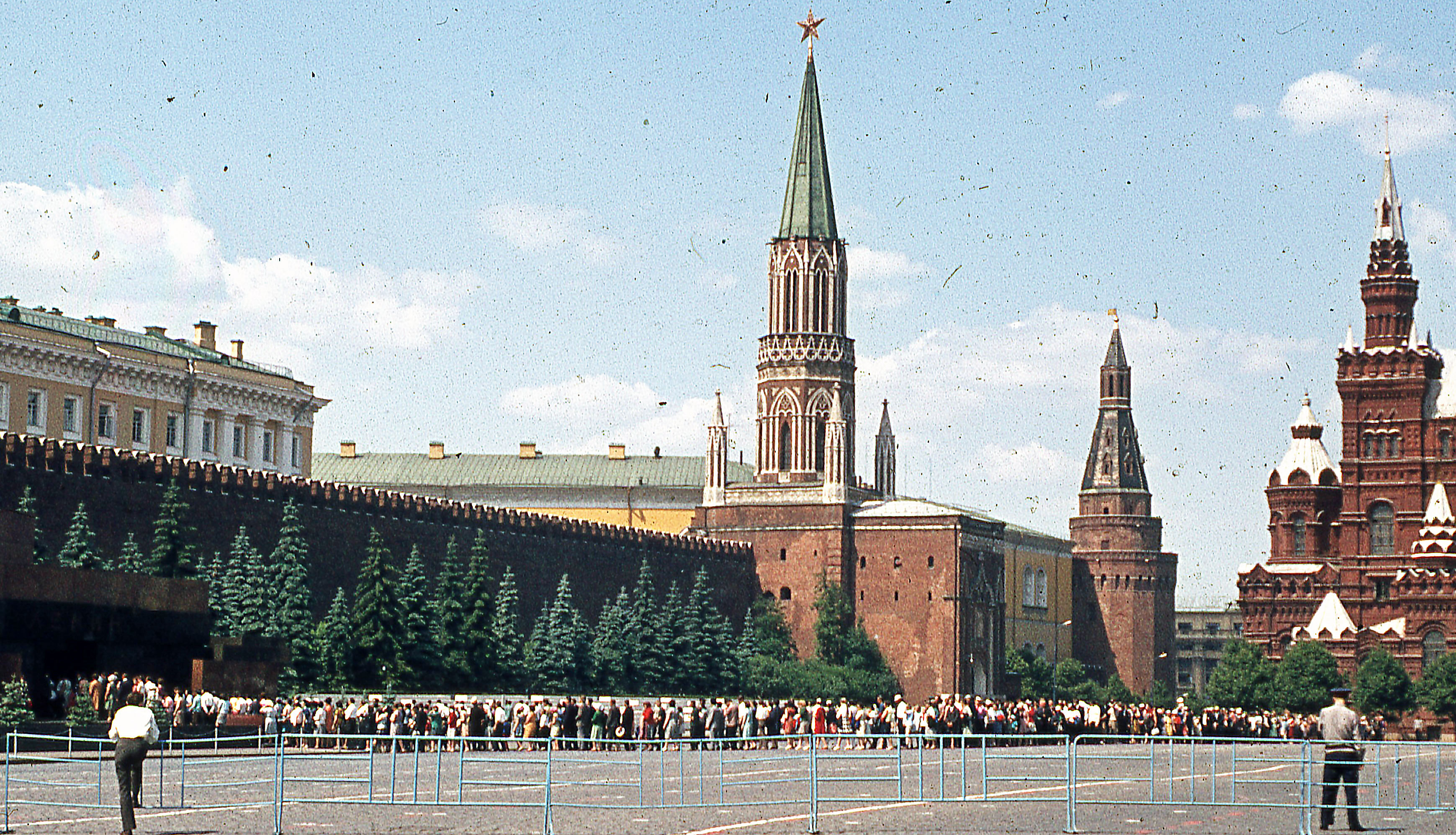
In Red Square there was a queue of people literally hundreds of yards long [left], slowly moving forward to pass through the Lenin Mausoleum — lots of little pioneers among them & behind the fenced off area where the queue was, hundreds more people watching the people in the queue — none of us has thought of suggesting a visit — weather has been very hot & we’ve heard of people who get up at 4 am to get a place in the queue — these seem to be limited, as the tomb seems to be open to the public on certain days of the week only & then till 12 noon only.

Well, in the last week or so, we’ve taken things at a more leisurely pace — looked around a bit, without having to rush on again. […]
19th June. We went to a huge showground — the Economic Achievements Exhibition — full of pavilions [above left] of every description, both architecturally & in their contents — all rather grand, with statues & columns [above centre] & various other decorations (Ian’s comment: some archeologist of the future is going to go mad digging it all up & reconstructing it) — fountains & park areas [above right] — one fountain with golden states of ladies (larger than life) all around it, I think representing each of the Soviet Republics.

At the huge columned gates [right] flags of all the republics, including Latvia, but they are the new flags, not the old ones. The Latvian flag is something like this [below]:

It was rather interesting to pick out things that were Latvian in the exhibit — photos of actors, musicians etc, a group of folk dancers photographed in Moscow etc. We’ve heard a surprising number of people speaking Latvian — there was a whole busload of Lat. ladies on tour here, staying overnight at the camping area, also about 3 families (one had come on a motorbike for their holidays) — we haven’t had more than a few words with them, but are determined to speak more in the future.
20th June, went to Film school & got shown over it (after usual initial pass problems) — Ian was hoping to meet someone recommended to him, who didn’t happen to be there but we did manage to watch a play by the drama students, who were doing it before their examiners as part of their exams.

Yesterday we were up at 5 am to get into town & do some filming — Ian is making a film that is to go with a Russian language course [above] […] — it’s a sort of set of scenes involving a couple of young people doing all the sorts of obvious things such as catching trains, going to the theatre, seeing sights in Moscow, shopping — all the usual language teaching situations — and now, wait for it, Laimons & me (& later Austra too) are the big stars — rather a trial, but we’re doing our best. […]
———-

19.06.68
[postcard[
[Moscow. Kremlin church spires across river]
Dear Mum & Dzid,
“With Love from Russia” from us — spent yesterday wandering around the Kremlin — will write longer letter later — have been here 3 days and another week or so to go — huge wide streets full of trucks & taxis — weather hot — prices high & queues long, but ok in special Gastronom — food shop with foreign prices for foreign currency — stocking up on everything & will also call there on way back from Leningrad, so should be good. All well & healthy & happy. Doubt we’ll meet sister, but will send her a card — problem that we have no address.
Inese & Laimons
—————-
7.7.68
Before setting off for Leningrad we stocked up on all necessary food (except bread, which is cheap everywhere) in our foreign currency shop here, so we’ve been doing well, even indulging ourselves with pancakes now & again — in Leningrad we went for a swim in the Baltic (Finish Gulf) — our campsite was a few minutes’ walk from the water — the most amazing thing was that the water was completely fresh — not a bit of salt in it — must be the many rivers etc from Finland emptying into it — still it seemed odd.
[…] writer Vilis Lācis — He seems to be about the most popular Latv. writer at the moment and is widely read in Russian translation — have also seen Russian translation of J.Rainis poetry.
Met some people that Ian knew about through Film School & they showed us a Russian film & provided us with a very good English interpreter who translated the film for us.
In Leningrad we found it very hard to get used to the “White Nights” — sun setting at about 10.30 and the night not even getting really dark — we’d be sitting around chatting or reading and sort of subconsciously waiting for dusk before starting tea [supper] — then discovering that it was 10 pm! One night we were reading till 11.30 pm!

[Photo L to R: Ian, Alex, Tanya, Austra, Inese at Peterhof]
However our stay was made really beaut by the people we met — a couple of school teachers (husb. & wife) — Russians who teach English […contacts Ian got in UK] — so we had a marvellous time, being taken to all the interesting places etc — their English was very good, so that communication was quite pleasant. Also they treated us to a couple of meals at their place & one at a friend’s (scientist who also speaks English) & so we sampled some typically Russian food — borscht, cabbage soup, “pilmeni” & sour cream, cheesecake, various cakes, biscuits & chocolates, Russian vodka. tea, and a drink called “kvass” made from bread.
The scientist (astronomer) showed us around the observatory he works in & told us how most of the work there is done in the winter, because that is when the nights are long, sometimes as long as 20 hours — & it’s cold work with the big telescopes, because the rooms can’t be heated as this would affect the lenses. Can’t say I’d like it.

From there we drove on to Pushkin, a town about 20 km out of Leningrad & there inspected Catherine II’s palace [left] — pretty well destroyed during the war, but now very well renovated — one of the best palaces we’ve seen, I was particularly impressed by the beautiful parquetry floors — the most intricate designs made from various coloured (natural) woods.

There too, was the room that is known as the “amber” room [above]– formerly it was apparently lined entirely with amber — now only a few decorative pieces — the rest were apparently removed by the Germans & so well hidden that no one has succeeded in locating it since.

Other things of interest — we saw a marriage — civil type, with woman official presiding, pressing button for “appropriate” music, standing behind desk in large marriage room in “Palace of marriages”. [Photo: Sample table for wedding toast celebrations available for rent]
And then of course looking at all the churches & domes (most of them golden) — the Winter Palace & the Hermitage — a rather rushed visit to the latter two — would have liked more time — fantastic rooms & fantastic collections of treasures of the past — also collection of paintings, including quite large section of foreign impressionists — some good Gauguins, rather indifferent Cézannes & very odd unsigned Picassos.

Visit to Peterhof [above] — palace & huge gardens outside Leningrad — most amazing collection of golden statues & fountains — on an artificial lake, watched performance by some ballet dancers on a platform jutting into the water in front of small palace building — looked beaut — reflecting in the water [below].

Visit to Peter & Paul fortress & church (golden spires) within it, view of Neva river & Leningrad from its walls — church containing huge gold altar.
Trip along the river on ferry boat — walks in parks on big islands in the river delta — river divides into about 4 or more major outlets — city full of bridges — one area of these parks is apparently turned into an ice skating rink in the winter, with more palace buildings for a backdrop.
It’s been a most informative & interesting trip — at first we thought 40 days would be too long, but now we’re glad, we really feel we’re getting to know the place a bit.
Today, we’re having one of our few luxury rest days — just sitting around, reading, writing — before we set off for the south, where it will probably be hotter still & more crowded with people, as that’s where everyone goes for their holidays.
We’ve been to a couple of bookshops & have bought a few books (books are very cheap here) that looked interesting, & were also given a few by our teacher friends as souvenirs.
Lots of love to you both,
Inese & Laimons
——————–

20.07.68
[Postcard]
[Kiev. The capital of the Ukranian SSR. Shevchenko State University (bright red!)]
Dear Mum & Dzid,
Crazy as it might seem, the building is more or less this colour! Unfortunately our two days in Kiev have been wet, so sight seeing has not been much fun — still we’ve managed a look at the huge, famous former monastery here, including miles of underground catacombs with mummified church dignitaries in coffins in alcoves — rather gruesome, but dry at least — above ground some quite wonderful churches with beaut gold domes. Before Kiev we were in Yalta for a couple of days & actually had a swim in the Black Sea — not much of a beach though — all covered in quite jagged fist-sized stones & thousands of outsized people covering every inch — still we’re adding to the list of seas we’ve bathed in. Tomorrow we’re off to Lvov & then border. We’re still healthy & well — eating well, including such things as stewed fruit! Lots of love from us all, waiting for news.
Inese & Laimons

———————-
21.07.68
[Postcard. Salzburg]
Had lunch here — drove around a bit, but no time for proper look. [Inese]
————————-

25.07.68
[Postcard left]
[München. Viktualienmarkt]
Dear Mum & Dzid,
Well we’re all out & safe & sound with all kinds of information which will fill up books rather than letters, but we have to organise our thoughts a bit — at the moment we’re busy with official things such as car registration — however, as soon as we’ve come down to earth a bit & got used to the pace of Western life again, you’ll get long, long letters.
Inese & Laimons
—

26.07.68
[Postcard left]
[München. Glockenspiel am Rathausturm]
Dear Mum & Dzid,
Well, I’ve just done a stupid thing — in my efforts to let you know that we’re all out and safe etc I’ve just posted you a card with the wrong postage on it, so you’ll probably get it months later — So I’m writing another — we’re busy with official things [etc…repeat of above]
München on return from Russia. [Inese]
———————————–
.
.
.
.

26.07.68
[Postcard right. München. Hofbräuhaus]
München on return from Russia — actually we visited this place with Regels & their friends previously — it’s a beer hall — the most famous in München, but usually too full of tourists. [Inese]
—–
———————

2.08.68
[Postcard right: Dümmersee]
Dear Mum & Dzid,
Still only a card, but be patient — the rest will come. Here we are camped by this small lake (about 30 km. north of Osnabrück & about 100 km south of Bremen) — in the meantime I’ve got my job as English teacher at Gymnasium (High Sch.) Damme (small town near here) — start 27.08.68 — Yesterday went to see Headmaster (I was scared stiff & had been trying to swot some German) — he was very nice — also other official business — Laimons has been guaranteed a work permit, though pay for mechanics is very poor (very good for teachers) — Headmaster is looking for a flat for us — then we’ll have an address.
Meantime, Harts have gone back to England — in next few weeks before school starts. (I’m terrified) we hope to do a bit more travelling & both swot our German — Laimons is already doing very well. DZID buy mum an ELECTRIC blanket!!
Love Inese & L.
—————–
Series of postcards from Inese from Aachen:

5.08.68
[Bad Aachen. Kupferstich] [left]
Old print of Aachen — prob 14-15 c. or later (as Gothic but seems to be there already — on Cathedral).
—-
.

[Aachen. Charlhalle des Aachener Domes] [above left]
Visited Aachen — looked at Cathedral — built by Charlemagne (abt 800) — this Gothic section added later.
Shrine (under glass at back) contains Charlemagne’s bones!
—–
[Bad Aachen. Dom] [above centre]
Old parts of Cathedral are more or less towers & dome at back — Gothic additions 14-15 c.
—-
[Bad Aachen. Dom] [above right]
Dome as built by Charlemagne, but mosaic renewed from drawings.

[Bad Aachen. Dom. Kaiserstuhl im Hochmünster] [above left]
Didn’t actually see throne (on balcony above — needed to be part of guided tour to get there). Charlemagne had it made & used it himself (around 800) — later Kings sat there after their coronation below & received homage or bestowed knighthoods from it.
——
[Aachener Domschatz. St. Petrus] [above centre]
Statuette about 18″-2′ tall — rather beautiful piece of work — in Treasury of Aachen Cathedral.
—-
[Aachen. Domschatz — Karlsbüste ca.1350] [above right]
Gold, silver & bejewelled bust of Charlemagne — Cathedral treasury.
————————–
9th August 1968. Forest near Oldenburg
Dear Mum & Dzid,
This is going to be the mammoth letter promised & so will probably take quite a few days to complete.
We’re camping in the forest — 3 days waiting for our money to arrive from England — at the moment we are broke (can’t afford a camping area fee) but still have food stocks — money should be here today — so we’ll be OK & hope to take a trip to Denmark & maybe Scandinavia before we start WORK — Laimons starts on 26th me on 27th in Damme.
When we arrived in München, there was a beaut pile of letters — most from you, you beauts — our friends, apart from Helen, don’t seem to write! — Also letter about job at German school — really most terrifying. It’s all very ironic — Austra was the one who was really keen & brave about working here & I more or less tagged on behind — now I’ve got a job, she hasn’t. We took them to Köln station from where they caught the train back to England while we continued on to Damme. Ian had to go back anyway to process the film we made in Russia […] & Austra went back with him — they both hope to work for a few months in Eng., then come back over here […]
Well, about the job [… detailed description of all the steps involved in dealing with German bureaucracy for work for both Inese & Laimons…] Laimons is to start at a local garage […] wage is terrible. […] My wage however is going to be very good, I don’t yet know the exact amount. Meantime headmaster is looking for a flat for us — we’ve arranged an emergency room in a boarding house […]
Damme is really a small village sort of place, abt 10,000 people (Laimons says that’s about Windsor [Australia] size) — school has under 500 kids, co-ed. School building is very modern — only 3 yrs old & has all imaginable equipment in it, including dark rooms for photography (extra-curricular hobbies) — is in the process of building an indoors pool & assembly hall, not likely to see them finished though. Area is quite pleasant — farms, quite large, small hills, bits of forest nearby & of course other villages every dew kilometers — lake about 12 kilometers away — & outdoors swimming pool just over the hill (proudly shown by the head).
Laimons is to start at a local garage (Mercedes place but big trucks & farm machinery only) — wage is terrible. My wage however is very good.
In last week, we went to the Nürburg Ring — famous car racing track about 45 kms south of Bonn — to see a Grand Prix race — it was wet & foggy & not the best — returned via Aachen & visited he old Cathedral there (built by Charlemagne in 800 with later additions. That’s all.
Now for the long awaited news of the Russian Trip. [Had been advised not to write anything critical or suspect, such as meeting relatives while in Russia.] Things for us personally were fine, but news from Russia & Latvia is not very happy. Life seems pretty difficult etc. We went in feeling very light hearted about everything, thinking all the stories told by parents & migrants generally can’t be true anymore today — that was all wo years ago — but came in for quite a few eyeopeners as the trip progressed. We also felt that we had been fairly open-minded about Communism before, but now feel less sure & feel that at the moment we are probably too far biased against it. We know that the kind of information we got is rather one sided, as we were not especially interested in the “achievements” of the USSR, didn’t visit many of their showplaces etc — we were too busy getting the sort of information that isn’t passed on to the West.
Now, the rest will be rather disorganised, as at this stage I’ll have to use the tape material [made by Ian] & we’ve had no time to organise & draw general conclusions. So be patient — also some info may be wrong (Mum will probably know some details — we would be glad if you could send any comments, corrections of facts etc.)
We arrived at Polish border & crossing at Brest at 6.15 am — Had to wait till 7.00 for border to open (Polish side) & 7.30 to be able to change our money — crossed into Russia at 8.00 am.
A. Our passports taken for checking — us waiting in large room full of Intourist (Russ. State Tourist Organisation — the only organisation dealing with tourists) pamphlets and posters, books on Lenin, posters of the type: “Visitez l’USRS en Auto”, showing charming French couple in VW with Tourist number plates like ours — waited 1 hour.
B. Intourist men approached us to give us our camping vouchers (pre-paid in London) & to sell us petrol coupons (can’t buy petrol with money & with coupons it’s supposed to be cheaper, actually isn’t, as we found out later) and to sell insurance (22 dollars) as, of course, the insurance card we already had, valid in most of Europe, is not valid in Russia.
C. Driver (Laimons) had to sign a pledge saying that he would take the car out of Russia again (i.e. not sell it there) & fill in customs declaration forms.
D. Car inspection by customs — pounced on tape recorder and sealed it up (tied with string & seal on knot) — not to be used inside Russia, though tape recorders can be bought at tourist foreign-currency shops for as little as $10 in Moscow (That’s probably the idea — Russia’s only interest in tourists seems to be the amount of dollars it can get from them & that’s not really an exaggeration). Vegetables (bag of onion tops & 2 cucumbers) — we were told that we could eat them there if we liked, so, as it was already past 11 am, we proceeded to do so. However, lady official was getting impatient (we were keeping her waiting, never mind the fact that we’d been kept there for 3 hours already) — twice she took them off us, twice we took them back, finally she managed to get them into the garbage tin while our backs were turned.
E. Car inspection proper — as Ian describes him “small cretin with torch & screwdriver, in overalls” came up — his job top check for secret hiding places in car & under it — proceeded to pull up seats & unscrew panelling on doors and ceiling, flashing torch inside. Another two officials meanwhile going through our luggage — particular interest in books, note books — went through all our (Austra’s & mine) Russian text & exercise books, great interest in Austra’s school mark book, which she happened to have along (full of lists of kids’ names with numbers & A’s & B’s etc!) — read all Ian’s letters. They made no comment on our binoculars, though we heard later of someone who had theirs taken from them & forwarded to their exit point to be collected when leaving the country.
F. Finally inspection over, Laimons and Ian went to change some traveller’s cheques — stood in queue (you queue for everything in Russia) & when their turn came, the officials were mystified by the Australian Commonwealth cheques (in Sterling) — they searched through their book containing photographs of all traveller’s cheques & couldn’t find a picture of one, so they refused to accept — Laimons stood his ground, saying “I’ve signed them, they’re no good to me now, you must accept them” — finally, after a phone call to someone, in which they read off every single word on the cheque to person at other end, they accepted — to the loud cheering of a group of Aussies, who were just leaving Russia after a mini-bus tour. All this took about 1 hour — Austra & me waiting in the car, with various officials coming up to ask us to move on. Finally an Intourist guide leant in and blew our horn — this was too much for me & I said rudely: “You must be joking!” — to which came the reply in good English (I nearly died!): “What’s this ‘Youmsky jumpsky’? It is new to me.” But I was still angry & replied rudely with “Well, it’s time you learnt!” — he slunk off — But really, that made four hours we had been there & we weren’t even obstructing the other traffic! So much for our entry.
About 40 km from the border, we discovered that Ian had left behind his folder (money, camping vouchers, passports) at the border — back we went — Intourist people had already sent out the alarm to police along our route (only one road we allowed to take) & they stopped us later to tell us that we had left our documents behind.
Arrived at Minsk camping ground — went to the office to ask if they had any pamphlets on the town — of course they had no information at all, But — if we would like to take a guided tour…? (costing dollars of course) — we declined.
That evening we were in the camp kitchen (one good thing about Russian tourist camps — most have cooking facilities — electric or gas rings) cooking our dinner, when in came 3 jolly Russian workers to heat their tin of pork — they learnt that we were from Australia & this brought on the usual reaction “Avstraalia! Wheeeew!!” — they were about to return to Tallin, having been sent to Minsk on some work project — one was the proud owner of a Moskvich car (Moskvich, Volga, Zaporoze, Chaika are the names of Russian cars — more about cars later — it is an achievement to own one) and had a daughter studying languages & was very interested in our travels. So out came the maps etc. (Austra’s Russian was beaut on the trip — it meant lots of interesting conversations with the locals, which we could not have had otherwise — mine extended to being able to get the general gist of the talks) — the second was a quiet, ultra polite Estonian, thrilled to discover Australian Latvians — the 3rd, as the other two explained, was a bit weak-minded, interested only in telling us how he’d been to Berlin in the war & been forced to shoot the Nazis and all he wanted was peace — he insisted we sing a song about peace, so we sang “Waltzing Matilda” (our repertoire is not that limited, but…)
[Inese & Laimons]
——————
31.8.68
Dear Mum & Dzid,
[… In Damme — Info about school, town, living, etc]
[…] On Sundays everyone gets dressed to the teeth, goes to church, & then parades around — jeans and jumper type gear just unheard of (I’m afraid they son will be though!) […]
[…] On Tuesday received a card from Austra. She’s here in Germany practically next door (about 25 kms away) in Vechta, the main village in this area, quite a bit bigger than ours, we’ve been there several times to settle official maters (endless in Germany — work permit, stay permit, medical tests etc etc) — fortunately may headmaster rang up all the people, made appointments for us, etc. I could never have managed it on my own. Austra’s also working in a high school (apparently her letter went to England to her old address, when she got it there, she decided she wanted the job after all & came back (!) on her own (!) Ian will probably come after Xmas — he’s busy with the film we made in Russia & apparently, so far, it looks good. […]
[…] About Russia — I’d like to send all the information on tape, so could you tell me the speeds of your tape recorder, so that we record it on the correct speed. […] News from Russia is not very happy — we had no trouble at all, but we met various people, Russian & Latvian, & managed to have some frank conversations with them — there is not much freedom, life is pretty hard (wages low, goods expensive etc).

[L to R: Inese, aunt Austra, Tanya Dukoff, Austra, Ian in Leningrad]
Meeting with Aunt was wonderful, but very upsetting for me — she told me all about Siberia — they are all well & happy enough at the moment, but a very important piece of information — there are shops in Riga where they can get goods for foreign currency much cheaper than anywhere else (e.g. a nylon all-weather coat costs them normally 70 Rubles (1R = 1$Aus.) & in this shop they cost only $3!!! — this is because Russia is trying to get all the foreign currency possible, especially American dollars) — Now, people in Latvia etc can’t get hold of foreign money, But it can be sent to them & receive coupons to shop in these special shops (we had about $40 between us & gave them to her, also various jumpers, shoes, blouses). The important thing is, could Mum write to Uncle Jaša in Canada & tell him, that if he wants to help (I think he’s said he does, but doesn’t know how) to send money, preferably in American dollars — parcels are useless, too expensive for the sender & usually not what the receiver wants (& there is little chance of re-selling goods, as other people can’t pay for them).

After we had made arrangements about jobs etc, we set off for 12 days [to Scandinavia] […] We took a longish drive [Sweden to Norway] through some of the most magnificent mountain, lake, fjord scenery in the world [avove] — also bought souvenirs (some pewter-ware at reasonable prices) — loved it,

Camped mostly in forests & wherever we stopped there were berries to pick — raspberries, blueberries & some wild strawberries — marvellous — one day we accidentally found an amazing patch of blueberries & in 3/4 hour had picked 1/3 of plastic bucket!! [right]We ate them for the next 3 days. It was a rather mad trip, so close to school time etc, but probably much needed — I think it gave me a rest from thoughts about Russia etc.
We’ve bought a transistor radio & with picking up BBC & Voice of America & trying to read the local papers, have been trying to keep up with the terrible news about Czechoslovakia — it’s particularly real & upsetting for us — both because we’ve been to Russia itself & also because we’ve been to Czech. — we loved the country — we even made friends with a couple of people in a cake shop (they would love to come to Australia). Even then it was impossible for them, now, we don’t even know whether it would be wise to write to them as we had promised — even if they got the letters, it probably would do them no good to have Westerners writing to them. It’s unbelievable & ghastly.
—————————-
8.9.68
Dear Mum & Dzid,
Happy Namesday Mum (I think)!!
[…] We are still working on as best we can, I’m not learning much German as in class I’m supposed to speak English all the time & this is more of less possible (which I find rather amazing). […] they are only about 12 and 13 years old! And they’ve been learning English since they were about 10. I have 25 periods a week including 3 on Saturday morning (which is normal in Germany, though I can’t say it appeals much to me!) — Laimons doesn’t work on Saturday morning & so he does the shopping instead. School starts at 8 am (!!) & Laimons starts at 7.30 (!) — so I’m always there early . The system is a bit different from home — you have all your periods in a row, one after the other (with a couple of short breaks) […] then when you’ve finished you go home […] the idea of going home for the afternoon sounds great […] but with all your periods in one after the other you end up pretty tired […]
[…] There are endless forms to fill for everything imaginable — the Germans leave the NSW Ed Dept for dead in this respect! […]
Meantime, we’ve been asking around for a flat — this place is so small that it doesn’t really cater for a transient population & most flats are too big for us & far too expensive (though compared to home rents are cheaper) and most are unfurnished, meant for those who are settling in for a while & therefor wanting their won furniture (& Germans have practically not heard of the good old second-hand furniture trade!) — still, we’ve found a room that will do us for a while — it’s just one room, but it has a wash basin with hot & cold water, heating, & the woman is putting in a couple of electric rings — we’ll sharing a bath & toilet, but what I like about it is that it has its own door opening out onto the back yard […] anyway I don’t think it matters much that it’s only one room — I’ll be there on my own all afternoon & at weekends we’re hoping to have the energy to get out & see places, so we’ll not be there most of the time. We’re hoping to move in next weekend.
Yesterday we went to Vechta & picked up Austra & a friend and all went shopping in Oldenburg — it’s really a very pleasant town — the central shopping area is compact & full of tiny narrow streets, some beaut old houses etc. All electronic goods etc are very cheap in Germany (e.g. we’ve bought a beaut steam iron for under £5 & a nice transistor/electric wireless for about £25) — as we’ve got most of our pots etc from our trip, we really don’t need much that’s new & can save our money for sightseeing etc. […]
[…] A bit about first impressions of Germans — can’t say I like them much — they are so status conscious & spend all their time, money, energy on what I think are just appearances that I find them rather boring — perhaps they’ll improve on closer acquaintance. (Teacher, by the way, especially Gymnasium teacher, rank pretty high. They’re all extremely well dressed & groomed & put any extra they have left over into their houses, cars & gardens. A Sunday-best parade in a tiny place like Damme is really quite hilarious — we are determined not to let it bother us & continue in thongs and slacks when off duty — school wear I have plenty of the right kind. Meantime, our present landlady has several apple trees & a huge pear tree in the garden — we are welcome to help ourselves & have been doing so liberally & cooking them up to have with porridge etc. […]
Inese & L.

———-
[Wollongong 9 Sept. 68]
Halo!
[from Erna…]
[note added by Dzidra]:
Dear both, I sit here chewing my pen and wondering what words of wisdom to write – I have been ordered to write… „WRITE – SOMETHING”.
School starts tomorrow – and the holidays have been beautiful – I revisited Newcastle and the heap of bricks that used to be 11 Parnell Place – but it didn’t really matter. My group of friends continues to grow wierder. One Berndt Apel, IQ of over 150 – who has been certified insane by Govt. doctors (because of his political views on New Guinea – where he was trying to get independence for the natives – so this is one way the govt can keep him out). He’s a strange character who fancies he can sing – in a sort of Al Martino style – & now is going to make his second attempt to crash show business — & next year wants to return to Europe to become tri lingual (he’s German – wants to learn French.)
Meanwhile I’ve gone mountain climbing with some mountain climbers — & I climbed DOWN a mountain & couldn’t get back up – so had to start along the long winding road to the top – in the end ended up hitching a ride – thought they’d have search parties out for me – but I got back before them – they were still doing proper climbing with ropes etc. Also I painted – one is an oil sketch of Hans which pleases me no end. Right now I’m attempting to make some sort of a Tax return — & it’s driving me up the wall. I’m rather curious to get back to school again – but no doubt one week of it will have me longing for more holidays AND I’m off to ski the weekend after next with the YHA group. Whoopee — but nothing to wear.
Anyway – love, DZID.
———————————–
15.9.68
Dear Mum & Dzid,
[…] About our room — calm down & don’t panic — we’ve just moved in & it’s quite beaut. It isn’t that there aren’t other flats around — we just can’t see the point of spending large sums of money for a flat (a) that we need for 9 months only (b) we’re not in most of the time (c) where we’d have to heat (& pay for heating) 3 rooms instead of one etc. This place is comfortable and has all we need — landlady is a business woman (owns shop in front) & is easy to get on with — she says just what she thinks & expects us to do the same, is busy herself & non-nosey — besides we have complete privacy & our own entrance. […]
[…] I think it’s time Mum stopped worrying about our food — believe you me, the thought is well inbred in me — we’re making porridge, eggs for breakfast, eating salads [… etc… more listing of food] […]
[…] Ian has written from England to say that the film we made in Russia has turned out beaut & people he made it for are pleased — only problem is that no-one seems to have money to make a commercial thing of it (for schools of course) — however negotiations are still in progress& Longmans (publishers) may be interested — I’m hoping we can manage a copy!
Ian will be coming over here at about Xmas — has been promised a teaching job — split between 2 schools (one a girls’ convent!) & is apparently (Austra reports) getting a bit neurotic about learning German — […]
If you get a chance, you might write Biddy a letter — about what you are doing, school, anything — maybe invite her to visit. She’s having a rather rough time. Earlier she wrote to us that she was having trouble with David — he left school after the Sch. Certif. (although he got a good pass) & got himself a dead-end job & dead-end friends — sole interest, motor bikes etc — got himself in & out of trouble with the police in the process. Now, she’s written that Hedley has just swallowed an overdose of sleeping pills & is recovering in hospital […] He seems to need psychiatric treatment but won’t agree to it — has been drinking heavily and doctors fell his character won’t respond to treatment much. It all sounds ghastly. […]
Lots of love from us — look after yourselves, especially you Mum!
Inese & Laimons
————-
——————–
24.9.68
Dear Mum & Dzid,
[…] Last weekend we set off on a rather long trip to visit Stuttgart & Würzburg (where Laimons used to live). We didn’t have much time — got to the outskirts of Stuttgart Sat night — was already dark, but we discovered that we were actually in Fellbach — so, happily slept in the car — next morning set off — I knew we lived near a vineyard-covered hill — so, seeing a hill, we set off towards it — then asked one person if they knew where Vordere Str. was — sure, just around the corner — off we went — past the tram stop (we’d been following the tram tracks as well). [below, tram at end of the street]

It was just as I remembered it — up a small hill & there was the baker’s shop on the corner [above right] & the milk shop down the lane [above centre] — Turned left — the blacksmith & his chestnut trees have gone […] — on to “our” house — it looked just the same — shutters, gate, backyard with cow sheds & small shed where there used to be pigs — When you look up towards the hill, there used to be a ruined house on the left, it has been rebuilt, the others were more or less as they were.

We met a fellow at the gate. I can’t quite work out who he is, but think he is an in-law of the Hummels & were invited for coffee a bit later (it was 8 am Sunday) — so we drove up the hill to where there is a fork in the road [above right] (we have a picture of Dzid & me there in the snow [left]) & went further on foot to the top — there used to be a lookout tower, which seems to have disappeared — however, the view across from the other side is still recognizable — a small chapel on a hill opposite is still there, though there seems to be a new housing settlement near it.

Then back down & to the cemetery — we’d almost given up, when we found grandmother’s grave [above] — there are lots of new ones in front of it — I didn’t know it had a headstone — the trees (birch & some sort of pine) are still there, only a little bigger.

Then back down for coffee — the old lady who lived downstairs has died — people upstairs are called Hauser (relatives of Hummels??) — man & wife & very old father (81) who produced a photo of dad’s of Dzid & me & the little girl, caps & stockings, eating sandwiches [right]. Downstairs, where we used to live, are a son of Hummel & his family — we didn’t meet them — the policeman & daughter are somewhere else (she is now a nurse) — they brought out two cardboard boxes which we’d left for someone to pick up, but no-one had come, so they’d kept them for 20 years!! — inside postcards (Mum’s tautu meitas) [below] — books of poems & pictures from Latvia — I don’t know what we’ll do with them — Anyway, it was all very exciting — we may have to go back for the Fellbach “Herbsttage” Oct 12-14 — presumably wine festival or something — I think the people would arrange a “family” gathering if we let them know — they were really nice & obviously please — we were sorry to have to rush away.

On return trip, we managed to find the place where the DP camp was at Würzburg — thrill for Laimons as here too, a lot of it had not changed much — it is now used as a police training centre. It was a marvellously successful trip. […]
[…] Mum, tell me all you can remember about the people, as I can’t work out who the Hausers are & where the Hummels fit in etc. […]
lots of love to you both — look after yourselves,
Inese & Laimons
P.S. Biddy has written that Hedley has recovered and has had treatment & they are both happier than the’ve ever been — really happy — miracles!


[Dzidra, Ilse(?), Inese]
—————
16.10.68
Dear Mum & Dzid,
Well, I’ve just finished making the promised tape [all about Russia] and will be sending it, possibly tomorrow, probably by airmail, so that you should have it soon. […]
[…] Now, a serious warning — don’t lend the tape itself to anyone, we don’t want any copies made of it because of the kind of information on it — this is quite serious — various people who know about things like that have warned us — the problem is that if the information gets into the wrong hands, the people who spoke to us in Russia, including our Aunt, can easily be traced — you may not think so, but there’s enough there to identify them, as there are records of all the people staying at the camping grounds etc — if found out, it could mean trouble for the people who spoke to us — and of course, if we ourselves are still entertaining vague thoughts about perhaps making a trip to Riga, it may be just as well not to go around sprouting anti-Russian type sentiments. It can’t really do any harm to let people listen to the tape, if there’s someone you think would be interested, but don’t let it out of your hands.
The information is all rather depressing and one sided, but it wasn’t all like that — we naturally enjoyed our trip and wouldn’t have missed it for anything — above all we feel it was educational and gave us a chance to see for ourselves — we are quite prepared to believe all kinds of stories about the great scientific and other progress that the Soviet Union has managed, but it seems that life is not as rosy as they like to make out in their publications to the West. No doubt Russia itself has gone a long way in improving the lot of the poor worker since the times before the Revolution, but we’re not so sure that the benefits have been all that great for some of the Republics, such as the Baltic States, the Ukraine etc. The most alarming thing perhaps is the suppression of truth or the outright falsification of it — the sort of rot they are told about the West is fantastic & not being allowed contact with the West themselves, they have little alternative but to believe it. Things like Siberia I feel are completely inexcusable and what really gets me is that so few people in the West know about it — in theory they do know about it — hence all the jokes about “the salt mines of Siberia”, which aren’t funny any more when you know the details. It can probably be explained by historical accident — Germany lost the war, so all its infamous concentration camp episodes etc have been dragged before the eyes of the world to be judged. Russia was on the winning side, so it did not need to justify, explain or account for anything it did. We’re in the process of watching Czechoslovakia being dragged back into line — and yet there’s not much that the West seems to be able to do about it, apart from ineffective protests. It really is quite terrible. […]
Love,
Inese & L.
———–
24.10.68

By now you must have received the tape — I hope. Meantime, it’s the last day of my short holidays and tomorrow, back to school till Christmas. Last weekend we managed a trip to Amsterdam. It was beaut. Holland is really the flattest country in the world & is full of people riding bicycles! Ideal for that! The only time there is any sort of rise in the road is to go over a bridge over a canal or to go up on an embankment or dyke [left]. Canals & waterways everywhere, a lot of them at different levels — there really seems to be little too much water and mud around and I’m not sure that some of the canals don’t get a bit smelly in the summer. Many country houses are completely surrounded by a small canal [below left], and access to them is over small bridges.


The work of reclaiming land seems to go on continuously — in the north there is an incredibly long dyke, about 20 miles long, across the gulf that was once the Zuider See & is now a huge lake [above centre] — we drove across the dyke on our way home — it’s hard to imagine just how much work must have gone into the building of it, truckload after truckload of earth, all the way across! We did see the occasional windmill, but I don’t know to what extent they are still used. A lot of people still wear clogs in the country [above right in Marken]. [On way home also stopped to look at Edam and its famous cheeses, left.]

On Saturday, we set out early, drove west and were in Amsterdam by midday. In Amsterdam we went off to find Rembrandt’s house, pretty well preserved and full of sketches and etchings (prints available, quite reasonably priced, but at this stage we only bought postcard variety). Then quite near there, we discovered a flea market [right] — we’ve never seen anything quite like it before! It really was a junk-collector’s paradise — but real junk — I think the people selling the things must have got them from dumps — no exaggeration — goods ranged from worn clothing & shoes (including moth-eaten old furs) to broken dolls, wireless sets, old phones, bits of cars, bikes — you name it & it was there — hundreds of salesmen & women each with their few bits junk spread out on the ground or on a table. And plenty of buyers, poring intently over rusty bike chains, chipped pots, etc. Incredible!
Then we went on to one of the big Museums of Art — this one was full of old Dutch Masters. We didn’t have time to look at most of them, but they’re cunningly set out, so that you have to walk through dozens of rooms of all the others to get to the Rembrandts at the end — Rembrandt’s “Night Watch” displayed in full glory right at the end in a room to itself — it’s quite huge — also looked at the 3 Vermeers they had — a bit disappointed that there weren’t more. Then, again prints etc available at very reasonable prices — we picked out two — I chose Vermeer’s “Kitchenmaid” (near window, pouring milk into bowl, yellow bodice) & Laimons chose Rembrandt’s “Self-portrait as Apostle of St. Paul” — they’re about 12″ x 8″ mounted on masonite & are now adorning our room — beaut!
Then off to the City Museum — more modern art this time, but again had time to look at Van Gogh only — quite large collection, though not the very best-known ones, but therefore also interesting s some were earlier versions, painted sketches if you like, of later well-known painting — here again, bought some prints — one set of 8 sketches (drawings) — really beaut — you don’t often get prints of his drawings — and also two huge posters (prints on beaut firm paper) by Toulouse Lautrec for about 7/- each. Fabulous! — Doubt we’ll get round to framing them here — not really worth it, as they’ll be too bulky then.

Well, then we wandered round the city a bit, watched the lights come on along the canals and went to see and incredibly bad American movie on Vietnam (Green Berets) & drove a little way out of town to sleep in the car — cow paddock on one side, permanently moored house-boats along canal on the other — there seem to be hundreds of these — many look just like small modern houses [left].
Sunday we went back into town to take some photos of the fascinating houses along the canals — some date from 17th century — all are narrow, about 3-4 storeys high with facade fronts, all joined on to one another — in the middle of the top of each there is a protruding beam of wood with a hook on it — apparently the stairs inside are too steep & narrow to allow furniture to be carried up, so it was hauled up on ropes outside & pulled in the windows of the various floors.
[…] The German part of the trip was all foggy — then, when we crossed into Holland, it became a beautiful sunny day, quite clear and since the last time we were out for a drive, autumn has advanced in leaps and bounds and trees were marvellous and colourful. […]
[…] Well, that was our short, but beaut trip to Holland — next weekend we’re going to Münster to visit Vita Kristovskis.
Lots of love to you both — don’t be afraid to write about your hot summer!
Inese & Laimons
———–

25.11.68
A week ago, on Sunday, we went off to the Harz Mountains — more or less due east from here on the border with East Germany. On the way, we visited Hameln [right] (of Pied Piper fame) — short look at old part of town hall only — then on to Goslar [below left] — already a bit of snow there — marvellous old town — arrived in time to hear a piece of the bells arranged on the outside wall of one of the old buildings (Glockenspiel) in the old market place — drove into the Harz mountains themselves & suddenly everything was white [below right] — not snow, but frost! All sort of fuzzy round each branch, twig, pine-needle! Fantastic!

—————

8.12.68
[Postcard]
[Traditional Xmas toy hedgehog characters (Meckis), tree, candle]
.
.
.
.
Dear Mum & Dzid,

Thanks for your letter, this time only a short card, as we’re trying to write a little bit to everyone before Xmas. Happy Xmas etc. to you & thanks for info on Austria — yesterday we bought ourselves skis and boots! (They’re cheaper here than back home). Your bushfires etc sound terrible — there has been TV coverage here but I haven’t watched any. We had a cold spell & then it got warmer & now it’s gradually getting colder again — today went walking in the forest — fabulous — all leaves are down & puddles frozen — mornings it’s dark till 8.15 — school starts at 8! Afternoon sun goes down at 4.15! Then you get that Xmas feeling — dusk & even dark, shops, houses all lit up & people hurrying about, cold in the streets, warm in shops — kids in colourful knitted hats, scarves, mittens, stockings, looking at toys & Xmas decorations in shop windows — Friday St. Nikolaus [students right] came and brought them all lollies, nuts, oranges, chocolate & marzipan — me too!
Lots of love,
Inese & Laimons
————————–
8.01.69
[Postcard: Area, town, kids on T-bar lift]
[Bruck an der Glockenstrasse, 758 m. Wintererholungsort.

Just a short note to let you know that we’re home safe & sound after a fabulous 2 weeks in the snow — will write more later — it was lovely — we headed towards the Grossglockner, but only got as far as this place (north of the mountain, Winklern is on the other side) because road was closed further down — is snowed Xmas Eve — beautiful — after one week here (including ski lessons) got itchy feet & headed for Switzerland & Liechtenstein, then home via Schwarzwald & Rhine — apparently they had some snow here (Damme) for about a week, but then it all melted (warm period in all of Germany) — no snow around now — glad we went South & had white Xmas.
——————-
18.2.69
We had a beaut holiday at Xmas. On way to Austria, called in and visited the Regels in München, then headed towards Grossglockner. We got as far as a place called Bruck (to the north of Gg.) for a week — took ski lessons (me black & blue & stiff) had a lovely Xmas Eve. Bruck is small village in valley — huge mountains around — it was snowing, we went for walk after dinner — all quiet, lights in windows, church bells — walked through local cemetery — all graves had lighted candles on them — snow falling silently — lovely.
After the week, we went up in a cable car to the top of some of the mountains to a glacier on which you could ski — all the way fine — very cold, but sunny — then took a smaller lift to the top of a fairly steep rise — suddenly, on top, I panicked — too scared to move in any direction, so I stood there & howled — tears freezing on the front of my parka — poor Laimons didn’t know what to do, but finally managed to talk me down!
From there we went east into Switzerland — went to St. Moritz — famous expensive ski resort, full of ex-film stars & other celebrities (Shah of Persia & family are there now) — Laimons had a ski (just to boast that we had) & we sent postcards to all our skiing friends at home. Then on to Liechtenstein — it really is tiny — had a ski there — & home via Schwarzwald and along Rhine.

A week ago we had Karneval celebrations here [right] — Damme is the centre for the celebrations in this area — for a week beforehand there are big gatherings in the local hall, where people (town celebrities and well to do locals) dressed in various costumes (basic themes fools’ & jesters’ costumes) — also other locals — get up and give witty speeches making fun of various local personalities and events. Then, private parties — we went to one at teacher’s place — Laimons dressed as Hippy (fantastically authentic-looking with long-haired wig), me, as Chinese in my cheong sam. Then a costume ball (we didn’t go to that). I forgot to mention that a Prince of Fools is chosen earlier, who reigns for the week & chooses his princess — they star at the ball. Then comes the Rosenmontag procession through the town with floats and costumes and lollies and sweets are tossed to the crowd by those taking part in the procession [above left].
———-

3.03.69
[Postcards above]
[Luftkurort, Damme i.O.]
Dear Mum & Dzid,
It’s just occurred to me that I said in the letter that the story would be that the money came from D. I think it would be better not to say anything about it at all. Otherwise it would be even more awkward if stories got around & someone told D — it is possible.
So here’s a few pictures of Damme. I walk home from school along the bottom left one, which continues down top right one & then a bit further (not much). Church is centre of Damme.
There will be tulips in Holland soon!
Love, I & L.
———————-
3rd March.
Dear Mum & Dzid,
[…] It has just occurred to us that if Mum is to get anything out of coming here, she’d better come straight away! I don’t know how your plans are progressing, Dzid, but unless you are setting a definite date before say about June, we’re going to run out of time to do anything in. Then, if Mum did come now and you did decide on a date before August, I guess Mum could go back for it. We definitely think Mum should come immediately and get here before Easter, if possible. That doesn’t mean much time at your end!! There are quite a few things to be done — passport, vaccinations etc. and these take some time. […]
[Long list of what needs to be done at various institutions — mostly in Sydney not Wollongong] […]
I think Mum should get in touch with Ojārs [Neimanis] as soon as she arrives in Sydney — he could go with her & sort things out — it’s near where he works & he can take time off & extended lunch hours etc. Also, if you’re married, you need husband’s permission to leave the country — I think a statutory declaration or something like that saying that they’re separated should do — Ojārs again could arrange that. […]
[…] If anything is to come of this, you must get cracking — Lots of love — it’s not extravagant, we don’t want a house — babies, yes, but later.
I & L
P.S. If passport ready in time, get plane to be in Frankfurt by 29.3. at latest, earlier if possible — if not, then ROME on 1, 2 or 3 of April.
P.P.S. DZID — Please send us your bank’s postal address (or whatever) & your account number, so that we can send you the money.
————–
6.3.69
Dear Mum & Dzid,
We’ve just got your letter written on 28th Feb. — we’re very proud of you Mum! You’ve really been busy & got things organised! We’ve had another think about it all and the Al Italia group flight sounds like a good thing, so I hope you haven’t cancelled it since our last letter! We’ve rethought our plans and everything would now work out really beaut. We’ve decided not to do the French course this summer but to do it next summer instead, after Canada — this works out much better in every way & will give us a chance to see a bit more of Europe this summer & having extra time to travel around with you Mum will be just beaut. So go ahead with passports and everything and book the flight. I don’t think a ship would be any better at all & certainly not any of the Chandris Lines‘ Greek boats — we know all about them. […]
[…] As soon as things are more definite we’ll send you the money — you must tell us exactly when it is needed and how much.
Also, when you book the flight, find out about a train to Germany — Köln would probably be best, but if the line goes to Frankfurt or somewhere else, that’s OK too. I think for the train you should make sure that you get whatever is the most comfortable — the price difference isn’t worth worrying about — and after a long plane trip, which probably messes up your day/night rhythm, it would be silly to try anything at all uncomfortable — or you’ll be too worn out to even think straight. […]
[…] Well, I can’t think of anything else official for the moment […]
[…] Meantime, we’re both very happy with the way things are turning out — much better than we had thought at first — we’ve got the whole summer holidays & can feel nice and relaxed and not rushed about time to see places. […]
[…] Spring is coming!
Love,
Inese & L.
————

25.03.69
[Postcard]
[Albrecht Dürer, Hare]
Dear Mum & Dzid,
Happy Easter to you both! Thanks for B’day greetings. Last bits of snow are finally disappearing, though had another fall a couple of nights ago — apparently an unusually long winter in Europe this year. But to business: if Mum hasn’t been to Sydney, she can write to Ojārs & send him things to be signed. Apart from stamps (variety doesn’t matter, just quantity, I teach about 200 kids!) Could Mum also get following for me: 1.) Mitchum (or was it Mitchell?) Deodorant & Anti-Perspirant — not more than one (they cost about $3!) 2.) Some Revlon “Silicare” hand cream — used to be big flat plastic bottle at about $2.
Over Easter we + Harts are going with a group of Germans to Prague and are looking forward to it — about 10 days — then 3-4 days in Berlin + seeing Aunt.
How much money will Mum need? And what is your Bank’s name and address + your account number?
Love I & L.
————————-
15.4.69
Dear Mum & Dzid,
[…] School has just started, we’re back from our trip to Prague & Berlin […]
Mum, I think it would probably be simplest, if immoral, to sign the form yourself — Dzid cab probably do a fair imitation. If this doesn’t work, then I think that a New Zealand trip (Latvian writers or something) sounds a reasonable excuse, but Dzid would have to persuade Dad to sign it quickly — I rather imagine Dad dragging things out. […]

Our trip was very interesting — in Prague we were with a group of Germans who went there on a more or less official visit as members of a Czech-German friendship society — So, we met representatives from newspapers, unions, writers’ group etc for talks — most rewarding. In between we managed some tie looking at Prague and visiting some Czech friends of Ian’s who had been with him at the London Film School. So we felt the trip worthwhile and rewarding —

Things are not going well for Czechoslovakia — after the anti-Russian exuberance in Prague in the rejoicing about the ice-hockey results (Czechs beat Russia in both games 2:0 and 4:3) [above left on fountain in front of the National Museum, Wenceslas Square] the Russians are putting pressure on them again to conform to pro-Russian Party line – censorship has been re-introduced and security measures increases etc. People are not happy — [right: National Museum pillars pock-marked by bullets]
In Berlin, we stayed with Annā tante [right] — it seems that both she and I were rather terrified of the meeting — all unfounded, as it turned out — we got on very well, found we had lots in common and were very happy & will try to manage another visit.

She is at the moment a rather successful business woman, is well and full of life — after a period of extreme depression at her husband’s death — has now got over it and, together with a young secretary/companion, is working hard, but finding it satisfying. She is a sort of representative for a number of firms, mainly dealing in heavy machinery. She arranges sales, contracts of all kinds for these firms with interested buyers in East Germany — she’s sort of a go-between — travelling continually between East & West Berlin on these business deals — when a contract gets signed, she gets a percentage of it.
While there we were fed & fed & wined at her place — both of them cooking and serving and running about — and talking German! But it really was very nice. She send you both her love & is very human. Mum, you must find a copy of your book for her. I sent a copy to Latvia from Czechoslovakia — hope it gets through.

[Right: Office of Russian travel agency, Intourist, in Prague after it was vandalized]