Ian’s notes on Russia (Ķikure/Kikure)

In the Extracts from Inese’s letters and cards sent to Erna from Europe and Russia, the section on Russia is limited, as we were warned [by our Embassy in Moscow, right] that we should be careful about what we said in letters home. That was partly because 3 of us were born in Latvia and even though we were Australian citizens, Russia did not necessarily recognize that citizenship and could treat us as citizens of the Soviet Union, if it so decided. For example, someone who was born elsewhere might be expelled from the Soviet Union for trying to smuggle out a Russian icon — we could end up in jail. Therefore, Ian, became our note-taker, but he too was told not to identify any people we met, since locals were officially discouraged from talking to foreigners and they could be traced, if we were too specific.

Ian took more complete notes of our time in Russia and typed them up later into the following report. Back in England, he too was advised not to try to publish his report at that time, because the people we met could still be identified, even by time and place, and there could be unpleasant consequences for them in Russia. The world has changed somewhat, so here is his report:

Russia Notes — Write-up of notes from a trip to the USSR, June and July 1968.
by Ian Hart

[Photographs added by Inese]


I. Entering the country, Customs, etc.

The Soviet border point at Brest is a bleak place at 6 am. We had camped in a mosquito-ridden forest and arrived early. But unfortunately the Polish side did not begin work until 7 am. The barrier was closed and the guard on the bridge regarded us suspiciously, slinging his machine gun from one shoulder to the other and stamping backwards and forwards to keep warm and awake. From somewhere across the fields the crisp morning air amplifies the occasional sound of shots. Hunters, we thought, until several bursts of firing revealed it to be machine guns.

The border officials arrived on bicycles, the guard was changed and it was not until 7.30 that our passports were stamped and the barrier lifted to allow us to drive onto the bridge. And on the bridge we stayed, covered by a second machine gun on the Soviet side, for another half-hour, presumably until the Russians came to work at 8 am. We drove down the twisting road and parked in front of the Customs house. A dour guard with red and gold epaulettes took our passports and visas and asked us to take a seat in the waiting room — bright and cheerful, with books on Lenin, Intourist pamphlets and posters on the wall. One poster represented a nice conflict: “Visitez l’USSR en Auto” it said and showed a happy couple in a Volkswagen 1500 with a West German “z” number-plate (the plate issued to non-residents who buy a car in the Federal Republic to export it). We waited for an hour.

The Intourist representative came to work at 9 am. and began bustling about, asking questions and checking our itinerary (arranged and pre-paid in Western currency before we left London — which is obligatory). He issues our camping vouchers and calculated our petrol coupons; it is impossible to buy petrol for cash, he told us. A second English-speaker arrived and explained that the Green card was not valid in the USSR and offered to sell insurance which is not compulsory anyway. We wanted it however, and after showing disbelief that a VW Kombie could have only a 1200 cc motor, he calculated it to be $26 for forty days.

And then things began to happen. After having waited for 1 1/2 hrs, everyone wanted us at once. People kept wanting the driver and taking him out of the room to sign pledges to take the car out of the USSR and to drive carefully on the Soviet roads. One notice he had to read and sign went:

  “Many accident have been caused by tourists not observing the USSR road rules… If you see a truck driver open his door, you must on no account overtake. The driver may be about to do something…”

Now, with our hindsight, we no longer laugh. This is an understatement.

After several such excursions into the back rooms, the big moment arrived: the driver was asked to open the car. It was driven up to an inspection pit and the team gathered around for the first vehicle of the day — the Inspector himself, resplendent in uniform and epaulettes; his assistant, small and agile in a boiler suit with electric torch and all-purpose screwdriver kit (he kept walking nervously about the car, clicking hi tongue and noting panels and screws obviously concealing opium or inflammatory literature); and a uniformed woman, an ex-athlete of s woman, whose job was to confiscate our vegetables and obviously, if necessary, take the ladies into the back room and search them for illegally imported roubles.

The first thing to be pounced upon was our tape recorder. It was wrapped in self-disintegrating Russian paper, tied with string and sealed, so that we could not use it in the USSR. They ignored our tapes; they ignored the fact that we could have bought a new recorder in Moscow for 10 dollars; they ignored the fact that the lead seal slipped up and down on the string and could easily be taken off and put back on at will. It was the law. Our vegetables were next — some potatoes, a few onions and a bunch of greens. They may not be taken into the country, but, we elicited, they may be eaten here and now. So, not having eaten since 5 am, we sliced some bread and began cutting up the greens to eat on it. Three times she tried to take the vegetables while our backs were turned; three times we rescued them. But the fourth time we were too late: she had thrown them in the garbage and was striding across the tar, back to her interrupted cup of tea when we discovered the loss.

The inspection of the luggage was, I suppose, quite reasonable. All printed matter was closely inspected, all written material had to be explained, Russian grammars and dictionaries drew guffaws of amusement and were treated to public recital, all suitcases were opened and disarrayed. The only bag not inspected contained 30 rolls of film (20 over the limit). And then, with ceremony, the Inspector stepped back and the fretting Assistant was soloed onto the panelling. Every seat was inspected, every door panel was unscrewed, the roof was tapped and poked, the engine compartment was measured, the hub-caps kicked. Until, with some show of disappointment, our passports were returned and we were allowed to leave. All that remained was to exchange our money and try to reach Minsk by dusk.

A group of Australians stood in the queue, returning from a bus tour and trying to exchange roubles for dollars. This proved more difficult than they had expected, it seemed. Some did not have the correct documents, some were foolish enough to want to exchange kopeks. No, the lady was saying, you may buy souvenirs, cigarettes with the money. We do not exchange it for you. Later, we saw one of the unhappy lot counting his money and pointing to the confectionary despondently. Those chocolates must be good, we joked, if they cost 60 kopeks each! He turned on us with a snarl: I’ve had them before. They’re horse shit.

The “Commonwealth Trading Bank of Australia” travellers’ cheques [right] confounded them. The teller looked through her picture book three times and could not find a picture of one. At length she called our friend the Intourist man. No, he said, assuming an air of confident refusal we were soon to learn so well, we do not accept these. But by a stroke of fortune, we were so angry at having been around for four hours we refused to go away. They are the only cheques we had, we told him, and we must have money. In any case, we have signed them, they are no use to us any more and he must take them. Such a line of reasoning had its effect. Six telephone calls were made and in each one every piece of printing on the now crumpled and sorry cheques were read off at length, prompted by either despair or the sarcastic comments of the queue of Australians, they gave in and changed £10 into roubles for us.

Meanwhile, our car was still at the inspection pit and the Russians wanted it to move off. Several uniformed officials had mimed this to our wives and they had mimed back that the driver was inside. At length a jolly little gentleman leaned in the window and honked the horn. The girls were in a similar temper to us by that stage and turned on him: You must be joking! snapped Inese. He smiled benignly. What is dis “Jumski jomski”? he enquired. It is new to me. They were taken aback a little that he could speak English. He was an Intourist guide. Well, it’s time you damn well learned! retorted the rude Inese and he slunk away, apologetic.

Our first two victories against the legendary official Russian rudeness. We were quite proud of ourselves.

And then, 20 kilometers away from the border we discovered that in our bad temper and haste we had left the folder behind containing our camping vouchers, passports and travellers’ cheques. And, shamefaced, we had to slink back and ask whether they had been found. It was the Intourist representative who had found them. I telephoned immediately to the policeman on the highway, he said. I am glad that he stopped you. You might have reached Minsk without discovering your loss. We slunk out again, negotiating the sandpit trap and the iron gates for a second time and were stopped twice by militiamen who were waiting for us at road junctions to send us back. There is only one road we could have travelled on and had they not stopped us we would have been spying: travelling on a non-tourist road.


II. Minsk; Conversations: (a) Three workers (b) Two engineers (c) Sportswomen

Before being allowed to drive through the USSR for a camping tour, one has to present an itinerary of the places one is staying at and the time to be spent at each camp, then to pay for the camping area in advance in Western currency. It costs approximately 7/6 stg. per person and 5/- per car per night. The actual route presents little difficulty as only certain major roads are open to tourist traffic, though it usually means one must travel several roads twice. Our route was to take us on the road from Brest to Moscow, camping at Minsk and Smolensk, then north to Leningrad, pausing at Novgorod, back again to Moscow via Novgorod again and south to Yalta, stopping at Orel, Kharkov, and Zaporozhe. From Yalta we must go back to Kharkov, stopping again at Zaporozhe, to Kiev, Lvov and exit into Czechoslovakia at Uzhgorod. The only tourist road we would not have covered runs from Kharkov, through Rostov-on-Don and around the Caucasian circle via Sochi, Tblisi and Pyatigorsk. The difficulty in planning the itinerary rests in the ludicrous information given about the cities in Intourist pamphlets and the fact that there are only camping areas in major cities which often have nothing to offer the tourist at all.

Such a city is Minsk [left]. Completely destroyed in the war it has been rebuilt into a “charming industrial town”, but tempted by the prospect of the “old capital of Byelorussia, founded in the 12th century” and its “famous examples of folk art and handicraft” we had elected to stay for four nights.

The camp is some 18 km out of the city (all the better to be out of the industrial smoke), set in a forest. The omnipresent little lady in a scarf, sitting in a chair was at the gate to receive us, another was at the door of the administrator’s room, a third sat all day at the locked door of the shower room. Since having presented our itinerary in London, we had had second thoughts and we decided that if it was possible we would stay only a couple of days at places which did not appeal to us and longer in towns where we discovered something to see, and there was no trouble. With all the mythology surrounding Soviet beaurocracy they had no record whatsoever of our latent movements, so we began by cutting a day off Minsk. Subsequently, we were to find that almost every tourist was trying to cut his tour by several days, paying willingly the 10% which Intourist required for this service.

We were prepared for the vagaries of camping with a methylated spirit stove and 20 litres of spirits (having sampled the prices in the other communist countries) but it was a pleasant surprise to find that every camp contained a “self-cooking” kitchen with gas or electricity free of charge. We were not, however, prepared for the price of food — sausage 3 roubles per kilo, cheese and butter even more expensive. We were almost reconciled to living for 40 days on bread and kvass until we heard rumours of a foreign currency shop in Moscow which sold food at buyable prices. [Photo: Austra near street-seller of kvass — sold by the glass. A very common sight in cities]

We were cooking dinner that evening when we had the first of many experiences which made the trip worthwhile and which are the reason for the existence of these note: conversations with ordinary Soviet citizens. Some were short, being nothing more than a few words passed at a petrol station; some lasted for six or seven hours and were conducted in hushed tones and furtive glances, quite as melodramatic as it sounds. The first was quite innocent but for us proved so interesting that it served as a stimulus for us to grab the opportunity whenever it arose.

Three jolly workers rolled into the kitchen, surrounding an open tin can of what seemed to be pork — there was a picture of a pig on the tin. We lent them a match and they balanced the can on a gas jet then turned to us. Where were we from? they asked. And then almost a learned response to our answer (a common response every time we replies to the question): “Avstralia!” (and a long, drawn-out whistle).

They were workers on a “Komanderovka”, a very common occurrence in the USSR, when workers are sent across the country to another factory to exchange views and pick up any new techniques, lasting from a few days to several months. The first and most literate of them owned a Moscvich 107 car and was intensely interested in where we had been and where we were going and how we managed to do it if our parents had not given us the money. He was very impressed that Austra could speak Russian after only one year of night school and told us that his daughter was at the university studying languages. The second was a tall, quiet, ultra-polite Estonian, thrilled to discover that three of us had been born in Latvia and sorry that we were not allowed to drive to Riga, which, he assured us, was very beautiful. The third, as the others explained quietly, was weak minded and cornered each of us in turn and explained how he had captured Berlin and was forced to shoot the Nazis and only wanted peace.

I had my guitar and we sang them Waltzing Matilda because they insisted we sing a song about peace. Number three miraculously produced a bottle of vodka from beneath his coat and we had to drink to peace in the Russian manner — half an inch in the bottom of an enamel mug thrown down in one gulp/ Under cover of the general hilarity the first drew Austra aside and began to ask about “This man Petrov…” but he was interrupted by number three who wanted a translator to ask Laimons about Berlin and the conversation never developed.

When it neared the time to go to bed, they insisted on giving us a present to remember them by and the first brought out a pair of vernier calipers. The third was going to give us his war ribbons, which he had pinned to his coat, but we would not take them, so he found a metal tape measure and made us accept it. In return we searched hard and I found a spare camera brush which we gave to the one with a camera. And at last a well-dressed, discreet young man came and took them away, returning to say “I am sorry.”

We had only reached the steps when we were approached again, this time by an earnest, young-looking engineer from Archangel, that most northerly of cities. “Avstralia!” he whistled. A friend arrived, and then two more, and so, for another two hours we sat on the steps and talked, drinking their wine and smoking their cigarettes. They wanted to know everything about Australia — it is a place they cannot conceive of, and the one thing they want to do is to leave the USSR for their holidays, just to look at some Western countries. Did we have rich parents? How could we afford the trip then? Are we going to work in the USSR? They were surprised at our laughter and an argument developed: they were sure that we could work and we were equally certain that we could not work. At least, one made a philosophical conclusion: what you say is probably true, but we are told you are welcome to come and work. (And leave?)

But there was a great difference between talking to the “authentic Soviet workers”, as we were continuously reminded; caricatures of soviet workers almost; but immensely likeable, and the young men — interested and intense, aware of the necessity for duplicity in what one knows and what one may believe. They want desperately to speak to people in the West, to see for themselves and to judge for themselves It seemed to us that we were humans their own age first of all, and bourgeois and capitalist are words referring to there, not to us.

The first two invited us to their “home” (a rented tent) at 9 am the next day for a talk, but we had forgotten to put our watches forward and arrived at 11 am. They had gone for a swim, after waiting for an hour for us. But by midday they had found us and had come to our “home” for a talk, bearing vodka, wine and beer. We sat, cross-legged in the sun, throwing done huge dollops of vodka because they insisted they would be offended if we didn’t, trying to eat something, but only managing a herring and a slice of bread during the whole afternoon. We played and sang a few songs, and Sergei completely re-tuned the guitar and sang some Russian songs. In our state we pooh-pooh’d the customs officials and undid the tape-recorder and carefully place the seal on the grass (it took us hours to find it again) and recorded the songs, and I took a photograph of us all “enjoying ourselves”.

Until then the talk had been most superficial and jolly, but they obviously seemed worried about being taped and photographed. Only one photograph, said Boris. I don’t mind if you tape the songs, but please don’t tape anything we say, asked Sergei. Why? we asked, emboldened by vodka. What is there to be worried about?

Boris and Sergei [left] were “special workers”: Engineers in a large shipbuilding factory in Archangel, doing high priority and presumably secret work. At the moment they were on one week’s Komanderovka to Minsk to look at a trade exhibition. There was no choice about it — the boss just said: You two will go. Because of their special status as “special workers” they are not allowed to travel out of the Soviet Union; not even to Czechoslovakia, they said (which might sound understandable now). They are not allowed to receive mail from outside the USSR. And least of all, could it be known that they were talking to Capitalists! In Archangel they were certainly not allowed to be seen drinking in public; they have to “set an example”. If they were seen drinking with workers on the shop floor, social inferiors, they would be told: If you want to drink with them, you can work with them too. And they would be demoted.

Sergei was becoming quite drunk and telling us these things. Boris — tall, dour and quiet — kept drawing him aside and stopping him from going on. Many more things were said, but they were lost on us. I passed out twice and Laimons was sick. They did no think much of our drinking ability. In Archangel, they told us, where they are icebound for eight months of the year, they work hare and drink hard. Because we couldn’t drink hare, they reasoned we mustn’t work hard.

They left at about midnight and we collapsed into bed. But we were not to escape so easily. Next morning they were around, inviting us to their “home” once again, and we could not refuse, though this time we successfully refused to drink. We had collected up seven empty vodka bottles and six wine bottles that morning. We determined to make the conversation all-important and to clear up some of the dimly-remembered topics from the previous, disastrous day.

We asked them about the military aircraft we had seen flying over that morning. They looked something like the “Mirage” jet, we said. They looked very good aircraft. The conversation was quickly steered to the newest “Illusion” jet, the largest supersonic plane in the world.

Sergei, though he could speak no more than five words of English, insisted that one of his jobs was translating technical material from English and he seemed most interested in the Soviet authors we had read. Tolstoy, Dostoievski, Chekhov, Turgenev, Gogol, we said. The only modern writer we knew was Sholokov and Quiet Flows the Don and a few poems by Yevtushenko. We didn’t mention Pasternak or Sinyavsky, though I wish we had. Sergei had read all the great English authors: Dickens, Frank Hardy, Katherine Susanna Pritchard, Jack London… Western people, they told us, read no Russian authors, know nothing about the USSR and don’t want to know. (This conversation was being held in Russian, occasionally hindered by Sergei composing a sentence in broken English).

We facetiously asked why they will not come to Australia in order to make sure we had the story right. They have two reasons: (1) They cannot leave the USSR (2) They have to “build Communism” (standing with fist in the air). We answered that we have to “build Australia”, giving the same gestures, but I don’t think they understood. Anyway, they said, three of you were born in Latvia. Why don’t you go and work in Latvia where there is a great shortage of schoolteachers? We did not answer the question again.

It is perhaps interesting to note that when we first met them they were disbelieving that we could be ordinary “workers” whose parents ha quite ordinary jobs in Australia, but by this time we were accepted quite as equals and workers of the same status. Even Boris had stopped digging Sergei in the ribs and only occasionally were the eyelids lowered and the sentence stopped midway through.

Boris, maker of huge diesel engines, with “the best qualifications available in the USSR” insisted on looking at our engine and checking the oil for us. When — horrors — he discovered that the oil was low! And from that moment on, much that could have been interesting was not able to be said. Boris was going to fix it for us. There was a small amount of seepage underneath the car and he insisted that the whole engine needed to be dismantled and carefully cleaned with kerosene, else our car would catch on fire. It could not be driven even 50 meters in this condition! He was quite certain that we did not understand the seriousness of the situation. Even though Laimons was by trade a motor mechanic, we were lectured to what amounted to several hours on how Westerners do not look after their machines. He was certain that if he did not do it for us, we would leave without doing the job and our car would burst into flames as soon as we got out the gate. Eventually Laimons topped up the oil in his presence and promised to clear off the oil.

And the last, safe, topic of conversation was, naturally football. Here, they would agree, England was very good. They know the names of the England World Cup team and all Russia had cheered for England against West Germany in the final game. The Russian team had been having a bad time, it seemed. In their last game the unsporting Czechs had deliberately incapacitated their five best players. I revealed that in my student days I had played in goal and was immediately set several tactical problems with matches and cigarette packets. I think I failed.

Boris and Sergei had mentioned that a Latvian basketball team was training in the camp and we had been looking out for them as Laimons was both a Latvian and a basketballer, but they appeared to have left. We did, however, find the Byelorussian women’s rowing team in camp and one of the rowers was a Latvian. She did everything possible to avoid us and the only way we did eventually meet her was by the persistence of one of her friends who hauled her out of bed after we had been brought around to their hut. Having been forced to meet us eventually, she became very friendly, overwhelmingly so.

We sat in their room, the Latvian girl and three Byelorussians, talking about the West, pleasantly surprised by their insatiable curiosity. Their one dream, they said, was to be able to visit France or Sweden or England, to see for themselves. They were quite ingenuous about it. The Latvian girl spoke in Latvian, though she was shy about it, saying that she never spoke it any more as she lived in Minsk and wrote her parents in Polish, but Austra tried to ask her some questions about their situation today. The conversation usually ended up in the air:

— But why can’t you go to the West? Is it money?

— No it is not money.

— Is it the country’s economics?

— No, it is not economics.

— Do you know the reason?

— Yes. I know the reason… I would like to tell you but I won’t.

The coach came into the room, gave out their meal coupons and told them to go to bed, and they laughed when he left. They are not professional sportsmen, but they have a one month training camp, fully paid, apart from their holidays and they are paid when they go away for competitions. The Latvian girl is a sister in the hospital. It was with them that we did show our ignorance about Soviet nationalism. This is only our second day in Russia, we said. With one voice they rebuked us: You are not in Russia! You are in Byelorussia, a republic of the USSR!

When we left they insisted on giving us mementos, which was most embarrassing, as we had nothing whatsoever to give them. We took away two badges of Minsk, a signed photograph of the rowing team and a film magazine.

The Soviet system of giving presents can be quite embarrassing if, as we did, you come unprepared for it. Most young people carry a badge of their city which they are eager to swap for any small western token. The next morning we exchanged the few Australian coins we had for a badge, but anything will do — a picture, a postcard, a book, a biro. It is a practice common all over the USSR.


III. Minsk to Smolensk: strange sights and petrol stations

On the road from Minsk to Smolensk we had to smile at Boris’ eulogies of “good Soviet engineers”. The trucks are a major road hazard [right]. Endless streams of them bump and swing along, pulling trailers, often on a dangerous list owing to the broken springs and lack of shock absorbers. On hills the drivers have the doors open or stand on the running boards to escape from the petrol fumes in the cabins and when there are rear-vision mirrors they are set so close in that it is impossible for the driver to see anything behind him. Indicators and stop lights, when they are fitted, work at random. More than half of them would not be allowed on British roads under safety regulations. The tyres are bald or hanging in tatters and the roadsides are littered with machines broken down. Every fifth truck is towing another one. And yet they are carrying nothing at all… or scrap iron and rubbish… or soldiers…

The road itself [left] is of a straightness only equalled by the Nullabor Plain highway, but consists of a series of steady undulations, every kilometer or so. The only trees have obviously been recently planted and run along the side of the road, shielding the fields or lack of them from the motorist’s sight. The ground does not look particularly fertile in this region and afforestation programmes seem to be having the most success.

The road surface is notable for its lack of success — almost every unsuccessful surfacing seems to have been tried and given up. Huge potholes lurk in the shadows of the older sections and the newly-made sections are hazardous to drive on hot days — they are a mirror-surface of melted tar. [below: road repairs, mostly by women, in town and out in the coutryside]


Uneventful as the scenery might be, there is plenty to look at along the way and the driver certainly never has a chance to get bored — every side-road hides a potential suicidal cyclist who has never looked to the left at a crossroad in his life. But a petrol company in the West could devise the most interesting motoring game of all time with a competition to see who was doing the most unusual and useless job by the road. The people are the scenery. The following is a select list from my notebook:

— A woman, miles from nowhere, in the middle of a perfectly flat plain, sweeping the road with a birch broom.

— A man in the forest with a scythe, who would find a clearing, take three swings at the grass and walk on to the next.

— Another man, in the same type of scenery as the woman, raking uncut grass.

— In the most remote areas one would come across one person, or a couple, or a whole family, dressed in bikini swimmers, the men with knotted handkerchieves on their heads… sunbathing. There is no settlement in sight and no vehicle.


— And of course, mention must be made of the statues [above]. Every village has its statue of a peasant (usually a woman) and/or factory worker (a man) in a heroic pose. Every pioneer camp has its statues of precocious-looking children blowing bugles.


Every crossroad has its war memorial [left] (usually a tank with red star) and several times we saw “spontaneous demonstrations” before them — the policeman, collective farm director, a few children, peasants and army men, all with their hair done, clutching armsful of flowers, being photographed as they reverently placed them beneath the tank treadle.


The statues are in gold or silver frost, mass-produced and indescribably ugly. They litter the sides of the road, gesturing dramatically or launching white doves over the rank undergrowth. The only thing which can rival them is the signs. They are everywhere [left] — Western advertising billboards are things of restraint and beauty beside them. They split up into three definite groups:


(1) The inspirations to further production — pictures of the best workers in the village, statistics on how much the village produced last year and will produce next year and quotations from Lenin on “work”. They are always gaudy, large and red [right].

(3) Simple instructions, almost Religious in their authority. always on the top or along the face of the tallest building — “Praise…” to anything at all — to the Communist Party, to Soviet Youth, to Peace…

(2) Inspirations to national unity, slashed across the sides of buildings or on banners across the road: The country and party are one; The press is the mighty organ of the Lenin party: Communism is the forerunner of world peace!; or a sign simply giving the word “peace” in fifteen languages. (Yet in no country we visited was there so much military activity and constant awareness of war. But this is topic better treated later.)

A fourth, rather ironical sub-group is the signs on the backs of the green trucks, giving advice on road safety. A full list of the signs we collected will be included in a supplement.

And getting petrol deserves a few paragraphs still in these days when we are plagued by petrol stations on each corner. The stations are still far enough apart, so that if one misses one it is quite possible to run out before the next. Petrol comes in four octane grades 66, 72, 76 and 98. Standard petrol as we know it, about 86 octane, does not exist. Petrol is sold by coupon, not for money, and in lots of five litres — one guesses at how much the tank will hold. The system is as follows:

One waits in the queue, often several hundred meters long, choking in the petrol and diesel fumes, until the car gets to the pump required. Then the driver hands over as many coupons as he thinks he needs to the office, rushes back, opens the tank and puts in the hose before the manager (in his office) turns on the petrol. When the 15 or 20 litres is run through, the petrol stops, the driver replaces the hose and leaves.

Probably the most sensible rule in the whole of the USSR is that one is forbidden to smoke in a petrol station — petrol is often running inches deep on the ground due to: (a) Faulty equipment: split hoses and pumps which do not turn off. (b) Inexpert hosemanship on the part of the drivers, who sometimes do not get the hose in the tank on time or miss altogether or alternate the nozzle between the tank and a spare can, and (c) The fact that petrol is put in in 5 litre lots, so that if someone has bought say, 20 litres and his tank holds 17, three litres are spilt on the ground [left]. Many hoses cannot be turned off at the nozzle.

We were about to run out of petrol near the town of Mazhaisk, about 50 kilometers from Moscow, so we drove off the highway (forbidden) in the hope of finding a pump. In the town we asked a family — mother, father and daughter, walking along the road. At first they refused to even acknowledge our presence and then the daughter suggested we try the centre, a few blocks away. In the centre we were directed back to the outskirts — under the railway and to the left, where we had already been. At length we found it, hidden amongst the trees. There was no queue and at least ten pumps. The 98 octane pump was bright and new and shiny with both litre and tenth-litre and price indicators, rather than the usual clock-face dial. And the face itself had been newly painted in Russian with “KOPEK” beside the price dial. We got our petrol by normal means, via the twin hoses and shiny regulating nozzle with automatic stop, but as were preparing to leave, we noticed the price which had come up: 26.70. (The indicator said 0.89 per litre). Now, was it 26.70 kopeks for 30 litres (i.e. 2/6 stg,) or 26.70 roubles (i.e. £13)? Neither seemed possible. We asked the attendant out of interest… No, she said. She did not know what it meant either. Perhaps it meant nothing at all. It was a new Austrian machine, transported to this obscure little town to measure 98 octane petrol (which nobody used), and to measure a fictitious price, which doesn’t matter anyway, because nobody pays for their petrol in money.

Fooled again by the guide book, we stayed the night at Smolensk, an “old Russian city, mentioned in chronicles as far back as the 9th century… with ancient 12th century churches, the Smolensk kremlin and the imposing 17th century Cathedral of the Assumption (which) will give you a good notion of the many charms of old Russian art and architecture.” We missed the relevant qualifying sentence: “Today it is a big industrial centre with the Soviet Union’s biggest linen mills…” The Kremlin and the cathedrals were there, of course, but the daunting prospect of the cobbled streets and the tram lines, raised six inches above the road, and the thick grime covering every post and railing encouraged us to turn back to the camping area and brave the mosquitoes and the flush toilets which the Russians still haven’t learned about.

What perversity has persuaded the Russians to build nearly half their camping areas on or next to swamps? Of course when we complain about mosquitoes they laugh. “Moskit” in Russian refers to the huge, man-eating monsters of the arctic circle. You have seen nothing, they say, they are just our little “kamar”! But at times there are so many of these “little kamar” that it is impossible to use the lavatory or the washbasin. People with converted vans and built-in cooking facilities locked their windows, stuffed up all the holes with rags and did not step out of their vehicles the whole time they were there. Even the prospect of luke-warm showers was not enough to persuade us to take of the clothes we had pulled up and down to cover our legs, hands and half our faces. We ate dinner walking around — not staying in one place long enough for a cloud to gather — and we went to bed early and zipped up the tent.


IV. Moscow

We drove into Moscow [“Mocow — Hero City” right] in the late afternoon along the perfectly straight road, having seen the tower of the university from ten kilometers out and watched for it, on the advice of the guide book. The camping area, we knew, was somewhere to our left before the city, but we were lost in the desert of Kutuzov Prospect and almost at the Kremlin before we managed to ask directions and get back again. This time we tried turning off at a clover-leaf junction onto the outer ring which marks the city limits and makes it the biggest city in the world (although the dwellings do not begin for another ten kilometers). This time we asked a militiaman who was sitting on his motorcycle keeping an eye on the junction. Oh yes, he said, the camp is just 50 meters away, up the hill. And then he proceeded to explain clearly and concisely how we should get to it — by backing up the motorway and making the remaining three turns of the clover-leaf in order to go in the same direction we had been going before we foolishly turned off, driving past the entrance and doing a “U” turn further down the road in order to come back to the gate. This small baptism gave us much more confidence in the legendary Moscow traffic for the remainder of our stay.

We had missed the camp because the international camping sign had been replaced by a billboard which looked like an advertisement for a futuristic Cadillac with “Camping: in four languages, in small print, underneath. The unsmiling, bescarfed lady on the chair at the gate grudgingly raised the barrier for us and we drove into the most modern camping area in the USSR; Moscow’s second camp, only open a year [left]. It is a large, spacious, well-grassed area with no swamps in sight. All the buildings made of light coloured brick in an austere modern style. There are continuous hot showers, flush toilets with seats to sit on (rather than the French version, the hole in the ground), a shop, albeit containing no more than ten tins of meat and a dozen bottles of beer and a large, efficient kitchen with four huge electric stoves, an electric samovar, tables and wash basin.

Unfortunately a good section of the verandah is about to collapse. Russians have no respect for drainage, so that even in the city the highest, most modern buildings simply shed their water onto the footpath when it rains, and the water escapes down the road into the nearest available river as best it can. In this building the roof ends short of the edge of the balcony of the verandah and the rain water falls onto the cement, forming pools and seeping through the cracks and after one year the foundations in this area have sunk six inches, the outer wall bulges, and if one is not careful walking across the cement to the steps one trips and goes down the steps head-first. A small detail perhaps, but there are so many such small details. We have met an architect convinced that modern Moscow will stay up for a maximum of ten years.

A jolly article in a recent issue of the Daily Worker by their Moscow correspondent explains how: “At regular intervals I hear friends moan with anguish and exclaim ‘we’re having a “remont”‘ a Russian word covering everything from minor repair to major refit… “A full-scale ‘remont’ can put a shop or office out of commission for anything up to a year: cracked or loose plaster on walls and ceilings is removed and replaced, windows and doors rehung, floors taken up and relaid.” In some buildings, we were told, there is major repair work going on at one end while the other end is still being built.

While we were cooking dinner that evening, exchanging groans with a New-Zealand couple an American came into the kitchen and said: WE must form a club of people who have been to the USSR — nobody else will believe us! This is a major problem. It is impossible to express in words the sense of incredulity, anger, frustration or vacant disbelief at times, that tourists should be encouraged to come and look. There is no more insane way, he said, to show off the country than to let people drive through it!

The New Zealanders had been trying to get ballet tickets and had gone to the Bolshoi and left 10 roubles in the hope of getting tickets the next day. They arrived at the appointed time, but were met at the box office with: I am afraid it seems to me we can do nothing for you. All the tickets are sold. They offered to exchange the roubles for dollars and she said she would see what could be done. She went out the back and returned a few minutes later with two tickets. It is very lucky you came so early, she said.

An old Dutch carpenter who had had all his vegetables confiscated on the border — 10 kilos of potatoes, carrots, onions and marrow said: Not only that! I look at these buildings, and I look… I can’t believe. The worst carpenter in Holland could do better than the best Russian architect.

On our first day we visited the university to try to find a professor of philology whom I had met in Sydney. The huge Lomonsov University in the “wedding cake” style [right] of Stalin’s period was finished in 1952 and is nothing if not impressive, towering over Moscow from the height of the Lenin hills. We entered through the one swing door for 20,000 students and were met immediately by a fat little lady with a scowl and a scarf. “Passa” she demanded. We explained our mission politely, but to no avail, the department of Philology was in the old university in the city and he would not let us in. Could we just have a look around the building? we asked. Not without a pass. Meanwhile students were slipping in behind her back while her attention was diverted with us or with another student who fumbled for an exaggerated amount of time with his bag or wallet.

The students whom she did catch without a pass were treated to a most abusive lecture and they cringed before this little demi-god. We consoled ourselves with the thought that in Australia at least she would have been trampled underfoot.

We were saved at last by a German lecturer who though we seemed to be in trouble. She summoned one of her students, telephoned for permission and arranged for us to go around the university with a group of sight-seeing Hungarians and the student as Russian-German translator (there was already a Russian-Hungarian translator, which made things complicated at times!)


Inside, the university is like a huge version of the Metro, with chandeliers, marble columns, marble stairs, even news stands. We were shown first to the assembly hall, vast and marbled with a red, pop-art mural at the end behind the inevitable bust of Lenin [above left]. We saw the indoor swimming pool [above right — banner on the wall: “Glory to the Soviet athlete”] and the gymnasium and a “typical student’s room” — very elegant: two bedrooms, cum study, bathroom and WC. We took the lift to the 24th floor as the observation platform on the 28th was closed for the day, but we weren’t allowed on the balcony there either as there was danger of falling stones… It is true. Moscow’s largest, most prestige building is slowly crumbling. The balcony was littered with pieces of masonry from the floors above.

Later, parked in the city beside a four-storey apartment house about fifteen years old (in style at least), we were startled by a resounding crash and a group of ladies passing the car scattered for fright. At least six or seven kilos of plaster had fallen onto the roof of the car from the third floor. We drove across the road and looked up — nearly half the facing of the building had disappeared and the exposed bricks seemed to have no cement between them at all.

I have mentioned the price of food and will probably do so again. But to really sample Russian life, one has to go through the full process of buying it in an ordinary Gastronom [left]. To actually buy anything it is necessary to queue three times: (1) One queue to ask if the product is available, or even on sale if it is on the shelves — it could be for display only — and to find out the price. (2) This queue is at the “Kasse” where one pays and receives a docket for the total sum of all purchases at one counter, say dairy products. (3) One then rejoins the first queue, hands over the docket and collects purchases. They are very seldom wrapped and paper bags are unknown. One may even be forced to carry eggs in the hand or in a hat if one is thoughtless enough not to have brought a container. This process is repeated with every type of product — vegetables, meat and fish, tinned food, bread… even clothes, stationery, toys and to a much more refined extent motor cars, though the queue here lasts for years, not minutes.

It may be appropriate to quote a whimsical and well-informed book on the subject here: “Moscow for Beginners” (in German) by Jurij Cramer and Paul Flora, Diogenes Tabu:

“The heart and soul of all trade is the abacus — that very instrument which our kindergartens use with such success — even in the most modern glass and neon business houses. The cash register is there primarily to give the Kassierka confirmation that she has hit upon the right price with the shuttling balls. Customers who are able to calculate the price of three purchases in their heads are either mathematics professors, or spies.”

The foreign currency food store, or The Gastronom below] (Australian girls pronounce it as a combination of gastric and gnome) represents something of an improvement. There, they have electric adding machines and miraculous devices which whiz and click and convert roubles into any convertible currency one wished to pay in. Here is the only place in the USSR where, by dexterous changing of travellers’ cheques, one can receive US dollars in change (anywhere else cheques can only be exchanged for roubles, and what can one buy for roubles?).

It is the continual source of amazement to us that the Russians do not storm the Gastronom! It is the only shop in Moscow where one can have, under one roof, a reasonable selection of food, from potatoes to caviar, from sardines to Scotch whiskey, at prices less than half of what one pays in an ordinary shop. In Bulgaria it was not possible to buy many of the Bulgarian jams and preserves on sale here and imported items from Western countries are often cheaper than in their country of origin.

Of course the exchange one is offered here is only realistic. When the rouble was devalued (or “revalued” as they like to call it) in the early sixties, the one factor which influenced the new value was that it had to be more than the US dollar, so that now US $1 is equal to 90 kopeks. Anywhere on the street one can exchange a dollar for four or six roubles with the “Partsofshchiki” — the young men, often in organised groups of foreign language speakers who pester the tourist for dollars, ball-points, chewing gum or clothes — anything Western. And the tourists’ eyes boggle at the prices they are willing to pay — 70 roubles for a plastic raincoat, 40 roubles for a pair of shoes, 2 roubles for a clicking ball-point, 1 rouble for a packet of chewing gum. But when they are available the clothes cost this much in an ordinary Russian shop, and they can get more than twice this on the black market. Perhaps the Gastronom is a device to try and channel some of these much needed dollars into the public coffers.

The tourist is encouraged only to shop in the “Berioska” foreign currency shops, and the bargains offered make it hard to brave the church bazaar atmosphere of GUM and the other Russian shops. Watches cost 2-£6stg, cameras up to £60. Amber, gold, furs, records and souvenirs are all cheap. The State Bank competes against the citizens for foreign exchange. “Com,” said the American, “but bring your dollars with you! That should be Intourist’s motto.”

Much of our time in Moscow was spent finding locations and shooting footage for a series of educational films to be used for the teaching of Russian and we were naturally interested to see what was happening with the Soviet film — we always seem several years behind with the Russian films Sovexportfilm allows us to see. We visited the Moscow Film Institute, next to Gorki Studios and the Exhibition of Economic Achievement.

At first we were not allowed to go in as the Institute was having examinations, but by dint of persistence we at last found a student who had no examinations and was willing to show us around the school. He even spoke passable English. He was a third year student in the Faculty of Theory (studying History, Criticism and Writing) but at times seemed lost in the building — their studies are so compartmentalised that he had not even been along some of the corridors — perhaps due to the “classical” methods still employed in film making. “It seems to me,” he would say, “that we are on the third floor…” (Many Russians begin sentences with this phrase. It sounds funny to our ears, but it is the only equivalent phrase for the Russian expression).

There are five major faculties in the school: Photography, Sound, Production, Acting and Direction, Painting and Design, and Theory. Theorists may become film editors (Heaven help us!). The school had its own photographic laboratories run by professional technicians and a new extension housing two large and three or four small studios, dressing rooms and a carpentry shop. The newest development will be a television studio and a new faculty or set of faculties to match.

Students specialise from the first year and stay for a varying number of years, e.g. Art, six years; Theory, five years; Camera, four years. And the various faculties hardly seem to liaise at all. During their time, students study other subjects but film — in some faculties a foreign language is compulsory and we heard one nervous girl being quizzed on her knowledge of an English detective story. Such is the specialisation that it is inconceivable that a person could “go and make a film”. I am sure they did not understand when I told them about the film I was making with a camera, two actors and Moscow. [Photo: Ian, Inese, Laimons]

Later in the afternoon we were invited to watch the Drama students acting “The Marriage” (a 1920s farce cum satire on the bourgeoisie) before the head of the faculty, Babischkin, star of “Chapayev“. It was very enjoyable and quite understandable with a minimum of translation by our guide and so well-known that the examiners were prompting from memory when one of the cast “dried”. Babischkin was most charming and spoke to us in beautiful French. He hoped we had enjoyed the play and recited the familiar: “Australie! (Whistle) a long way to have come!”

Our guide began to thaw by the end of the tour and we exchanged addresses and we asked a few, more interesting, questions. He is hopeful that he will one day travel to an English-speaking country, and we expressed our amazement that he could speak English so well without ever having been outside the USSR. We were surprised that with 1,000 students at the school everyone could be assured of a job on graduation. He replied, with what might have been a wry smile: As you know there is no unemployment in the Soviet Union. He may have to go to Vladivostok to work, but he will be given a job.


We called in on the Exhibition over the road on our way home and looked aghast at the golden statues and the Greek and Romanesque decadence of the buildings. An archeologist is going to have a fine time working this out in 1,000 years. We filmed our actor getting off a plane parked in the Exhibition [left], as it is forbidden to film at Moscow airport, admired the famous space ship statue outside [below right] — it must be the one piece of tasteful, post-revolutionary statuary in the USSR — and were conventionally appalled at the huge “Factory Worker and Collective Farm Worker” [below left].


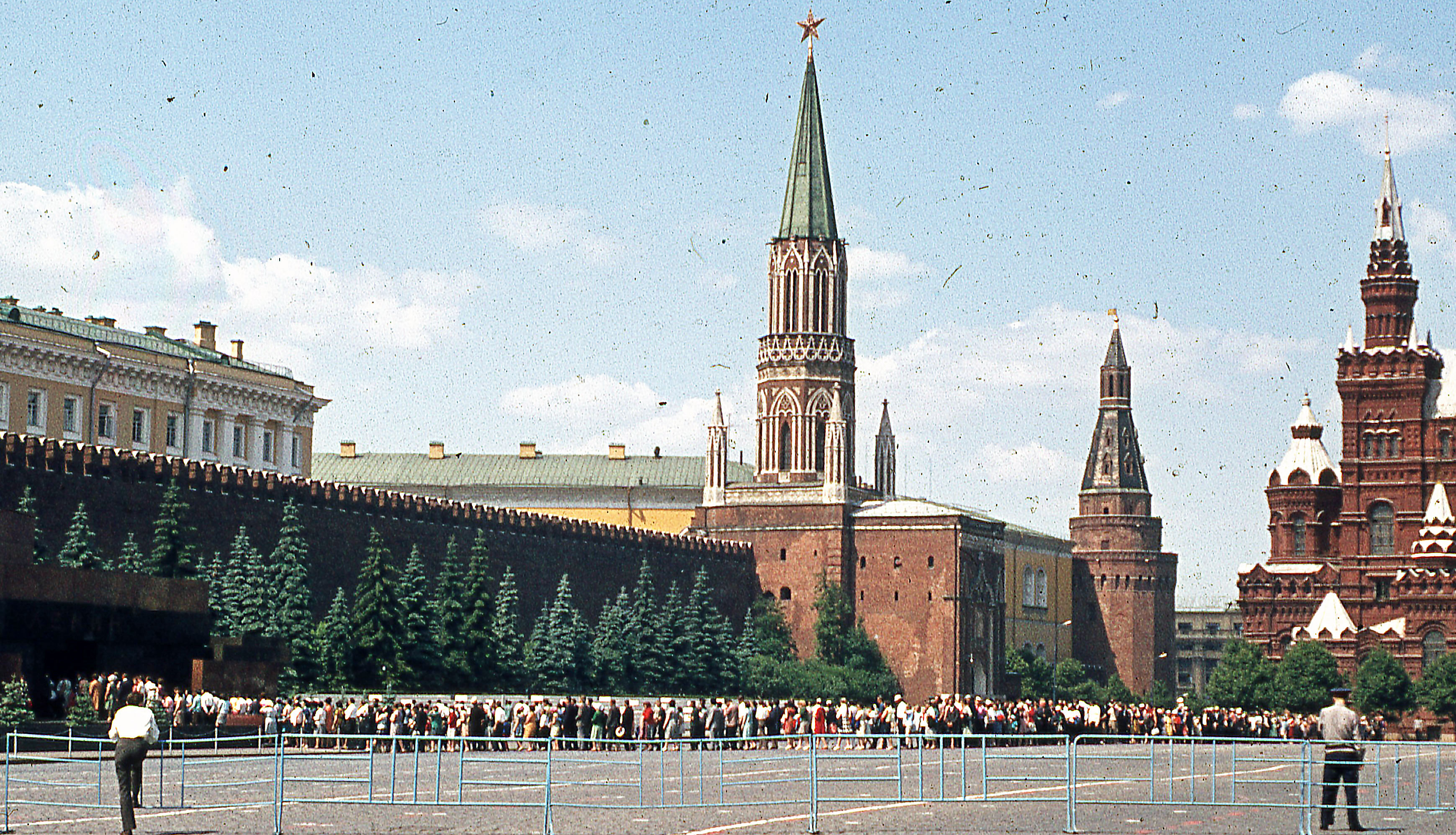
And naturally we visited the Kremlin and the monastery where Stalin’s wife is buried, though we could not face queueing for Lenin, even though tourists can get in at the head of the two or three kilometer queue [right]. The changing of the guards on the tomb is quite perfect in its quiet way, though nothing as pompous and splendid as Buckingham Palace.


The guard of two and its officer [left] leave the Kremlin a few minutes before the hour and goose-step with no accompaniment of military band across Red Square, coming to attention in front of the old guard right on the first stroke of the bell in the Kremlin tower. At the end of the peal they march back to the barracks and it is all over before one has time to focus one’s camera.


Our second contact in the film industry was at “Cinema Art“, the Soviet Film Magazine. They offered us all the facilities of a professional unit to help us with the film — lights, sound recordist, actors… but it would have taken us weeks longer to finish had we accepted. Deciding that they must do something for us as we had come all the way from Australia, they offered to show us some representative, modern Soviet films and we accepted eagerly. We carried on most of the conversation in French with an Armenian film critic who was amazed at Austra who was Latvian and could speak as many languages as he could and “looked so young!”

The film was one showing in Moscow at the moment: To Speak Again About Love. It was a very mediocre film really, in the style of the French cinema of the early fifties. It concerns the love between an air-hostess (played by the first lady of the Moscow theatre) and a scientist, engaged upon mysteriously dangerous work. An on-off affair. She: You don’t need anybody else — you are strong enough. He, coming to a realisation of how much he needs her but never able to express his feelings. The story is filled with unattached threads. In the end her job proves more dangerous — the plane crashes and she lives only long enough to ask a friend to meet him and tell hi and he walks off kicking the leaves on the footpath. The photography is ordinary but competent, the editing is classical but the style is uneven. The direction and photography of the actress gives the impression that the director was rather overawed by her. Her performance is interesting.

The second film was an editing exercise by film students, made from cuttings of the film “Simple Fascism“. It is completely Nazi-shot footage, used to make a film concerning the German soldiers at the siege of Leningrad and the last letters they wrote home, which Hitler was going to make into a book to inspire others with patriotism. Unfortunately, most of the letters were not patriotic and the project was abandoned. The film, called “The Last Letters” lasts 10 minutes and uses ten of these letters, illustrating them with this Nazi footage and music. A pointed, anti-Bavarian film. but no so Russia-oriented as one might expect. Again the editing is in the Eisenstein school, with freeze frames abounding and close-ups of faces most important.

The translator who had been recruited from an “Institute” especially for the purpose spoke English so fluently and with an American accent, that we thought he must have been a defector. Are you Russian? we asked him. Of course, he replied. You speak English so fluently you must have lived in the West for some time, we said. No, he replied, I lived in England for a few years when I was a boy, but since then I have not left the USSR. We could not believe it and we said so. It is my job, he said, simply.

It is something which must strike every foreign tourist: the standard of language teaching in the USSR. Those who do speak foreign languages are amazingly fluent without ever having been to a country which speaks the language.

The only other topic which is obligatory for the Moscow tourist is the traffic. They are amazed that in a city with so little traffic (comparatively) and such wide streets it can be such a problem. In the main streets one may see a huge transporter towing a whole house, or an aeroplane or another transporter and travelling at walking pace. Seeing one coming, one should not be too hasty to cross the road, estimating its speed sufficiently slow to allow one to traverse the 70 or 80 yards in safety, for at any moment a huge official “Chaika” is likely to whip around it at 100 km/hr. Driving is another problem as cars and trucks pass on both sides at breakneck speed, cross over in front to left and right and then 50 yds further on, turn to right and left. Truck drivers hanging out their doors are a signal that they are about to change direction. A truck stopped dead in the middle of the road simply means that the driver is carrying out some minor repairs, like dismantling the engine, or has abandoned it for the afternoon while he goes to one of the three or four garages in the city for spare parts or a mechanic or a tow.

Of course, it is impossible to do a left turn at an intersection. One has one of two alternatives: (1) One turns right and then does a “U” turn further along the road and continues down the originally-intended road, or (2) One continues past the intersections and then does a “U” turn, cutting across the traffic to turn right at the lights.

But the most famous turn of all, in the whole of Moscow, is a forbidden right-hand turn. It can really only be described by diagram (see supplement) but here is an attempt: (1) One stops at the traffic lights in the right-hand lane and when the light changes to green, does a half right then left turn to stop with the traffic going to the left. (2) When these lights change one proceeds along in the centre of the road (there are no marked lanes) and prepares for a “U” turn at the first opportunity. (3) “U” turn when the traffic allows and go back to the traffic lights. (4) When the lights turn green, go on. You have now turned to the right!

The militiamen [left] are on every corner, sometimes practising incomprehensible, virtuoso baton movements in the middle of the intersection, sometimes standing on the kerb, blowing a whistle occasionally, or just watching the cars. In any case they completely ignore the pedestrians, who wander across the roads, surviving miraculously, either ignoring the lights altogether or seeing the red light, and believing it to be the “glorious colour of Communism” cross in the assurance of absolute invulnerability.

A Dutch lady in the camping area, who told us how she had knocked down two pedestrians — one on a wobbly bicycle, one drunk — and had had “an experience” with a drunken militiaman who hitched a lift, recounted her experience crossing Moscow from the garage. She got lost, and after driving around in circles for hours, drove up to a militiaman on duty and stopped to ask him directions. He was so angry he fined her on the spot. In the end she had to hire a taxi to drive to the camp so that she could follow him.

And there is hardly one tourist who, in desperation, had not driven to the outer ring road and driven 50 to 100 kilometers around it as the simplest way to get home.


V. Conversations: (a) Old man (b) Student in Gorki Park (c) Latvian family (d) Latvian woman (Party member) (e) Tourists in the camping area

The first, short, conversation which we thought of recording was one of Austra’s attempts to hold “one conversation in Russian per day”. We chose for her the old, white-bearded Russian who sometimes worked the gate to the entrance to the camping area. He had come up onto the balcony, looked closely at my typewriter, admired my beard and had made the international borrowing sign for a cigarette from Laimons. When Austra trapped him, he was sitting on a chair, watching the sky, exhaling great wisps of American tobacco through his moustache.

— Hello, said Austra. Moscow is a beautiful city.

— Those buildings, he replied, after a long pause and pointing to a clot of new, five storey, white monstrosities on the opposite hill… Those buildings are for workers, not rich people. Five years ago there were only wooden huts. (He then pointed to the new motel, under construction). In one year that will be finished.

— Really?

— The Metro is better than anything you have in America.

— We have heard…

— The university… very big.

— Yes. We have heard it has 22,000 students.

— Very big. (Then a long pause. Topics of conversation seemed to be exhausted.)

— This camping area, he said, nodding to the tents, has only been open for one year.

— Really? What did you do before?

— I worked.

— Where did you work?

— In Moscow. (Silence. Then… ) In winter — it is very cold.

— Do you have snow?

— This camp is closed for six months.

— Yes? What do you do for a living then?

— I work.

— What do you do?

— In Moscow.

And this terminated this very dangerous conversation. The last words were said almost over his shoulder as he fled from this espionage interrogation.

————————

We had to shoot some film in Gorki Park and arrived early on Sunday to begin. By midday the grounds were crowded with a carnival atmosphere: ferris wheels, boats on the lake, ice-cream sellers, men and women crowded around the domino table, paper hats and loud-speakers blaring music and political slogans. At one o’clock there was a variety concert in a music shell which faced onto a hot dusty square and we joined the crowd in the shade of the trees beside the square.


It was a performance by dancers and singers [above] from the farms and factories in the Moscow area and Austra was trying to write down the essence of the introductory speech by the compere. A citizen behind her, who was looking over her shoulder, offered a few corrections and a young man on the other side assisted with some spelling mistakes. The middle-aged citizen was saying: Australia is a long way away! and began repeating, louder and louder, as though this would solve the problem, that these performers were amateurs, “self-doers”! And then he began shouting, the young man asked him to speak more quietly as his shouting seemed unnecessary. The citizen turned upon him:

— You are not a Russian, he accused.

— No, said the young man. I am Ukrainian. A Soviet.

Soon the citizen grew tired of us and left, but the young man introduced himself to us. He was a medical student at the Moscow Medical School and was very interested to be able to speak to students, or ex-students, from the West.

The talk wandered along on general topics for a while, to the accompaniment of accordion music and national dancing. What does he know about the West? we asked him. Several people we had talked to had some rather strange ideas, we said.

Yes, he knew about them. They are all “told” about the West at regular intervals and they all solemnly take note and agree, but the Ukrainian students, at least, have other information. Every evening they listen to a midnight broadcast in Ukrainian from Canada. Students know, though they don’t go around shouting it. He had heard, for example, about the recent wave of student unrest all over the world. We think there is no student unrest in the USSR, but it is just that we don’t hear about it. In the Ukraine lately there have been several marches and demonstrations. Perhaps they have been photographed and published as pictures of patriotic parades. In any case, they are very quickly suppressed.

He was the first of the man bitter patriots from the “republics” that we were to meet and in the Ukraine the sense of injustice at Russian exploitation runs very high. Russia can grow one potato for itself, he said, and all the food from the Ukrainian food basin goes straight to Moscow. The Ukrainians never have enough to eat even though they grow everything. It could be one of the richest agricultural countries in the world. Ukrainians are very patriotic and very bitter towards Russia and the Russians.

This is not all that he was bitter about. He was training to be a doctor for six years, on a scholarship of 35 roubles per month, which meant that his family had to support him. The only luxuries he could afford were occasional sweets. His entertainment was Gorki Park at the weekend. When he graduated as a doctor his wage would be 90 roubles per month. This is not his starting wage; he remains on it until he is promoted to head of a hospital or polyclinic. That ice cream seller, he said, pointing to the lady with her trolley, earns 140 roubles per month.

How can he be a student, knowing this? we asked. What is the use of studying? He shrugged his shoulders. For the soul? It is the policy of the state to pay “real workers” better than professionally qualified people, so that an engineer in a factory will always earn less that the worker on the floor. Some professions are better paid than others: engineers begin on about 120 roubles per month, schoolteachers on about 130. Doctors are the lowest paid profession in the USSR.


And these “amateurs” up on the stage… he gestured. Don’t think they are doing this for nothing! On a farm or in a factory one is supposed to do something extra, outside of working hours for the prestige of the establishment. If you dance or sing and show enthusiasm you might get to the head of a queue for an apartment or take your vacation when and where you like or get a promotion or a bonus on your wage. And see those men sitting at the side of the stage [above left] ? They are the judges. If they see someone with real talent he is whipped off to the dancing school or the circus school and if he succeeds there he never has to worry about anything again. The Soviet amateurs — sportsmen and performers are a joke even in the USSR.

Completely unprompted by us, the talk switched to Vietnam. He accepted that there was a great deal of opposition to American and Australian involvement in America and Australia and everywhere else. And he told us a few “anti-Vietnam” jokes or rude stories about the Imperialist Johnson; jokes about the USSR’s involvement directly in the war. Unfortunately they do not translate into English very humorously, but they are a scream in Russian!

(1) An American pilot, shot down over North Vietnam is interviewed about how he thinks the war is going. Well, he says, it wasn’t too bad at first — they just shot at us with pistols… now they have developed anti-aircraft guns! (i.e. Where did they get the guns?)

(2) And what is the first thing you heard when you landed? the pilot was asked. Well, I heard one North Vietnamese turn to another and say: (an untranslatable Russian idiom, roughly: “Give it to ‘im Ivan!”)

(3) Two North Vietnamese swimming in a swamp. One splashes up some water and says: Isn’t this just like home, on the Volga?

We offered him a cigarette, but he refused. I am not allowed to smoke, he said with a smile; medical students have to set an example. This sounded familiar, with Boris’ and Sergei’s story about drinking in public, so we asked him about this — is it a common rule? Yes, that’s what it is, he said. The Young Pioneers set an example to the young children; the Komsomol sets an example to the Young Pioneers; the Party sets an example to the Komsomol; and the Government sets an example to the Party. I shall smoke when I leave the school.

We told him we thought he had been rather frank, and we wondered how he could do it. Wasn’t he worried? (The conversation had been carried on, we noticed, only when there was music blaring out — between items he pretended he did not notice us. Even with the music he was always looking over his shoulder to see who might be listening in.) No, he was not worried. Nobody had been taking any notice. And even if someone noticed, he would only be warned not to do it again.

We parted with him offering to show us where we could eat for one rouble each and he could not believe that we could go back to our tents and have a meal for one rouble for the four of us. How he affords it we do not know; one of his shoes was falling apart at the seams.

——————

Austra, Inese and Laimons had heard some Latvians talking in the camp and summoned up the courage to speak to some women on a bus tour who were staying in the cabins. They had to leave, but were very disappointed we had not spoken to them earlier, and so, hearing a family later who were speaking Latvian together, we approached them and introduced ourselves. The first talk we had was with the husband on the steps and he did not seem very happy about being seen speaking with us. His wife refused to be introduced and would not even approach us while we were talking, so after this we did not try to get them into conversation again. However, the next nigh they came up and invited us to their tent where “we can have some privacy”. This time the wife sat with us and, although she was obviously still worried, joined in the conversation. We had been watched on both occasions, by one of the English-speaking Intourist guides from the office who kept walking past and trying to listen in or standing on the hill, some 50 meters away, and all but observing through binoculars.

All our conversations were noted in the camping areas, even when we began talking loudly with other Western campers — there was always the Intourist representative, trying to be inconspicuous, coming into the kitchen to wash a bottle or to pick up a piece of paper on the floor. Who knows whether they heard anything? But it was a sufficient constant reminder that if we ever did get into trouble, the authorities would never be short of evidence of one sort or another. Only recently a pair of young Americans had been brought before the head of Intourist for talking rather loudly and outspokenly to some Russian students. The things you are telling them, they were told, can do them no good at all.

But sometimes it is too hard to keep one’s voice down and the daredevil “What can they do to me for saying what I think!” attitude is difficult to resist.

This Latvian family had driven from Riga to Gorki and Moscow on a motorcycle with a sidecar for their holidays. It had not been entirely holiday: one of the main objects had been to try to get some spare tyres for the bike — completely unobtainable legally in Riga and Moscow at least. In Gorki a Jewish friend had spent the day telephoning his friends and had at last managed to get two spare tyres for them. He didn’t know, though, whether the bike would get them home — the generator was almost worn out and nowhere had he been able to get a new one. Without it, his bike was useless and he would have to put it up on blocks in the garage when he got home. They had saved for over a year for this trip and their friends had considered them very lucky to be able to go on such a “luxury” vacation. One son was with them; the other had to be left at home because he wouldn’t fit on the motor bike.

The first time they arrived in Moscow (on the way to Gorki) they tried to get into the Motel (50 meters away) but is was full. They tried the camping area, to see if they could hire a tent for the night and were refused again. This camping area is for foreigners and citizens on organised tours only, and what’s more they were rather dirty from the road. But they had nowhere to go, they told the administrator, and it was late. He relented a little. What time would they be leaving? Five o’clock. Very well, on the condition they left at five o’clock he would allow them to sleep on some open duckboards in the furthest corner of the camp. They had to pay the normal 90 kopeks each and 50 for the bike for the privilege.

This time, they looked a little more respectable and had been given a tent for a few days.

He was fascinated by our car and found it difficult to accept that we had paid only 400 roubles for it second-hand. His motor bike had cost 1,600 roubles. In the Baltic countries motorcycles are the main means of private transport, apart from a few pre-war German “Opel“, as he puts it “Raised from the dead”. Parts are virtually unobtainable, even for new cars, if one can afford them. A “Moscvich” costs 4,500 roubles and a new “Volga” costs nearly 7,000 roubles, and there is a two to six year waiting list for them. All through the conversation he kept coming back to this:

— And if you wanted a spare part, he would ask, what would you have to do?

— Why, we replied, just walk into the shop and ask for it. If you wanted a new or second-hand car, the main difficulty would be to fight off the salesman!

He kept asking to hear this like a child who wants to hear the same fairy story again and again. He would go home and tell his mates, he said, but they would not believe him.

He has a good job. He is a highly skilled mechanic in a small factory which is also an academy; perhaps a research institute. In any case, there is some security surrounding the work done there. When he applied for the job, his mail was checked for several years back, and if he had received any letters from outside the USSR he would not have got the job. If he received letters now, he would lose the job. He used to correspond with his wife’s cousin in Melbourne, but he has not done so for years.

He earns 130 roubles per month, 10 roubles more than the engineer he works with, but not as much as many of the ordinary “workers”. What did this represent? we wanted to know. Wages are meaningless unless they can be compared to the cost of living. A day’s wage would buy him a kilo of butter (about 5 roubles). For the three of them to go to a restaurant and buy a meal consisting of soup, a main course and desert, it would cost about 6 roubles, in any case more than most men could earn in a day. His wife also works and earns 90 roubles. An average wage is 110 to 120 roubles. A pair of ordinary shoes cost 40 roubles (and in Riga there is rarely any choice of styles), an ordinary, nylon raincoat, such as we buy in Woolworth’s for about £2, costs 70 roubles. Food is so expensive that even with their combined wage it is impossible to make ends meet by the end of the month if they want to buy any clothes at all or to save anything towards a holiday.

Traditional Latvian delicacies and cooking are unknown. Smoked eel has not been seen for years, and fish (which is one of Latvia’s main products) is too expensive to buy, when it is obtainable. Only five years ago the only bread available was heavy, black bread.

If a fisherman catches more than his quota, he cannot keep the fish or eels. He may be paid a bonus, but the fish must go to the factory. Blackmarketing of fish is looked upon as a very serious crime. Once, he had visited a fisherman friend and had been given a bucket of fish to take home and he knew that if he was stopped at one of the many checkpoints along the road and the fish were found, both he and the fisherman would get into trouble. He wrapped them in a blanket and sat the boy on them. He was stopped; he was searched, but the fish was not found. There might have been very serious consequences from this little escapade… “Serious consequences” seems inevitably to mean at least losing one’s job.

There are other, more simple ways of losing one’s job. A few years ago, for example, it was frowned upon for a married couple to wear wedding rings — “bourgeois sentimentality”. A Komsomol member who wore a ring to work was dismissed from the Komsomol and told that if he did it again he would be dismissed from his job. Today, rings are officially recognised and one month before marriage, the couple is given a form which allows them to buy the rings — gold is normally unobtainable. But two friends of his, recently married in the local “Palace of Weddings” drove 100 kilometers to have a secret wedding in a locked church. They wanted to keep their jobs.

There are no christenings. Several times every year the parents bring new children to a “party” with presents, where the children are all given names. There is a similar party when the children reach sixteen, a “coming of age”, where they all receive their identity cards.

All over the Soviet Union, housing is still a great problem, even though “The Book” tells us that, in Moscow, “some 400-500 housewarmings are celebrated every day”. In Riga the queue for apartments is from six to ten years long. If one considers that one’s quarters are too cramped, an inspector comes to measure the space, and if there is more than three square meters per person, the application is dismissed. Housing co-operatives are allowed, and one can pay 2,500 roubles down to join and 15 roubles per month for 20 years for an apartment, after which one owns it, and can re-sell. He described the apartments that were being put up — in huge, pre-fabricated slabs, crumbling as the crane lifted them up…

There are other ways to get an apartment, of course. One can be a member of the Party, or a “good worker”, or do extra outside Party work, then the queue is shortened for houses and cars. This is excused, the people are told, because these people are working for you and they deserve it.

All the top jobs in Latvia are held by Russians, although some Latvians are working their way up these days. We had heard, we said, that Latvians are getting to the top by co-operating with the system and once there trying to help the mass of people. He laughed. Those who get to the top do so for their own gain. We hate them more than the Russians. And they hate the Russians. They come here in the army, he says, get a cushy job and stay. They seem to have no home.

He was very proud of the nationalism of some of the other republics like Estonia and Georgia, where there are very few Russians because they have such a hard time. In these republics, shop assistants refuse to speak Russian to the Russians, although it is the official lingua franca. (If a Latvian first speaks his own language and then changes to Russian he will be served. If he speaks Russian first he will be ignored.) And in other ways there is a steady resistance. In Georgia there are always cases of Russian soldiers, out alone at night, disappearing and in the morning nobody has heard about anything.

Under the 1936 constitution (Article 17) there is provision for any republic to secede from the Union. In 1949 in Estonia a petition was signed by 80% of the population for the secession and presented to Moscow. It was followed by mass-arrests and deportations and the petition was never acknowledged.

After Stalin’s death the Georgians got up a petition which demanded more freedom of speech and the running of their own affairs. The petition was presented in Georgia, accompanied by a mass-demonstration in the square. After several hours, when those who presented the petition had not reappeared, the crowd began to get restless. Soldiers were called up and they fired into the crowd to disperse it. The petition was never mentioned again. But the Georgians still drink to Stalin, who at least looked after Georgia and the Soviet Union first, and his picture is on the wall where Lenin’s ought to be.

He is depressed about the Latvians and their way of making the best of the situation. The novelist Vilis Lacis, well-known before the war, saw the light after the revolution and re-wrote many of his earlier books. In one semi-autobiographical novel he had described how his father had been battered to death in Siberia and thrown into an ice-hole. In the rewritten version he is bringing home a cart through the forest on a stormy night and is crushed by a falling tree.


[above: bus from Latvia, with rear compartment kept open to cool the engine]

Any resistance that is offered is in a small humorous way. On annual festivals of traditional singing and dancing, when Latvians come to Riga from all over the country, pamphlets are circulated saying that a revolution is brewing and the Russians leave for their holidays… Out on a bus trip, when they pass a huge, patriotic sign, covered with an essay on Communism, they stage a well-rehearsed scene:


— Driver, stop the bus! did you read the sign?

— No, replies the driver. I was watching the road, like a driver should.

— Well then, the sign must have been for us to read. Back up the bus!

And they back up the bus and read the sign. While the traffic honks behind them.

On days of national celebration, when it is compulsory to march to the statue of Lenin and the Russian tank with the red star and lay wreaths of flowers [right], a bunch of red and white flowers (the old national colours) always appears surreptitiously under the one “pre-revolutionary” statue that is left standing and they nudge one another and point to it as they march past. This statue, a woman holding aloft a handful of stars, is the monument to the creation of Latvia as an independent state after the First World War. In 1945 the Russians pulled all the old statues down, except this one, because they feared a national uprising had they done so. It was excused because “the stars have five points, and can be thought of as stars of Lenin“.

He is depressed that the children get nothing but the straight party line at school and it is left to the parents to tell their children about the other side of the case. His sons know what is going on, he says, and his son was sitting with us throughout the conversation.

Do Latvians in Australia drink? he asked. And we, remembering the huge parties with the kegs on the back steps and the visitors remaining for the whole weekend, replied in the forceful affirmative. This is not what he meant. In some factories after pay day, work stops for a few days. The whole factory is too drunk to work. Wives who can, come to the factory to meet their husbands and rescue the pay packets if they want to live for the next month. Drunkenness is a huge problem. (Almost every other person we spoke to said the same thing. It is impossible to drive down some streets at night for the drunks wandering along the road or jumping out in front of the car to hitch a lift.) They are told that in the West things are ten times worse, and they can’t believe it — this was his question. To curb this most restaurants do not sell anything stronger than beer, if they sell it at all, and it is impossible to get a second glass. There are no “pubs” in the Soviet Union. But this does not stop them, he says. The Russians are the worst, they drink like animals, they drink anything — brew it themselves or water down methylated spirits or pure alcohol. This is why unsupervised Russians are not allowed into these camps — they would disgrace themselves.

The other great problem is theft. As so many things are unobtainable, the only way to get them is to steal. On their way they stopped the bike in front of a restaurant and were about to go in when a militiaman stopped them. He told them not to leave their bicycle unattended — when they came back it would be stripped bare. From no on one of them always stays with it. A friend’s daughter had the valve stolen from her bicycle. It was a major tragedy — to get a new valve, one must buy a complete new wheel. And bicycles are always being stolen. Any Russian lucky enough to have windscreen wipers on his car, takes them off when he parks and locks them in the car.

The official side of the story is hilarious, if one has a warped sense of humour. Several years ago a ferry-boat overturned in the Bay of Riga. Half the passengers were drowned and the other half struggled ashore, losing everything they had with then, including, in many cases, their papers. After a few days they went to the police station to get new papers, were given a form and told to state what had happened to them.

— Papers lost in recent ferry-boat disaster in the Bay of Riga, they wrote. The militiaman tore the forms up.

— No such thing happened, he said. They thought a bit.

— Could they have been stolen, perhaps? they asked.

— Of course not! (There is no theft, murder, rape, extortion, or any other kind of crime in the Soviet Union.) This went on.

At last it was decided that the papers had been “negligently lost” and they all had to pay a fine of 10 roubles.

Neither are there any natural disasters in the USSR. In the recent “little” Tashkent earthquake, no lives were lost; nobody was around at the time.

This Latvian, like the Ukrainian student expressed the same type of resentment which we are expressing at the spendthrift policies of the government — pouring arms into Vietnam and the UAR, expending a fortune on countries like China who then turn and spit in our faces, putting all their energies into a stupid race or the moon… When it is home which needs the money. A few years ago, they say, wherever you looked there were Chinese. You’d think we would have learned our lesson. Now wherever you look you see Africans and Arabs. Who will we have when they have taken all they can get from us?

We asked him about personal freedoms within the USSR. He is naturally not allowed to travel outside or to have dealings with the West, but where can he go within the country? Anywhere, naturally, he replied. We are constantly being told that this is our country. In 1969 identity cards would no longer say “Born in Latvia/Lithuania/Kazakhstan…” They would simply state “Soviet Citizen”. (Lenin’s theories of national identity take another beating?) But within Latvia itself there are many places they cannot visit. The whole town of Liepaja (a Baltic port) is a prohibited area. The train stops outside the city, passes are examined, non-residents must have a special “visa” to get in, like entering a foreign country, and the journey is continued by bus. All the beaches on the Baltic are closed at 8 pm and after that a machine comes along and ploughs them, presumably to show whether anyone has tried to escape by sea, or perhaps to keep the Westerners out.

He had many questions about the West and I must admit that we were cruel, often returning (under his questioning) to the ease with which one can get a motor car or medicines. In Riga, medicines are almost unobtainable and there is a special pharmacy for the Russians, as there is a special set of restaurants and shops, where things are available which cannot be bought in ordinary stores. We criticise South Africa all the time, he said, but there is racial discrimination here which could teach them a few things.

He knew that in the West there were no pensions and that old people were left to starve on the streets. The pension scheme in the USSR (a comparatively recent scheme in parts of Latvia — 1965) is the only such scheme in the world. At 60 years of age, if a person has worked for 30 years he or she is given a pension of half his wage. His father, retired, gets 20% extra as his wife has never worked. Should his father die first, the wife will receive a steady pension of 15 roubles per month.

If he were to go to the West could he get work? They were continually barraged by frightening unemployment figures and statistics on the number of people who starved to death. He knew that the worker could not afford to go to the doctor or to hospital in any Western country and that the child of a worker was denied anything but an elementary education. He had heard about the English universities (he even knew their names — Oxford and Cambridge) where the only students were the sons of Lords and millionaires. He was most surprised when we told him about our parents and the scholarships we had to the university.

He expressed frank incredulity about the letters his wife’s cousin used to send them from Australia. He had once sent them a photograph of himself out hunting with a bag or “at least seven rabbits”. And he was always telling then about the motor cars and the wages. Friends said, he is forced to tell you things like this — they aren’t true. Before the Melbourne and Tokyo Olympics the teams were told — Take no notice of all the motor cars, they have been brought from all over the country for show, they are not there all the time. The roads have been specially built for the games.

He was amazed at the low clearance of some of the Western cars he had seen. How can they manage the roads? Of course, he said, the main roads you travel on in the USSR are magnificent. We perhaps laughed to rudely at this. We can understand and believe things we are told like this, he said. So much here is only for show. The books we are allowed to send to relative in the West are printed on good, glossy paper and are only picture books of the beautiful countryside. The huge wedding-cakes of buildings are nothing more than show-pieces. One was built in Riga after the war to be used as a Palace of Culture — “A gift from the Russian People”. We refused to accept it — major restoration work was being carried on while it was being built. It is now an academy of sciences.

When we parted he did not tell us his name or anything about himself. He asked us not to write home saying we had met him: he was certain that all our mail would be read. His last comment was the most depressing of all: It has been an interesting conversation, he said, but it probably won’t do me any good. With a glance up the hill at the young man leaning against the wall.

————————-

This conversation was followed the next evening by a meeting with another Latvian, a woman and a Party member. She is on holidays with her family, on a bus tour to Moscow and she had to get to bed early because next morning they were all going into Red Square at 5 am to queue for Lenin’s tomb. They do it every time they come to Moscow.

She was trained as a schoolteacher but works at an institute of metallurgy for 100 roubles per month. In the evenings she lectures on Political Economics at an institute. This extra work, she insists, brings her no extra money.

It is the obligation of every Soviet citizen to take on some kind of patriotic activity. Folk dancing or sport did not appeal to her, so she lectures. How can she lecture on Political Economics when she has never seen any of the countries which she so blithely talks about? we wondered. We have textbooks, she replied.

Life is not too bad, she says. We have enough money to live on, we have an apartment and we only had to wait for it for a year. By 1971 we will have a 4,000 rouble car. We have holidays all over the USSR and every year we get a bonus of one month’s wage. At the moment they have a motorcycle and sidecar and have no trouble travelling.

We did not get the chance to ask anything else. The rest of the conversation was spent in eulogies over beautiful Moscow and the fantastic Exhibition of Economic Achievement [right]. They go there every year and stay until evening, when the lights make it look “just like a fairyland”. And the most beautiful area of Moscow, the Arbat district — all new, towering skyscrapers, all glass and aluminium!

—————————

The tourists in the camping areas are a mixed lot: innumerable family groups of Canadians in huge vans with camping bodies, doing Europe; groups of Americans, seemingly come to atone in public for Vietnam; young Swedes, travelling in couples, referring to one-another as “my fiancé”; the Dutch, travelling in convoy with the most elaborate camping gear, sitting in the area all day talking to their next-door neighbour from Amsterdam; people like us,, small groups in the inevitable VW Kombie van with tents; groups of 10-20 US students, in semi-organised tours, but completely disorganised as far as camping goes; young Czechs, anxious only to get into Red Square as quickly as possible and sell a few clothes; East Germans who talk to nobody and sun tan all day; Poles who seem to drive all the time, only over staying for one night.

Most of them you can talk to. Most have an interesting opinion to offer, though usually the talk is completely one-sided — incredulous at what they have seen. The young Americans and Swedes, much to their credit, seem to have made an effort to learn some Russian and are always anxious to talk to people. They don’t get their ballet tickets through Intourist, they queue for them at a kiosk, they go to the ordinary Russian cinema, they keep their eyes open and they get into trouble. They are just the type of tourist the Russians don’t want.

The type they welcome are the mini-bus tours of Australian girls, recruited in London on the back page of the “Times“. “See Europe for $70. 10 countries in 10 wks.” They are organised trips, nine to a mini-bus, with a driver who works for the company. They stay in Youth Hostels when they are available and camp in camping areas when they are not. They seem to be all the misfits of England, Australia, New Zealand and the USA, usually girls, collected together with their enormous Corn Flakes to keep them regular. They form a little ethnic group, with their own jokes, etiquette and mode of conversation. In a crowded camp kitchen they can take up three quarters of the cooking appliances without noticing the queue for the other quarter. Everyone else is “a local” or a Communist they assume, and cannot speak English anyway, so they talk at a shout, about the Berioska store and the price of American cigarettes at “the Gastronome”. they are surprised and distrustful if you speak to then in English, perhaps to tell them that they have just turned off the stove rather than on, and they quickly try to forget this piece of, possibly dangerous, contact with the world outside the group. Their Intourist guide, whom they picked up at one border and will leave at their point of exit, shepherds them through the dangerous waters, takes their cigarettes, makes sure what they don’t see and tries to blend into the merry group. He/she is often successful — such are they all misfits.

At the end of the trip they know three things about the USSR: the bad roads, the rude shop assistants, and “Nee Pannimayer” (That means “I don’t understand” they will tell you, “in Russian”.) which they use for chasing off the wolves, the militiamen, the drunks and the money-changers.

It is this type of tourist which Intourist loves. The organised tours of idiots with their guide and the good Communists whose first stop is at Friendship House and from there the guided tour all the way. The most lucrative, presumably most loved type we had little to do with — the well off American or British capitalist, despised but fêted in the luxury hotel and driven around by a chauffeur in a Chaika. We saw some of them in the hotels when we went to change a traveller’s cheque or, out of desperation, to buy a copy of the “Daily Worker”. They were sitting in the foyer or the bar, picking through the Berioska shop, waiting for their taxi, like prisoners, afraid to move outside.

Or am I being cruel? We decided in a kitchen conference that when we got home we would advise everyone to visit the USSR. Especially every little “textbook Communist”. Tell him only to bring roubles, make sure his car has a minor breakdown, make him find his way around on his own — no guides. Encourage everybody, to come and see for himself.


VI. Moscow to Leningrad


We had heard such horrific tales of Novgorod camping area that we set out early on the road to Leningrad to drive the whole 700 km. rather than stop there, with the mosquitoes and the toilets, which had been spoken about in hushed tones. It is a much more eventful road than the one from Minsk to Moscow, there is a little agriculture and some dairy industry on a small scale. The houses along the road are in traditional styles, made from logs, with carving around the windows and roofs [above]. But even if the scenery becomes boring, the road itself offered constant diversion: tempting one up to 100 km/hr and then forcing one to either slam on the brakes or break an axle.

Road works [right] were going on over the whole length at sporadic intervals, though more often than not nobody was in sight. Huge heaps of gravel stood in piles down the centre of the road at intervals of 20 meters, pots of smoking tar stood by the side of the road… When we came back along the road a fortnight later, the gravel was somewhat dispersed by the cars running over it, and the tar was no longer smoking.

100 kilometers short of Novgorod we were about to run out of petrol, so we stopped at a crossroad to ask some locals what we could do. Novgorod is the next, they said. But we did not have enough petrol to get there. Well, there is one in the village here, said an old citizen and he tried to explain how to get to it. It was too difficult: he said he would come with us and we could bring him back here. Accordingly, in he got and of we went, bumping up and down the streets of this village, through potholes feet deep that we drove into and out of, turning left and right and back upon ourselves until we reached the petrol station on the other side of the village. It was simply a fence with two pumps and a tank on the other side [below].

Our guide explained things to the lady attendant and a few locals came across to look at us. They were always interested, these old fellows who came up to have a few words — where were we from? Avstralia! We like your car. Where have you been? A few simple questions and a toothless smile, just to assure themselves that, probably, for the first time in their lives they had talked to foreigners. Talking to these people was always most gratifying for the sheer disinterested interest they showed. Our guide was the same: he asked where we had been and where we were going. The south of the USSR is very beautiful, he said. We asked: Do you go there for your holidays? Who, me? he looked at us in amazement. I am just a farm worker. I only earn 90 roubles per month…

On the way back from the petrol station, a motor scooter whizzed out from a side street with a militiaman on the back. It cut us off, like they do in the movies, and the militiaman leapt off and waved us to stop. Where were we going, he wanted to know. To get petrol, we told him. How did we know where to find it? His eyes were almost popping out as he peered suspiciously inside our car. Our Tavarisch here was kind enough to show us, we said, putting in our friend. Right, he said, follow me. And he leapt back onto the motorscooter, like Hopalong Cassidy, and it took off in a cloud of thick dust. We bumped along behind as he took us back to the road leading from the highway to the village [right, but rider is a local man]. We apologised to this little worker we seemed to have got into trouble. Will he do anything? we asked. He shrugged his shoulders as if to indicate that he had never heard of such a thing.

At the outskirts of the village, the militiaman was stopped and lying in wait for us (he had kept a good eye on us from the back of the motorcycle as we went along). He flagged us down again and hauled our friend from the car. That is the road, he said, pointing, then forgot us and began lecturing the old man. He was fully 20 years old with a brand new, bristling moustache and a shiny pistol holster. The man was sixty, bent and lined with work. The policeman was lecturing him like a kindergarten teacher lectures a child who has just pulled all the flowers out of the entire school garden, and the old man stood there and listened. We all got out of the car and shook his hand: “Bolshoi spaseba!” we said, and looked as evilly as we could on the militiaman.

It seems a little gauche, drawing morals from our little encounters, but this one was constantly with us: It is never we who get into serious trouble (all that can happen to us is that we get deported, we thought); it is always potentially the person we are talking to.

On every crossroad there is a militiaman, on every bridge there is a half-witted looking guard with a rifle and fixed bayonet — we always wave to him and he never know whether to wave back or shoot us straight out. The second time we were stopped by the militia was in a speed trap. We came over the hill at 80 km/hr and did not see the sign, on a perfectly straight, flat piece of road, 40 km for 1 km. We were stopped by a red-faced militiaman who began shouting louder and louder, when he discovered that we did not have a guide/translator. We understood that we were exceeding the speed limit; we think he said that if we did it again he would take our car away; then he said a word which Austra had never heard before, so she began leafing through the dictionary… You won’t find it in there! he choked, then waved us on and stalked back to his post behind the bushes.

We drove into Leningrad at 8 pm and began looking for the road to the camp. We knew that the camping area was at Repino, 40 km along the road to Viborg. There are no signs in Leningrad, hardly even street signs, and only one camping sign, which we missed. For two hours we drove around, finding likely-looking streets, asking likely-looking people the way [left]. They had never heard of Repino, so we asked for Viborg, and after this time, we found ourselves on a likely-looking road which headed out of the city. Just to make sure we asked an army officer. Yes, this was the Viborg road.

At about 20 km we saw our first sign — to Viborg — and our first militiaman, who, naturally, flagged us down. He came up, writing down our number-plate as he walked. Where were we going? To the camping area. This is not the way to the camping area! Isn’t this the Viborg road? This is not the way to the camping area. We were told this was the Viborg road. Who told you? An army officer… and it went on. This is not a tourist road, he told us. We apologised and said that we did not know, we were only trying to find the camp. You knew very well that this is not a tourist road! he said. Give me your passports.

[Below: inside capmpground, map of road to Viborg on billboard at left]


We felt impotent. Austra did not know enough Russian to be rude to him, though we made it very obvious that we were very angry. But what can you do when he has your passports and visas, and is carefully writing down all the information? We brought out our map (printed in the USSR) and asked him to show us where we were. He refused. He told us how to get to the correct road with impossible directions, and sent us off, not saying another word. At times like this one gets so screwed up with impotent fury one is shaking an hour afterwards. I wonder what would happen if one punched a militiaman?

Militiamen don’t wear numbers, or any means of identification, though one polite one who stopped us for a similar offence (being on a non-tourist road) saluted, smiled and gave his name and district. The locals seem to hate them — thugs, they say, recruited in the country. One can’t honestly say though, that our cross section was any worse than a cross section of Australian policemen I have met in my life.


VII. Leningrad

We had been corresponding with two schoolteachers [right] in Leningrad, whose address was given to us by a professor in Australia. In the first letter, we told them approximately when we were coming and they had replied. We had written two more letters from England but they had not replied and from Moscow we wrote again, giving definite dates — this was the next letter they receiver from us. The other two letters had “disappeared” in the mail.

Alex is an amazing fellow. An ex sailor, now a teacher of English, with post-graduate qualifications in navigation and engineering, and he has taught marine engineering, navigation and metallurgy at special schools during the day and at Pulkovo Observatory and at the airport at night. His wife, Tanya, teaches English and Geography (in English) at an “English school”, where all subjects are taught in English. Alex is also a climbing instructor, tennis player, skier, walker… an all-in enthusiast and admirer of Francis Chichester (he even looks like Chichester!) .

He corresponds with about half a dozen people in England and Australia — it is his major hobby — and for the third yea they have applied for permission to travel to England for their holidays. They apply at the first opportunity and at the last minute they are always refused. Alex thinks that perhaps it is because of his foreign correspondence, but hi won’t give it up. He was offered a lucrative teaching post at the naval academy, but to accept it he would have had to give up writing to his friends. He prefers to keep going as he is.

When we arrived, Alex had everything planned. First we would go to Pulkovo, where a “pupil” would show us around, then we would look at the things to see outside Leningrad — the famous summer palaces — then we would look at the things to see in the city — Peter and Paul Fortress, the museums, the Hermitage, the churches… it was all timetabled. We found later that they had postponed their holidays in the south so that they could meet us. Alex had returned their railway ticket and later would queue for another one (“Two or three hours, no more.”).

That afternoon we went to the observatory where we were met by Alex’s “pupil”, second-in-charge of Pulkovo, a brilliant astro-physicist who spoke English better than Alex. He took us around for two hours, showing us the museum, the old and new telescopes, the radio astronomy department and their newest “baby”, a huge interferometer. Pulkovo is the oldest observatory in the USSR and the headquarters of astronomy in the Soviet Union, though it only does photographic and astro-physical work and can only be used in the winter (the “white nights” make it impossible for observation in the summer). He described graphically the way the telescope housings must be the same temperature inside as outside and how the observer has to sit all night in his overcoat keeping an eye on things with the temperature around -20°C. As we parted, he invited us to dinner with him the next evening, where we would have some “real Russian food”.

Alex next rushed us off to Pushkin palace and inside the museum found us a guide who could speak French. The palace is nearly half restored after being nearly completely destroyed in the war. The Nazis, we were told in every room, stole even the wallpaper, used the furniture for firewood and stabled their horses in the chapel. In every room of every palace under restoration visitors were continuously reminded of the Fascists and the atrocities they perpetrated during the siege of Leningrad. And the Russians are slowly restoring the palaces to their former splendour, with woodcarving, silk painting, sculpting, gilding going on all the time. Many of the unique parquet floors [right] remain or are being restored with rosewood, walnut, ebony, teak, cedar… several complete floors were stolen by the Fascists.

The Germans are much more hated than the czars. In fact several czars are openly loved, especially Peter I, and they reconstruct his palaces with loving care, from old photographs and drawings. What a time these selected Russian craftsmen must be having! Being encouraged to practise these old “bourgeois” arts officially. One of the nice little contradictions of Russian life is the loving reconstruction which will only be used to demonstrate to the people the decadence of the royal house. These days, the intricate sculpture in semi-precious stone, the iron work, the woodcarving, are exhibited as the work of Russian craftsmen… workers.

The palace of Peterhof was again almost completely destroyed in the war. The Fascists dug trenches through the gardens and set up their guns on the shore to cover Leningrad and Kronstadt. It is Peter the Great‘s most famous palace and garden. Today it is like Gorki Park — Russians can come and tread the paths once trodden by the foreign ambassadors and the elegant ladies of the court, for 30 kopeks. Music shells blare out songs and by the lake we watched a ballet given by a local, amateur company. (Part of “Swan Lake“, naturally.)

The gardens are famed for their fountains[above and below] which are fed from a series of lakes up in the hills. The central complex is resplendent in gold — hundreds of gold figures and statues [above right: L to R in centre group Ian, Austra, Inese & Tanya, Alex bottom right], grouped around “Samson” in the centre. (The original Samson was stolen by the Fascists and the one there now is a copy. Nobody likes it very much — the original one, they say, was magnificent and is now gracing some German palace.)

From this complex, a canal leads down to the Gulf of Leningrad, lined with fountains [right]. It was one of Peter’s little jokes to let the barges come half way up the canal and then turn on the fountains! He seems to have had an unfortunate sense of humour about wetting people. There must be six or seven trick fountains, looking like innocent park benches or rotundas or trees, which tempt one to approach and then erupt into a shower of spray when one treads on a concealed device. The Russians go wild over them! Every second person in the park is dripping wet. “They are from the country,” said Alex, disapprovingly, “not Leningraders”.

We had lunch in a self-serve “Stolovaya” in the park — borscht, meatballs & potatoes and compote (a glass of weak fruit juice with a few pieces of stewed fruit in the bottom). Russians do not eat at home very much and are encouraged to eat in these places where such a meal costs about one rouble. I do not like them very much, says Alex, the menu has been the same since the war. I feel hungry, I walk into one and look at the menu and my appetite disappears. All the meals we did have in Stolovayas confirmed his opinion, I must say, though at the beginning they were sufficiently novel to be reasonably enjoyable.

Alex wanted to take us to a wonderful Chinese palace at Lomonsov, but we were stopped on the road by the polite policeman that I mentioned — it was not a tourist road, though we could have walked, or taken the train.

We then tried for the Pavlovska Gardens, but about two kilometers short the road was impassable, with a huge ditch right across it. We went back and found a clearly marked prohibited road through the trees and across the fields, and, as there were no militiamen in sight, we tried it. Miraculously, it took us to Pavlovsk without a sight of a tank, a missile base or even a soldier guarding a bridge.

We walked through the gardens a little, though it was beginning to rain, talking about the aristocracy and the palaces. Then the talk quietly changed. One never sees our new aristocracy here, we were told. They have their palaces out near Repino and in the trees beside the Neva and they go to them in their chauffeur-driven Chaikas. Last year the palaces were yellow; this year they are all painted green so that they are hard to distinguish. We pressed Alex on this: did he think it right to have such obvious privilege in evidence? No, he did not. If you are going to be a communist you must be a communist all the way.

This from a man with very high qualifications and 20 years teaching experience who earns 150 roubles per week (with extra work) and lives with his wife in a four room flat, shared with three other families.

In London their flat, like the scientist’s, which we visited the next night, would be considered almost a slum. They like it though, as it is near a park. They share the kitchen and toilet with the other families (one to a room), the lavatory looks like a converted cupboard, and was certainly added after the flats were built. There is no bathroom and no washing facilities other than a sink in the kitchen. But they consider themselves lucky to have it. Why, they have three rooms in one! says Alex: A bedroom, a study and a dining room.

The next day we slept in and arrived at our friends’ flat an hour late. They were worried. They thought the militia had been out to the camp checking up on us after yesterday’s adventures on non-tourist roads. They were serious.

It was Saturday, and as we drove into the city we passed a wedding party getting into taxis. That is our palace of weddings, said Alex. Would you like to see a wedding? We went into the spacious, marbled building and up the wide, impressive staircase, managing to get into the “Wedding room” just in time, behind a small wedding party. The bride in a simple, white dress with a veil, the groom in a suit, the relatives with hair slicked down, ties too tight on their necks, carrying bunches of flowers. We sat at the back on seats reserved for those who have come to watch, in the large, light, baroque room, designed a century ago. The only new piece of decoration was a huge bust of V.I. Lenin at the end, behind the desk.


The couple enters through the rear door, along the once-plush carpet, and into the room, to stand on a well-worn carpet in the centre of the room, in front of the carved desk at which sits the female registrar. A bored or sleeping photographer slouches on the chair in the corner, his Leica and flash hanging beside him. When everything is ready, the registrar pushes a button on her desk to stop the Wurlitzer music. She stands and begins her peroration, bored but smiling. She mentions Lenin, communism, Lenin, Leningrad, Lenin,… then asks the usual: Do you take…? and they reply: Da, in hushed whispers. The registrar pushes the button and the organ starts again mid-bar. She comes out from behind her desk and gives them the rings. The photographer checks that there is any film left in his camera, levers himself off the chair and flashes off a few photos as they exchange rings. The relatives come forward and give the flowers, flash, flash goes the photographer, then the music stops with a jolt. The registrar then gives a well-rehearsed, four minute sermon, reciting the duties of one to the other and both to the state, then presses the button again and the voice of a bass (with Wurlitzer accompaniment) blares out from the concealed speakers. The couple leave by the front door, followed by the scuttling photographer, while another couple are waiting at the rear door.

In the same pink, blue, gold and white interior of the building there is a reception room for those who can afford them, with an oak table, cut crystal, caviar and champagne [left]. Next to it is another room where wedding presents can be bought — amber, dolls and practical alarm clocks. Outside the building wait the “wedding taxis” — ordinary Leningrad taxis, newly washed with a red flag on the front.


Was it as a deliberate contrast that Alex took us next to a practising Orthodox church? There is no comparison between the simple tastelessness of the wedding ceremony and the mediaeval splendour of the service. The church was St. Nicholas‘ [right], the patron saint of seamen, Alex told us. It was dark and crowded and the smell of incense caught in the back of the throat. All around us were the shadowy figures of old ladies, bent double to cross themselves or lying prostrate on the marble floor. The priest in the sanctuary, dressed in an emerald green cloak, chanted an endless list of names of those to be remembered. At the other side of the church stood four open coffins where another priest swung a censer and intoned a funeral service. A choir to the side of the sanctuary made responses pure, timeless, stirring, Russian harmonies — singing it is a lifetime’s experience to hear! It is the beauty of the service and the purity of the singing which attracts even non-believing Russians and makes them stand quietly at the rear. Alex loves the church for the singing — “The most pure Russian!” Alex is a great respecter of pure Russian.

The great churches, like St. Isaac’s [left, L to R: Ian, Alex, Austra, Tanya, Inese, aunt Austra], the Kremlin churches and the Kiev monastery, have been turned into museums. Now, apart from the days that they are “closed for cleaning”, they are filled with endless tours of Russians from the country, off buses with their guides. Some churches bear huge signs: “The church is the enemy of science!” and have lurid documentation of the persecutions of the Inquisition and “hero portraits” of Galileo. To get their own back on the churches, those with magnificent domes are used for the demonstration of scientific principles — such is St. Isaac’s. From the centre of the dome is suspended a free-swinging pendulum and on the floor beneath is marked a large circle marked in degrees. The tourists huddle around as the guide explains the rotation of the earth, sets up a block of wood six inches from where he starts the pendulum, lets it go and they watch until, with a gesture of triumph from the guide, it knocks over the wood. Galileo was right! But in spite of everything, Isaac’s remains a splendid church and even they can’t resist showing off its treasures to the best advantage.

The Hermitage [right] is huge and rich and impressive as everyone knows and its collection is said to be unrivalled anywhere. This may be so — it was too huge for us to see anything but a fraction and we certainly were impressed. One grumble worth recording though, is the insane way in which so many of the treasures are displayed. Glass-covered pictures are hung facing a row of windows, so that it is impossible to see them from any angle whatsoever, and tiny, intricate brasses and carvings are mounted on pedestals in front of a window — the silhouettes are beautiful! But we can’t complain. The gallery is public property and the public certainly do visit it — by the busload, hauled from eh Renoirs to the Rembrants to the Vincis and out again, knocking down anyone who gets in their way…


The Peter and Paul fortress [left]is the same — one can look at nothing in peace and quiet. Tours are everywhere, everything has a slogan and a motto, the Fascists had something to do with its destruction. Outside, hundreds of people were swimming in the Neva and a sixteen stone woman changed out of her swimmers on the grass. “They are like that,” said Alex.

That evening we went to supper with the scientist. He has a small flat to himself which one approaches via backyards and up a set of grimy stairs with broken windows. He has been to Africa, China and the USA and he showed us his set of mementos, which came to life with his enthusiasm. We saw two home movies of the trip he had made on skis to a famous island with unique wooden churches and some transparencies on horrible ORWO colour of Tashkent and Soviet Asia. We managed to find some pictures of Sydney and they were as much impressed by the Kodachrome as by Sydney Harbour. Alex did not like the Opera House.

Dinner was, as promised, Russian. Spiced meatballs with peas, cucumber and dill salad and “pilmeni“, a Siberian specialty made of meat in a pastry case, something like ravioli or Chinese short soup. A huge plate of sour cream accompanied the meal, with kvass and vodka. We could be accused of being ungrateful, but one should mention that everything we ate could be bought pre-frozen in the shop around the corner, Russians just do not eat at home, and with his wife working too (she is a scientist) she has no time to cook. But the meal was delicious, helped along by the company ant the sense of humour of our host.

We arrived at the camping area very late, but it is still light in summer until after midnight. A busload of Finns had arrived and by this time they were all roaring drunk. We were told later that they all come to the USSR on bus trips to drink — alcohol is much cheaper in Leningrad than in Finland. The next morning, while we were sitting outside the tents we were witness to a strange sight: a woman, dressed in a black uniform was going through the garbage can. She pulled the papers out one by one, looked at them and put them in one of three piles. She even unwrapped the garbage to inspect it and pulled scraps out of boxes of Corn Flakes which people had used as a receptacle. Eventually she put one pile back into the can, burnt a second and carried off the third. Very sinister, we thought. The same evening we told an Australian couple with a small baby about it. I hope she didn’t get any of my Corn Flakes packet, said the mother. All the baby’s used paper nappies were in it!

Inese had written to her aunt [left] in Latvia when she was in Moscow, suggesting that she should reply care of Alex and Tanya. The aunt did not reply: she got on the first train available and came straight to Leningrad. Thank the lord she knocked on Alex’s door at 7.30 am and no-one else’s. We arrived at 11 and there was a tearful reunion — Inese had never seen her aunt before. In 1941 she had been deported to Siberia and remained there until 1956.

We spent the day out at Repino, Laimons and I swimming with Alex and Tanya, the aunt keeping Inese in tears at the tents. That night she stayed with us in the tent (quite illegally) and Alex was worried — If there is any trouble, he said, come to us straight away… at three o’clock in the morning if necessary. But there was no trouble and we got her onto the train the next evening loaded down with whatever we had with us that might have been useful. Of course, the only really useful thing is American dollars — with them they can buy decent clothes, otherwise unobtainable, medicines, food, in the foreign currency shops. It is even quite legal.

On our last night with Alex and Tanya we had dinner in their flat, toasted everything we could think of with vodka and Scotch and had a tearful parting. We made them a present of y 8mm movie camera which was “Even better than Dimitri’s!” (the scientist). But as we began to explain how it worked to Alex he found a Russian proverb to fit the situation: There was a woman who had no troubles; then she bought a pig.


VIII. Conversations: (a) Two schoolteachers (b) Inese’s aunt (Latvian) — Siberia and Riga today

(1) Alex and Tanya

This represents a summary, under subjects, of ten or more conversations we had with this couple over the ten days we were in Leningrad.

Alex’s first question, after five minutes’ acquaintance, took us off guard: And how do you find us? No shops, no businesses privately owned. Do you like Russia? How do you find the people? We smiled a few generalities. When in Amsterdam in 1936, he told us, it was as though he had come to the moon: everyone brightly dressed and bustling about — so much life; at home everyone was dressed in black. Are we still like this? We tried to answer politely and untruthfully, but the question kept recurring and on better acquaintance we became more frank and he wasn’t offended. To every question Alex asked, he wanted the truth.

He was by no means as naive as many of the Russians we met and in fact had very accurate views about the West on many subjects. Alex’s full-time hobby is meeting people. He had picked up our professor of education while he was in a group visiting the school and he knew several Western teachers. Last year an Englishman and his wife and daughter had come and stayed with them for a fortnight and Alex referred to him as “our Communist friend”. I have already mentioned his drawers full of correspondence.

Tanya, I have mentioned, is a teacher in an “English school”, where she works extremely hard, running an International Club and a puppet theatre (in English). She is applying for a transfer because of the pressure of work and the headmistress. Alex has no regard for the headmistress’ qualifications. She is a fool, he said, only there because she is a Party member. We couldn’t believe this. Was she a teacher? No, not a teacher certainly, a stupid woman. What is her educational background, then? we asked. Probably none. Then Tanya, luckily, came in. How can you say such a thing, Alex! Of course she is educated! Well, yes, she is probably educated… a concession.

Both of them have been in the type of selective school which is continuously visited by foreign delegations and both have found the strain too heavy. A teacher has a reasonably high status amongst the professions, but Alex’s normal teaching wage (without his extra work) is still lower than that of the woman across the corridor who works a lathe in a factory. Tanya has been offered work in an Institute, but she would get less there than she does at present — 130 roubles per month,

When she told the headmistress she was leaving, the woman took her aside and tried to persuade her against it: If you leave I will have to take on another Jew to replace you and half the staff are Jewish already. And there is an unofficial discrimination against Jews in education: only a certain percentage are allowed into special schools and universities. We would be swamped by them if we let them all in, Alex says.

Alex enjoys his extra work at the observatory, teaching the children of the employees, but before this he taught at a night school. The system is that if a child finished the eight year school and leaves at 15, not having been up to a satisfactory standard in some of his subjects, his employer may require him to continue his education at night school. If one is a conscientious teacher like Alex, one has to keep a roll, give continuous work and tests and keep up the reports on the pupils so that they can be presented to the factory at any time. But most teachers keep fictitious rolls, give fictitious examinations and present fictitious reports at the end of the year on fictitious pupils. Any other way is too hard. Alex found himself finishing work at 10 pm, then having to go by public transport to call on all the pupils who had been absent that evening and find the explanations. More often than not the pupil was not at home and father was interrupted from his television and abused Alex all the way down the stairs. And on the way home, dressed in a suit and carrying a briefcase, he had to suffer the insults of the “workers” on the street corners. He gave up night school after one year.

Hooliganism, crime and drunkenness were problems which Alex had a fixation about. Ten years ago, he said, the worker was invulnerable. There were cases of workers’ children bashing up pilots only a few years ago and nothing was done by the authorities. The only time they really acted was when a militiaman was killed by hooligans who were after his pistol. He knew about the problem with firearms in the USA but his only comment was: If we were allowed guns there would be civil war! Never, he stressed, pick up a hitch hiker. There have been cases recently of people being battered to death in their cars, for no reason whatsoever.

He was very scathing about the much-publicised, new ten-year education. It will just keep the hooligans at school for another two years, he says. It is just for Western consumption anyway. In the USSR children start school at the age of seven and stay for eight years (soon for ten). This is unique in the world, they are told. In no other country are children given such a free education. But they still buy their own text books and clothes for school. The bill for fountain pens alone is a problem, said another friend. They are not allowed to write with ball-points and Russian fountain pens might last for a day or a month — rarely longer!

But the Russians stress that they have free education and expect us to say that we have not. In secondary grades there are five 45 minute lessons with a ten-minute break between each (longer for lunch) per day, six days per week. Alex tells horrific stories of how he has to fight his way to the tuck shop and eat his lunch in ten minutes over the heads of the children. He talks about his schools full of thugs, which sound as bad as anything one could find in England or America.

Alex fought in the siege of Leningrad and almost starved to death. He was taken out to convalesce in Siberia, across the ice. He still cannot eat sale. His war stories would curdle the blood and tells them like a buccaneer — how he commanded a squad of cut-throats in the Ukraine after the war and the locals wrote to Kruschev saying that his squad had done more damage than the whole German army! The way he tells it, he was not entirely blameless. He has as much reason as anyone to hate the Nazis, yet he can see the other side — the side of the ordinary soldier, and he tells stories about drunken Russian soldiers after the war which equal most atrocity stories told about the Germans. But the anti-German propaganda which he is fed with daily make him completely blind to anything good we had to say about West Germany. He did not believe us when we said, for example, that the German roads were the best in Europe. The words “good” and “Germany” cannot be used in the same sentence. I know they all want to shoot us, he said.

We don’t think he will ever get his planned trip to England. His letters are probably the biggest factor against him. He was certain that his English “Communist friend” would never get permission to stay with them and another friend, a teacher of Russian in an English private school, who has been to the USSR three times, has just had her visa refused. She is certain that it is because she writes to Russia, so she has stopped corresponding with Alex.

For several years they have been trying to get a larger apartment. Officially they do not live together: Alex had an address with an old woman in the city. They have applied for at least two rooms as they are teachers and need space. But the inspector has already been and inspected “Tanya’s apartment” and has found it above the minimum. Their one hope is that Alex might get a room of his own. Then, with two rooms, one on each side of Leningrad, they might be able to swap for two rooms together. A Jewish friend who has a comfortable two room apartment had to effect ore than ten changes before he got it. Come over for a day, he told them, and I will tell you how I did it.

Another couple they know have another ruse for getting a larger apartment. They live in one room with a ten year old child. They are going to get divorced, then the state will be forced to give them another room, which they can swap… then they will re-marry.

Alex and Tanya cannot afford a car, though Tanya’s brother has one — in the garage for lack of spare parts. But friends of theirs, a pilot and his wife, saved the money and then took it in turns to queue for a fortnight in the snow. The queue was to get onto the queue for the list. Once they got onto the list they would have to wait for two years at least for the car, having paid for it in advance. And when it arrived they would have no choice in the matter — if it was green or black, no matter what colour they had wanted, they would have to take the one they got.

Tanya’s father, the head of a medical museum, needed a new suit, as he was to chair an international medical convention. In January he queued in the snow for several hours to order it. The conference was in May, but he still did not have the suit by July! He had to wear his son’s.

They listed for us some of their expenses. Their last dentist’s bill cam to 90 roubles. They go to the home of a dentist who has his own private (illegal) practice, rather than to the dental hospital where they fill all your teeth with silver and pull them out rather than take the trouble. Alex’s only suit (made of wool) cost 200 roubles — three meters of cloth at 35 roubles per meter, plus sewing. After their English friends had gone home, in order to take their holidays they had to pawn their winter clothes. A year later they still have not been able to afford to get then all out.

Teachers do not get school holidays with the children. In fact the only holidays they get are two to four weeks (depending on the school) in the summer. In the other vacations they attend school as usual, marking, making up reports or designing visual aids etc. or else they go to in-service courses.

We spent several evenings looking at school text books used for teaching English. They gave us some and other we bought for ourselves because we were so shocked at what we saw. In the 1968 edition of a text for 15 year olds, for example, it tells how workers in England work 12 hours per day, sometimes seven days per week; it goes on a tour of London… to the East end and the impoverished, out-of-work, starving citizens who have to draw on the pavement for a living; the “America” section gives an authoritative account of the American capitalist, war economy which thrives on boom periods and recessions (during which time the workers presumably starve); “Australia” tells about the maltreatment of the aborigines; etc. etc. etc. In the supplement I will include some quotations from texts supposedly meant for the teaching of English.

Alex told us more stories about the nationalistic Georgians. He had suffered there for being a Russian and had been refused service in the shops. He talks about Georgians as “Fat and rich, drinking to Stalin all the time”. And his little stories about the Jews show that there is a great deal of prejudice against their “natural ability” to prosper, even against the system. But it is an asset to know a Jew it seems.

He is also certain that the purges are still going on. He left the sea for a “safer” occupation in 1936, only just in time it seems, because his friends all disappeared a few months later. He told us the story about the Georgian demonstration, mentioned earlier, and of a recent demonstration in Moscow, by students, under the statue of Pushkin, for more freedom in Soviet art. It was quickly stopped by the militia and the leaders disappeared. In Leningrad, he told us, the partsofshchiki are disappearing. He is certain they have been sent away. Recently in a factory, the quota was lowered and the wages went down with it. The workers came to work but refused to do anything. It was quickly broken up and leaders arrested.

Their clever and humorous “Communist friend” found a picture of the Queen in a copy of English Woman they had. Underneath it he wrote in ink: “Royal parasites!” Vastly amusing. Their friend lives in a semi-detached house with a garden and works as a foreman in a recording studio.

We left them, as I have mentioned, with an evening of traditional Russian sentimentality. They bought and gave us books, we gave the few books we had and the camera. Real Russians, patriotic and proud of Leningrad; Russians who accepted us as humans and equals no matter what they were forced to “know” about us from the newspapers, books and radio programmes forced down their necks daily. They were not unique.

———————–

(2) Siberia

In 1941, when the Soviet Union occupied Latvia, they found it necessary to take action against all those who could be considered dangerous: known patriots, army officers, people in political positions. These days the expatriot Latvians remember June 14th as the day of the first of a series of mass deportations.

On June 14th, 1941, she [Erna’s sister, Austra] was at home with her three children, the youngest six months old, when the Russians called. Her husband was the mayor of the town and had been an officer in the national guard, and this evening, quite by chance, he was away. They took her and the children, giving them just enough time to pack a few belongings before they put them onto the trucks. She telephoned to her sister [Erna] who was living a few miles away and got what she could together. The truck got bogged and the delay gave the sister enough time to arrive by bicycle and see her in the truck. She picked a few flowers from beside the road and handed the through the bars, They were treasured for years.

After this they were loaded into railway cattle trucks [above] which were boarded up and a hole left in the floor to be used as a communal toilet. They were given nothing to eat for the six day journey — across Siberia, to a place somewhere near Lake Baikal, They arrived, starving. They were given a spade and told to dig. “You are here to work,” they were told/ “When you die there will be plenty to replace you.”

Soon after they arrived they were “asked” to sign two papers. One stated that they had come to Siberia as “voluntary workers”; the other stated that they willingly signed over 700  of their 900 roubles to the state towards a national loan. (This was their annual “wage” — 900 old roubles — worth one tenth of their value in new roubles. In this decade, Kruschev officially repudiated this “loan” and it was never returned.) Those who refused to sign were awoken at regular intervals for as many nights as it took them to break down.

It was continually stressed that they would never return, that they were to die here. “Remember who you are!” they were told.

At no time in the whole of the 16 years she was there was there ever any pretense of feeding them. Her staple diet was nettles, boiled with salt, which was available. Flour cost 1,000 (old) roubles per kilo and, consequently was unobtainable. A month’s wage bought two buckets of potatoes, which worked out at three thin slices per person per day. If they caught a rat or any other rodent they had meat in their soup.

The children went to school in a village several kilometers away, on foot, so that when it snowed the school was cut off. After a year the clothes they had were rags. The youngest child developed a rash which spread over her face and eye lids and they feared for her sight, and when the rash disappeared she came out in huge, blue cysts all over her body. There was no medical attention and no medicine. When people died, from overwork, from starvation or from punishment, or when they were suddenly sent away, their children were either looked after by others, or died.

Her saddest memory is coming home after dark to see her children waiting for her. She had no food to give them, so she could only put them to bed. It makes her sad to remember that they never complained.

Her job was minding calves in the spring, which involved her wading through swamps, often up to her waist in the water and mud. She worked from before dawn until after dark. One night coming home from work she saw a dog carrying something. She chased the dog and found it had a calf’s head. She took it from the dog and several families had meat for a week. Another time some cattle died and were dumped in the forest. They found the carcases and had meat again for months.

After five years, somebody decided that it was inhuman to treat children this way, so it was announced that the children were to be taken home. Someone had sent her 1,000 roubles, but all she could buy for it were some old army blankets which she made into some trousers and a coat for the boy and a skirt and coat for the eldest girl. She took the padding out of some pillows and made blouses for the girls from the material. The youngest child at least had some clothes to wear.

While the children were waiting for the train, a Russian woman going past was so overcome by the sight of the thin, shivering little girl that she took off her daughter’s coat and gave it to her. Another Russian woman went into her house and brought them a pot of boiled potatoes, telling them to keep the pot between them for warmth and to eat the potatoes on the journey.

When they reached Latvia they were put into orphanages, though later on, relatives were notified, or found out somehow and claimed many of the children. Any relatives who claimed the children were paid 50 (old) roubles per month for their board and the children had to work accordingly. It was many years before she re-established contact with her children and found that they were still alive.

After the children had gone they were told: Don’t think that this is the thin end of the wedge. Just because the children have gone, don’t imagine that you are next. You will never see them again.

For those who showed any resistance there were two favourite punishments. The first was marching. They were simply marched to death. Often this was done to the men just to remind them of where they were. She remembers the sight of a gang marching up and being allowed to sit down on a grass bank for a rest. When they left the ground was black: not a single stalk of grass remained.

The second, most terrible punishment was “sending North”. This was tantamount to execution as only 2% of those sent survived. In the summer the men were employed carting logs through the swamps, up to their necks in the water, attacked by the huge arctic mosquitoes which could kill men in their weakened condition. A friend of hers was sent North for stealing two handfuls of grain for her children, for two years, one for each handful. She was lucky: she got a job working in the kitchen, so she did not starve. In the evenings she and the other women collected the bodies of those who had died in the last 24 hours, loaded them onto a cart and hauled them out into the woods where they were dumped. All that remained of the previous night’s bodies were the bones — the wolves had finished them off.

At the time of the 1941 purges a class of children (aged 9-10 years) had been heard singing an “old” national song (I would rather sacrifice my head than my country, etc.). The whole class was deported to Siberia. They were marched to death. It was the normal practice to shoot anyone who dropped from exhaustion, so these columns of marchers were a pitiful sight — everyone helping everyone else to keep on his feet until the very last moment.

In 1956 they were released and sent home. The one suit of clothes she owned had fifty patches in it.

—————–

She now is home again, a free Soviet citizen, presumably grateful for all that communism has done for her. She lives with her eldest daughter and son-in-law and their three children in a two-room flat. You can touch the roof with your hand.

When she retired she went to the pensions office with her slip of paper to say that she had worked in Siberia for sixteen years. They would not accept it. She had to keep travelling into Riga for months, to hire a lawyer who sent a letter to Head Office for her. Letters went back and forth and after months of nervous and physical energy she got her pension. “Why didn’t you come straight to us, rather than hiring a lawyer?” they asked.

She gets 50 roubles per month on her pension and earns another 60 roubles, working in a plant nursery.

The impressions she gave us of Riga today confirmed and added to what we had been told by the other Latvians. Communism, she says, might be very good for the Russians, but it has bled all the other republics dry. All the top posts are held by Russians who keep a separate community with their own shop and entertainment, yet Russian is the official lingua franca. Very few Latvians are any better off than they were before the war, most are far worse off. The people who are satisfied with the new order had no shoes before the “revolution” and now they have two pairs.

Fish is unavailable as is fresh meat and milk products and until five years ago it was only possible to buy black bread. There is no traditional baking any more (there are no ingredients, even if one remembers how). There is no tradition left at all.

There is no sense of responsibility for anything, as no-one owns anything. A man goes out to fix a tractor and if you follow him you can collect a whole box of tools. The next time there are no tools and the tractor does not get fixed. Nobody will raise a hand to do a repair in a block of apartments — the attitude is: when it falls down the government will give us a new one. And the buildings do fall down — every day. Drunkenness is a terrible problem and she told us the same story about the wives going to the factories to meet their husbands.

But what else do these people have? What did they do before to amuse themselves? Is it any wonder that people take the opportunity to study in spite of the lack of reward? To give themselves something. More than often they hide their qualifications and work in a factory, denying that they ever had an education.

But she is not so depressed about the children as the other Latvian was. They have eyes, she says. Her two eldest children remember Siberia.

She was not worried about talking to us or being seen talking to us. What has she to lose? She has lost everything already and there is very little more they could do to her (though today in Riga there is a minister of religion who has twice recently been sent to Siberia for being outspoken). Inese looked at her aunt and kept seeing her mother — the clothes did not fit, neither did her shoes or her false teeth and she looked twenty years older than her sister in Australia.

We took her to the railway station to get a ticket. She queued at the window and handed over a ten rouble note for her ticket which cost 8.75. I have no change! screamed the woman across the counter and snatched back the ticket. So she had to go and change her note and queue again for the ticket.

——————————–


Extract from: The Struggle of the Latvian Nation in the Great Patriotic War, 1941-1945 (Published in Latvia, 1964)

(Our translation). p.38.

“When it became imminent in 1941 (the threat of German invasion) it became necessary to send all known counter-revolutionaries (police, mayors, partisans, etc.) and their families out of the country. To a certain extent this was justified. Unfortunately it was never explained fully to the people and they never really understood the reasons for the mass-deportations. Unfortunately some mistakes were made — some deported were innocent and many active anti-Soviets remained free. Not having been adequately explained, the West has used the deportations as anti-Soviet propaganda… During the occupation, German Fascists and Latvian bourgeois nationalists made wide use of these few mistakes in their anti-Soviet propaganda, thus slowing down the partisan and anti-Fascist activities in Latvia during the War… We must take into account that the dispossessed exploiters were still in the country, hoping to re-establish their power; whereas in older republics the exploiters had been liquidated and the people were politically and morally united. Because of the widespread, petit-bourgeois layer who were a consequence of the twenty years of injection of nationalist propaganda… all these factors had their effect on the political war.”

The twenty years are the years of independence of Latvia as a state between the wars. The only time the Latvians ever talk about.


IX. Leningrad to Moscow; Moscow again; Australian Embassy; Soviet youth

We drove back to Moscow over the same route. The piles of gravel were still there, but the pots of tar were no longer smoking. We missed Novgorod camp again, having heard confirmation of the distressing mosquito stories and a supplement of other camps to avoid if possible, such as Orel. So we got to Moscow tired, but at least knowing where the camp was.

If one travels in the USSR for long enough, one makes friends among the other travellers and keeps meeting them again and again. Everyone travels on the same roads. Our itinerary seemed to synchronise with several others and we became quite good friends with a Canadian family who exchanged notes with us most evenings. They had been to church on their last Sunday in Moscow — to the Baptist church. The Baptist congregation is growing amazingly quickly. There is only one church in Moscow, but it has a baptised congregation of about 5,000 and on the day they went there was to be a christening of 25 people, mostly men, mostly young. “People give up a great deal to become a Christian,” the minister told them. They have a choir and a Sunday School and three services every Sunday. All they don’t have is enough Bibles: the customs will not let them in. Under customs regulations each visitor is allowed one Bible. A friend of the minister had tried to bring in a suitcase full: they were confiscated and he was told: “We have no use for them in the Soviet Union.”

Another group we had come across several times was a semi-organised group of American students travelling in three VW Kombies boasting “McCarthy for President” stickers. All the men had scrubby beards or moustaches and they all spoke loudly and frighteningly like a TV series from Desilu. They appeared to be a mixed group of college students (they all wore different sweaters with their college names). We did not like them very much: they looked too well-off, too “social” looking, too forcedly over-casual. But they all spoke Russian very well and seemed interested in looking for themselves.

A very “social” South African girl with a cropped head and ten guinea playsuits in a Fiat sports car had “an experience” which will sum up Russia for her. She and her friend had gone to a restaurant (in a simple cocktail dress) and met two Russian girls who, after eating a 14 rouble meal, opened their handbags and passed around cucumbers and tomatoes to share. It was hilarious, they said. They had learned four Russian words, but forgot them on the way home.

An American boy, travelling with a Finnish friend, seemed determined to get into trouble somehow. He had gone through a red light, not stopped when the first militiaman waved him down and then his friend had taken a photograph of the second policeman who had all but set up a road block for them. That incident cost them four hours and the intervention of the police commissioner. Their second brush with the militia was in a restaurant when they demanded a receipt for their, very expensive, bill. The waiter called the militia after an hour of argument. They are convinced that they just escaped without a bashing. Two friends of theirs, architects, had been taking a photograph of a rather well-designed building they saw in the middle of Moscow. A citizen saw them and called the militia and their film was confiscated — it was an electronics factory, but there was nothing on it to say so.

Alex told us of a friend of his (Canadian) who took some photographs of men playing draughts in a park. [Left: players of chess, draughts, dominos, etc., is common in parks.] When they saw him they attacked him — one hit him with a briefcase, another tried to take his camera. Why? he asked Alex. It was quite simple: It was an off-season period (autumn) and he was quite recognisably a foreigner (he had white trousers), and these men knew that he would publish this photograph in a Western newspaper, saying that the Russians have nothing better to do than play draughts all day. They would get into trouble.

Our nastiest shock was still to come, however. Laimons [right] had decided that there was something wrong with our rear wheel bearing. It might get us 50 kilometers or 1,000, but it probably would not get us out of the USSR. We had heard of a couple who had to stay in Kiev for 27 days, waiting for a part for their Kombie and we were worried, so we went into the Australian Embassy to see what could be done. The Consul looked at our passports and pointed immediately to the “Place of Birth” section.

— You were born in Latvia, he said. You realise that if you get into trouble the Russians regard you as Soviet citizens. I can do nothing for you. They don’t recognise your Nationalisation. There are three of you right now who have been trying to get our for six years.

I must admit that we panicked for a few minutes. The best thing you can do, he said, is to get out of the country as quickly as you can. It turned out later that he was exaggerating slightly: the Latvians he was talking about had all come back giving indications that they wanted to stay. When they changed their minds they found that the door was closed behind them.

But it certainly had its effect on us. We kept our voices down rather more, did not attempt to sell anything or change any money, resolved to eat my notebooks rather than give them up at the border…

The spare parts were effected very quickly, with a Telex to Helsinki. Laimons spent a day servicing two of the Embassy cars and they did not charge us anything for the parts or the Telex. For a few days, we were on Australian soil again, reading in the library and having a beer with the staff in the little pub in the basement. What surprised us was that we could tell them things about Russian life. The Embassy staffs live in a closed community in Moscow. They meet no Russians unofficially — the Russians will not be seen talking to them — and unless they speak Russian, the only information they get is through the newspapers which come in the diplomatic bag.

We had set out with a “mandate” to speak to Russian youth; to find out what they thought about things, how they compared with the much-publicised Western youth. Wee did not meet very many at all, though not for want of effort on our part. But the ones we did meet fell into three quite clearly defined categories:

(1) The most noticeable are the “Partsofshchiki”, the organised money-changers and buyers of ball-points, chewing gum and clothes. They speak good English (German, French, Spanish and Italian) with extreme confidence, leaning on the window and peering into the car to see what they can make a bid for. A sub-group is the schoolboy with just eight or nine words of English: “Excuse me Mister… I would like to buy… (shirt, shoes, ball-point, chewing gum, dollars, etc.)” But these children do not know the fixed black-market prices and never offer enough to the experienced trader. They are not pleasant to talk to and are not interested in talking anyway, especially if you refuse to sell as we always did (having nothing to sell and a lot to lose).

(2) The second type is the student, such as the one we met in Gorki Park: desperately interested in communicating, wanting to know about the West, wanting to tell you about your misconceptions of the USSR (especially if he is not Russian). He is not the least interested in trade, except perhaps for swapping a badge. These students will be the future of the country, one hopes, and it is heartening to meet them, knowing that they think, that they listen and keep silent for the time being and that they are dissatisfied. “Students will break this system,” said the man in Gorki Park. But they will wait for their chance. Look at the example they have before their eyes night and day — V.I. Lenin himself! They seem more aware, more mature than many Western students.

(3) This is the Komsomol member, the student of languages who, in his vacation works as an Intourist guide. Sometimes one doubts his sincerity about Communism and sometimes the mask slips to reveal a smiling, human face underneath. Many are not interested in showing you Moscow or Leningrad or Kiev, they just want to talk about American Jazz, or borrow Agatha Christie novels. They are certainly the most pleasant officials to deal with in the whole of the USSR — if one is dissatisfied, they will even seem worried and try to help! There is hope here too, perhaps.

With the Olympic Games coming up, Soviet amateurism is a laugh (or grimace) on everyone’s lips, even the Russians themselves smile about it. But one amusing discovery in a non-sporting field was told to us by a ham radio enthusiast from Finland. The ham radio operators of the world are a strange and inbred community, talking to one-another across the ether every night, swapping postcards, playing chess… Apparently there is a well-known group of Soviet ham radio operators who invite others to write to them at Box 88 Moscow. This Finn, being in Moscow, decided to call on them personally and see their equipment, so he got in touch with them and went along.

He found a whole electronics factory! Precision radio equipment was made and loaned to radio operators who could come and use it. The whole thing was a prestige venture, with the most powerful equipment in the world. Ten secretaries were employed to process the postcards which arrived in their thousands from all over the world!


X. Moscow-Kharkov–Zaporozhe–Simferopol

A few days behind schedule we set off South for the Crimea, through Tula, which revels in the story of how a blacksmith shoed a flea, missing Orel on the advice of all who had been there and into the Ukraine. It is amazing how the land changes almost immediately across the border. The vast, rolling steppes are intensively cultivated with everything from wheat to sunflowers [right]. The people are different — whole villages seemed entirely inhabited by film extras for an Eisenstein film; the whole atmosphere is rural.

There may be no more peasants in the Soviet Union, but going through one village on a Sunday and seeing the endless cartloads of people going to and fro the market [left] it was difficult to imagine a more mediaeval scene. We stopped by the road and picked apricots from the trees, spilling with fruit and bought some apples from the endless lines of women sitting by the road with fruit and vegetables for sale.

We were given five experiences of the militia on that one day. The first was very polite: he stopped us at one of the normal militia posts at crossroads, checked our papers and asked where we were going. The second, at about dusk stopped us to warn us that the road was wet and we must drive slowly. The third was just out of Kharkov — we wanted to know how to get to the camp on the other side of the city and he stopped us going on the diversion to Simferopol and sent us into the middle of Kharkov, where we promptly got lost.

It must have been payday, because almost everyone we saw from then on was quite drunk. We certainly got some interesting stories about how to get to the camp! Obviously on the wrong road, we stopped to ask three policemen who were standing by their motorcycles at the crossroads. They reeked of vodka and answered Austra (who had spoken in Russian) in a mixture of German and “foreignese”, sending us back the way we had come. While he was explaining at great length one of the militiamen was wandering about in the middle of the of the intersection, blowing his whistle and waving his baton. When we left, he had stopped two trucks and three cars and had them all lined up at the kerb while he looked for fresh victims.

Lost again, we asked another policeman who was standing by the road. By this time it was nearly 10 pm. He was rather far gone too but seemed to realise his inadequacy. He stopped a taxi and told the driver to take us to the camp. The taxi had a fare, but he led us to the correct road and told us clearly where to go. It was an interesting experience.

Kharkov, being a “great industrial centre”, we left the next morning for our next scheduled stop at Zaporozhe, a town made famous by Gogol’s story Taras Bulba. It was the ancient headquarters of the Zaporozhian Sech of Cossacks, on an island in the middle of the Dnepr River. The island now boasts two factories and several pioneer camps and rest homes for workers. All that remains of its history is a supposedly 500 year old oak tree. We did not stay in Zaporozhe for more than the night either. The city is now a “charming industrial centre and garden city”.

The next day we drove down through the Crimea, through Simferopol to Yalta [right], “the pearl of the Crimea” and one of the largest resort centres on the Black Sea.


XI. Yalta; More Latvians

It is difficult to know how to talk about Yalta without being rude. On the one hand one reads the guide books and absorbs the eulogies of praise and wonders how it will be possible to see everything in the few days at one’s disposal. But once there the problem is to spend the scheduled time, going into the place as little as possible. We were forced to go in as we had to shoot part of the film in a holiday resort.

The town itself is like any modern resort: crowded with people from the city on vacation; new jerry-built apartments side by side with the old house of Chekhov’s time, cramped into streets never designed for motor cars; cafes, souvenir shops, amusements. But it is dull, grey and dun-coloured, with few of the trappings we associate with the most painfully “jolly” of English resorts.


The beaches are rock [above]: not smooth round pebbles which the Australians laugh at; jagged rocks. And they are seething with, as some disillusioned Swedes put it, “tons of women” in skimpy bikini, lying on mattresses and pieces of wood. The sea laps in a desultory way on the shore and washes away the dirt. One of the most popular beaches is a construction site, with huge cranes, lumps of cement and piles of gravel all over it. And needles to say, we did not swim.


The only beautiful buildings [above] were built in the Czarist period and they are crumbling (no faster than the new buildings).


The famous “Swallow’s Nest” [left] nearly fell into the sea and is being propped up at the moment and the palace used for the Yalta Conference, which sealed the fate of the Baltic countries and part of Romania, is now a health resort. Yalta will have nothing at all to offer but its sunshine when these places fall down.


We met two young fellows on the beach who were trying their hardest to get into the film. How did we like Yalta? they asked us. Very lovely, we agreed. There are 10 million people in the Crimea at the moment, they assured us and 120,000 in Yalta. We told them that we were from Australia and that we thought we had more beautiful beaches and they weren’t as crowded as this [below].


— You don’t have any people on your beaches, they said, because in Australia workers don’t get any holidays. We couldn’t let this pass, so we set him quite definitely right. Very well, then, he continued. Even if they do get holidays they can’t afford to go on them. Everything is too expensive for the worker in the West. So we told them about our 400 rouble bus and his 4,000 rouble car. I think we left them wondering what kind of avenging furies they had come up against.

Our bad temper in Yalta made us resolve to let them get away with nothing. Austra was determined to refute every one of these warped, glib statements about “the West”, and she managed very well: cornering ladies in the kitchen who suggested that we were rich capitalists, telling them about the National Health in England (they couldn’t believe that medicine was free anywhere in the world), and the medical insurance schemes in Australia. But the most convincing and impressive story was about our car: they all knew it (it was bright red) and on one occasion one of Austra’s “victims” herself began cornering newcomers to the kitchen and saying: “You know their red bus, like our Riga Raf? They bought it for 400 roubles and will sell it for 300 roubles so their holiday will only cost them 100 roubles!”

The housewives, the people who probably know best about the hardships of the system, are certainly the most receptive. It is doubtful whether they ever believed what they were told about the West anyway.

We met another group of Latvians in the camp: two families who had travelled down by car for their vacation. It was an interesting mixture: one woman very voluble who would only give us the Party line straight as it was given to her and three quiet men who hardly opened their mouths until we succeeded in separating them on the pretext of Laimons showing them the car.

Their one piece of open rebellion was early in the conversation when we said that things were expensive in the USSR and that even petrol was the same price as it is in the West. Ah, she said, but our cars work on the cheapest petrol (66 octane) so they are much more economical with a much better engine. The men could not let this pass undisputed!

Wages and cars were again major topics of conversation. An average wage, according to them, is 70-100 rouble per month. One of the men, a first-class chauffeur, earns 130 rouble, another (engineer) and his wife (schoolteacher) earn less than 300 roubles between them. An engineer in a non-administrative post has a top salary of 150 roubles per month. All these figures are gross. Tax averages about 6% and there are other “non-compulsory” (their quotation marks) deductions, e.g. union fees, and various donations for funds and monuments. Some deductions for medical insurance are also made, we were never certain of the exact system, but free medicine is certainly more of an ideal than a practice — medicines themselves are very expensive and in short supply.

They bought a Moscvich car in 1958 for 1,500 (new) roubles, before the price went up. He could sell it now for 1,000 roubles — he has had it for the required amount of time before it can be resold.

When they go on organised tours to foreign countries (they quoted Czechoslovakia and Sweden) food and lodging is paid for in advance and they can bring a maximum of 100 roubles with them. They must keep together all the time and they are guided. If the trip is to a non-Communist country only one of a family can go: either the husband or wife. And there must be a very good reason to be allowed to travel abroad (if it is not an organised excursion). One good reason, surprisingly, was to visit relatives, but it is “not always granted”.

Earlier, the good Party woman had been saying: Oh, we can travel abroad with no problem at all! Money is the only objection, because travel in the West is so expensive! To go to Japan it would cost 8,000 roubles, though we could save it in two years… It was only after a considerable amount of questioning, browbeating almost, that the information from the last two paragraphs was wrung from her. And it seems to conflict somewhat… But we are not badly off, she said. We can afford clothes, though we have to go without a few things to buy something nice. And of course we can’t afford 30 pairs of shoes a month to have something different every day, but we do have one pair for work and another for going out.

Latvia is industrial now! she said proudly. It produces rolling stock, radio and electronic equipment, silk weaving and a vehicle, similar to the Kombie van called the Raf. She dismissed agriculture and fishing as unimportant bourgeois activities.

But the standards have not gone down by any means. There is a collective farm, “Lacplesis” (the showpiece, which tourists are taken to) which can lay a table equal to anything they had in the old days — in 1938! There are still some collectives which are still rather run down, she admitted. It depends on the Director.

The state farms have picked up over the last few years, since they were reorganised. Under the old system the arm rented the land and hired the equipment from the state and paid it back in produce. In bad years the farm got into debt and the workers were paid nothing, and even in good years they had hardly enough to live on. This discouraged the agricultural workers from working their hardest and encouraged them to spend their time on their own little plots of land. Under the reorganised system, the state owns the land and pays the workers a wage for piece work, to give incentives to work harder.

After they have been working for a few years, agricultural workers are allowed to own some land or a cow (which is very profitable: a good cow can bring in 100 roubles per month). But this is usually the way old people earn some extra money. It is more profitable today for the young person to work hard for bonuses and ensure his pension. Everywhere in the Ukraine, one sees old ladies, looking after one cow with as much care as a child.

In Riga there is a very flourishing “private market” where the old people bring their produce in for sale. There is no price control and with competition, prices are much lower than in the shops for better quality, fresher fruit and vegetables. She was very proud of this market: Russians are amazed at the variety of thing available! she said.

She is a schoolteacher, and as such has to visit the homes of truants. Later in the conversation, when she stopped the straight “Party line” she also admitted the drunkenness and the broken homes which these children come from. An even worse influence, she said, is the port of Riga, where the children go and ape the foreign sailors on their “days off from school”. The less academic children, she says, compensate for this by dressing up in dirty clothes and growing their hair because they have heard that this is what Western youth is like (from official channels). They think that to be dirty is to be Western! she sighed. (Which is surely a whimsical piece of feedback!)

She knew about Siberia: her mother and brother had been taken in 1941. But her mother was “a bourgeois”, she said. She owned a farm. Her brother died in Siberia, but “he would have been pardoned in 1956 had he lived”.

One of the men had been sent to Siberia in a deportation in 1949. The state had been having difficulty organising the countryside into collective farms, so they solved the problem by deporting everyone who owned any land at all. They had not necessarily shown any resistance. At this time whole families went and they stayed together. They were told that they were never to return, so many made their homes there and far fewer died.

They did not believe us when we told the about pension schemes in the West. They were not interested in ever going to the West because they knew they would never be able to get a job with the 50% unemployment. They spoke of the “democratic” and the “capitalist” countries; we made a point of saying the “communist” and the “free” countries.


XII. Kiev; Estonian woman; Uzhgorod

In Kiev it rained. By this stage in the trip we were so exhausted (having driven in the preceding days non-stop to Kharkov and then to Kiev) that we did not have the energy to do more than look at some of the more famous sights and do the obligatory shots for the film.

At the great monastery of Kiev we suffered claustrophobia in a trip through the catacombs [left], shoulder to shoulder with the touring Russians who reeked of alcohol, in an unending line underground through the twisting passageways no higher than six feet and as wide as a man, past chapels and coffins with the mummified corpses displayed in their priestly robes in the open coffins.

A picture of Lenin, picked out in different coloured flowers on a grass bank caught our attention [right]. And outside the railway station we met a little man with a huge moustache who thought we might be Austrians (with “AUS” on the back of the car). He worked a weighing machine at the entrance to the station. He had, he explained, been in the Ukraine since 1916, though he was born in Austria and spoke German very fluently. We thought it might be nice to film our two characters weighing themselves and asked his permission and he accepted “if it is approved”. But we lined up the shot and he stepped out of the picture. No, we said, we wanted you in it! He refused. I have no right to be in the picture. I am not a Soviet Citizen and for me it is strictly forbidden. We asked him why, and he just shrugged his shoulders. Fifty two years and he was still a foreigner.

There was a group of American girls in the camp, “mad and snaked” as someone put it. They were going to Moscow to do a course in Russian, they thought, or perhaps to Leningrad, or both. They already knew a few words: “Spasseyber” and “Horror show”. We met them in the kitchen, trying to cook their dinner, though they had not thought about bringing any utensils. They had borrowed a saucepan from a friendly Ukrainian and were eating out of glass jars. An English medical student “from Cambridge. Ever heard of it?” had been to the opera, but thought it was not as good as “the Garden“.

In the camping area at Lvov we met an Estonian family. Austra spoke to them in Russian, saying: We have heard so many conflicting stories about the Baltic states: some say things are not good, others say everything is very rosy.

Don’t you believe it, she said. Things are terrible. I have worked for 25 years and I have nothing. When I retire I will have half. I am spending my holidays in this track suit because when I want to buy a dress we don’t eat as much. They had hired a car to come for their holidays, a Moscvich at least five years old, for 200 roubles for month, and when they return it they will have to pay extra depending on the mileage. If one makes a few calculations, assuming that the State paid no more than 2,000 roubles for the car (more than it costs in England), it only has to hire it ten times to be making a profit. They could have hired a dacha for their holidays for 120 roubles per month (one room and a kitchen) if it was near transport and about 90 roubles if it was not.

Compare this to the West. Hire of a car costs one and a half times a man’s wage. Rent of a tiny holiday cottage costs about a man’s wage exactly. Would we pay it? Perhaps competition has its advantages.

An interesting piece of gossip about the tourist trade in Latvia: before the war, writers, painters and other artists put their money together and built a large house out of the city in a forest, which they could use as a club. It was apparently a very beautiful building. These days bus tours are taken past it and shown it as “the type of house the bourgeois exploiters built for themselves at the peoples’ expense”. One remembers the green-painted palaces Alex pointed out to us in Leningrad.

They hear broadcasts from the West. Many people listen to them, though it is strictly forbidden. They never discuss the broadcasts among themselves and they never mention that they have been listening. Somebody is always taking a note of what you say.

We arrived on the border at midday and customs formalities took three hours. Much of the time was spent waiting for the passports to be processed in the office — Heavens knows what they do to them for two hours. But the customs inspection was, if anything, more thorough than on coming in. We had met two Americans on the first visit to Moscow who had only recently been caught trying to smuggle some icons out in the panelling of the doors and some Chinese leaflets (from the Embassy in Moscow) under the matting. We had nothing to hide but these notes, written in several books in illegible handwriting. But we thought we were very clever, separating them into several plastic bags of books and pamphlets we had bought in Russian bookshops. The customs inspector saw them immediately and sent all the books and printed matter with our address book straight into the Customs House to be inspected, presumably by English speakers.

While he methodically pulled every bag apart, explaining with a smile that he was looking hard because we had so much to look at, an English “translator” stood beside us obviously to listen in on anything we might say about our concealed manuscripts and opium. Later he was called into the Customs House to help with the deciphering of the notebooks. We sat on the stone fence and listened to the chorus of machine gun fire from over the hill. Only the peace-loving Russians could devise such a fine psychological situation for anybody with a guilty conscience.

The books were returned to us, notebooks presumably untranslated, as I doubt they would have got through in an hour had the Russians suspected anything inflammatory in them, and we bumped over no-man’s land, inches deep in mud, to the Czechoslovak border.

It was like coming home. The border officials sat at a table in the shade and we laughed and joked with them. “Had a tough time over there did you?” And they tried to keep a bit of dignity as we recited our “time” to them. Two French boys arrived in a Citroen, going into the USSR. It appeared that they had overstayed their visas by about a week — the head of the customs wagged his finger at them and made them pay $5 each for the privilege and they all laughed. (The French boys not quite as hard as they could have, perhaps.)

Along the road we picked green apples and got out of the car to take deep breaths of the mountain air and it the evening camped by a forest and a stream with a castle high on the hill. Unsupervised, free of charge, quite legally.

The next day we sneered from the car at the 10 kilometers long line of Soviet Army armoured vehicles. But we didn’t take any photographs.


XIII. General notes: Intourist; Ideal tour; The System

Can it be possible that there exists in the world a monolithic organisation comparable to Intourist? An organisation so huge and so inefficient that not one tourist we have met has not had some trouble with it. Some rich Americans we met in Moscow had booked everything: hotels, tours, tickets to the ballet and the circus. In Leningrad, nothing was arranged and they had to take twelve single rooms rather than the six doubles they had booked, and they had to fight for anything they got. We met them in Moscow in the same situation — a woman at the desk was repeating over and over to the leader of the party: “I am sorry… It seems to me that it is impossible…”

We met a Swedish couple in Yalta who had left some medicine in the camp at Novgorod. They wanted to have it sent on. But Head Office of Intourist did not know the address of the camp (which it runs), nor could they find the phone number… Nje znaiju… We must have it, they persisted. Where can we look up the telephone number? At the Central Telecommunications Office (the only place with a telephone book in all of Moscow). Where is the Central Telecommunications Office?… Nje znaiju…

It is a phrase which hangs in the corridors of 16 Marx Prospect. That and “Ne panje maju” when they don’t want to be bothered, or, if they speak English: “It seems to me that it is impossible…”

—–

To amuse ourselves, we made a list of the “ideal tourist group” for a trip to the USSR. At the end it consisted of the following occupations:
Traffic policeman
Civil engineer
Efficiency expert
Manager of Marks and Spencers or Woolworths
Architect
Headmistress of a girls’ finishing school
Sydney beach inspector
Motor fanatic
Pure air society official
Health inspector
Social worker from Alcoholics Anonymous

———-

One wonders how there was ever a revolution in the USSR when one looks at the spinelessness of the people today. They will argue and fight with one another but never with the system; they will never even question the system. They have thrown over one oppressor for another: a czar and aristocracy for the most top-heavy of bureaucracies, and we had serious doubts whether they are any better off.

Anyone in authority, be he camp manager, militiaman or waitress has full licence to be rude, and usually is. A citizen will never be rude back, will never argue. This meekness carries over into their complete acceptance of the system as an instrument of divine guidance. Hence the queues, the inefficiency of the shops and the unbearable patience of the people. [Photo: typical food shopping queue, outside a dairy products shop]

One example: Austra was in the camp kitchen at Yalta when the fuse blew and lights and cooking rings went off (all connected to the one fuse). The ladies began to collect their things. “It is too late,” they said. “They have turned the electricity off.” “Nonsense,” said Austra, “the fuse is blown, we should go up and tell the office.” There was some discussion and they all put their pots down again and waited. “Perhaps it will come back again.” Austra had finished cooking but she stayed on: “Why don’t we all go up in a body and complain?” They smiled at this thought. “That would certainly be interesting,” they said. But they settled down and the queue formed outside the door…

Has it been instilled by fear? Or is it simple brain-washing? In the “republics” it most certainly is fear and it still exists today. The fear has been built up over a generation and the people aged thirty to forty feel it the most, with the deportations to remember and their pensions to anticipate. But how about the younger generation? We saw no signs of obvious rebellion, though most of the youth was out of the cities and on the farms when we were around. Most people hold out little hope. They have the same slanted text books as they always had, the Komsomol is as strong as it ever was and the newspapers carry the same rewritten and selected news. How can they be free to judge for themselves?

But they are learning. We know that people listen to Western radio, though they don’t make it public, they meet people like us who insist on seeking them out, somehow books and even films get in (a student at the Film Institute had seen “Blow Up“.)

We were told that Soviet citizens will never be allowed to travel until their standard of living is as high as that in the West. And this, in fact, was quoted as one of the reasons for the Berlin wall — East Germany was losing tangible assets in the people who were defecting in a huge “brain drain” and it was becoming a severe economic problem.

Why aren’t they honest with the people? Why must they lie about the West and say in one breath that we have everything they have and more and then go on to say that in 50 years we will have caught up with the USA? Every statistical figure produced for public consumption quotes the present figures (for doctors, for sheep, for tractors, for skyscrapers, for chocolates…) and compares them with 1912! What country has not developed since 1912? One absurd pamphlet we saw compared agricultural production and medical services in Siberia with 1860!

It may seem cruel to pointedly demonstrate to a Russian that he is badly off compared with the rest of Europe, especially when he has already been convinced that he has the highest standard of living of anywhere in the world. But it might be the honest thing to do for the cause of world revolution. Any shaking of complacency is good. Any argument against fascism is good. And without a doubt, the Soviet Union is the greatest fascist state in the world at present.

Surely the state must get in first and be honest with its people before they find out. Surely if the state were to shake their complacency it may help to put some sense of responsibility back into the “revolutionary spirit”.

The Soviet Union is a depressing place to be in at the moment, with its half-finished revolution, its poverty, its ignorance and above all its hypocracy. “The students will be the undoing of the system” said the man in Gorki Park. Perhaps. Something must happen.


XIV. Supplement: Signs and Slogans; Petrol station; Some quotations

(A) Signs and Slogans

(1) Two huge (20ft high) signs at the entrance to Gorki Park.

Toilers
Of the Soviet Union!
Raise the Soviet Flag
And Compete to complete
The Five Year Plan ahead of schedule
So that we may be worthy to celebrate
The centenary of the birth of
Vladimir Ilich
Lenin!

Inspired by Marxist-Leninism —
Guided by the Communist Party —
Forward to new victories,
Onward to new triumphs
Of Communism
In our country!

(2) Slogans on signs at the side of the road, on buildings and in camping areas.

Lenin was, Lenin is, Lenin shall be!
Our compass is Leninism.
The Soviet press it the mighty weapon of the Lenin Party!
Communism stands for… work/peace/freedom/equality/brotherhood/happiness!
  Communism is the forerunner of Peace!
Our Goal is Communism!
We shall make Communism succeed!
Forward to the victory of Communism!
The people and the party are one!

To peace and friendship among peoples!
To peace throughout the world!
World peace!
Peace conquers war!
Tourism — the pathway to peace!
(And huge signs with “Peace” in up to 10 languages)

SLAVA (Praise! or Long Live!) the following:
CPSU (Communist Party of the Soviet Union)
VLKSM (Leninist Young Communist League of the USSR)

Soviet people!
Workers!
Government!
Soviet Scientists!
Women!
Komsomol!
Cosmonauts!

(3) Signs on the back of the huge, green, dirty trucks. (The irony is lost without their presence.)

Do not overtake unless you can do so with safety.
Do not exceed the speed limit.
Do not brake suddenly!
Obey the rules of the road!
Drive carefully!

(4) Signs in petrol stations.

(a) Rules:
(i) Do not smoke (already mentioned)
(ii) Passengers must alight before vehicle refuels.
(This second rule is strictly observed with buses — there have been several cases recently of these vehicles catching fire in petrol stations.)

(b) Charges for services in the petrol station:
Petrol
Octane               Price per 10 l.
66                     47 kopeks
72                     55         “
76                     64         “
93                     89         “
98                     1.01      “
NB. These prices are cheaper than the prices of coupons, but petrol cannot be bought for cash.

Other Services (in English)                          Price
Front Glass wiping                                  15 k.
Side Glass wiping                                    21 k.
Back glass and turn indicators wiping          15 k.
Pouring the radiator full                            15 k.
Tyre pumping and pressure checking per each wheel                15 k.

———————


(B) Quotations

Moscow News (no.26, 1968) Students’ Page (for English students)

SOME FINER POINTS OF ENGLISH.
Terminology from the Press.
maladministration: The British Foreign Office was accused of injustice and maladministration.
to be at a dead end: US foreign policy is at a dead end.
on behalf of: On Monday the union’s executive will discuss tougher action on behalf of the 22,000 counter clerks .
to demonstrate against: In Beirut, over 20,000 people demonstrated against the Israeli parade.
to back away: From the moment the Government of North Vietnam declared its readiness to negotiate with the Americans, Johnson started to back away.
the key to success: Participation of workers at all levels of decision making is the key to success.
T.N.T.: The Stratofortresses frequently carry at least two 24-megaton bombs — each equivalent in explosive force to 24 million tons of T.N.T.

———–

From a report to the National Assembly of the Communist Party by the Minister for Health.

“The constant solicitude of the Communist Party and the Government for the health of the people, the speaker said, was vividly reflected in the rapid growth of the health services. In prerevolutionary Russia the expenditure on health protection totalled only 91 kopeks per capita per annum. In 1968 the allocations for health protection will reach more than 8,000 million roubles, and per capita expenditure will be nearly 34 roubles.

Illustrating this section of his report, Boris Petrovsky made a comparison between an average, well-cared-for Soviet man, supplied with free medical services, and the worried, ordinary people who fall sick, for example, in such an economically developed country as the USA. One single day in a hospital in New York costs about 60 dollars for an American patient, and the treatment of certain diseases, especially if an operation is necessary, reaches several thousand dollars…

The Minister said that as compared with the prerevolutionary times, the general death rate in the country has dropped by nearly four times (at present it is lower than in other countries); the child mortality rate has been reduced by more than 10 times, and the average life-expectancy had increased by 2.5 times, i.e. up to 75 years.

The health of the Soviet man, the prolongation of his life span and the increasing of his ability to work are connected with the protection of nature and the prevention of air and water pollution. The Soviet Union is the first country in the world where the limits for the concentration of harmful substances in the air have been established.” [right]

Inese’s letter extracts (Ķikure/Kikure)

EN ROUTE, AUSTRALIA TO EUROPE

9.01.68
[Postcard, left]
[London Court, Perth, West Australia. English style architecture in the heart of the City]

.


We’ve just arrived in Perth [right] as you can see. The picture shows a gorgeous arcade [above] all built in Old English style. Did you get the prints I sent? — I got most of them in Melbourne Art Gallery — the ones marked “gallery” are actual pictures in the place — they’ve got 2 Rembrants & some Picasso & I can’t remember the others — originals! We spent a most pleasant 1/2 day with Ivars & Vija Birze in Adelaide and now we’re about to leave this great continent for more distant shores. Last night we celebrated our anniversary in style! Me in cheong-sam, Laimons in dress shirt & bow tie drinking very good French Champagne and dancing to beaut jazz band that they’ve got on board!

—————


10.1.1968

[Fragment on torn piece of card, with Dzidra’s small sketch of 2 “cross-looking” gals faces propped on elbows, hands under chins.]

From wastepaper basket Museum.

D. DZELME — “MĀJĀ PALICĒJI” — “The leftovers.”

This is a greeting to you with one of Dzidra’s scribbles that I found discarded in the wastepap. basket. This is how we are feeling …
Dzidra is better [healthier] today, but now she looks lost. I also feel as if thrown out of the boat. But we will get over it soon. How are you? XXXM

—————————

18.01.68
[2 Postcards. Durban]
[Tourist Mecca. A fine aerial view of Durban’s popular beach front. With the harbour area in the background. Durban, South Africa.]

This is what the beachfront of Durban looks like [right] — our boat berthed where I have put the ring — it’s a sort of inlet harbour — All these buildings (or most) right on the beach are fancy hotels & apartment houses. The beach stretches for miles to the right. [Inese]

————–

[Flats and office blocks look out across the harbour to the green hills of the Bluff and Indian Ocean. Durban, South Africa.] [right]

Another view of Durban — foreground is main city area, stretching left — the beach on the other card is along the sea in the background, also stretching left, circled is the spot where we berthed. [Inese]


—————


21.1.68
[postcard, left]
[“Rhone” – Situated at Simondium, near Paarl, Cape.
A classic example of a graceful farm homestead.]


This is somewhere outside of Capetown – we didn’t actually see this house, but saw others like it – this particular style is quite common – except that doors & window frames are usually lighter – brown polished wood – they look beaut. Note the rocky hills in left hand corner – they seem to rise up rather majestically behind most of the towns etc. They sort of tower over the place.

———————-


26.01.68
[Postcard, left]
[Groot Constantia, Cape Peninsula. — photo of typical “Dutch” style building, white with curved front and end panels]


—————–


Dear Mum and Dzid,
The Officer of the Watch has just announced that we are just crossing the equator — so we’re on the other side of the world now. We had a marvellous time in S. Africa — In Durban we met Inara’s brother & wife.


In Durban & Capetown we took a couple of bus tours — saw the Natal Lion & Game reserve (including some lions!) [above]


went to a Zulu reserve & saw some native dancing [above] (I bought a beaded necklace) — In Capetown went to this fantastic mountain (flat on top) with views in all directions — had to go up in cablecar — it’s just behind the city & sort of hangs over it almost — most impressed by beautiful homes in S. Africa — lots like the one on this card [above] — immense gardens around them — but best of all, I like the thatched roofs (on some) & the wooden doors, window frames etc. (see pict) [left] most buildings have them — even in the city itself — they make modern aluminium look tinny. Love, I&L.
p.s. I know there’s been a mail strike — waiting for news most anxiously.


Series of 2 postcards from Inese [right] from Las Palmas, Canary Islands:

30.01.68
[Las Palmas de Gran Canaria. House of Colon, interior (courtyard) view of the well from 15.c.]

This is Columbus House [left] — belonged to the City Mayor at the time & Columbus apparently stayed there, before setting out on three of his four voyages of discovery — it is now a sort of Columbus museum, with maps, compasses & bits & pieces of the time. We only had a short time to spend in it — were going to take a shot of this very corner — it’s an inner courtyard of which there are several — but had to rush on, so I’ m glad I found this card — those cockatoos are real & were there — There seem to be a lot of them in Las Palmas, chained to perches like this in various tourist places — they are quite approachable & feedable.

—

This is the outside, front entrance to Columbus House [right].

————————-

Series of 7 postcards from Inese from Lisbon, Portugal:

2.02.68
[Lisbon. Restauradores Square, above left]

A square in the main part of the city — it’s quite big — with quite big shops & office blocks — it’s rather hilly with steep streets, many of them cobbled.
—-
[Lisbon. The old quarter of Alfama. Right: small cobbled square, with narrow street steps in back, and group around water fountain/well in one corner]

All these postcards of “Alfama” (old city)  are the old part of Lisbon — I’m glad I bought them, as our one good slide of a street just like this, but with more washing, kids & dogs, was ruined — so these are the only pictures we have. It’s a fabulous place & it’s all hilly — these lanes go up & down & around corners & as you can see, turn into steps every so often.
—

[narrow lane, washing poles, etc.]

This us just like the lane that we saw full of fish sellers, orange sellers & most other bits & pieces & full of people carrying their shopping in baskets on their heads — some quite immense.
—
[similar at night with old fashioned street lanterns]

We didn’t see them at night — but this gives a good idea of the washing hanging out everywhere — there was even more of it — even in the more main part of the city higher up above the shops, etc.
—

[narrow lane, steps, lanterns, sun, shadows

A lot of the lanes really are this narrow — we were there rather early in the day — less sunshine, more shadows & damp & most smelt of fish as all the women were out selling fish etc — the lanes were quite crowded.


—


[St. George’s castle above some ruins in garden with couple of b&w storks(?)]

This is the castle [right] in Lisbon that we went mad over — those birds: there were all kinds in the grounds, but mainly white peacocks, which spread out their gorgeous tails — This is the only postcard I bought of the castle, thinking that we’d have plenty of slides — but a lot of the ones we took seemed to be black on about 1/2 the picture — so no white peacocks.
—–


[Cascais. Museo de Castro Guimarães]

—————————-

We saw this place [left] on our bus tour, travelling from left to right along the road that you can see a bit of in the left corner — it was less colourful than this — the sea is all along the right side — the water is an inlet (or a creek) running under that bridge & forming a sort of moat around that building behind, which used to be some sort of palace, but is now a museum. The house in the foreground is probably a private home — this area seems to be a rather rich resort area. [It has one of the huge conical kitchen chimneys that we saw in one of the palaces/museums here — it extended down to the basement, and formed more or less the whole ceiling of the huge kitchen, with huge fireplace, also part of cooking arrangement…]


UNITED KINGDOM


Feb. 1968
[Postcard below left: Admiralty Arch, London]


I don’t know the history of this — just one of the places one is supposed to see in London — When we saw it it was a much greyer day — also trees were bare. [Inese]
—-

.


[Postcard below right: The Tower of London]


Visited 6th Feb. (trees bare) — little men in “yeomen’s” (I think — whatever that means) uniforms everywhere, who take you on guided tour & explain it all & show you where the chopping block was & who’s heads rolled etc. [Inese]

——————-


.

.


9.02.68
[Postcard left: National Gallery and St. Martin-in-the-Fields, London]

Again, when we went to the gallery it was a much greyer, drizzly day, because it was still late winter. Fountain in front is part of Trafalgar Square. [Inese]

——————-


12 Feb. 1968

Well here we are in “foggy London town.” Sorry I haven’t written for so long, but there has been so much to see that we absolutely collapse into bed every night – we are both well & happy & everything is beaut except that we are waiting most anxiously for news from you both – we haven’t had any letters from Australia since Perth (I know there was a strike on) […]

I’ll try to go back to Lisbon — Lisbon is a marvellous old city — we set off early in the morning and walked through the city to the old section of the town — all kinds of incredibly tiny winding cobbled streets that are about 6 foot wide in parts and steep & end up stairways leading to other levels, full of old ladies selling fish, bits of cloth and oranges, and scruffy kids and dogs & cats & washing hanging out over the alleys from every window and balcony — it was fantastic!… We also climbed the hill to the castle of St. George — built by the Romans (!) and captured by the Moors & then captured again by the 1st King of Portugal — it was our first real castle & we went mad climbing up and down the towers and ramparts and looking through the slits for arrow shooting till our legs nearly dropped off (literally, I could hardly walk back to the ship). It’s a sort of old fortress — no one lives there now, and there aren’t really any proper rooms left in it — it’s sort of semi-ruined and the grounds were full of white peacocks that spread out their magnificent tails — and swans & ducks etc.

In the afternoon we took a bus tour to the surrounding areas — Lisbon is about 10 miles from the sea on a river and all along are al sorts of old forts built centuries ago as defence against Spanish and other invaders — monument to the “Discoverers” such as Vasco da Gama — where he set out on his voyages to discover the “New World” etc.

We were shown over the Palace at Sintra — an old semi-Moorish palace, with all the rooms preserved, which was the summer palace for the various kings of Portugal — rather magnificent — each room built on a slightly different level, so that there are a couple of steps down/up to each.

Oh yes, before Lisbon, there was Las Palmas in the Canary Islands — it is a duty-free port, so we bought a portable tape recorder (£30) and a small slide viewer — we went on a coach tour to see the extinct volcano crater (most of the island seems to be volcanic) & at the bottom (inside) of the crater there is a farm!

In las Palmas there were fantastic woven rugs, fairly cheap, & I had to be physically restrained from buying one. We also saw what is called “Columbus House” — a place where Columbus stayed before setting out on his voyages to America.

Well, we arrived in London on Sunday morning & the sun was shining!!! We docked at a place called Tilbury, about 25 miles from London itself — & at about 11 am caught a special train to Liverpool Street Station – Austra & Ian had said they would meet us there – so there we were with our bags & baggage & up they came (Austra hasn’t grown any taller, but Ian has a beard which suits him) – But not only them, they had Tony Unwin with them (you may remember the Unwins, Tony & Jackie & three little boys […] friends of Austra’s parents and also came tour wedding) Well they came to London earlier last year […] well, they have given us a lovely room for as long as we like – Tony scooped up our bags & here we have been for a week, snug & warm and well fed!! London has been cold but no unbearable and we haven’t seen any snow yet – plenty of cloud & a bit of drizzly rain most days – it doesn’t usually rain hard here – I’ve bought a collapsable umbrella that goes with me everywhere & gloves & Laimons has a duffle coat (he looks gorgeous in it) [left] and gloves – my own boots have been warm enough.

Well, we‘ve spent a week sold sight-seeing, having tea at Austra’s place & yapping till 11pm nearly every night, when we rush off to get one of the last trains home. Poor old Ian has been able to take three days off from his Film School & so volunteered kindly to shepherd us on & off the Underground (the Tube) & show us the sights — well, we’ve nearly worn him out. It goes like this:

Monday. Met Ian in town at one of the stations (Covent Garden) and, actually we arrived a bit early and wandered around a bit on our own & in the middle of Covent Garden Markets, in among the carrots & Brussel sprouts, we found the Covent Garden Opera house! —

Then, with Ian… walked down the Strand (famous big street in business area) to Piccadilly Circus with its statue of Eros & on to Trafalgar Square & statue of Nelson & millions of pigeons — then looked at all the big shops in Oxford St (+ the fashion names: Bond St & Saville Row) & home to be fed by the Harts.

Tuesday. Met Ian again at St. Paul’s & went to see St. Paul’s Cathedral & climbed thousands of steps up into the dome — inside there is a circular gallery round the inside wall called the “Whispering Gallery” — if you whisper against the wall, someone on the other side can hear you distinctly & it’s quite huge, the sound apparently travels around the wall.

Wednesday. Met Ian again at Westminster & went to see Westminster Abbey, which is really fascinating — tombs absolutely everywhere. All sorts of kings, including Henry V & also poets, writers such as Dryden, Shelley, Keats, Jonson, Shakespeare, TS Eliot etc etc etc….

Thursday. Spent morning at home… Then met Ian & Austra & went to Madame Tussaud’s the famous waxworks, with models of all the famous people imaginable, including the London policeman that people are usually sent to go & ask the time or directions etc — they really are quite real-looking. Then to tea in a pub called the “Cockney Pride” — beaut old place — food in these cheap… one of the pubs — they are marvellous, they really have a nice atmosphere — warm & you can have things like “Bangers & Mash” (sausages & mashed potato) & beer —

Then we went to the Tower of London — old fortress near the Thames & near the Tower Bridge (the one that opens in the middle) — The Tower is the old prison where all kinds of famous people were imprisoned & some beheaded on the chopping block (Sir Walter Raleigh spent abt. 16 years here & in one part the boy Princes were murdered at the orders of Richard III etc etc). There were guards in beaut uniforms & beaverskin hats & guides in Medieval (beefeater) costumes …

To a jazz club in Soho (London’s King’s Cross type area) where we had our ears blasted off with very modern jazz.

Friday. This time we went into town alone & went to the National Portrait Gallery & spent hours looking at all the fabulous paintings — you would have gone nuts in this place — Renoir, Van Gogh, Cezanne & Italian & Flemish & Dutch & English etc. (including a room full of Rembrandts) — & walk along the Thames to the Tate Gallery — more of the same + Picasso, & the Moderns & Rodin etc — In both galleries I bought a lot of postcards of some of the pictures we saw…

Saturday. Went with Harts in bus to Windsor to see Windsor Castle — it’s fabulous — saw changing of the guards [right] — went through the State Rooms — saw collection of Da Vincis & Holbeins & some other drawings — walked to Eton & saw all the little boys walking around in their striped pants & tailed coats (they have to wear these)…

Impressions of London — it is terribly big — the Underground is fantastic — efficient, fast, cheap — at first I didn’t think I’d ever be able to follow all the lines etc, but they’re really quite simple, & now we feel quite confident.

People: on trains etc no one ever talks or makes a noise, it’s fantastic — even people together don’t talk or maybe a very discreet whisper, very rarely) — When Laimons walks down a tunnel to the station whistling, all heads turn — However, I think you could wear anything or nothing & they wouldn’t even bat an eyelid — outfits are certainly varied — from real British businessman in suit, bowler hat & furled umbrella (they do exist) to mini skirts or long skirts & cloaks & army cloaks, uniforms, braid, anything & everything imaginable.

Monday we’re at home having a rest & packing – Tomorrow we leave at 9am – we are taking a bus (all day journey, so that we see a bit of the countryside) to Manchester to stay with Jo & Ian Jolly – so that’s where we will be till we set off on our European/Russian trip – I think we may try & find a bit of work for a while – […]

It seems that we probably won’t go to Latvia as we can’t drive there in our own vehicle – Ian & Austra have been n touch with some people in Russia who seem anxious & glad to show us other parts – but all that is still not finalised. Please write – perhaps you have to the other address – will know tomorrow. Our future address will be the one on this letter.

Love,
Inese & Laimons

————————–

Feb. 1968
[Postcards from Inese]

[Greetings from London — Bobby directing traffic, big red double decker bus, large old Austin black cab]

London buses, cabs and Bobbies do look like this [left].
—-


Feb. 1968
[St. Paul’s Cathedral, London] [right top]

One of the coldest dreariest days in our visits to London — we climbed hundreds of spiral steps (inside) to come out on balcony just below dome — fabulous views of London in all directions, except for the cold & mist.

—
Feb. 1968
[Big Ben, The Houses of Parliament and Parliament Square, London] [right bottom]

1st visit, trees bare — day grey — April trees budding, days much nicer.

————

Frid. 1st March 1968

We went to Aberdeen, Scotland for 4 days. We did manage one castle [above left] (I souvenired an iron key) & one circle of Druid stone [above right] & a 12th century ruined abbey dedicated to St Thomas à Becket – we whizzed past literally dozens more castles – it’s heartbreaking, but couldn’t be helped. En route we stopped at a couple of pubs – one was a fabulous one with all kinds of antique stuff – to feed baby (not on grog – it was somewhere to warm her bottles).

————————-

4.03.68
[Postcard. Station Road, Cheadle Hulme]

This is one of a couple of nearby shopping centres where we buy our stuff. It’s about a quarter of a mile from Nursery Road — down the road you can see & left at the corner & left again further down. [Inese]
——

7.03.68
[Postcard. Old Shambles, Manchester. Big, half-timbered.]

This is what a lot of English pubs look like — This particular one — in the middle of Manchester (it has big grubby city buildings all around it) — is really a group of buildings — we saw it only from a distance on a rushed shopping trip one morning, so I don’t know anything about it, except that it caught my eye because all those houses seem to be leaning at different angles against each other (even more than you can see here) & the centre bulge looks as if it will collapse onto the road & the roof sags here & there. If we’re in Manchester again & have a bit of time, we’ll try & visit it. [Inese]

————————

18.03.68
[Postcard right: Hulme Hall, Cheadle Hulme — half timbered]

This place is about 200 yards from 25 Nursery Road — down the road & over the railway — it was probably once a private home — it is now an Old People’s Home — this type of black and white architecture seems to be peculiar to Cheshire — there are lots of old homes like that & even some more recent ones seem to favour bits of it… [Inese]

———————-

Mon. 18th March 1968

April 21st we set off by train for Germany (Köln) where we start looking for a van. We may have to hitch hike around a bit to find one, staying at Youth Hostels – when we buy a suitable one, Laimons will check it & do anything needed & then we set off – we have to reach the Russian border by May 31st – so that should give us time to see a bit of Europe – we haven’t got anything planned there, except that we are going through Czechoslovakia & Poland (Ian has some acquaintances in Prague who might be useful).

Russia – this part of the route has been sent to the Russian Intourist people who have to approve it – we’re waiting for their reply – in the meantime, this is our plan:

Lvov May 31 (stay 2 days}
Kiev June 2 (4 days)
Tchernovsky June 6 (2 days)
Odessa 8 (2)
Yalta 10 (½)
Sochi 11 (2)
These three are ports on the Black Sea – we board a ferry (vehicle & all) at Odessa – have ½ day stop in Yalta – leave ferry at Sochi.
Tblisi 13 (2)
Piatigorsk 15 (2)
Rostov on Don 17 (2)
Kharkov 19 (1)
Orjol 20 (1)
Moscow 21 (6)
Novgorod 27 (1)
Leningrad 28 (6)

We then enter Finland & should have time to see some of Scandinavia before heading South again.

————————

Series of postcards from Inese in England:

31.03.68
[Little Moreton Hall, Cheshire, South-West exterior. This fifteenth-century moated house is one of the finest and most elaborate examples of half-timbering in England. The moat, winter home of a pair of swans, left, is crossed by a charming stone bridge.]

One of the most famous of the “black & white” houses in Cheshire — note the uneven roof etc — all of it seems to be leaning in all directions, inside & out nothing is square — most of this is probably due to warping of timber beams with age, though some of it seems to have been rather uneven when built — staircases and all timber work is hand hewn.
—

[Little Moreton Hall, Cheshire, courtyard bay windows, right.

Carved at the top are the words: “God is Al in Al Thing: This windoves whire made by William Moreton in the yeare of Oure Lorde M.D.LIX.” Below, the carpenter adds his own claim.]

Inside courtyard — note bottom left windows crooked — inscription is along top of windows, just below the gables.

‘


[Little Moreton Hall, Cheshire, Long Gallery interior. The Long Gallery was added, with some risk to structural stability, probably in mid-Elizabethan times. … The structural stresses involved in its addition here are reflected in the irregular floor boards, warped wainscotts, and the iron ties put in later to hold the walls together.]

Hall with inscribed wall bit at the end (one at each end actually) — note dips in floor & crooked walls [rght].
—
[Little Moreton Hall, Cheshire, Plasterwork in Long Gallery. … Panels of plasterwork probably executed c.1580 from designs in The Castle of Knowledge, printed in 1556.]

Triangle of wall with inscription & bit of ceiling.
—-

.

.

——————

6th April 1968

It’s spring here — or the beginning of it — there are daffodils out everywhere [above, Austra & Inese] & trees have buds on them — but one afternoon it suddenly snowed & for a short while everything was white. We’ve taken a couple of drives around the countryside to look at the famous Cheshire black & white houses — white with black beams everywhere.

———–

7.04.68
[Bramall Hall, Bramhall]

One of the most famous — probably the most famous — of the “black & white” houses of Cheshire.

—–
[The Flemish Bed]

Bedroom Bramall Hall — Flemish bed — climb into it up the steps — box attached top left of it is for wigs — put them in there overnight — wooden cradle & big 4 poster.

—–
[The Priest’s Hide]

This is one of secret entrances to priest’s hiding place — in Reformation times it was a crime of treason (I think) to be harbouring a priest.

—
[The Elizabethan Withdrawing Room]

The two rounded shapes & the low railing in front of fireplace are gorgeously worked brass — door handles surrounded by similar brasswork.

—-


Easter 13.04.68
[Elm Hill, Norwich]

With Bob & Penny — Elm Hill is old area, cobbled, narrow streets — Houses really were this colour. [white, pink, yellow, right]
—-
[The Presbytery Apse, Norwich Cathedral]

Visited with Bob & Penny — immense cathedral.

—
[Tombland Alley, Norwich]

With Bob & Penny — another old part of Norwich, near Cathedral. [half timbers, cobbles]

—
[St. Peter Mancroft Church and Market Place, Norwich]

With Bob & Penny — looked at small corner of market & went through church.


15.04.68
[Hampton Court Palace, Middlesex. Anne Boleyn’s Gateway and the Great Hall from the Base Court] [left]

The bricks is red — but looked slightly duller to me.

—

.

[Hampton Court — Air view from North-West]

Visit with Austra & Ian.

—-
[Hampton Court — The Pond Garden]

Only a few of the flowers were out.

—
[Hampton Court — The Astronomical Clock, made by Nicholas Oursian in 1540. Right]

Visit with Austra & Ian. Clock looks rather tinny here — it looked more shiny golden than colourful to me — situated above one of the arches.


CONTINENTAL EUROPE

20th April 1968

Well, we’ve just finished packing our bags — we’re taking them in today to book them onto train for Cologne — train leaves tomorrow morning & we arrive in Cologne late evening — we’re book into a Youth Hostel there, so it should be OK.

Our plans for Russia have been changed slightly, because the ferry across the Black Sea has been chartered by someone & the next one goes about fortnight later, which is too late. But anyway, here is he final, approved route. We enter Russia via Brest on 12th June.

Minsk June 12 (for 4 nights)
Smolensk 16 (1)
Moscow 17 (9)
Novgorod 26 (1)
Leningrad 27 (9)
Novgorod July 6 (1)
Orjol 9 (1)
Kharkov 10 (1)
Zaporozhe 11 (1)
Yalta 12 (3)
Zaporozhe 15 (1)
Kharkov 16 (1)
Kiev 17 (4)
Lvov 21 (1)

This means that we miss out on Georgia (east of Black Sea) which is rather a beautiful mountain area — also many of our stops have been reduced to 1 night which may mean we see less but we  have longer in Moscow & Leningrad. However, the section to & from Leningrad & Yalta covers the same ground, as you’re only allowed on certain roads.

We’ve been to see “A Man for All Seasons” & also visited Hampton Court — the big castle affair where it was filmed & where Cardinal Wolsley & Henry VIII actually lived once. Also spent the Easter weekend in Norwich with Bob Ewin (friend from Uni) & his wife & looked at cathedrals etc there — the weather was lovely & we wen for walks along the river & sat in the grass etc. Last night we went to hear a jazz concert by Count Basie & Georgie Fame (English singer) in the Royal Albert Hall — marvellous immense concert hall with balconies in tiers going up.

——————————–

Series of postcards from Inese in Germany:

21.04.68
[Köln am Rhein. Hautbahnhof]

Arrived here — main station — at about 10 p.m. — it was Hot — we would never have believed it! We were dressed in jumpers and duffle coats etc & loaded with rucksacks and 101 bags & parcels. The spot where this picture has been taken from is where Cologne Cathedral rises to all its grandeur [right] — it’s immense — We walked out of the doors in the centre & it loomed out of the darkness in front of us, towering up and almost seeming to overhang — a marvellous entry to Cologne really — most impressive.

—-


22.04.68
[Köln am Rhein. Dom]

Started in 1248, took 623 years to complete — compare size to several storey buildings on left — it really is immense.
—-
[Köln am Rhein. Altstadt mit Dom un Damfenanlegestellen]

Something like this was our view of the city in the morning — it’s taken from the bank of the Rhine where our YH was — it’s the old part of the city — houses on left really look a lot quainter (& there are more of them) — also, when we saw it, there were fewer ferries, But more Barges, which I think are more typical. — again Hot Hot Hot (about 800 I think & us still in jumpers etc) — setting off to look for VW Combi van — we eventually found one.
—-
[Köln am Rhein. Opernhaus un Schauspielhaus]

Haven’t been to look at this yet — saw it from a bird’s eye view from top of one of Cathedral spires — looked a rather impressive building.

—–

23.04.68


[Köln am Rhein. Dom von Osten] [left]

Back view — note flying buttresses — central spire being restored — note sections at back — the Gothic part has been destroyed & ordinary brick put in.
—-
[Köln am Rhein. Dom, Westportal] [centre]

Main entrance — quite a lot of it has been damaged in war — in fact it’s a miracle it survived as well as has — windows mostly replaced — only a few stained glass from early period — a lot of ornament bits broken off — but work still seems to be going strong to restore it.
—-
[Römisch-Germanisches Museum Köln. The Mosaic of Dyonisos near the Cathedral (about 220 AD][right]

This is one of 31 frames in a big mosaic floor which has been excavated right next door to the Cathedral — apparently part of a Roman building that stood there about 220 AD — various bits and pieces of statues etc have been found there (now small museum) — Cologne was once a Roman town (“Colonia” — presumably meaning “colony”) — Throughout the city there are bits of old Roman wall left.

—-

25.04.68
[Köln am Rhein. Hahnentor] [left]

One of several Roman-Medieval towers & sections of wall that once encircled the city — note restaurant (or something) built on to tower — This is an interesting feature here — we saw another tower today that had been extended to form a modern apartment — many new buildings also have old statues or decorative bits from old ones incorporated in them.


[Köln. Rautenstrauch-Joest Museum. Photo: small Mexican clay statuette] [right]

Absolutely marvellous museum — spacious, beautiful building — everything tastefully set out — colour schemes worked out to display each object to best advantage — attendants most pleasant & helpful, ethnological museum (old Indian, Polynesian, New G., African, American Indian, Asian & Austr. sections) — comfortable coffee lounge & theatre.

————————————

29.4.68

Dear Mum & Dzid,

Well, here we are in Köln, sitting in the railway waiting room, writing letters home, with the immense & beautiful Gothic cathedral looming just outside. Last Sunday (a week ago) — train to Dover (+ 2000 bits of luggage between us) — Ferry across Channel to Ostende (Belgium), continued by train (through Brussels & Aachen) to Köln, where we arrived about 10 pm and went straight to Youth Hostel we’d booked into beforehand.

Monday set off to find car dealer in Köln — much travelling on trams backwards & forwards (with tram driver hopping out of tram, leaving it in the middle of the street & showing us where we had to go) (&v lady passenger also doing same, but noting that we were “English” & promptly talking something that could only be called “foreign” — mixture of German, English, French etc) we finally found a combi van (VW) with windows that seemed suitable & signed for the deal with the salesman in a café over a cup of coffee — Austra & I being main translators (Austra really) — there was still a good deal of work to be done on the van, so we had the next few days to fill in sightseeing in between fixing up details about the car — today everything should be complete — final cost should be about £220 which is OK & we had a choice of colour (it needed respraying) — so: grey on top & bright orange lower half (!) […]

Sightseeing Monday pm. Cologne Cathedral — absolutely marvellous — one of the best (if not the best) example of Gothic — we climbed all of the 509 steps up (& down!) into one of the spires — beaut view of Cologne — Rhine + barges & ferries flowing almost directly below (also we walked across bridge over Rhine to & from our Y.H. to city).

Tuesday more sightseeing — old part of city — not much of it left — Cologne was almost completely flattened in war, so most buildings new & streets quite wide — but some old bits still left — a lot of the churches still being rebuilt — it’s a wonder (a miracle really) that the Cathedral managed to survive — it has suffered some damage, but mostly quite repairable (except for stained glass windows of course) — an interesting feature of rebuilding is that bits of the old building, such as the odd bit of decoration, statue, bits of old Roman walls, old towers (Cologne was once a Roman settlement) are being incorporated into the new buildings [above] — it looks beaut (one tower & bit of old wall has been bought by an architect who has converted the inside & added to it in modern style to make a fabulous apartment).

Then walk through beautiful park along Rhine [right] back to YH. In Germany Spring seems to be at least a month ahead of England & so there are flowers & blossoming trees everywhere (lots of chestnut trees in flower, tulips, nearly all trees are green — lovely.)

Wednesday more business with car & more sightseeing — took cable car across Rhine — beaut view — ends in park on the other side. Thurs. — off to other YH in Köln — visit to beaut museum (old civilizations) — beautiful modern building & exhibits perfectly displayed — spacious, tasteful, colour schemes all worked out — the Germans certainly have a flair for this sort of thing — living standard seems very high — everyone is perfectly dressed & always so — beautiful tailored suits — possibly conservative (no way out gear as in England) but certainly becoming.

————-


30.04.68
[Heidelberg. The Holy Ghost Church and Castle] [above left]

On way to München — (Koblenz  to Stuttgart & Ulm stretch) — stopped at Heidelberg to have lunch & look at castle.
—-
[Heidelberg. Partie am Neckar] [above centre and right]

Ruined castle — lots of styles in its architecture — old fortress type walls in parts — powder tower with walls 12′ thick — secret passages down to town (now closed) — much later sections (about 18.c.) — did not go inside to see any of preserved sections.

——————————-

Series of postcards from Inese, Southern Germany to Italy:

1.05.68
[München. Rathaus von der Rosenstrasse] [left]

This is the Town Hall — our view of this was more or less like this — evening — Marvellous building — this is only a small section — about as much again to left and right — The coloured sections near the light on the tower (1/2 way up) are a set of clockwork figures attached to clock — apparently they do some sort of little dance or something at 11 o’clock each day — we didn’t happen to see them perform.
—-
2.05.68
[München. Blick auf Frauenkirche, Peterskirche und Rathaus]

Another view of centre of München — churches and townhall.


3.05.68
[München. Blick in den Park von Schloss Nymphenburg] [left]

Visit to this place — gardens looked more or less like this, except that fountain was not working — to left & right, more paths leading off into the “woods”, to small palace buildings. This is view from centre of main building — great hall.


—–
[Schloss Nymphenburg. Deckenfresko des Grossen Saales von Johann Baptist Zimmerman 1756/57] [top right]

The ceilings really do look like this.

.


—-
[Schloss Nymphenburg. Grosser Saal] [lower right]

This is really a beautiful room — huge windows & glass doors at both ends, looking out onto parkland gardens in front of & back of building.

.

——————
4.5.68

Munich. Yesterday we looked at Nymphenburg Palace, a marvellous rococo palace & its gardens — one of those orderly, symmetrical types — hedges, walks, statues, ponds with ducks & swans — then another park — more foresty — with little squirrels in it — red ones — quite tame.

————–

4.5.68

[Card (Hümmel illustration): Zum Muttertag, herzliche Glückwünsche]

Dear Mum,

Happy Mother’s Day! from the Happy Wanderers — We drove from Köln down the Rhine) there really are castles, ruined, semi-ruined, more or less preserved, on every hilltop — vineyards on every square inch — barges & ferries steaming up and down) [below].

.


Marvellous scenery — stayed night at Koblenz, high on rocky hill overlooking city (junction of Rhine & Moselle), bridges & churches — the Youth Hostel where we stayed was in fact an old semi-ruined fortress — marvellous — then through Mainz, & east to Stuttgart — we only had time to have a meal & see a tiny bit of the city, not much at all — but I did see trams going to Fellbach! I felt like hopping on! but we didn’t really have time — still, we will get back there sometime — also, I’m busy noting all the things that I remember — people saying “gel?”, signs saying “Sprudel” everywhere etc — […]

For last 3 days we have been in München staying with Renate’s sister (married) (sleeping in our sleeping bags on lounge floor — it’s been beaut) — we’ve had a look around Munich, have bought a tent — have left some surplus luggage with a friend of Ingrid — so things are going well. […]

[…] Today we’re setting off towards Italy — I don’t know how much we’ll see — we have almost 4 weeks — then we’ll call here for mail before Russia & again afterwards — so you can write here.

Lots of love — we are well & happy
Inese & Laimons

————


5.05.68
[Tyrol. Hut in mountains]

I don’t think we actually saw this spot — but this is what southern Austria does look like — on way to Brenner Pass into Italy.


—-
6.05.68


[Verona. Arena] [left]

Stopped here on way to Trieste to buy food — out of sight in foreground, small tobacconist where we bought stamps and also asked directions to Market Place (Method: Ian picked out card with picture of market — Austra took it to lady and asked “Dove é?”, meaning “where is it?”) — anyway we found it ok — no time to look around city — looked very interesting — lots of old buildings, ranging from Roman remains, such as the arena pictured (it is still incomplete — apparently the inside has been fixed up & they stage plays & operas there) to all the centuries in between.

——————————————

Series of postcards from Inese on way to Greece:

9.05.68
[Zagreb. Panorama of city] [right top]

Cathedral, market & buildings out of sight on left = old town. Foreground row of buildings — some more recent = Revolutionary Square.
—
[Zagreb. Cathedral] [right middle]

Cathedral at Zagreb — round towers seem to be parts of old town walls or Cathedral fortifications — 4th rebuilding of cathedral — 1st destroyed by Turks (?) — 2nd & 3rd by earthquakes — cathedral & surrounding area on hill — old town.
—
[Zagreb. St. Marc’s church.] [right bottom]
(Roof: two coats of arms in checkered background — all in colourful roof tiles)

Historical church in old town — colours in roof are accurate — don’t know if they have historical significance or if they are a recent idea.

—-

10th May off to Belgrade — had lunch at small village full of horses & carts [above], cows, ducks — rather beaut. Countryside flattened out — immense fields of some sort of cereal crops — look like collective farms, but peasants still seem to use pretty primitive methods (I think the fields can only have been tractor ploughed & possibly sowed to begin with, but then the caring for then on seems to be done by hand) — groups of 20-30 farmers (men & women) hoeing & weeding. In small patches of green grass small flocks of sheep (5-10) or a few pigs or s couple of cows being looked after by a shepherd (often old grandmother).


11.05.68
[Belgrade. Church of St. Marc] [left]

Did not visit this church — dressed in slacks — didn’t really see much of Belgrade as couldn’t get map of city which included information on points of interest — only museums — visited one, but found the most interesting one (folk craft) closed!
—-


[Belgrade. National Museum. Katarina Ivanivic (1811-1882) Woman in Arabic costume] [right]

One of paintings by local artists.
—–

.


[Left: Belgrade. National Museum. Paul Gauguin (1848-1903) Nature morte. Cognac bottle with plate of fruit in front]


Belgrade Museum has quite a nice collection of originals by famous names — both paintings & sketches.

—-

12/13.05.68
[Macedonia. Folk round dance “Kalajdžisko”] [right top]

Camped in area that we think must have been part of Macedonia — camped in hills — just drove off the road — decided that if we could get away with it, it would be a lot better than paying about 5/6 each — saw some small girls in Niš wearing costumes a bit like these (not the same) — also peasant women wore something similar (or the odd one anyway) though of course not as elaborate — more workday versions.
—-
[Macedonia. Men’s folk dance from Milač, West Macedonia] [right centre]

Didn’t actually see any men dressed like this — but from the clothes some did wear, we could imagine it — just bought this (as were leaving Jugoslavia) for fun.
—-
[“Moreška” knight’s dance] [right bottom]

Didn’t see any of this at all — except costumes (less splendid versions) like that on the girl at the right (also no veil) — pantaloon affairs — Turkish influence I presume — quite strong in south of Jugoslavia — (usually fat old lady with an immense stomach that was wearing the outfit).

—-

.


13.05.68
[Thessaloniki. Rotunda] [left top]

St. George’s Church — originally intended as Mausoleum for Emperor Galerius (about 1st c. AD I think), then about 4th c. AD turned into Christian church — inside some interesting bits of early Christian mosaics.

—-
[Thessaloniki. St. George (Rotunda). Mosaic of the early 5th c.] [left]

One of the better preserved bits of mosaic.

————————-


17.05.68
1. Right [Athens. The Parthenon]

We spent a whole day inspecting every inch of the whole Acropolis area.
—
2. [Athens. The Propylaea]

Entrance part of Acropolis — Temple of Athena Nike to right.
—
3. [Athens. The Caryatids]

Beautiful bit of building called Erecthion, “designed to house the shrines of most ancient worship” — They are in the process of restoring this building (fragment by fragment). Acropolis.

—-
4. [Athens. Dionysos’ theatre]

This is on the side/base of the Acropolis (Parthenon roof visible at top) — round back edge of stage can see backs of marble thrones/chairs — they are all inscribed with names of donors — other (backless) seats used to extend up to last row of trees on right.

—-

.

18.05.68
[Ancient Corinth. Acropolis] [left]

Exactly this view is what we woke up to in the car — we had no idea it was there — had been driving around looking for somewhere to camp — gave up here and slept in the car — we knew there were some ruins somewhere nearby — but had no idea we had ended up at the very foot of them. Spent all day exploring the place — it’s big and on top of very steep rocks (can’t really see that here) — view for miles in all directions — farms, Corinth, Aegean & Adriatic seas.

—————————————-

19.5. 68

When we set off from Köln we went down the Rhine — we had to get to Munich in a couple of days, so didn’t have time to stop anywhere much, but we should have a chance to see that part of Germany later if we get work there. So we drove through Bonn (which is now more of less used as the capital of Germany, since Berlin itself is a bit difficult to reach, being in the Eastern Sector. Berlin is still the real capital, but Parliament etc has moved to Bonn).

Down along the Rhine to Koblenz — beautiful city at junction of Rhine & Mosel rivers — it’s the real wine growing district of Germany & very beautiful — hills all along the Rhine — there really is a castle or ruin of one on every hilltop [right] — every square inch of soil that isn’t rock & isn’t too steep (though some looked pretty steep) is covered with vineyards — when we were there it was still rather early & the grape vines were not really green yet. However plenty of flowering trees — chestnuts in flower, tulips, forget-me-nots, lilacs. We spent the night at Youth Hostel in Koblenz — it was a huge semi-ruined fortress, high on a rocky hill overlooking city & junction of two rivers — bridges, barges, ferries.

Then 30th April — on further down Rhine to Mainz & then turning east we had lunch at Heidelberg & looked at the castle there & went on further to have tea [dinner] at Stuttgart — didn’t have time for any sightseeing — (had to get to YH at Ulm by evening) — beautiful country around Stuttgart — hills covered in pine forests — lots of orchards — also saw a lot of signs advertising “Sprudel” which I remember from before.

Munich. Evening at Hofbräuhaus — a big beer hall — famous in Munich — waitresses wearing dirndls etc — huge wooden tables & beer in Steins — usually it crawls with tourists — but since tourist season was not yet in full swing, we did see some locals — still the place is too well known to be anything very authentic (Had Schweinefleisch mit Kraut un Kartoffeln.)

In Munich had a look at the city, Town Hall etc & discovered Market place — full of vegs, cheeses, sausages etc — fabulous.

Visited the Deutsche Museum — famous science museum — working models of everything from musical instruments to dams, bridges etc — in the mining section you actually walk through mines (models, but realistic)

4th May set off again heading south — beautiful countryside — mountains (Tyrol) — South Germany & Austria full of fantastic scenery [above, Inese’s sketches en route] — huge mountains & small villages (each with tall church spire) in valleys — houses often have outside mural paintings (usually religious in theme) or decorated shutters — there are small religious shrines everywhere along the roadside — often in middle of a field — usually in form of crucifix or saintly figure & roof over top & candles or lanterns burning in front (similar ones, though local differences, in Jugoslavia, Italy, Greece — in Greece they often have shape of church, but domed type) — everywhere green slopes of pastures & dotted around small wooden log huts — presumably to keep feed or something.

Camped for first time at Innsbruck, near river (fast flowing, cold, clean). In evening walked into the hills & sat in grass looking down at city. (Innsbruck is also the place where last winter Olympics took place — huge mountains around it, but when we were there, weather lovely, slight patches of snow only on tops of highest mountains).

5th May set off again — mountains all the way — through Brenner Pass by mid-morning into Italy — south to Lake Garda [left] — at northern end mountains go straight down into lake — we camped further south where there was space near lake’s edge. Up till then we had thought we’d try & see Italy — but then decided that since we had a bit of time on our hands we should try & head for somewhere further away as we’d probably be able to get to Italy while working in Germany. So we headed east for Jugoslavia & Greece.

Had lunch in Verona — beautiful old town (of Romeo & Juliet fame) — big Roman arena in centre — apparently they hold open air plays & things there — operas etc — we found Market Place… travelled through Italian landscape to Trieste — yellowish plaster houses — vineyards (already very green here — fruit trees also green — fields & fields of yellow dandelions [right] & red poppies) — dark green slender cypresses…

We stayed a couple of days (camping) in Trieste — beautiful, near sea — Italian (also Greek) toilets are a joy – they consist of a hole in the floor & two marked spots for your feet — one’s aim has to be pretty good — they do have water to flush them — but heaven’s know what the advantage of this type is supposed to be?


Again we shopped in the market [right] — doing fine till we went to buy 88 lire worth of apples — Austra held out 1000 lire note to gypsy-looking woman — she grabbed it all in process of serving 3 other customers — we waiting for our change — nothing happened — Austra asks for it & woman pretends she knows nothing about it — us in despair — Thank God for Austra — she got so angry that she kept shouting at the woman “I’m not leaving till I get my change” (in English) & appealing to the bystanders (in sign language + Eng + a few words of Italian) till the saleswoman thrust a handful of change at her — Austra counted out & finding not enough thrust it back — eventually we got the right change!

I’ve never seen so many cars in one town as in Trieste — + narrow streets [and lining the harbour, left]– Parking seems to be a matter of stop the car & get out! — there are plenty of No Parking signs, but they seem to be generally ignored — narrow streets, have double parking one side, single the other & two-way traffic on the one remaining lane — with a bit of hand-waving, stopping & backing occasionally, things seem to right themselves.

Then 8th May on to Jugoslavia — scene seems to change quite amazingly once over the border — trees seem to be different & countryside more rocky — probably because Italians have cleared & cultivated mor intensely for a longer period of time — between the border & Ljubljana (where we camped) lots of old farmhouses, horses & carts, old peasants (women in longish black skirts & scarves — tiny strips of cultivated land — they seem to suggest that these are plots for private use worked by older people, while younger ones work somewhere else — I don’t know if that’s true or not, but that’s what it looked like — gorgeous huge hay barns ( I seem to remember ones like that from way back, I don’t know where).

By now we had put two AUSTRALIA signs in our side windows, which created quite a lot of interest (we don’t want to be taken for Germans from our German number plate). Jugoslavia had fewer private cars but lots of big trucks — many of them quite old.

Before I forget — in Italy there seem to be few post offices — stamps are sold by tobacconists — they also sell postcards & matches (inch long plastic — almost impossible to light without burning fingers!) In Trieste we were trying to buy salt — went into grocer & tried the word “salt” on them — they kept saying “tobacconist”, we thought they couldn’t understand what we wanted & asked again — they insisted — si, si, tobacconist — we didn’t believe them – eventually, another grocer who spoke a bit of English explained that that was right because of some sort of state monopoly on salt.

 Postage in Europe is terribly expensive, particularly Italy (about 3/6 or more for air mail letters).

Then went on to Zagreb — again shopping in market & supermarket — food cheap in Jugoslavia (or at least the basic essentials are) — rather frustrated in Jugoslavia (& Greece a bit) when don’t speak the language — Austra’s bit of Russian didn’t help much — more German spoken than Russian — for getting around OK, but not sightseeing — hard to get info on places, so don’t really know what looking at.

Town rather depressing (so were the others e visited later) — lots of rather dilapidated old houses & lots of ugly “modern” concrete flat blocks & immense official buildings (huge, ugly, heavy) — In Jugoslavia pedestrians seem to own the place — walk on roads, cross wherever they feel like it.

However, camping ground with hot showers — marvellous (whole camping ground fenced, kept locked & guarded, which was rather good).

10th May off to Belgrade — had lunch at small village full of horses & carts [above], cows, ducks — rather beaut. Countryside flattened out — immense fields of some sort of cereal crops — look like collective farms, but peasants still seem to use pretty primitive methods (I think the fields can only have been tractor ploughed & possibly sowed to begin with, but then the caring for then on seems to be done by hand) — groups of 20-30 farmers (men & women) hoeing & weeding. In small patches of green grass small flocks of sheep (5-10) or a few pigs or s couple of cows being looked after by a shepherd (often old grandmother).

19.5.68

Dear Mum & Dzid,

Well here we are in Greece & loving it [right]. But I’ll go back & fill in the rest first. Before that however, Dzid, Happy Birthday! & Namesday to follow!

I hope by now you’ve acquired an atlas or map of Europe, because you’re going to need it —

[…] but first one small traveller’s experience from Münster — driving in the evening to this Latvian place where we were to spend the night — I had to go to the lav. — so we pulled up on a dark road & I hopped down the embankment & bobbed down — when I got up I felt a strange stinging sensation “somewhere” — STINGING NETTLES! (In nearly all places in Germany you have to pay a bit to go to the toilet. The best one was one Ian found: 30 Pfennig to go to the toilet & 50 Pfennig to wash hands afterward!!!) […]

[…] We left some of our luggage with a friend of Ingrid’s [left, L to R: Austra Inese, Ingrid, her friend, in Munich] — a German girl — beautiful house — we had afternoon tea there — prepared by her grandmother — real German type — fabulous cakes (tortes) with cream & strawberries — starched, embroidered tray-cloths etc — Then Ian was persuaded to get out guitar & we attempted a singing session of Eng/German songs — main problem was remembering words — […]

[…] Had a look at the city, town hall etc & discovered Market Place — full of vegs, cheeses, sausages etc — fabulous — we’ve been shopping at markets ever since. […]

[…] to Italy […] Had lunch in Verona […] We found market place like this: Austra & Ian had learnt a little bit of Italian on their ship but couldn’t remember the word for “Market”, so Ian picked out a postcard showing market & Austra asked “where is it?” — (we’ve got a beaut spirit stove & cook beaut meals with plenty of cheap vegetables — sandwiches & milk for lunch). […]

In Belgrade as we were wandering around looking for sights to see (the map of the place we got didn’t give any information except to locate museums, one of which we saw), Laimons became fascinated with an interesting sign that kept appearing at street corners “jedan smer” + arrow pointing down the street — decided to follow them & find out what this place was (must be good with so many arrows pointing to it). After a while light dawned — it meant “one way” streets!!

Then south through Niš to Skopje — all towns rather similarly depressing — people quite unfashionably & rather poorly dressed etc. The further south we went the more donkeys we saw — people riding the or walking beside them (donkey carrying load) & horses for ploughing seemed to gradually be replaced by buffalo (black) — small herds of buffalo being looked after by little kids — a lot more Mohammedans (men wearing skull caps & Mohammedan-type churches) — also Turkish ruins & influence in dress — some ladies in flowing pantaloon type outfits.

By now we were a bit sick of paying about 5/6 each at camping places & decided to try our luck on our own — camped on a Macedonian mountain [above left, L to R: Inese, Austra, Ian] — tried to keep out of sight of gypsy-type settlements in case they pinched our hubcaps etc — (there were quite a lot of gypsies in Jugoslavie — particularly south).– quite pleased with ourselves & decided to continue to camp on our own whenever possible, using official camping areas only when we needed a proper wash etc. In the morning we inspected the area more closely [above right] & had an interesting nature study session watching hairy grubs — there were thousands of them & they had eaten most of the shrubs around quite bare — forming up into long single file trains (head to tail) when they had finished one tree & setting off for the next. […]

13th May & Greece — first stop Thessaloniki (north-east on Aegean Sea) — people still pretty poor, but seemed much happier — most helpful & friendly & willing to communicate — Shopping in backstreet market — couldn’t quite make ourselves understood (we wanted bread) — up came a Doctor (as the shopkeeper kept impressing on us) who spoke English & who went out of his way to be helpful & show us where to go — Shopping in Greece is a bit confusing — milk seems to be confined to a few special milk shops, hard to find (in a big town sometimes seem non-existent — in smaller villages, no trouble) — then shops that sell cheese & sausages & a few olives or nuts & nothing else — bread at baker only, again have to search for it — grocers often have a very limited number of things — we do manage to get what we want, but it means a lot of trotting around & a lot of asking for directions.

Drivers in Greece are mad, particularly buses, they keep honking at everyone for no apparent reason etc. Greek highways are a bit of a trap — without any warning you find yourself faced with toll gates & paying out quite large sums of money for short stretches of road — then another toll gate for next stretch, etc (& there don’t seem to be any alternate routes except dirt roads) e.g. stretch of road starting some distance after Thessaloniki & going to Korinth eventually cost us 24/- for about 200 miles.

On night of 13th we camped at beaut camping area on the beach — called “Castle Camping” because on top of one headland there were ruins of old castle — towering behind campsite in distance was Mount Olympus, snow capped.

15th May set off for Athens — had lunch at a place called Thermopolai [right] which used to be a famous pass through the mountains where Greeks fought valiantly to hold off Persian invaders — the place is a old spa — had a sulphur spring — hot water smelling of sulphur.

Arrived at Athens — went straight up to Acropolis but too late to explore — camped just out of main part of city — more or less by roadside — between road & sea in a bit of waste land. (We had tried the hills — in Greece it’s almost impossible to find your own camping spot – it is either all olive groves or rock & thistles — literally — I don’t know how the farmers ever managed to find land — it seems to have been a process of centuries of shifting rocks & stones & carefully preserving he soil — it is all almost solid rock — beaut scenery however).

16th May up early & we were at the Acropolis by 7.15 am — nice surprise on Thursdays & Sundays it is free — spent whole day, armed with guide booklet [top left, Laimons, Inese & Austra] — explored every inch of Acropolis & its temples & two amphitheatres at the base [bottom left] — went through museum of bits left & inspected another nearby set of ruins — tired but happy — actually very little of the ruins have withstood time & various disasters — at various stages in the past most of the temples had been pulled down & the marble used as building material for other buildings — the Parthenon itself was used as an arsenal in 19th century (I think) & was hit by cannon ball & gunpowder in it exploded, blowing it (almost) to bits. Lord Elgin apparently carted off most of the friezes & statues to England etc — now slow, painful reconstruction work is in process & quite a bit has been restored. We were so glad we got there early — from about 9 am on, busload after busload of tourists & schoolchildren kept arriving — the place was crawling with them. We spent another day in Athens wandering around the back street shops, couldn’t resist a few souvenirs — we were hoping to see a “Sound & Light” performance in the evening, but it rained — Sound & Light means a combination of spotlighting various parts of the Acropolis with audience sitting on opposite hill & listening to recorded sound either giving bits of historical info or bits of suitable poetry etc — so we set off again for Corinth.


[Driving up mountain in dark] trying to find somewhere to camp — tried everywhere — just rock & thistles — gave up — slept in car. Next morning woke up to find ourselves right next to a ruined fortress rising still higher above us[above left], right on top of mountain with fantastic views in all directions [below] — Adriatic on left, Aegean on right & villages & farms below. Spent all day most happily exploring ruins, walking round walls, inspecting underground wells [above right] , watching bugs & lizards & photographing humming birds (first we’ve ever seen) — also saw quite a few grass snakes.

Lots of love to you both — keep writing to the München address so that we have lots of mail when we get back there (probably after Russia).

Inese & Laimons

—————

Series of postcards from Inese, Greece to Austria:

.


19.05.68
[Hydra. Photo: waterfront plaza]

This is a typical scene on the harbour’s edge — various fishing and other boats unload goods here & donkeys are more or less the only means of transport on the island, which is steep and rocky.
—-


[Hydra. Harbour]

This is what it looks like & the boat does exist — it seems to be some sort of exhibition of Greek ceramics — The island is inhabited by a lot of artists from everywhere, who exhibit & sell their goods in small shops along the harbourside to the thousands of tourists who flock here — the goods are actually very beautiful — handwoven cloths & clothes, ceramics, paintings, jewellery —
—-


[Picturesque road of an island.]
[Photo: narrow village street, woman, in black, hanging washing, etc.]

This seems to be an unspecified place — which is quite ok — it could in fact be any village in Greece — that’s what the houses, streets & people look like — it’s beaut — We are in fact on the island of Hydra.
—


[Picturesque corn [sic] of an island]
[Photo: Village street, donkeys, sellers of fruit, melons in huge baskets]

Again this is an unspecified place — but could be anywhere in Greece or the Greek islands.

—-


22.05.68
1. [Olympia Museum. Photo: group of assembled bits of statues, 3D, perhaps from a pediment ]
2. [Olympia Museum. Hermes of Praxiteles (back view)]

Museum at Olympia — a good one — not a great many items, but interesting & well preserved.

———————

27th May, 1968

Dear Mum & Dzid,

[…] In case Mum is wondering how we manage to eat, we’re doing very well, vegetables & eggs etc from the markets — we always head for a market when we get to a new place & shop. We’ve discovered beaut yoghurt in Greece (also in Bulgaria) & have it with most of our meals — bread everywhere has been lovely, fresh baked, bought straight from the baker, usually still warm. Also, we’ve discovered very cheap Greek wine called Retsina & apparently made from tree resin of some sort — 1/2 gallon, wicker-covered bottle, can be refilled for about 5/6 [left, Inese & Austra with wine bottle, Hydra harbour]– we have a bit of that with tea [supper] usually. […]

Monday 20th May — we wanted to visit a Greek island — so we set off, following a route that seemed to be a very round about way of getting to the coast, but apparently was the only reasonable road & roads in Greece are always a problem because it is so very mountainous. Anyway, we eventually got there (a very posh seaside resort) & took a boat across a fairly short distance to the island of Hydra [right, Inese & Austra with refillable wine bottle, Hydra harbour] — a fairly large, rocky island — only small scrubby vegetation, but it has a fair sized village-port (+ shepherd huts & monasteries in the hills). The village is apparently a favourite with artists & painters who come & stay there for various lengths of time to work. All along the quayside are small shops full of the most fascinating stuff produced by these people (probably selling this to the tourists who call there regularly on ferry tours they make enough money to enable them to live & possibly do more serious work). However, the goods were beautiful — all kinds of jewellery, ranging from the traditional Greek to very modern, hand-woven materials (again traditional & modern) made into rugs & gorgeous dresses, embroidery, pottery & paintings. I kept thinking that it would be a paradise for you two. The prices were quite reasonable for this sort of thing (about £3 for beaut gold necklace).

We wandered around looking at the displays & at people swimming, diving off the rocks into perfectly clear water, walked up & down narrow back streets & stairways — sunny & hot & whitewashed houses quite blinding in their brightness. Sat at an open air café & wrote a couple of letters & watched the tourists arriving in great boat-loads, staying for an hour or two & departing again. Our boat (a small one) was fairly late coming, so we had a chance to see a bit more local life after the tourists had gone in the evening — local Greeks sitting at the café tables on the wharf, sipping their wine or Turkish coffee (tiny little cups & glass of water). Donkey trains coming down to the harbour to collect or deliver goods — fishing boats coming in — an important looking priest, accompanied by two others, walking past in his flowing black robes + beard + squarish black cap, blessing all the people, who stood respectfully as he passed.

From about 1 pm to about 5 pm it is siesta time — all shops close & people either stay inside or sit at shaded tables outside cafés or under trees in their own yards — at about 5 pm, all comes to life again. And it really is hot during the day.

That evening we camped in an olive grove on the mainland.

21st May. Set off early, heading for Olympia (home of Olympic Games) — a rather long drive through very mountainous country, road winding backwards & forwards up mountain sides & down again [left] — mostly uninhabited except for a few shepherd huts made of stone.

.


Greece really does seem the rockiest place we’ve ever seen — there are fertile valleys, but mostly it seems to be mountains — inhabited by shepherds with small flocks of sheep [top right] or goats (an interesting thing: most sheep flocks seem to have a goat amongst them, which seems to act as a sort of leader, rather like a dog in fact!). From time to time there are villages on the hillsides [right, village fence made of rocks removed from fields, ubiquitous in Greece] — the fields must have taken centuries of back-breaking shifting of rocks to clear — there are piles of rock all round each small patch & sometimes boulders in the middle — & even then it looks so stony that you wonder how a plough ever survives in it.


Stopped for lunch near Tripoli — on the other side of Tripoli the scenery changes a bit — still very rocky & mountainous, but more meadows & fertile land & more forests instead of short scrubby bushes — quite beautiful & less stark.

As we were driving along, we accidentally came upon a village celebration — we heard music & saw a gathering — suddenly a shepherd hailed us & we were invited to join — 3 musicians under a tree (obviously locals) playing Greek music on home-made guitar/bazooki & clarinet-type instruments, outside a small shack that was the village pub. In the shade on a few chairs & on the grass were gathered the locals, including the village priest & policeman & in a clearing in the middle about a dozen dancers (mainly men) doing Zorba-type dances [top, Ian at right]. We were made to join in, much to the amusement of everyone [centre, Inese & Austra at left]. The Greek ladies at the side more or less adopted me [bottom, Inese sitting on ground in front] — I had to have photos taken with them & in sign language they indicated which were their children, admired my bracelets & insisted on pinning a St. Constantine’s badge on me (apparently it was a St. Constantine feast day). No one spoke a word of anything but Greek & we of course none of that, so all attempts at communication collapsed in laughter.


Later that evening we camped off the road near another village & were soon being closely observed in our tent-putting-up activities by serious local kids [right]. We shooed them away to have our supper & later up came two older boys (about 18, last year of school) with whom in their one-year-school English we managed to communicate a few basic facts, such as that we came from Australia & that one of them had a brother there (being Australians seems to be a great advantage to Greeks — they are immediately interested, probably as many of them seem to have friends/relatives there or are contemplating going there themselves). But, in general, Greeks are just such warm, friendly people that it’s wonderful being in Greece — this is probably why people rave about the place. Well, our two friends took us to a taverna (sort of café-pub-eating place with music) at nearby village & we were treated to more “Greek life” — the place really only starts coming to life at about 10 pm — everyone seems to come there, drink a bit, eat & listen to music (authentic Greek) — as the mood strikes them, Greek men get up, either alone or several, & do their slow dances in complete serious absorption with no participation (except respectful watching) from the audience.

Well, 22nd May, on to Olympia — looked at the ruins of the old town, including bits left of the temple of Zeus & the stadium where the original games were held & from where the torch is carried for the present ones [left]. The museum containing statues etc remaining is a very good one — included is a statue of Hermes of Praxiteles, well preserved & quite famous.

.


It was terribly hot here & so we decided to head for the coast (west) — had lunch near Pyrgos & then on to Patra — 40 km further at Egion we took a car ferry [above left] across to Itea at the foot of Delphi on mount Parnassus. By then it was getting dark & by the time we had driven up more winding roads, through olive groves, to DelphI, a tiny village, where there are the ruins of the famous Oracle of Delphi & the temple of Apollo — our usual problem of where to camp? Eventually we found some flat ground & as it was quite warm slept in our sleeping bags on our air-beds in the open [right]. Looking up at the stars, it suddenly struck me that I was looking at completely different skies with unfamiliar star formations.

23rd May. Went off to look at ruins & museum (which contains another famous statue: the bronze “charioteer”)

The sanctuary & all the temples are situated in a really magnificent spot. There is an amphitheatre built on the site [above] — looking down at the stage you realize why they didn’t use artificial scenery — just behind would have stood the temple of Apollo (just behind & a bit lower as it’s all on a steep slope) — then you gaze further at the beautiful valley below & the mountains opposite — it’s really breathtaking.

Then, after filling up our water can at the once sacred spring (where the priestesses & others used to cleanse themselves before entering the temple [right]) we set off on what was really a return journey to Thessaloniki & out of Greece. There are a lot of springs in Greece — most villages use spring water (that’s probably why they are built there) — otherwise water is very scarce — the ancient Greeks used to believe the springs were gifts from Gods & held them sacred & often built temples near them.

So, via Levadia, Atlanti — camp near sea, where we were nearly eaten alive by mosquitos — back to Castle Camping (our first spot by the sea) & on to Thessaloniki.

Then on to Bulgarian border — we didn’t need any visas or anything, so formalities consisted mainly of 3 Greek checkpoints, waiting for passports to be stamped & then on to Bulgarian side, where the same procedure. Here we tried to buy petrol coupons (cheaper prices) but they are sold for foreign money only — we had American traveller’s cheques, but apparently they don’t consider them as real money — they wanted “real” dollars (this is nonsense of course).

Then on into Bulgaria — 1st petrol station didn’t sell petrol, second one had closed ten minutes earlier — it was raining and water was rushing across the road in parts (thunderstorm) — peasants splashing home with bits of plastic over their heads (some lucky ones that is, the rest just soaked through — it must have been a surprise storm). Well, without petrol & too we to camp — so we simply parked outside the petrol station & slept in the car. We were up next morning (yesterday) in time for the first trucks arriving & lining up for petrol. When the petrol station opened (6 am) we had finished breakfast (to a few curious stares) & joined the queue — then off for Sofia through beautiful countryside — miles & miles of orchards — & just lovely hills & forests & streams — fields of grain & other crops — some already full of workers — other workers arriving by the cartload all along the roadside [left]. The only problem, the road — apart from usual bumps & potholes, every so often it changes from tar into stretches of cobblestones, guaranteed to rattle your teeth loose — we really do have the most patient little bus.

Arriving at Sofia (quite a pleasant city) we found the camping ground, set up tents & went to look at the city — looked at a beaut museum of local life — full of gorgeous embroidered national costumes, fam implements from the past, wood carvings & metal work. Looked at a huge golden domed basilica, the Alexander Nevsky memorial church — medieval & later religious painting museum in one section — filed through a Gerogi Dimitrio’s Mausoleum where he lies in state — ahead of us was a long crocodile of respectful schoolchildren in their Sunday best — queued for ice-creams in the park & gazed in wonder at the patience with which people queued for everything (we were to see & in our shopping efforts take part in lots of same type of queues) — in the park, there seemed to be lots of kiosks displaying books — all with long queues — on closer inspection, however, they seemed to sell only one or two types of book, brought out from under the counter at intervals (???)

[…] I think our further plans take us to Rumania, Hungary, Austria, Poland & Czechoslovakia, but we’re not sure.

Lots of love — please keep writing,
Inese & L.

————


27.05.68
[Sofia. “Alexander Nevski” Cathedral] [left top]

Fantastic huge building (much bigger than it looks here) — domes shine about that golden colour in the sun — could only catch glimpses of the interior (all walls covered in murals) — part of building a museum of religious paintings from medieval & other periods.
—-
[Sofia. National “Ivan Vazov” Theatre] [left bottom]

Walked past this theatre — the red colour is as dark as this — opposite the columned entrance is a park — bought ice creams & looked at little bookstalls which seemed to display a variety of books, but sell one type only to queues of waiting people.

——


29.05.68
[Romania. Folk costume of the Mureš valley (young couple)] [left]


In Bucharest we went to a museum that consisted of a whole lot of reconstructed village houses (quite authentic) — in the yard of one of them a local film production was in progress, using the farm house as background — in front of it was set up a wedding-type feast & people in national costumes, something like these, were busy acting & dancing — marvellous. The embroidery is fantastic & a lot of it very “Latvian”. [Photo of wedding feast, above right]

———-

1.06.68
[Budapest. Parliament] [right top]

Parliament House — fantastic Gothic building right on the edge of the Danube (this is back view) — it is quite a lot longer than shown here — done in centre & symmetrical towers (one is shown) both sides.
Reminds me a bit, both in style & position, of Houses of Parliament in London.
—
[Budapest. Millenium Memorial] [right centre]

Memorial to celebrate 1000 years of Hungary‘s existence — Centre base: 5 heroes on horseback — magnificent Magyars — curved colonnades behind show kings of Hungary from 900 to 1850 (approx.) — below each a relief, showing some aspect of their reign — many were warriors, others church builders & law-makers.
—
[Budapest. Matthias Church with St. Stephen’s Monument] [right bottom]

Fabulous church built by King Matthias in 15.c. — roof brightly coloured tiles — arch is part of Fisher’s bastion, a sort of decorative fortification — fabulous view of city across Danube below.
—


[Budapest. Fisher’s bastion] [right]

Series of towers & wall — a sort of decorative fortification around the Matthias church & some courtly houses/palaces on hill overlooking city — building across river is Parliament House.
—
Didn’t see it at night — but fabulous enough in daylight — Doubt if it ever served as real fortifications — looks more decorative than useful.

———-

2nd June 1968

Dear Mum & Dzid,

Well, as you can see we’ve moved on again — three countries further in fact [Rumania, Hungary, Austria] since you last heard. The closer we get to München, the more impatient we are becoming for news from home — so, in two days, I hope… […]

A few more impressions — shopping, even for food, was rather a disappointment in Bulgaria (also later in Rumania) — there are fairly large self-serve type stores for food. They are fairly modern looking & windows contain displays of various jars, tins, bottles, packets. However, once inside, the variety turns out to be very limited, both in the kinds of goods sold (jams, preserves, sugar, sausages, yoghurt, soap, wine, a bit of cheese & that’s about all) & also in choice of make or type (only a couple of types jam at the most). But the worst part is the system of purchasing which seems to involve endless queues — 1. queue to choose article & obtain its price, which is written on a piece of paper by the person behind the counter 2. you take the paper (but not the goods) over to the cashier & queue to pay & get receipt 3. back to the counter with the receipt to queue for your parcel of chosen goods. Sometimes you can’t even choose the goods first, you simply pay first & then get the article — we didn’t ever discover what happens if they’ve sold what you wanted in the meantime. Still, for our humble needs, we managed OK — I can’t say that I’d enjoy the queues as part of daily routine, though.

A word of advice — if you plan to travel — English does not get one everywhere in Europe. About the only English we’ve spoken has been to fellow English speaking campers at campsites — otherwise it seems to be French or German (surprisingly French was the main language in Bulgaria & Rumania, even Hungary — German seems the best standby anywhere else, including Greece) — so brush up on your school French (Ian manages some communication in his) & do some Beginners German (Laimons fares very well on his) — you enjoy things much more if you can communicate even the tiniest bit with the natives — most of the English-speakers we met seemed to complain of getting sick of talking to each other only. 

After Sofia, we set off for Rumania (28th May), heading for the border town Russe — only to find that we had to make a lengthy detour because roads were being repaired — this sort of thing just keeps happening & the roads at best of times are pretty bumpy — long stretches of cobblestones (apart from the usual patchy repairs in which potholes appear almost immediately). On our way we saw the usual small flocks of sheep or a couple of cows — but this time tended by ladies who were spinning wool by the good old fashioned method — lump of wool on staff in one hand, twirling thread with the other. Countryside (apart from one beautiful stretch on the detour of mountains & chalk cliffs amongst red cliffs & river in valley below, running red with the red clay) was just like one huge collective farm, stretching over miles & miles of flat or gently rolling countryside, with a lone tractor or a group of workers seeming quite lost & dwarfed in the huge expanse of fields — rather overwhelming & almost monotonous — I didn’t think I’d enjoy living on a collective farm — you don’t seem to be able to get away from it at all (though they’re supposed to have shops & even entertainment centres on the farms themselves.

[…] Across a huge span of bridge over the Danube into Rumania (the border is marked by a line across the centre of the bridge). On the Bulgarian side we were assured that we could change our money (the small amount that we had left) into Rumanian money on the Rumanian side — when we got there, they would have  none of it, sneering rather scornfully at the story the Bulgarians had told us (there seems to be no great love lost between any two of these countries!) Some of the coins we had were called Stutinkis, which we promptly labelled “Stinkies” (which term we have generalized to cover any small, more or less useless coins.) […]

More collective farms & flat country — but somehow Rumania is quite different to Bulgaria, despite these similarities — in the villages & towns you can see that they have kept a lot of their special character — particularly evident in style of housing — probably the most house-proud people we’ve seen, at least that was the impression we got as we passed — a lot of houses gaily painted in different colours, though very tastefully worked out — various combinations of what you might call mossy, corn etc shades of greens, browns, oranges, yellows — a lot quite definite, though palish, blue houses, which looked quite beaut with green vines & rose gardens & bits of woodwork (often carved eaves & verandah posts) [above, carving around an unusual type of well] & quite often thatched roofing — quite poor on the whole, but so neatly kept.

Nearly every farmyard has stables & hay sheds behind the house & most have a good old-fashioned well of the [balanced beam — left] type, or there is a community one nearby.

We drove straight to Bucharest, the capital & fell in love with it at first glance — it seems to have suffered less war damage than the Western European cities & has managed to preserve a lot of the beautiful big buildings — some of them look as if they’ve been some sort of princely palaces — towers & gables & domes — statues & friezes & other bits of ornamentation. Also lots of modern buildings — in particular some exhibition type halls etc, looking quite interesting. They seem to have put a lot of effort into making the city look beautiful — huge well-designed parks, ornamental lakes & various monuments (not all beautiful — some too much of he usual “workers forever” type, but much fewer of these than in Bulgaria.)

At our camping site for some reason the water had been stopped — in the course of various complaints about it (Austra is good at this sort of thing) we ended up having quite a pleasant conversation (in French — this is what I mean — particularly in Rumania this is the main foreign language) with a Rumanian engineer who treated us to a glass of Rumanian plum brandy & a local meat dish & told us a bit about Rumania’s history etc. (We eventually did get the water as well.)

Somehow, probably because of the older European-style buildings etc. Bucharest had a more European & cosmopolitan air about it (though Ian was the receiver of many stares in his shorts, thongs & beard!)

Next day we managed a bit of shopping with the help of some kindly French speakers, & Ian, Laimons & I got our hair cut for 2/6 each (though I must say I didn’t get much say in the style — it was a case of head under tap, out with the razor, then under the drier & lots of pulling & teasing) — still, it’s ok now.

We visited a museum that consisted of a whole lot of village houses gathered from all over the country & reconstructed with barns, churches, water mills & wells — all quite authentic — each house full of appropriate furniture, rugs etc — really fantastic — the kind of old farm dwellings that you see in pictures of old Latvian farmhouses — kitchens with big beams, huge pots over open hearth — sleeping room on top — carved chairs, bowls, spoons — butter churners — embroidered tablecloths, rugs, beautifully woven wall hangings & carpets — the patterns all look very “Latvian”– room with loom in it & usually a suspended cradle. While we were there, we accidentally came upon a film production in progress being filmed in one of the farmyards — some sort of old wedding-type feast, with everyone in national costume, feasting & dancing & the old farm buildings as backdrop — we of course clicked away merrily with our cameras.

Then on to look at the Folk Museum — a collection of folk art by a certain Dr. Munovici, who seems to really have loved the old Rumanian customs & traditions — embroideries, weaving, furniture, costumes, musical instruments, traditionally painted Easter eggs, plates etc. all housed in a beautiful gabled house, built in the style of a fortified farm building with a watch tower — here we were lucky in our guide — a charming little lady who explained it all to us lovingly (in German) & seemed to lament the passing of an age when people had time & patience for such crafts — next door, surrounded by a garden full of statues & reliefs stood the house of his nephew, also a collector (he, and old man now, was actually there, delighted that visitors from as far away as Australia had come to see his life’s work — insisted we sign the visitors’ book & put “Australia” in) — his collection was of European art — medieval to about 19th century — library, various bits or religious equipment, paintings, carvings, engravings, statues etc. All again beautifully housed in a house built especially for it (Tudor style).

30th May we moved on heading for Hungary — more collective farms & beaut villages — stopped to look at a 17th C. monastery on the way — countryside beautiful — mountains & forests — along river valley — as we moved north, the villages became more medieval-looking –houses on street front joined to each other, with big solid wooden gates leading into central courtyards (the kind of door/gate that carriages must have once driven through & which have a smaller door in them when people just want to go through) — cobbled streets etc. Also, the further north we went, the more often we saw people wearing work-day versions of national costume or part anyway — an embroidered blouse or a full skirt + apron or a “ņieburs”-type jacket [traditional sleeveless fitted vest] — men often in white tight pants with an embroidered smock-shirt & small black vest on top of that + black hat.

31st May. On through more villages of the Medieval type to another fairly large & again beautiful city with lots of big baroque style buildings & churches amongst the more modern ones. (An interesting feature here, which was beginning to strike us more & more, was the Russian war memorials, inevitably ugly & massive, usually placed, I’m sure intentionally, fair & square in front of some beautiful graceful old building!)

Finally arrived at border town of Ordea [left, street sign pointing to Oradea] — everything fine until discovered that needed two passport photos for visa into Hungary — we had some spares, the Harts didn’t — mad dash back into town (about 12 km) to find tourist office which could direct us to photographer who could do them in about an hour — got there 5 mins to spare before shops etc. closed at 1 pm, not to open till 4.30 pm. 

Back to border again & came across first bit of officialdom asserting itself — customs men searching the car. We of course don’t care & don’t feel or appear impressed, which probably makes them feel like putting on an even sterner air — so they crawled in & out & under & measured engine space & were going to ask us to open the big trunk, which of course had all our junk on top of it, but thought better of it as they got progressively dirtier — car was rather muddy, as we’d had some rain.

On the Hungarian side there was no searching at all — a rather nice bloke who helpfully gave us the words for essentials such as “bread”, “milk”, “vegetables”, “market” etc — Hungarian is an impossible language which corresponds to no other — we never did manage to work out any of it at all — all our communication was in French or German or English at campsite.

1st of June & Budapest, the most marvellous city of them all [right] — it somehow has remained as a bit of real old Europe — graceful, beautiful buildings — atmosphere so European — café life etc. We really were thrilled & happy — fantastic old buildings — & bits of luck. As we were driving around, trying to find the places of interest & work our way there + map — we had stopped on our way to a castle marked on the map & were peering at the map, trying to work out which turn to take, when up came a little, very Hungarian gentleman (grey-haired, spectacles, suit, umbrella, brief case, looking like a professor) & asked us in German what we were seeking – we told him & he insisted on taking us there & showing us what was the most “sehenswürdig” thing about it — showed us in, got us an interpreter etc — it turned out that he was someone quite important at the place, which is really a museum — most of it had been bombed in the last war & it’s in the process of being reconstructed (a baroque & later period palace) — as they started the reconstructions, they apparently came upon a much older section buried beneath (13-14 century) & this was what we had to look at — & it really was worth it — archeologists must have gone mad with excitement when they found it — now the digging is complete & the preserved bits have been marvellously set out & presented — with a modern museum section more or less incorporated & fitting so well with the ole — apparently they even consulted Peter Brueghel to get an idea of the type of garden favoured at the time — down to the detail of the kinds of plants popular — & have added a small reconstructed garden to complement the excavated halls. Our guide was an obvious expert — again a charming lady, obviously loving it all & pleased at our enthusiasm.

After such a fine start to our sightseeing, we continued on our own with much enthusiasm, looking at churches & other buildings, including Parliament house — a fantastic huge fine Gothic building, right on the edge of the Danube (the castle is high on a cliff opposite [left] — from it there’s a magnificent view down over the river & the city with all its domes & spires).

We really felt we could stay in Budapest quite happily for quite a long time — it’s really marvellous that so much of the old European Capital-type city has remained — Germany, of course, used to be like that too, but now is so modern because most of it was destroyed. Somehow, in Budapest we didn’t at all feel that we were in a communist country — & most difficult & upsetting was trying to imagine the terrible street fighting & tanks & all that had been there in the troubles of 1956 — it’s such a graceful city, that it’s hard to believe that things like that could have taken place — though there are plenty of bullet scarred housefronts to prove that it did.

Well, today, reluctantly we had to leave & set off for Austria & Vienna — the delights of the latter are in store for us tomorrow & there are plenty of them — this again is an old European capital that has managed to preserve much of its old beauty — magnificent baroque buildings & plenty of them.

Somehow, when we crossed the border into Austria, we all had a sense of “homecoming” & celebrated the fact by allowing ourselves a small feast of the fabulous cakes (tortes) that seem to be a specialty of Austria & Germany — the strawberries & cream + coffee variety, which we have so far been very good at resisting!

So Vienna tomorrow & back to our “real” home München the next day to collect lots of mail, we hope, & to stock up on goods which we found to be cheaper & more available in Germany than in the communist countries (though very basic food essentials tended to be quite cheap in the latter) — also things like extra film, hairspray & bits & pieces, before continuing on to Prague & a bit of Poland & Russia on the 12th.

So lots of love to you both — we are very well & very happy — our camping efforts are most successful in every way except that time for writing letters is very scarce — so if you see anyone who might be interested in this info, please pass it on — we don’t manage this sort of letter to friends — only “family”.

Love
Inese & Laimons

—————–

3.06.68
[Wien. Staatsoper] [top left]

Didn’t see it at night, but had guided tour through in day time — huge stage (50m x 50m) — small auditorium (1500 seated 500 standing) (cost 400schg — 20 schg) — hydraulic hoists for whole sections of stage & scenery — underground passage for scenery trucks from nearby storehouse, lift to stage.
Front part survived — rest of exterior restored — most of interior (apart from front section) modern.
—
[Wien. Rathaus mit Springbrunnen] [centre left]

Town Hall, wide symmetrical — tall tower in middle — hung with flags when we saw it.
—


[Wien. Michaelerplatz] [bottom left]

Hofburg behind — old palace of emperors etc (Franz Joseph — we looked at apartments) — foreground, one of less decorated fiacres (some had hood over back seat made of flowers & feathers) used for taking visitors around city — we didn’t try one for fear of expense.

.

.


[Wien. Schloss Schönbrunn] [top right]

Only had time for quick look at park around this castle — trees were much greener & quite thick, forming huge straight walls & smooth arches.
—


[Wien. Straussdenkmal] [centre right]

Didn’t see this one, saw Mozart & others — still this one seems to appear on all guide books etc.
—


[Wien. Stephansdom. Kancel von Anton Pilgram 1510, … mit dem Bildnis des Künstlers unter der Kanzelstiege aus einem Fenster blickend] [bottom right]

This was one of the most interesting bits of this church — sculptures so different from usual church stuff — so full of character. (Also visited catacombs below church — chambers full of human bones, some from last plague.)

———————————–


3.6.68


[Picasso. Pan] [left]
[Picasso. Faun with leaves] [right]


Picasso exhibition (+3 films) Vienna – didn’t actually see this, but others like it (esp. in film)


—————-

5.6.68

[part of letter lost, where stamp was torn off]

Vienna. — guided tour of Opera House [right] — […] things that strike one in it […] it has the features that Utzon planned [for Sydney Opera House] — which his bourgeois successors have managed to more or less wreck — huge stage (50 metres x 50 metres) with hydraulic hoists to move whole sections of the stage (scenery & all for quick scene changes) — small auditorium (seats only 1500 + 500 standing room) — special underground passage along which huge trucks can collect scenery from a nearby storehouse & take it direct to the Opera House & up in a lift onto backstage, avoiding city traffic, etc — the place is just so efficient — of course it runs at a deficit — no Opera House can really make money (so it’s state supported, which Australia can’t  yet manage — which seems the main reason the Sydney Op.H. is getting it all wrong). Even so, the best seats cost £7.

Part of the old Opera House was bombed — the front part has survived – the outside restored in old style — most of inside new, with some very modern sections, but as usual for the Germanic nations, all fits very well.

We also saw the old Hofburg [left] (Emperor’s palace) & had a guided tour through the apartments – huge Baroque rooms, hung with dreadful tapestries etc.

.


[photo below, L to R: Mozart, HC. Andersen, “Valkyrie” riding to battle]

Vienna is full of statues & memorials to all the composers [and writers, etc., above] — Mozart, Schubert & of course Strauss, all set in bits of parkland — big theatres with imposing fronts lined with statues of the muses & fountains leaping about in odd corners — a lot seems to have survived, making it again a beautiful old city (amongst all the modern as well, of course).

There seems to be a tradition of taking visitors around the city in open horse-drawn carriages [right], decorated with a canopy of flowers & feathers, with coachman high in front — we didn’t try one, fearing the expense, but they looked good along the cobbled (though wide) streets past stately buildings. Then by chance we came upon an exhibition of works by Picasso — quite a large collection, including a few of the of the well-known ones (eg boy + dove) + 3 short films on Picasso — quite a marvellous opportunity.

Finally, we had time enough to make a very quick visit to Schönbrunn castle grounds (palace itself already closed) — again a huge baroque place with symmetrical paths & patterned lawns & fountains & statues etc [left].

.


——————————

Series of postcards from Inese, Germany to Poland:

5.06.68
[Regensburg. Dom St. Peter und Brückentor]

Stopped here on way to Czech border — just long enough to buy some vegs & post some letters — marvellous place — old, full of narrow streets & interesting houses, gates, towers — on the Danube.

————–

9.06.68

[Czechoslovakia. Hradec u Opavy. Photo: castle in forest, fields in distance]

My “fairy castle” in Czechoslovakia — beautiful old towers with a later building inside walls (the white one) — apparently Beethoven had stayed here 1806-1811 and Liszt from 1846-48. Beautiful setting — pine forests on surrounding hills — village down below — beaut gardens & forest walks.
—
Another view of same “Fairy Castle” [right] — view of beaut old towers of entry gate, looking down garden from main (more modern) building.

————

11.06.68
[Warsaw]

Clock on corner of house (post office) in old part of Warsaw.
—
[Warsaw. Zygmunt’s Column]

Castle Square — old Warsaw behind — modern Cathedral building rising above roofs.
—
Partly reconstructed Barbicon around old town. [right]

———————————–

18.6.68

Well, we set off from München for Czechoslovakia, stopped at Regensburg to buy a few vegetables etc — it’s a lovely medieval town, hope we can visit it again & have a closer look — old bridges across the Danube, towers, churches, narrow streets etc. Camped that night on the German side of the border in a pine forest — marvellous — went for walks in it — part of the Böhmer Wald.

Got to Prague the next day — parts of it still very old [left] — like some beautiful old towers, presumably once fortifications — climbed up into one & looked all around the city — on to old town square with old houses & old town hall & down narrow back streets — the city seemed to be full of young people — lots of student types, girls in slacks etc — camp site by the river (Vistula) which seemed to be full of young people rowing in slim canoes (I think part of the camp was a rowing club).


.

.


Next day (7th June) went sightseeing in town [above, Ian, Austra, Inese in front of astronomical clock and clock before and immediately after WWII] — walk across a very old bridge (now closed to cars) which was lined on both sides with statues (saints & kings & others) [below] — bridge towers both ends & old city at the other end — looked marvellous — all sorts of old houses & towers everywhere — just above, on a hill, is the palace & all the surrounding area below is full of narrow streets & what must once have been noblemen’s houses with decorative fronts.


We walked up to the Palace itself which is a collection of all sorts of buildings within the outside walls — old, beautiful cathedral, some old halls, such as the Vladislav Hall, where twice (I think) in it’s history, now famous “defenestrations” have taken place — the best-known one was just before (it more or less led to its outbreak) the 30 years’ war. I can’t remember the dates, nor the accurate facts, but one of the princes/kings involved sent messengers to Prague with some sort of unacceptable compromise offers, whereupon the angry receivers at Prague threw the poor fellow out of the window! (“de-fenestrated” them!) I think there is a further touch added by history teachers (true/untrue) that to add to their hurt pride (but also saving their lives) they landed in a dung heap below! Well, so much for history — the palace grounds also include modern buildings where (I think) the Parliament now meets.

Prague us full of beaut Baroque churches — we visited several & in one of them accidentally walked into a rehearsal for an opera (religious — songs & music only I think) to be performed there that evening (a lot of churches seem to have concerts etc given in them) — well, we sat down & looked at the rich baroque interior & listened to the rich baroque music (singing + orchestra + organ music floating down from the organ part of the church) [left] — it fitted the place perfectly & really made our visit worthwhile — went later to visit old Jewish synagogue (apparently the oldest in central Europe) & Laimons & Ian had to borrow hats (L. borrowed Austa’s — a blue straw, sailor’s peaked cap type) in order to enter — by then it was unfortunately too late to visit the Jewish cemetery & museums, apparently fantastic collections of Jewish history. We’re hoping to manage to get back to Prague & see them on our return trip.

Sat 8th June. We set off for Polish border — through various towns, villages, some a bit interesting others not – one (Litomysl) the birthplace of what seems to be the most famous Czech composer Bedrich Smetana, there we looked at castle buildings which included rooms where this composer had worked — he seems to have been at the court for some time — the town itself has preserved a lot of its medieval character — housefronts on the main square all had arcaded walks below them — so that the footpath really goes under part of the first floor. Farm houses tended to be big solid plaster buildings, built around a courtyard which has stables etc at the back — little evidence of the primitive wells we’d seen in other places.

[near border] […] set off to look for a nearby castle [right] that they recommended — it turned out to be a beaut one near a village called Hranec [?]. The main building was more modern, but it was surrounded by beaut old walls with gate towers & watch towers etc. On the walls were plaques commemorating stays there by Beethoven (1806-11) & Liszt (1846-8) — beaut woodland park — walks through more or less natural forest with clearings & glimpses of the village & farms in the valley.


10th June off to border & then into Poland. Not far from the border we visited Auschwitz [below], the former concentration camp — it’s been well preserved & displays of evidence of all kins were quite horrifying — the watchtowers, the once electrified fences [left], the bunks & cells etc etc. + gas chambers & ovens [right] — unbelievable really — but strangely though, busloads of quite young schoolkids kept arriving to be taken on guided tours through the place — what this achieves I don’t know — probably more indifference than anything — they were obviously too young to understand or care much & spent most of the time being more interested in each other than anything else.


On through patchwork fields to Warsaw where we stayed at a youth hostel (it was raining) which turned out to be a boarding school — in the morning we were having our breakfast amongst dozens of young girls & boys & their supervisors, all busily scurrying about having theirs.

Down to shop for food — queues for everything — queue for basket, queue to choose goods & find out their price [etc etc, as already described earlier] — its “fun” — prices were almost impossibly high, so we decided to live on the stocks we’d brought from Germany till we got to somewhere better. Prices aren’t all that high for the locals, we’re discovering — it’s just that the amount of currency we get when we change our money makes them high for us. After our shopping efforts, we felt a bit sick of it all & only had a quick look around Warsaw — mainly the old part of the town which was quite beaut — again narrow streets, interesting shop signs hanging out in front [right].

Camped in a forest — the countryside was beaut there — rather what I imagine might be a bit Latvian — woods & patchwork fields — rather interesting wooden farmhouses, some thatched — birch trees everywhere, oaks, pines & others that I can’t name.


18th June. Moscow.

Dear Mum & Dzid,

Sorry I haven’t written for so long — I only just realized how quickly time has passed — I remembered writing from Warsaw to home, but I’ve just realized that that was to Dad! […]

[…] Sat 8th June, we set off [from Prague] for the Polish border […] We didn’t really have time to explore much of anywhere as we thought we should be at the border the next day — well we got there only to find we had to spend another day in Czechoslovakia, because we could not get transit visas (a short-stay type, costing less) for 48 hours in Poland only & had a fixed date (12th) for entering Russia (couldn’t enter earlier) — So there we were, regretting rather that we hadn’t known earlier & so been able to spend longer somewhere more interesting, like Prague.

However, we had to fill in the day somehow & so went off to the nearest town Ostrava — ugly industrial place — we were driving around feeling rather miserable — decided to try a cake shop to cheer ourselves up (such extravagances are limited to occasions like this one only) — there a fat, jolly, blond “Witwe” (widow — as she described herself) & young girl assistant went into raptures when they discovered we were from Australia — apparently they would love to go there — dream about it & collect pamphlets on it — however they need a relative or friend there, who can guarantee a place to live before they can consider going — well we had quite a mad, hysterical session (in German) talking about the place & what we were doing etc — Meantime the girl’s boyfriend (young engineer) also arrived & joined (he also wants to go to Aust.) the happy throng. Much later we finally departed after exchanging addresses & promises to write. They were really nice people (+ beaut cakes) — so we felt much happier & set off to look for a nearby castle that they recommended.

12th June — early start, up at 5 am, at the border by 6 am, only to find that it didn’t open until 7 am! Finally crossed into Russia (near Brest) — spent 4 hours with customs formalities & searches (even undid the some of the panelling in the car!) Finally, in our eagerness to set off, Ian forgot a folder full of important papers — had to turn back again (luckily hadn’t gone too far). People at the border had discovered it & had phoned police ahead of us who kept asking us if we had got our papers. Well, we finally arrived at camping ground in Minsk & discovered that Russian food prices for us were even wors (1/3 per egg £1 lb sausages!!) — our prospects for the next 40 days looked rather grim — our food stocks might last a week. That evening, while cooking our tea [supper] in the camp kitchen (one very good thing about Russian camping areas, they all have stoves for use by campers) in came three workers who were also staying there — one a Lithuanian, the other 2 Russians — jolly fellows — great shouting session — mainly via Austra’s Russian — spreading of maps to show where we’d been — they offering vodka, we offering them tea etc — Austra presented with a pair of calipers (measuring tool) — me with measuring tape as souvenirs etc. Then, when their boss had finally hauled them off to bed, we met a couple of young engineers — more communicating and invitation to visit their place (tent) next day at 9 am.

Next day, when we arrived, they weren’t there — we then discovered that our watches were an hour slow (time change as we’d driven east). Anyway, later they turned up at our camp site, armed with grog & bread & cheese & sausage — spent the rest of the day talking to them & drinking & eating. They both come from Archangel (the most northern port in Russia) — there for 3 months in the winter, not even ice breakers can get through. In the 3 months of summer they get, trees do turn green, but grass doesn’t manage to grow. It had been snowing when they left the day before (by plane — in Minsk it was hot). Apparently they’re sent to various places like Minsk to either work of observe etc. — all this communicating done mainly by Austra’s Russian & one of the bloke’s 1/2 dozen words of English — my Russian is limited to understanding bits & pieces (still a blessing) because I’ve neglected it completely since the ship. Next day another session of talking to them & sleeping off the grog.

15th June setting off for Smolensk — across Steppes (I think) — great undulating plain — collective farms alternating with forests — again lots of birches etc — wooden village houses (some actually log hut type) — huge statues & monuments here & there along roadside — usually some peasant or worker — quite ugly really — sometimes they seem to be there in the middle of nowhere — road straight (though a bit bumpy) going on for miles & miles — little traffic, apart from some big trucks (sometimes full of young pioneers going on some sort of excursion, all with little white caps on & red scarves around their necks) — also posters & other signs along the road celebrating 50 yrs of Sov. Union etc.

Smolensk itself proved a disappointment — little of old town left — factory chimneys, apartment blocks, posters of astronauts, huge bus stations, dug up roads, tram lines sticking out of deep ruts, statues & posters of Lenin smiling benignly over all. Camping are was even worse, there were so many mosquitoes that you literally couldn’t have a wash (let alone strip for a shower!) for fear of being eaten alive — we ate our meals hopping around — if you stood still, that was it! — we retreated into our tents & zipped them up! However, there’s one advantage — it’s still light here till after 9 pm — light enough to even read in the tent.

In the morning we packed up & fled to Moscow — here there are hot showers (which don’t go off at unpredictable moments) & there’s a huge kitchen with beaut big electric stoves. In our shared complaining about prices of food etc. we discovered from fellow sufferers that there’s a Gastronom (food store) in town which deals in foreign currency, where food is normally priced — we made a beeline for it & have been eating like kings ever since (eggs are 52¢ for 10, sausages 56¢ a kilo, vegetables, fresh & in tins, jams cheese, yoghurt, milk etc etc) — so we’re going to stock up here to last us to Leningrad & back & then stock up again for the south — a real life saver.

Looked at Moscow University [right] — huge wedding-cake building (there are about 8-10 such buildings in Moscow,, mostly hotels — something like this: [sketch] — I can’t really draw it — it’s huge — after some trouble with the “little” Russian lady guarding the entrance (you need a pass to get into anywhere like this — or else be a member of an organised tour or something) a German lecturer (kind lady) rescued us & got one of her students to show us around — big marble halls, quite impressive I suppose.


Looked at Red Square, next to the Kremlin, & watched a changing of the guard ceremony at Lenin’s tomb [left].

Streets in Moscow are very wide, but filled with huge old trucks & taxis — the streets aren’t marked out with lanes, so traffic tends to wander all over the place — traffic lights don’t seem to mean anything to pedestrians who cross no matter what is showing — still, Laimons has become such an expert at handling European traffic of every description that I guess we’ll make it.

18th June — decided to visit the Kremlin — quite beaut — churches with lots of really golden domes gleaming in the sun — the old walls with beaut towers (dark brick red) — various yellow coloured palaces — a modern concrete & glass Congress Hall etc — the churches have been opened to the public as museums + other museums — we looked at a couple of them — saw collection of gold & silver plate from former palaces.

In Red Square there was a queue of people literally hundreds of yards long [left], slowly moving forward to pass through the Lenin Mausoleum — lots of little pioneers among them & behind the fenced off area where the queue was, hundreds more people watching the people in the queue — none of us has thought of suggesting a visit — weather has been very hot & we’ve heard of people who get up at 4 am to get a place in the queue — these seem to be limited, as the tomb seems to be open to the public on certain days of the week only & then till 12 noon only.


Well, in the last week or so, we’ve taken things at a more leisurely pace — looked around a bit, without having to rush on again. […]

19th June. We went to a huge showground — the Economic Achievements Exhibition — full of pavilions [above left] of every description, both architecturally & in their contents — all rather grand, with statues & columns [above centre] & various other decorations (Ian’s comment: some archeologist of the future is going to go mad digging it all up & reconstructing it) — fountains & park areas [above right] — one fountain with golden states of ladies (larger than life) all around it, I think representing each of the Soviet Republics.


At the huge columned gates [right] flags of all the republics, including Latvia, but they are the new flags, not the old ones. The Latvian flag is something like this [below]:


It was rather interesting to pick out things that were Latvian in the exhibit — photos of actors, musicians etc, a group of folk dancers photographed in Moscow etc. We’ve heard a surprising number of people speaking Latvian — there was a whole busload of Lat. ladies on tour here, staying overnight at the camping area, also about 3 families (one had come on a motorbike for their holidays) — we haven’t had more than a few words with them, but are determined to speak more in the future.

20th June, went to Film school & got shown over it (after usual initial pass problems) — Ian was hoping to meet someone recommended to him, who didn’t happen to be there but we did manage to watch a play by the drama students, who were doing it before their examiners as part of their exams.

Yesterday we were up at 5 am to get into town & do some filming — Ian is making a film that is to go with a Russian language course [above] […] — it’s a sort of set of scenes involving a couple of young people doing all the sorts of obvious things such as catching trains, going to the theatre, seeing sights in Moscow, shopping — all the usual language teaching situations — and now, wait for it, Laimons & me (& later Austra too) are the big stars — rather a trial, but we’re doing our best. […]

———-

19.06.68

[postcard[
[Moscow. Kremlin church spires across river]

Dear Mum & Dzid,

“With Love from Russia” from us — spent yesterday wandering around the Kremlin — will write longer letter later — have been here 3 days and another week or so to go — huge wide streets full of trucks & taxis — weather hot — prices high & queues long, but ok in special Gastronom — food shop with foreign prices for foreign currency — stocking up on everything & will also call there on way back from Leningrad, so should be good. All well & healthy & happy. Doubt we’ll meet sister, but will send her a card — problem that we have no address.
Inese & Laimons

—————-

7.7.68

Before setting off for Leningrad we stocked up on all necessary food (except bread, which is cheap everywhere) in our foreign currency shop here, so we’ve been doing well, even indulging ourselves with pancakes now & again — in Leningrad we went for a swim in the Baltic (Finish Gulf) — our campsite was a few minutes’ walk from the water — the most amazing thing was that the water was completely fresh — not a bit of salt in it — must be the many rivers etc from Finland emptying into it — still it seemed odd. 

[…] writer Vilis Lācis — He seems to be about the most popular Latv. writer at the moment and is widely read in Russian translation — have also seen Russian translation of J.Rainis poetry.

Met some people that Ian knew about through Film School & they showed us a Russian film & provided us with a very good English interpreter who translated the film for us.

In Leningrad we found it very hard to get used to the “White Nights” — sun setting at about 10.30 and the night not even getting really dark — we’d be sitting around chatting or reading and sort of subconsciously waiting for dusk before starting tea [supper] — then discovering that it was 10 pm! One night we were reading till 11.30 pm!

[Photo L to R: Ian, Alex, Tanya, Austra, Inese at Peterhof]

However our stay was made really beaut by the people we met — a couple of school teachers (husb. & wife) — Russians who teach English […contacts Ian got in UK] — so we had a marvellous time, being taken to all the interesting places etc — their English was very good, so that communication was quite pleasant. Also they treated us to a couple of meals at their place & one at a friend’s (scientist who also speaks English) & so we sampled some typically Russian food — borscht, cabbage soup, “pilmeni” & sour cream, cheesecake, various cakes, biscuits & chocolates, Russian vodka. tea, and a drink called “kvass” made from bread.

The scientist (astronomer) showed us around the observatory he works in & told us how most of the work there is done in the winter, because that is when the nights are long, sometimes as long as 20 hours — & it’s cold work with the big telescopes, because the rooms can’t be heated as this would affect the lenses. Can’t say I’d like it.


From there we drove on to Pushkin, a town about 20 km out of Leningrad & there inspected Catherine II’s palace [left] — pretty well destroyed during the war, but now very well renovated — one of the best palaces we’ve seen, I was particularly impressed by the beautiful parquetry floors — the most intricate designs made from various coloured (natural) woods.

There too, was the room that is known as the “amber” room [above]– formerly it was apparently lined entirely with amber — now only a few decorative pieces — the rest were apparently removed by the Germans & so well hidden that no one has succeeded in locating it since.

Other things of interest — we saw a marriage — civil type, with woman official presiding, pressing button for “appropriate” music, standing behind desk in large marriage room in “Palace of marriages”. [Photo: Sample table for wedding toast celebrations available for rent]

And then of course looking at all the churches & domes (most of them golden) — the Winter Palace & the Hermitage — a rather rushed visit to the latter two — would have liked more time — fantastic rooms & fantastic collections of treasures of the past — also collection of paintings, including quite large section of foreign impressionists — some good Gauguins, rather indifferent Cézannes & very odd unsigned Picassos.

Visit to Peterhof [above] — palace & huge gardens outside Leningrad — most amazing collection of golden statues & fountains — on an artificial lake, watched performance by some ballet dancers on a platform jutting into the water in front of small palace building — looked beaut — reflecting in the water [below].

Visit to Peter & Paul fortress & church (golden spires) within it, view of Neva river & Leningrad from its walls — church containing huge gold altar.

Trip along the river on ferry boat — walks in parks on big islands in the river delta — river divides into about 4 or more major outlets — city full of bridges — one area of these parks is apparently turned into an ice skating rink in the winter, with more palace buildings for a backdrop.

It’s been a most informative & interesting trip — at first we thought 40 days would be too long, but now we’re glad, we really feel we’re getting to know the place a bit.

Today, we’re having one of our few luxury rest days — just sitting around, reading, writing — before we set off for the south, where it will probably be hotter still & more crowded with people, as that’s where everyone goes for their holidays.

We’ve been to a couple of bookshops & have bought a few books (books are very cheap here) that looked interesting, & were also given a few by our teacher friends as souvenirs.

Lots of love to you both,
Inese & Laimons

——————–

20.07.68

[Postcard]
[Kiev. The capital of the Ukranian SSR. Shevchenko State University (bright red!)]

Dear Mum & Dzid,

Crazy as it might seem, the building is more or less this colour! Unfortunately our two days in Kiev have been wet, so sight seeing has not been much fun — still we’ve managed a look at the huge, famous former monastery here, including miles of underground catacombs with mummified church dignitaries in coffins in alcoves — rather gruesome, but dry at least — above ground some quite wonderful churches with beaut gold domes. Before Kiev we were in Yalta for a couple of days & actually had a swim in the Black Sea — not much of a beach though — all covered in quite jagged fist-sized stones & thousands of outsized people covering every inch — still we’re adding to the list of seas we’ve bathed in. Tomorrow we’re off to Lvov & then border. We’re still healthy & well — eating well, including such things as stewed fruit! Lots of love from us all, waiting for news.
Inese & Laimons

———————-

21.07.68
[Postcard. Salzburg]

Had lunch here — drove around a bit, but no time for proper look. [Inese]

————————-

25.07.68
[Postcard left]
[München. Viktualienmarkt]

Dear Mum & Dzid,

Well we’re all out & safe & sound with all kinds of information which will fill up books rather than letters, but we have to organise our thoughts a bit — at the moment we’re busy with official things such as car registration — however, as soon as we’ve come down to earth a bit & got used to the pace of Western life again, you’ll get long, long letters.
Inese & Laimons

—

26.07.68
[Postcard left]
[München. Glockenspiel am Rathausturm]

Dear Mum & Dzid,

Well, I’ve just done a stupid thing — in my efforts to let you know that we’re all out and safe etc I’ve just posted you a card with the wrong postage on it, so you’ll probably get it months later — So I’m writing another — we’re busy with official things [etc…repeat of above]

München on return from Russia. [Inese]

———————————–

.

.

.

.


26.07.68
[Postcard right. München. Hofbräuhaus]

München on return from Russia — actually we visited this place with Regels & their friends previously — it’s a beer hall — the most famous in München, but usually too full of tourists. [Inese]


—–

———————

2.08.68
[Postcard right: Dümmersee]

Dear Mum & Dzid,

Still only a card, but be patient — the rest will come. Here we are camped by this small lake (about 30 km. north of Osnabrück & about 100 km south of Bremen) — in the meantime I’ve got my job as English teacher at Gymnasium (High  Sch.) Damme (small town near here) — start 27.08.68 — Yesterday went to see Headmaster (I was scared stiff & had been trying to swot some German) — he was very nice — also other official business — Laimons has been guaranteed a work permit, though pay for mechanics is very poor (very good for teachers) — Headmaster is looking for a flat for us — then we’ll have an address.

Meantime, Harts have gone back to England — in next few weeks before school starts. (I’m terrified) we hope to do a bit more travelling & both swot our German — Laimons is already doing very well. DZID buy mum an             ELECTRIC blanket!! 
Love Inese & L.

—————–

Series of postcards from Inese from Aachen:

5.08.68
[Bad Aachen. Kupferstich] [left]

Old print of Aachen — prob 14-15 c. or later (as Gothic but seems to be there already — on Cathedral).
—-

.


[Aachen. Charlhalle des Aachener Domes] [above left]

Visited Aachen — looked at Cathedral — built by Charlemagne (abt 800) — this Gothic section added later.
Shrine (under glass at back) contains Charlemagne’s bones!
—–
[Bad Aachen. Dom] [above centre]

Old parts of Cathedral are more or less towers & dome at back — Gothic additions 14-15 c.
—-
[Bad Aachen. Dom] [above right]

Dome as built by Charlemagne, but mosaic renewed from drawings.


[Bad Aachen. Dom. Kaiserstuhl im Hochmünster] [above left]

Didn’t actually see throne (on balcony above — needed to be part of guided tour to get there). Charlemagne had it made & used it himself (around 800) — later Kings sat there after their coronation below & received homage or bestowed knighthoods from it.
——
[Aachener Domschatz. St. Petrus] [above centre]

Statuette about 18″-2′ tall — rather beautiful piece of work — in Treasury of Aachen Cathedral.
—-
[Aachen. Domschatz — Karlsbüste ca.1350] [above right]

Gold, silver & bejewelled bust of Charlemagne — Cathedral treasury.

————————–

9th August 1968. Forest near Oldenburg

Dear Mum & Dzid,

This is going to be the mammoth letter promised & so will probably take quite a few days to complete.

We’re camping in the forest — 3 days waiting for our money to arrive from England — at the moment we are broke (can’t afford a camping area fee) but still have food stocks — money should be here today — so we’ll be OK & hope to take a trip to Denmark & maybe Scandinavia before we start WORK — Laimons starts on 26th me on 27th in Damme.


When we arrived in München, there was a beaut pile of letters — most from you, you beauts — our friends, apart from Helen, don’t seem to write! — Also letter about job at German school — really most terrifying. It’s all very ironic — Austra was the one who was really keen & brave about working here & I more or less tagged on behind — now I’ve got a job, she hasn’t. We took them to Köln station from where they caught the train back to England while we continued on to Damme. Ian had to go back anyway to process the film we made in Russia […] & Austra went back with him — they both hope to work for a few months in Eng., then come back over here […]

Well, about the job [… detailed description of all the steps involved in dealing with German bureaucracy for work for both Inese & Laimons…] Laimons is to start at a local garage […] wage is terrible. […] My wage however is going to be very good, I don’t yet know the exact amount. Meantime headmaster is looking for a flat for us — we’ve arranged an emergency room in a boarding house […]

Damme is really a small village sort of place, abt 10,000 people (Laimons says that’s about Windsor [Australia] size) — school has under 500 kids, co-ed. School building is very modern — only 3 yrs old & has all imaginable equipment in it, including dark rooms for photography (extra-curricular hobbies) — is in the process of building an indoors pool & assembly hall, not likely to see them finished though. Area is quite pleasant — farms, quite large, small hills, bits of forest nearby & of course other villages every dew kilometers — lake about 12 kilometers away — & outdoors swimming pool just over the hill (proudly shown by the head).

Laimons is to start at a local garage (Mercedes place but big trucks & farm machinery only) — wage is terrible. My wage however is very good.

In last week, we went to the Nürburg Ring — famous car racing track about 45 kms south of Bonn — to see a Grand Prix race — it was wet & foggy & not the best — returned via Aachen & visited he old Cathedral there (built by Charlemagne in 800 with later additions. That’s all.

Now for the long awaited news of the Russian Trip. [Had been advised not to write anything critical or suspect, such as meeting relatives while in Russia.] Things for us personally were fine, but news from Russia & Latvia is not very happy. Life seems pretty difficult etc. We went in feeling very light hearted about everything, thinking all the stories told by parents & migrants generally can’t be true anymore today — that was all wo years ago — but came in for quite a few eyeopeners as the trip progressed. We also felt that we had been fairly open-minded about Communism before, but now feel less sure & feel that at the moment we are probably too far biased against it. We know that the kind of information we got is rather one sided, as we were not especially interested in the “achievements” of the USSR, didn’t visit many of their showplaces etc — we were too busy getting the sort of information that isn’t passed on to the West.

Now, the rest will be rather disorganised, as at this stage I’ll have to use the tape material [made by Ian] & we’ve had no time to organise & draw general conclusions. So be patient — also some info may be wrong (Mum will probably know some details — we would be glad if you could send any comments, corrections of facts etc.)

We arrived at Polish border & crossing at Brest at 6.15 am — Had to wait till 7.00 for border to open (Polish side) & 7.30 to be able to change our money — crossed into Russia at 8.00 am.

A. Our passports taken for checking — us waiting in large room full of Intourist (Russ. State Tourist Organisation — the only organisation dealing with tourists) pamphlets and posters, books on Lenin, posters of the type: “Visitez l’USRS  en Auto”, showing charming French couple in VW with Tourist number plates like ours — waited 1 hour.

B. Intourist men approached us to give us our camping vouchers (pre-paid in London) & to sell us petrol coupons (can’t buy petrol with money & with coupons it’s supposed to be cheaper, actually isn’t, as we found out later) and to sell insurance (22 dollars) as, of course, the insurance card we already had, valid in most of Europe, is not valid in Russia.

C. Driver (Laimons) had to sign a pledge saying that he would take the car out of Russia again (i.e. not sell it there) & fill in customs declaration forms.

D. Car inspection by customs — pounced on tape recorder and sealed it up (tied with string & seal on knot) — not to be used inside Russia, though tape recorders can be bought at tourist foreign-currency shops for as little as $10 in Moscow (That’s probably the idea — Russia’s only interest in tourists seems to be the amount of dollars it can get from them & that’s not really an exaggeration). Vegetables (bag of onion tops & 2 cucumbers) — we were told that we could eat them there if we liked, so, as it was already past 11 am, we proceeded to do so. However, lady official was getting impatient (we were keeping her waiting, never mind the fact that we’d been kept there for 3 hours already) — twice she took them off us, twice we took them back, finally she managed to get them into the garbage tin while our backs were turned.

E. Car inspection proper — as Ian describes him “small cretin with torch & screwdriver, in overalls” came up — his job top check for secret hiding places in car & under it — proceeded to pull up seats & unscrew panelling on doors and ceiling, flashing torch inside. Another two officials meanwhile going through our luggage — particular interest in books, note books — went through all our (Austra’s & mine) Russian text & exercise books, great interest in Austra’s school mark book, which she happened to have along (full of lists of kids’ names with numbers & A’s & B’s etc!) — read all Ian’s letters. They made no comment on our binoculars, though we heard later of someone who had theirs taken from them & forwarded to their exit point to be collected when leaving the country.

F. Finally inspection over, Laimons and Ian went to change some traveller’s cheques — stood in queue (you queue for everything in Russia) & when their turn came, the officials were mystified by the Australian Commonwealth cheques (in Sterling) — they searched through their book containing photographs of all traveller’s cheques & couldn’t find a picture of one, so they refused to accept — Laimons stood his ground, saying “I’ve signed them, they’re no good to me now, you must accept them” — finally, after a phone call to someone, in which they read off every single word on the cheque to person at other end, they accepted — to the loud cheering of a group of Aussies, who were just leaving Russia after a mini-bus tour. All this took about 1 hour — Austra & me waiting in the car, with various officials coming up to ask us to move on. Finally an Intourist guide leant in and blew our horn — this was too much for me & I said rudely: “You must be joking!” — to which came the reply in good English (I nearly died!): “What’s this ‘Youmsky jumpsky’? It is new to me.” But I was still angry & replied rudely with “Well, it’s time you learnt!” — he slunk off — But really, that made four hours we had been there & we weren’t even obstructing the other traffic! So much for our entry.

About 40 km from the border, we discovered that Ian had left behind his folder (money, camping vouchers, passports) at the border — back we went — Intourist people had already sent out the alarm to police along our route (only one road we allowed to take) & they stopped us later to tell us that we had left our documents behind.

Arrived at Minsk camping ground — went to the office to ask if they had any pamphlets on the town — of course they had no information at all, But — if we would like to take a guided tour…? (costing dollars of course) — we declined.

That evening we were in the camp kitchen (one good thing about Russian tourist camps — most have cooking facilities — electric or gas rings) cooking our dinner, when in came 3 jolly Russian workers to heat their tin of pork — they learnt that we were from Australia & this brought on the usual reaction “Avstraalia! Wheeeew!!” — they were about to return to Tallin, having been sent to Minsk on some work project — one was the proud owner of a Moskvich car (Moskvich, Volga, Zaporoze, Chaika are the names of Russian cars — more about cars later — it is an achievement to own one) and had a daughter studying languages & was very interested in our travels. So out came the maps etc. (Austra’s Russian was beaut on the trip — it meant lots of interesting conversations with the locals, which we could not have had otherwise — mine extended to being able to get the general gist of the talks) — the second was a quiet, ultra polite Estonian, thrilled to discover Australian Latvians — the 3rd, as the other two explained, was a bit weak-minded, interested only in telling us how he’d been to Berlin in the war & been forced to shoot the Nazis and all he wanted was peace — he insisted we sing a song about peace, so we sang “Waltzing Matilda” (our repertoire is not that limited, but…)

[Inese & Laimons]

——————

31.8.68

Dear Mum & Dzid,

[… In Damme — Info about school, town, living, etc]

[…] On Sundays everyone gets dressed to the teeth, goes to church, & then parades around — jeans and jumper type gear just unheard of (I’m afraid they son will be though!) […]

[…] On Tuesday received a card from Austra. She’s here in Germany practically next door (about 25 kms away) in Vechta, the main village in this area, quite a bit bigger than ours, we’ve been there several times to settle official maters (endless in Germany — work permit, stay permit, medical tests etc etc) — fortunately may headmaster rang up all the people, made appointments for us, etc. I could never have managed it on my own. Austra’s also working in a high school (apparently her letter went to England to her old address, when she got it there, she decided she wanted the job after all & came back (!) on her own (!) Ian will probably come after Xmas — he’s busy with the film we made in Russia & apparently, so far, it looks good. […]

[…] About Russia — I’d like to send all the information on tape, so could you tell me the speeds of your tape recorder, so that we record it on the correct speed. […] News from Russia is not very happy — we had no trouble at all, but we met various people, Russian & Latvian, & managed to have some frank conversations with them — there is not much freedom, life is pretty hard (wages low, goods expensive etc).

[L to R: Inese, aunt Austra, Tanya Dukoff, Austra, Ian in Leningrad]

Meeting with Aunt was wonderful, but very upsetting for me — she told me all about Siberia — they are all well & happy enough at the moment, but a very important piece of information — there are shops in Riga where they can get goods for foreign currency much cheaper than anywhere else (e.g. a nylon all-weather coat costs them normally 70 Rubles (1R = 1$Aus.) & in this shop they cost only $3!!! — this is because Russia is trying to get all the foreign currency possible, especially American dollars) — Now, people in Latvia etc can’t get hold of foreign money, But it can be sent to them & receive coupons to shop in these special shops (we had about $40 between us & gave them to her, also various jumpers, shoes, blouses). The important thing is, could Mum write to Uncle Jaša in Canada & tell him, that if he wants to help (I think he’s said he does, but doesn’t know how) to send money, preferably in American dollars — parcels are useless, too expensive for the sender & usually not what the receiver wants (& there is little chance of re-selling goods, as other people can’t pay for them).


After we had made arrangements about jobs etc, we set off for 12 days [to Scandinavia] […] We  took a longish drive [Sweden to Norway] through some of the most magnificent mountain, lake, fjord scenery in the world [avove] — also bought souvenirs (some pewter-ware at reasonable prices) — loved it,

Camped mostly in forests & wherever we stopped there were berries to pick — raspberries, blueberries & some wild strawberries — marvellous — one day we accidentally found an amazing patch of blueberries & in 3/4 hour had picked 1/3 of plastic bucket!! [right]We ate them for the next 3 days. It was a rather mad trip, so close to school time etc, but probably much needed — I think it gave me a rest from thoughts about Russia etc.

We’ve bought a transistor radio & with picking up BBC & Voice of America & trying to read the local papers, have been trying to keep up with the terrible news about Czechoslovakia — it’s particularly real & upsetting for us — both because we’ve been to Russia itself & also because we’ve been to Czech. — we loved the country — we even made friends with a couple of people in a cake shop (they would love to come to Australia). Even then it was impossible for them, now, we don’t even know whether it would be wise to write to them as we had promised — even if they got the letters, it probably would do them no good to have Westerners writing to them. It’s unbelievable & ghastly.

—————————-

8.9.68

Dear Mum & Dzid,

Happy Namesday Mum (I think)!!

[…] We are still working on as best we can, I’m not learning much German as in class I’m supposed to speak English all the time & this is more of less possible (which I find rather amazing). […] they are only about 12 and 13 years old! And they’ve been learning English since they were about 10. I have 25 periods a week including 3 on Saturday morning  (which is normal in Germany, though I can’t say it appeals much to me!) — Laimons doesn’t work on Saturday morning & so he does the shopping instead. School starts at 8 am (!!) & Laimons starts at 7.30 (!) — so I’m always there early . The system is a bit different from home — you have all your periods in a row, one after the other (with a couple of short breaks) […] then when you’ve finished you go home […] the idea of going home for the afternoon sounds great […] but with all your periods in one after the other you end up pretty tired […]

[…] There are endless forms to fill for everything imaginable — the Germans leave the NSW Ed Dept for dead in this respect! […]

Meantime, we’ve been asking around for a flat — this place is so small that it doesn’t really cater for a transient population & most flats are too big for us & far too expensive (though compared to home rents are cheaper) and most are unfurnished, meant for those who are settling in for a while & therefor wanting their won furniture (& Germans have practically not heard of the good old second-hand furniture trade!) — still, we’ve found a room that will do us for a while — it’s just one room, but it has a wash basin with hot & cold water, heating, & the woman is putting in a couple of electric rings — we’ll sharing a bath & toilet, but what I like about it is that it has its own door opening out onto the back yard […] anyway I don’t think it matters much that it’s only one room — I’ll be there on my own all afternoon & at weekends we’re hoping to have the energy to get out & see places, so we’ll not be there most of the time. We’re hoping to move in next weekend.

Yesterday we went to Vechta & picked up Austra & a friend and all went shopping in Oldenburg — it’s really a very pleasant town — the central shopping area is compact & full of tiny narrow streets, some beaut old houses etc. All electronic goods etc are very cheap in Germany (e.g. we’ve bought a beaut steam iron for under £5 & a nice transistor/electric wireless for about £25) — as we’ve got most of our pots etc from our trip, we really don’t need much that’s new & can save our money for sightseeing etc. […]

[…] A bit about first impressions of Germans — can’t say I like them much — they are so status conscious & spend all their time, money, energy on what I think are just appearances that I find them rather boring — perhaps they’ll improve on closer acquaintance. (Teacher, by the way, especially Gymnasium teacher, rank pretty high. They’re all extremely well dressed & groomed & put any extra they have left over into their houses, cars & gardens. A Sunday-best parade in a tiny place like Damme is really quite hilarious — we are determined not to let it bother us & continue in thongs and slacks when off duty — school wear I have plenty of the right kind. Meantime, our present landlady has several apple trees & a huge pear tree in the garden — we are welcome to help ourselves & have been doing so liberally & cooking them up to have with porridge etc. […]

Inese & L.


———-

[Wollongong 9 Sept. 68]

Halo!
[from Erna…]

[note added by Dzidra]:

Dear both, I sit here chewing my pen and wondering what words of wisdom to write – I have been ordered to write… „WRITE – SOMETHING”.

School starts tomorrow – and the holidays have been beautiful – I revisited Newcastle and the heap of bricks that used to be 11 Parnell Place – but it didn’t really matter. My group of friends continues to grow wierder. One Berndt Apel, IQ of over 150 – who has been certified insane by Govt. doctors (because of his political views on New Guinea – where he was trying to get independence for the natives – so this is one way the govt can keep him out). He’s a strange character who fancies he can sing – in a sort of Al Martino style – & now is going to make his second attempt to crash show business — & next year wants to return to Europe to become tri lingual (he’s German – wants to learn French.)

Meanwhile I’ve gone mountain climbing with some mountain climbers — & I climbed DOWN a mountain & couldn’t get back up – so had to start along the long winding road to the top – in the end ended up hitching a ride – thought they’d have search parties out for me – but I got back before them – they were still doing proper climbing with ropes etc. Also I painted – one is an oil sketch of Hans which pleases me no end. Right now I’m attempting to make some sort of a Tax return — & it’s driving me up the wall. I’m rather curious to get back to school again – but no doubt one week of it will have me longing for more holidays AND I’m off to ski the weekend after next with the YHA group. Whoopee — but nothing to wear.

Anyway – love, DZID.

———————————–

15.9.68

Dear Mum & Dzid,

[…] About our room — calm down & don’t panic — we’ve just moved in & it’s quite beaut. It isn’t that there aren’t other flats around — we just can’t see the point of spending large sums of money for a flat (a) that we need for 9 months only (b) we’re not in most of the time (c) where we’d have to heat (& pay for heating) 3 rooms instead of one etc. This place is comfortable and has all we need — landlady is a business woman (owns shop in front) & is easy to get on with — she says just what she thinks & expects us to do the same, is busy herself & non-nosey — besides we have complete privacy & our own entrance. […]

[…] I think it’s time Mum stopped worrying about our food — believe you me, the thought is well inbred in me — we’re making porridge, eggs for breakfast, eating salads [… etc… more listing of food] […]

[…] Ian has written from England to say that the film we made in Russia has turned out beaut & people he made it for are pleased — only problem is that no-one seems to have money to make a commercial thing of it (for schools of course) — however negotiations are still in progress& Longmans (publishers) may be interested — I’m hoping we can manage a copy!

Ian will be coming over here at about Xmas — has been promised a teaching job — split between 2 schools (one a girls’ convent!) & is apparently (Austra reports) getting a bit neurotic about learning German — […]

If you get a chance, you might write Biddy a letter — about what you are doing, school, anything — maybe invite her to visit. She’s having a rather rough time. Earlier she wrote to us that she was having trouble with David — he left school after the Sch. Certif. (although he got a good pass) & got himself a dead-end job & dead-end friends — sole interest, motor bikes etc — got himself in & out of trouble with the police in the process. Now, she’s written that Hedley has just swallowed an overdose of sleeping pills & is recovering in hospital […] He seems to need psychiatric treatment but won’t agree to it — has been drinking heavily and doctors fell his character won’t respond to treatment much. It all sounds ghastly. […]

Lots of love from us — look after yourselves, especially you Mum!
Inese & Laimons

————-

——————–

24.9.68

Dear Mum & Dzid,

[…] Last weekend we set off on a rather long trip to visit Stuttgart & Würzburg (where Laimons used to live). We didn’t have much time — got to the outskirts of Stuttgart Sat night — was already dark, but we discovered that we were actually in Fellbach — so, happily slept in the car — next morning set off — I knew we lived near a vineyard-covered hill — so, seeing a hill, we set off towards it — then asked one person if they knew where Vordere Str. was — sure, just around the corner — off we went — past the tram stop (we’d been following the tram tracks as well). [below, tram at end of the street]

It was just as I remembered it — up a small hill & there was the baker’s shop on the corner [above right] & the milk shop down the lane [above centre] — Turned left — the blacksmith & his chestnut trees have gone […] — on to “our” house — it looked just the same — shutters, gate, backyard with cow sheds & small shed where there used to be pigs — When you look up towards the hill, there used to be a ruined house on the left, it has been rebuilt, the others were more or less as they were.

We met a fellow at the gate. I can’t quite work out who he is, but think he is an in-law of the Hummels & were invited for coffee a bit later (it was 8 am Sunday) — so we drove up the hill to where there is a fork in the road [above right] (we have a picture of Dzid & me there in the snow [left]) & went further on foot to the top — there used to be a lookout tower, which seems to have disappeared — however, the view across from the other side is still recognizable — a small chapel on a hill opposite is still there, though there seems to be a new housing settlement near it.

Then back down & to the cemetery — we’d almost given up, when we found grandmother’s grave [above] — there are lots of new ones in front of it — I didn’t know it had a headstone — the trees (birch & some sort of pine) are still there, only a little bigger.

Then back down for coffee — the old lady who lived downstairs has died — people upstairs are called Hauser (relatives of Hummels??) — man & wife & very old father (81) who produced a photo of dad’s of Dzid & me & the little girl, caps & stockings, eating sandwiches [right]. Downstairs, where we used to live, are a son of Hummel & his family — we didn’t meet them — the policeman & daughter are somewhere else (she is now a nurse) — they brought out two cardboard boxes which we’d left for someone to pick up, but no-one had come, so they’d kept them for 20 years!! — inside postcards (Mum’s tautu meitas) [below] — books of poems & pictures from Latvia — I don’t know what we’ll do with them — Anyway, it was all very exciting — we may have to go back for the Fellbach “Herbsttage” Oct 12-14 — presumably wine festival or something — I think the people would arrange a “family” gathering if we let them know — they were really nice & obviously please — we were sorry to have to rush away.

On return trip, we managed to find the place where the DP camp was at Würzburg — thrill for Laimons as here too, a lot of it had not changed much — it is now used as a police training centre. It was a marvellously successful trip. […]

[…] Mum, tell me all you can remember about the people, as I can’t work out who the Hausers are & where the Hummels fit in etc. […]

lots of love to you both — look after yourselves,
Inese & Laimons

P.S. Biddy has written that Hedley has recovered and has had treatment & they are both happier than the’ve ever been — really happy — miracles!

[Dzidra, Ilse(?), Inese]

—————

16.10.68

Dear Mum & Dzid,

Well, I’ve just finished making the promised tape [all about Russia] and will be sending it, possibly tomorrow, probably by airmail, so that you should have it soon. […]

[…] Now, a serious warning — don’t lend the tape itself to anyone, we don’t want any copies made of it because of the kind of information on it — this is quite serious — various people who know about things like that have warned us — the problem is that if the information gets into the wrong hands, the people who spoke to us in Russia, including our Aunt, can easily be traced — you may not think so, but there’s enough there to identify them, as there are records of all the people staying at the camping grounds etc — if found out, it could mean trouble for the people who spoke to us — and of course, if we ourselves are still entertaining vague thoughts about perhaps making a trip to Riga, it may be just as well not to go around sprouting anti-Russian type sentiments. It can’t really do any harm to let people listen to the tape, if there’s someone you think would be interested, but don’t let it out of your hands.

The information is all rather depressing and one sided, but it wasn’t all like that — we naturally enjoyed our trip and wouldn’t have missed it for anything — above all we feel it was educational and gave us a chance to see for ourselves — we are quite prepared to believe all kinds of stories about the great scientific and other progress that the Soviet Union has managed, but it seems that life is not as rosy as they like to make out in their publications to the West. No doubt Russia itself has gone a long way in improving the lot of the poor worker since the times before the Revolution, but we’re not so sure that the benefits have been all that great for some of the Republics, such as the Baltic States, the Ukraine etc. The most alarming thing perhaps is the suppression of truth or the outright falsification of it — the sort of rot they are told about the West is fantastic & not being allowed contact with the West themselves, they have little alternative but to believe it. Things like Siberia I feel are completely inexcusable and what really gets me is that so few people in the West know about it — in theory they do know about it — hence all the jokes about “the salt mines of Siberia”, which aren’t funny any more when you know the details. It can probably be explained by historical accident — Germany lost the war, so all its infamous concentration camp episodes etc have been dragged before the eyes of the world to be judged. Russia was on the winning side, so it did not need to justify, explain or account for anything it did. We’re in the process of watching Czechoslovakia being dragged back into line — and yet there’s not much that the West seems to be able to do about it, apart from ineffective protests. It really is quite terrible. […]

Love,
Inese & L.

———–

24.10.68

By now you must have received the tape — I hope. Meantime, it’s the last day of my short holidays and tomorrow, back to school till Christmas. Last weekend we managed a trip to Amsterdam. It was beaut. Holland is really the flattest country in the world & is full of people riding bicycles! Ideal for that! The only time there is any sort of rise in the road is to go over a bridge over a canal or to go up on an embankment or dyke [left]. Canals & waterways everywhere, a lot of them at different levels — there really seems to be little too much water and mud around and I’m not sure that some of the canals don’t get a bit smelly in the summer. Many country houses are completely surrounded by a small canal [below left], and access to them is over small bridges.


The work of reclaiming land seems to go on continuously — in the north there is an incredibly long dyke, about 20 miles long, across the gulf that was once the Zuider See & is now a huge lake [above centre] — we drove across the dyke on our way home — it’s hard to imagine just how much work must have gone into the building of it, truckload after truckload of earth, all the way across! We did see the occasional windmill, but I don’t know to what extent they are still used. A lot of people still wear clogs in the country [above right in Marken]. [On way home also stopped to look at Edam and its famous cheeses, left.]


On Saturday, we set out early, drove west and were in Amsterdam by midday. In Amsterdam we went off to find Rembrandt’s house, pretty well preserved and full of sketches and etchings (prints available, quite reasonably priced, but at this stage we only bought postcard variety). Then quite near there, we discovered a flea market [right] — we’ve never seen anything quite like it before! It really was a junk-collector’s paradise — but real junk — I think the people selling the things must have got them from dumps — no exaggeration — goods ranged from worn clothing & shoes (including moth-eaten old furs) to broken dolls, wireless sets, old phones, bits of cars, bikes — you name it & it was there — hundreds of salesmen & women each with their few bits junk spread out on the ground or on a table. And plenty of buyers, poring intently over rusty bike chains, chipped pots, etc. Incredible!

Then we went on to one of the big Museums of Art — this one was full of old Dutch Masters. We didn’t  have time to look at most of them, but they’re cunningly set out, so that you have to walk through dozens of rooms of all the others to get to the Rembrandts at the end — Rembrandt’s “Night Watch” displayed in full glory right at the end in a room to itself — it’s quite huge — also looked at the 3 Vermeers they had — a bit disappointed that there weren’t more. Then, again prints etc available at very reasonable prices — we picked out two — I chose Vermeer’s “Kitchenmaid” (near window, pouring milk into bowl, yellow bodice) & Laimons chose Rembrandt’s “Self-portrait as Apostle of St. Paul” — they’re about 12″ x 8″ mounted on masonite & are now adorning our room — beaut!

Then off to the City Museum — more modern art this time, but again had time to look at Van Gogh only — quite large collection, though not the very best-known ones, but therefore also interesting s some were earlier versions, painted sketches if you like, of later well-known painting — here again, bought some prints — one set of 8 sketches (drawings) — really beaut — you don’t often get prints of his drawings — and also two huge posters (prints on beaut firm paper) by Toulouse Lautrec for about 7/- each. Fabulous! — Doubt we’ll get round to framing them here — not really worth it, as they’ll be too bulky then.


Well, then we wandered round the city a bit, watched the lights come on along the canals and went to see and incredibly bad American movie on Vietnam (Green Berets) & drove a little way out of town to sleep in the car — cow paddock on one side, permanently moored house-boats along canal on the other — there seem to be hundreds of these — many look just like small modern houses [left].


Sunday we went back into town to take some photos of the fascinating houses along the canals — some date from 17th century — all are narrow, about 3-4 storeys high with facade fronts, all joined on to one another — in the middle of the top of each there is a protruding beam of wood with a hook on it — apparently the stairs inside are too steep & narrow to allow furniture to be carried up, so it was hauled up on ropes outside & pulled in the windows of the various floors.

[…] The German part of the trip was all foggy — then, when we crossed into Holland, it became a beautiful sunny day, quite clear and since the last time we were out for a drive, autumn has advanced in leaps and bounds and trees were marvellous and colourful. […]

[…] Well, that was our short, but beaut trip to Holland — next weekend we’re going to Münster to visit Vita Kristovskis.

Lots of love to you both — don’t be afraid to write about your hot summer!
Inese & Laimons

———–


25.11.68

A week ago, on Sunday, we went off to the Harz Mountains — more or less due east from here on the border with East Germany. On the way, we visited Hameln [right] (of Pied Piper fame) — short look at old part of town hall only — then on to Goslar [below left] — already a bit of snow  there — marvellous old town — arrived in time to hear a piece of the bells arranged on the outside wall of one of the old buildings (Glockenspiel) in the old market place — drove into the Harz mountains themselves & suddenly everything was white [below right] — not snow, but frost! All sort of fuzzy round each branch, twig, pine-needle! Fantastic!


—————


8.12.68
[Postcard]
[Traditional Xmas toy hedgehog characters (Meckis), tree, candle]

.

.

.

.


Dear Mum & Dzid,

Thanks for your letter, this time only a short card, as we’re trying to write a little bit to everyone before Xmas. Happy Xmas etc. to you & thanks for info on Austria — yesterday we bought ourselves skis and boots! (They’re cheaper here than back home). Your bushfires etc sound terrible — there has been TV coverage here but I haven’t watched any. We had a cold spell & then it got warmer & now it’s gradually getting colder again — today went walking in the forest — fabulous — all leaves are down & puddles frozen — mornings it’s dark till 8.15 — school starts at 8! Afternoon sun goes down at 4.15! Then you get that Xmas feeling — dusk & even dark, shops, houses all lit up & people hurrying about, cold in the streets, warm in shops — kids in colourful knitted hats, scarves, mittens, stockings, looking at toys & Xmas decorations in shop windows — Friday St. Nikolaus [students right] came and brought them all lollies, nuts, oranges, chocolate & marzipan — me too!
Lots of love,
Inese & Laimons

————————–

8.01.69
[Postcard: Area, town, kids on T-bar lift]
[Bruck an der Glockenstrasse, 758 m. Wintererholungsort.


Just a short note to let you know that we’re home safe & sound after a fabulous 2 weeks in the snow — will write more later — it was lovely — we headed towards the Grossglockner, but only got as far as this place (north of the mountain, Winklern is on the other side) because road was closed further down — is snowed Xmas Eve — beautiful — after one week here (including ski lessons) got itchy feet & headed for Switzerland & Liechtenstein, then home via Schwarzwald & Rhine — apparently they had some snow here (Damme) for about a week, but then it all melted (warm period in all of Germany) — no snow around now — glad we went South & had white Xmas.

——————-

18.2.69

We had a beaut holiday at Xmas. On way to Austria, called in and visited the Regels in München, then headed towards Grossglockner. We got as far as a place called Bruck (to the north of Gg.) for a week — took ski lessons (me black & blue & stiff) had a lovely Xmas Eve. Bruck is small village in valley — huge mountains around — it was snowing, we went for walk after dinner — all quiet, lights in windows, church bells — walked through local cemetery — all graves had lighted candles on them — snow falling silently — lovely.

After the week, we went up in a cable car to the top of some of the mountains to a glacier on which you could ski — all the way fine — very cold, but sunny — then took a smaller lift to the top of a fairly steep rise — suddenly, on top, I panicked — too scared to move in any direction, so I stood there & howled — tears freezing on the front of my parka — poor Laimons didn’t know what to do, but finally managed to talk me down!

From there we went east into Switzerland — went to St. Moritz — famous expensive ski resort, full of ex-film stars & other celebrities (Shah of Persia & family are there now) — Laimons had a ski (just to boast that we had) & we sent postcards to all our skiing friends at home. Then on to Liechtenstein — it really is tiny — had a ski there — & home via Schwarzwald and along Rhine.

A week ago we had Karneval celebrations here [right] — Damme is the centre for the celebrations in this area — for a week beforehand there are big gatherings in the local hall, where people (town celebrities and well to do locals) dressed in various costumes (basic themes fools’ & jesters’ costumes) — also other locals — get up and give witty speeches making fun of various local personalities and events. Then, private parties — we went to one at teacher’s place — Laimons dressed as Hippy (fantastically authentic-looking with long-haired wig), me, as Chinese in my cheong sam. Then a costume ball (we didn’t go to that). I forgot to mention that a Prince of Fools is chosen earlier, who reigns for the week & chooses his princess — they star at the ball. Then comes the Rosenmontag procession through the town with floats and costumes and lollies and sweets are tossed to the crowd by those taking part in the procession [above left].

———-

3.03.69
[Postcards above]
[Luftkurort, Damme i.O.]

Dear Mum & Dzid,
It’s just occurred to me that I said in the letter that the story would be that the money came from D. I think it would be better not to say anything about it at all. Otherwise it would be even more awkward if stories got around & someone told D — it is possible.

So here’s a few pictures of Damme. I walk home from school along the bottom left one, which continues down top right one & then a bit further (not much). Church is centre of Damme.
There will be tulips in Holland soon!
Love, I & L.

———————-

3rd March.

Dear Mum & Dzid,

[…] It has just occurred to us that if Mum is to get anything out of coming here, she’d better come straight away! I don’t know how your plans are progressing, Dzid, but unless you are setting a definite date before say about June, we’re going to run out of time to do anything in. Then, if Mum did come now and you did decide on a date before August, I guess Mum could go back for it. We definitely think Mum should come immediately and get here before Easter, if possible. That doesn’t mean much time at your end!! There are quite a few things to be done — passport, vaccinations etc. and these take some time. […]

[Long list of what needs to be done at various institutions — mostly in Sydney not Wollongong] […]

I think Mum should get in touch with Ojārs [Neimanis] as soon as she arrives in Sydney — he could go with her & sort things out — it’s near where he works & he can take time off & extended lunch hours etc. Also, if you’re married, you need husband’s permission to leave the country — I think a statutory declaration or something like that saying that they’re separated should do — Ojārs again could arrange that. […]

[…] If anything is to come of this, you must get cracking — Lots of love — it’s not extravagant, we don’t want a house — babies, yes, but later.

I & L

P.S. If passport ready in time, get plane to be in Frankfurt by 29.3. at latest, earlier if possible — if not, then ROME on 1, 2 or 3 of April.

P.P.S. DZID — Please send us your bank’s postal address (or whatever) & your account number, so that we can  send you the money.

————–

6.3.69

Dear Mum & Dzid,

We’ve just got your letter written on 28th Feb. — we’re very proud of you Mum! You’ve really been busy & got things organised! We’ve had another think about it all and the Al Italia group flight sounds like a good thing, so I hope you haven’t cancelled it since our last letter! We’ve rethought our plans and everything would now work out really beaut. We’ve decided not to do the French course this summer but to do it next summer instead, after Canada — this works out much better in every way & will give us a chance to see a bit more of Europe this summer & having extra time to travel around with you Mum will be just beaut. So go ahead with passports and everything and book the flight. I don’t think a ship would be any better at all & certainly not any of the Chandris Lines‘ Greek boats — we know all about them. […]

[…] As soon as things are more definite we’ll send you the money — you must tell us exactly when it is needed and how much.

Also, when you book the flight, find out about a train to Germany — Köln would probably be best, but if the line goes to Frankfurt or somewhere else, that’s OK too. I think for the train you should make sure that you get whatever is the most comfortable — the price difference isn’t worth worrying about — and after a long plane trip, which probably messes up your day/night rhythm, it would be silly to try anything at all uncomfortable — or you’ll be too worn out to even think straight. […]

[…] Well, I can’t think of anything else official for the moment […]

[…] Meantime, we’re both very happy with the way things are turning out — much better than we had thought at first — we’ve got the whole summer holidays & can feel nice and relaxed and not rushed about time to see places. […]

[…] Spring is coming!

Love,
Inese  & L.

————

25.03.69
[Postcard]
[Albrecht Dürer,
Hare]

Dear Mum & Dzid,

Happy Easter to you both! Thanks for B’day greetings. Last bits of snow are finally disappearing, though had another fall a couple of nights ago — apparently an unusually long winter in Europe this year. But to business: if Mum hasn’t been to Sydney, she can write to Ojārs & send him things to be signed. Apart from stamps (variety doesn’t matter, just quantity, I teach about 200 kids!) Could Mum also get following for me: 1.) Mitchum (or was it Mitchell?) Deodorant & Anti-Perspirant — not more than one (they cost about $3!) 2.) Some Revlon “Silicare” hand cream — used to be big flat plastic bottle at about $2.
Over Easter we + Harts are going with a group of Germans to Prague and are looking forward to it — about 10 days — then 3-4 days in Berlin + seeing Aunt.
How much money will Mum need? And what is your Bank’s name and address + your account number?
Love I & L.

————————-

15.4.69

Dear Mum & Dzid,

[…] School has just started, we’re back from our trip to Prague & Berlin […]

Mum, I think it would probably be simplest, if immoral, to sign the form yourself — Dzid cab probably do a fair imitation. If this doesn’t work, then I think that a New Zealand trip (Latvian writers or something) sounds a reasonable excuse, but Dzid would have to persuade Dad to sign it quickly — I rather imagine Dad dragging things out. […]

Our trip was very interesting — in Prague we were with a group of Germans who went there on a more or less official visit as members of a Czech-German friendship society — So, we met representatives from newspapers, unions, writers’ group etc for talks — most rewarding. In between we managed some tie looking at Prague and visiting some Czech friends of Ian’s who had been with him at the London Film School. So we felt the trip worthwhile and rewarding —


Things are not going well for Czechoslovakia — after the anti-Russian exuberance in Prague in the rejoicing about the ice-hockey results (Czechs beat Russia in both games 2:0 and 4:3) [above left on fountain in front of the National Museum, Wenceslas Square] the Russians are putting pressure on them again to conform to pro-Russian Party line – censorship has been re-introduced and security measures increases etc. People are not happy — [right: National Museum pillars pock-marked by bullets]


In Berlin, we stayed with Annā tante [right] — it seems that both she and I were rather terrified of the meeting — all unfounded, as it turned out — we got on very well, found we had lots in common and were very happy & will try to manage another visit.

She is at the moment a rather successful business woman, is well and full of life — after a period of extreme depression at her husband’s death — has now got over it and, together with a young secretary/companion, is working hard, but finding it satisfying. She is a sort of representative for a number of firms, mainly dealing in heavy machinery. She arranges sales, contracts of all kinds for these firms with interested buyers in East Germany — she’s sort of a go-between — travelling continually between East & West Berlin on these business deals — when a contract gets signed, she gets a percentage of it.

While there we were fed & fed & wined at her place — both of them cooking and serving and running about — and talking German! But it really was very nice. She send you both her love & is very human. Mum, you must find a copy of your book for her. I sent a copy to Latvia from Czechoslovakia — hope it gets through.


[Right: Office of Russian travel agency, Intourist, in Prague after it was vandalized]

Inese 1993-99 (Ķikure/Kikure)

[The first section are extracts from Inese’s diary concerning Erna’s stroke on March 10, 1993 and its aftermath.]

[INESE’S DIARY]

Sunday, March 7, 1993.

Went to work on book [mum’s: Būs skaista diena] in later afternoon.

Wednesday, March 10, 1993

Home and having supper – then, Mum got dizzy & it didn’t go away (after 7) – took her to lie down on carpet – still no good – then, she sitting up – sat her on chair – her speech incoherent – called hospital, no help – called 911 & they sent ambulance – Mum unable to form words – totally collapsing.

To hospital – her heart going wild – it seems it is a stroke. There for 3 hrs – she throwing up if moved – also peed – also almost choked on aspirin in water (guy said afterwards that this is what happens in stroke – swallowing muscles don’t work – could have killed him! But too stunned…)

She unable to see/focus, even open eyes – trying to form words – couldn’t understand them at all – Doc said she was “in trouble” – may be permanent. Heart and blood pressure haywire. Eventually in a ward bed. She kept trying to talk – figured out at one point that her feet were cold – put on her socks. Left after 11, felt that her efforts to speak were too much.
At one time, earlier, she managed to say: “Cik ātri tas uz reizi viss iet…”

Toward the end of the evening, had the impression that Mum was slightly better – was also sure that she could understand me, at least to some degree – so, at home, later, had a slight surge of optimism and strength.
Home & up the street to get cigs! (had quit before). Home & couldn’t settle down till 3. Finally, did sleep in bits.

Thursday, March 11, 1993

To hospital to see her – can’t remember if this was the time I had to wait, because she was off at a test? Maybe – but she could speak!! Still can’t see straight – sees double & everything swims. Doc came & said that the improvement was quite remarkable.

Went to work (had phoned N. at home – he said to do whatever I needed to…) mostly because can’t just sit at home…

Back to see her at noon & also in evening. Sometime there she asked if we had to pay for all this – assured her that didn’t – she commented that Kline [Alberta premier] hadn’t managed to screw that up yet! Amazing!
Nurse said that it was like night and day compared to yesterday.
To office to work on book – till late – home & slept like a log.

Friday, March 12, 1993

To see her in am – also at noon – took her other clothes (already yesterday) & glasses etc. – slept heavily & had a hell of a time getting up at 8!!

Sat. March 13, 1993

Had arranged with N. to go hunting for a day bed – spent all morning running around – back to my place to re-measure library space (Mum had said that she would have to stay there) – all the beds & sofas etc., are about 2” too long – the space is awkward – one folding cot at Woolco is 6’(not 6’3”) – so that will be it…
Piano supposed to be tuned at 1 – no sign of Chris. Phoned at about 2, left messages – he called back & was coming…
To visit Mum & home for bread and bits of food – trying to clear fridge [I had been away] – didn’t have energy to cook properly.
To office to work on book – diarrhea from food…

Sun. March 14, 1993

Spent morning cooking up all the extra fruit around – washing dishes, etc.
To visit Mum, she’s not feeling as well as yesterday.
To office to work on book. I declined dinner offer (from N.) – mostly I think because I’m smoking!! & don’t want to let on!

To visit mum at 7 or so – chatting away & suddenly I felt queasy & felt the blood draining from my head & eyes blurring!! I was going to faint!! Surprise! Managed to bob down & lower my head & it passed!

Mum today described a little about the “other world” – says there is nothing there – saw two paintings, one the dead, the other the live. Dead one just black with a few little lines/scratches in white – the other full, crammed, colourful, busy, frantic – said she could look at both & not care about either – just felt that the other was peaceful, this one an effort. [She said later that she had looked at both versions for some time, trying to decide which to choose. She was tempted by the peaceful one, liked it better. Found the chaotic one loud, annoying. However, in the end, she opted for the busy version!]

N. said his mother told him that his grandmother had had stroke five years ago (at 84) & been totally paralyzed on left side – that way for 3 months, no sensation – then, it went away!!

After supper, to office, thought I could arrange the page sequence (had sorted that out on paper this afternoon) – tried several times & it just didn’t work – quit and home to scribble here.
Friday, I was supposed to work on book all day – but Gail away & all that, it didn’t happen.

Mon. Mar. 15, 1993

Monday – rough, tough day at work [with regular jobs].
Asked Gail to help me figure out book file – she tried & all sorts of odd things were happening.
After work, asked if Gail wanted to go for “one beer & 5 cigarettes”!! She agreed willingly – so, went & had 1½ beers — & talked some – quite good. Drove her home & dashed to see Mum – she thought she had a cold – high temperature – however, didn’t feel so disoriented, because this kind of sickness was familiar!…

Home & gulped a heated up supper & dash back to office to tackle book – Gail had said to call her if it worked so that she would not worry about it. She had tried to explain two possibilities — one I could understand, the other was beyond me…
So, worked away at the version that I could understand… & it worked!! Phoned Gail – completed it and printed it out – there till 11 p.m. Realized that I had not got a return call for my next ISBN# (had called too late Friday, left message – the # I had been given was one I had already used) – at home, I figured out where the book files were: in the cabinet in my loft – shoved there and forgotten!

All evening, worried about Mum – she did not seem to have a cold – so, what was the fever? An infection? Her firs IV had gone wrong & been eventually removed & put in her other hand – 1st arm swollen & red & painful to touch –
Slept fitfully & woke early.

Tuesday March 16, 1993

It is only Tuesday night & it feels like three weeks!
Up early & off to see Mum – quite anxious – her fever is gone & she seems better – had used the bedpan I put out in the night – also towel etc. – I had found all that in her drawers – she assumed they were not hers – I had also found her a walker.
So, took her to toilet & then for a walk along the hall – realized we could do that on all my visits – don’t know why I didn’t think of it before – feel as I’m the one who is “brain damaged”… It was a big relief & help for her – I guess one figures out how to use each system, not necessarily very quickly! Felt elated!

After work, me home to wolf another warmed supper. Earlier, had got my ISBN# & made the changes to the text in book & taken it to be copied – a test run had the pages in the right sequence, but machine chewed up a page – back to office to re-output – back to deliver & check that sequence ok. The backing up is off by about ¼” – nothing we can do, the machine shifts by that much – too bad. However, the gal (Fay?) is back & I know that if she can, she is quite careful about stuff – have to keep my fingers crossed…

To see Mum at 2 – not much new, though she has been down to see therapist & seen a lot of old & not so old people, in worse shape, struggling away at trying to walk, etc. Has left some impression on her.  She has a new co-patient – came in while I was there – pain in the neck type of person – a complainer & user… Too bad.
Anyway, evening – to see Mum & to go for walk with her (found her in the “common room” listening to guy playing the piano…)

Wednesday, Mar. 17, 1993

Picked up book copies of Mum’s – spent evening inserting extra blank pages & packing the box. Utterly exhausted.

Thursday, Mar. 18, 1993

Up & to visit mum & to deliver box to bus depot for Edmonton bindery.
After work, home, rush to see mum & supper – this morning, got to talk to her doc & physio etc., so that was great – seems there may be some chance of after hospital help. Mum has charmed her physio & she is willing to help…

Saturday, March 20, 1993

To see mum & to cut her hair, nails & toenails – all that accomplished while her room-mate was elsewhere – so, that was good.


[After her stroke, Erna came home from hospital and attended several weeks of group physiotherapy. Then spent the next 7 years at home, with some home care assistance for morning rising, dressing and bathing, as well as breakfast and lunch (I was working full time, so could not be home during the day). Dinner and going to bed was on our own.

Gradually her hearing and eyesight deteriorated. She got a hearing aid, but the loss of eyesight badly affected her ability to read and to play the piano. We had not realized that she depended for that on being able to read the music — she did not play from memory. That was devastating. I had her music enlarged several times, but there is a limit to how large becomes too large to fit on the piano and be manageable and readable. Dzidra came from Australia to visit and help for several months every summer. That was a godsend in every way.

In 2000, Erna had a gall bladder attack at the end of summer and was hospitalized. After the operation, the doctors decided that she should not return home, but had to enter long term care in a seniors’ home. I visited her after work every day.] 
— Inese


HONG KONG/SYDNEY POSTCARDS

[Inese and Nelson flew to Hong Kong. After a few days, Nelson continued on to India, Inese, a little later, flew to Sydney — postcards sent to Erna in Calgary]

Feb 17. 1996
[Calgary. The Olympic flame burns atop the Calgary Tower] [left]

Dear Mum!

Happy Chinese New Year!

Here we are at the airport — Looking at Calgary in the distance and the mountains behind.

The taxi driver said that he had driven you before. He was nice. I told him that if he drove you again to look after you.

We are having coffee and writing, Relax and be happy and calm. All good luck in the New Lunar Year.

Inese & N

———

Feb 17. 1996
[Vancouver, Canada. Alaska is the destination for this luxury cruise ship seen before passing beneath the Lions Gate Bridge] [right]

Hello Mum!

Here we are in Vancouver — at the airport, not the harbour — ready for the next stage — by plane, not by ship.

But you can remember your trip by ship!

xxx
Inese & N

———-

Monday Feb 19. 1996
[Hong Kong. Sunset over Western Harbour & Lantau Island] [left]

Hello!

This almost looks like the view from Austra’s flat.

Most shops are closed because of the New Year Holiday — so we have slept well, eaten well, talked a lot — gone for a drive and will go again.

Because of the holiday, this card will take longer to go…

By surprise, it is quite “cold” here — about 80!! But seems colder — and is cold to all the people here!

Inese

———

Tuesday Feb 20, 1996
[Hong Kong. The world’s most stunning harbour viewed from Lugard Road, The Peak] [right]

Hello Mum —

So, we are exploring Hong Kong. So far, Ian still has time off from work till tomorrow. Austra will have time off the whole time I’m here — so, we are doing the exploring together.

This evening we went down to the harbour downtown to watch the fireworks — it was quite nice, though still cool.

Lots of people — mostly Philippine (they work as maids here) — the Chinese mostly celebrate at home with their families at New Year.

Everything is really nice and comfortable and it is easy to get around etc.

Hope you are well & happy & OK.

Love to you,
Inese

———

Friday Feb 23, 1996
[Hong Kong. Trams and busses on Des Voeux Road, Central, in front of Chinese New Year decorations] [left]

Mum!

We took Nelson to the airport today, after having lunch with Ian at the University where Ian is teaching.

We have been having a very nice time. Some tourist activity, some dining out, lots of talking, sometimes late at night.

It is still unusually cold — but I am not sorry — it is easier to walk and travel when it is cooler.

Much love to you,
Inese

———–

Sunday 25th Feb, 1996
[Hong Kong. Statue Square and the Supreme Court surrounded by the Banks of Central] [right]

Hello Mum,

Nelson left for India on Friday afternoon — phoned yesterday to say that he is fine — but everything is quite the adventure & not all goes as expected always.

We are going to visit a village museum and some temples a little outside Hong Kong today.

Hope your shopping expeditions were OK and everything else is fine, including the weather — Here it is still cool — but OK for sightseeing.

Inese

———

Tuesday Feb 27, 1996
[Hong Kong. The floating seafood restaurants of Sham Wan, Aberdeen] [left]

Hello Mum!

Sorry that all my cards look the same — I bought a set of 12 and did not realize that they are very similar… Anyway, I am having a good time exploring the city — Ian is back at work — he only had 3 days holiday + weekends — we have been to some restaurants with him — Austra is still on holiday from work & sometimes comes with me. Michael, the son, works as a waiter at a restaurant and has varying shifts — sometimes day, sometimes evening — when he is home he sleeps or goes out with his friends.

There is a maid who lives here & cooks and cleans — they live in an apartment on 25 floor.

Inese

———

Wed Feb 28, 1996
[Hong Kong. Causeway Bay and the entrance to the Cross Harbour Tunnel] [right]

Hello Mum —

Well, it is the last day here — I’m not doing much — I have to go to town to pick up my slides and then just take it easy till Ian will drive us to the airport after 4 pm.

Well, it has been a nice visit and I have seen a lot of Hong Kong. It is very easy to get around with public transport here, so that means I can be independent. It also seems very safe. Chinese men do not harass women the way Western men do.

Love to you!
Inese

————

Monday March 4, 1996
[Sydney. Eating out] [left]

Hello Mum!

This is not quite a picture of us!! We are having a good time — We went on a tour of the Paddington galleries — also did the Paddington Market and I bought Dzid &b me some nice scarf/shawls — Clothes are incredibly expensive, but I am looking — bought one top here and a nice silk jacket in Hong Kong. We looked for pants for you, but it is the wrong season for wool.

Love to you,
Inese

————

Tuesday, Mar 5, 1996
[Sydney Opera House] [right]

Hello Mum —

Yesterday Dzid & I went to see a film, because it is cheaper on Mondays.

Today, we went to the Art Gallery of NSW and to the Museum of Sydney (historical stuff about Sydney, but well presented).

On Thursday we are going to Ida’s for a fondue — on Sunday, people are coming here for an “Open House” — I’ve been phoning to invite for 3 days…

Love to you — I’ll be home soon.
Inese

————-

Wednesday, March 6, 1996
[Sydney Opera House with commuter ferry and hydrofoil in the foreground] [left]

Hello Mum!

Today I went into town by myself. Dzid went to shop and to swim — and later to go to Miško’s course lectures —

I went to the University to go to some of the old places — and some of them have changed totally — I also went shopping and found some nice stuff that is not too expensive.

Inese

———

Thursday, Mar 7, 1996
[Sydney Harbour Bridge including old Australian terrace houses, viewed from Rocks area] [right]

Hello Mum —

We are just back from a lovely fondu lunch and afternoon at Ida’s place. She drove us back in her new car. She seems to be doing very well — has a few aches and pains, but otherwise is the same busy and involved Ida. Early next week she will probably drive us out to Windsor to visit Austra’s mum.

Nothing much else to report. It is quite warm (25-270) Sometimes I can bear it, sometimes I just melt & sweat!

Love,
Inese

—————

Sunday, March 10, 1996
[Sydney. The Rocks] [left]

Hello Mum —

Today, later, some of the old crowd of friends are dropping by for an Open House here. I made paté last night & still have to make a dip etc etc — We’ll see how it goes! It rained all night & still is raining — But it seems to be trying to clear up a bit — Went to the bookshop at Latviešu Nams yesterday — it has almost nothing in it — very poor!

Otherwise, we are all fine. See you soon,
Inese

———

Monday, March 11, 1996
[The majestic Sydney Opera House by the glow of night] [right]

Hello Mum —

So, the party went well & people seemed happy to see each other — Most of them do not keep in touch — So, Ojārs + Dagnija Greste, Sue Birstins, Sunny B. — Pat Mazoudier, Pete + Anda Garlick, Jānis Grauds, Maira + Johnny Kluina, Indulis + Liuki Masulāns, Imants Graudiņš, Ojārs + Renate Neimanis.

Some of them brought pictures of their kids — all grown up.

We had lots of food etc & so, it was OK — Now Dzid & I are going to the Art Gallery of NSW to see the Archibald Prize show.

Love,
Inese


[The following texts are extracts from letters by Inese to Dzidra, sections which concern Erna]

22.11.1993

[…] Mum got a part of my flu/cold, despite her flu shots — but less drastic than mine, so probably OK — We had a bout of early winter — temperatures to -32 at night — now it is milder & perhaps will stay that way for a while — it does not usually get vicious here till after the New year…

———

3.7.1995

[…] Rest of life plods on — Mum seems OK — We’ve had a letter back from Biruta that the “Power of Attorney” & its translation needs further validation from the Latvian Embassy — pain in the neck — But have spent the evening composing letter to send it off… Wonder what that is about. Bureaucracy or what…

[…] As far as I can tell, Mum’s commode is working well & is probably a big relief.

———–

4.5.1996
[sent by fax]

Hello Dzid —

Well, now I too am proud owner of a fax machine — and also don’t yet know how it all works. I’m not sure how may times it & all the phones ring when a fax is coming through — i.e. Will I fall out of bed & grab the phone in the middle of the night?? etc & what happens to the fax if I do?? — and what if Mum picks up the phone in the day, and it’s a fax etc etc —

[… in Erna’s writing in the middle of page: Halo! See you soon!!! Be happy. M.]

So Mum sends hello — but won’t write more at the moment — it is evening — we went shopping for food etc. — had artichokes for supper & other stuff, including trout for Mum (not for me!)

Dzid, I’m trying to be upbeat, but I am a little worried — Mum is more frail — a little so — and that is normal, I guess — However, I know she isn’t taking enough of her medicines (i.e. cutting back on it) — I’ve talked to her about it, showed her the info in a “pill book” on what it is supposed to do — to no avail — I don’t know what the real effects are —

She is supposed to go to the doctor before the next renewal (they will not give one without the doctor’s visit) — so, she has agreed to go “sometime soon” — last time the doctor didn’t give her a blood test — I had a fit — I’m sure she won’t ask — it’s the only way to know dosage….

…Anyway, I don’t know what else to do about Mum’s resistance — it is, of course, possible to do nothing, to acquiesce — to agree that it is her choice & her life — and she is no fool — though sometimes deluded by her own interpretations (as are we all) — Still, it is hard to be here, for her to say every day how hard her day has been — in terms of dizziness — failing eyesight etc — some of those can’t be helped or affected by medicine (as I understand it) — I’ve taken large print books out of the library — she can now again read them most of the day & evening. And that is a relief. Because there was a period where it was frantic, because she felt she couldn’t see… Unfortunately, the large print books are of poor selection — mostly popular pulp novels, mysteries and murder stories and Westerns. I had looked at the selection — then, later talked to the librarian, and she volunteered the same assessment, saying “Unfortunately…” She says it is changing (with the aging population) — but I suspect that will be a bit slow in this case. Of better literature, there is only the best known book by some of the best known — Librarian also told me that most are produced in England — So, found a Peter Carey book — i.e. Australia via England to here — Mum is reading it right now.

If you talk to Mum about her medicine etc, don’t in any way indicate you have my info —  we changed doctors 4 time because she thought they were (or I was) passing on previous information. Some of which was true! With the last doctor, I think that none of the information was given by me or previous doctor…

Anyway — you already have some sense of this —
Much love to you & Miško etc

————

6.5.1996
[sent by fax]

I have a new fax number — *****. It costs about $5 per month and is supposed to have a different ring from the phone — Don’t know what it sounds like yet. Also have some other questions about it (i.e. how it affects or links to the phone line — […])

Anyway, your short fax came through yesterday — Mum picked up the phone & figured out from the bips & squeaks that it must be the fax, laid the phone aside till it was over & then hung up — smart!

I assume you got mine, which went through with no problem from this end… I guess all of it will take some time to figure out.
Nothing else new — Mum said you called today and I’m glad.

————–­

15.5.1996
[by fax]

[…] Saturday night [before Mother’s Day] took Mum to the Banff Centre to see the ultra modern ballet (see article to follow) — all of that worked out very well & Mum felt good about it, despite the long ride both ways —

Got your article today — suspect that the print is a bit small for Mum — her eyes are not doing well lately…

[…] Your previous fax of drawing + letter & lovely “frieze” at the bottom was fine — the drawing came through twice, the letter once (since you asked).

—————-

3.8.1996
[by fax]

[…] Mum has watched a lot of the Olympics on TV (she never watches TV!) —

————

[no date]
[by fax]

[…] As to Mum’ s health — her doctor called for an ultrasound test for her liver — (from the blood tests you were part of) because the liver part was “not normal” .
Result — she has a gall-stone blocking part of the liver function.
Suggestion from Doctor — surgery to get rid of the stone…
Mum rejects the idea —
Doc says nothing about it — doesn’t push the surgery — though says he recommends a second opinion from the surgeon — not all treatments require surgery.

———-

[no date — Nov 1996?]
[by fax]

[…] Mum has been through a rough spot — am trying to figure out if medication (or lack of it) has something to do with it… We are doing some partial stuff on you liver book — good so far & I’ll do more with it next week.

We are in a sudden deep freeze — -20 in the day and -25 at night — all out of the blue…

Mum has watched the Piano Competition on TV (Lawna gave me tickets — no hope of going, partly weather, partly Mum’s not so good state) — Now I’ve asked for the rest of Cable channels, since one of the last ones (#36) is one that does music/theatre etc. — that all may work OK — it will be connected Thursday…

—————————

9.12.1996
[by fax]

[…] Got the dandelion stems in honey — they were beginning to ferment — container all puffed up — put them in the fridge for a day — then decided to “nuke” them in the microwave — that seems to have worked & got rid of the slightly fermented taste — Mum has been having them on her breakfast cereal.

Thank you for the liver cleansing book — I’ve read it and bought some of the stuff suggested (like tahini & lecithin spread & soya yoghurt) at health food stores — have been juicing vegetables & fruit — tried blending (bought a blender) but Mum can’t stand the thicker version — so, after a struggle, the “juice” version is OK — But almost nothing else — we tried soy milk etc etc — after a week, she asked one day if we were perhaps going “to go out” — and then said “I’m so hungry!” — it was pretty devastating — (visions of “elder abuse”!!) — most of the changed tastes she hates — and craves the old butter or “margarine” etc etc etc —

Anyway, the juice has taken and she dutifully drinks it every day. I eat the residue or bake it into bread. I’ve been making lots of vegetable soups, she’s using more bran (which she hated) on her cereal & ground up version of seeds &b nuts… & a bunch of herb supplements specifically for the liver.

I’ve given up on the “complete” version of the diet — I’ll be as careful as I can, but include some pleasure foods for her — it is too tough otherwise, since there is not much else left.

Winter struck early, by now a month ago… to -35… lots of snow… […] Also, Mum fell on her bum at the bottom of the stairs (not down the stairs) — she missed grabbing the rail hard enough & sat back. So, all that slowed everything down.

Now, all her fall “hurts” are over — we try to go for a walk most days — she holds on to my arm & we sit on all the benches — there is still snow & cold, but it is OK & we dress well.

This past Saturday, Mum came shopping with me for the first time in a while — holding on to the cart for a lot of it, but OK — Nelson had arranged to have lunch in a restaurant just off the Superstore lot & that was good — Also, she came to Khublai’s (the Mongolian place) a few days before… It’s a slow regaining of ground lost…

Nelson constructed  a brilliant gadget to support a book & a light, to swing out from the wall at her chair in the living room — Mum thought it was brilliant too — I’m not sure whether it isn’t too late — Mum tried it the other day — the contraption is OK, but she couldn’t see well enough — however, it is closer than anything we have for lining up the eye, the book & the magnifiers you bought (we haven’t tried them, but the physics make sense) — it includes the metal piece of a music stand to support the book (which she couldn’t hold any more). 

{sketch to illustrate device}

This probably doesn’t make sense, but if you imagine a music stand with a ledge on a moveable arm & a light (adjustable) that goes with it above… then that is it.

I have arranged to have her piano music enlarged — haven’t got all the bits in place yet, but soon will.

The TV bit, including your effort, has worked OK —

I bought an IKEA chair {sketch} & footstool — they are very comfortable — placed it in front of the TV — Mum has learned to channel-surf the cable version as well as anyone… Then, a couple of weeks ago, when I saw that she was taking to it, I extended the cable coverage to all the channels. This includes at least one channel that show reasonably good stuff… It all started with the broadcasting of the Esther Honens International Piano competition — the second — it happens every 4 years — Mum went to some of the concerts 4 years ago — now, she watched it all on TV (except the finals, which were not televised) — After that, I try to pick out programmes from the TV Guide that might be of interest & leave her a list daily — she watches some of that &v also “surfs” some of the time — & that is fine.

So, all your efforts re the TV were worthwhile — in fact, they may be the only thing left!

—————-

[spring 1997?]
[by fax]

[…] Mum is OK, though frailer. Her eyesight is worse. I’ve enlarged her music quite large, but she still has trouble with it. Has tried to learn some of the pieces a bit more by heart. Too bad she didn’t start earlier. However, the TV has worked well. Thank God for that.

[Dzidra helping Erna to learn her pieces by heart]

————

June 1997

[Ian Hart came to Calgary for a conference at the University. He stayed with Nelson. We shared some pleasant visiting time, both at Nelson’s and at my house. Inese]

———————-

[July 1997?]
[by fax]

Thursday night Nelson & Stephanie [left] came to dinner — Stampede breakfast dinner (sausages, pancakes, corn syrup etc) — then we watched a film on VCR — Mum didn’t watch all the film.

She has to check in with doctor (same or other) soon or her prescription won’t be renewed — she takes them according to her own system & I’ve stopped fighting it. She also needs to see an eye doc — New one, I guess — her eyes have deteriorated a lot this year — may manage it before you come or may not — may be glad of the help…
love xx
Inese

——————–

[no date — fall 1997?]
[by fax]

Dzid,

Thanks for your call & fax — haven’t read the letter to Mum yet (she’s napping) — will soon.

Mum is still doing well — despite her complaints — and, yes, her eyes are worse still — However, she seems to get on well with current lady — today I stayed home, but didn’t tell Mum (I didn’t want her to seem awkward with the helper) & I heard little bits of their upstairs interaction (mainly bathroom & shower) & it seems cheery, careful & fine. However, sometime soon, when winter sets in, there may be other care-givers — this gal has said she won’t be able to do it in the winter, as she has no car.

She offered her services to look after Mum for full days if necessary or to clean the house (she’s not supposed to offer that on her current contract — apparently the fine is some $2,000, of so she says in her note) — (I haven’t met her — all this is via notes & a few phone calls) — Anyway, Mum was pressing me to accept the cleaning offer & I ended up doing so — So, $10 per hour (which I remember Lawna & others paying) and two days of 4 hours each — so $80. It’s a big lump, but I am relieved — not much done, other than bits & pieces on the run, since you left. This time it was a lot — I know from Lawna & co form before that it takes about 4 hours to clean a place (& that is about what it takes me too) — Perhaps once a month. I’ll settle for it — it certainly is a temptation! — All these things are possible — all they take is money!!!

On Saturday shopping expeditions we now have lunch at some place or other — that is going well & Mum loves it & it’s easy on me!!
Love you muchly,
xxxxxxx Inese

————–

23.9.1997
[by fax]

[…] Both your fonts are fine — perhaps the first one is better (in my judgement) in that it is slightly more open & square — but both are great — and Mum is delighted to be able to read your letters.

She is also writing with her large letter files and that is great — she has written letters to all sorts of people & is now working on another piece of her own writing — the latter, her own writing, has only happened this year (i.e. the bits that I enlarged) — the computer large type is a nice solution & I am very happy that she is now using it — before, it was not a case of small or large type — she just couldn’t write — her last attempt was after her stroke, to write about that experience, and she found that so upsetting, that she stopped all of it. Now, it seems, that several things have come together — the piece (Doctor) that she wanted to do & that enlarging solved — today, she did another (re Ilya) — the letters have opened up a closed window — so, all of it sounds good.

By the way, her fax to you was sent in a regular font, which seems to come thicker than the Latvian version…

Other stuff — yesterday, in a kind of panic, I called the cemetery folk: “Here is paranoid Inese Birstins…” I said (I did!) — “but I have not received the invoice” etc — Well, this time I got someone who said — “Oh — um? Well, I will send you a copy.” (after I had offered to turn up wherever & pay on the spot — So, I asked her to fax the invoice — she did — I wrote the cheque & mailed it… So, I feel safe now. (P.S.) Today’s mail — I had the invoice!! Finally.

Still, it is done — by today, tomorrow or by the end of the week, they will have received the cheque (when I kept phoning, what encouraged me was that at some point of me saying it was “Birstins plot # so & so” & then, you could hear them turn pages & then they would say “Ineze” & I knew that it was right!! (since I had never said my first name!) It’s been a long haul, but finally, I think it is cased!!

[…] Much love to you & Miško — It is greyer without you,
xxx
Inese

—————

20.10.1997
[by mail]

[…]

By the way, did you get my brief E-mail — I sent a few lines with the address, which is info@think-design.com. (think-design is hyphenated because there is some other ThinkDesign in NY which got there ahead of us.)

I tried looking at the translation questions you sent for Mum’s book — found them way too hard and put them off for later.

[…] Received a formal letter/certificate from the City re cemetery plot ownership — so, that is done.

[…] You probably wonder how Mum is — she’s OK — your visit & time with her were certainly a “shot in the arm” and revived her. She has written some short pieces. So that’s nice — Her not doing any writing (as in “stories”) was not because of poor eyesight — she just couldn’t do it since her stroke, till now.

She has also gone for a walk around the block on her own — using her cane! Not easy, but she’s doing it. Other times, we go together. She came to a play, a one-woman effort, at the Small Theatre — the play was “Frida K.” — about Frida Kahlo — that was for her birthday.

[…] Well, it’s Oct. 26 — time flies — […] I bought & Nelson installed a new humidifier on the furnace — that should make the air less dry & make life more comfortable.

Hope the winter (with el Niño etc) will turn out to be milder — that would be nice. […]
Love to you all.

————–

6.2.1998 9.25 p.m.
[by fax]

Hello Dzid & Tanya [Hart, Austra’s daughter, helping with E-mail]

Received your e-mail of Mum’s stuff — it all came through fine, with a few quirks, but minor (eg, quotation marks as í — ) but it is readable — didn’t get a chance to print it out & bring it home [from work] yet… So, thanks! the system works.

Mum & I just watched the opening of the Olympics on TV — ended with a five-continent rendition of Beethoven’s “Ode to Joy“, conducted from Japan (Sydney, New York, Beijing, Berlin, Point Cape SA & Nagano) — all in sync — orchestras & choirs — perhaps you saw it — apparently it’s beyond normal TV technology, where there is a time lag — impressive use of Japanese know-how.

* All singing in German! — Beautiful, but with faint echoes of Nazi rallies!!

—————–

13.3.1998
[by fax]

Dzid,

Mum says you’ll come after your Film Festival in June — so, I assume that it will be about the same as last year — that is good, if we want to continue hiking & perhaps camping — not sure how much of the latter we’ll be able to do… Look forward to it!!!

Mum’s eyesight has taken a sudden turn for the worse about a week ago — we’re going to see a doc in the same place you took her — the woman she saw then, is gone — we’ll go next Thursday. All the rest wanes more slowly.

———–

.

July 1998

[Talis came to Calgary with Dzidra and spent a couple of weeks here. Dzidra stayed to the end of August.]

[photo: At Nelson’s place, Talis in background.]

.

—————–

7.9.1998
[by mail?]

[…] Yesterday went to Jan’s (farm) for a BBQ […] thought it was for lunch — turned out to be a BBQ cookout for some 40 people! not starting till about 4 pm!

We dashed off at about 6, since I had made no preparations for Mum’s supper, assuming I’d be home by about 4 at the latest!

[…] On Mum — all is fine —

About 2 weeks ago, first thing in the morning she fell beside her bed, full length — she said she was trying to stand up straighter, so that pee would go into the pad — maybe wasn’t holding on, I don’t know. Luckily, I was still home and managed somehow, to help her up — more or less lift her up & it’s quite the weight!! — I’m sure her care lady would not have been able to do it. She didn’t seem to be hurt, just shocked — So I got her changed and back to bed. Next day, she had a pain near her ribs — inside or outside was not clear, also if she breathed in too deep & fast — So, surely bruised and maybe cracked rib. She insisted she didn’t want to go to a doctor & I decided to wait a bit — in bits & pieces it seems to be getting better, so we have left it.

The care lady seems to be OK — same person every day, so Mum chats to her a bit & maybe there’s more of a relationship developing. I don’t know.

Mum is generally in quite good spirits and a lot stronger than she was. So your visit & care really helped her. On Saturday in the car (shopping) she was measuring her heartbeat & said that it was “much better, now that she was taking her medicines properly” (Yes! She said that!) — much more regular, apparently.

Also, your scrabble board is great! [Enlarged version created by Dzidra] We haven’t played scrabble, but Mum uses it every day, several times, like a large Xword or solo scrabble — i.e. she doesn’t try to add up her scores, though I think she still takes the high-scoring letters etc into some sort of incentive consideration — and puts out words till she runs out of bits. She asks questions about spellings & meanings and says she has thought a lot now about language, including Latvian… Anyway, she is engrossed for hours and although it may be tiring, it seems not to be bad at all.

Also, the going for lunch on Saturday shopping outings is working brilliantly!
So, for the moment, all seems well and her life has settled into an OK routine.

By the way, if you write faxes that are not enlarged (which is OK) — ones for me to read to Mum, try to keep your language simple — I know that is a pain in the neck, but it is very hard to try to read & when, not only she doesn’t hear it, but also she can’t understand what she hears — and my attempts at translating are not all that great — Try short sentences and somewhat simpler words then “overall concept & aim” “multitude of possibilities” “pristine environment” ” willingness to consider concept” “irrelevant stuff” “tedious” “instil” “debris” “residency”. I know this is a horrible thing to ask, but her aural comprehension does not match what she could once read — so, she loses the thread of the whole idea and, essentially, I have to translate it all. Perhaps just short sentences is enough, so we can deal with each idea separately. […]

P.S. Sept 12 is Mum’s namesday

——————

[no date — Sept 1998]
[by fax]

[…] P.S. Mum says her ribs are fine — so, it was probably a bruise.

————-

20.11.1998
[by fax]

Dzid,

[…] It was good to be able to tell you about Mum — have been thinking of faxing all the info, but, of course, that keeps getting sidelined.

The day programme has been an easy ride! First had to re-apply for the Handi-Bus, including going to see her doc for certification — several hours of waiting room (but just me — didn’t bring Mum).

Then and interview visit there with Mum — she seemed pleased enough, because the rooms are bright & airy. More forms to fill and payments to make. $15 per session, with 4 days notice if to cancel.

First day coming up, Mum develops earache day before (real, I think) & can’t sleep all night — So, we cancel bus, cancel session. Also had to re-arrange person to get her up to come earlier. Also bought boots that she can remove easily when she comes home.
2nd week — more struggle — I decided to drive her there & she took the bus home, though I was home to make sure she got in (driver unlocked the door) —
3rd week, I stayed long enough to see her on the bus in the morning — I think she is very brave to undertake it all — including all the anxiety.
4th week — Birthday dinner for Nelson night before — Decided not to go out of laziness and cold weather — But in the end she went — and said later, that “after all, she should go.” So goes the saga!!

——————

[Summer 1999]

[Horse races at Millarville Farmers’ Market & Fair]


——————

[Xmas 1999]

[At Nelson’s suggestion Inese bought Erna a small portable CD player, earphones and some classical music CDs, especially piano (Chopin, Mozart, etc.]

To other friends (Ķikure/Kikure)

DICK BRAAMS

[My room in Antwerp 1939]

Postcard from Dick

19.5.67
[picture of pier — Sheveningen]

Dear Erna,

Just a card to let you know I have not forgotten you. Hope to write you soon. How do you like our new Pier?
With love
Dick
Dick Braams

Den Haag

—————

5 November [1968?]

Dear Erna,

It is already some months ago I received your letter and I understand that it is about time now to answer this. I intended to answer your letter about a month ago, but I had to postpone it every time. Anyway, I read your letter with much interest and many thanks, and especially for the enclosed stamps which were certainly useful to me.

This year we had here most beautiful summer one could think of. Autumn has arrived now with much rain and wind. Generally we start heating the house towards the end of September, but this year however we started almost at the end of October. You have summer now in Australia, I suppose.

Edmond, my son, married in Canada on the [..]oth September – my birthday. For this event I made two albums with hundreds of fotos, from baby till grown up. This was quite a job, some of them were so more than 20 years old – and they all had to be reprinted. The result was a fine collection and he was very happy with it. He asked us to come over for the wedding, but his wish – and ours also – unfortunately couldn’t be fulfilled through lack of money. You understand in case he stays in Canada, he surely will ask us again to come to Canada within a couple of years. A trip to Canada is quite expensive, although the fares of charter trips are much cheaper than they used to be, still it means about $500 and that is not so easily saved.
However, my son had still a surprise for us, for he sent us a short film of the wedding and you can understand that we are very happy with it.

In Paris, there is at the moment an exposition of the Dutch painter ‘Van Dongen’. If I am well informed, this exposition will come to Holland towards the end of this month at the Municipal Museum in Rotterdam. I think Van Dongen is a very great artist and I am very fond of his work. He belongs to the Fauves, for which I have a great admiration. Do you like the Fauves too? So, I am sure to go to Rotterdam and if possible I’ll send you some photographs of his work.
Professor Opsomer died last year. He became 90 years. Some age, isn’t it? Van Dongen is still alive and is 91, but has stopped painting quite a time now.

I am afraid this is all for the time being, wishing you all the best and till later. I enclose also some stamps for your daughter, hoping she can use them.
With love from
Dick
[handwritten]:
Excuse my bad typing. Hope you understand my English!


DOCTOR J.P. CZITROM

Montreal, 9. March, 1989.

Dear Doctor J.P. Czitrom,

I am sending you my little book in gratitude, that you have persuaded me – not to take medicine for minor cases. I really never will.
Here I will tell you the recent story about pills of my friend in Australia. She is about 72, married, has 3 grown up children, a husband and a house. She is tall, strong, intelligent, now retired.

About this Xmas she wrote to me that her doctor had changed the pill she had taken (for her heart) for some years. The new pill made her behave kind of – crazy… She did not feel it herself, but people started to talk, even told her husband to take her to a psychiatrist. They found out that it was reaction of the new pill, named Talvon (or Tolvon?).

She was put on a different pill. After a short time she got normal. Then she got a sore throat, a common thing, not to worry about. But it did not get better. Doctor gave her antibiotics, it did not help. Her throat inflamed so drastically she could not drink or eat, and the temperature rose. They put her on all the possible tests (even the marrow of her bones) and found out that she has no more any protective white blood cells. They put her in hospital in a separate room, and fed her antibiotics in the wen. Her husband writes me, that she is recovering. The new pill had killed all her white blood cells and prevented her body to produce them. The name of the pill – Thiorigadin.

About the book: the poems are mine, the reproductions of the paintings and drawings of my younger daughter, (lives in Australia), the critical essay at the end of my older daughter, (lives here), the couple of translations, of a friend of my daughters, (lives in Australia), the design and all the arrangement of the book – of a young French Canadian, (works in Banff’s Art College).

Sorry, You wont be able to read the poems, but may be You would be interested to look at the reproductions, essays, and the design of the book, in the meantime of your work as a doctor.
Sincerely Yours, patient, [signature]
[Erna Dzelme]


JEAN PIERRE GIRERD

[on La Presse notepaper — renowned cartoonist for Montreal newspaper, admired by Erna — on receiving Artava]:
La Presse                                                                                    
MTL 18/9/89

Chère Madame,

Votre carte et ce livre me touchent profondément et si malheureusement je ne peux apprécier le texte, les dessins me ravissent et j’en admire la fraîcheur et la lègerté du trait. Merci pour cette pensée
Jean Pierre Girerd


DIANNE

[Friend of Dzidra & Clive in England]

[no date]

[Postcard]
[Pablo Picasso (born 1881)
Child with a dove – 1991
Collection Lady Aberconway, London
Available as a Pallas Print in facsimile, Pallas Gallery, London]

Dear Mrs. Dzelme,

Many thanks indeed for everything from the coaching to your conversations, and the embroidery lessons. Don’t forget that I have a typewriter so you could work here when you come and please do come.

Best wishes,
Dianne


OTHERS

Aid to Latvia

Matiss Parcel Service

[Addressed to E.D, sent from Indianapolis, IN. 18 Oct 1995]

Matiss Parcel Service
12998 Andover Drive, Carmel IN 46044 USA
Tel. (317) 843-2425

*********************************************************

AMBER GLOBAL FUND

Amber Global Fund Ltd.  
294. S. Bayview Ave., Freeport, New York 11520 U.S.A.
35 Church St., Suite 602, Toronto, Ontario M5E 1T3 Canada

1990. gada 16. oktobrī.

Mrs. Erna Celme Ķirme [sic]
Calgary, Alberta [….]

***********************************

NORLAND EXPRESS

[order form for sending parcels to Latvia]

Norland Express                           Pre-shipped parcels
Telephone: (416) 535- 5000
Toll-free: 1-800-561-3113 Fax: (416) 535-5001
1650 Bloor Street West Toronto Canada M6P 4A8

Sender:                     Receiver:

Telephone:                Telephone:

Date        Price           Quantity          Total

10 kg flour, 10 kg rice,   10 kg sugar      50.00

12 litres Unico vegetable oil (4 x 3 ltr)    6.00

10 pounds (4.54 kg) chicken soup base       30.00

6 kg peanut butter    (12 x 500 gm)         34.00

72 cans Riga smoked sprats                  64.00

20 kg sugar, 400 gm instant coffee          48.00

31 various Canadian products  (20 kg)       95.00

17 various Canadian products  (12 kg)       65.00

220 volt electric space heater              75.00

Total

Prices include product, transport and delivery.

————

Various Canadian Products

………………………………31 items – 20 kg………… 17 items – 12 kg

All-purpose flour…………1 x 2.5 kg …………1 x 2.5 kg

Canned peaches……………  1 x 398 ml

Canned pineapple………… 1 x 540 ml……………1 x 540 ml

Cheese spread………………  1 x 500 gm

Chicken soup mix………… 4 x 56 gm………………1 x 400 gm

Chocolate bars……………… 4 x 35 gm………………4 x 35 gm

Cinnamon sugar……………  1 x 113 gm

Cooked ham…………………    1 x 340 gm

Cookies…………………………    1 x 350 gm………… 1 x 350 gm

Evaporated milk…………… 1 x 385 ml……………1 x 385 ml

Flavoured coffee……………1 x 198 gm

Garlic salt……………………… 1 x 227 gm

Hot chocolate………………… 1 x 400 gm……………1 x 500 gm

Instant coffee…………………1 x 200 gm……………1 x 200 gm

Jelly powder…………………… 2 x 85 gm

Ketchup…………………………    1 x 1lt……………………1 x 1 lt

Lard…………………………………………………………………       1 x 454 gm

Lemon juice……………………  1 x 500 gm

Luncheon meat………………… 1 x 300 gm……………1 x 340 gm

Luncheon meat………………  1 x 198 gm

Macaroni…………………………   1 x 900 gm……………1 x 900 gm

Macaroni & cheese…………1 x 200 gm

Orange crystals………………3 x 75 gm

Peanut butter……………………1 x 500 gm……………1 x 500 gm

Pepper………………………………   1 x 113 gm……………1 x 113 gm

Quaker oats…………………………1 x 1 kg

Raisins………………………………  1 x 375 gm……………1 x 300 gm

Rice……………………………………   1 x 2 kg…………………1 x 2 kg

Seasoned salt………………… 1 x 187 gm

Sugar…………………………………   1 x 2 kg…………………1 x 2 kg

Vegetable oil……………………1 x 3 lt

Yeast………………………………    3 x 8 gm

———–

August 25, 1995

Notice to Customers

Nordland Express advises its customers of a general price increase effective September 1, 1995. The price increase has been necessitated primarily by significantly increased costs of delivery in Latvia and the low value of the Canadian dollar. The new price schedule is as follows:

……………………………………………………… Current…………   New Prices

Sea Parcels

Empty 1 and 1 ½ cu ft boxes……$ 1.00…………………$ 1.00

Empty 2, 3 and 5 cu ft boxes $ 2.00…………………$ 2.00

Transportation –

1 cu ft box………………………………………   $ 7.50…………………$ 8.00

1 ½ cu ft box……………………………………  $11.25……………… $12.00

2 cu ft box………………………………………   $15.00……………… $16.00

3 cu ft box………………………………………   $22.50……………… $24.00

5 cu ft box………………………………………   $37.50……………… $40.00

Non- standard boxes – per cu ft…$ 7.50…………$ 9.00

Air Parcels

Price per kg………………………………………  $ 4.75…………………$ 5.50

Money Transfers

Transfer fees –

Up to $5,000………………………………………… 4 %…………………  4%

Over $5,000…………………………………………  3%…………………   3%

Delivery

First 40 kg…………………………………………… $15.00……………… $20.00

Every additional 20 kg……………… $ 5.00…………………$ 5.00

Pick-up Service        no charge      no charge

We hope that you will understand the necessity for the price increase and that you will continue to support our company in order that we can continue to provide you with a dependable affordable service.

Yours truly,
Nordland Express

—————-

1995. gada 25. augustā.

Paziņojums klientiem

Lai noturētu mūsu firmas darbošanos līdzšinējā līmenī un turpinātu to aizvien celt, esam pieņēmuši jaunas likmes sākot ar š.g. 1. septembri. Cenu paaugstinājums tiek ievests, lai galvenokārt atspēkotu paaugstinājušos piegādāšanas izdevumus Latvijā un zemo Kanādas naudas kursu. Jaunās likmes sekojošas:

…………………………………………………….         Līdzšinējās………….Jaunās

Kuģu saiņi
Tukšās 1 un 1 ½ k.p. kastes… $ 1.00…………….$ 1.00
Tukšās 2, 3 un 5 k.p. kastes…$ 2.00…………….$ 2.00
Transports –
1 k.p. kaste…………………………………………  $ 7.50…………… $ 8.00
1 ½ k.p. kaste…………………………………   $11.25…………… $12.00
2 k.p. kaste…………………………………………  $15.00…………… $16.00
3 k.p. kaste…………………………………………  $22.50…………… $24.00
5 k.p. kaste…………………………………………  $37.50…………… $40.00
Nestandarta kastes – uz ku. pēdu…$ 7.50………$ 9.00


Gaisa pasts
Cena uz kg………………………………………….   $ 4.75…………….$ 5.50


Naudas pārvedumi
Līdz $5,000…………………………………………..  4 %……………….4%
Virs $5,000……………………………………………   3%…………………3%


Piegādāšana
Lidz 40 kg…………………………………………..  $15.00……………..$20.00
Par katru papildus 20 kg………………$ 5.00……………… $ 5.00


Saiņu pieņemšana Jūsu mājās………bezmaksas ……bezmaksas

Cerot uz mūsu klientu sapratni un pretimnākšanu,                                                                                               
ar cieņu,                                                                                                                                     
Nordland Express

————————————-

Nordland Express
GS 7803
Telephone: (416) 535- 5000
Toll-free: 1-800-561-3113 Fax: (416) 535-5001
1650 Bloor Street West Toronto Canada M6P 4A8

Sender:                                                                                     
Erna Dzelma
 Calgary Alberta
Telephone:    

Receiver:
Birutai Birnītei
Madonas raj.
Ļaudonas pag.
Telephone:                                                                              

Description of contents/Saiņa saturs:  1 s 20 kg Kanādas produkti
Value/Vērtība:
Declaration:
I declare that the contents of the accompanying parcel are as above described. I decline insurance coverage beyond the basic $100 per shipment.

Sūtītāja apliecinājums:
Ar savu parakstu apliecinu, ka saiņa satura saraksts atbilst saiņa saturam. Es atsakos no papildus apdrošināšanas virs firmas segto $100.

Date/Datums:
Sūtītāja paraksts:

______________________________________________________________________________

Saņēmēja apliecinājums:
Es apliecinu ka saņēmu saini nebojātā iesaiņojumā 1996. gada 06.05. Birnīte. [in her writing]
Pases numurs:
Saņēmēja paraksts:

—————————————-

Nordland Express                                                                           
Nordland Post Corporation                               

Sūtītājs:

Vārds, Uzvārds______________

Adrese___________________

Tālrunis_____________________

Saņēmējs:

Vārds, Uzvārds________________

Adrese_______________________

Tālrunis____________________

Nogādāt Ls_________

Pārsūtamā summa…….. U.S. $___________……CDN $___________

Pārsūtīšana – 4 %…………………___________………………___________

Piegādāšana………………………..____$15.00__…………..____$20.00__

Kopā…………………………………..___________………………___________

Pasūtījums pieņemts__________________ Datums_______________

Nordland Express    

To/from Inese 1960-69 (Ķikure/Kikure)

Šodien saņēmām Tavu vēstuli. 20.7.60. [today I got your letter]
Dear Inesīt,

I would like to help you so much, but I think – you even have no time to read what I am writing – so – I start in English!
There may be only two reasons why you cannot write the terrible essay –
1) your home and kindness and friendship (what you needed and still need so badly) takes away some of your independence and ability to work properly
2) there are too much to do.
Which reason it is – consider it quickly and act – if it is the first be harsh against yourself cut out all happiness and softness and – do your work.
If it is the other – give some things from university up.
But before do it – try as I said – just like going over a river in a too narrow bridge – dont look back or round, look straight away and go and go – write just to try – and if you cannot – give up, and don’t worry!
I am worried about you and I need to think – you are all right.
Xxx M.

———————

[Early 1966? Newcastle.]


Dear Ini, this impressive lady is Dzidra, who is very beautifully busy studying to become a teacher and keeps one eye and one ear, (no with both ears), on the lookout for a particular volkswagen in case someone taller (in her opinion) than Laimons [my first husband] might come upstairs. The rest she will write to you herself.

————–

15.2.66.
[On back of page, from Dzidra]:
Dear Inny,

Hello, well mum’s written so much garbage that there’s not much for me to add, except come soon — & bring photos, and I’m going folk dancing, and I might even end up in New Zealand!

We have a black & white cat friend that is supposed to belong downstairs – but visits us quite often. I took out a book ‘The Philosophy of Buddha’ – mum’s comment – „you should read a bit about Christianity first before you start on any others.” Actually I thought Buddhism would be much closer to Christianity than it is – I thought it too would preach things like love you neighbour and all the rest of basic goodness – but it is terribly different in its whole attitude to the purpose of our existence – completely incompatible with Christianity.

Anyway, I’d better let you get back to looking after your husband & your school kids. And don’t strain yourself too hard – they’re not worth it – the school kids I mean.
Love,   Dzid.

————-

29. III. 66.
[Erna to Inese]

Glazed carrots
1 ½ lb carrots ½ pint stock or water + beef cube
1 tabl.spoon sugar 2 oz. butter, pepper.
Boil 30 m. till liquid reduced to syrup glazed, add little b. salt.
Carrots take small size and do not cut, leave them whole.

————–

8. dec.[nov.?] 1967.
[note added by Dzidra]:

Mother says I may add a few words – so I’m now adding a few words. Good grief! Cripes! Phew! Aaagghhh – are some of the only words I’m capable of. Hope you are both all right. I hope we are both all right… I’ve my final written exam tomorrow – but an essay & painting exhibition after that… and much needed party on Saturday. Lord, only just now I read mum’s report of my behaviour! Anyway, all I can add is that without mum’s support — & had Wendy & Leanna still been here – I swear I would not have survived the exams. As it is, I have hardly felt their passing. One splendid little touch from life… the night before my 1st exam, just opposite my window across the park – a woman got killed by a car – I went down & watched her last gurgles in her own pool of blood. Then next day I was required to go to the speech exam & show how nicely I could mouthe my vowels, & write what I would give kids to paint in lessons. The ambulance took ½ hour to arrive – it came nicely & sedately without haste, without sirens. No police came at all. Just a little group of us watched a woman die. I left in disgust while the ambulance men fumbled around getting her into the ambulance. But somehow all through I was more moved by the plight of the young nineteen year old boy into whose lap this accident had fallen. He was so numb, so stunned – felt so helpless – I felt helpless with him. One minute driving – next minute a killer – at 19! Now he’s got a manslaughter charge on his head. God…

But enough! There was a bomb scare at Art school a fortnight or so back. Some – I think extremely brilliant – person had phoned someone to say – „a bomb has been placed in Newcastle Technical College” – thereby, in one blow dismantling the 3 technical colleges, for no-one could be sure which one he meant. Now that I call superb!

Perhaps I ought to feel old since I don’t feel too wise, but Christine King is engaged to a Greg Collins who was in our class all through high school – who was her on & off boyfriend throughout — & who once, a long time ago told me that the first time he laid eyes on her in Mr. Botham’s class when we first assembled as 1A decided that that was for him. He told me this about 4th year – a boy who knows what he wants & apparently gets it.

I HOPE to be leaving for Adelaide about Dec. 23rd – so I’ll have to see you both before then, and being a veteran overseas traveller, give you all my words of wisdom… or something.
And now – having added these few words – I must continue on with my Constructivism, Symbolism, Gothic Cathedralism etceteraism all for the sake of wisdomism.

Dzid.
(child of mmmamma) – and all that, that, in this case, entails.

——————

[Inese and Laimons left on the Himalaya for England on Jan 2. 1968]

—————–

9.01.68
[Postcard, left]
[London Court, Perth, West Australia. English style architecture in the h

.


Dear Mum & Dzid,
Thanks for your letter — got it this morning — we’ve just arrived in Perth [right] as you can see. The picture shows a gorgeous arcade [above] all built in Old English style. Did you get the prints I sent? — I got most of them in Melbourne Art Gallery — the ones marked “gallery” are actual pictures in the place — they’ve got 2 Rembrants & some Picasso & I can’t remember the others — originals! We spent a most pleasant 1/2 day with Ivars & Vija Birze in Adelaide and now we’re about to leave this great continent for more distant shores. Last night we celebrated our anniversary in style! Me in cheong-sam, Laimons in dress shirt & bow tie drinking very good French Champagne and dancing to beaut jazz band that they’ve got on board! Don’t worry too much about where you get sent — just have a go at getting wherever you want to go & if you can’t, it will still be OK & try again next year. Lots of love to you both from us both,
Inny & Laimons

—————–

10.1.1968
[from Erna]


D. DZELME — “MĀJĀ PALICĒJI” — “The leftovers.”

This is a greeting to you with one of Dzidra’s scribbles that I found discarded in the waste pap. basket. This is how we are feeling …
Dzidra is better [healthier] today, but now she looks lost. I also feel as if thrown out of the boat. But we will get over it soon. How are you?
Sarma wrote and asked if we could publish my and his letters in a book? I think we could.
xxx m.
From wastepaper basket Museum

————-

[Postcards from Inese & Laimons on their way to UK and the Continent to Erna & Dzidra.]

18.01.68
[2 Postcards. Durban]
[Tourist Mecca. A fine aerial view of Durban’s popular beach front. With the harbour area in the background. Durban, South Africa.]

This is what the beachfront of Durban looks like [right] — our boat berthed where I have put the ring — it’s a sort of inlet harbour — All these buildings (or most) right on the beach are fancy hotels & apartment houses. The beach stretches for miles to the right. [Inese]

————–

[Flats and office blocks look out across the harbour to the green hills of the Bluff and Indian Ocean. Durban, South Africa.] [right]

Another view of Durban — foreground is main city area, stretching left — the beach on the other card is along the sea in the background, also stretching left, circled is the spot where we berthed. [Inese]


—————


21.1.68
[postcard, left]
[“Rhone” – Situated at Simondium, near Paarl, Cape.
A classic example of a graceful farm homestead.]


This is somewhere outside of Capetown – we didn’t actually see this house, but saw others like it – this particular style is quite common – except that doors & window frames are usually lighter – brown polished wood – they look beaut. Note the rocky hills in left hand corner – they seem to rise up rather majestically behind most of the towns etc. They sort of tower over the place.

———————-


26.01.68
[Postcard, left]
[Groot Constantia, Cape Peninsula. — photo of typical “Dutch” style building, white with curved front and end panels]


—————–


Dear Mum and Dzid,
The Officer of the Watch has just announced that we are just crossing the equator — so we’re on the other side of the world now. We had a marvellous time in S. Africa — In Durban we met Inara’s brother & wife.


In Durban & Capetown we took a couple of bus tours — saw the Natal Lion & Game reserve (including some lions!) [above]


went to a Zulu reserve & saw some native dancing [above] (I bought a beaded necklace) — In Capetown went to this fantastic mountain (flat on top) with views in all directions — had to go up in cablecar — it’s just behind the city & sort of hangs over it almost — most impressed by beautiful homes in S. Africa — lots like the one on this card [above] — immense gardens around them — but best of all, I like the thatched roofs (on some) & the wooden doors, window frames etc. (see pict) [left] most buildings have them — even in the city itself — they make modern aluminium look tinny. Love, I&L.
p.s. I know there’s been a mail strike — waiting for news most anxiously.


Series of 2 postcards from Inese [right] from Las Palmas, Canary Islands:


30.01.68
[Las Palmas de Gran Canaria. House of Colon, interior (courtyard) view of the well from 15.c.]

This is Columbus House [left] — belonged to the City Mayor at the time & Columbus apparently stayed there, before setting out on three of his four voyages of discovery — it is now a sort of Columbus museum, with maps, compasses & bits & pieces of the time. We only had a short time to spend in it — were going to take a shot of this very corner — it’s an inner courtyard of which there are several — but had to rush on, so I’ m glad I found this card — those cockatoos are real & were there — There seem to be a lot of them in Las Palmas, chained to perches like this in various tourist places — they are quite approachable & feedable.

—

This is the outside, front entrance to Columbus House [right].

——————-

2. febr. 1968
[from Erna]

Dear Inī and Laimon!!
Your letters still do not arrive, but I have to ask and tell things, so I just go on writing. I finished a letter for Dzidra in English, so that she has no trouble to read it, but for you es sāķšu lativski {I’ll start in Latvian]

—————-.

[Series of 7 postcards from Inese from Lisbon, Portugal]


2.02.68
[Lisbon. Restauradores Square, above left]

A square in the main part of the city — it’s quite big — with quite big shops & office blocks — it’s rather hilly with steep streets, many of them cobbled.
—-
[Lisbon. The old quarter of Alfama. Right: small cobbled square, with narrow street steps in back, and group around water fountain/well in one corner]

All these postcards of “Alfama” (old city)  are the old part of Lisbon — I’m glad I bought them, as our one good slide of a street just like this, but with more washing, kids & dogs, was ruined — so these are the only pictures we have. It’s a fabulous place & it’s all hilly — these lanes go up & down & around corners & as you can see, turn into steps every so often.
—

[narrow lane, washing poles, etc.]

This us just like the lane that we saw full of fish sellers, orange sellers & most other bits & pieces & full of people carrying their shopping in baskets on their heads — some quite immense.
—
[similar at night with old fashioned street lanterns]

We didn’t see them at night — but this gives a good idea of the washing hanging out everywhere — there was even more of it — even in the more main part of the city higher up above the shops, etc.
—

[narrow lane, steps, lanterns, sun, shadows

A lot of the lanes really are this narrow — we were there rather early in the day — less sunshine, more shadows & damp & most smelt of fish as all the women were out selling fish etc — the lanes were quite crowded.


—


[St. George’s castle above some ruins in garden with couple of b&w storks(?)]

This is the castle [right] in Lisbon that we went mad over — those birds: there were all kinds in the grounds, but mainly white peacocks, which spread out their gorgeous tails — This is the only postcard I bought of the castle, thinking that we’d have plenty of slides — but a lot of the ones we took seemed to be black on about 1/2 the picture — so no white peacocks.
—–

.


[Cascais. Museo de Castro Guimarães]

—————————-

We saw this place [left] on our bus tour, travelling from left to right along the road that you can see a bit of in the left corner — it was less colourful than this — the sea is all along the right side — the water is an inlet (or a creek) running under that bridge & forming a sort of moat around that building behind, which used to be some sort of palace, but is now a museum. The house in the foreground is probably a private home — this area seems to be a rather rich resort area. [It has one of the huge conical kitchen chimneys that we saw in one of the palaces/museums here — it extended down to the basement, and formed more or less the whole ceiling of the huge kitchen, with huge fireplace, also part of cooking arrangement…]

————————–

[Series of postcards from Inese in England]

Feb. 1968
[Postcard below left: Admiralty Arch, London]

I don’t know the history of this — just one of the places one is supposed to see in London — When we saw it it was a much greyer day — also trees were bare. [Inese]
—-

.

.


[Postcard right: The Tower of London]

Visited 6th Feb. (trees bare) — little men in “yeomen’s” (I think — whatever that means) uniforms everywhere, who take you on guided tour & explain it all & show you where the chopping block was & who’s heads rolled etc. [Inese]

—–

.

.

.


9.02.68
[Postcard left: National Gallery and St. Martin-in-the-Fields, London]

Again, when we went to the gallery it was a much greyer, drizzly day, because it was still late winter. Fountain in front is part of Trafalgar Square. [Inese]

—————–

.


Feb. 1968
[Postcards from Inese]

[Greetings from London — Bobby directing traffic, big red double decker bus, large old Austin black cab]

London buses, cabs and Bobbies do look like this [left].
—-


Feb. 1968
[St. Paul’s Cathedral, London] [right top]

One of the coldest dreariest days in our visits to London — we climbed hundreds of spiral steps (inside) to come out on balcony just below dome — fabulous views of London in all directions, except for the cold & mist.

—
Feb. 1968
[Big Ben, The Houses of Parliament and Parliament Square, London] [right bottom]

1st visit, trees bare — day grey — April trees budding, days much nicer.

——-———————

Mon. 12 Feb.

Dear Mum & Dzid,

Well, here we are in “foggy London town”. Sorry I haven’t written for so long, but there has been so much to see that we absolutely collapse into bed every night – we are both well & happy & everything is beaut except that we are waiting most anxiously for news from you both – we haven’t had any letters from Australia since Perth (I know there was a strike on) […]

I’ll try to go back to Lisbon — Lisbon is a marvellous old city — we set off early in the morning and walked through the city to the old section of the town — all kinds of incredibly tiny winding cobbled streets that are about 6 foot wide in parts and steep & end up stairways leading to other levels, full of old ladies selling fish, bits of cloth and oranges, and scruffy kids and dogs & cats & washing hanging out over the alleys from every window and balcony — it was fantastic!… We also climbed the hill to the castle of St. George — built by the Romans (!) and captured by the Moors & then captured again by the 1st King of Portugal — it was our first real castle & we went mad climbing up and down the towers and ramparts and looking through the slits for arrow shooting till our legs nearly dropped off (literally, I could hardly walk back to the ship). It’s a sort of old fortress — no one lives there now, and there aren’t really any proper rooms left in it — it’s sort of semi-ruined and the grounds were full of white peacocks that spread out their magnificent tails — and swans & ducks etc.

In the afternoon we took a bus tour to the surrounding areas — Lisbon is about 10 miles from the sea on a river and all along are al sorts of old forts built centuries ago as defence against Spanish and other invaders — monument to the “Discoverers” such as Vasco da Gama — where he set out on his voyages to discover the “New World” etc.

We were shown over the Palace at Sintra — an old semi-Moorish palace, with all the rooms preserved, which was the summer palace for the various kings of Portugal — rather magnificent — each room built on a slightly different level, so that there are a couple of steps down/up to each.

Oh yes, before Lisbon, there was Las Palmas in the Canary Islands — it is a duty-free port, so we bought a portable tape recorder (£30) and a small slide viewer — we went on a coach tour to see the extinct volcano crater (most of the island seems to be volcanic) & at the bottom (inside) of the crater there is a farm!

In las Palmas there were fantastic woven rugs, fairly cheap, & I had to be physically restrained from buying one. We also saw what is called “Columbus House” — a place where Columbus stayed before setting out on his voyages to America.

[…] Well, we arrived in London on Sunday morning & the sun was shining!!! We docked at a place called Tilbury, about 25 miles from London itself — & at about 11 am caught a special train to Liverpool Street Station – Austra & Ian had said they would meet us there – so there we were with our bags & baggage & up they came (Austra hasn’t grown any taller, but Ian has a beard which suits him) – But not only them, they had Tony Unwin with them (you may remember the Unwins, Tony & Jackie & three little boys […] friends of Austra’s parents and also came tour wedding) Well they came to London earlier last year […] well, they have given us a lovely room for as long as we like – Tony scooped up our bags & here we have been for a week, snug & warm and well fed!! London has been cold but no unbearable and we haven’t seen any snow yet – plenty of cloud & a bit of drizzly rain most days – it doesn’t usually rain hard here – I’ve bought a collapsable umbrella that goes with me everywhere & gloves & Laimons has a duffle coat (he looks gorgeous in it) [left] and gloves – my own boots have been warm enough.

Well, we‘ve spent a week solid sight-seeing, having tea at Austra’s place & yapping till 11pm nearly every night, when we rush off to get one of the last trains home. Poor old Ian has been able to take about three days off from his Film School & so kindly volunteered to shepherd us on & off the Underground (the Tube) & show us all the sights – well, we’ve nearly worn him out.

Monday. Met Ian in town at one of the stations (Covent Garden) and, actually we arrived a bit early and wandered around a bit on our own & in the middle of Covent Garden Markets, in among the carrots & Brussel sprouts, we found the Covent Garden Opera house! —

Then, with Ian… walked down the Strand (famous big street in business area) to Piccadilly Circus with its statue of Eros & on to Trafalgar Square & statue of Nelson & millions of pigeons — then looked at all the big shops in Oxford St (+ the fashion names: Bond St & Saville Row) & home to be fed by the Harts.

Tuesday. Met Ian again at St. Paul’s & went to see St. Paul’s Cathedral & climbed thousands of steps up into the dome — inside there is a circular gallery round the inside wall called the “Whispering Gallery” — if you whisper against the wall, someone on the other side can hear you distinctly & it’s quite huge, the sound apparently travels around the wall.

Wednesday. Met Ian again at Westminster & went to see Westminster Abbey, which is really fascinating — tombs absolutely everywhere. All sorts of kings, including Henry V & also poets, writers such as Dryden, Shelley, Keats, Jonson, Shakespeare, TS Eliot etc etc etc….

Thursday. Spent morning at home… Then met Ian & Austra & went to Madame Tussaud’s the famous waxworks, with models of all the famous people imaginable, including the London policeman that people are usually sent to go & ask the time or directions etc — they really are quite real-looking. Then to tea in a pub called the “Cockney Pride” — beaut old place — food in these cheap… one of the pubs — they are marvellous, they really have a nice atmosphere — warm & you can have things like “Bangers & Mash” (sausages & mashed potato) & beer —

Then we went to the Tower of London — old fortress near the Thames & near the Tower Bridge (the one that opens in the middle) — The Tower is the old prison where all kinds of famous people were imprisoned & some beheaded on the chopping block (Sir Walter Raleigh spent abt. 16 years here & in one part the boy Princes were murdered at the orders of Richard III etc etc). There were guards in beaut uniforms & beaverskin hats & guides in Medieval (beefeater) costumes …

To a jazz club in Soho (London’s King’s Cross type area) where we had our ears blasted off with very modern jazz.

Friday. This time we went into town alone & went to the National Portrait Gallery & spent hours looking at all the fabulous paintings — you would have gone nuts in this place — Renoir, Van Gogh, Cezanne & Italian & Flemish & Dutch & English etc. (including a room full of Rembrandts) — & walk along the Thames to the Tate Gallery — more of the same + Picasso, & the Moderns & Rodin etc — In both galleries I bought a lot of postcards of some of the pictures we saw…

Saturday. Went with Harts in bus to Windsor to see Windsor Castle — it’s fabulous — saw changing of the guards [right] — went through the State Rooms — saw collection of Da Vincis & Holbeins & some other drawings — walked to Eton & saw all the little boys walking around in their striped pants & tailed coats (they have to wear these)…

Impressions of London — it is terribly big — the Underground is fantastic — efficient, fast, cheap — at first I didn’t think I’d ever be able to follow all the lines etc, but they’re really quite simple, & now we feel quite confident.

People: on trains etc no one ever talks or makes a noise, it’s fantastic — even people together don’t talk or maybe a very discreet whisper, very rarely) — When Laimons walks down a tunnel to the station whistling, all heads turn — However, I think you could wear anything or nothing & they wouldn’t even bat an eyelid — outfits are certainly varied — from real British businessman in suit, bowler hat & furled umbrella (they do exist) to mini skirts or long skirts & cloaks & army cloaks, uniforms, braid, anything & everything imaginable.

Monday we’re at home having a rest & packing – Tomorrow we leave at 9am – we are taking a bus (all day journey, so that we see a bit of the countryside) to Manchester to stay with Jo & Ian Jolly – so that’s where we will be till we set off on our European/Russian trip – I think we may try & find a bit of work for a while – […]

It seems that we probably won’t go to Latvia as we can’t drive there in our own vehicle – Ian & Austra have been n touch with some people in Russia who seem anxious & glad to show us other parts – but all that is still not finalised. Please write – perhaps you have to the other address – will know tomorrow. Our future address will be the one on this letter.

Love,
Inese & Laimons

—————–

16th Feb. 1968

Dear Mum & Dzid,

Well we are now at Cheadle Hulme – we arrived on Tuesday evening & Jo & Ian & Fiona (the baby) picked us up in the car and brought us home to a dozen of your letters – I’ll first tell you about us & then I’ll try & answer your letters – This place is in the North of England a few miles from Manchester. The Jollys have half a two-storey house & we have a room upstairs – it is very nice here – since we’ve been here we’ve had sun most of each day – there is no more snow (we saw a few isolated patches of old snow on a few paddocks on our way here — but that was all) – Jo at the moment is feeding Fiona (2 months old now) – Yesterday, Laimons rang up 6 garages & they all said he could start work immediately – so he went to see one of them & is going to start on Monday – it will mean that we will be able to cover all our expenses while we are here – so I’m not looking very seriously for work at the moment (there seem to be plenty of various kinds of factory or shop positions, but there’s not  much chance of any decent teaching position as it is about half-way through the school term at the moment – so if I get sick of being at home I’ll do some odd job, if not I’ll just stay here & be a “housewife”. Now to answer your  letters –

Sarma’s & Mum’s letters – sounds like a good idea – also keep writing & get a book together & get it published – don’t put it off.

Dzid – keep seeing doctors etc. till you’re better – you’d be insane to try & cope with first year teaching if you’re not completely fit – Austra’s advice to me in 1st year teaching always was to get plenty of sleep each night – even if you don’t prepare the lessons to perfection & I think this is sound – what you need more than anything is energy & alertness (this sounds unbelievable & unimportant I know – I used to feel that if I could cope with going to Uni & lectures after 3 nights with no sleep, then surely teaching would be no different, but it is) – the kind of energy teaching requires is quite different – it is to be 100 % there all day – you can’t put it all into 1st lesson & then flake for the rest of the day – if you are all there, you can adapt quickly to situations that arise in classroom & be a step ahead of them, otherwise things just build up & kids take advantage of it. Even now, Austra doesn’t stay up late, or drink the night before – you just can’t cope if you do.

About Art books for History of Art – it’s no good looking for anything here, because schools here don’t set texts – they don’t have a syllabus – most schools do whatever they (head + teachers) decide is suitable (they can even choose subjects etc., etc) But at home you have a syllabus – the school should have one – if not write to Ed. Dept. – there’s absolutely no need to feel lack of confidence in the fact that you’re the only one doing art at the place – it’s a good thing […]

[… etc etc – much detailed advice about teaching, based on Inese’s experience, etc…] Well, that’s enough schoolmarmy talk for the moment, I don’t know if it helps, I hope it does.

Yes, we received the letter from the French Embassy.

Slides – if you can be bothered or want to – any slide that has not been mounted, you can take to a photographic shop & they’ll mount it for a couple of bob.

Our trip was very uneventful – seas were calm – and sunshine all the way & weather here is quite OK. Not nearly as cold as we had expected – in any case, inside is warm & outside you put on a coat, gloves & boots & it’s OK.

There is nothing you can send us.

Jo has just given me her sister’s address in Wollongong – if feeling lonely, can call in for a cup of tea – Jo says she would be glad – She’s married & has about 3 little boys & is I think a primary school teacher – she lives close to main shopping centre: [xxx – address] Jo says she’ll mention it in letter to her.

Glad to hear that mum has suitable boarder – Don’t work or worry too much!!

[… more advice for school]

Mum – don’t give away your neon light & ruin your own eyes!! And if you need money please say so, because we are O.K.

Mum – please send Laimon’s licence renewal to Sunny […]

Dzid – don’t panic & worry – all those terrible things you are feeling – everybody feels like that – things do improve — & don’t forget that some of the biggest clots & dills end up teaching — & if they can do it so can you – I know it’s not much use saying all this – I did not believe Austra when she used to tell me either – but it all proved true. Also, you and mum spend too much time turning it all into dramatics & tragedies – others have survived, you will too & better than most, I’m quite sure of that. […] I know this happens to be one of the burdens of our family […]

Anyway, enough moralizing – I don’t really want to sound like a maiden aunt. As Laimons says “She’ll be right” & things usually are.

We are both happy & well. In a fortnight’s time we are going to Scotland for a weekend with the Jollys to show Fiona to Ian’s parents & relatives – then the following week Austra & Ian are coming up for a weekend & we are all going to sit around getting down to finalizing plans for The Trip. [to Russia] […]

[…] Lots of love to you both – write soon – I want to hear more about school.

Inese & Laimons

————-

Frid. 1st March 1968

Dear Mum & Dzid,

[…] About going to Latvia – it just happens to be one of the rules there that you can’t bring in a car,  you can’t drive into the place – you have to fly or go by train or something in a more or less organised tour – this would probably be much too expensive – so we’re not considering it – as is, our timetable is going to be very hurried, as we will have enormous distances to cover in a very limited time. This weekend Austra & Ian are coming to visit us & we’ll finalise all plans then & I’ll write again.

[… more school advice…]

Last weekend we went to Aberdeen, Scotland for 4 days – to show baby Fiona […] We did not manage much […] we did manage one castle [above left] (I souvenired an iron key) & one circle of Druid stone [above right] & a 12th century ruined abbey dedicated to St Thomas à Becket – we whizzed past literally dozens more castles – it’s heartbreaking, but couldn’t be helped. En route we stopped at a couple of pubs – one was a fabulous one with all kinds of antique stuff – to feed Fiona (not on grog – it was somewhere to warm her bottles). Well that’s all for today – L’s first payday – waiting to see how much.

Love
Inny

P.S. Please keep writing about yourselves & about your life at home & school – once on the Trip we won’t be able to receive much news from you.

———–

Series of postcards from Inese in England:

4.03.68
[Postcard. Station Road, Cheadle Hulme]

This is one of a couple of nearby shopping centres where we buy our stuff. It’s about a quarter of a mile from Nursery Road — down the road you can see & left at the corner & left again further down. [Inese]
——

7.03.68
[Postcard. Old Shambles, Manchester. Big, half-timbered.]

This is what a lot of English pubs look like — This particular one — in the middle of Manchester (it has big grubby city buildings all around it) — is really a group of buildings — we saw it only from a distance on a rushed shopping trip one morning, so I don’t know anything about it, except that it caught my eye because all those houses seem to be leaning at different angles against each other (even more than you can see here) & the centre bulge looks as if it will collapse onto the road & the roof sags here & there. If we’re in Manchester again & have a bit of time, we’ll try & visit it. [Inese]

————————


18.03.68
[Postcard right: Hulme Hall, Cheadle Hulme — half timbered]

This place is about 200 yards from 25 Nursery Road — down the road & over the railway — it was probably once a private home — it is now an Old People’s Home — this type of black and white architecture seems to be peculiar to Cheshire — there are lots of old homes like that & even some more recent ones seem to favour bits of it… [Inese]

———————-

Mon. 18th March

Dear Mum & Dzid,

Mum, when it gets cold, light the oven in the kitchen & keep the door open – when we were in Scotland & stayed at a Youth Hostel, the man in charge told us to do that in the kitchen there – he said it was the cheapest way to keep ourselves warm – I’m sure he knows what he is talking about. Also, take your typewriter to a shop that sells that sort of thing & explain that it doesn’t keep the spaces between the lines even – they will either fix it or tell you where it can be fixed – if your typewriter is new, then the firm that made it will probably fix it for free. […]

[…] Anyway, before I run out of space I’d better give our plans for Russia etc. A fortnight ago Ian & Austra came to visit us & on Sat night we had the Big Six and a Half conference till 2am through the haze of cigarette smoke & rum fumes. We all sat around one of those tables that you can extend, with Ian presiding with his pipe & beard, a detailed agenda in front of him. We all planned, calculated, measured – maps spread all over the table, lists of equipment etc. The Jollys were not yet completely decided whether to attempt the trip with baby & all or not. […] Since then, they have decided that they won’t after all, but are returning to Australia instead. […]

Laimons & I are going to London on about April 9-10 – Austra will have finished school – we’ll have a last look at London & finalize arrangements, buy sleeping bags etc.

April 21st we set off by train for Germany (Köln) where we start looking for a van. We may have to hitch hike around a bit to find one, staying at Youth Hostels – when we buy a suitable one, Laimons will check it &b do anything needed & then we set off – we have to reach the Russian border by May 31st – so that should give us time to see a bit of Europe – we haven’t got anything planned there, except that we are going through Czechoslovakia & Poland (Ian has some acquaintances in Prague who might be useful).

Russia – this part of the route has been sent to the Russian Intourist people who have to approve it – we’re waiting for their reply – in the meantime, this is our plan:

Lvov May 31 (stay 2 days}
Kiev June 2 (4 days)
Tchernovsky June 6 (2 days)
Odessa 8 (2)
Yalta 10 (½)
Sochi 11 (2)
These three are ports on the Black Sea – we board a ferry (vehicle & all) at Odessa – have ½ day stop in Yalta – leave ferry at Sochi.
Tblisi 13 (2)
Piatigorsk 15 (2)
Rostov on Don 17 (2)
Kharkov 19 (1)
Orjol 20 (1)
Moscow 21 (6)
Novgorod 27 (1)
Leningrad 28 (6)

We then enter Finland & should have time to see some of Scandinavia before heading South again. Austra & I are enrolling in a course for foreigners at one of the Southern Unis in France & so have to get there by end of July – course lasts till about mid-August & then I guess it will have to be WORK of some kind – preferably in Germany – but it all depends on what is available & where – in any case we plan to keep the van for a while & the four of us try our luck together. Well such are our plans at the moment – write soon – once we leave you won’t be able to write to us probably. So

lots of love till then
Inese & L.

—————-

Series of postcards from Inese in England:

31.03.68
[Little Moreton Hall, Cheshire, South-West exterior. This fifteenth-century moated house is one of the finest and most elaborate examples of half-timbering in England. The moat, winter home of a pair of swans, left, is crossed by a charming stone bridge.]

One of the most famous of the “black & white” houses in Cheshire — note the uneven roof etc — all of it seems to be leaning in all directions, inside & out nothing is square — most of this is probably due to warping of timber beams with age, though some of it seems to have been rather uneven when built — staircases and all timber work is hand hewn.
—

[Little Moreton Hall, Cheshire, courtyard bay windows, right.

Carved at the top are the words: “God is Al in Al Thing: This windoves whire made by William Moreton in the yeare of Oure Lorde M.D.LIX.” Below, the carpenter adds his own claim.]

Inside courtyard — note bottom left windows crooked — inscription is along top of windows, just below the gables.

‘


[Little Moreton Hall, Cheshire, Long Gallery interior. The Long Gallery was added, with some risk to structural stability, probably in mid-Elizabethan times. … The structural stresses involved in its addition here are reflected in the irregular floor boards, warped wainscotts, and the iron ties put in later to hold the walls together.]

Hall with inscribed wall bit at the end (one at each end actually) — note dips in floor & crooked walls [rght].
—
[Little Moreton Hall, Cheshire, Plasterwork in Long Gallery. … Panels of plasterwork probably executed c.1580 from designs in The Castle of Knowledge, printed in 1556.]

Triangle of wall with inscription & bit of ceiling.
—-
.


6th April, 1968

Dear Mum & Dzid,

[…] Thanks for birthday wishes & I’m glad you didn’t send anything else. Laimons’ mum sent us a couple of cartons of Styvesants — they cost her $7.70 (Aust) to buy $3.50 (Aust) to send & when they arrived here we had to pay £4/5/10 (Sterling) import and tax duty on them!! So that works out to about 10/- a packet! No more presents like that please — we can’ t afford them!

[…] About going to Latvia — we can’t change our route at the moment — however we may be able to take a trip from Finland across by boat, if we all want to. Ian has been busy getting in touch with all kinds of people (mainly Uni people who present courses in Russian) to try & interest them (& so get some sort of support, financial or otherwise) in a travelogue-type film on Russia. They all have been very interested & have given all sorts of contacts in Russia etc. — so Ian will probably spend the trip filming & we will spend it acting (hamming!)

About the flat at Roseville — I think it would be better to change it to Andy’s name etc & you, mum, get your deposit back & finish with it altogether — don’t forget to ask gas, electricity & telephone people for deposits (I think there should be some for all) — then Andy, if he wants to stay on, can fix all that up for himself.

[…] Soon I’ll be posting you a parcel of all kinds of junk — art pictures from papers & magazines, travel brochures on France & Germany & postcards & pictures of places we’ve been to or hope to go to & also letters I’ve received & can’t bring myself to throw out — if you have room, keep them for me — we don’t want to cart them around with us. They’ll probably take a month or more to arrive, as I’m sending them by sea.

You must buy an atlas so that you can follow our journeys.

Dzid — yes I have read “Catch 22” — read it last year. It’s certainly a depressing book, but in the end I felt it was a bit too clever & too long. […]

Well, we are now preparing to leave here — yesterday Laimons finished work & found that after averaging about £20 per week & paying £5 per week tax, he doesn’t get any of it back — so we’ve really been “backing Britain” without knowing it! It’s not exactly a country to get rich in — still, we’ve covered our expenses & that’s all that matters.

It’s spring here — or the beginning of it — there are daffodils out everywhere [above, Austra & Inese] & trees have buds on them — but one afternoon it suddenly snowed & for a short while everything was white. We’ve taken a couple of drives around the countryside to look at the famous Cheshire black & white houses — white with black beams everywhere. There will be some pictures in the parcel.

Love to you,
Inese

———–

7.04.68
[Bramall Hall, Bramhall]

One of the most famous — probably the most famous — of the “black & white” houses of Cheshire.

—–
[The Flemish Bed]

Bedroom Bramall Hall — Flemish bed — climb into it up the steps — box attached top left of it is for wigs — put them in there overnight — wooden cradle & big 4 poster.

—–
[The Priest’s Hide]

This is one of secret entrances to priest’s hiding place — in Reformation times it was a crime of treason (I think) to be harbouring a priest.

—
[The Elizabethan Withdrawing Room]

The two rounded shapes & the low railing in front of fireplace are gorgeously worked brass — door handles surrounded by similar brasswork.

—-


Easter 13.04.68
[Elm Hill, Norwich]

With Bob & Penny — Elm Hill is old area, cobbled, narrow streets — Houses really were this colour. [white, pink, yellow, right]
—-
[The Presbytery Apse, Norwich Cathedral]

Visited with Bob & Penny — immense cathedral.

—
[Tombland Alley, Norwich]

With Bob & Penny — another old part of Norwich, near Cathedral. [half timbers, cobbles]

—
[St. Peter Mancroft Church and Market Place, Norwich]

With Bob & Penny — looked at small corner of market & went through church.


15.04.68
[Hampton Court Palace, Middlesex. Anne Boleyn‘s Gateway and the Great Hall from the Base Court] [left]

The bricks is red — but looked slightly duller to me.

—

.


[Hampton Court — Air view from North-West]

Visit with Austra & Ian.

—-
[Hampton Court — The Pond Garden]

Only a few of the flowers were out.

—
[Hampton Court — The Astronomical Clock, made by Nicholas Oursian in 1540. Right]

Visit with Austra & Ian. Clock looks rather tinny here — it looked more shiny golden than colourful to me — situated above one of the arches.

——————————————

20th April 1968

Dear Mum & Dzid,

Well, we’ve just finished packing our bags — we’re taking them in today to book them onto train for Cologne — train leaves tomorrow morning & we arrive in Cologne late evening — we’re book into a Youth Hostel there, so it should be OK.

Our plans for Russia have been changed slightly, because the ferry across the Black Sea has been chartered by someone & the next one goes about fortnight later, which is too late. But anyway, here is he final, approved route. We enter Russia via Brest on 12th June.

Minsk June 12 (for 4 nights)
Smolensk 16 (1)
Moscow 17 (9)
Novgorod 26 (1)
Leningrad 27 (9)
Novgorod July 6 (1)
Orjol 9 (1)
Kharkov 10 (1)
Zaporozhe 11 (1)
Yalta 12 (3)
Zaporozhe 15 (1)
Kharkov 16 (1)
Kiev 17 (4)
Lvov 21 (1)

This means that we miss out on Georgia (east of Black Sea) which is rather a beautiful mountain area — also many of our stops have been reduced to 1 night which may mean we see less but we  have longer in Moscow & Leningrad. However, the section to & from Leningrad & Yalta covers the same ground, as you’re only allowed on certain roads.

However, I’m sure it will be OK. We have our visas & all seems to be in order. We have spent most of the time in London rushing about to Embassies fixing it all up. When we return from Russia, Austra & I are enrolled (we think) in a French course for foreign teachers at a Uni in Aix-en-Provence (a bit north of Marseilles) in the South of France. This lasts from 29th July till 24th August — then a quick dash to Germany, Coblenz or Mainz where we have applied for jobs as teachers & have a good chance of getting them. We’ll probably have to teach English, which is rather a terrifying thought — I’ve just bought a little booklet in German on “English Verbs”!! Laimons bought himself a little technical dictionary to help with “gear boxes & fan belts” etc. in German. Actually his German is coming on very well, we’re all proud of him. I haven’t done any Russian for ages, but Austra has been working very hard & is doing very well. […]

[…] I’ll try to write to mum’s sister, or better if she wrote, since you have the dates of where we’ll be when, but I doubt if they’ll be able to meet us — I don’t know where the camping grounds are in these places.

If we get a job in Germany in August, we will probably have to work there for a year.

[…] We are both very well & healthy, so don’t worry. England is a terrible place to for earning money — small wages, enormous taxes etc but it doesn’t really matter to us.

We’ve been to see “A Man for All Seasons” & also visited Hampton Court — the big castle affair where it was filmed & where Cardinal Wolsley & Henry VIII actually lived once. Also spent the Easter weekend in Norwich with Bob Ewin (friend from Uni) & his wife & looked at cathedrals etc there — the weather was lovely & we wen for walks along the river & sat in the grass etc. Last night we went to hear a jazz concert by Count Basie & Georgie Fame (English singer) in the Royal Albert Hall — marvellous immense concert hall with balconies in tiers going up. […]

Love
Inese & L.

—————————–

[Series of postcards from Inese through Germany]

21.04.68
[Köln am Rhein. Hautbahnhof]

Arrived here — main station — at about 10 p.m. — it was Hot — we would never have believed it! We were dressed in jumpers and duffle coats etc & loaded with rucksacks and 101 bags & parcels. The spot where this picture has been taken from is where Cologne Cathedral rises to all its grandeur [right] — it’s immense — We walked out of the doors in the centre & it loomed out of the darkness in front of us, towering up and almost seeming to overhang — a marvellous entry to Cologne really — most impressive.

—-


22.04.68
[Köln am Rhein. Dom]

Started in 1248, took 623 years to complete — compare size to several storey buildings on left — it really is immense.
—-
[Köln am Rhein. Altstadt mit Dom un Damfenanlegestellen]

Something like this was our view of the city in the morning — it’s taken from the bank of the Rhine where our YH was — it’s the old part of the city — houses on left really look a lot quainter (& there are more of them) — also, when we saw it, there were fewer ferries, But more Barges, which I think are more typical. — again Hot Hot Hot (about 800 I think & us still in jumpers etc) — setting off to look for VW Combi van — we eventually found one.
—-
[Köln am Rhein. Opernhaus un Schauspielhaus]

Haven’t been to look at this yet — saw it from a bird’s eye view from top of one of Cathedral spires — looked a rather impressive building.

—–

23.04.68


[Köln am Rhein. Dom von Osten] [left]

Back view — note flying buttresses — central spire being restored — note sections at back — the Gothic part has been destroyed & ordinary brick put in.
—-
[Köln am Rhein. Dom, Westportal] [centre]

Main entrance — quite a lot of it has been damaged in war — in fact it’s a miracle it survived as well as has — windows mostly replaced — only a few stained glass from early period — a lot of ornament bits broken off — but work still seems to be going strong to restore it.
—-
[Römisch-Germanisches Museum Köln. The Mosaic of Dyonisos near the Cathedral (about 220 AD][right]

This is one of 31 frames in a big mosaic floor which has been excavated right next door to the Cathedral — apparently part of a Roman building that stood there about 220 AD — various bits and pieces of statues etc have been found there (now small museum) — Cologne was once a Roman town (“Colonia” — presumably meaning “colony”) — Throughout the city there are bits of old Roman wall left.

—-

25.04.68
[Köln am Rhein. Hahnentor] [left]

One of several Roman-Medieval towers & sections of wall that once encircled the city — note restaurant (or something) built on to tower — This is an interesting feature here — we saw another tower today that had been extended to form a modern apartment — many new buildings also have old statues or decorative bits from old ones incorporated in them.


[Köln. Rautenstrauch-Joest Museum. Photo: small Mexican clay statuette] [right]

Absolutely marvellous museum — spacious, beautiful building — everything tastefully set out — colour schemes worked out to display each object to best advantage — attendants most pleasant & helpful, ethnological museum (old Indian, Polynesian, New G., African, American Indian, Asian & Austr. sections) — comfortable coffee lounge & theatre.

—-


Mon. 29.4.68

Dear Mum & Dzid,

Well, here we are in Köln, sitting in the railway waiting room, writing letters home, with the immense & beautiful Gothic cathedral looming just outside. Last Sunday (a week ago) — train to Dover (+ 2000 bits of luggage between us) — Ferry across Channel to Ostende (Belgium), continued by train through Brussels & Aachen) to Köln, where we arrived about 10 pm and went straight to Youth Hostel we’d booked into beforehand.

Monday set off to find car dealer in Köln — much travelling on trams backwards & forwards (with tram driver hopping out of tram, leaving it in the middle of the street & showing us where we had to go) (&v lady passenger also doing same, but noting that we were “English” & promptly talking something that could only be called “foreign” — mixture of German, English, French etc) we finally found a combi van (VW) with windows that seemed suitable & signed for the deal with the salesman in a café over a cup of coffee — Austra & I being main translators (Austra really) — there was still a good deal of work to be done on the van, so we had the next few days to fill in sightseeing in between fixing up details about the car — today everything should be complete — final cost should be about £220 which is OK & we had a choice of colour (it needed respraying) — so: grey on top & bright orange lower half (!) […]

Sightseeing Monday pm. Cologne Cathedral — absolutely marvellous — one of the best (if not the best) example of Gothic — we climbed all of the 509 steps up (& down!) into one of the spires — beaut view of Cologne — Rhine + barges & ferries flowing almost directly below (also we walked across bridge over Rhine to & from our Y.H. to city).

Tuesday more sightseeing — old part of city — not much of it left — Cologne was almost completely flattened in war, so most buildings new & streets quite wide — but some old bits still left — a lot of the churches still being rebuilt — it’s a wonder (a miracle really) that the Cathedral managed to survive — it has suffered some damage, but mostly quite repairable (except for stained glass windows of course) — an interesting feature of rebuilding is that bits of the old building, such as the odd bit of decoration, statue, bits of old Roman walls, old towers (Cologne was once a Roman settlement) are being incorporated into the new buildings [above] — it looks beaut (one tower & bit of old wall has been bought by an architect who has converted the inside & added to it in modern style to make a fabulous apartment).

Then walk through beautiful park along Rhine [right] back to YH. In Germany Spring seems to be at least a month ahead of England & so there are flowers & blossoming trees everywhere (lots of chestnut trees in flower, tulips, nearly all trees are green — lovely.)

Wednesday more business with car & more sightseeing — took cable car across Rhine — beaut view — ends in park on the other side. Thurs. — off to other YH in Köln — visit to beaut museum (old civilizations) — beautiful modern building & exhibits perfectly displayed — spacious, tasteful, colour schemes all worked out — the Germans certainly have a flair for this sort of thing — living standard seems very high — everyone is perfectly dressed & always so — beautiful tailored suits — possibly conservative (no way out gear as in England) but certainly becoming — they look at us poor birds in our grubby slacks and jumpers — but we don’ t care a bit. Friday & Sat more business (Laimons also doing bits to car) more walking — we seem to have walked through, round, across every conceivable bit of Cologne, we’re not even using a map any more! Sat. about 5 pm car roadworthy — so packed it full of luggage & set off to visit a Latvian friend (Vita Kristovskis) in Münster (she’s from Sydney & is teaching at the Latv. High School in Münster) — Laimons driving, the rest of us saying THINK RIGHT at every corner (driving on right side) & reading maps on our knees & giving instructions — at first it was rather frightening, but by the time we got back (this morning) Laimons feeling quite confident. (Ian’s turn when we get to some quieter place as he hasn’t driven for a while) — you get used to it quite soon. Sunday a look around Münster & stayed with some Latvians — there seem to be quite a few in Münster — all beer drinkers etc, folk dancers, but all rather hysterical about being faithful to Latvia (whatever that means) & being morbidly anti-communist etc. — didn’t like them at all. […]

[…] Laimons is doing marvellously with his German — he & mechanic get on fine — common knowledge of cars, technical dictionary, pointing & bits of German etc. […]

Love,
Inese

———


30.04.68
[Heidelberg. The Holy Ghost Church and Castle] [above left]

On way to München — (Koblenz  to Stuttgart & Ulm stretch) — stopped at Heidelberg to have lunch & look at castle.
—-
[Heidelberg. Partie am Neckar] [above centre and right]

Ruined castle — lots of styles in its architecture — old fortress type walls in parts — powder tower with walls 12′ thick — secret passages down to town (now closed) — much later sections (about 18.c.) — did not go inside to see any of preserved sections.

——————————-

Series of postcards from Inese, Southern Germany to Italy:

1.05.68
[München. Rathaus von der Rosenstrasse] [left]

This is the Town Hall — our view of this was more or less like this — evening — Marvellous building — this is only a small section — about as much again to left and right — The coloured sections near the light on the tower (1/2 way up) are a set of clockwork figures attached to clock — apparently they do some sort of little dance or something at 11 o’clock each day — we didn’t happen to see them perform.
—-
2.05.68
[München. Blick auf Frauenkirche, Peterskirche und Rathaus]

Another view of centre of München — churches and townhall.


3.05.68
[München. Blick in den Park von Schloss Nymphenburg] [left]

Visit to this place — gardens looked more or less like this, except that fountain was not working — to left & right, more paths leading off into the “woods”, to small palace buildings. This is view from centre of main building — great hall.


—–
[Schloss Nymphenburg. Deckenfresko des Grossen Saales von Johann Baptist Zimmerman 1756/57] [top right]

The ceilings really do look like this.

.


—-
[Schloss Nymphenburg. Grosser Saal] [lower right]

This is really a beautiful room — huge windows & glass doors at both ends, looking out onto parkland gardens in front of & back of building.

.

——————

4.5.68

Munich. Yesterday we looked at Nymphenburg Palace, a marvellous rococo palace & its gardens — one of those orderly, symmetrical types — hedges, walks, statues, ponds with ducks & swans — then another park — more foresty — with little squirrels in it — red ones — quite tame.

————

4.5.68

[Card (Hümmel illustration): Zum Muttertag, herzliche Glückwünsche]

Dear Mum,

Happy Mother’s Day! from the Happy Wanderers — We drove from Köln down the Rhine) there really are castles, ruined, semi-ruined, more or less preserved, on every hilltop — vineyards on every square inch — barges & ferries steaming up and down) [below].

.


Marvellous scenery — stayed night at Koblenz, high on rocky hill overlooking city (junction of Rhine & Moselle), bridges & churches — the Youth Hostel where we stayed was in fact an old semi-ruined fortress — marvellous — then through Mainz, & east to Stuttgart — we only had time to have a meal & see a tiny bit of the city, not much at all — but I did see trams going to Fellbach! I felt like hopping on! but we didn’t really have time — still, we will get back there sometime — also, I’m busy noting all the things that I remember — people saying “gel?”, signs saying “Sprudel” everywhere etc — […]

For last 3 days we have been in München staying with Renate’s sister (married) (sleeping in our sleeping bags on lounge floor — it’s been beaut) — we’ve had a look around Munich, have bought a tent — have left some surplus luggage with a friend of Ingrid — so things are going well. […]

[…] Today we’re setting off towards Italy — I don’t know how much we’ll see — we have almost 4 weeks — then we’ll call here for mail before Russia & again afterwards — so you can write here.

Lots of love — we are well & happy
Inese & Laimons

————


5.05.68
[Tyrol. Hut in mountains]

I don’t think we actually saw this spot — but this is what southern Austria does look like — on way to Brenner Pass into Italy.


—-
6.05.68


[Verona. Arena] [left]

Stopped here on way to Trieste to buy food — out of sight in foreground, small tobacconist where we bought stamps and also asked directions to Market Place (Method: Ian picked out card with picture of market — Austra took it to lady and asked “Dove é?”, meaning “where is it?”) — anyway we found it ok — no time to look around city — looked very interesting — lots of old buildings, ranging from Roman remains, such as the arena pictured (it is still incomplete — apparently the inside has been fixed up & they stage plays & operas there) to all the centuries in between.

——————————————

Series of postcards from Inese on way to Greece:

9.05.68
[Zagreb. Panorama of city] [right top]

Cathedral, market & buildings out of sight on left = old town. Foreground row of buildings — some more recent = Revolutionary Square.
—
[Zagreb. Cathedral] [right middle]

Cathedral at Zagreb — round towers seem to be parts of old town walls or Cathedral fortifications — 4th rebuilding of cathedral — 1st destroyed by Turks (?) — 2nd & 3rd by earthquakes — cathedral & surrounding area on hill — old town.
—
[Zagreb. St. Marc’s church] [right bottom]
(Roof: two coats of arms in checkered background — all in colourful roof tiles)

Historical church in old town — colours in roof are accurate — don’t know if they have historical significance or if they are a recent idea.

—-

.


11.05.68
[Belgrade. Church of St. Marc] [left]

Did not visit this church — dressed in slacks — didn’t really see much of Belgrade as couldn’t get map of city which included information on points of interest — only museums — visited one, but found the most interesting one (folk craft) closed!
—-


[Belgrade. National Museum. Katarina Ivanivic (1811-1882) Woman in Arabic costume] [right]

One of paintings by local artists.
—–

.


[Left: Belgrade. National Museum. Paul Gauguin (1848-1903) Nature morte. Cognac bottle with plate of fruit in front]


Belgrade Museum has quite a nice collection of originals by famous names — both paintings & sketches.

—-

.


12/13.05.68
[Macedonia. Folk round dance “Kalajdžisko”] [right top]

Camped in area that we think must have been part of Macedonia — camped in hills — just drove off the road — decided that if we could get away with it, it would be a lot better than paying about 5/6 each — saw some small girls in Niš wearing costumes a bit like these (not the same) — also peasant women wore something similar (or the odd one anyway) though of course not as elaborate — more workday versions.
—-
[Macedonia. Men’s folk dance from Milač, West Macedonia] [right centre]

Didn’t actually see any men dressed like this — but from the clothes some did wear, we could imagine it — just bought this (as were leaving Jugoslavia) for fun.
—-
[“Moreška” knight’s dance] [right bottom]

Didn’t see any of this at all — except costumes (less splendid versions) like that on the girl at the right (also no veil) — pantaloon affairs — Turkish influence I presume — quite strong in south of Jugoslavia — (usually fat old lady with an immense stomach that was wearing the outfit).

—-

.

[Series of postcards from Inese in Greece]


13.05.68
[Thessaloniki. Rotunda] [left top]

St. George’s Church — originally intended as Mausoleum for Emperor Galerius (about 1st c. AD I think), then about 4th c. AD turned into Christian church — inside some interesting bits of early Christian mosaics.

—-
[Thessaloniki. St. George (Rotunda). Mosaic of the early 5th c.] [left]

One of the better preserved bits of mosaic.

————————-


17.05.68
1. Right [Athens. The Parthenon]

We spent a whole day inspecting every inch of the whole Acropolis area.
—
2. [Athens. The Propylaea]

Entrance part of Acropolis — Temple of Athena Nike to right.
—
3. [Athens. The Caryatids]

Beautiful bit of building called Erecthion, “designed to house the shrines of most ancient worship” — They are in the process of restoring this building (fragment by fragment). Acropolis.

—-
4. [Athens. Dionysos’ theatre]

This is on the side/base of the Acropolis (Parthenon roof visible at top) — round back edge of stage can see backs of marble thrones/chairs — they are all inscribed with names of donors — other (backless) seats used to extend up to last row of trees on right.

—-

.


18.05.68
[Ancient Corinth. Acropolis] [left]

Exactly this view is what we woke up to in the car — we had no idea it was there — had been driving around looking for somewhere to camp — gave up here and slept in the car — we knew there were some ruins somewhere nearby — but had no idea we had ended up at the very foot of them. Spent all day exploring the place — it’s big and on top of very steep rocks (can’t really see that here) — view for miles in all directions — farms, Corinth, Aegean & Adriatic seas.

——————————-

19.5. 68

When we set off from Köln we went down the Rhine — we had to get to Munich in a couple of days, so didn’t have time to stop anywhere much, but we should have a chance to see that part of Germany later if we get work there. So we drove through Bonn (which is now more of less used as the capital of Germany, since Berlin itself is a bit difficult to reach, being in the Eastern Sector. Berlin is still the real capital, but Parliament etc has moved to Bonn).

Down along the Rhine to Koblenz — beautiful city at junction of Rhine & Mosel rivers — it’s the real wine growing district of Germany & very beautiful — hills all along the Rhine — there really is a castle or ruin of one on every hilltop [right] — every square inch of soil that isn’t rock & isn’t too steep (though some looked pretty steep) is covered with vineyards — when we were there it was still rather early & the grape vines were not really green yet. However plenty of flowering trees — chestnuts in flower, tulips, forget-me-nots, lilacs. We spent the night at Youth Hostel in Koblenz — it was a huge semi-ruined fortress, high on a rocky hill overlooking city & junction of two rivers — bridges, barges, ferries.

Then 30th April — on further down Rhine to Mainz & then turning east we had lunch at Heidelberg & looked at the castle there & went on further to have tea [dinner] at Stuttgart — didn’t have time for any sightseeing — (had to get to YH at Ulm by evening) — beautiful country around Stuttgart — hills covered in pine forests — lots of orchards — also saw a lot of signs advertising “Sprudel” which I remember from before.

Munich. Evening at Hofbräuhaus — a big beer hall — famous in Munich — waitresses wearing dirndls etc — huge wooden tables & beer in Steins — usually it crawls with tourists — but since tourist season was not yet in full swing, we did see some locals — still the place is too well known to be anything very authentic (Had Schweinefleisch mit Kraut un Kartoffeln.)

In Munich had a look at the city, Town Hall etc & discovered Market place — full of vegs, cheeses, sausages etc — fabulous.

Visited the Deutsche Museum — famous science museum — working models of everything from musical instruments to dams, bridges etc — in the mining section you actually walk through mines (models, but realistic)

4th May set off again heading south — beautiful countryside — mountains (Tyrol) — South Germany & Austria full of fantastic scenery [above, Inese’s sketches en route] — huge mountains & small villages (each with tall church spire) in valleys — houses often have outside mural paintings (usually religious in theme) or decorated shutters — there are small religious shrines everywhere along the roadside — often in middle of a field — usually in form of crucifix or saintly figure & roof over top & candles or lanterns burning in front (similar ones, though local differences, in Jugoslavia, Italy, Greece — in Greece they often have shape of church, but domed type) — everywhere green slopes of pastures & dotted around small wooden log huts — presumably to keep feed or something.

Camped for first time at Innsbruck, near river (fast flowing, cold, clean). In evening walked into the hills & sat in grass looking down at city. (Innsbruck is also the place where last winter Olympics took place — huge mountains around it, but when we were there, weather lovely, slight patches of snow only on tops of highest mountains).

5th May set off again — mountains all the way — through Brenner Pass by mid-morning into Italy — south to Lake Garda [left] — at northern end mountains go straight down into lake — we camped further south where there was space near lake’s edge. Up till then we had thought we’d try & see Italy — but then decided that since we had a bit of time on our hands we should try & head for somewhere further away as we’d probably be able to get to Italy while working in Germany. So we headed east for Jugoslavia & Greece.

Had lunch in Verona — beautiful old town (of Romeo & Juliet fame) — big Roman arena in centre — apparently they hold open air plays & things there — operas etc — we found Market Place… travelled through Italian landscape to Trieste — yellowish plaster houses — vineyards (already very green here — fruit trees also green — fields & fields of yellow dandelions [right] & red poppies) — dark green slender cypresses…

We stayed a couple of days (camping) in Trieste — beautiful, near sea — Italian (also Greek) toilets are a joy – they consist of a hole in the floor & two marked spots for your feet — one’s aim has to be pretty good — they do have water to flush them — but heaven’s know what the advantage of this type is supposed to be?


Again we shopped in the market [right] — doing fine till we went to buy 88 lire worth of apples — Austra held out 1000 lire note to gypsy-looking woman — she grabbed it all in process of serving 3 other customers — we waiting for our change — nothing happened — Austra asks for it & woman pretends she knows nothing about it — us in despair — Thank God for Austra — she got so angry that she kept shouting at the woman “I’m not leaving till I get my change” (in English) & appealing to the bystanders (in sign language + Eng + a few words of Italian) till the saleswoman thrust a handful of change at her — Austra counted out & finding not enough thrust it back — eventually we got the right change!

I’ve never seen so many cars in one town as in Trieste — + narrow streets [and lining the harbour, left]– Parking seems to be a matter of stop the car & get out! — there are plenty of No Parking signs, but they seem to be generally ignored — narrow streets, have double parking one side, single the other & two-way traffic on the one remaining lane — with a bit of hand-waving, stopping & backing occasionally, things seem to right themselves.

Then 8th May on to Jugoslavia — scene seems to change quite amazingly once over the border — trees seem to be different & countryside more rocky — probably because Italians have cleared & cultivated mor intensely for a longer period of time — between the border & Ljubljana (where we camped) lots of old farmhouses, horses & carts, old peasants (women in longish black skirts & scarves — tiny strips of cultivated land — they seem to suggest that these are plots for private use worked by older people, while younger ones work somewhere else — I don’t know if that’s true or not, but that’s what it looked like — gorgeous huge hay barns ( I seem to remember ones like that from way back, I don’t know where).

By now we had put two AUSTRALIA signs in our side windows, which created quite a lot of interest (we don’t want to be taken for Germans from our German number plate). Jugoslavia had fewer private cars but lots of big trucks — many of them quite old.

Before I forget — in Italy there seem to be few post offices — stamps are sold by tobacconists — they also sell postcards & matches (inch long plastic — almost impossible to light without burning fingers!) In Trieste we were trying to buy salt — went into grocer & tried the word “salt” on them — they kept saying “tobacconist”, we thought they couldn’t understand what we wanted & asked again — they insisted — si, si, tobacconist — we didn’t believe them – eventually, another grocer who spoke a bit of English explained that that was right because of some sort of state monopoly on salt.

 Postage in Europe is terribly expensive, particularly Italy (about 3/6 or more for air mail letters).

Then went on to Zagreb — again shopping in market & supermarket — food cheap in Jugoslavia (or at least the basic essentials are) — rather frustrated in Jugoslavia (& Greece a bit) when don’t speak the language — Austra’s bit of Russian didn’t help much — more German spoken than Russian — for getting around OK, but not sightseeing — hard to get info on places, so don’t really know what looking at.

Town rather depressing (so were the others e visited later) — lots of rather dilapidated old houses & lots of ugly “modern” concrete flat blocks & immense official buildings (huge, ugly, heavy) — In Jugoslavia pedestrians seem to own the place — walk on roads, cross wherever they feel like it.

However, camping ground with hot showers — marvellous (whole camping ground fenced, kept locked & guarded, which was rather good).

10th May off to Belgrade — had lunch at small village full of horses & carts [above], cows, ducks — rather beaut. Countryside flattened out — immense fields of some sort of cereal crops — look like collective farms, but peasants still seem to use pretty primitive methods (I think the fields can only have been tractor ploughed & possibly sowed to begin with, but then the caring for then on seems to be done by hand) — groups of 20-30 farmers (men & women) hoeing & weeding. In small patches of green grass small flocks of sheep (5-10) or a few pigs or s couple of cows being looked after by a shepherd (often old grandmother).

——–

19.5.68

Dear Mum & Dzid,

Well here we are in Greece & loving it. But I’ll go back & fill in the rest first. Before that however, Dzid, Happy Birthday! & Namesday to follow!

I hope by now you’ve acquired an atlas or map of Europe, because you’re going to need it —

[…] but first one small traveller’s experience from Münster — driving in the evening to this Latvian place where we were to spend the night — I had to go to the lav. — so we pulled up on a dark road & I hopped down the embankment & bobbed down — when I got up I felt a strange stinging sensation “somewhere” — STINGING NETTLES! (In nearly all places in Germany you have to pay a bit to go to the toilet. The best one was one Ian found: 30 Pfennig to go to the toilet & 50 Pfennig to wash hands afterward!!!) […]

[…] We left some of our luggage with a friend of Ingrid’s [left, L to R: Austra Inese, Ingrid, her friend, in Munich] — a German girl — beautiful house — we had afternoon tea there — prepared by her grandmother — real German type — fabulous cakes (tortes) with cream & strawberries — starched, embroidered tray-cloths etc — Then Ian was persuaded to get out guitar & we attempted a singing session of Eng/German songs — main problem was remembering words — […]

[…] Had a look at the city, town hall etc & discovered Market Place — full of vegs, cheeses, sausages etc — fabulous — we’ve been shopping at markets ever since. […]

[…] to Italy […] Had lunch in Verona […] We found market place like this: Austra & Ian had learnt a little bit of Italian on their ship but couldn’t remember the word for “Market”, so Ian picked out a postcard showing market & Austra asked “where is it?” — (we’ve got a beaut spirit stove & cook beaut meals with plenty of cheap vegetables — sandwiches & milk for lunch). […]

[…] In Belgrade as we were wandering around looking for sights to see (the map of the place we got didn’t give any information except to locate museums, one of which we saw). Laimons became fascinated with an interesting sign that kept appearing at street corners “jedan smer” + arrow pointing down the street — decided to follow them & find out what this place was (must be good with so many arrows pointing to it). After a while light dawned — it meant “one way” streets!!

Then south through Niš to Skopje — all towns rather similarly depressing — people quite unfashionably & rather poorly dressed etc. The further south we went the more donkeys we saw — people riding the or walking beside them (donkey carrying load) & horses for ploughing seemed to gradually be replaced by buffalo (black) — small herds of buffalo being looked after by little kids — a lot more Mohammedans (men wearing skull caps & Mohammedan-type churches) — also Turkish ruins & influence in dress — some ladies in flowing pantaloon type outfits.

By now we were a bit sick of paying about 5/6 each at camping places & decided to try our luck on our own — camped on a Macedonian mountain [above left, L to R: Inese, Austra, Ian] — tried to keep out of sight of gypsy-type settlements […] — quite pleased with ourselves & decided to continue to camp on our own whenever possible, using official camping areas only when we needed a proper wash etc. In the morning we inspected the area more [above right] closely & had an interesting nature study session watching hairy grubs — there were thousands of them & they had eaten most of the shrubs around quite bare — forming up into long single file trains (head to tail) when they had finished one tree & setting off for the next. […]

13th May & Greece — first stop Thessaloniki (north-east on Aegean Sea) — people still pretty poor, but seemed much happier — most helpful & friendly & willing to communicate — Shopping in backstreet market — couldn’t quite make ourselves understood (we wanted bread) — up came a Doctor (as the shopkeeper kept impressing on us) who spoke English & who went out of his way to be helpful & show us where to go — Shopping in Greece is a bit confusing — milk seems to be confined to a few special milk shops, hard to find (in a big town sometimes seem non-existent — in smaller villages, no trouble) — then shops that sell cheese & sausages & a few olives or nuts & nothing else — bread at baker only, again have to search for it — grocers often have a very limited number of things — we do manage to get what we want, but it means a lot of trotting around & a lot of asking for directions.

Drivers in Greece are mad, particularly buses, they keep honking at everyone for no apparent reason etc. Greek highways are a bit of a trap — without any warning you find yourself faced with toll gates & paying out quite large sums of money for short stretches of road — then another toll gate for next stretch, etc (& there don’t seem to be any alternate routes except dirt roads) e.g. stretch of road starting some distance after Thessaloniki & going to Korinth eventually cost us 24/- for about 200 miles.

On night of 13th we camped at beaut camping area on the beach — called “Castle Camping” because on top of one headland there were ruins of old castle — towering behind campsite in distance was Mount Olympus, snow capped.

15th May set off for Athens — had lunch at a place called Thermopolai [right] which used to be a famous pass through the mountains where Greeks fought valiantly to hold off Persian invaders — the place is a old spa — had a sulphur spring — hot water smelling of sulphur.

Arrived at Athens — went straight up to Acropolis but too late to explore — camped just out of main part of city — more or less by roadside — between road & sea in a bit of waste land. (We had tried the hills — in Greece it’s almost impossible to find your own camping spot – it is either all olive groves or rock & thistles — literally — I don’t know how the farmers ever managed to find land — it seems to have been a process of centuries of shifting rocks & stones & carefully preserving he soil — it is all almost solid rock — beaut scenery however).

16th May up early & we were at the Acropolis by 7.15 am — nice surprise on Thursday & Sundays it is free — spent the whole day, armed with guide booklet [top left, Laimons, Inese & Austra] — explored every inch of Acropolis & its temples & its two amphitheatres at the base [bottom left] — went through museum of bits left & inspected another nearby set of ruins — tired but happy — actually very little of the ruins have withstood time & various disasters — at various stages in the past most of the temples had been pulled down & the marble used as building material for other buildings — the Parthenon itself was used as an arsenal in 19th century (I think) & was hit by cannon ball & gunpowder in it exploded, blowing it (almost) to bits. Lord Elgin apparently carted off most of the friezes & statues to England etc — now slow, painful reconstruction work is in process & quite a bit has been restored. We were so glad we got there early — from about 9 am on, busload after busload of tourists & schoolchildren kept arriving — the place was crawling with them. We spent another day in Athens wandering around the back street shops, couldn’t resist a few souvenirs — we were hoping to see a “Sound & Light” performance in the evening, but it rained — Sound & Light means a combination of spotlighting various parts of the Acropolis with audience sitting on opposite hill & listening to recorded sound either giving bits of historical info or bits of suitable poetry etc — so we set off again for Corinth.

[Driving up mountain in dark] trying to find somewhere to camp — tried everywhere — just rock & thistles — gave up — slept in car. Next morning woke up to find ourselves right next to a ruined fortress rising still higher above us[above left], right on top of mountain with fantastic views in all directions [below] — Adriatic on left, Aegean on right & villages & farms below. Spent all day most happily exploring ruins, walking round walls, inspecting underground wells [above right] , watching bugs & lizards & photographing humming birds (first we’ve ever seen) — also saw quite a few grass snakes.

Lots of love to you both — keep writing to the München address so that we have lots of mail when we get back there (probably after Russia).

Inese & Laimons

—————

Series of postcards from Inese, Greece to Austria:

.


19.05.68
[Hydra. Photo: waterfront plaza]

This is a typical scene on the harbour’s edge — various fishing and other boats unload goods here & donkeys are more or less the only means of transport on the island, which is steep and rocky.
—-


[Hydra. Harbour]

This is what it looks like & the boat does exist — it seems to be some sort of exhibition of Greek ceramics — The island is inhabited by a lot of artists from everywhere, who exhibit & sell their goods in small shops along the harbourside to the thousands of tourists who flock here — the goods are actually very beautiful — handwoven cloths & clothes, ceramics, paintings, jewellery —
—-


[Picturesque road of an island.]
[Photo: narrow village street, woman, in black, hanging washing, etc.]

This seems to be an unspecified place — which is quite ok — it could in fact be any village in Greece — that’s what the houses, streets & people look like — it’s beaut — We are in fact on the island of Hydra.
—


[Picturesque corn [sic] of an island]
[Photo: Village street, donkeys, sellers of fruit, melons in huge baskets]

Again this is an unspecified place — but could be anywhere in Greece or the Greek islands.

—-


22.05.68
1. [Olympia Museum. Photo: group of assembled bits of statues, 3D, perhaps from a pediment ]
2. [Olympia Museum. Hermes of Praxiteles (back view)]

Museum at Olympia — a good one — not a great many items, but interesting & well preserved.

——

27th May 1968

Dear Mum & Dzid,

[…] In case Mum is wondering how we manage to eat, we’re doing very well, vegetables & eggs etc from the markets — we always head for a market when we get to a new place & shop. We’ve discovered beaut yoghurt in Greece (also in Bulgaria) & have it with most of our meals — bread everywhere has been lovely, fresh baked, bought straight from the baker, usually still warm. Also, we’ve discovered very cheap Greek wine called Retsina & apparently made from tree resin of some sort — 1/2 gallon, wicker-covered bottle, can be refilled for about 5/6 [left, Inese & Austra with wine bottle, Hydra harbour]– we have a bit of that with tea [supper] usually.

Monday 20th May — we wanted to visit a Greek island — so we set off, following a route that seemed to be a very round about way of getting to the coast, but apparently was the only reasonable road & roads in Greece are always a problem because it is so very mountainous. Anyway, we eventually got there (a very posh seaside resort) & took a boat across a fairly short distance to the island of Hydra [right, Inese & Austra with refillable wine bottle, Hydra harbour] — a fairly large, rocky island — only small scrubby vegetation, but it has a fair sized village-port (+ shepherd huts & monasteries in the hills). The village is apparently a favourite with artists & painters who come & stay there for various lengths of time to work. All along the quayside are small shops full of the most fascinating stuff produced by these people (probably selling this to the tourists who call there regularly on ferry tours they make enough money to enable them to live & possibly do more serious work). However, the goods were beautiful — all kinds of jewellery, ranging from the traditional Greek to very modern, hand-woven materials (again traditional & modern) made into rugs & gorgeous dresses, embroidery, pottery & paintings. I kept thinking that it would be a paradise for you two. The prices were quite reasonable for this sort of thing (about £3 for beaut gold necklace).

We wandered around looking at the displays & at people swimming, diving off the rocks into perfectly clear water, walked up & down narrow back streets & stairways — sunny & hot & whitewashed houses quite blinding in their brightness. Sat at an open air café & wrote a couple of letters & watched the tourists arriving in great boat-loads, staying for an hour or two & departing again. Our boat (a small one) was fairly late coming, so we had a chance to see a bit more local life after the tourists had gone in the evening — local Greeks sitting at the café tables on the wharf, sipping their wine or Turkish coffee (tiny little cups & glass of water). Donkey trains coming down to the harbour to collect or deliver goods — fishing boats coming in — an important looking priest, accompanied by two others, walking past in his flowing black robes + beard + squarish black cap, blessing all the people, who stood respectfully as he passed.

From about 1 pm to about 5 pm it is siesta time — all shops close & people either stay inside or sit at shaded tables outside cafés or under trees in their own yards — at about 5 pm, all comes to life again. And it really is hot during the day.

That evening we camped in an olive grove on the mainland.

21st May. Set off early, heading for Olympia (home of Olympic Games) — a rather long drive through very mountainous country, road winding backwards & forwards up mountain sides & down again [left] — mostly uninhabited except for a few shepherd huts made of stone.

.


Greece really does seem the rockiest place we’ve ever seen — there are fertile valleys, but mostly it seems to be mountains — inhabited by shepherds with small flocks of sheep [top right] or goats (an interesting thing: most sheep flocks seem to have a goat amongst them, which seems to act as a sort of leader, rather like a dog in fact!). From time to time there are villages on the hillsides [right, village fence made of rocks removed from fields, ubiquitous in Greece] — the fields must have taken centuries of back-breaking shifting of rocks to clear — there are piles of rock all round eac


Stopped for lunch near Tripoli — on the other side of Tripoli the scenery changes a bit — still very rocky & mountainous, but more meadows & fertile land & more forests instead of short scrubby bushes — quite beautiful & less stark.

As we were driving along, we accidentally came upon a village celebration — we heard music & saw a gathering — suddenly a shepherd hailed us & we were invited to join — 3 musicians under a tree (obviously locals) playing Greek music on home-made guitar/bazooki & clarinet-type instruments, outside a small shack that was the village pub. In the shade on a few chairs & on the grass were gathered the locals, including the village priest & policeman & in a clearing in the middle about a dozen dancers (mainly men) doing Zorba-type dances [top, Ian at right]. We were made to join in, much to the amusement of everyone [centre, Inese & Austra at left]. The Greek ladies at the side more or less adopted me [bottom, Inese sitting on ground in front] — I had to have photos taken with them & in sign language they indicated which were their children, admired my bracelets & insisted on pinning a St. Constantine’s badge on me (apparently it was a St. Constantine feast day). No one spoke a word of anything but Greek & we of course none of that, so all attempts at communication collapsed in laughter.


Later that evening we camped off the road near another village & were soon being closely observed in our tent-putting-up activities by serious local kids [right]. We shooed them away to have our supper & later up came two older boys (about 18, last year of school) with whom in their one-year-school English we managed to communicate a few basic facts, such as that we came from Australia & that one of them had a brother there (being Australians seems to be a great advantage to Greeks — they are immediately interested, probably as many of them seem to have friends/relatives there or are contemplating going there themselves). But, in general, Greeks are just such warm, friendly people that it’s wonderful being in Greece — this is probably why people rave about the place. Well, our two friends took us to a taverna (sort of café-pub-eating place with music) at nearby village & we were treated to more “Greek life” — the place really only starts coming to life at about 10 pm — everyone seems to come there, drink a bit, eat & listen to music (authentic Greek) — as the mood strikes them, Greek men get up, either alone or several, & do their slow dances in complete serious absorption with no participation (except respectful watching) from the audience.

Well, 22nd May, on to Olympia — looked at the ruins of the old town, including bits left of the temple of Zeus & the stadium where the original games were held & from where the torch is carried for the present ones [left]. The museum containing statues etc remaining is a very good one — included is a statue of Hermes of Praxiteles, well preserved & quite famous.

.


It was terribly hot here & so we decided to head for the coast (west) — had lunch near Pyrgos & then on to Patra — 40 km further at Egion we took a car ferry [above left] across to Itea at the foot of Delphi on mount Parnassus. By then it was getting dark & by the time we had driven up more winding roads, through olive groves, to DelphI, a tiny village, where there are the ruins of the famous Oracle of Delphi & the temple of Apollo — our usual problem of where to camp? Eventually we found some flat ground & as it was quite warm slept in our sleeping bags on our air-beds in the open [right]. Looking up at the stars, it suddenly struck me that I was looking at completely different skies with unfamquite warm slept in our sleeping bags on our air-beds in the open [right] — looking up at the stars it suddenly struck me that I was looking at completely different skies with unfamiliar star formations. We didn’t know where we were & were expecting to wake up among ruins with busloads of tourists around us, but as it turned out, it was just a piece of waste land.

23rd May. Went off to look at ruins & museum (which contains another famous statue: the bronze “charioteer”)

The sanctuary & all the temples are situated in a really magnificent spot. There is an amphitheatre built on the site [above] — looking down at the stage you realize why they didn’t use artificial scenery — just behind would have stood the temple of Apollo (just behind & a bit lower as it’s all on a steep slope) — then you gaze further at the beautiful valley below & the mountains opposite — it’s really breathtaking.

Then, after filling up our water can at the once sacred spring (where the priestesses & others used to cleanse themselves before entering the temple [right]) we set off on what was really a return journey to Thessaloniki & out of Greece. There are a lot of springs in Greece — most villages use spring water (that’s probably why they are built there) — otherwise water is very scarce — the ancient Greeks used to believe the springs were gifts from Gods & held them sacred & often built temples near them.

So, via Levadia, Atlanti — camp near sea, where we were nearly eaten alive by mosquitos — back to Castle Camping (our first spot by the sea) & on to Thessaloniki.

Then on to Bulgarian border — we didn’t need any visas or anything, so formalities consisted mainly of 3 Greek checkpoints, waiting for passports to be stamped & then on to Bulgarian side, where the same procedure. Here we tried to buy petrol coupons (cheaper prices) but they are sold for foreign money only — we had American traveller’s cheques, but apparently they don’t consider them as real money — they wanted “real” dollars (this is nonsense of course).

Then on into Bulgaria — 1st petrol station didn’t sell petrol, second one had closed ten minutes earlier — it was raining and water was rushing across the road in parts (thunderstorm) — peasants splashing home with bits of plastic over their heads (some lucky ones that is, the rest just soaked through — it must have been a surprise storm). Well, without petrol & too we to camp — so we simply parked outside the petrol station & slept in the car. We were up next morning (yesterday) in time for the first trucks arriving & lining up for petrol. When the petrol station opened (6 am) we had finished breakfast (to a few curious stares) & joined the queue — then off for Sofia through beautiful countryside — miles & miles of orchards — & just lovely hills & forests & streams — fields of grain & other crops — some already full of workers — other workers arriving by the cartload all along the roadside [left]. The only problem, the road — apart from usual bumps & potholes, every so often it changes from tar into stretches of cobblestones, guaranteed to rattle your teeth loose — we really do have the most patient little bus.

Arriving at Sofia (quite a pleasant city) we found the camping ground, set up tents & went to look at the city — looked at a beaut museum of local life — full of gorgeous embroidered national costumes, fam implements from the past, wood carvings & metal work. Looked at a huge golden domed basilica, the Alexander Nevsky memorial church — medieval & later religious painting museum in one section — filed through a Gerogi Dimitrio’s Mausoleum where he lies in state — ahead of us was a long crocodile of respectful schoolchildren in their Sunday best — queued for ice-creams in the park & gazed in wonder at the patience with which people queued for everything (we were to see & in our shopping efforts take part in lots of same type of queues) — in the park, there seemed to be lots of kiosks displaying books — all with long queues — on closer inspection, however, they seemed to sell only one or two types of book, brought out from under the counter at intervals (???)

[…] I think our further plans take us to Rumania, Hungary, Austria, Poland & Czechoslovakia, but we’re not sure.

Lots of love — please keep writing,
Inese & L.

————

Series of postcards from Inese, Greece to Austria:


27.05.68
[Sofia. “Alexander Nevski” Cathedral] [left top]

Fantastic huge building (much bigger than it looks here) — domes shine about that golden colour in the sun — could only catch glimpses of the interior (all walls covered in murals) — part of building a museum of religious paintings from medieval & other periods.
—-
[Sofia. National “Ivan Vazov” Theatre] [left bottom]

Walked past this theatre — the red colour is as dark as this — opposite the columned entrance is a park — bought ice creams & looked at little bookstalls which seemed to display a variety of books, but sell one type only to queues of waiting people.

——


29.05.68
[Romania. Folk costume of the Mureš valley (young couple)] [left]


In Bucharest we went to a museum that consisted of a whole lot of reconstructed village houses (quite authentic) — in the yard of one of them a local film production was in progress, using the farm house as background — in front of it was set up a wedding-type feast & people in national costumes, something like these, were busy acting & dancing — marvellous. The embroidery is fantastic & a lot of it very “Latvian”. [Photo of wedding feast, above right]

———-

1.06.68
[Budapest. Parliament] [right top]

Parliament House — fantastic Gothic building right on the edge of the Danube (this is back view) — it is quite a lot longer than shown here — done in centre & symmetrical towers (one is shown) both sides.
Reminds me a bit, both in style & position, of Houses of Parliament in London.
—
[Budapest. Millenium Memorial] [right centre]

Memorial to celebrate 1000 years of Hungary’s existence — Centre base: 5 heroes on horseback — magnificent Magyars — curved colonnades behind show kings of Hungary from 900 to 1850 (approx.) — below each a relief, showing some aspect of their reign — many were warriors, others church builders & law-makers.
—
[Budapest. Matthias Church with St. Stephen’s Monument] [right bottom]

Fabulous church built by King Matthias in 15.c. — roof brightly coloured tiles — arch is part of Fisher’s bastion, a sort of decorative fortification — fabulous view of city across Danube below.
—


[Budapest. Fisher’s bastion] [right]

Series of towers & wall — a sort of decorative fortification around the Matthias church & some courtly houses/palaces on hill overlooking city — building across river is Parliament House.
—
Didn’t see it at night — but fabulous enough in daylight — Doubt if it ever served as real fortifications — looks more decorative than useful.

—————-

2nd June. Vienna

Dear Mum & Dzid,

Well, as you can see we’ve moved on again — three countries further in fact [Rumania, Hungary, Austria] since you last heard. The closer we get to München, the more impatient we are becoming for news from home — so, in two days, I hope… […]

A few more impressions — shopping, even for food, was rather a disappointment in Bulgaria (also later in Rumania) — there are fairly large self-serve type stores for food. They are fairly modern looking & windows contain displays of various jars, tins, bottles, packets. However, once inside, the variety turns out to be very limited, both in the kinds of goods sold (jams, preserves, sugar, sausages, yoghurt, soap, wine, a bit of cheese & that’s about all) & also in choice of make or type (only a couple of types jam at the most). But the worst part is the system of purchasing which seems to involve endless queues — 1. queue to choose article & obtain its price, which is written on a piece of paper by the person behind the counter 2. you take the paper (but not the goods) over to the cashier & queue to pay & get receipt 3. back to the counter with the receipt to queue for your parcel of chosen goods. Sometimes you can’t even choose the goods first, you simply pay first & then get the article — we didn’t ever discover what happens if they’ve sold what you wanted in the meantime. Still, for our humble needs, we managed OK — I can’t say that I’d enjoy the queues as part of daily routine, though.

A word of advice Dzid, if you plan to travel — English does not get one everywhere in Europe. About the only English we’ve spoken has been to fellow English speaking campers at campsites — otherwise it seems to be French or German (surprisingly French was the main language in Bulgaria & Rumania, even Hungary — German seems the best standby anywhere else, including Greece) — so brush up on your school French (Ian manages some communication in his) & do some Beginners German (Laimons fares very well on his) — you enjoy things much more if you can communicate even the tiniest bit with the natives — most of the English-speakers we met seemed to complain of getting sick of talking to each other only. […]

After Sofia, we set off for Rumania (28th May), heading for the border town Russe — only to find that we had to make a lengthy detour because roads were being repaired — this sort of thing just keeps happening & the roads at best of times are pretty bumpy — long stretches of cobblestones (apart from the usual patchy repairs in which potholes appear almost immediately). On our way we saw the usual small flocks of sheep or a couple of cows — but this time tended by ladies who were spinning wool by the good old fashioned method — lump of wool on staff in one hand, twirling thread with the other. Countryside (apart from one beautiful stretch on the detour of mountains & chalk cliffs amongst red cliffs & river in valley below, running red with the red clay) was just like one huge collective farm, stretching over miles & miles of flat or gently rolling countryside, with a lone tractor or a group of workers seeming quite lost & dwarfed in the huge expanse of fields — rather overwhelming & almost monotonous — I didn’t think I’d enjoy living on a collective farm — you don’t seem to be able to get away from it at all (though they’re supposed to have shops & even entertainment centres on the farms themselves.

Across a huge span of bridge over the Danube into Rumania (the border is marked by a line across the centre of the bridge). On the Bulgarian side we were assured that we could change our money (the small amount that we had left) into Rumanian money on the Rumanian side — when we got there, they would have  none of it, sneering rather scornfully at the story the Bulgarians had told us (there seems to be no great love lost between any two of these countries!) Some of the coins we had were called Stutinkis, which we promptly labelled “Stinkies” (which term we have generalized to cover any small, more or less useless coins.) […]

More collective farms & flat country — but somehow Rumania is quite different to Bulgaria, despite these similarities — in the villages & towns you can see that they have kept a lot of their special character — particularly evident in style of housing — probably the most house-proud people we’ve seen, at least that was the impression we got as we passed — a lot of houses gaily painted in different colours, though very tastefully worked out — various combinations of what you might call mossy, corn etc shades of greens, browns, oranges, yellows — a lot quite definite, though palish, blue houses, which looked quite beaut with green vines & rose gardens & bits of woodwork (often carved eaves & verandah posts) [above, carving around an unusual type of well] & quite often thatched roofing — quite poor on the whole, but so neatly kept.

Nearly every farmyard has stables & hay sheds behind the house & most have a good old-fashioned well of the [balanced beam — left] type, or there is a community one nearby.

We drove straight to Bucharest, the capital & fell in love with it at first glance — it seems to have suffered less war damage than the Western European cities & has managed to preserve a lot of the beautiful big buildings — some of them look as if they’ve been some sort of princely palaces — towers & gables & domes — statues & friezes & other bits of ornamentation. Also lots of modern buildings — in particular some exhibition type halls etc, looking quite interesting. They seem to have put a lot of effort into making the city look beautiful — huge well-designed parks, ornamental lakes & various monuments (not all beautiful — some too much of he usual “workers forever” type, but much fewer of these than in Bulgaria.)

At our camping site for some reason the water had been stopped — in the course of various complaints about it (Austra is good at this sort of thing) we ended up having quite a pleasant conversation (in French — this is what I mean — particularly in Rumania this is the main foreign language) with a Rumanian engineer who treated us to a glass of Rumanian plum brandy & a local meat dish & told us a bit about Rumania’s history etc. (We eventually did get the water as well.)

Somehow, probably because of the older European-style buildings etc. Bucharest had a more European & cosmopolitan air about it (though Ian was the receiver of many stares in his shorts, thongs & beard!)

Next day we managed a bit of shopping with the help of some kindly French speakers, & Ian, Laimons & I got our hair cut for 2/6 each (though I must say I didn’t get much say in the style — it was a case of head under tap, out with the razor, then under the drier & lots of pulling & teasing) — still, it’s ok now.

We visited a museum that consisted of a whole lot of village houses gathered from all over the country & reconstructed with barns, churches, water mills & wells — all quite authentic — each house full of appropriate furniture, rugs etc — really fantastic — the kind of old farm dwellings that you see in pictures of old Latvian farmhouses — kitchens with big beams, huge pots over open hearth — sleeping room on top — carved chairs, bowls, spoons — butter churners — embroidered tablecloths, rugs, beautifully woven wall hangings & carpets — the patterns all look very “Latvian”– room with loom in it & usually a suspended cradle. While we were there, we accidentally came upon a film production in progress being filmed in one of the farmyards — some sort of old wedding-type feast, with everyone in national costume, feasting & dancing & the old farm buildings as backdrop — we of course clicked away merrily with our cameras.

Then on to look at the Folk Museum — a collection of folk art by a certain Dr. Munovici, who seems to really have loved the old Rumanian customs & traditions — embroideries, weaving, furniture, costumes, musical instruments, traditionally painted Easter eggs, plates etc. all housed in a beautiful gabled house, built in the style of a fortified farm building with a watch tower — here we were lucky in our guide — a charming little lady who explained it all to us lovingly (in German) & seemed to lament the passing of an age when people had time & patience for such crafts — next door, surrounded by a garden full of statues & reliefs stood the house of his nephew, also a collector (he, and old man now, was actually there, delighted that visitors from as far away as Australia had come to see his life’s work — insisted we sign the visitors’ book & put “Australia” in) — his collection was of European art — medieval to about 19th century — library, various bits or religious equipment, paintings, carvings, engravings, statues etc. All again beautifully housed in a house built especially for it (Tudor style).

30th May we moved on heading for Hungary — more collective farms & beaut villages — stopped to look at a 17th C. monastery on the way — countryside beautiful — mountains & forests — along river valley — as we moved north, the villages became more medieval-looking –houses on street front joined to each other, with big solid wooden gates leading into central courtyards (the kind of door/gate that carriages must have once driven through & which have a smaller door in them when people just want to go through) — cobbled streets etc. Also, the further north we went, the more often we saw people wearing work-day versions of national costume or part anyway — an embroidered blouse or a full skirt + apron or a “ņieburs”-type jacket [traditional sleeveless fitted vest] — men often in white tight pants with an embroidered smock-shirt & small black vest on top of that + black hat.

31st May. On through more villages of the Medieval type to another fairly large & again beautiful city with lots of big baroque style buildings & churches amongst the more modern ones. (An interesting feature here, which was beginning to strike us more & more, was the Russian war memorials, inevitably ugly & massive, usually placed, I’m sure intentionally, fair & square in front of some beautiful graceful old building!)

Finally arrived at border town of Ordea [left, street sign pointing to Oradea] — everything fine until discovered that needed two passport photos for visa into Hungary — we had some spares, the Harts didn’t — mad dash back into town (about 12 km) to find tourist office which could direct us to photographer who could do them in about an hour — got there 5 mins to spare before shops etc. closed at 1 pm, not to open till 4.30 pm.

Back to border again & came across first bit of officialdom asserting itself — customs men searching the car. We of course don’t care & don’t feel or appear impressed, which probably makes them feel like putting on an even sterner air — so they crawled in & out & under & measured engine space & were going to ask us to open the big trunk, which of course had all our junk on top of it, but thought better of it as they got progressively dirtier — car was rather muddy, as we’d had some rain.

On the Hungarian side there was no searching at all — a rather nice bloke who helpfully gave us the words for essentials such as “bread”, “milk”, “vegetables”, “market” etc — Hungarian is an impossible language which corresponds to no other — we never did manage to work out any of it at all — all our communication was in French or German or English at campsite.

1st of June & Budapest, the most marvellous city of them all [right] — it somehow has remained as a bit of real old Europe — graceful, beautiful buildings — atmosphere so European — café life etc. We really were thrilled & happy — fantastic old buildings — & bits of luck. As we were driving around, trying to find the places of interest & work our way there + map — we had stopped on our way to a castle marked on the map & were peering at the map, trying to work out which turn to take, when up came a little, very Hungarian gentleman (grey-haired, spectacles, suit, umbrella, brief case, looking like a professor) & asked us in German what we were seeking – we told him & he insisted on taking us there & showing us what was the most “sehenswürdig” thing about it — showed us in, got us an interpreter etc — it turned out that he was someone quite important at the place, which is really a museum — most of it had been bombed in the last war & it’s in the process of being reconstructed (a baroque & later period palace) — as they started the reconstructions, they apparently came upon a much older section buried beneath (13-14 century) & this was what we had to look at — & it really was worth it — archeologists must have gone mad with excitement when they found it — now the digging is complete & the preserved bits have been marvellously set out & presented — with a modern museum section more or less incorporated & fitting so well with the ole — apparently they even consulted Peter Brueghel to get an idea of the type of garden favoured at the time — down to the detail of the kinds of plants popular — & have added a small reconstructed garden to complement the excavated halls. Our guide was an obvious expert — again a charming lady, obviously loving it all & pleased at our enthusiasm.

After such a fine start to our sightseeing, we continued on our own with much enthusiasm, looking at churches & other buildings, including Parliament house — a fantastic huge fine Gothic building, right on the edge of the Danube (the castle is high on a cliff opposite [left] — from it there’s a magnificent view down over the river & the city with all its domes & spires).

We really felt we could stay in Budapest [right] quite happily for quite a long time — it’s really marvellous that so much of the old European Capital-type city has remained — Germany, of course, used to be like that too, but now is so modern because most of it was destroyed. Somehow, in Budapest we didn’t at all feel that we were in a communist country — & most difficult & upsetting was trying to imagine the terrible street fighting & tanks & all that had been there in the troubles of 1956 — it’s such a graceful city, that it’s hard to believe that things like that could have taken place — though there are plenty of bullet scarred housefronts to prove that it did.

Well, today, reluctantly we had to leave & set off for Austria & Vienna — the delights of the latter are in store for us tomorrow & there are plenty of them — this again is an old European capital that has managed to preserve much of its old beauty — magnificent baroque buildings & plenty of them.

 […] Somehow, when we crossed the border into Austria, we all had a sense of “homecoming” & celebrated the fact by allowing ourselves a small feast of the fabulous cakes (tortes) that seem to be a specialty of Austria & Germany — the strawberries & cream + coffee variety, which we have so far been very good at resisting!

So Vienna tomorrow & back to our “real” home München the next day to collect lots of mail, we hope, & to stock up on goods which we found to be cheaper & more available in Germany than in the communist countries (though very basic food essentials tended to be quite cheap in the latter) — also things like extra film, hairspray & bits & pieces, before continuing on to Prague & a bit of Poland & Russia on the 12th.

So lots of love to you both — we are very well & very happy — our camping efforts are most successful in every way except that time for writing letters is very scarce — so if you see anyone who might be interested in this info, please pass it on — we don’t manage this sort of letter to friends — only “family”.

Love
Inese & Laimons

—————–


3.06.68
[Wien. Staatsoper] [top left]

Didn’t see it at night, but had guided tour through in day time — huge stage (50m x 50m) — small auditorium (1500 seated 500 standing) (cost 400schg — 20 schg) — hydraulic hoists for whole sections of stage & scenery — underground passage for scenery trucks from nearby storehouse, lift to stage.
Front part survived — rest of exterior restored — most of interior (apart from front section) modern.
—
[Wien. Rathaus mit Springbrunnen] [centre left]

Town Hall, wide symmetrical — tall tower in middle — hung with flags when we saw it.
—


[Wien. Michaelerplatz] [bottom left]

Hofburg behind — old palace of emperors etc (Franz Joseph — we looked at apartments) — foreground, one of less decorated fiacres (some had hood over back seat made of flowers & feathers) used for taking visitors around city — we didn’t try one for fear of expense.

.

.


[Wien. Schloss Schönbrunn] [top right]

Only had time for quick look at park around this castle — trees were much greener & quite thick, forming huge straight walls & smooth arches.
—


[Wien. Straussdenkmal] [centre right]

Didn’t see this one, saw Mozart & others — still this one seems to appear on all guide books etc.
—


[Wien. Stephansdom. Kancel von Anton Pilgram 1510, … mit dem Bildnis des Künstlers unter der Kanzelstiege aus einem Fenster blickend] [bottom right]

This was one of the most interesting bits of this church — sculptures so different from usual church stuff — so full of character. (Also visited catacombs below church — chambers full of human bones, some from last plague.)

———————————–


3.6.68


[Picasso. Pan] [left]
[Picasso. Faun with leaves] [right]


Picasso exhibition (+3 films) Vienna – didn’t actually see this, but others like it (esp. in film)


—————-

5.6.68

[part of letter lost, where stamp was torn off]

Vienna. — guided tour of Opera House [right] — […] things that strike one in it […] it has the features that Utzon planned [for Sydney Opera House] — which his bourgeois successors have managed to more or less wreck — huge stage (50 metres x 50 metres) with hydraulic hoists to move whole sections of the stage (scenery & all for quick scene changes) — small auditorium (seats only 1500 + 500 standing room) — special underground passage along which huge trucks can collect scenery from a nearby storehouse & take it direct to the Opera House & up in a lift onto backstage, avoiding city traffic, etc — the place is just so efficient — of course it runs at a deficit — no Opera House can really make money (so it’s state supported, which Australia can’t  yet manage — which seems the main reason the Sydney Op.H. is getting it all wrong). Even so, the best seats cost £7.

Part of the old Opera House was bombed — the front part has survived – the outside restored in old style — most of inside new, with some very modern sections, but as usual for the Germanic nations, all fits very well.

We also saw the old Hofburg [left] (Emperor’s palace) & had a guided tour through the apartments – huge Baroque rooms, hung with dreadful tapestries etc.

.


[photo below, L to R: Mozart, HC. Andersen, “Valkyrie” riding to battle]

Vienna is full of statues & memorials to all the composers [and writers, etc., above] — Mozart, Schubert & of course Strauss, all set in bits of parkland — big theatres with imposing fronts lined with statues of the muses & fountains leaping about in odd corners — a lot seems to have survived, making it again a beautiful old city (amongst all the modern as well, of course).

There seems to be a tradition of taking visitors around the city in open horse-drawn carriages [right], decorated with a canopy of flowers & feathers, with coachman high in front — we didn’t try one, fearing the expense, but they looked good along the cobbled (though wide) streets past stately buildings. Then by chance we came upon an exhibition of works by Picasso — quite a large collection, including a few of the of the well-known ones (eg boy + dove) + 3 short films on Picasso — quite a marvellous opportunity.

Finally, we had time enough to make a very quick visit to Schönbrunn castle grounds (palace itself already closed) — again a huge baroque place with symmetrical paths & patterned lawns & fountains & statues etc [left].

.


—————-

Series of postcards from Inese, Germany to Poland:

5.06.68
[Regensburg. Dom St. Peter und Brückentor]

Stopped here on way to Czech border — just long enough to buy some vegs & post some letters — marvellous place — old, full of narrow streets & interesting houses, gates, towers — on the Danube.

————–

9.06.68

[Czechoslovakia. Hradec u Opavy. Photo: castle in forest, fields in distance]

My “fairy castle” in Czechoslovakia — beautiful old towers with a later building inside walls (the white one) — apparently Beethoven had stayed here 1806-1811 and Liszt from 1846-48. Beautiful setting — pine forests on surrounding hills — village down below — beaut gardens & forest walks.
—
Another view of same “Fairy Castle” [right] — view of beaut old towers of entry gate, looking down garden from main (more modern) building.

————

11.06.68
[Warsaw]

Clock on corner of house (post office) in old part of Warsaw.
—
[Warsaw. Zygmunt’s Column]

Castle Square — old Warsaw behind — modern Cathedral building rising above roofs.
—
Partly reconstructed Barbicon around old town. [right]

———————————–

18.6.68

Well, we set off from München for Czechoslovakia, stopped at Regensburg to buy a few vegetables etc — it’s a lovely medieval town, hope we can visit it again & have a closer look — old bridges across the Danube, towers, churches, narrow streets etc. Camped that night on the German side of the border in a pine forest — marvellous — went for walks in it — part of the Böhmer Wald.

Got to Prague the next day — parts of it still very old [left] — like some beautiful old towers, presumably once fortifications — climbed up into one & looked all around the city — on to old town square with old houses & old town hall & down narrow back streets — the city seemed to be full of young people — lots of student types, girls in slacks etc — camp site by the river (Vistula) which seemed to be full of young people rowing in slim canoes (I think part of the camp was a rowing club).


.

.


Next day (7th June) went sightseeing in town [above, Ian, Austra, Inese in front of astronomical clock and clock before and immediately after WWII] — walk across a very old bridge (now closed to cars) which was lined on both sides with statues (saints & kings & others) [below] — bridge towers both ends & old city at the other end — looked marvellous — all sorts of old houses & towers everywhere — just above, on a hill, is the palace & all the surrounding area below is full of narrow streets & what must once have been noblemen’s houses with decorative fronts.


We walked up to the Palace itself which is a collection of all sorts of buildings within the outside walls — old, beautiful cathedral, some old halls, such as the Vladislav Hall, where twice (I think) in it’s history, now famous “defenestrations” have taken place — the best-known one was just before (it more or less led to its outbreak) the 30 years’ war. I can’t remember the dates, nor the accurate facts, but one of the princes/kings involved sent messengers to Prague with some sort of unacceptable compromise offers, whereupon the angry receivers at Prague threw the poor fellow out of the window! (“de-fenestrated” them!) I think there is a further touch added by history teachers (true/untrue) that to add to their hurt pride (but also saving their lives) they landed in a dung heap below! Well, so much for history — the palace grounds also include modern buildings where (I think) the Parliament now meets.

Prague us full of beaut Baroque churches — we visited several & in one of them accidentally walked into a rehearsal for an opera (religious — songs & music only I think) to be performed there that evening (a lot of churches seem to have concerts etc given in them) — well, we sat down & looked at the rich baroque interior & listened to the rich baroque music (singing + orchestra + organ music floating down from the organ part of the church) [left] — it fitted the place perfectly & really made our visit worthwhile — went later to visit old Jewish synagogue (apparently the oldest in central Europe) & Laimons & Ian had to borrow hats (L. borrowed Austa’s — a blue straw, sailor’s peaked cap type) in order to enter — by then it was unfortunately too late to visit the Jewish cemetery & museums, apparently fantastic collections of Jewish history. We’re hoping to manage to get back to Prague & see them on our return trip.

Sat 8th June. We set off for Polish border — through various towns, villages, some a bit interesting others not – one (Litomysl) the birthplace of what seems to be the most famous Czech composer Bedrich Smetana, there we looked at castle buildings which included rooms where this composer had worked — he seems to have been at the court for some time — the town itself has preserved a lot of its medieval character — housefronts on the main square all had arcaded walks below them — so that the footpath really goes under part of the first floor. Farm houses tended to be big solid plaster buildings, built around a courtyard which has stables etc at the back — little evidence of the primitive wells we’d seen in other places.

[near border] […] set off to look for a nearby castle [right] that they recommended — it turned out to be a beaut one near a village called Hranec [?]. The main building was more modern, but it was surrounded by beaut old walls with gate towers & watch towers etc. On the walls were plaques commemorating stays there by Beethoven (1806-11) & Liszt (1846-8) — beaut woodland park — walks through more or less natural forest with clearings & glimpses of the village & farms in the valley.


10th June off to border & then into Poland. Not far from the border we visited Auschwitz [below], the former concentration camp — it’s been well preserved & displays of evidence of all kins were quite horrifying — the watchtowers, the once electrified fences [left], the bunks & cells etc etc. + gas chambers & ovens [right] — unbelievable really — but strangely though, busloads of quite young schoolkids kept arriving to be taken on guided tours through the place — what this achieves I don’t know — probably more indifference than anything — they were obviously too young to understand or care much & spent most of the time being more interested in each other than anything else.


On through patchwork fields to Warsaw where we stayed at a youth hostel (it was raining) which turned out to be a boarding school — in the morning we were having our breakfast amongst dozens of young girls & boys & their supervisors, all busily scurrying about having theirs.

Down to shop for food — queues for everything — queue for basket, queue to choose goods & find out their price [etc etc, as already described earlier] — its “fun” — prices were almost impossibly high, so we decided to live on the stocks we’d brought from Germany till we got to somewhere better. Prices aren’t all that high for the locals, we’re discovering — it’s just that the amount of currency we get when we change our money makes them high for us. After our shopping efforts, we felt a bit sick of it all & only had a quick look around Warsaw — mainly the old part of the town which was quite beaut — again narrow streets, interesting shop signs hanging out in front [right].

Camped in a forest — the countryside was beaut there — rather what I imagine might be a bit Latvian — woods & patchwork fields — rather interesting wooden farmhouses, some thatched — birch trees everywhere, oaks, pines & others that I can’t name.


18th June. Moscow.

Dear Mum & Dzid,

Sorry I haven’t written for so long — I only just realized how quickly time has passed — I remembered writing from Warsaw to home, but I’ve just realized that that was to Dad! […]

[…] Sat 8th June, we set off [from Prague] for the Polish border […] We didn’t really have time to explore much of anywhere as we thought we should be at the border the next day — well we got there only to find we had to spend another day in Czechoslovakia, because we could not get transit visas (a short-stay type, costing less) for 48 hours in Poland only & had a fixed date (12th) for entering Russia (couldn’t enter earlier) — So there we were, regretting rather that we hadn’t known earlier & so been able to spend longer somewhere more interesting, like Prague.

However, we had to fill in the day somehow & so went off to the nearest town Ostrava — ugly industrial place — we were driving around feeling rather miserable — decided to try a cake shop to cheer ourselves up (such extravagances are limited to occasions like this one only) — there a fat, jolly, blond “Witwe” (widow — as she described herself) & young girl assistant went into raptures when they discovered we were from Australia — apparently they would love to go there — dream about it & collect pamphlets on it — however they need a relative or friend there, who can guarantee a place to live before they can consider going — well we had quite a mad, hysterical session (in German) talking about the place & what we were doing etc — Meantime the girl’s boyfriend (young engineer) also arrived & joined (he also wants to go to Aust.) the happy throng. Much later we finally departed after exchanging addresses & promises to write. They were really nice people (+ beaut cakes) — so we felt much happier & set off to look for a nearby castle that they recommended.

12th June — early start, up at 5 am, at the border by 6 am, only to find that it didn’t open until 7 am! Finally crossed into Russia (near Brest) — spent 4 hours with customs formalities & searches (even undid the some of the panelling in the car!) Finally, in our eagerness to set off, Ian forgot a folder full of important papers — had to turn back again (luckily hadn’t gone too far). People at the border had discovered it & had phoned police ahead of us who kept asking us if we had got our papers. Well, we finally arrived at camping ground in Minsk & discovered that Russian food prices for us were even worse (1/3 per egg £1 lb sausages!!) — our prospects for the next 40 days looked rather grim — our food stocks might last a week. That evening, while cooking our tea [supper] in the camp kitchen (one very good thing about Russian camping areas, they all have stoves for use by campers) in came three workers who were also staying there — one a Lithuanian, the other 2 Russians — jolly fellows — great shouting session — mainly via Austra’s Russian — spreading of maps to show where we’d been — they offering vodka, we offering them tea etc — Austra presented with a pair of calipers (measuring tool) — me with measuring tape as souvenirs etc. Then, when their boss had finally hauled them off to bed, we met a couple of young engineers — more communicating and invitation to visit their place (tent) next day at 9 am.

Next day, when we arrived, they weren’t there — we then discovered that our watches were an hour slow (time change as we’d driven east). Anyway, later they turned up at our camp site, armed with grog & bread & cheese & sausage — spent the rest of the day talking to them & drinking & eating [left]. They both come from Archangel (the most northern port in Russia) — there for 3 months in the winter, not even ice breakers can get through. In the 3 months of summer they get, trees do turn green, but grass doesn’t manage to grow. It had been snowing when they left the day before (by plane — in Minsk it was hot). Apparently they’re sent to various places like Minsk to either work of observe etc. — all this communicating done mainly by Austra’s Russian & one of the bloke’s 1/2 dozen words of English — my Russian is limited to understanding bits & pieces (still a blessing) because I’ve neglected it completely since the ship. Next day another session of talking to them & sleeping off the grog.

15th June setting off for Smolensk — across Steppes (I think) — great undulating plain — collective farms alternating with forests — again lots of birches etc — wooden village houses (some actually log hut type) — huge statues & monuments here & there along roadside — usually some peasant or worker — quite ugly really — sometimes they seem to be there in the middle of nowhere — road straight (though a bit bumpy) going on for miles & miles — little traffic, apart from some big trucks (sometimes full of young pioneers going on some sort of excursion, all with little white caps on & red scarves around their necks) — also posters & other signs along the road celebrating 50 yrs of Sov. Union etc.

Smolensk itself proved a disappointment. […] Camping are was even worse, there were so many mosquitoes that you literally couldn’t have a wash (let alone strip for a shower!) for fear of being eaten alive — we ate our meals hopping around — if you stood still, that was it! — we retreated into our tents & zipped them up! However, there’s one advantage — it’s still light here till after 9 pm — light enough to even read in the tent.

In the morning we packed up & fled — to Moscow. Here at least there aren’t any mosies, there are hot showers (which don’t go off at unpredictable moments) & there’s a huge kitchen with beaut big electric stoves. In our shared complaining about prices of food etc. we discovered from fellow sufferers that there’s a Gastronom (food store) in town which deals in foreign currency, where food is normally priced — we made a beeline for it & have been eating like kings ever since (eggs are 52¢ for 10, sausages 56¢ a kilo, vegetables, fresh & in tins, jams cheese, yoghurt, milk etc etc) — so we’re going to stock up here to last us to Leningrad 7 back & then stock up again for the south — a real life saver.

Looked at Moscow University [right] — huge wedding-cake building (there are about 8-10 such buildings in Moscow,, mostly hotels — something like this: [sketch] — I can’t really draw it — it’s huge — after some trouble with the “little” Russian lady guarding the entrance (you need a pass to get into anywhere like this — or else be a member of an organised tour or something) a German lecturer (kind lady) rescued us & got one of her students to show us around — big marble halls, quite impressive I suppose.


Looked at Red Square, next to the Kremlin, & watched a changing of the guard ceremony at Lenin’s tomb [left].

Streets in Moscow are very wide, but filled with huge old trucks & taxis — the streets aren’t marked out with lanes, so traffic tends to wander all over the place — traffic lights don’t seem to mean anything to pedestrians who cross no matter what is showing — still, Laimons has become such an expert at handling European traffic of every description that I guess we’ll make it.

18th June — decided to visit the Kremlin — quite beaut — churches with lots of really golden domes gleaming in the sun — the old walls with beaut towers (dark brick red) — various yellow coloured palaces — a modern concrete & glass Congress Hall etc — the churches have been opened to the public as museums + other museums — we looked at a couple of them — saw collection of gold & silver plate from former palaces.

In Red Square there was a queue of people literally hundreds of yards long [left], slowly moving forward to pass through the Lenin Mausoleum — lots of little pioneers among them & behind the fenced off area where the queue was, hundreds more people watching the people in the queue — none of us has thought of suggesting a visit — weather has been very hot & we’ve heard of people who get up at 4 am to get a place in the queue — these seem to be limited, as the tomb seems to be open to the public on certain days of the week only & then till 12 noon only.


Well, in the last week or so, we’ve taken things at a more leisurely pace — looked around a bit, without having to rush on again. […]

19th June. We went to a huge showground — the Economic Achievements Exhibition — full of pavilions [above left] of every description, both architecturally & in their contents — all rather grand, with statues & columns [above centre] & various other decorations (Ian’s comment: some archeologist of the future is going to go mad digging it all up & reconstructing it) — fountains & park areas [above right] — one fountain with golden states of ladies (larger than life) all around it, I think representing each of the Soviet Republics.


At the huge columned gates [right] flags of all the republics, including Latvia, but they are the new flags, not the old ones. The Latvian flag is something like this [below]:


It was rather interesting to pick out things that were Latvian in the exhibit — photos of actors, musicians etc, a group of folk dancers photographed in Moscow etc. We’ve heard a surprising number of people speaking Latvian — there was a whole busload of Lat. ladies on tour here, staying overnight at the camping area, also about 3 families (one had come on a motorbike for their holidays) — we haven’t had more than a few words with them, but are determined to speak more in the future.camping area, also about 3 families (one had come on a motorbike for their holidays) — we haven’t had more than a few words with them, but are determined to speak more in the future.

20th June, went to Film school & got shown over it (after usual initial pass problems) — Ian was hoping to meet someone recommended to him, who didn’t happen to be there but we did manage to watch a play by the drama students, who were doing it before their examiners as part of their exams.

Yesterday we were up at 5 am to get into town & do some filming — Ian is making a film that is to go with a Russian language course [above] […] — it’s a sort of set of scenes involving a couple of young people doing all the sorts of obvious things such as catching trains, going to the theatre, seeing sights in Moscow, shopping — all the usual language teaching situations — and now, wait for it, Laimons & me (& later Austra too) are the big stars — rather a trial, but we’re doing our best. […]

[…] Lots of love to you — pass news to Dad, I think he’d rather I didn’t write.

Inese & Laimons

———-

[Postcards from Inese in Russia]

19.06.68

[postcard[
[Moscow. Kremlin church spires across river]

Dear Mum & Dzid,

“With Love from Russia” from us — spent yesterday wandering around the Kremlin — will write longer letter later — have been here 3 days and another week or so to go — huge wide streets full of trucks & taxis — weather hot — prices high & queues long, but ok in special Gastronom — food shop with foreign prices for foreign currency — stocking up on everything & will also call there on way back from Leningrad, so should be good. All well & healthy & happy. Doubt we’ll meet sister, but will send her a card — problem that we have no address. Love
Inese & Laimons p.s. Pass news on to Dad please.

——————-

7.7.68. Moscow

Dear Mum & Dzid,

Well, we’re back in Moscow again after a most interesting visit to Leningrad — you’ve probably heard about it already, so I won’t say much now.

Before setting off for Leningrad we stocked up on all necessary food (except bread, which is cheap everywhere) in our foreign currency shop here, so we’ve been doing well, even indulging ourselves with pancakes now & again. Yesterday we stocked up again for our trip south. Weather has been very hot, though in Leningrad we went for a swim in the Baltic (Finnish Gulf) — our campsite was a few minutes’ walk from the water — the most amazing thing was that the water was completely fresh — not a bit of salt in it — must be the many rivers etc from Finland emptying into it — still it seemed odd.

Mum, so you remember a writer Vilis Lācis? He seems to be about the most popular Latv. writer at the moment and is widely read in Russian translation — have also seen Russian translation of J.Rainis poetry.

Met some people that Ian knew about through Film School & they showed us a Russian film & provided us with a very good English interpreter who translated the film for us.

In Leningrad we found it very hard to get used to the “White Nights” — sun setting at about 10.30 and the night not even getting really dark — we’d be sitting around chatting or reading and sort of subconsciously waiting for dusk before starting tea [supper] — then discovering that it was 10 pm! One night we were reading till 11.30 pm!

[Photo L to R: Ian, Alex, Tanya, Austra, Inese at Peterhof]

However our stay was made really beaut by the people we met — a couple of school teachers (husb. & wife) — Russians who teach English […contacts Ian got in UK] — so we had a marvellous time, being taken to all the interesting places etc — their English was very good, so that communication was quite pleasant. Also they treated us to a couple of meals at their place & one at a friend’s (scientist who also speaks English) & so we sampled some typically Russian food — borscht, cabbage soup, “pilmeni” & sour cream, cheesecake, various cakes, biscuits & chocolates, Russian vodka. tea, and a drink called “kvass” made from bread.

The scientist (astronomer) showed us around the observatory he works in & told us how most of the work there is done in the winter, because that is when the nights are long, sometimes as long as 20 hours — & it’s cold work with the big telescopes, because the rooms can’t be heated as this would affect the lenses. Can’t say I’d like it.


From there we drove on to Pushkin, a town about 20 km out of Leningrad & there inspected Catherine II’s palace [left] — pretty well destroyed during the war, but now very well renovated — one of the best palaces we’ve seen, I was particularly impressed by the beautiful parquetry floors — the most intricate designs made from various coloured (natural) woods.

There too, was the room that is known as the “amber” room [above]– formerly it was apparently lined entirely with amber — now only a few decorative pieces — the rest were apparently removed by the Germans & so well hidden that no one has succeeded in locating it since.

Other things of interest — we saw a marriage — civil type, with woman official presiding, pressing button for “appropriate” music, standing behind desk in large marriage room in “Palace of marriages” — [Photo: Sample table for wedding toast celebrations available for rent] […]

And then of course looking at all the churches & domes (most of them golden) — the Winter Palace & the Hermitage — a rather rushed visit to the latter two — would have liked more time — fantastic rooms & fantastic collections of treasures of the past — also collection of paintings, including quite large section of foreign impressionists — some good Gauguins, rather indifferent Cézannes & very odd unsigned Picassos.

Visit to Peterhof [above] — palace & huge gardens outside Leningrad — most amazing collection of golden statues & fountains — on an artificial lake, watched performance by some ballet dancers on a platform jutting into the water in front of small palace building — looked beaut — reflecting in the water [below].

Visit to Peter & Paul fortress & church (golden spires) within it, view of Neva river & Leningrad from its walls — church containing huge gold altar.

Trip along the river on ferry boat — walks in parks on big islands in the river delta — river divides into about 4 or more major outlets — city full of bridges — one area of these parks is apparently turned into an ice skating rink in the winter, with more palace buildings for a backdrop.

It’s been a most informative & interesting trip — at first we thought 40 days would be too long, but now we’re glad, we really feel we’re getting to know the place a bit.

Today, we’re having one of our few luxury rest days — just sitting around, reading, writing — before we set off for the south, where it will probably be hotter still & more crowded with people, as that’s where everyone goes for their holidays.

We’ve been to a couple of bookshops & have bought a few books (books are very cheap here) that looked interesting, & were also given a few by our teacher friends as souvenirs.

Lots of love to you both,
Inese & Laimons

——————–

20.07.68

[Postcard]
[Kiev. The capital of the Ukranian SSR. Shevchenko State University (bright red!)]

Dear Mum & Dzid,

Crazy as it might seem, the building is more or less this colour! Unfortunately our two days in Kiev have been wet, so sight seeing has not been much fun — still we’ve managed a look at the huge, famous former monastery here, including miles of underground catacombs with mummified church dignitaries in coffins in alcoves — rather gruesome, but dry at least — above ground some quite wonderful churches with beaut gold domes. Before Kiev we were in Yalta for a couple of days & actually had a swim in the Black Sea — not much of a beach though — all covered in quite jagged fist-sized stones & thousands of outsized people covering every inch — still we’re adding to the list of seas we’ve bathed in. Tomorrow we’re off to Lvov & then border. We’re still healthy & well — eating well, including such things as stewed fruit! Lots of love from us all, waiting for news.

———————

[Series of postcards from Inese after Russia on way to Damme, Germany, to start teaching at Gymnasium Damme]

21.07.68
[Postcard. Salzburg]

Had lunch here — drove around a bit, but no time for proper look. [Inese]

————————-

.

25.07.68
[Postcard left]
[München. Viktualienmarkt]

Dear Mum & Dzid,

Well we’re all out & safe & sound with all kinds of information which will fill up books rather than letters, but we have to organise our thoughts a bit — at the moment we’re busy with official things such as car registration — however, as soon as we’ve come down to earth a bit & got used to the pace of Western life again, you’ll get long, long letters. In the meantime, our French course is off (probably bec. of troubles in France) but I have a job in Germany (North, near Osnabrück) to start in September — I’m terrified — have to go & see them next week — can’t speak German, but hope that will be able to practise some in the next 4 weeks — write to same address — lots of love.
Inese & Laimons

—

26.07.68
[Postcard left]
[München. Glockenspiel am Rathausturm]

Dear Mum & Dzid,

Well, I’ve just done a stupid thing — in my efforts to let you know that we’re all out and safe etc I’ve just posted you a card with the wrong postage on it, so you’ll probably get it months later — So I’m writing another — we’re busy with official things [etc…repeat of above]

München on return from Russia. [Inese]

———————————–

.

.

.

.


26.07.68
[Postcard right. München. Hofbräuhaus]

München on return from Russia — actually we visited this place with Regels & their friends previously — it’s a beer hall — the most famous in München, but usually too full of tourists. [Inese]
—–

.

2.08.68
[Postcard right: Dümmersee]

Dear Mum & Dzid,

Still only a card, but be patient — the rest will come. Here we are camped by this small lake (about 30 km. north of Osnabrück & about 100 km south of Bremen) — in the meantime I’ve got my job as English teacher at Gymnasium (High  Sch.) Damme (small town near here) — start 27.08.68 — Yesterday went to see Headmaster (I was scared stiff & had been trying to swot some German) — he was very nice — also other official business — Laimons has been guaranteed a work permit, though pay for mechanics is very poor (very good for teachers) — Headmaster is looking for a flat for us — then we’ll have an address.

Meantime, Harts have gone back to England — in next few weeks before school starts. (I’m terrified) we hope to do a bit more travelling & both swot our German — Laimons is already doing very well. DZID buy mum an ELECTRIC blanket!!

Love Inese & L.

——————-

Series of postcards from Inese from Aachen:

5.08.68
[Bad Aachen. Kupferstich] [left]

Old print of Aachen — prob 14-15 c. or later (as Gothic but seems to be there already — on Cathedral).
—-

.


[Aachen. Charlhalle des Aachener Domes] [above left]

Visited Aachen — looked at Cathedral — built by Charlemagne (abt 800) — this Gothic section added later.
Shrine (under glass at back) contains Charlemagne’s bones!
—–
[Bad Aachen. Dom] [above centre]

Old parts of Cathedral are more or less towers & dome at back — Gothic additions 14-15 c.
—-
[Bad Aachen. Dom] [above right]

Dome as built by Charlemagne, but mosaic renewed from drawings.


[Bad Aachen. Dom. Kaiserstuhl im Hochmünster] [above left]

Didn’t actually see throne (on balcony above — needed to be part of guided tour to get there). Charlemagne had it made & used it himself (around 800) — later Kings sat there after their coronation below & received homage or bestowed knighthoods from it.
——
[Aachener Domschatz. St. Petrus] [above centre]

Statuette about 18″-2′ tall — rather beautiful piece of work — in Treasury of Aachen Cathedral.
—-
[Aachen. Domschatz — Karlsbüste ca.1350] [above right]

Gold, silver & bejewelled bust of Charlemagne — Cathedral treasury.

——————————-

9th August 1968. Forest near Oldenburg

Dear Mum & Dzid,

This is going to be the mammoth letter promised & so will probably take quite a few days to complete.

We’re camping in the forest — 3 days waiting for our money to arrive from England — at the moment we are broke (can’t afford a camping area fee) but still have food stocks — money should be here today — so we’ll be OK & hope to take a trip to Denmark & maybe Scandinavia before we start WORK — Laimons starts on 26th me on 27th in Damme.


When we arrived in München, there was a beaut pile of letters — most from you, you beauts — our friends, apart from Helen, don’t seem to write! — Also letter about job at German school — really most terrifying. It’s all very ironic — Austra was the one who was really keen & brave about working here & I more or less tagged on behind — now I’ve got a job, she hasn’t. We took them to Köln station from where they caught the train back to England while we continued on to Damme. Ian had to go back anyway to process the film we made in Russia […] & Austra went back with him — they both hope to work for a few months in Eng., then come back over here […]

Well, about the job [… detailed description of all the steps involved in dealing with German bureaucracy for work for both Inese & Laimons…] Laimons is to start at a local garage […] wage is terrible. […] My wage however is going to be very good, I don’t yet know the exact amount. Meantime headmaster is looking for a flat for us — we’ve arranged an emergency room in a boarding house […]

Damme is really a small village sort of place, abt 10,000 people (Laimons says that’s about Windsor [Australia] size) — school has under 500 kids, co-ed. School building is very modern — only 3 yrs old & has all imaginable equipment in it, including dark rooms for photography (extra-curricular hobbies) — is in the process of building an indoors pool & assembly hall, not likely to see them finished though. Area is quite pleasant — farms, quite large, small hills, bits of forest nearby & of course other villages every dew kilometers — lake about 12 kilometers away — & outdoors swimming pool just over the hill (proudly shown by the head).

Laimons is to start at a local garage (Mercedes place but big trucks & farm machinery only) — wage is terrible. My wage however is very good.

In last week, we went to the Nürburg Ring — famous car racing track about 45 kms south of Bonn — to see a Grand Prix race — it was wet & foggy & not the best — returned via Aachen & visited he old Cathedral there (built by Charlemagne in 800 with later additions. That’s all.

Now for the long awaited news of the Russian Trip. [Had been advised not to write anything critical or suspect, such as meeting relatives while in Russia.] Things for us personally were fine, but news from Russia & Latvia is not very happy. Life seems pretty difficult etc. We went in feeling very light hearted about everything, thinking all the stories told by parents & migrants generally can’t be true anymore today — that was all wo years ago — but came in for quite a few eyeopeners as the trip progressed. We also felt that we had been fairly open-minded about Communism before, but now feel less sure & feel that at the moment we are probably too far biased against it. We know that the kind of information we got is rather one sided, as we were not especially interested in the “achievements” of the USSR, didn’t visit many of their showplaces etc — we were too busy getting the sort of information that isn’t passed on to the West.

Now, the rest will be rather disorganised, as at this stage I’ll have to use the tape material [made by Ian] & we’ve had no time to organise & draw general conclusions. So be patient — also some info may be wrong (Mum will probably know some details — we would be glad if you could send any comments, corrections of facts etc.)

We arrived at Polish border & crossing at Brest at 6.15 am — Had to wait till 7.00 for border to open (Polish side) & 7.30 to be able to change our money — crossed into Russia at 8.00 am.

A. Our passports taken for checking — us waiting in large room full of Intourist (Russ. State Tourist Organisation — the only organisation dealing with tourists) pamphlets and posters, books on Lenin, posters of the type: “Visitez l’USRS  en Auto”, showing charming French couple in VW with Tourist number plates like ours — waited 1 hour.

B. Intourist men approached us to give us our camping vouchers (pre-paid in London) & to sell us petrol coupons (can’t buy petrol with money & with coupons it’s supposed to be cheaper, actually isn’t, as we found out later) and to sell insurance (22 dollars) as, of course, the insurance card we already had, valid in most of Europe, is not valid in Russia.

C. Driver (Laimons) had to sign a pledge saying that he would take the car out of Russia again (i.e. not sell it there) & fill in customs declaration forms.

D. Car inspection by customs — pounced on tape recorder and sealed it up (tied with string & seal on knot) — not to be used inside Russia, though tape recorders can be bought at tourist foreign-currency shops for as little as $10 in Moscow (That’s probably the idea — Russia’s only interest in tourists seems to be the amount of dollars it can get from them & that’s not really an exaggeration). Vegetables (bag of onion tops & 2 cucumbers) — we were told that we could eat them there if we liked, so, as it was already past 11 am, we proceeded to do so. However, lady official was getting impatient (we were keeping her waiting, never mind the fact that we’d been kept there for 3 hours already) — twice she took them off us, twice we took them back, finally she managed to get them into the garbage tin while our backs were turned.

E. Car inspection proper — as Ian describes him “small cretin with torch & screwdriver, in overalls” came up — his job top check for secret hiding places in car & under it — proceeded to pull up seats & unscrew panelling on doors and ceiling, flashing torch inside. Another two officials meanwhile going through our luggage — particular interest in books, note books — went through all our (Austra’s & mine) Russian text & exercise books, great interest in Austra’s school mark book, which she happened to have along (full of lists of kids’ names with numbers & A’s & B’s etc!) — read all Ian’s letters. They made no comment on our binoculars, though we heard later of someone who had theirs taken from them & forwarded to their exit point to be collected when leaving the country.

F. Finally inspection over, Laimons and Ian went to change some traveller’s cheques — stood in queue (you queue for everything in Russia) & when their turn came, the officials were mystified by the Australian Commonwealth cheques (in Sterling) — they searched through their book containing photographs of all traveller’s cheques & couldn’t find a picture of one, so they refused to accept — Laimons stood his ground, saying “I’ve signed them, they’re no good to me now, you must accept them” — finally, after a phone call to someone, in which they read off every single word on the cheque to person at other end, they accepted — to the loud cheering of a group of Aussies, who were just leaving Russia after a mini-bus tour. All this took about 1 hour — Austra & me waiting in the car, with various officials coming up to ask us to move on. Finally an Intourist guide leant in and blew our horn — this was too much for me & I said rudely: “You must be joking!” — to which came the reply in good English (I nearly died!): “What’s this ‘Youmsky jumpsky’? It is new to me.” But I was still angry & replied rudely with “Well, it’s time you learnt!” — he slunk off — But really, that made four hours we had been there & we weren’t even obstructing the other traffic! So much for our entry.

About 40 km from the border, we discovered that Ian had left behind his folder (money, camping vouchers, passports) at the border — back we went — Intourist people had already sent out the alarm to police along our route (only one road we allowed to take) & they stopped us later to tell us that we had left our documents behind.

Arrived at Minsk camping ground — went to the office to ask if they had any pamphlets on the town — of course they had no information at all, But — if we would like to take a guided tour…? (costing dollars of course) — we declined.

That evening we were in the camp kitchen (one good thing about Russian tourist camps — most have cooking facilities — electric or gas rings) cooking our dinner, when in came 3 jolly Russian workers to heat their tin of pork — they learnt that we were from Australia & this brought on the usual reaction “Avstraalia! Wheeeew!!” — they were about to return to Tallin, having been sent to Minsk on some work project — one was the proud owner of a Moskvich car (Moskvich, Volga, Zaporoze, Chaika are the names of Russian cars — more about cars later — it is an achievement to own one) and had a daughter studying languages & was very interested in our travels. So out came the maps etc. (Austra’s Russian was beaut on the trip — it meant lots of interesting conversations with the locals, which we could not have had otherwise — mine extended to being able to get the general gist of the talks) — the second was a quiet, ultra polite Estonian, thrilled to discover Australian Latvians — the 3rd, as the other two explained, was a bit weak-minded, interested only in telling us how he’d been to Berlin in the war & been forced to shoot the Nazis and all he wanted was peace — he insisted we sing a song about peace, so we sang “Waltzing Matilda” (our repertoire is not that limited, but…)

[Inese & Laimons]

—————

31.8.68

Dear Mum & Dzid,

[… In Damme — Info about school, town, living, etc]

[…] On Sundays everyone gets dressed to the teeth, goes to church, & then parades around — jeans and jumper type gear just unheard of (I’m afraid they son will be though!) […]

[…] On Tuesday received a card from Austra. She’s here in Germany practically next door (about 25 kms away) in Vechta, the main village in this area, quite a bit bigger than ours, we’ve been there several times to settle official maters (endless in Germany — work permit, stay permit, medical tests etc etc) — fortunately may headmaster rang up all the people, made appointments for us, etc. I could never have managed it on my own. Austra’s also working in a high school (apparently her letter went to England to her old address, when she got it there, she decided she wanted the job after all & came back (!) on her own (!) Ian will probably come after Xmas — he’s busy with the film we made in Russia & apparently, so far, it looks good. […]

[…] About Russia — I’d like to send all the information on tape, so could you tell me the speeds of your tape recorder, so that we record it on the correct speed. […] News from Russia is not very happy — we had no trouble at all, but we met various people, Russian & Latvian, & managed to have some frank conversations with them — there is not much freedom, life is pretty hard (wages low, goods expensive etc).

[L to R: Inese, aunt Austra, Tanya Dukoff, Austra, Ian in Leningrad]

Meeting with Aunt was wonderful, but very upsetting for me — she told me all about Siberia — they are all well & happy enough at the moment, but a very important piece of information — there are shops in Riga where they can get goods for foreign currency much cheaper than anywhere else (e.g. a nylon all-weather coat costs them normally 70 Rubles (1R = 1$Aus.) & in this shop they cost only $3!!! — this is because Russia is trying to get all the foreign currency possible, especially American dollars) — Now, people in Latvia etc can’t get hold of foreign money, But it can be sent to them & receive coupons to shop in these special shops (we had about $40 between us & gave them to her, also various jumpers, shoes, blouses). The important thing is, could Mum write to Uncle Jaša in Canada & tell him, that if he wants to help (I think he’s said he does, but doesn’t know how) to send money, preferably in American dollars — parcels are useless, too expensive for the sender & usually not what the receiver wants (& there is little chance of re-selling goods, as other people can’t pay for them).

After we had made arrangements about jobs etc, we set off for 12 days [to Scandinavia] […] We  took a longish drive [Sweden to Norway] through some of the most magnificent mountain, lake, fjord scenery in the world [above] — also bought souvenirs (some pewter-ware at reasonable prices) — loved it.

Camped mostly in forests & wherever we stopped there were berries to pick — raspberries, blueberries & some wild strawberries — marvellous — one day we accidentally found an amazing patch of blueberries & in 3/4 hour had picked 1/3 of plastic bucket!! [right] We ate them for the next 3 days. It was a rather mad trip, so close to school time etc, but probably much needed — I think it gave me a rest from thoughts about Russia etc.

We’ve bought a transistor radio & with picking up BBC & Voice of America & trying to read the local papers, have been trying to keep up with the terrible news about Czechoslovakia — it’s particularly real & upsetting for us — both because we’ve been to Russia itself & also because we’ve been to Czech. — we loved the country — we even made friends with a couple of people in a cake shop (they would love to come to Australia). Even then it was impossible for them, now, we don’t even know whether it would be wise to write to them as we had promised — even if they got the letters, it probably would do them no good to have Westerners writing to them. It’s unbelievable & ghastly.

[Inese & Laimons]

———————————–

8.9.68

Dear Mum & Dzid,

Happy Namesday Mum (I think)!!

[…] We are still working on as best we can, I’m not learning much German as in class I’m supposed to speak English all the time & this is more of less possible (which I find rather amazing). […] they are only about 12 and 13 years old! And they’ve been learning English since they were about 10. I have 25 periods a week including 3 on Saturday morning  (which is normal in Germany, though I can’t say it appeals much to me!) — Laimons doesn’t work on Saturday morning & so he does the shopping instead. School starts at 8 am (!!) & Laimons starts at 7.30 (!) — so I’m always there early . The system is a bit different from home — you have all your periods in a row, one after the other (with a couple of short breaks) […] then when you’ve finished you go home […] the idea of going home for the afternoon sounds great […] but with all your periods in one after the other you end up pretty tired […]

[…] There are endless forms to fill for everything imaginable — the Germans leave the NSW Ed Dept for dead in this respect! […]

Meantime, we’ve been asking around for a flat — this place is so small that it doesn’t really cater for a transient population & most flats are too big for us & far too expensive (though compared to home rents are cheaper) and most are unfurnished, meant for those who are settling in for a while & therefor wanting their won furniture (& Germans have practically not heard of the good old second-hand furniture trade!) — still, we’ve found a room that will do us for a while — it’s just one room, but it has a wash basin with hot & cold water, heating, & the woman is putting in a couple of electric rings — we’ll sharing a bath & toilet, but what I like about it is that it has its own door opening out onto the back yard […] anyway I don’t think it matters much that it’s only one room — I’ll be there on my own all afternoon & at weekends we’re hoping to have the energy to get out & see places, so we’ll not be there most of the time. We’re hoping to move in next weekend.

Yesterday we went to Vechta & picked up Austra & a friend and all went shopping in Oldenburg — it’s really a very pleasant town — the central shopping area is compact & full of tiny narrow streets, some beaut old houses etc. All electronic goods etc are very cheap in Germany (e.g. we’ve bought a beaut steam iron for under £5 & a nice transistor/electric wireless for about £25) — as we’ve got most of our pots etc from our trip, we really don’t need much that’s new & can save our money for sightseeing etc. […]

[…] A bit about first impressions of Germans — can’t say I like them much — they are so status conscious & spend all their time, money, energy on what I think are just appearances that I find them rather boring — perhaps they’ll improve on closer acquaintance. (Teacher, by the way, especially Gymnasium teacher, rank pretty high. They’re all extremely well dressed & groomed & put any extra they have left over into their houses, cars & gardens. A Sunday-best parade in a tiny place like Damme is really quite hilarious — we are determined not to let it bother us & continue in thongs and slacks when off duty — school wear I have plenty of the right kind. Meantime, our present landlady has several apple trees & a huge pear tree in the garden — we are welcome to help ourselves & have been doing so liberally & cooking them up to have with porridge etc. […]

Inese & L.


———-

[Wollongong 9 Sept. 68]

[note added by Dzidra to Erna’s letter to Inese & Laimons]:
Dear both, I sit here chewing my pen and wondering what words of wisdom to write – I have been ordered to write… „WRITE – SOMETHING”.

School starts tomorrow – and the holidays have been beautiful – I revisited Newcastle and the heap of bricks that used to be 11 Parnell Place – but it didn’t really matter. My group of friends continues to grow weirder. One Berndt Apel, IQ of over 150 – who has been certified insane by Govt. doctors (because of his political views on New Guinea – where he was trying to get independence for the natives – so this is one way the govt can keep him out). He’s a strange character who fancies he can sing – in a sort of Al Martino style – & now is going to make his second attempt to crash show business — & next year wants to return to Europe to become tri lingual (he’s German – wants to learn French.)

Meanwhile I’ve gone mountain climbing with some mountain climbers — & I climbed DOWN a mountain & couldn’t get back up – so had to start along the long winding road to the top – in the end ended up hitching a ride – thought they’d have search parties out for me – but I got back before them – they were still doing proper climbing with ropes etc. Also I painted – one is an oil sketch of Hans which pleases me no end. Right now I’m attempting to make some sort of a Tax return — & it’s driving me up the wall. I’m rather curious to get back to school again – but no doubt one week of it will have me longing for more holidays AND I’m off to ski the weekend after next with the YHA group. Whoopee — but nothing to wear.
Anyway – love, DZID.

——————–

15.9.68

Dear Mum & Dzid,

[…] About our room — calm down & don’t panic — we’ve just moved in & it’s quite beaut. It isn’t that there aren’t other flats around — we just can’t see the point of spending large sums of money for a flat (a) that we need for 9 months only (b) we’re not in most of the time (c) where we’d have to heat (& pay for heating) 3 rooms instead of one etc. This place is comfortable and has all we need — landlady is a business woman (owns shop in front) & is easy to get on with — she says just what she thinks & expects us to do the same, is busy herself & non-nosey — besides we have complete privacy & our own entrance. […]

[…] I think it’s time Mum stopped worrying about our food — believe you me, the thought is well inbred in me — we’re making porridge, eggs for breakfast, eating salads [… etc… more listing of food] […]

[…] Ian has written from England to say that the film we made in Russia has turned out beaut & people he made it for are pleased — only problem is that no-one seems to have money to make a commercial thing of it (for schools of course) — however negotiations are still in progress& Longmans (publishers) may be interested — I’m hoping we can manage a copy!

Ian will be coming over here at about Xmas — has been promised a teaching job — split between 2 schools (one a girls’ convent!) & is apparently (Austra reports) getting a bit neurotic about learning German — […]

If you get a chance, you might write Biddy a letter — about what you are doing, school, anything — maybe invite her to visit. She’s having a rather rough time. Earlier she wrote to us that she was having trouble with David — he left school after the Sch. Certif. (although he got a good pass) & got himself a dead-end job & dead-end friends — sole interest, motor bikes etc — got himself in & out of trouble with the police in the process. Now, she’s written that Hedley has just swallowed an overdose of sleeping pills & is recovering in hospital […] He seems to need psychiatric treatment but won’t agree to it — has been drinking heavily and doctors fell his character won’t respond to treatment much. It all sounds ghastly. […]

Lots of love from us — look after yourselves, especially you Mum!
Inese & Laimons

————-

[18 Sept. 68]

[Dz’s handwritten addition to Erna’s letter]:
Ich bin ein Mädchen. Ich habe nicht das Geld. Hi! Today I received a statement of Indebtedness from the Education Dept! – apparently both my Newcastle dentist and the Gas Co. got in touch with them about uncompleted payments. So I’ve $22 to find somewhere. Otherwise life is beaut – and if I can remember not to be too impatient about Die, Das, Den, Dem, Der, Des – though so help it’s not easy to remain calm about them – then perhaps I’ll enjoy German. I’ve got one of those books with pictures – and it’s rather fun – and a suitable thing to do a bit of on the way to school in the morning. We’re going on strike next Thursday – goody – I’ll be able to shop around for wood for frames. Ich habe zwei Ohren un einen Mund. Oh boy               love, Dzid.

————–

24.9.68

Dear Mum & Dzid,

[…] Last weekend we set off on a rather long trip to visit Stuttgart & Würzburg (where Laimons used to live). We didn’t have much time — got to the outskirts of Stuttgart Sat night — was already dark, but we discovered that we were actually in Fellbach — so, happily slept in the car — next morning set off — I knew we lived near a vineyard-covered hill — so, seeing a hill, we set off towards it — then asked one person if they knew where Vordere Str. was — sure, just around the corner — off we went — past the tram stop (we’d been following the tram tracks as well).

It was just as I remembered it — up a small hill & there was the baker’s shop on the corner [above right] & the milk shop down the lane [abovre centre] — Turned left — the blacksmith & his chestnut trees have gone […] — on to “our” house — it looked just the same — shutters, gate, backyard with cow sheds & small shed where there used to be pigs — When you look up towards the hill, there used to be a ruined house on the left, it has been rebuilt, the others were more or less as they were.

We met a fellow at the gate. I can’t quite work out who he is, but think he is an in-law of the Hummels & were invited for coffee a bit later (it was 8 am Sunday) — so we drove up the hill to where there is a fork in the road [above right] (we have a picture of Dzid & me there in the snow [left]) & went further on foot to the top — there used to be a lookout tower, which seems to have disappeared — however, the view across from the other side is still recognizable — a small chapel on a hill opposite is still there, though there seems to be a new housing settlement near it.

Then back down & to the cemetery — we’d almost given up, when we found grandmother’s grave [above] — there are lots of new ones in front of it — I didn’t know it had a headstone — the trees (birch & some sort of pine) are still there, only a little bigger.

Then back down for coffee — the old lady who lived downstairs has died — people upstairs are called Hauser (relatives of Hummels??) — man & wife & very old father (81) who produced a photo of dad’s of Dzid & me & the little girl, caps & stockings, eating sandwiches. Downstairs, where we used to live, are a son of Hummel & his family — we didn’t meet them — the policeman & daughter are somewhere else (she is now a nurse) — they brought out two cardboard boxes which we’d left for someone to pick up, but no-one had come, so they’d kept them for 20 years!! — inside postcards (Mum’s tautu meitas) — books of poems & pictures from Latvia — I don’t know what we’ll do with them — Anyway, it was all very exciting — we may have to go back for the Fellbach “Herbsttage” Oct 12-14 — presumably wine festival or something — I think the people would arrange a “family” gathering if we let them know — they were really nice & obviously please — we were sorry to have to rush away.

On return trip, we managed to find the place where the DP camp was at Würzburg — thrill for Laimons as here too, a lot of it had not changed much — it is now used as a police training centre. It was a marvellously successful trip. […]

[…] Mum, tell me all you can remember about the people, as I can’t work out who the Hausers are & where the Hummels fit in etc. […]

lots of love to you both — look after yourselves,
Inese & Laimons

P.S. Biddy has written that Hedley has recovered and has had treatment & they are both happier than the’ve ever been — really happy — miracles!


[Dzidra, Ilse(?), Inese]


———–

16.10.68

Dear Mum & Dzid,

Well, I’ve just finished making the promised tape [all about Russia] and will be sending it, possibly tomorrow, probably by airmail, so that you should have it soon. […]

[…] Now, a serious warning — don’t lend the tape itself to anyone, we don’t want any copies made of it because of the kind of information on it — this is quite serious — various people who know about things like that have warned us — the problem is that if the information gets into the wrong hands, the people who spoke to us in Russia, including our Aunt, can easily be traced — you may not think so, but there’s enough there to identify them, as there are records of all the people staying at the camping grounds etc — if found out, it could mean trouble for the people who spoke to us — and of course, if we ourselves are still entertaining vague thoughts about perhaps making a trip to Riga, it may be just as well not to go around sprouting anti-Russian type sentiments. It can’t really do any harm to let people listen to the tape, if there’s someone you think would be interested, but don’t let it out of your hands.

The information is all rather depressing and one sided, but it wasn’t all like that — we naturally enjoyed our trip and wouldn’t have missed it for anything — above all we feel it was educational and gave us a chance to see for ourselves — we are quite prepared to believe all kinds of stories about the great scientific and other progress that the Soviet Union has managed, but it seems that life is not as rosy as they like to make out in their publications to the West. No doubt Russia itself has gone a long way in improving the lot of the poor worker since the times before the Revolution, but we’re not so sure that the benefits have been all that great for some of the Republics, such as the Baltic States, the Ukraine etc. The most alarming thing perhaps is the suppression of truth or the outright falsification of it — the sort of rot they are told about the West is fantastic & not being allowed contact with the West themselves, they have little alternative but to believe it. Things like Siberia I feel are completely inexcusable and what really gets me is that so few people in the West know about it — in theory they do know about it — hence all the jokes about “the salt mines of Siberia”, which aren’t funny any more when you know the details. It can probably be explained by historical accident — Germany lost the war, so all its infamous concentration camp episodes etc have been dragged before the eyes of the world to be judged. Russia was on the winning side, so it did not need to justify, explain or account for anything it did. We’re in the process of watching Czechoslovakia being dragged back into line — and yet there’s not much that the West seems to be able to do about it, apart from ineffective protests. It really is quite terrible. […]

Love,
Inese & L.

——————

24.10.68

By now you must have received the tape — I hope. Meantime, it’s the last day of my short holidays and tomorrow, back to school till Christmas. Last weekend we managed a trip to Amsterdam. It was beaut. Holland is really the flattest country in the world & is full of people riding bicycles! Ideal for that! The only time there is any sort of rise in the road is to go over a bridge over a canal or to go up on an embankment or dyke [left]. Canals & waterways everywhere, a lot of them at different levels — there really seems to be little too much water and mud around and I’m not sure that some of the canals don’t get a bit smelly in the summer. Many country houses are completely surrounded by a small canal [below left], and access to them is over small bridges.


The work of reclaiming land seems to go on continuously — in the north there is an incredibly long dyke, about 20 miles long, across the gulf that was once the Zuider See & is now a huge lake [above centre] — we drove across the dyke on our way home — it’s hard to imagine just how much work must have gone into the building of it, truckload after truckload of earth, all the way across! We did see the occasional windmill, but I don’t know to what extent they are still used. A lot of people still wear clogs in the country [above right in Marken]. [On way home also stopped to look at Edam and its famous cheeses, left.]


On Saturday, we set out early, drove west and were in Amsterdam by midday. In Amsterdam we went off to find Rembrandt’s house, pretty well preserved and full of sketches and etchings (prints available, quite reasonably priced, but at this stage we only bought postcard variety). Then quite near there, we discovered a flea market [right] — we’ve never seen anything quite like it before! It really was a junk-collector’s paradise — but real junk — I think the people selling the things must have got them from dumps — no exaggeration — goods ranged from worn clothing & shoes (including moth-eaten old furs) to broken dolls, wireless sets, old phones, bits of cars, bikes — you name it & it was there — hundreds of salesmen & women each with their few bits junk spread out on the ground or on a table. And plenty of buyers, poring intently over rusty bike chains, chipped pots, etc. Incredible!

Then we went on to one of the big Museums of Art — this one was full of old Dutch Masters. We didn’t  have time to look at most of them, but they’re cunningly set out, so that you have to walk through dozens of rooms of all the others to get to the Rembrandts at the end — Rembrandt’s “Night Watch” displayed in full glory right at the end in a room to itself — it’s quite huge — also looked at the 3 Vermeers they had — a bit disappointed that there weren’t more. Then, again prints etc available at very reasonable prices — we picked out two — I chose Vermeer’s “Kitchenmaid” (near window, pouring milk into bowl, yellow bodice) & Laimons chose Rembrandt’s “Self-portrait as Apostle of St. Paul” — they’re about 12″ x 8″ mounted on masonite & are now adorning our room — beaut!

Then off to the City Museum — more modern art this time, but again had time to look at Van Gogh only — quite large collection, though not the very best-known ones, but therefore also interesting s some were earlier versions, painted sketches if you like, of later well-known painting — here again, bought some prints — one set of 8 sketches (drawings) — really beaut — you don’t often get prints of his drawings — and also two huge posters (prints on beaut firm paper) by Toulouse Lautrec for about 7/- each. Fabulous! — Doubt we’ll get round to framing them here — not really worth it, as they’ll be too bulky then.


Well, then we wandered round the city a bit, watched the lights come on along the canals and went to see and incredibly bad American movie on Vietnam (Green Berets) & drove a little way out of town to sleep in the car — cow paddock on one side, permanently moored house-boats along canal on the other — there seem to be hundreds of these — many look just like small modern houses [left].


Sunday we went back into town to take some photos of the fascinating houses along the canals — some date from 17th century — all are narrow, about 3-4 storeys high with facade fronts, all joined on to one another — in the middle of the top of each there is a protruding beam of wood with a hook on it — apparently the stairs inside are too steep & narrow to allow furniture to be carried up, so it was hauled up on ropes outside & pulled in the windows of the various floors.

[…] The German part of the trip was all foggy — then, when we crossed into Holland, it became a beautiful sunny day, quite clear and since the last time we were out for a drive, autumn has advanced in leaps and bounds and trees were marvellous and colourful. […]

[…] Well, that was our short, but beaut trip to Holland — next weekend we’re going to Münster to visit Vita Kristovskis.

Lots of love to you both — don’t be afraid to write about your hot summer!
Inese & Laimons

———–

13.11.68

Dear Mum & Dzid,

[…] We’ve both given up smoking (!!). It saves us £2-3 a week (+ health of course!) About a week ago the weather suddenly cooled down & one morning we had snow falling!! very light and it melted immediately, but it was exciting. Even all the naughtiest boys in my naughtiest class were thrilled & kept looking out the window and telling me, all shiny-eyed, that when the snow starts to fall Xmas gets nearer. […]

[…] We’ve been getting an invitation now & again from various teachers to come for coffee & cakes & have been accepting them all […] partly in an effort to get to know some people. […] For the same reason I’m attending an “art for beginners” painting class once a week and am enjoying it more than I expected to — once a fortnight I go bowling with a group of teachers’ wives (husbands can come once in 4 weeks) & both of us are going to a series of 5 biology lectures […]

End of last month we went to Münster to visit Vita Kristovskis & stayed overnight with a Latvian lady (Mrs Roga) who makes Latvian jewellery. In the evening, went to see a a play in a small theatre. Austra came too. […]

By the way, thanks for the Namesday greetings for Laimons — Our Aunt also remembered him and sent him a card — we wrote a while back, sending the photos from Leningrad — the letter was returned — apparently the German stamp on it (one showing the Brandenburger Tor, which is now in East Berlin) is not acceptable to the Russians — so I put everything into a new envelope, new stamps & sent it off again — haven’t heard yet if they have been received. […]

[…] I’ve been spending all my spare time reading as much German as possible — I keep getting books out of the local library — nothing with much value, but it’s German anyway — also, I’ve discovered that teachers here can get a certain number of text books etc free from publishers — within their teaching subjects, that is — I’ve given my teaching subjects as English, French & German [back home] — and have acquired quite a few German books — they’re intended as readers for various levels, but are rather beaut books — hard covers, decent authors (short stories, extracts, poems) and all the books are full of beaut reproductions of paintings and drawings as their illustrations — marvellous. Actually, it’s quite nasty in a way, the teachers get copies for free or at cut prices, the kids pay full prices for these luxury editions — they have to buy their text books here — I guess it pays the publisher to indulge the teacher with sample copies in the hope that his particular book will be recommended to the kids & so bought in large numbers — meantime, I’m profiting by it — I think the Germans are bastards!

Love,
Inese & Laimons

——–

25.11.68

Dear Mum & Dzid,

A week ago, on Sunday, we went off to the Harz Mountains — more or less due east from here on the border with East Germany. On the way, we visited Hameln [right] (of Pied Piper fame) — short look at old part of town hall only — then on to Goslar [below left] — already a bit of snow  there — marvellous old town — arrived in time to hear a piece of the bells arranged on the outside wall of one of the old buildings (Glockenspiel) in the old market place — drove into the Harz mountains themselves & suddenly everything was white [below right] — not snow, but frost! All sort of fuzzy round each branch, twig, pine-needle! Fantastic!


[…] Talking about Xmas, for heaven’s sake don’t send us anything — the idea is nice etc & we appreciate it, but save it for when we get back! The less of anything we have the better while we’re still trying to keep mobile and in any case, we should be buying things here, since we’re not likely to be coming back, but at the moment, we’re trying to save for skiing and other trips, so you’ll have to understand if we send you lots of love & not much else for Xmas — souvenirs later! Mum, thank you, but don’t send wool, I’m not going to do any knitting. The thing that would make us happiest would be if you both saved some money! We ourselves are not short of money, but we are trying to save some for more travel — next summer, etc. […]

Last Friday we had the German equivalent of an Inspection at school — were visited by the Oberschulrat, who seems to think he’s a very important gentleman — and none of the teachers do anything to dispel this view — I’ve never seen so much bowing and scraping in all my life — Germans go quite silly before authority — all Thursday everyone, including the headmaster, ran around in a flap — some of this feeling must have communicated itself to me — Friday morning I awoke with stomach cramps — eventually, of course, the inspection was fairly uneventful, except that I was perhaps mor nervous than I might have been.

About your flat etc — for heaven’s sake keep playing the piano, & often, when the new people move in — since they’re the new ones they’ll have to assume you’ve been doing it all along & will have to accommodate themselves to you, not the other way around! […]

[…] Well, now I know what it’s like to go to school in the dark! At the moment, the sun rises shortly before 8 am, but as I’m already there before 7.30, it’s quite dark — by mid-December it will still be dark by 8 am! — Sun goes down soon after 4 pm — shop windows starting to look Xmasy — about 5 pm, people shopping, lights in windows, fairly cold…

Inese

———-

8.12.68
[Postcard]
[Traditional Xmas toy hedgehog characters (Meckis), tree, candle]

.

.


Dear Mum & Dzid,
Thanks for your letter, this time only a short card, as we’re trying to write a little bit to everyone before Xmas. Happy Xmas etc. to you & thanks for info on Austria — yesterday we bought ourselves skis and boots! (They’re cheaper here than back home). Your bushfires etc sound terrible — there has been TV coverage here but I haven’t watched any. We had a cold spell & then it got warmer & now it’s gradually getting colder again — today went walking in the forest — fabulous — all leaves are down & puddles frozen — mornings it’s dark till 8.15 — school starts at 8! Afternoon sun goes down at 4.15! Then you get that Xmas feeling — dusk & even dark, shops, houses all lit up & people hurrying about, cold in the streets, warm in shops — kids in colourful knitted hats, scarves, mittens, stockings, looking at toys & Xmas decorations in shop windows — Friday St. Nikolaus [students right] came and brought them all lollies, nuts, oranges, chocolate & marzipan — me too!
Lots of love,
Inese & Laimons

————-

8.01.69
[Postcard: Area, town, kids on T-bar lift]
[Bruck an der Glockenstrasse, 758 m. Wintererholungsort.

Dear Mum & Dzid,

Married 3 years!!!
School tomorrow, ugh!!!
Just a short note to let you know that we’re home safe & sound after a fabulous 2 weeks in the snow — will write more later — it was lovely — we headed towards the Grossglockner, but only got as far as this place (north of the mountain, Winklern is on the other side) because road was closed further down — is snowed Xmas Eve — beautiful — after one week here (including ski lessons) got itchy feet & headed for Switzerland & Liechtenstein, then home via Schwarzwald & Rhine — apparently they had some snow here (Damme) for about a week, but then it all melted (warm period in all of Germany) — no snow around now — glad we went South & had white Xmas. Love.
Inese & Laimons

——————-

Damme 18.2.69
[From Inese to Dzidra]

Dear Dzid,

I am starting this letter at school, so I don’t have your letter here to answer — I’ll do that later. Meantime, it has occurred to me that if possible we ought to try to work out soon when Mum can come — she has written saying that she’d like to, & sounding happy about it, so I’m assuming that we go ahead. Now, this is not meant to be pressure on you with your decisions, but it might help if you know our dates as well. For us it would probably be better if Mum came fairly soon, mid-March sort of thing & stayed till we left for Canada toward the end of August. But this is the ideal picture, which can be modified in any number of ways. It would be ideal because of our holiday dates — we plan to use every available free day to get about seeing places. 1. Easter 29th March to 14th April (both days inclusive). 2. May 24-28th (could extend it to 1st June). 3. End of school 29th June — 5th July. 4. Then Austra and I are applying to do a French course in France in Vichy — [I did not enrol, though sat in on a few bits when we visited Austra there] — The course lasts 6th July to 30th August, but we may have to leave early because of Canada. For this period, we would probably be rather stationary apart from organized weekend tours — I really don’t know enough about it yet.

Well, those are our dates — get out a calendar and mark them on it and see how it looks. At Easter we are planning to go south to Italy/Spain — if you were able to decide on April 5th, it wouldn’t matter much as I’m sure we could arrange to pick Mum up somewhere en route!
[Inese]

—————

18.2.69

Dear Mum & Dzid,

Well, Mum, we’re glad that you are happy about the thought of coming here — I think Dzid, that pretty soon, even if you haven’t worked out the dates yet, you should go to a largish travel agent and ask about price, bookings, how often flights go, where they stop over, how long it takes, how soon one has to book, how long a return ticket is good for, etc. We’ve got probably enough money, though we may have to ask dad to send us some from our bank at home to help out as well — anyway more of that when it’s more definite. In the meantime I think you should keep quiet about it all — stories have a strange way of getting around and we wouldn’t like to upset Laimon’s mother — we’ll think of something for her later.

Meantime, I think Mum should get herself off to Melbourne instead of just talking about it! And as for nonsense about trying to earn some money for the trip!! That really is not necessary — the money is not such a large sum, and in any case, not so important. You would be much better off & we would be happier if you did finish writing  those letters & get them published and did some writing of your own!

News from us — We had a beaut holiday at Xmas. On way to Austria, called in and visited the Regels in München, then headed towards Grossglockner. We got as far as a place called Bruck (to the north of Gg.) for a week — took ski lessons (me black & blue & stiff) had a lovely Xmas Eve. Bruck is small village in valley — huge mountains around — it was snowing, we went for walk after dinner — all quiet, lights in windows, church bells — walked through local cemetery — all graves had lighted candles on them — snow falling silently — lovely.

After the week, we went up in a cable car to the top of some of the mountains to a glacier on which you could ski — all the way fine — very cold, but sunny — then took a smaller lift to the top of a fairly steep rise — suddenly, on top, I panicked — too scared to move in any direction, so I stood there & howled — tears freezing on the front of my parka — poor Laimons didn’t know what to do, but finally managed to talk me down!

From there we went east into Switzerland — went to St. Moritz — famous expensive ski resort, full of ex-film stars & other celebrities (Shah of Persia & family are there now) — Laimons had a ski (just to boast that we had) & we sent postcards to all our skiing friends at home. Then on to Liechtenstein — it really is tiny — had a ski there — & home via Schwarzwald and along Rhine.

A week ago we had Karneval celebrations here [right] — Damme is the centre for the celebrations in this area — for a week beforehand there are big gatherings in the local hall, where people (town celebrities and well to do locals) dressed in various costumes (basic themes fools’ & jesters’ costumes) — also other locals — get up and give witty speeches making fun of various local personalities and events. Then, private parties — we went to one at teacher’s place — Laimons dressed as Hippy (fantastically authentic-looking with long-haired wig), me, as Chinese in my cheong sam. Then a costume ball (we didn’t go to that). I forgot to mention that a Prince of Fools is chosen earlier, who reigns for the week & chooses his princess — they star at the ball. Then comes the Rosenmontag procession through the town with floats and costumes and lollies and sweets are tossed to the crowd by those taking part in the procession [above left].

[ …] Since Xmas we have had a T.V. — a teacher lent us a spare set which one of his relatives had left him — it’s rather beaut, except for time. […]

[…] When we went back to school after Xmas, our Aunt, Dad’s sister, rang me up at school from Berlin (I wrote to her at Xmas) — we arranged that we’d visit her sometime when the weather got warmer — it was funny talking to her, because she soon gave up trying to cope in Latvian and we ended up in German! […]

Love,
Inese & L.

P.S. For St. Valentine’s Day I got a red rose & a card saying “Du bist meine geheime Valentine” from L.

————–

3.03.69
[Postcards above]
[Luftkurort, Damme i.O.]

Dear Mum & Dzid,
It’s just occurred to me that I said in the letter that the story would be that the money came from D. I think it would be better not to say anything about it at all. Otherwise it would be even more awkward if stories got around & someone told D — it is possible.
So here’s a few pictures of Damme. I walk home from school along the bottom left one, which continues down top right one & then a bit further (not much). Church is centre of Damme.
There will be tulips in Holland soon! Love, I & L.

3rd March.

Dear Mum & Dzid,

[…] It has just occurred to us that if Mum is to get anything out of coming here, she’d better come straight away! I don’t know how your plans are progressing, Dzid, but unless you are setting a definite date before say about June, we’re going to run out of time to do anything in. Then, if Mum did come now and you did decide on a date before August, I guess Mum could go back for it. We definitely think Mum should come immediately and get here before Easter, if possible. That doesn’t mean much time at your end!! There are quite a few things to be done — passport, vaccinations etc. and these take some time. […]

[Long list of what needs to be done at various institutions — mostly in Sydney not Wollongong] […]

I think Mum should get in touch with Ojārs [Neimanis] as soon as she arrives in Sydney — he could go with her & sort things out — it’s near where he works & he can take time off & extended lunch hours etc. Also, if you’re married, you need husband’s permission to leave the country — I think a statutory declaration or something like that saying that they’re separated should do — Ojārs again could arrange that. […]

[…] If anything is to come of this, you must get cracking — Lots of love — it’s not extravagant, we don’t want a house — babies, yes, but later.

I & L

P.S. If passport ready in time, get plane to be in Frankfurt by 29.3. at latest, earlier if possible — if not, then ROME on 1, 2 or 3 of April.

P.P.S. DZID — Please send us your bank’s postal address (or whatever) & your account number, so that we can  send you the money.

————–

6.3.69

Dear Mum & Dzid,

We’ve just got your letter written on 28th Feb. — we’re very proud of you Mum! You’ve really been busy & got things organised! We’ve had another think about it all and the Al Italia group flight sounds like a good thing, so I hope you haven’t cancelled it since our last letter! We’ve rethought our plans and everything would now work out really beaut. We’ve decided not to do the French course this summer but to do it next summer instead, after Canada — this works out much better in every way & will give us a chance to see a bit more of Europe this summer & having extra time to travel around with you Mum will be just beaut. So go ahead with passports and everything and book the flight. I don’t think a ship would be any better at all & certainly not any of the Chandris Lines‘ Greek boats — we know all about them. […]

[…] As soon as things are more definite we’ll send you the money — you must tell us exactly when it is needed and how much.

Also, when you book the flight, find out about a train to Germany — Köln would probably be best, but if the line goes to Frankfurt or somewhere else, that’s OK too. I think for the train you should make sure that you get whatever is the most comfortable — the price difference isn’t worth worrying about — and after a long plane trip, which probably messes up your day/night rhythm, it would be silly to try anything at all uncomfortable — or you’ll be too worn out to even think straight. […]

[…] Well, I can’t think of anything else official for the moment […]

[…] Meantime, we’re both very happy with the way things are turning out — much better than we had thought at first — we’ve got the whole summer holidays & can feel nice and relaxed and not rushed about time to see places. […]

[…] Spring is coming!

Love,
Inese  & L.


———————-

25.03.69
[Postcard]
[Albrecht Dürer,
Hare]

Dear Mum & Dzid,

Happy Easter to you both! Thanks for B’day greetings. Last bits of snow are finally disappearing, though had another fall a couple of nights ago — apparently an unusually long winter in Europe this year. But to business: if Mum hasn’t been to Sydney, she can write to Ojārs & send him things to be signed. Apart from stamps (variety doesn’t matter, just quantity, I teach about 200 kids!) Could Mum also get following for me: 1.) Mitchum (or was it Mitchell?) Deodorant & Anti-Perspirant — not more than one (they cost about $3!) 2.) Some Revlon “Silicare” hand cream — used to be big flat plastic bottle at about $2.
Over Easter we + Harts are going with a group of Germans to Prague and are looking forward to it — about 10 days — then 3-4 days in Berlin + seeing Aunt.
How much money will Mum need? And what is your Bank’s name and address + your account number?
Love I & L.

————————-

15.4.69

Dear Mum & Dzid,

[…] School has just started, we’re back from our trip to Prague & Berlin […]

Mum, I think it would probably be simplest, if immoral, to sign the form yourself — Dzid can probably do a fair imitation. If this doesn’t work, then I think that a New Zealand trip (Latvian writers or something) sounds a reasonable excuse, but Dzid would have to persuade Dad to sign it quickly — I rather imagine Dad dragging things out. […]

Our trip was very interesting — in Prague we were with a group of Germans who went there on a more or less official visit as members of a Czech-German friendship society — So, we met representatives from newspapers, unions, writers’ group etc for talks — most rewarding. In between we managed some tie looking at Prague and visiting some Czech friends of Ian’s who had been with him at the London Film School. So we felt the trip worthwhile and rewarding —


Things are not going well for Czechoslovakia — after the anti-Russian exuberance in Prague in the rejoicing about the ice-hockey results (Czechs beat Russia in both games 2:0 and 4:3) [above left on fountain in front of the National Museum, Wenceslas Square] the Russians are putting pressure on them again to conform to pro-Russian Party line – censorship has been re-introduced and security measures increases etc. People are not happy — [right: Narional Museum pillars pock-marked by bullets]

In Berlin, we stayed with Annā tante [right] — it seems that both she and I were rather terrified of the meeting — all unfounded, as it turned out — we got on very well, found we had lots in common and were very happy & will try to manage another visit.

She is at the moment a rather successful business woman, is well and full of life — after a period of extreme depression at her husband’s death — has now got over it and, together with a young secretary/companion, is working hard, but finding it satisfying. She is a sort of representative for a number of firms, mainly dealing in heavy machinery. She arranges sales, contracts of all kinds for these firms with interested buyers in East Germany — she’s sort of a go-between — travelling continually between East & West Berlin on these business deals — when a contract gets signed, she gets a percentage of it.

While there we were fed & fed & wined at her place — both of them cooking and serving and running about — and talking German! But it really was very nice. She send you both her love & is very human. Mum, you must find a copy of your book for her. I sent a copy to Latvia from Czechoslovakia — hope it gets through.


[Right: Russian Intourist travel office boarded up in Prague to prevent it from getting vandalized]

Love
Inese & L.

————–

7.5.69

Dear Mum & Dzid,

Well, I’m expecting a letter from you […] if you have sent off a letter to us which will reach us before Tuesday 13th, saying that all is OK, then it’s all right. If not send a telegram (or whatever the Post Office suggests) & let us know if the flight 15-16th is on of not — actually you only need to let us know if you are not coming by that flight — we must know on the 13th if we have to cancel.

I hope everything is OK though. Be prepared — it will be a long flight — if you get a headache or anything, or want to know anything at all, don’t forget that that is exactly what the hostesses are there for — ask! You seem to have several stops of approximately 1 hour at places like Singapore, 2 cities in India (can’t remember which ones) Bahrain in the Persian Gulf and Rome — I don’t think this can mean more than a possible stretching of legs at the airport — But if you get out anywhere & get on a street, please remember that traffic is likely to be coming from the other side, so don’t step off automatically, as one normally does — this is quite serious — I had trouble remembering at first when we came.

I think I mentioned that we are planning to go to Holland at Pfingsten (May 24th to 28th) & hope to do the trip camping — so have something not too fancy to wear, but don’t bring much, as I said — I’ve got jumpers & cardigans, if it gets cool. Don’t even bring a towel — we’ve got some.

I’ve spoken to my landlady & she has offered a room here in the same building as we’re in — so that’s OK. […]

[…] Oh yes, Laimons just reminded me that you probably don’t know much of our plans. Well, we go on working till end of June — you can go for walks in the countryside, especially the beaut forests & enjoy the Spring. We may take a weekend trip somewhere, though this is limited as I work Saturday mornings. We’ll see a bit of the Harts. Then from beginning July to more or less end of August (when we have to leave for Canada & I guess you will be heading home (unless the travelling bug gets you!) We plan to spend the time travelling & camping. Basically, I want to see France & then whatever is possible of Spain and/or Italy. We’ll probably head South first, along the Rhine — have a look at Fellbach & on through the Schwarzwald to Switzerland & then I presume on to France. We don’t have a fixed plan.

Don’t forget your glasses & sunglasses & maybe swimmers. I really can’t think of anything else. […]

Love
Inese & L.

—————

Sat. 27th Sept. 1969 [Cochrane, Ontario]

Dear Mum & Dzid,

Hope you got home OK Mum, and have been resting properly to get over the time change — NB Dzid — make sure Mum does get sufficient rest, and doesn’t spend her time shopping & cooking to feed you!! — the change of time is pretty rough on the system & it takes a couple of weeks to recover!

Well, about us — I’ve been “teaching” for a week now […] Laimons has been out looking for a job — nothing very definite yet — he’s sure to get something — has had some offers.

We should be able to move into our flat next week — the flat is beaut! — bedroom, living room. kitchen, bathroom, small hall — upstairs section of house, outside staircase — i.e. completely self-contained & private — someone had been there before and now it’s being renovated, painted, etc — it will be like new — it is heated. We’ve put deposits on 2nd hand fridge & electric stove and the teachers seem to be willing to lend us other furniture (bed, tables, chairs) — there’s plenty of cupboard & wardrobe space built in. Right now we are still with the family I started with — full board (all meals etc) — nice people — a real help for getting used to the place.

The town itself is rather like Wyong — one main street of shops & scattered houses — very “small town” sort of place — everyone knows everyone (& all their business). Parts of the town are quite pretty — school is on bank of small lake (about 5 mins from flat) — last week trees all suddenly turned yellow & red pretty well overnight. […]

[…] No sign of the rest of our luggage yet — I think we’ll have to write to Paris and ask.
Rang up Lācis last night — they’re setting off for their 2 weeks today — said they had a card from Mum.

Mum, slippers are beaut, both of us wearing them around the house. If you want to make vest — off-white or bone-type — V neck + buttons — fairly long seems to be the style — don’t make it too thick wool. [sketch of vest, right] […]

Austra & Ian should be home by now.

Lots of love
Inese & Laimons

———-

14th Oct. 1969

Dear Mum & Dzid,

A very belated Happy Birthday — […]

[…] Been very busy — school is pretty horrible — I sympathise a lot more with you in Wollongong now — I’ve got real hillbillies here — but I mean real — long hair, beards — most of them aren’t really bad — it’s just that school doesn’t interest them etc etc —


.


Anyway, we’ve moved into our flat [upstairs of house, left] — it’s beaut — bought second-hand fridge & electric stove — just had Thanksgiving Weekend & we roasted a traditional Thanksgiving Turkey in the oven — all 13 lbs of it! & stuffing!! all by our two selves!! — (turkey here is the cheapest meat — we’ll still be on this one next week!). The flat was unfurnished, but in typical frontier fashion, teachers & people we started out with all lent us bits & pieces — and now we have a furnished flat, including a desk for me! [right]

Guess what — yesterday morning we looked out of the window & all was white!! — snow!! Same today — […] Mum, don’t worry about the cold! Flat is heated, car is heated, Laimon’s workshop (he got a job here in town) is heated, school is over-heated — I’m forever rushing around opening windows and turning heaters down & I’m going to get a good winter coat and a pair of boots — for the very few occasions I’ll be outside […]

Laimons caught his first pike (līdaka) the other day (& boy, was he happy! — he’s been trying ever since, without success so far) & we had it for tea [dinner] — even I had to admit that it was nice!

Well, the “town” here is full of hunters — all in red coats and caps — nevertheless reports still keep coming in of accidents etc — they seem to blast anything that moves, wearing horns or red coat doesn’t seem to matter — some bloke even empties a few barrels into his own car, which he’d driven into the bush…

We’re steering clear — this is the big moose district, but apparently fewer around this year — other possibilities are bears (haven’t heard of anyone getting one yet) & lots of partridge —

Well, I don’t really know much about all that — I’ll have to get in touch with my uncle & see how they fared in their 2 weeks.

We’ve got a phone.

Birstiņa kundze (not me!) has written Mum a letter to here! wishing happy birthday etc — I’ll send it on with next letter in envelope {i.e. not aerogram]. Lots & lots of love from us both! Mum, look after your health & Dzid you make sure she does! […]

I & L

———–

9.11.69

Dear Mum & Dzid & Clive,

So nice to hear that you’re happy and well & got some poems sent off etc — Glad you’re happy about trip — we are! […]

[…] We rang up Toronto — apparently they managed 2 moose between 6 of them & so were pretty happy, I guess. […]

[…] Today, Sunday, went for a drive to one of the rivers here & Laimons tried his luck with the line again — caught an 8 lb pike — he’s so proud of it you’d think he was the father! — He’s busy cleaning it at the moment.

Yesterday did a bit of hunting of my own & came home with a skin — don’t panic — I’d ordered from catalogue [right], from Eaton’s in Toronto… a fur coat!! And got it yesterday — an opossum skin — sending picture — price works out to a fortnight’s wage… have a new pair of boots, cap & scarf — Let the winter roll! — Laimons has jacket similar to one pictured — his is brown — under waterproof outside jacket there is a separate white wool one, which has the fur trim on cap — […]

[…] Our luggage still hasn’t arrived — no sign at all so far — Laimons has written twice now, so either it shows up soon or we’ll have to get nasty… It’s pretty annoying, but no drastic yet as there’s nothing that is essential in there — just like to have it!

Did Laimons’ mum like the Spanish shawl??


Our flat is rather beaut — most comfortable & convenient etc — I’ve framed the prints I bought in Paris (Picasso & Gaugin & boy with flute — Manet?) — we’ve draped & hung our Spanish rug and castanets & leather wine bottle & bullfight poster [right] — very Spanish at the moment.

For Xmas we’ll probably go to Toronto. […]

Lots of love
I & L

———————-


30.11.69

Dear Mum & Dzid & Clive,

Absolutely nothing new to report — writing just so you won’t get anxious about no letter…

Snow has been with us for at least a month and is obviously here to stay [right] — for last couple of weeks temperatures have rarely risen to freezing (320) — at night go down to below zero, during the day somewhere between zero and about 250. But so far the cold has been no problem at all. […]


[…] As the snow is starting to pile up (still only about 1 foot) — all the locals are starting to use snowmobiles [left] — small machines, cross between gogomobile car and scooter with engine & skis — look like a lot of fun.

Have heard that our luggage has finally arrived in Canada this week, so maybe we’ll get it before Xmas. Have ordered and paid for Russian film, but not yet received. you must ask Austra & Ian to arrange some way for you to see their copy. They are staying at Ida’s place and were saying that they intended visiting you. […]

[…] We’ll be going to Toronto for a week at Xmas. […]

[…] I’m not really at all happy teaching here, so if I last the year, I can’t really see me staying for another, unless there are lots of Big Changes. It would of course be sensible to stay in Canada one more year and here in the North you get better paid than anywhere else — just to save up and be able to make a decent start at home, but I don’t know about that yet… at the moment I can’t see us staying another year. […]

[…] Laimons says that his 8 lb fish was 2′ 9″ long — in any case it fed us for a whole week — last week was again turkey week — one bird really keeps us going —

And you, Mum, stop your knitting and fiddling and dithering and get some writing done […]

Lots of love
Inese & L.

————–

To/from Dzidra 1959-84 (Ķikure/Kikure)

1st May 1959

Dear Inese,

[…] We went & saw “Sayonara” at the Savoy Theatre. Marlon… oh, he’s terrific. […]
{sketch of Erna in black skirt & sweater}
This is how nice Mum looked.
Send Mum a letter, she hasn’t been very cheerful lately. She’s always waiting for a letter from you.
I don’t know about dad.
Love,
Dzid xxx

————

29. 12. 60. 2 p.m.

Mīļo Dzid!

Jāraksta Tev būs angliski lai Tu saproti. [I will have to write to you in English, so that you can understand.]
We are sitting in a pretty train with Inese and going to – Melbourne! We just passed the place where your teacher Miss Ryen is living – a [..]oking small town with very dry country round.

[sketch of hills with scraggy trees scattered about] and so on.


There was a hill like this: [sketch of rocky outcrop] probably Miss Ryen goes there for a walk.
We both with Inese are very sleepy – we went to sleep 1 a.m. and got up at 5.30 a.m. Johny did not drive very fast, but really smooth and good. The last half of the way he was driving pretty fast too.

I ironed my skirt in the morning and Inese made me a cup of coffé. And I had nice showers. Now I feel clean and fresh – except that I am falling asleep sometimes, there is nothing much to see – all the country about the same as I tried to draw, and between there are coming some small towns (one horse towns!) and in some places the trees are more green, in some quite dried out, in some places are more flat some with lovely hills – but all of them not cultivated – that means – no crop, no beans and peas or so. We passed some pasture of cuttle and some of sheep. The sheep were lovely in the sun.

Our carrige is airconditioned and cool.
As I could not fight any more my sleep (and when I am falling asleep my mouth opens…) we went to the dining wagon with Ines and had a cup of coffé and a raisin toast (6/- !) The train was running very fast and it was like on a ship. In the dining wagon there is one long table (not many small ones as it was in Latvia) – on the one side of the table the people are sitting and taking their meals, from the other side they are served by the girls:

[sketch of girl handing cup of coffee to one of 5 diners, seated at table with backs to us – arrows pointing to last two, one shorter fatter the other taller thinner person: ‘me and Inese’]

Sorry I could not draw Inese’s head because the train is running madly.
How are you, dear?!
How are the ducks? How is DAD?

6 p.m.

Now we are in Victorias territory. We changed the train. Our carrige here looks more elegant, but no so good air condition, it is much warmer, and we can imagine that outside is still hot at 6. p.m.
Albury ooked beautiful, the hills round and a river through it.
Here the seats are softer, we can change them lower if we feel like sleeping, they are from leather exactly the same color as my shopping bag, only softer.
We never had seats together with Inese, but in the same carrige and we changed them with other people so that we can seat nearer, one behind the other we feel really good.
And I wander how you can manage your duties. I suppose dad is helping you and then you have – ice cream!
Lots of love Xxxxx Mā!

———————

30. 12. 60.

Mīļo Dzid!
Dear Dzid!

We are in our new home by Mrs. Kreišmanis. She met us at the station and took home in a taxi. They have a wonderful, big home, they have bought only 3 month ago. We had a small supper in the garden, there is a 6 feet long and 3 feet deep cemented pool, like this [sketch of roundish pool] shaped, this is green grass. They have a girl 11 years old and she was very happy to meet Inese, mother had said to her – dont think of playing with the young lady, she is not a little girle any more, — but the girl Baiba – had said – but I will wait her, anyway she is just a girl!

They have a very nice big dog dark brown like Lassy his name is Nuldis – (like Uldis)
We slept in one room with Inese.
It is very hot. Yesterday in Melbourne had been temp. over 100° —
That’s all. We have to hurry, to iron dresses and so on.
Ines goes to sports grounds. I will stay at home to finish the story I have to read.
I hope you are all wright
Best wishes dear darlings!
Xxxx Mumm.

—————–

[note added by Inese to letter of 24.4.1962]:

Guess what – I went to see Margot Fonteyn (it cost me a fortune – but it was worth it) – she was fantastic –

The confirmations were O.K. but not anything terribly exceptional – I don’t like confirmations very much. – Must hurry now – I’ve wasted all Easter with all this rushing around.

I hope you guys are still alive & that Mrs. K. is back & liked her egg etc.
Give my love to everyone
& bye now
Inese.

———————

[letter typed]          22. jūl. 1962.

My dear Dzidrulīt,

I will try to write a letter to you in English, or what suppose to be English… It is sunday and the weather is cold and wet, Inese is studiing (wrong spelling?) in her room and I am all the day through and make exercises. Inese bought a very good book for me – Pitman’s Commercial Typewriting, (in University Book sells, reduced from 19.6 to 5/- ) It is a very good book, there is everything in how to write commercial letters, how to read manuscripts etc…

I don’t know if I will have a job at Readers Digest or not, but I am preparing very carefully for it.
I was there in Readers Digest Office to speak about the job, and the ‘Latvian Leader’, Mr. Ronis said that they are waiting for some Americans to come here next week, if they will decide and give a job. If no then I might have something else, not typing, to do in office, to put some cards with names in alphabetical order or so. But still it is not 100% sure that I can have the job, so I don’t know what I will do after Terlys will go away from here. But I think that I won’t go with them, because I am expecting more money somewhere else.

It is not very happy to live without you, and I don’t know how it will be in case Inese will have her room somewhere away from me. But there is nothing to do, but live and fight for better.
Since I know that you have to do all the work at home, my head is going round from thinking – what to do, but there is no answer. Just to hope – that a woman will arrive there and it all will be good at last.

When will you come to Sydney? Are there no sports at all this year? I would like to meet you very much. But I understand that it would be almost impossible for you to come here and waste the time. Arn’t you angry with me that I cannot help you? And can you keep up in school with everything you have to do? I pray you would have a help soon.

When you take all the things to the new house, please put all my ‘grabažas’ somewhere together. Please take care of my Diploma of Academie [right] and a small piece of wood, where there is the letter of my father written when he was in jail. Do you know this piece of wood?

.


Oh, you will have a owful time to carry all the things over, but at least in the new house it will be beautiful!
Please put all may lupatas and grabažas in some boxes and leave somewhere in safe place near you, will you my dear girl?
Xxxxx M.


———————–

[fragment – undated] — may be late 1965

(never force them to accept things where there are the slightest doubt — ) the instincts will be the better leaders all your life. Ones practical mind is narrow and cruel comparatively with ones feelings. But feelings (instincts could say too) must be kept clean by following them.

About the concert I am very very glad – you really have had a good experience – you have watched the musicians discovering them by their way of playing, this is good experience to juge people and for you could be useful also when you draw people and want to express their caracters.
Inese and Laimons were here. We had a cup of coffé and a peace or rum cake which I bought today.

You know what happened – yesterday: the machine I worked at, caught my glove and my hand and turned round the borer (stick that turns round and bores holes) and my left hands little finger is a little broken in the first joint. The hand was badly twisted and I had a bad shock seeing how my hand goes to peaces and I thought – I will never play again. When I was released – I massaged so hopefully and violently – that all the first pain and red patches were gone – and the doctor to whom I was brought was doubtful if to take an exray or no – and I thought – no. He said – if I feel bad – I can go to a doctor later on.
So I did, because in the evening the other fingers recovered, but the little finger went stiff and red and painful.
Today I had an exray – it’s – painful only when I touch it, otherwise it’s not very bad. I might have a couple of weeks no playing with the left hand and maybe not work.

With Moris (or Mouric) it is finished (I hope) the most unbelievable story.
Do you know what he really was? A boy that kills every girls love! Lets fall her in love – and then just like taking a knife, he takes his cigarette in the mouth, goes to her and says her something in a cold voice – till she is dead – her love dies just before his eyes – her heart breaks – and she must accept that he does not love her any more.

I sow him do this with two girls – exactly at the same machine. After the one I saw him go, and drink a glass of water (and look at me!). The one girl left the next day and never returned (her cardigan still is hanging behind the machine) she probably was a stupid (but not too stupid) sexy and very self assured beautiful Irish girl, married to a Yougoslav she said. The other is an older (about 40) very sympathetic cheerful divorcée. She is still there, I do not know at the moment how are they connections, she was not at the job lately. Both their romances if you could call so – were very short, may be just a day, or hours – just an offer of a love game (the same as he did to me) and when the girl is burning for him – he goes and kills. When I remember this – my hair goes up from horror.
So – he has offered me the game for the same reason – to see how I love him and how I die.

I was at the same machine when he came to me – very pale, absolutely white, the eyes black behind the smoke of the cigarette – there was no smile, only cold voice (to test the screws I made). I knew what he is doing, and somehow did not know. I did not believe it, because I believed he loves me, he has something sincere towards me. When he finished the testing and still were standing there I said „could you pleas shut the window. Just the one side may be.” He was already looking at the window, because couple of minutes ago I tried to shut the window, but I was to short, and could not reach it. I saw also, that he saw this.

He went and shut the window, both sides, and I felt only – that he did it for me – and actually had come to me more for the reason to shut the window (what I could not do myself) as to – kill my love. That was my triumph. And so it went. And writing this I also understand – that he is less guilty (not so much as I thought) of having pleasure to kill souls, then the women are guilty, because all what he has seen from them is – the shameless offer of sex! And he is so far fed with it – that despises them and kicks them like rats out of his way.

Very like what you wrote about the men – big fat pigs! If you have seen this beautiful young Irish women – how she had dressed the last day (when she was thrown over the bord) – hands bare, neck bare, her soft nice busts all in a white soft little bits of something knitted, one on the other, like an old two peace, so that you can take the more covering cardigan away – and stand like a cheese cake all offered… I think he asked her to go outside the factory – there are plenty of place, where he could put his hands on the offered things – because later on when he came in, he had very red lips, he went round for a while brisque and straight – and later went to the girl – and probably said the death sentence of her very effectively.

I think – he demonstrated for me it – or if not exactly so – he did not mind seeing me this – I was working at a machine in the middle of the room and could see everything —
Such is life.

Well – then there came Helga in. She wanted to do it so – long time ago. And the Bob – the production manager, a German, protects her as if she were his daughter. But what happened in this game (that would come out quite fair – for she is young, and I am old – and naturally I must give the play up – and she may have the reality — ) What happened is – that nobody of us (me, Bob Moris) did see (in time) that she is a subnormal kid – a woman of 22 with the mind of a girl 13-15, but very nasty little mind – and so it all went to an ugly end for Helga, who was sitting and almost weeping like a stupid animal there for many days. And we who had played like mad – had to help her out.

The end for my role was so – that I did not accept my substitute for Moris, not David they offered, nor anyone else, I stayed alone letting everybody know – I was involved with Moris, he has gone – I accept my loneliness and I am proud that I loved him, and I am sure he – loved me. And Moris is finished. Showing – I loved her and in front of the girl who comes now in my life – I show that she is still dear to me, and even the greatest par of my heart belongs still to her…

Helga was showed this. She had time to play – that she respects our feelings and come just to wait some days, be friendly and graceful – instead she sat there helpless and when everybody went home – stayed to see Moris, to wait for his affection behind my back – when there was clear to see – that he does not want to see her.

It’s not to long for you? It is. And now I don’t like to send it to you – because it’s not written in a stile short enough to enjoy it – and my spelling gets terrible.
O Dzid – I feel bad. I have to write it – it’s all happened to make a better man of Mouric and to make an author of me. I know. But at the moment, I am so mad as to think – couldn’t I write in English!!! ???

My dear Dzid! What else has happened, and still happens to me – is, that I rebuilding my caracter as well. From a kind, helpless mummy, who dared to lough only when allowed, to be earnest when allowed – to obey in everything – to accept everything – to be a nice nuisance. From this stage – I recovered slowly in the young mans affection for me, by daring to be a person again, by daring imagine that I am strong, attractive, wise, etc. hundred little things, that came more like the woman I was before my marriage. I will keep this feeling as hard as I can. I am also 5 years younger by my looks as I was when I started to work in the factory. (Men see me again.) It’s a great thing. It’s not finished yet, I have to grow, to grow back, what I was and to grow further, what I have to be.

Dear Dzid – don’t think this too foolish – but this boy (man sure…) let me feel – what a husband is. I never knew it. I read in books sometimes about the sorrows of women who looses their husbands – I read and tried to imagine how it is to loose a husband? How sad and bad and terrible it is??? – I could not. There was no in me the feeling, the experience, the knowledge – what a husband is.

Now, when Mourice came to work at the machine next to me, to show everybody that he stays with me, and we worked in complete silence and peace, just feeling each others kindness and gentleness and somewhere hidden great force, that suddenly could wake up and throw us together in the fireful great passion – then I knew what a husband and wife is.

Yes – it’s my imagination. But it’s also Mouric’s imagination. And even David has got under the force of this imagination. He is the young man who had in our play the second best man’s role. He made Mourice jealous when I needed it. He was my friend.

Now, when I broke my finger, and came back from doctor – I sow him at the machine next to me (where Mourice once had been and usually one or another boy is working without any meaning in our game) David’s face had such an expression (it’s about the third time I have seen it on his face) that showed how deeply he feels my trouble, how he stands by me with all his heart full of gentleness if not to say more.

I do not think he would like a play with me – he would not like it because of all the trouble it can give him and me and many others may be – but he still is involved in our play and unconsciously (?) lives the play further. I would like to have his friendship. It would not be love, it would be friendship – but sure – it could turn to the same – love. And have to keep out of it. I would like to exchange letters with him – but he might not be so intelligent to cop with it. So better nothing – except little talk, we are on speaking terms, with Moric we were not. We spoke only with the eyes, cigarettes, coughing, going and coming etc.

Do you still think I am of my full mind?
I could not persuade myself to believe in all what had happened, yesterday when after seeing my doctor about the finger, I walked home and thought it all over.
I accept that what had happened is – that my talent of writing have burst out of a talent of letting them live with me, what I have not had time to write. They all accepted the roles and we played – lived a story!

Pirmdiena. [Monday]

Laimons’ mother phoned me from Strathfieldas — she had finished singing and was going to come to visit me.] Very well! But – all my day is gone! All my mad wishes to write, to write to express myself gone under the stream of the everyday’s chatter clatter, under the evil mediocrity way of thinking she brought with her.
Nothing doing!
Tell me should I try to write to you in English and is there any hope that I could write in English?
Sure you will say – yes, mā! But how can I know if it is worth trying? I love you I love you
I love you                             XXXX M.

———–

Trešdiena 3. nov. 1965.

English section of letter (Morris St.)

My garden looks very unkept – I cannot move the lawncutter. Strawberries suffer from dry weather. But I will fix it all up again!

Helga yesterday was not at factory and said to me, that today she will be there the last day!!!
I don’t know what’s going on there? If she leaves on her own will or is she dismissed? And why?
She said one boy was dismissed – there were missing some things – the factory is making, some expensive machine parts in brass! And from one’s workers pocket was disappiered 15 pounds! It’s owful!
I don’t know what will happen to me, if they still would like me to go to work or no??? When Helga is dismissed – it may be question about me to? But Helga is terribly lazy there!
I do not talk to Helga much, because she upsets me so, that I cannot sleep, she has been to nasty, and she is always telling lies so that I simply keep out of her way.

———————–

[Note to Dzidra from Inese: plans for wedding clothes. No date, later 1965]


GROW HAIR – DON’T CUT

Hair up somehow, possibly a band thing of dress material in it or flowers to match the sleeves or something like that.

Flowers to carry – probably browny/beigy orchids.

I’m not real sure how final all this is, but it will be something like this & I think it will be quite fabulous – Austra’s mother will probably make the dresses. All the colours are different shades of the same basic thing (dress) – sleeves slightly lighter, gloves/shoes lighter still.

I haven’t a clue yet what my own dress will be – but I’m trying out ideas thinking about it & looking for it…

Probably basically straight. [Inese]

——————————————-

[8.1.1966 Inese’s Wedding Day]:


[Photos clockwise: 1. Inese’s wedding party. L to R: Back row: Billy and Sunny. Front: Dzidra, Austra, Inese, Laimons Mr. & Mrs Ērglis. 2. Dzidra and Laimons. 3. Mrs & Mrs Ērglis]


——————

In Vaucluse — 1966?
Sestdiena [Saturday]

Hello Dz!

Tā kā vakar nebij no Tevis vēstules [since there was no letter from you yesterday] I was thinking about going to Newc. tonight. But your letter arrived this morning, and you have told me everything, or at least this and that – and so I will keep the money for your dress. It might be very interesting if you print it really – mad + nice. And when there is a design printed on it, so the pattern, the stile may be very simple. Make it great!

I am tired of ‘money making’ and I would like to be in my own house that is – with you again. But it is still too early. I have got only £40. It is saturday and maybe it is the all weeks – heaviness that is pushing my spirits down at the moment, and therefor I do not feel like working any more. But tomorrow is off and I will go to Austras place and play a little (and will be annoyed that my fingers are not moving quickly…)

Oh, Dzid! It’s funny to be a cook! Some things I can do very fine, but in a terrible fear I am every time when I am making the meals.
I made an other cake, a chocolate cake, but this one is not so good as the first one, it is a little bit dry. These people here do not eat ‘garozas’ and do not eat much fruit, but they eat much meat and icecream, and all together they do not eat anything else, but what is tasty, that is – what they really like, never just to satisfy the hunger. So I have to make good, tasty meals. I made a curry (lamb chops) – I had never made before. It was not bad. I cook the fish and chips in oils and so on.

If I know that you are all wright, then I can go on here being a domestique – these people are kind with me and I am learning a lot how to prepare and serve Austr. food and – how to keep myself together, that means not to give up doing everything how it must be done.
The mother, Mrs. Moore is very sick, she does not seem to get better.

Sestdiena 13. aug. 66.

There is no letter from you this week and I feel a little sad, but I hope, the letter is on the way. You have plenty to do, I know! Today I got again my £12/-/- . And so if I do not spend – there will be on Monday (when I put the money in Bank) £52/-/- And thats the consolation for being alone. Anyway – the people are kind and I am trying to do my best. I think it is good for me once again – to keep myself in hands and to be prime and proper.

Tomorrow I would like to meet Inese and ask her about taxation forms, but I would like also to go and have a little practise on piano. May be I will just go to Austras flat and may be Inese can meet me there – they always are going somewhere near along. I hope you will have a good time tonight. I wish I could assist you when you will get dressed for the ball. But I cannot – so I will think about you. Though I will have to think about Wienna snitzel + Latvian salad what I have to prepare for tonight’s guests. Only girls will be there – and the dinner will be light – weal, salad, vegetable and baked apples. God help me! I hope the best.
Yesterday I made an orange cake and it was – success. So it goes.

Now, when we will be together again, you will have to prepare meals and I will assist! All wright? It’s easy when you know how. And when you are very very careful, watchful and so on.
Please write me – when your holidays start, and how much of them you will spend in Sydney.
I wonted to go to Ensemble theatre, but postponed it till you will be here. I want to be with you in this theatre. I know you will enjoy it.

Otrdiena 16. Aug. 66.

Thank you for your nice long letter very much! You are wright there is no need for these letters when you just write and moan about being alone.
Why I do this it’s because I am frightened you will forget me and I will be only one other old woman to you. And I am regretting in a way, that I came to Sydney, and still – I am not, because I had to. But it’s [line cut off] only one, who still needs you a bit and who will grow out of it and you will be useless, forgotten. But – as I said – I had to come. you are a grown up, nice woman, I will try to be your dear mother however far away.

Now! How was the ball? About the next ball – do not worry at all – it will be a success! Juris is a really intelligent block. You can take and you must take him seriously and nicely as young nice man – and he will respond. Rely on him how to behave and what to do. Be happy and gay, but do not force yourself in anything. Do not try to catch Juris or anyone else – they will come to you without catching.

Be sure that your dress is good, because – it will be good. You cannot fail making a dress when you can make pictures and compositions etc. I really am very pleased that Juris has choosen you for that ball. I know that his father is an intelligent man, and is not a Latvian only in words and in boasting, but he knows what he is looking for in this country and he knows what he has got with him from his native country. Do speak with Juris as you can speak – with all your heart and intelligence about everything and I believe you will have a good time together. And dance! Yes – dance as you love it to do! Oh, Dzid! You are doing fine! Do not worry – be happy!!

I am quite sure that in this coming ball you cannot fail and I am quite sure that you have an excellent partner. None of you are madly in love with each other, but free and expecting good time!
Well – good luck! I hope to hear from you before the ball, but write only when you feel like doing it. Of course – I am looking always in the mailbox with hungry eyes!

I am doing quite fine too – as a cook, I mean!
Last friday night there were fish, as usually on fridays, and young Mr. Moore asked for a second helping. I was very pleased and said – „At least one in the family appreciates food!” And they laughed and became more free with me. Hendra said that she will have some guests on Saturday night – could I make a Latvian supper! I made – weal snitzel (the same as Vienna snitzel) with really rich Latvian way green salads – cucumber, lettuce, tomatoes in sour cream and mayonase – for desert – baked apples + almonds!

When the supper was finished Hendra said – „it was absolutely gorgeous.” And I was happy. Next Saturday they will make a party of 20 people! I dont know how I will manage. But Hendra will take the charge of everything. Actually they said – they will make a party and could I give the hand?
So – your mother plays a continental hostess-cook!

I played the piano on 14.th. and spend the night at Inese. [line cut off]
P.S. Dzid, do keep the silk screen – you can use it for an other dress on different material with different colors. Or still to mix this pattern with an other – I think there are many possibilities. I hope you will be beaut! Have you got good gloves? Think about everything make yourself look splendid! What about shoes? You know this week I am working for the dress. And then I will start to think about my debts and my – dentist… Weh!

When I was at Ineses place and In + Laim were away at Billies Imants rang, and said goodby (to me) he said he is leaving next sunday. I thought if you were here, you could go and see him fly away. He sounded a little lost…

Oh Dzid – I hope the ball will be a success for you! That is good – that Inārs Kalninš is also there and Juris will sure be a good [text missing?] be a belle for your table and everywhere! Jancis likes you too – and And. and Juris – if you just be yourself, nice girl!!! If it is a Fraternities (corporation) ball, there is no such girls as Fraternities – because it’s a men’s corporācija. Bet the girls mostly can be from some women corporācijas. But it does not matter at all if you are not, because if one of ‘corporelis’ like Juris, takes a girl who is not a ‘corporelene’, he knows very well what he is doing – he takes a girl that he has seen to be the right girl for him in such a ball!
Excuse my enthusiasm about you, but I think you are grand, to go over all those love things about And + Jancis and be fair and with open eyes for things that is coming –
Xxx M.

——————————-

[two gum leaves attached]         14. Sept. 1966.

Trešdiena klāt bet no Tevis vēstules nav. [Wednesday has arrived but no letter from you.] I suppose you are very busy, but drop some words for me, so that I know you are all wright!

I don’t know yet, if I will be able to get free on Saturday and to go with Inī + Laimons on the way to Newcastle. If no – I don’t know what to do? I would like to be there, and see you very much, but if its only for a couple of hours, I don’t know if its wise to go or not? I would like to see you very much, you know, to have a little rest from being alone, to talk to you and if possible, to help with some small things. Sure – its of no importance, if you have to live and manage alone all the time now, but still…
If I will be able to go – I suppose I will arrive Saturday night at you! I have my key.

Here everything goes all wright – they are kind all the time and I am working hard, doing practically all they are asking. There was the party, I made the small sandwiches (quite nice!) and washed up, at 12 pm. was in bed. It was not to hard for me. But I slept all the sunday, only went for a little walk in the afternoon, the leaves I am sending you seemed to me very beautiful.

I hope you are all wright – [line cut off] serious with your many admirers!! Be happy but watchful. And do not waste too much time with ‘Dzintars’.
I don’t know what will happen to me after the job will come to an end here in October?
Shall I go in pension?

Then I could live with you (sleep in the dining room, as it will be warm) and cook again (better) for you until you have done your both colleges this year. Maybe it would help you, if I wash and iron, and make a cup of tea while you are working. Sure I would keep out of your way when you will work, and also I would be cheerful, as the money troubles would not be so hard any more. But that could be so, only if I have the pension money coming every week, and then afterwards I could earn a little here and [line cut off]. All those things we could talk over a little if I would go to Newcastle this weekend. There are some nice orchids blooming, and other flowers, but no many. Sometimes I am going to Vaucluse for shopping, and then I see the world around, all full of spring.

How are you? What will you need for New Zeeland? Are you looking for it to go there? Could nobody from the ‘Dzintarieši’ go too? How are your money things going?
It’s too long I have not herd from you.
Just to live and live with pots and pans!…
Rakstnieku dienas [Writers’ Days] will be on 2. oct. I could not possibly go to Melbourne.
I hope you are happy!
Xxxx M.
Sveicini [give my greetings to] Mrs. Berziņš + Mrs. Svirskis!

————————

Piektdiena, 16. Sept. 1966

Dear Dzid!

Thank you for the letter, it’s quite different feeling again, when I have had a few words from you. I was a little worried how you are. I guessed it’s Mike… and not that I mind, only – be sensible as you have been. I mean – do not hurt and don’t get hurt. It’s for nothing my speech, but there it comes as usually from the ‘dear mother’. Sure – I will postpone my trip to Newcastle. I hardly could join Ines and Laimons, but I was planing to ask my bosses to give me a free day. So I will do something an other weekend. You tell me when it would be more convenient for you. I am             happy you have a good sunday ahead. Enjoy yourself, make friends, look at people – listen to what Mike’s thinks, listen to others, pick out what is you like to hear. ‘Chercher la femme’ the French said. ‘Chercher le man’, — ‘Chercher the life’ – it means.

Ah, it’s good to have a few words from you! It was to long a time without them.
I will sit quietly this weekend. No, it will be hard! The spring is there. Thank Heavens these people are kind with me. Lately I am starting to be absent minded because I think of writing stories etc. Best wishes in your work and play!
Xxx M.

—————————————————-
———————————–
[postcards to Dzid in Wollongong]

[Groeten uit Amsterdam]

26.5.69

Dear Dzid,

[Inese’s writing] Happy Namesday tomorrow – Saturday we went to Amsterdam – ride along the canals in sight-seeing boat – Sunday in the Hague – Art Gallery & visit to tulip gardens near the town. Afternoon, visit to mum’s friend of 30 or so years ago, Dick – great exchanges of past memories etc. – Today in Rotterdam, more galleries etc. – at the moment are celebrating in a Chinese Restaurant (our first Chinese meal since Sydney) – about to head in general direction of Antwerp. Camping is working out fine. [I & L & M]

——

[Grosse Wiesel – Brown and beige weasel in forest]

[to Dzidra]

Here we are on the border of Switzerland. Yesterday evening came at Fellbach (at Stuttgart) went to cemetery, camped at the hilltop where you kids used to play. This morning went once more to mother’s grave – put some violet (from the forest) plants on it and came through Black Forest, Schwarzwald, to Basel. [xxx M]

[Inese adds] Everything is beaut – camping is working out well – from here we cross Switz. to Austria & try to visit place where we used to live.

P.S. Don’t be amazed if in 5-6 weeks’ time parcels start arriving – sent home books & other excess junk.

———-

[Les Gorges du Tarn. La route sur le Causse Méjean entre Meyruels et Ste-Enimie]

24.7.69

Dear Dzidra!

We left Vichy Wednesday morn. and going over Massif Central mountains and Cevennes Mountains, towards sea and then Spain. We went through the little tunnel in the rocks (see on this card [centre right]) to a place where there were many rocks turned like [into] sculptures of all kind of faces and animals. We are camping in bush and flowers.

We eat French bread and French cheeses, but our French speeking does not improve much. The world is very wide and there are many fabulous countries, roads, rocks, towns – castles like rocks, rocks and rocks like castles etc. I would like to know – how are you? [xxx M]                 

——————

3.8.69
[Roma. Pinacoteca Capitalina. Mosaico della Colombe]
Dear Dz!

We arrived in Rome 1.08. Next morning went to Coloseum (– really collosal!) Forum, St. Peters Church. Catacombs in via Appia. At night (9 p.m.) attended the Opera in open air in the Old Roman Baths! Opera — Aïda. Could not hear much, but was — fine. Today saw the old (ancient) Roman art in Hill of Capitolin. Then went for a flea market. Came back to van — found all good things stolen!!! 2 suitcases with cloth[es], radio, Ian’s typewriter, binocles etc. We are laughing and sighing etc. I am tired of looking, but till this afternoon (with the robbery) all went fine! I miss you very much! We have no paper (all stolen) where to write a letter (today is Sunday). How are you? xxx In. L. M.

————-

30.8.69
[GOYA. Pepe Illo haciendo et recorte al toro. MUSEO DEL PRADO. MADRID]
Dear Dzidra!

We are having good time in Spain, Madrid at the moment. Spain is very beautiful country. Marvellous colours, even the earth (zeme) has hundreds of bright tones. (Silvery green olive trees on “terra sienna” ground, and on ochre — etc.) The cities are big, the people mouve free and look soupple. You would make a fine Spanish senioritta! The painting I like better than Italians. Fine, caracteristic, real personalities — Goya, Velasquese, El Greko, and many others. Its very hot in the middays, nice evenings. People start day’s most enjoiable time at 6 p.m. even later. We have plenty of adventures.

Hope — you are happy! Wait for me!! How is everything?!
Lots of love to you + Clive _+ friends.
xxxxxxxxx M. I. L.

————————-

[EL ESCORIAL. Monastery Sacristy. “St. Eugene, Archbishop in Toledo.” Dominicus Theotocopulis (El Greco). 1547-1614.]
Toronto
15. sept. 1969

High! I don’t know yet when I will come home! Maybe a little longer will stay here. Inese got a full time teachers job in Cochrane 450 miles north from Toronto. She will write you from there.
xx M

.

.


————-


Monday 1st Dec. 1969
[to Inese from Dzidra]

Dear Inny,

Troubles with Mum have begun again. It has been so good for so long — and I was even surprised that before and after the trip, since the coming of Clive [right] — she’s hung on so well. But now its started — or at least it’s boiling to the surface — and I’m terrified. Things were better — you went off to marriage, and there was still me to need Mum — … now I’ve got Clive, & there’s no one left who can take care of her. The “institution” bit has started — & people are leaving messages etc — & testing her & judging her again.

She picks on any male she can see regularly — to idealize — this year it’s been a bus driver. Things go all right for a while — but she’s not game to meet some fellow in her walks to the beach & up the mountain who would like to take her out or whatever — she can’t do it, & runs away. Hence her frustrations build up to breaking point — & any approach or people who look at her become members of the institution — out to get her & punish her for liking or having designs on the young bus driver. Age is driving her mad. She doesn’t feel or look or act 63, people don’t take her for being 63 — there’s the eternal irrevocable thing that she was talking to me about just recently — the most normal, natural desire for sex & love — something she feels she’s been cheated of all her life — & yet her inability to do anything about it. It’s got to be ideal — it never is; she lives in her own world — but somehow it’s not enough. This morning I sat down in front of her typewriter while she tied my bow — & in the typewriter was a letter in English to some “Dear Sir” about him being the only one that talked to her as a human being last time — through all the horror & terror of it — & that she has no other way of expressing her gratitude but through begging him to read this letter — & hope that he will help her again. But that she is annoyed by the methods of the institution in watching her. That they were completely wrong in guessing that her reason for taking the bus trip up mount Kiera (a mountain at the back of Wollongong) was to see the young bus driver… that’s about all she had written — I don’t know who she’s sending it to — she wrote also in one of the paragraphs about him being able to make her a normal woman again.

Whether it’s someone local, or whether she’s connected to that other time — and is writing to someone from those times I don’t know.

But what am I to do? In a way she knows what’s happening to her — that’s what’s terrifying — her absolute sanity at times — how she can say “I’ve got to take hold of my whole situation and accept it & fight it.” She herself mentioned a schizophrenic tendency… but she was more referring to her life as a mother at home, and then her wild young pretentions & flirtations with people during her walks etc. — and it’s true, she can be really sane, & you’re convinced she realizes that it’s nothing but herself, she seems to agree it’s her own imagination, etc etc — & then next thing she’s not anymore, she’s writing letters, and is being followed & victimized — & all the rest — & I can’t decide whether it’s schizo — or whether it’s just so close to normalness as to pretend she agrees it’s only her — because she doesn’t want to upset me — even while she’s very convinced that it’s all really true. She’s just so alone in this fight. We talked about it on Saturday morning — & decided she should try another live-in job — because as she so sanely knew — she needs somewhere where there’s a male — like Warren (Vaucluse) — where there’s just that element of stimulation & inspiration to keep her happy. This is why one of those jobs where you just look after an old sick lady would be no good. She needs that bit of attraction. Well, after the talk I felt there’s hope but I’d come out in one of those old rashes all over my face — & she saw it — & as soon as she saw someone still cared for her & worried so much — she felt guilt stricken at having burdened me with all her “games she plays”, as she put it — & she seemed to take heart & strength. But Sat. night & on Sunday, Clive & I went out — & mum went to Sydney to see some Latvian theatre last night, coming home at about 2 am as she said she would. In Sydney, she met Mrs. Freimanis — wife of the pianist who died last year I think. He used to have a music school — & his wife is carrying on with it — but Mum says she can play better than Mrs. Freimanis, & Mrs. F. asked Mum to come & help her teach — as she’s got more pupils than she knows what to do with. Well — this could be OK, but I don’t think it will be. She’s asked Mum to live with her even — & there’s nothing Mum needs less now than to be living with a socialite (I don’t mean it nastily) of the Latvian society — not a woman anyway. She was in a similar position when we left her in Summer Hill — being with a girl (who soon became part of the institution bit) and had a job & all… Mum would be restricted in her ideal love life etc — it might sound harsh & Freudian & too much concerned with sex etc — but I’ve lived with Mum long enough now to know what sort of things are needed in her life. At home here she is restricted too — she feels she can’t bring any friends she meets home — she feels guilty even about needing such friends — & feels it cheap to make these searches & lovelifes into actual pick-ups — she’s afraid of strangers, she always looks so young — & they take her for being young — how, she asks, can she tell them she’s sixty three. So the frustration & loneliness becomes unbearable. And how to advise her? Should she go into the Latvian society… she will feel too exposed there, & restricted — & I fear she’ll just break down completely so soon.

This morning she came & she said she feels ready to fight, & thinks she will win — but she looked so pallid & white & drawn, that I knew she’s been having a horrible time with herself again… and I heard her typing — & when I accidentally read what she was writing about — I knew it was the same as last time — she’s receding right into this other terrible world — even while she’s begging more phantom than real figure to help her become a normal woman again.

I’m terrified — I can’t just let her go on living in this terrible world — to speak to her seems so sane — & it’s so horrible to know that all this same discussion IS NOT getting anywhere — that this other thing is bigger & more consuming & is taking her over — and it’s not beyond possibility that in her loneliness if we can’t provide an answer — we too may be included in this institution — in league against her. That hasn’t happened yet — but O God… Clive & I aren’t, or  haven’t yet officially married, but I suppose we’re just as though married — & whether we do officially marry or not before going overseas — we still ARE going overseas — I don’t know when. WHEN ARE YOU COMING HOME? God only knows what’s going to happen in the 7 long months between now & our departure date — 1st of July — but I don’t fancy leaving mum alone in Australia in this state if you haven’t returned. Mum, when she returned from her trip, felt guilty & angry with herself at how she’d often behaved with you two, how she’d made more trouble than good, & even taken sided & worried etc, & worse how she’d always seemed to be thinking about ME, & home, & yet ever since you’ve been away — she’s always been worrying about you — & as soon as she came back, all we heard about was you — as she admitted — she always gives the one she’s with a rougher time by worrying about the other one. & Now she feels she’s lost us both. I cannot stand it much longer — I’m being irritable, tending to burst into tears etc & just simply terrified about what will happen. I don’t suppose I can say hurry up & come home & start having kids — but I’ve got to say something… I know that probably won’t save anything much — they’ll be your kids, & you won’t need baby sitters or interfering mothers all that much — but I’m desperate. Last time I was unattached & willing to look after her while you began your married life. Now I’ve already begun mine — & I don’t want it wrecked. We’ll have trouble enough with Clive’s parents — they still haven’t replied to Clive’s last letter about living together.

I can’t just ignore it — you can’t watch your mother crack up & pretend it’s not happening.

I don’t know how important this all will sound to you overseas, but I’m desperate — and it’s not enough just to look after & make her feel needed. We’ve done that as much as we can, &she won’t be “fooled” by it. She knows we’re making lives for ourselves — permanently — that her job finished, but she can’t accept old age, & still wants to live a second, young life with a man — but is simultaneously unable to do it. Please help — somehow!

Love,
Dzid.

———-

Thursday Jan 15 [1970]
[to Inese from Dzidra]

[…] As for her other troubles — I try to ignore it as much as possible — she’s been cornering me to talk about it more often — which I hate because it upsets me — but I know it’s good for her — because it’s such a lonely fight she has to put up — and the symbol of all her Wollongong trouble — the red buses which she became involved with — or one of the drivers — come hurtling past her window every 10 minutes — & I know it’s hard for her to ignore it — & she already tenses up almost before the buses come in sight — & you can always tell the sound of them — even when you’re not looking. […]

————–

Sunday, 12th April 1970
[to Inese from Dzidra]

[…] Meanwhile Mum is writing — & reading about the places she visited in France etc., She still does get mild depressions whenever she lets herself think about the reality of our going away etc. but then she doesn’t seem to let herself ponder that fact much, and I think I’m really doing a marvellous job of trying to keep her spirits up, &b herself as busy with writing as possible. Biggest problem before s is still what to do with the flat after we go. If we could successfully get someone to share it with Mum — OK — but that’s now always possible, or reliable — and it still will leave Mum in a town where there isn’t really anyone she knows. To move again costs money, & more important — where to? because any place is bound to cost something, & this place is at least big enough to share — plus the fact that there are piano & other furniture to try to fit into wherever else we would find. […]

—————–

Tuesday, 16th [October, 1973]
[to Inese from Dzidra]

[…] [Tālis was born September 7] Meanwhile my new life has been unbelievably marred by an incredible, silly, sad sad sad and by now seemingly insolvable misfiring with mum. For the first time in her or my life, she simply did not trust me. Subject — Talis. In all the other escapades of my life, foolish or wise — I have always felt her ultimate support. And that precious laissez faire. Probably feeling a lack of basis upon which to give advice. But she HAS had children. And her natural love and concern for Talis made her want to help and give advice. Fair enough. But then another well established point of contention interfered. Her obsession with food. And the more it went on, the more I got to think that the origin of it in her began with you — her own horror of how she had not fed you enough, how she had left you to cry having milked off an amount of milk BEFORE putting you to the breast — and only later finding out that there was hardly any left. So commenced her concern as to whether Talis was getting enough… Getting breast feeding established is a tense enough thing anyway — but when came the daily CONCERN from Mum as to whether I had enough milk… after my birth/hospital stay experience, I was dying to get home away from it all — just to be at home alone with my baby… to get some rest, to begin to know and feel and love my new child — away from all that the hospital meant… to come home and be faced with Mum haranguing me to “milk myself to check how much milk I have”… to weigh him, to see if he’s gaining enough… and she was incapable of coming anywhere near him without grabbing each limb in quick succession to feel if he was too cold. She has never heard of — not only colic, but WIND at all. Neither of us had it, she declared, so it’s something unnatural — something wrong with the baby, the baby is sick. I know I should have been calmly able to rise above it, not to react — to have the strength of my own convictions — my excuse? true fatigue — when I came home from hospital I had had nearly two weeks of virtual sleeplessness. And I was a new mother — needing all the support and very much feeling my way slowly. So I bit back. My defence — hoping to quickly get Mum off my back — was to call some of her advice “old wives’ tales”. She was deeply hurt. She hasn’t, and never will, forgive me for treating her in such a manner. And from there it snowballed. She imagined that I considered all her opinions old wives’ tales, and felt all the more duty bound, for Talis’s sake to tell me that he was hungry every time he opened his mouth… to wrap him up in bits of her own clothing as well as all his blankets any time she nursed him, till only his nose was left out… to surreptitiously put booties and extra cardigans on him whenever she got the chance… all this, mind you, in a genuine attempt to show me how to look after him. And nothing LESS conducive toward a good milk supply and a happy baby than a tense mother. I mean it when I say that Sue had it lucky with Mrs. Birstins, for she is a figure you can be against — that you can regard as an enemy — and however much she tries to hurt and upset you, you can add to your weapons your opinion of her as a stupid twit of a woman whom you don’t respect. But Mum is someone whom I have been prone to love, respect, be perhaps too close to for my own good. And powers of selfdoubt are huge. So that when I’m tense, I do start worrying about my milk supply, and the next time she says something about it, I begin to wonder if what she says has come true… etc. etc. It’s all an impossible horror story… with no-one, but no-one benefitting. We did talk it out and cleared up some points — but my shock that she should have so little faith in my ability and even desire! to do the best for my son, and her hurt at my overt rejection of her advice (I believe she still doesn’t know how much I brooded and worried over her implications of my inadequacies — which of course were never intended as a personal insult, but just supposed incentives to check to make sure they weren’t true, FOR TALIS’S SAKE) that was the whole point. Everything was for Talis’s sake, and Mum in her own inimitable blithely undiplomatic way, for Talis’s sake, hit his new mum where mums hurt most, so that every time she opened her mouth about my milk supply I began to see red.  Today, when he was crying — about to be attended to with a change and feed, mum said that she had never heard such unhappy crying. I asked her to describe to me what happy crying was like…!

Among other FACTS are these:- that he is now over 11 pounds in weight, that at the age of TWO WEEKS he began to give up his night feed, that the health visitor thinks he’s in marvellous condition.
Oh shit!
Yes, that’s another bone of contention… Mum thinks the turds should be creamy and turn brown… the health visitor said that while he’s breast fed, the turds will be like scrambled eggs and bright yellows — the yellower the better. Mum looks at the perfect turd and says with such suffering as only she can manage that “viņam ir slikts vēderiņš”. Luck was actually my way that day, for that very nappy that mum had declared sick and the wrong colour was there to be seen by the health visitor who arrived moments later and was able to put my already mounting worry to rest. […]

[…] The saddest bit of it all is that the situation is so inflexible. She is very sorely feeling the upcoming separation with Talis — the feeling that next time she sees him he will be a shy stranger to her… I don’t envy her at all — I think it really is going to be hard for her to go from him. It would be so good if it was like the usual grandmother/grandmother-in-law type of situation where you can go and visit for a weekend, have her visit, leave the child there at times… but not be constantly on each other’s necks. Yet for us, now when she goes — it will be literally to the other side of the world…

——————————————————————————

[Jan 1974]

Dear Dzid!

You have your own family to look after, but — gosh — I would like you to be here. I really think — Inese sits in a crap and all she knows is to “boose” — suck her beer. She is the only woman with her bottle all the evenings long, and as one is empty (and even not yet) her escort is eager to bring her a full one. Yesterday for the first time maybe in my life, I really had enough of those english speaking people. I don’t know where I wanted to be — but — to spend a Xmas in 6, no 7! parties and not to hear a single Xmas song, and to… no — I do not see how these people differ from Americans however they hate Americans. There are no traditions, or customs — no, it’s not true — there are customs, the houses are all illuminated with electric lamps. They all have turkeys roasted (30-35lb. big) they drive in they enormous cars and they have their “grogs”, and jocks and — they are nice people. And they all drive to hell. Pardon me.

If you feel alone in England, you will be twice as alone here. Those beautiful pines and grandious mountains cannot consolate. Something is missing here, what is important. I hated Englands class system — but still — there is some grace and some thoughts in people — here they are great big slobs mentally — No probably I am wrong. I am very wrong. And I might be wrong about Gordon too — but I do not like him, as I should. He is quite sweet and patient at home — cooks, washes, cleans, is nice to people, probably is an excellent lover, would hand me a bottle of beer every minute, if I wonted it.

Thursday, when the children (and teachers!) go back to school.
No letter from you. I was waiting so much. I could not sleep. For a week, or more, I am going, it means falling asleep only about 3-4 in the mornings. I cannot clam down after the days experience.

In two of the parties (there might be in all 7 of them) I sow young, beautiful women attacking Gordon — his old “flames” — one with anger, like little snake, the other with tenderness, like a protect over bird — Inese went white with rage, I calmed down — what I should not have done, (but my stupid peace loving nature…) — the other morning Inese did not want to start the day, did not come out of the bed — again — I was who changed her mind by presenting her with the new west, I made on the handloom — It’s owful to be here, mix in all that, turn things one direction or other — not knowing what side would be the right one. And still may be impress too much. Gordon still asks me “What do you think of us, as a couple?” … I dare not say — I hate all the thing, and I dare not to do so, either, to hate — but I somehow do.

And — to see Inese drinking and getting cheerful, loud, like a little idiot… And no help, no way of escape.
Once she talked to me (pleaded to excuse her, later for shouting, she said — she cannot speak about all that but shouting and crying) she does not talk more. But of what Gordon says — I am here to support her, to calm her down!? How? To agree with all what happens? Or not to agree? I don’t agree with her drinking — she somehow — took it as a must — not to drink so much, but next — she thinks that she does not drink too much and goes on, and it is too much or it will be!

New Years day, we were for supper at Jow’s place. (Garth is away with his mother) there came for a short time Laimons. Unhappy, drunk (so not to badly) went away after some minutes. Ines did not move from the table to speak to him. Gordon did. Then I did. But — what’s the use. He is beaten, but goes on working. He might be in the state, where he does not want to go back to live with Inese…

O, heavens — to see the mess Inese and Gordon has behind them — and then to see them “boose” and not to be able to make their lives happy! Mostly because Gordon’s crippled kind of state, Inese does not trust him, he says so to me and asks — “why she does not?” How the hell can I know? I do not trust him either. He speaks compliments to every person in such a way — that the person starts to build things on that — and not take them as compliments. Yesterday there was an artist — Australian born (6 years here) works as a teacher (has been a teacher for a while in school where Gordon has been a principal). Gordon prices him as an artist, encourages him to work etc., even if the woman with whom he lives should be abandoned, just to go on with painting, make exhibitions, he — Gordon would help etc. Then Gordon went to play hockey — the artist stayed with Inese + me — and we spoke more definitely about his exhibition, supported and led by Gordon. When Gordon later returned from sports, and the artist left us — Gordon quite disappointed exclaimed — “and now I really have to arrange the exhibition for him!!?”

So — if his words (loud and convincing and repeated many times) have to be realised — now he is surprised and annoyed! So — what???
If it realises (but I doubt — if Gordon will put effort in it) then Brians (the Australian artist) exhibition here (somewhere) will take place, then yours Dzid — you will send your work here — Inese thinks. It might work! So do paint — just go on, and on.

I have not seen Brian’s work, he seems to be a tender person (a cross between Ray and Karl + something stronger maybe), he teaches for 6 years now. His wife have left him. He lives with an other woman who has 2 girls (9, and 10). What happened to her marriage, I dont know. Now Brian has not painted seriously about a year — he cannot go on anymore — school — buying, rebuilding house — no time, no place, no real support and encourigement and no forces to go on painting — even no money and studio. Gordons suggestion — get out of it (woman, children life) and paint!
Is it possible?

You paint your life. How one can leave his life — and paint? Sure — money would help. He might go back to Australia, for a year — to relax. But is it possible — who can tell. So — there are other frustrated people round. I would like to be with you for a while.
Lucky — you have Tālis. What ever happens, how life is — Tālis will help you. You will not take the bottle of beer to cheer you up. Look that Clive does not do it either — only people who have given up, can do it.
I would like to hear from you. xxx M.
P.S. This is a useless letter, not fair, but still some truth in it.

———————————————————-

[Jan 1974]
Monday

Dearest kids.

Monday morn. It’s snowing. All white. Visibility about 100 yards. All world — sky and earth — one colour, all one big bag full of moving snowflakes, all the spacy Canadian landscape disappeared, all lulled in thouse snowflakes.

On Saturday — we (In. + I) went to Vanc. for shopping — tools for Ineses juwelry class. She also bought tickets for a theatre show — next saturd. afternoon. (I am the theatergoer devil — all the time complaining that there is no culture…). Came late for supper, after having only breakfast that day at 11 am. I slept that night sound first time for a long time.

There was, as you know, their little owful fight on Thursd. evening, I could not sleep (lumps coming on my head) then I wrote you the letter. Wrote a letter to Laimons, because I wanted to meet him — but I did not send that letter — what can I speak? I just wanted to find out more about In + Gord. But there is no use.

Friday evening, at supper (they came later as usual from the boose in pub with teachers, what they have on fridays, and they have had more boose…) I blurred out my opinion about Gordons behavior. I said him straight on eyes, how he treated Inese and what I feel about that. Inese, after some hesitation what to say — agreed with me. Spoke also about other cases like mine… But what’s the use — they were kind of very satisfied to heard me talking things out — but no one of them think — that there is no future for them. I just fell in a roll as to help Ines — to “rebuild” Gordon. Gord. himself says — he won’t change. Inese thinks — she will change him. Because she clings to him, she can not — just give up. Now less than some month ago, because Laimons may be is not waiting for her anymore, and also, because — she gives more and more of her life, hopes, love to Gordon.
So — once more — I have to submit. Maybe In. will have powers in her — to go on, to survive, to live. May be — that’s what she wants — fight, work with just one man, not with family.

I would like to leave. Not to disturb. them. but Inese — seems to appreciate (till tears) that I watch and juge and talk to her — what’s going on. She sees help in me to mend, to build that life — but I hardly believe in that. I only should stay — to support her strength. But — is it right? May be she had to be left alone with all that? I am the peacemaker even when I speak out all my sharper criticism.
May be after all — Gordon is not a monster — but he fights hard for himself, for what he thinks — are his position, his place. —
So it goes on — and where too? what for? A life with just one perspect. — to live, make love, disappear. —

Its early afternoon. The snow is still coming. The roads probably will be cleaned by snowploughs, otherwise nobody will be able to come home from the jobs.
I am waiting for the mailman (1.30 pm), longing to have a letter from you. Have most owful mood. What I am here for? To witness the desperate fight of Inese? To see her alone, just with that uncerten friend of hers? No people round — exept her school. What does she love in this country (cold streams, no swimming in sommer not in the ocean, not in the rivers)? Just the dollar. Which will stop coming in, when she will leave school, so or so. And she is frightened of that too. I feel that people are more “uncultured” here, even then in Australia — you should see those enormous shops with kind of “arts and crafts” — (Indians or what) dogs, cats, bulls — sculptured (in what) painted in gold and silver, plastic things all round — heaps and piles of them, we were in a juwelry shop, to buy things for Ines. class — thousands of rings and pendants of semi-precious stones (beautiful stones) most tasteless sets — cheep as hell — for everybody. Who will buy a thing Inese will make 1 – 2 in a fortnight with care and pain? May be, may be. Shop would be nice, of course, but if the monthly rent will eat them up? No — I do not mean its false to try — but the country seems so ugly cold in that way — and overcrowded in handycrafts from Indians and Eskimos — also in better quality then those plastics I mentioned.
No letter from you. No letter from anybody.
How is Talis? Tell me something about him, please! Write something.
xxx M.
Well — have to — cheer up! Have to do something. Finish my west. Have to start a new one… Have to write. Be kind. Clever. etc. xx
When all will be all right (if it will be) I will probably price this country as the most beautiful etc.
Stupid human being.

——————————————————

Wenesday

Dear kids!

Today is the day Gordons children come for supper. The girl — Lorel, has birthday today. Gordon went to Vancouver for a present with her. He is making supper now — hamburger, and some sweet afterwards. Festival. Happy. Where Inese comes there in? Almost as young (juging by her cheerful jabbering) as they. Some quarells sometime happen, but not much since Xmastime, and then all was accepted, forgiven — how else you could go on? Gordon is quite patient, sweet etc., when all goes as he suspects. Inese? Who knows? She, in a way submits, wants to go on. She said — she does not think of marriing him, it does not matter to her etc. She bursts out sometimes here and there, but all together, inside her, she might be far more shy than I ever imagine her to be. Yesterday after your letter, she (when we were alone) suddenly said to me “Now — do you want to go back to England?” … I was wondering — “Why?” … “Nu — maybe you want Talis…?” I said — “Yes, I would like to see Talis, very much so, but I am not going, or wishing to go back to England now. I want to stay with you — for a while, as long as I can and as long as you want me…” Sure, she said, she would like me to stay those 6 months, I can stay… So she somehow does not know, what is going even in me. I care for her very much — however I cannot accept happily what she does, or what she has done, and does not see a way out. About the children etc., I also cannot insist and press her — who knows may be she has some deeper reasons for her doubts about having a child. May be she is, she is not sure if she can have children, when she has such doubts, even kind of fright to have them after having them, wishing them. She will still go to 2 courses — continue juwelry and weaving.

There will be ceramic course in Abbotsford (once a week) they think I could go, if I wish. May be I will. Its cheep. Actually — I am busy with weaving now. Its a very slow work, about the same as knitting — and what one could knit for — selling? But… Something. Working with 4 colours (basic) and some fine lighter colour stripes — I have learned to understand more of — abstract art! Ha! to see things, to feel things may be, just in colour, and shapes how they agree or fight each other, how there is constant movement, actually, life in them. Also I discover from the material, that I could weave kind of lacy things — wests, or tops, just — its slow. For me — it’s almost only for the family.
I have to write some stories now very soon…

Yes, your Xmas card with the animals is gorgeous. It’s complete little picture — miniature, to put a wide gold frame (oxidated) and put on the wall. But unless it’s done, there are not many people who would see in it more the — just a Xmas card. But it is a painting, very, very tender. I was afraid — you might freeze like the animals in snow. But I hear — you are busy. However — I am waiting the time you will be finishing the house, and do some painting, and don’t neglect Talis — speak, sing, smile, look at him, he is the most communicating baby I have seen. Did he go to much suffering till you changed to bottle? I expected you will have to do it, you could not go on drinking the cups and cups of tea and forcing yourself on food. But look well after him (and you all) he has to build bones, nerves, blood, brain etc etc. etc.

[Next section typed]

Today m thursday, Inese in the evening will go to Wanc. to juwel. course. Yesterday evening G. children came for supper and also Lorels girlfriend. Stayed a short time. Everybody was offered liquer (made of plums soaked in rum. Ineses recepy. ?…) The children do not drink, “viebjas”, but just to be polite, swallowed a drop. Gord. allowed himself a half hidden half showed (to the boy) dirty joke. Why? To educate? To show the Atmosfaire of this house? I am so nasty, that I would be able to accuse him of every dirty trick. Why? Did I ever accuse people of that?

When in the afternoons Gord. comes home. he is nice and charmant etc. and accept him. When I spend the night thinking little things over — I see him not suitable for Inese future, rather see him as a well of possible great fall and unhappiness for her. Why?

His girlfriend, before Inese — (Inese told me) had been a good drinker, and with such a peculiarity — as soon as she got some drink, she had to rush to bed with the first man who was near her. So Gord. had to watch to be — near her. Was it like that? Is it possible that other woman also an get to such bad habit? I wonder. And so I wonder — why the alcohol is offered so amiably?

I warned Inese, that she is drinking to much, by my opinion. She thinks, that she has been drinking since Uni time, that she does not drink more, that she did with Laimons, that she can drink, and not get drunk as good as the men, that she can take more than Gord. etc. I told her only my opinion, that being with Laimons was different, secure position for her (7 years marrige, common youth), and now she is on her own, given to all bad influences what drinking could cause (for her health and her social situation) much more trouble. Sure — she denies it. Sometimes I think, she somehow refuses more often the drink, but I do not think there is a change. I also do not know, if she should drink less, but I think she should think of it a little what she does.

I will try to describe all the social life we attended on Xmas time, and what about In. Gord. situation I saw. Yes — first of all — Laimons opinion: when he came here for divorce documents, took me in his lorry to his place to ply the piano, we talked a little on the way there. I mentioned, that I see in Gord. a flatterer and do not really know what to think of all what has taken place and is going on. He exclaimed right away, that that is what he saw in Gord. and that Gord. has made fool of some other women, left them more the one. I said only — that with Inese he is now in such a position, that if he will leave her unhappy, he might hurt his status in his social life and position, and if he lets Inese leave him — he will loose his name as a irresistible man. Laimons only exclaimed that that want stop him. The rad was to short to talk more, also — I do not dare to talk too much one or the other side. I only said that I am worried about Inese future, and do not see any help, or advice, and that I think, she herself is just going ahead stubbornly the way she by some accident has started. That I think is why Laimons was at newyears day at Jo’s place to meat Inese again, but she just sat with her back turned to him, and did now move, not to Gord. nor to him. So he left.

Yes — the Xmas parties.
On 27. Dec. In. Gord. planned their “open house”, they called it, when all the guests they asked, will be able to drop in for a drink all the day long. They bought drinks. I made piparkukas, two lots of them — a big box full (they expected more then 50 people).

I made speka rausi, kimen kukeas and cinamon maisites — piparkukas were very good, the other things just medium. They had cheese (not very carefully arranged, just one peace, on simple board, they had one dip and potato chips, and some more little nibbles.

People started to come about 3 p.m. finished after midnight. In. and Gord. sure were very worn out by entertaining, drinking etc., for a while Inese looked very drunk, and I tried to keep her conscious of her position as hostess. It ended alright. The people who stayed late were mostly young people, who can take more themselves and criticise less. Altogether it was a very successful party and In. and Gord. were very happy — I think they were a little worried how it all will go in their three dimension home. It was O.K. They got invitations to visit and take me with them. I think, I did my best as Inese mum — I had on the light bluish green patterned with brown buttons suit on, had the hair freshly, but well cut, could speak intelligebly to people, did not drink etc.

Next day we went to a teachers home to a party (not just us). Inese drink the beer, got pretty loud, I was worried already, said something to her, she got a little angry with me, but we left very soon after that — and it was good. It could be not so good, if we stayed longer, There is a funny mood in the air — Inese does not feel it, but it would be good, if she did. So I think, it was not to bad, if I helped with my old fashioned watchfulness. I really think it was not bad.

Next day we went to visit a teacher — lives out of town, in a beautiful old fashioned house, with his wife and 3 teenagers. It might be that I told you about them. There were only us. The teacher is very sympathetic, earnest man, feminine, nice wife. There, pretty late, arrive a bunch of school kids — girls and boys. Just came in where we were sitting in the drawing room, stayed at the door, came a little further, round Gordon, then one (fair lad, with very long hair and tiny blond face, but not childish) sat near Inese, started to talk

[unfinished — rest handwritten]

The letter — un finished. No time, no mood for long writing, would like to — talk, talk… But you are there…
Yes, I just wanted to illustrate all the Xmas parties, but it takes so long.

In the next party there was the girl who wanted to “stir” (?) Gordon, it seamed to me, for some of his former behaving. She went really shamelessly and definite on him. How it started — I did not see, they were in the other room — I only saw Inese rushing in from there alone, all white with rage, she sat on a coach all “clenched” and ready to burst. then Gordon came in sat somewhere opposite her, one of the teachers (good older man) went and kept position behind Inese, it seamed to me — to calm her down, if they would start a “fight”. Inese luckily left the seat there, joined some ladies on my side. Then the young thing — beautiful, very nicely shaped blondine came in, her chair moved in the middle of the room opposite me. Gordon came, sat next to me — then the girl started to attack, her cheeks burning with red spots, eyes getting black, putting her long blond, blond hair in and out of her high collar dress, slipping with legs apart down the chair (she had along dress on) in between she went to show something to a man sitting on the coach, where Inese formerly sat, there she bent her nice bottom like a “lielgabals” back to Gordon, swaying it etc. Then came back to her chair, by this time Gordon started to speak to me — And how he can make it, took me in a deep conversation — and all the performance from the girl was probably stopped, I took Gordon busy with our talk and we did not lift our heads for maybe 15 minutes, When we looked up everybody were ready to leave. Inese was calm, her face normal again. It was like a storm had been pushed aside. Next day at breakfast Inese only — flashed up and said to Gordon “Only I have been the fool to believe everything you say…” It was kind of beginning of fight. but — I calmed her down.

In the evening — a party to a group of some teachers and cleaners of the school where Gordon has worked before.
There — I noticed a young (little nice woman) sister of the school cleaners wife — she was “the one”. You could say it soon, she eyed Gordon all the time, she was without her husband, eyes a little read, as if from crying. There was dansing. After dansing with others — Gordon “at last” took her for a dance. I did not look how it went, Inese dansed too, when she returned — she was again in “that state”, pale, savage etc. Again I calmed her down. But what I saw in that girls face, was quite the opposite from that other girl — instead of anger, just broken heart pleading etc. To think — that Gord. has been “bad” to her, his school cleaners wifes sister.. It was disgusting. The other morning Inese did not want to wake up, to go out of the bed, to start the day. Again I was the stupid peacemaker. I just had made ready her west — I wanted to give it to her and to see it — how it looks. I even said — “come on, you are the winner”… She came up. But — should I calm her??

[Note on side of page]

All that crap here — is for nothing — But Laimons said “He (Gord.) has left many girls…” Well — thats the one trouble more with G. and shy for what “happening”?
xx M.

——————————-

[Extract from Dzidra’s diary]:
Wednesday 29th June 83.

Mum and I just had a good day — lunching in the Botanic Gardens, seeing the Free Concert (a young clarinetist at the Conservatorium and then talking for ages about all the exit from Latvia in a coffee lounge in the MLC complex…

So. When first the war came — Mum went back to the country — and Dad went too.

Out of context: When they arranged to meet, by letter — mum responding to Dad’s newspaper ad — he put in his letter that if they catch sight of each other and don’t like the look of each other — or one of the other — they must still go through with the meeting — and NOT run (or pretend that they aren’t the one.) That sort of instructions can only have come from experience on his part of somebody having done that to him. And Mum says that if she had not had such instructions — that based on her initial reaction to seeing him — she would have “run”. She didn’t like him. But she “went through with it” — and later still made herself continue and toe the line denying feelings of dissatisfaction with him.

Anyway — the rumours of Jewish hardships — there were lots of Jews — some in more lower class shop owning groups — others rich and big shop owners. Rumours of them having being herded together — starving. Some people gave them food. Beliefs — that they were connected with Communism — … they were made to wear the star of David.

Mum’s mother didn’t shop in the Jewish areas — they were known to be great ones for bargaining and taking advantage of unwary shoppers. But some others enjoyed the interactions.

Mum had had one “boyfriend” who expressed his anti-semitism in such terms that “we will wipe them out so hard that you won’t even be able to scrape the remains off the wall with a knife.”…

Back on the farm — the Germans had already gone through — and the “war” came when the Russians began pushing the Germans back — so the front line began approaching.

Then the German extract people were given and opportunity to return to Germany. Some went — some didn’t — the two ugly German daughters — who had been so retiring, isolated — not integrated — one had asked some Latvian lady known to Mum whether the daughter could possibly go & travel by train to Berlin (i.e. wasn’t she too unpresentable — too ugly!!!!)

The daughter went — the old father stayed.

Jaša rang and said — shoe [harness?] the horses — and for real prepare to leave. He drove all the way from Riga to offer to take Mum, Grandmother & Inese — (Dad seems to be busying himself among the Germans & not always present) AND MUM DIDN’T UNDERSTAND and Grandmother assumed she did understand. And she says if she had understood that he’d come for that — she would have gone.. —

So — Jaša drove back.

Mum & Dad packed 3 carts — (one Dad got by some bullying of some neighbour who was staying). They buried much stuff around the place — Mum wanted to take the a little bound packet of photos — Dad wouldn’t let her — too heavy — himself had packed these great balls of leather belts…

Other stuff wa bags of oats etc, dried meat, dried other foodstuffs — one roll of Mum’s good etchings etc was allowed.

They drove 20 kilometres to some neighbouring barn — deposited Gran & Inese there, un loaded one cart — went back. Mum tidied up the place, put up her drawings that were still there — they still took a walk around the whole place — almost felt as though there was no danger — should they really go — when they heard the zing of bullets. They had even the previous days on Dad’s suggestion made love there outdoors.

They packed the horse — Mum still looked back at the house and privately asked it — is this it — will I see you again — an open ended question. Que sera. You choose.

They went bad — buried more stuff. In all Mum counted 7 barn stopovers.

At some stage one of the carts overturned — she saw the roll of drawings — even was aware of a moment where she could grab them — and yet that choice — that they were HER things, & so didn’t matter…

In one of the places Dad would be off among the Germans by day — Mum was milking the 2 cows they took with them. Gran & Inny stayed in the house — Mum was 1/2 kilometre away in the barn with the horses & cow. She had too much milk — decided to go back to the house or somewhere where there were German soldiers. Offered them milk — they were still well supplied at that stage — but 2 of them came back with her. Subsequently one returned at some later stage — mum registered a moment of — possible personal encounter — she says it would not have been rape — she was attracted too — but she was afraid — & he sensed that fear — and it dissipated into him telling her she (and the situation — the barn, the horses) reminded him of his sister & home. Mum remembers it as a poignantly human situation — one where he valued the human being more than any desire to take advantage of a situation.

Finally they were down to one horse and cart (other foodstuffs etc had been used up). They went through Riga — Mum remembers someone observing them & crying at the sight — that Latvia had come to this.

They went on to some sea port further than Riga [Liepāja] — and thence sailed to some German port [Gottenhaven]. Then by train to Bransdorf (?) and then Jägerndorf 12 kilometres outside that was a camp (refugee). Somewhere near the Czech border. There the train journey had been freezing — Grandmother became ill & so did Inese. They both went to hospitals. Inese went to the Czech (?) one — and she had pneumonia etc — and diphtheria broke out — so Mum & Dad grabbed her — even though they weren’t supposed to and raced her off to the German hospital. She was refusing to eat — one German lady, whose husband had taken her kid because he was true German & she was one of those Germans who had come from stock (!!) who’d settled outside Germany — & so this lady was probably just in hospital through a nervous breakdown — she took on the task of looking after Inese — because the German nurses weren’t going to accept her — they had no time. Inny was refusing food etc.

So this lady took it upon herself to coax Inese into eating. She was there maybe a month while Mum was still able to visit — but it got so she’d cry so, that after a while Mum would just go and look through the curtains so that Inese would not catch sight of her.

Inese would have only been 2. Then some sort of word came from Dad’s sister Anna that they could go stay with her — so — Gran, Mum & Dad went the 12 hour train journey — leaving Inese in the hospital. Finally 2 letters came, saying she was getting better. But Mum could hear how people were coming by train from those parts — she knew there would not be much time to go back & get Inese. She went to find where she could get a pass to catch the train back. Some German woman official said — but from this letter we don’t even know if it’s your child. You can’t go — if you can bring a telegram showing evidence that it’s your child — she’s well — you can go get her. Mum pleaded — the woman got some other official who said “No chance.” — & then Mum just grabbed hold of the edge of the table — as though not to be moved from there. The woman saw the look on her face — didn’t say more — went into another room — and brought back the pass. Mum — grateful (!) gave her the only 2 cigarettes she had & promised more when she returned.

She went & got Inese. When Inese saw her (a month since she’d seen her — or maybe even more) — she just clung around her neck & wouldn’t let go — such that the other women were moved — & made Mum a bed there so that she could spend the night there & go back next morning (to Berlin).

Catching the train — it was 200% over crowded. Some woman on the train beckoned indicating she was prepared to take Mum & child — some 15 year old young thing took it upon herself to look after Mum. The woman on the train indicated she wouldn’t open the carriage door to the huge (either one or two) fat man with bulging suitcases who were batting the door & trying to get on the train. Mum says she doesn’t know where the young girl got the police man — but she did — & he just grabbed the man & suitcases literally by the scruff of the neck and got him out of the doorway — the woman got Mum on & the door closed and the train was off.

Mum & Inese had a horrific 29 hour train journey back to Berlin — the train being held up all the time.

But they didn’t even feel like eating the sandwiches they’d been given by the hospital.

Then came notices that things were good in Austria. So, Mum, Dad, Gran & Inese went to Austria. They were in an English camp — and while earlier there had been possible movement between the allied refugee camps — some ruling had come preventing this — but still on talk that the American camp was richer, with better provisions, some 40 families took flight from the English & went to the American camp [Sillenbuch]. There for a while it was good — and I was BORN! It was a brief time of plenty — chocolate milk powder etc.

However it came to light that our entry (along with those others) had been illegal — that dates had been changed — & that we’d arrived after some cut-off date — so there was a court case (?!) and we were all thrown out — returned to German territory! Here times were bitter. First we went to some place where there was some cripple with two daughters who complained about our presence (we were farmed out to German families) — so we only stayed there about a week — finally after sleep in a school house we got one big room somewhere else [Fellbach]. There was talk that we were all going to be sent back to Russia!

Along the way — somewhere Dad started some sort of shop [Fellbach] — selling sardines and other bits & pieces. He was doing quite well. An incident — at some stage Mum was stuck with Grandmother & child hard up — and Dad was off among the Germans — & he sent her via a German a ring for her birthday. She looked at it in dismay — a ridiculous gesture when they didn’t have enough to eat. Also around there there was a somewhere where they got word from Jaša that there would be more famine. Whereas in fact the letter came when things were not really going to get worse — the worst was over — but Dad got extra scared — & they just had some sort of dried bread that Mum had prepared — and Dad wouldn’t give any to Mum or Grandmother. He figured only some would survive — so he fed himself & Inese. I hate him for that. I hate him for that. Mum pulled out some bits of bread from the sack’s stitching at times… — Jesus!

Anna came from Berlin to visit — Dad managed to get bacon & cabbage — Mum prepared cabbage, & cabbage & cabbage — it was better than they’d had before. Anna said but I really need some greens & started finding elsewhere to eat — thinking probably that Mum was some sort of dumb wife — not even really comprehending any of the situation at all!

Grandmother got sick — went to hospital — came back — one night some tiff between Mum and Dad — she pushed him as he was leaving to go out somewhere — he turned in a rage of “You’ll push me??!” and shoved the door back into Mum’s face — her nose began to bleed. So when Mum went back to her mother with bleeding face the older woman became distraught and yelled & couldn’t sleep — and Mum thinks the landlady called the ambulance or police or whatever that she should be taken to hospital. By which time Grandmother was feeling better — and she clung to the wall protesting not to be sent to hospital — but off she was carted — Mum again powerless…

Within a few days at hospital she was better.

However there came a letter that Austra (Mum’s sister) was alive — & Mum took that letter & read it to her mother — who right then had a stroke — one side of her face — one side paralysed. She lay in a coma for a few more days & died.

The way Mum can recount it now indicates her coming to terms with it.

Moments when they were travelling through Latvia with carts — Grandmother still in the woods with hers — Mum & Dad already further — they hear an explosion behind them during an air raid (?) and the feeling — that they must just go on — maybe she’s injured, or the horses are injured — but that helpless felling by Mum that there is no choice (under the pressure of Dad and the whole situation) — that you just keep going. And then she drives safely out of the woods unharmed. Then Mum when they stopped by a stream — fell to drinking at it, she says, like an animal.

—————

Wednesday 25 July 1984
[to Inese from Dzidra]

Dear Inny,

Hi. Important things first — another cheque came HERE for mum — did she get my letter? And has she done what I wrote her she must do? i.e. WRITE to the
ACCOUNTING OFFICE
AUST. DEPT. OF FINANCE
AUSTRALIAN EMBASSY
1601 Massachusetts Ave.
WASHINGTON D.C. 20036 USA

— she must write from Canada to let them know she’s arrived or they’ll keep sending cheques here. She may well have done that by now — however — anyway… check up on her! I know she went in good time here to fill in all the forms — but they still wait for written indication from her that she has actually arrived — and giving the address where she wants the cheques to go. If you’re likely to be moving around a lot you might be better off getting her to ask them to pay it straight into a bank account so that she can take it out whenever she likes, wherever she is. That’s what I do — it saves waiting for the silly cheque like she always did here on Wednesdays & then having to go & bank it. So! I’ll send over some of the Commonwealth Bank withdrawal slips — if she wants the money to be taken out — I’ll need her account book (I don’t know why she took that with her) and one of the slips signed by her — then I can take it out cash at this end. Otherwise it can sit in the account. Though she could send over her book and a slip signed but NOT DATED so I can take out whatever is in the account if that’s ever needed. If she sends the book & slip over — I’ll just keep both (unused) till she indicates she wants the money out — comprenez?!

Meanwhile life continues much as before…
… Write Mum or ring or whatever — see if she HAS written them.

Lots of love. Dzid.

Literary (Ķikure/Kikure)

HUGO SKRASTIŅŠ

[This is the correspondence about a dispute with publisher Hugo Skrastins in Minneapolis. He was supposed to publish one of Erna’s books. She paid him the requested money, but partly because of delays, the costs went up. Eventually, the book did not get published, the money paid was not returned — and worst of all, her manuscript was not returned either. Erna was devastated by the loss of her manuscripts. Gordon Leaman, Inese’s husband, tried to help with writing letters to Skrastins, the press and lawyers. Erna could not afford to go to court and there was resolution to the dispute.]

[translation of correspondence for Action Line, a division of The Province, British Columbia newspaper.]

[letterhead]: Voyageur magazine
Box 7246, Powderhorn Station
Minneapolis, Minnesota 55407
February 27th, 1975.

Dear Mrs. Dzelme:

Already three days your letter is on my table but I still haven’t been able to decide what to answer. Since my letter of last October, the economic situation in this land has continued to worsen and no change for the better is foreseeable. Since there won’t be any change in the oil situation nothing will change in this economy. If in Palestine this spring will start a war then the economic situation in America will be still worse because Arabs will withhold their oils as in the past. If there won’t be a war the Arabs will raise the price of oil so high that America’s economy will suffer again.

All that has affected the book market on this continent so that in the last year I have dared to publish only two books.
I have typeset four books but I am afraid to print them because I don’t know if I can go through with the whole scheme. With the previous one I have gone in the hole.

In the previous letter I mentioned to you that I think the cheapest way to publish your book would be in Australia for your land doesn’t suffer so much and won’t suffer so heavily as this continent from inflation. I think also the Latvian book market in Australia will stay alive for some years yet.

As it is important for you to get this book ready in this year then the question of printing must be settled now. No matter where you print it, the job will take four to six months.

Now about the actual printing of the book. I have said to you before and will say again in this letter this and that what you can take as the Latvian book market information, but I say it for the reason that you could understand and realize all problems and that will help you decide. Friendship is much more difficult to keep than to get. What I have read from you in periodicals I have liked very much and, therefore, in cooperation with you I would like to take on only that which would maintain the confidence which has developed up until now. In case you find another possibility to print your book please keep confidential the figures mentioned in this letter and the market possibilities for the book as your personal information – it is not meant for the reader or other publishers.

First I will give you the cost of a 250 page book (hardcover). This calculation is based upon an 800 book edition. Besides the expenses are only approximate because the prices of paper, binding and sending can change. But if the book is published in the next six months then the price can rise only for the paper approximately 10 or 15% and it won’t make much difference for the calculations.

1.Wages for typesetting, proof reading, printing $1,600
2.Paper …………………………………………………………      $  400
3.Binding in cloth cover………………………………………  $ 640
4.Dust cover………………………………………………………  $  160  Total………………………………………………………………    $2,800

This is a reality which we have to face. The sum must be put in to get the book out. There are not mentioned yet the expenses for postage for it will depend on the weight of the book. Because of the setting up of colour printing facilities and the dwindling Latvian book market in this country (the last reason is the most important) for the time being I have decided to keep the printing of Latvian books to a minimum. As you can see from the note I have sent to the readers of that country. If you wish there will be two possibilities to publish your book in ‘TILTS’ edition.

First Possibility: You pay all expenses of publishing and all books are yours. I would be ready to find a Latvian bookseller to distribute your book. I have dealt with Mr. Kruklitis in the past because he is the only one who hasn’t descended to the level of a fishmonger. I have to pay 40 to 50% commission. At the moment it is not possible to distribute more than 300 books on this continent. Any unsold copies I would send to you in Australia where you could sell as many as on this continent again. You would sell much more if you sign your books.

Second Possibility: We will divide all expenses in half. I will have for this country 400 copies and you would have for Australia 400 copies.

If it wouldn’t be possible to pay all at once it would be sufficient if I got half the money together with the manuscript and the other half a month later so that I could buy the paper and materials for binding.

If you decide for me, then I would like to start the typesetting right away for typesetting and printing requires two months. The binding also 1-2 months. For mailing the books to Australia approximately two to three months. Together it makes six or seven months.

As far as content and the set up of the book is concerned, you shouldn’t rely on other people. The good critic does not always know how to lay out a book. If you put your money in, arrange your book so that you are satisfied. If we share half the expenses even then I would like to consider your wishes. However, I will have some technical advice which must be considered in the publication. This comes as the result of my experience and has nothing to do with the content.

If you decide for one of the two possibilities please let me know at once. In such a case my jobs must be arranged to typeset your manuscript right away.

With this letter I am sending you the new number of ‘TILTS’ devoted to Australia and the coloured sample is an example of our new coloured printing.

Many Greetings,
Hugo Skrastins.

————————————

[translation for Action Line]
May 29th, 1975.

Dear Mrs. Dzelme:

I am sorry you have had to wait so long on my letter. Since everything goes on without much problem I postponed the writing of the letter until the time I will be able to read your manuscript leisurely. In my opinion the manuscript is good and is meant for a high quality reader of whom there aren’t many among Latvian migrants. But don’t worry we will make the book in such a way that it unifies the content with the form. As regards the size or length it seems that it could be about 300 pages. Therefore, it would be advisable that you slowly read through your copies and send me a table of contents with your notes indicating what we might leave out if there were too much material. Although illustrations make the book much more expensive, from an aesthetic point of view, I have always tried to publish books with illustrations. But I don’t mean illustrations literally, they must speak for themselves. Linocuts and wood cuts with heaviness and pen drawings with light lines. For you book the best would be an interplay of strong lines and shapes for in your stories the heavy things are very delicately put. For those drawings there is time until the book will be typeset. It would be good to know how many drawings are intended. I received your book ‘Musu Kaimins’. Thank you for the inscription.

The linocuts are very good only they would look better if they didn’t have the titles under them and if the back of the page were white. They require a white space, which many people don’t understand, but feel if it is done in that manner.

If there won’t be any political catastrophes which would turn everything upside down then you can count on getting your book in November. Together with this letter I am sending you the rest of the magazines. Send me some rough outlines for the layout of the pages.

When I will have heard your wishes I will try to arrange them as you wish.
To make a book the number of the layout sheets is important. We use 32 page sheets because the binding for 16 page sheets costs the same.
Write everything that you wish. I will try to take notice of it in arranging the layout.

Greetings,
H.  Skrastins
P.S. At the end of May I plan to buy the paper. If it is possible send me the remaining $400.

[apparently a fragment reprised in next section – No date – may or may not belong here]

—————————–

[translation for Action Line]
June 14th, 1975.

Dear Mrs. Dzelme:

On the 20th of May I sent you a letter in which there were some questions about your book. Till now I haven’t received your answer, therefore, I will repeat some of the questions.

1. What can we leave out from the text as my calculations show there will bet more than 300 pages and the estimate was for 250 pages. Without additional cost I could add one 32 page layout sheet to get 288 pages. I don’t mind printing a thicker book but then the additional costs should be shared. At the moment I cannot tell how much the costs would be until I have the layout and typeset.
2. It is important for me to know what kind of illustrations and how many there will be. Without that information I can plan nothing. It would be better if I could get in contact with your daughter who will draw the illustrations. Please send her address and tell me whether to write in Latvian or English.
3. Already now I have to know the type of layout, whether:
a) To start every story only on the odd numbered pages. To put the title on top of the page and to begin the text low on the page, or to begin the text on the top.
b) To begin the stories on odd and on even pages.
c) To put the title on the middle of the page or on the side of the page.

To be able to take note of your wishes it would be nice if you would make some sketches as to how you would like it. I can also work on my own but I would like to take note of your opinion.

From your letters I see that you are worried about the publication date of you book. There is no need for that. I have given my word that approximately 6 or 7 months from your paying of $1400 your book will be published. I will stand by this promise. Till now I have received $1000.

Greetings,
H.  Skrastins.
P.S. Together with this letter I am sending the last magazine ‘Tilts’.

——————

Australian Post Office
TELEGRAM [stamp: Post Office, 23 June 1975. Cammeray, NSW 2062]
SOA1796 MINNEAPOLIS 40 1258HRS 20TH
MRS ERNA DZELME **** ST    2 CAMMERAY 2062  
TO PUBLISH YOUR BOOK IN TIME I AM REQUESTING YOUR IMMEDIATE ACTION AND ANSWERS TO ALL POINTS MENTIONED IN MY JUNE 14 LETTER OTHERWISE I WILL BE FORCED TO DELAY PUBLICATION ….
SKRASTINS
9.10 A M

———-

[translation for Action Line]
March 31st, 1976.

Dear Mrs. Dzelme:

As I said on the phone, your book is typeset but not corrected yet. All the manuscript material has been put in and I would like to put it all in the book. The typesetting went very slowly as the manuscript wasn’t as I hoped it would be. The typesetter needs a properly rewritten copy to be able to do his work but it is not your fault. In order to know what a manuscript should be like you would have to work in a print shop. I will do everything to see that the final product will be pleasing to the author and the reader. To achieve that I need your cooperation.

1. To escape any errors in printing – which could easily happen because some correction in the manuscript had been done by hand which was hard to decipher. After correction I would like to send the proofs to you to read. Usually, the editors don’t do that because the authors want to correct too much. Last minute changes create the greatest problems. I will write to you on what you can do to escape those errors.
2. It would be good if the book would have some illustrations. The works of Dzidra’s that you have sent are great because she is very talented. Only from coloured drawings it is no good to make black & white illustrations for they lose much. Can she make similar ones with ink or charcoal.
3. In a hurry I have to know the name of the book or you can let me make it up. I would like it better if you did it yourself. I have to know the title of the book in a week’s time for I am announcing my new books and I would like to include yours.
4. Please tell me your phone number so that I may get in touch with you, if necessary.

 Hugo Skrastins.

———————————

Canada Post/Postes Canada No. 906
Registration Receipt/Récépissé de recommendation
To/à name/nom Hugo Skrastins
Post Office/Bureau de Poste Minneapolis Mn [etc]
[Stamped]: Mission, B.C., 26 VIII 1976

———

August 26, 1976.

Mr. Hugo Skrastins
Powder Horn Station MINNEAPOLIS, MIN. 55407 U.S.A.

Dear Sir:

Re: Erna Dzelme

I am writing this letter at Ms. Dzelme’s request in order that we may expedite the publication of her book. There is apparently some confusion as to what is required in order to have the book go to press. To that end would you please reply by return mail and indicate point by point exactly what must be done by Ms. Dzelme to bring this publication to fruition. Please write in English.

If we do not have a reply to this letter by September 30, 1976, we will deem it necessary to refer the whole matter to our solicitor.

Yours truly,
J. G. Leaman,
Director.
JGL:e
Cc: L. Duignan, Barrister
Encl. 1

——————————

[stamped]: DEC 2 1976
Mission, B.C.
November 30, 1976.

Action Line
c/o The Vancouver Province,
2250 Granville Street, Vancouver, B.C.

Dear Sirs:

Here is a problem with international flavour which I hope you will be able to help me solve.

At the end of World War II my mother migrated from Latvia to Australia where she took up her life as a new Australian. While there my mother managed to write and publish magazine articles and small books for the Latvian community in that country. In recent time, the Latvian publisher in Australia died and my mother was unable to find someone in Australia to publish her books. She finally located a publisher/printer in Minnesota who knew of her writings and agreed to publish her most recently completed works. My mother, a pensioner, sent $1,400 to this publisher who agreed to: publish her book, send half of the first edition to her in Australia, and sell the other half to the Latvian community in the United States. Publication time was to have been within the year and was to have hit the market in December, 1975. Since that time she has had very little successful communication with the publisher. She has talked to him on the phone and received empty promises. She has written letters, including registered letters, and has received no reply. Now, a year later, it is her feeling that she has been bilked out of her $1,400 as well as her manuscripts and illustrations.

My mother, who is now a landed immigrant in Canada, and living with me at the above address, has all the correspondence and all the agreements which have been undertaken between her and the publisher, and would be willing to present them to you for information.

Your assistance in helping us bring the book to publication or a return of the manuscripts and the $1,400 would certainly be appreciated. The publisher’s name and address are as follows: Hugo Skrastins, Box 7246, Powder Horn Station, Minneapolis, Minnesota. 55407.

Yours truly,
[signed] Inese Birstins
[letter composed by husband Gordon Leaman]
[signed] E. Dzelme

——————————

[stamped} DEC 10 1976
December 8th, 1976.

Action Line [etc]

Dear Sirs:

Thank you for you early reply to our first letter of inquiry. Attached you will find our original letter with my mother’s signature as requested and four contractual letters written by the publisher, Hugo Skrastins, in Latvian, with the appropriate English translation attached. Please understand that Latvian is a highly inflected language and word-for-word translations are really not possible. However, we have done our best to make them precise and accurate. We will look forward to receiving you next communication.

Yours truly,
[signed] Inese Birstins
Enclosures.

———————————

[stamped]: JAN 18 1977
[letterhead]: Voyager Magazine
Box 7246 Powderhorn Station Minneapolis, Minnesota 55407

January 14, 1977

Ruth Lea Taylor
Action Line
The Province
2250 Granville St. Vancouver, BC V6H 3G2 Canada

Dear Ms. Taylor:

I am sorry that I can answer your December 22 letter only today, but I have been sick with a bad case of pneumonia since Christmas.

In regards to Inese Birstins’ letter, I have to advise you that this matter has to be handled by lawyers or be decided by the courts.
Inese Birstins’ letter, which you quote as ‘self-explanatory’, is part truth, part misunderstanding, and part imagination. I am requesting that everything published in The Province on this matter be sent to me also.

Mrs. Erna Dzelme’s book has been typeset for a long time, but she has not provided the promised illustrations – her own line drawings which were foreseen as necessary for this publication.

I have in my possession correspondence regarding this situation, which show that Mrs. Dzelme should be aware of this problem. How can a publisher print what the author has not yet submitted for publication? Also, the author has not yet decided upon the title of her book.

As soon as Mrs. Dzelme submits the promised illustrations for her book, a title for the book, and the drawings for the cover and jacket, I will be able to proceed.
I hope you will be able to communicate with Mrs. Dzelme and explain to her the reason why her book has not been published yet.

Sincerely,
[signed] Hugo Skrastins
Publisher
[stamped]: JAN 21 1977
HS: am

——————————

Mission [etc]
January 27, 1977.

Hugo Skrastins,
Minnneapolis [etc]

Dear Sir:

Attached to this letter you will find the following:
1. Illustrations for my book.
2. Title for my book.
3. Drawings for the jacket of my book.

Please note the following instructions regarding the cover and jacket:
1. The book jacket shall include the drawings and the title.
2. The book cover shall only include the title.

I trust this completes all the necessary requirements and I shall soon hear from you that publication of my book is completed.

Yours truly,
E. Dzelme
cc: Action Line,
The Province.

——————————

Mission [etc]
March 12th, 1977.

Hugo Skrastins
Minneapolis [etc]

Dear Mr. Skrastins:

Thank you for your letter of March 5th, 1977. I will try by this letter to clear up the outstanding problems you mention in your recent epistle.

1. It was not my intention that the illustrations follow the text of the book. I don’t believe it is necessary.
2. If the illustrations submitted are not suitable for printing as you suggest then please publish the book without illustrations.
3. Regarding the title, please note that I find it perfectly appropriate and would like to see it published as I have suggested. If, in your view as publisher, it is not fitting I would feel free to have you select an appropriate name.

In closing may I say that your concern with the relationship between the content and the title and the content and the illustrations is undoubtedly valid in most cases. It is my feeling, however, that my suggestions are appropriate considering the part of the population which will serve as the market for this publication.

It is my sincere hope that this book may come to the market soon as I have another manuscript nearing completion and would like it to be published sometime in the near future as well.

E. Dzelme
cc: Action Line,
The Vancouver Province.

———

[telegram]
CNCP Tēlēcommunictions
[handwritten notes: Mail orig. Inf. Nfl 1206P
Ask Zelma 826-2707 wrong pty. Don’t know addressee.]
[stamp] 1977 MAY 1 AM 10. 53
VIA 788
ZCZC VIA 789 011246
AML631 CYA0 (1204) (2-019434E121)PD 05/01/77 1204
ICS IPMBNGZ CSP
6127227717 TDBN MINNEAPOLIS MN 31/26 05-01 1204P EST
PMS MRS E DZELME, RDM REPORT DELIVERY BY MAILGRAM
RR 2 MISSION BC CAN V2V 4H9  

BT TO CONTINUE PREPARATIONS FOR PUBLISHING YOUR BOOK I AM REQUESTING YOUR IMMEDIATE ANSWER TO MY APRIL 21ST LETTER REGARDING YOUR OWN ILLUSTRATIONS FOR THE BOOK
HUGO SKRASTINS
(BOX 7246 POWDERHORN STATION MINNEAPOLIS MN 55407)

————-

The Province
Vancouver, B.C. V6H G2
Telephone 732-2222
[stamped]:   May 11 1977

Dear Reader:

Thank you for contacting the Province Action Line.
We are returning the enclosed documents which you sent to us.

Sincerely,
[signed] R. Taylor
 ACTION LINE

———————————

Mission [etc]
May 5th, 1977.

H. Skrastins
Minneapolis [etc]

Dear Mr. Skrastins:

Thank you for sending me the proofs of my book – part ‘Diendiena’. I am returning them with pages numbered. Approximately like that would suit the text. Most important – print all that part as one long text under the main title ‘Diendiena’, the poems and prose following each other with only the asterisks (*) and gaps in between. In some items, where the heading seems to be very important, print it close to the text as you have done it already in the proof.

I agree that there is no need for subtitles ‘short story’ or ‘sketch’ all through the book.

I am sending here 5 more drawings. Use them for illustrations in the book and on the cover as you like. I made inquiries – the reduction to page size and preparing a printing plate costs $12 here. I presume your price would not differ much. As we have no previous agreement about illustrations, I am prepared to pay my half of the expenses for them. These illustrations are final. If you cannot use them, print the book without illustrations.

My proposed title for the book, with your agreement, is ‘Iela uz juru.’
Illustrations by Dzidra Mitchell-Dzelme.

Yours sincerely,
E. Dzelme
cc: Action Line,
The Province.


SKAIDRĪTE RUBENE

[First 3 letters are copies of letters that Rubene wrote to unknown person(s) — shared with Erna. Photo of Rubene from Jaunā Gaita journal.]

Nov. 19th, 1983.

Since you called – I have never stopped talking to you. Think, how it would have been if you had had to listen to it all… Though some parts you may have enjoyed. Others were answers to your questions. But as I of yet have not devised the way to send my thoughts directly to the person intended I will have to help them with words. I promise, with mercifully FEWER than those released by a flash flood of feeling. For it was something like that. I was surprised at the joy I felt just to hear your voice. And that it brought all back. Especially of late I had wondered what had happened to you, but logically it seemed that there was not the slightest chance that I would ever learn.

And yet, when you started to speak my being sort of went forth from the physical cage – as if on the edge of a sword somewhere high up – ecstatically happy – towards a blinding light… As I said in somewhat more restrained terms – I was so grateful that you simply were. Do I feel ashamed to say it so openly? – No. The longer one lives the clearer one realizes that the times one meets another human being towards whom one has feelings are extremely rare. With you it was like walking through a desert for years and years and suddenly coming – well, upon the Garden of paradise… Or walking into a dark seemingly deserted medieval church – and the space suddenly shaken by a baroque organ – bursting forth in glorious jubilation. I did not know what I was seeking but when you spoke – it was all there – and so much more. How could I stop liking (though love is the correct word) when you went away? And that love did not turn to hate – as some ‘loves’ do. I just – like a Bluebeard… – put that love behind a door and kept it well locked – but the Paradise behind it survived. Yesterday and this morning when I kept frenetically talking to you – tears kept streaming down my face just looking at that Paradise. You see, how much better it is to put this down on paper – to save embarrassment to us both. Also, there are some things one tell to the person directly, but many – no matter how one wants – one can not. At least, not at the moment one should have and even if one sees that that it was the only moment that it mattered to say them.

Which brings us to that awkward dinner at that Chinese restaurant and what preceded it. You may remember, you had been away for quite a while. When you had left it had hurt as much as losing my child. But one survives. Only I felt a bit like a Baseidov dog – ‘cautious’… Also, there are times no matter what one’s mind says – the feelings go ‘flat’ – simply no reaction. I needed time and reassurance that you were not going away again. Yet, I got the feeling that YOU rejected me even before we left the house. When we got to the restaurant I sort of felt ‘outside myself’: I was what I was – I could not be otherwise. I saw you ‘receding’ – watched it all as if from above and yet was not able to explain or plead – for what? It all seemed futile. I think, if people are friends over a longer periods and do not have to fear that the present meeting might be the last one for years – that people learn to relax with each other and forgive those ‘flat moments’ because they do come in any relationship. Even those visions of Paradise one does not get any time one wishes. How could I ever ‘disapprove’ of you? – Does this somewhat explain what you thought were my reactions at the time?

As for my house-set up: I never lived ‘with my parents’. Unasked, they moved in with me and since father at that time (I had barely gotten the work with the university when he retired) took mother out of psychiatric hospital – raving with sound hallucinations – and put her on my doorstep. Father said he was dying with a head-wound he had received at work – I could not refuse them. Well, both are alive – twenty three years later… Parents, too, eventually can turn into vampires… Mother eventually went senile and when that became too unbearable – we finally put her into nursing home. Father is still with me, but he at least is SANE. Yet, looking back, what a waste of time and energy!

But there were reasons – partly to repay father, who had been good, partly to expiate ‘guilt’ – for once having tried to escape ‘duty’ and now trying to do whatever ‘Duty’ required. But that would be too long a story for one letter.

But to go back to why this letter was written – namely, you. I wanted to assure you that I do not try to hold onto you for any kind of ‘exterior’ reasons. I have work, I have friends – in my own ethnic group – artists and actors; among Americans mostly young ‘daughters by association’ and some rather strange types. I am still curious of life – I go to foreign films, plays and dance performances and I go alone – I like it better that way. But – one would like to share what one sees and thinks but for that the place I work is a desert.

Which brings us to my friend. When you left – in summer 1974 I went to Italy. Partly to see what you had seen, partly, because that is an obsession with all Northerners. We stayed there only three weeks (the other three we divided between Germany, France and England) but since the tour was well organized we saw a lot. On the last day in Florence we were given a free afternoon to see what we wished. I decided to see the leaning tower of Pisa. On my way back, in the train, I met a middle aged lady and gentleman – a brother and sister – who were returning from the trip to the just discovered northernmost Etruscan site. The gentleman said, he had gone to photograph it. So he talked Etruscans. Well, it did sound familiar… On leaving the train in Florence he handed me his calling card asking me to write them. Back in the states I felt so lonely that I finally did. He promptly answered and that exchange turned into a correspondence that lasted nine years – on the average twice a week and long letters too. Yet, he never wanted to meet me again – so I never went there. He died this summer, in August. Who was he? For me also a kind of gift of gods. When you left I wished that I at least would be given a FRIEND. And this time the gods heard and my wish was granted. But how gods play – even with their gifts, and yet – how wisely. My friend was half-Jewish, from Philadelphia but only a generation back from France and Italy. His French ancestors were mostly doctors and lawyers, his Italian relations had gone into publishing (The Milano Lattes publishing house is owned by a cousin). He himself had gone to Europe with the American Army (in the Intelligence service) and then done his studies in Greece and later in France and Rome. By profession he was press photographer and journalist, but had dabbled in arts and film-making and for 16 years had worked on the Spoleto Festival committee doing publicity. He had never married, considered himself a bi-sexual, but naturally mostly liked men. Why did he write to me? When we met he apparently had gone through some kind of crisis – material and emotional, had left his Rome studio and moved to Florence and HATED IT. He once had money, but lost most of it – rather given it away. He had scattered his rather numerous talents so he felt like a failure. He was also growing older (he would have been 66 this month) and did not know how to deal with it. He simply needed a point in space to center on. My eagerness to have a friend provided that focus. His interests were somewhat different from yours – some suited me less, but since he was willing to be a friend – I tried to learn about things that interested him – so we would have something to talk. So first I learned about photography – that is photographers and styles, etc., then since he liked films and had known a number of Italian filmmakers – (while they were unknown they had been quite accessible) – I went to any Italian movie that came around. Having lived in London some time he liked theatre – so we caught up with the major names in that. After that it was the assorted gay lore, dance, memoirs, women’s literature – you name it. It takes a lot of matter to fill bi-weekly letters over nine years… But I learned. And to him too I am grateful.

Why do I talk so much about him? Maybe, to show, that there are many forms relationships can take – that still enrich life. Maybe, you would like me just to write you sometime? I would have somebody to talk to and maybe it would amuse you to have letters? And small amounts of carefully selected BRIEF pieces of reading matter? But this is almost too much for one letter and too many questions too soon.

The letter did not turn out as romantic as my private monologues… I apologize… But you can always refer to that first letter I wrote you – if you still have it. Also, it was not romantic at all. Only a coldly scientific registering of effect your person would leave on an objective observer…

Please, keep yourself warm and dry!
Yesterday I kept repeating „My love, my love”… Today it has turned grey and it is more difficult to believe in ‘paradises’ – so if you permit let me at least sign off as your friend.

(reading matter follows in a separate folder)

————————

[letter starts abruptly, without intro or capital letter – maybe a part is missing, maybe not]
Nov. 23, 1983.

maybe it is too many letters but I want to write while the words still come…

Until this morning just kept ‘thinking of you’ – actually not allowing the mind to form any thoughts – just trying to protect the joy that you are there. But later it started to rain – the day turned gray and damp – the mind crawled out from its lair and the joy went and hid herself. Without that ecstatic joy – should one write at all? – Well, one could try one of those ‘other kind of letters’…

First, a bit ‘patron intellectual landscape improvement business’. Because of your present work and also of that upcoming San Francisco conference I assume you do not have time to do much pleasure reading. Still, the weather being so dreary I thought you needed something with pictures – so I sent you a book on India, by John Keays. It has a chapter on the deciphering of the various Indic scripts among other things – so I thought you might enjoy it. I will send the Tanizaki book too, but want to wait as I think there are books you would enjoy more. Did you ever read Stoppard’s play ‘Jumpers’? It is one of the most brilliant exercises in logic which by using the metaphor of Zeno’s arrows proves that God exists. – The other prize piece of my literary gem collection – Umberto Eco’s tongue-in-cheek list for an intelligent man’s summer reading – I could not find. I know I have it – just have to look through the Espressos, find the issue and make a xerox copy. It is a very sophisticated piece of literary criticism of some very esoteric works and very amusingly presented.

To answer your question: yes, all three items at their time were part of correspondence with my Florence friend. However, I wish to assure you – should occasional letters be acceptable – they would not consist of ‘already used items’… Also, every person is SO DIFFERENT. As I looked through my collection of articles I became aware of how few of them would please or interest you. That is, as much as I believe to know your tastes. Not that my friend’s interests were invalid – they were just different. And yet I will not deny him. His sharing of what interested him kept me alive these years. I would have rather written to you – if I had had the choice – but it was not to be. So I learned about things that my friend was willing to share with me. I am grateful to him too. So much about that matter.

Guilt. If people come from the same place and the same social milieu there are many ways to find out about the other. Otherwise it is like coming from different planets. Some people believe that keeping one’s life completely secret makes the person more interesting. To some extent of course, it is true. On the other hand even just in friendship – or correspondence – one would like to know who the other person is. I do not ask it of others and I do not volunteer that information just to anyone I happen to talk. But in my life you mattered greatly. And still do. So – MAYBE – in case – should you take liking of receiving ‘romantic letters’… I think, you should know those facts about my life that may influence you wanting (or not wanting) to talk to me. No one can go back and rearrange one’s life to make it look better. One can only go ahead and make a ‘new life’. So about that guilt.

I had another daughter – by the same man. I had just passed my exams for a Ph.D. when he turned up – and starving. So I stopped studying and started to work so could help him. When I got pregnant (ironically the night I was going to break the relationship) and he got his degree (M.A. in music) he (naturally) ran away. I only knew – to California. A few months later I followed. That summer I lived on a cucumber and a can of sardines a day. Later I worked for a family – so neurotic one, that when my first daughter was born I wanted to be just with her and applied for social aid. They asked who the father was and I told them. They found him through the Embassy in less than a week. I immediately lost the aid and he forgot my address… I had no money and my mother being mad I could not go back to my parents. It is too long to explain, but eventually I gave her up. And then the despair took over. I tried to get her back but it was no longer possible. I arranged everything for a clean formal suicide but felt so desperately lonely I went to see the man who in some ways still had meant something to me – it was the end of that relationship but – without knowing it – I got pregnant again. I duly took the 100 pills (I had read in the paper that 40 had killed another woman almost instantly) but due to [something missing] from morning till night. Ten days later – with just one bag of unsorted papers leaning against a chair – I went back to work – slightly annoyed that that feeling about the visitor had not produced anything. And yet, that evening, when I was returning from work – that visitor – a man I had never seen before – was standing at my door. He had come to talk about my daughter. I asked him in an he told. (I am making the story very short) My daughter had been adopted (together with a slightly older Chinese boy) by a Chinese family. Had graduated from college – had travelled – in the East and several times in Europe – had married and was now living in France. So I thanked him and asked him who he was. Oh, just a friend. But after he left I thought that he had talked in a way a friend had not and he must have been her husband. Two days later he called that my daughter had flown in from Europe and wanted to see me. So I said: Sunday morning – and she came. Aiko was all passionate feeling. Christine – pure mind. Self-confident, composed, elegant. The reason she had tried to find me was that they were moving to Kenya for five years and it would be difficult to make contact from there. The man indeed was her husband – she had met him in Switzerland he and her husband’s father both taught at universities. Well – it was a miracle. All those years I was so afraid that being given up had driven her to despair – loose living, drugs or something like that. Yet, she had been perfectly brought up and apparently in quite well to do family. And what was best – she had grown up as Oriental among Orientals – something I could have never provided for her. – I have since seen her two more times when she comes to visit her adoptive parents on her annual leave. She works for the government on some economic development survey. Her husband works in industry – teaching management. I still do not know her present name – nor her real address – except a c/o P.O. Box number… She is as secretive as her father. Her father married a Korean shortly after Aiko was born and moved out of our lives. Still, Christine’s reappearance, too, was a miracle. At least, I know, that she is. But is it not absurd? The child I gave away – turned out well. The one I kept and so desperately tried to do the right things for – because of not good enough parenting discipline or whatever – died so pitifully young and so horribly.

What was the ‘price’ for getting to see her? Learning that a real closeness there will not be. How could there be? But at least I know that she survived.

In the meantime – again out of need for affection – to give and take – I have acquired four ‘daughters-by-association’ – all about the age of my daughters. One from the San Francisco family I took care of while she was little – the others I met here, by chance. All come from educated, but troubled or broken families. So I have some ‘daughters’. Also the friends I mentioned by my previous letter.

As for this bit of telepathy that I have mentioned. That has manifested itself also at other times. When my German teacher – my life’s ‘guru’ – died some years ago – he came in a dream to say good-by. As for my friend – one night I suddenly dreamed that I had received from him two absolutely black envelopes – I woke up with a start and as soon it was decent to call – called his sister and learned that he had just had a heart attack and had been taken to a clinic. He died ten days later. I think, people’s minds work like weak radios and in times of stress are able to send messages to other people who operate on more or less the same wave length.

This letter turned out so dreadfully long. But it says about all I thought you needed to know – in case you decided occasionally to talk to me again. I think it was better to put it on paper before. Should we ever meet – I would much rather listen to your stories or talk pleasant nonsensical things.

Herewith I solemnly promise never (well except when the subject possibly could not be treated in fewer words) to write longer letters than just one page.

May you be kept safe and well
Skaidrīte

p.s. FOUND Eco’s article on intelligent vacations! Hope you will like it.
Was I to provide vital statistics too? – I will be 57 in January. I have not grown fat. There are more wrinkles. But other people get them too and they still find it possible to talk to each other – from time to time…

—————————-

Jan. 31st., 1984.

do you know what ‘mind’ looks like? – Like a drunk, with a terrible hangover, who walks into the kitchen and starts telling the woman all the truths he thinks she should know, but which she knows already and would prefer not to hear again…

When, after your phone call I wrote that my ‘mind’ crawled out of its lair – that is what it looked like and that is what it did… In that conversation – even though you mentioned coming to San Francisco, you never said, that you intended to stop by… But though my mind – annoyed at my stupidity – explained all this to me – my heart in wild joy kept materializing your face and eyes across a table with that starched white table cloth and good strong coffee… Foolish heart – as if it did no know that if one desires that intensely – of practically living it – it gets counted as if it had happened – and life – true to its preference for ever producing something new – does not permit the desired, already imagined – lived – thing to happen…

Did the article, at least, reach you? Yes, for a moment I had forgotten part of your name though actually it was rather peculiar quirk of just partial recall. But as you remember – in our brief acquaintanceship – your name was only an addition…

Sometimes I wonder why you called – as the person who answered your call at the information desk is very capable and probably gave you the correct information right away? I prefer to think that it was only to get the article a few days sooner. Were you just curious – about what? At times my mind projects an image of you like a jungle idol – with a huge square head and burning eyes – behind which the poor savage worshipper senses a mind like a huge computer figuring out possibilities – instantly clear to the idol, but beyond the grasp of the poor savage. Was that idol – that afternoon – for a moment – feeling lonely and needed some ‘smoke break entertainment’? Whatever his reasons were – for the worshipping savage ‘the god’ spoke…

No bitterness, indeed. From all my heart I was happy to learn that you still were. When my ‘Florence friend’ died last August I thought (since his letters had brought joy) that I would never know joy in my life. To know that you were there – made the world beautiful again. Even if that was all that was meant to be – it was the greatest gift anyone could give me.

I was so pleased that you told a few things about your life. That you are capable of making your name prevail in your field – your articles, your present position – that only confirmed what always was quite evident. But your life in Yukatan raised other questions – as I, alas – ha, ha… – am not just that ‘disembodied mind’ to whom my friend preferred to address himself. My woman’s mind – also quite logically – says the if you have a house there – there must be a woman to look after it. So most likely you have a family there too. Are you happy? Once you save enough – will you return to live there permanently?

If this assumption is correct – you really do not need any letters? And if you never answer – as much as a line – how am I to know if they are still being read? Or if they – unopened – land straight into the wastepaper basket? – About that phone conversation. I got the feeling that you were offended that I tried to cut the conversation short. But the telephone is not at my desk – it is in an open station – with cloth walls to other catalogers cubicles – and as a prolonged phone call always creates interest I was aware, that the surrounding typewriters had fallen silent…

Have I remained ‘faithful’? People are very complex. When two people meet, usually only parts or their beings ‘make chords’. Not only that. Though some chords in both beings may make harmonious sounds – one person may have a much larger range of strings or ‘pipes’. So it often happens that the person with fewer ‘pipes’ may believe that her instrument has found the perfect echo – while the other – with the ‘barock church organ’ – may be appalled by the poverty that he hears and naturally would be looking for another ‘barock organ’. Still, if one finds something that one seeks – one loves it and cannot stop loving. In that sense Natasha will never stop loving Onegin (though her staying with the general, of course, had nothing to do with faithfulness to a given word. The woman, having gotten used to good life and to being admired and respected – AND having some sense – decided to stay with the good life… After all – if she had run away with Onegin – from one cheap rented room to another, ostracized by society and without any money – Onegin’s love for her had died in no time at all. So it was better for her – and even for her love – that she stayed with her general…

Speaking of books – did the India book reach you and did you have time to look into it? India fascinates me and the book was well written. In my previous letter I mentioned that during the past years I have read a fairly large number of biographies. One of the most fascinating ones was Peggy Guggenheim’s updated memoirs ‘Out of this century’. What interested me was her incredible energy – and the long tortuous way it took to finding out what she should do with her life. But then, that type of a book may be more of interest to a woman than to a man. – The best book about a man – I have ever read is still Mary Renault’s study of Alexander (‘The nature of Alexander’ now out in paperback but which one still should read in the original illustrated edition. Of art criticism I have enjoyed most Robert Hughes’ ‘Heaven and hell in Western art’. (Maybe I will xerox a page or two to give you a taste. The image of the soul on the sword may have indirectly been influenced by a passage in Hughes’ book though there the context is different. Though how true those Jungian images are… Like that being on a sword going towards blinding light… There is an absolute necessity and yet – a sword somewhere up in a dizzying height – is not a bridge… The being needs the light but the light… etc. Better back to books.

After Gilbert Highet (Catullus, Man and Devil) have much enjoyed critic Elizabeth Hardwick. Not quite as elegant as Highet, but womanly wise and witty. Will try to collect a few brief passages to illustrate this evaluation.

No point talking about movies as it is not likely that Yukatan would offer a video library to keep up with them. However, should you have a video down there, this is the base collection that you should have – or view NOW while you are in a place where videos (and the necessary aerials and plugs) are available… Namely: Werner Herzog’s ‘Kaspar Hauser: or, man against God and God against all’; the Taviani brothers (Italian) ‘Padre padrone’ (if not available on video – maybe you would like to have the biography on which the movie is based? About a Sardinian shepherd who until age 21 remained illiterate and then in eight years through sheer will power from an illiterate made it to a doctorate in linguistics and then could not get adjusted to the life of an intellectual (a realized human being) – a most moving story, also the film is beautifully shot with images that look purely Greek. Visconti’s ‘Ludwig’ (about that mad king of Bavaria who built those castles and was madly in love with Wagner), ‘Conversation piece’ and ‘Innocent’. Also the Brazilian filmmaker Glauber Rocha’s ‘Antonio de los muertes’. Fellini’s ‘Satyricon’ and ‘Roma’, Satvajit Ray’s ‘Apu’ trilogy, ‘Music room’, and ‘Devi’, and, because your living among Indians – the recent Japanese movie ‘Bride of the Andes’ which describes a Japanese scholar’s (or scholarly inclined man’s) living alone in an exclusively Inca village up in the Andes.

Why – after those first three ‘semi-romantic’ letters did I stop writing – if you wondered? For ten days came down with the usual pre-holiday flu. As soon as I could move about – it was time to do the Christmas decorations for the Library lobby – in connection with the Christmas book exhibit (I have done this for the past few years – as a concession – return to my earliest ‘profession’ – i.e. that of a would be florist) This year I did it in purely neo-classical style – with gilded palm branches, whitened acanthus stalks and (for color – a few poinsettia plants in a gilded basket on the stair. Also put ray crowns (of gilded palm branches) on the god’s heads. It worked. Otherwise enjoyed what came – visits with two of my daughters by association – wrote letter to the others and – in between talked to – well ‘somebody up North’… Even made a new friend – met a young (35) beautiful woman whose name is Hera. Imagine the faith of the parents in daring to name their child Hera – a woman-goddess worthy to become the consort of the ruler of all gods! Well, the name suits her…

Monday finished my latest ‘exercise’ – a review of the 1982 Soviet Latvian film ‘A limousine in the color of Midsummer night’ which we showed here at the Pacific Archives. That done, I can now enjoy a couple of days freedom and do (mostly read) what I like.

I hope you have been well and wish you good health, success and happiness for the New Year!

if you permit – in friendship

—————————

[card: THE BALLET. The court theatre’s elaborate facilities for staged illusion led from the court masque to the spectacle of the ballet. The greatest artists, composers, and dancers of the age were enlisted in its service. In modern times this tradition found its champion in the Russian Diaghilev, who matched the talents of Nijinsky, Karsavina, and Pavlova with the avant-garde genius of the composers Ravel and Stravinsky and the artists Derain and Picasso. In 1910, Diaghilev startled Paris with the brilliance of Stravinsky’s Firebird, and ballet assumed its place in the theatre of the modern world.

—

One of the banners illustrating theatrical history that decorate the lobby of Zellerbach Hall at the University of California, Berkeley. (Designed by Betty DeMars).]

1988.g. 14.jūn.

———————————————-

Skaidrīte Rubene
February 1991

WHEN THE TAILS OF OWLS WILL BLOOM…
Latvian Political Theatre of the Eighties

David Shoemaker – thanks to whose interest and efforts this event is taking place – has asked me to say a few words about the play which you are about to see.

In the past two years I have translated 5 political plays from Latvian into English of which Helds’ play is one. I chose his play because it is a pretty good little satire, but also because it addresses a rather frightening aspect of any totalitarian system, especially Communism, namely, the emergence of ‘power figures’ who can make careers rise and fall. Helds’ own blocked career as a dramatic writer may be a case in point.

Juris Helds (in his late thirties) for the past two decades has worked as actor at a large Latvian provincial theatre and also in the last three years has been very active in the Latvian Independence Movement. To date Helds has written 7 plays, more or less in the same sharply satirical, somewhat surrealistic vein as ‘The Applause for the Flies’. Though ‘Flies’ were written as early as 1978 (and circulated in manuscript) it was published after the Writers’ Plenum that started Latvian Second National Awakening Movement (which Helds play predicts) ‘the moment’ for Helds’ play had already passed. On the other hand, some persons (or types of persons) at whom his barbs were directed, still held considerable power (still do) as a result his play has never been performed (nor his other plays).

Held’s play tells about such a just mentioned ‘power figure – Mrs. Miram – who by her heroic exploits in World War II (40 years later Mrs. Miram still likes to get on her ‘old battle horse’…) and due to the power position held by her late husband literally holds careers, privileges and maybe even lives in her hands. Getting somewhat on in age and also sensing a change in the political winds (which could mean her own demise as power figure) Mrs. Miram decides to stage her own funeral – with games… in which the three of her closest friends would treat her with (under the political system) a very rare delicacy – the truth – in this case, confessions as to why they are holding on to her. The rest you will find out from the play.

How does Helds’ ‘Flies’ fit in the Latvian political theatre of the eighties?

As we know political theatre can do many things: ‘Teatro Campesino’ tried to help the farmworkers organize against their employer-exploiters. San Francisco ‘Mime Troupe’ (in their latest hit) tried to mediate between Israelis and Palestinians. American off-stream theatre has produced many plays protesting against the Vietnam War. The purpose of this short introduction is to show how Latvian political theatre of the eighties – by awakening and strengthening in Latvians the feeling, that they were a nation with a language and culture of their own – tried to help the nation in its fight for freedom and self-preservation.

To return to our theme, in this dramatic crucial decade in Latvian history, besides Helds there were some 10 writers who produced political plays. However, in my opinion, next to Helds (a very daring, first swallow) there were only two other writers whose themes were politically DARING and whose plays also represent high quality literary achievements. They are: Mara Zalite and Ugis Seglins.

Mara Zalite (age 38) has 5 collections of poetry and 6 plays to her name (Mara’s Room is full of Small Cradles, The Trial, The Living Waters, Bearslayer, the Hedgehog), of which for our topic ‘Mara’s Room’ and ‘Bearslayer’ are the most important ones.

Ugis Seglins (just turned 28) to date has written 5 plays (The Corner, The Meeting’s Bed, The Tract, ‘The Creamcheese-Chocolate-Covered-Tootsie Roll, Coca Cola, The Matchstick and the Egg’ and ‘Attention, Passengers’) of which the most important is his ‘Attention, Passengers’.

Both authors are university graduates in literature and both have furthered their education at the prestigious Literary Institute in Moscow. However, they are very different as persons and their differences carry over into the themes, the characters and the literary style of their plays.

Mara Zalite was born in Siberia as granddaughter of Latvians who had been taken there in the first wave of deportations in 1940. After Stalin’s death they were allowed to return to Latvia. Zalite grew up in the country, somehow becoming steeped in Latvian folk poetry and traditions, which permeate her poetry as well as her plays. Hence Zalite speaks for the Latvian as a peasant, bound to the land, its traditional beliefs, customs and heroes. The other theme – partly due to the experiences of her family – is the theme of injustice done to the Latvian nation by its various occupiers and rulers.

Together with Rainis (1865-1929) (of the pre-World War I period), and Ziedonis and Belsevica (or the post-World War II period) Zalite now of the younger generation is one of the strongest most original poetical talent that Latvians have had. What sets her apart from the others is, that in her poetry as well as in the plays – rather than as an individual – Zalite speaks with the voice as if (coming from) of the collective national subconscious – sort of as a medium. At other times Zalite can be quite harsh her voice turning into that of the tribune – judge of her own people.

Ugis Seglins, in contrast, speaks with the voice of a city born and bread intellectual – rejecting the past and zeroing in on specific contemporary problems – like intermarriage of Latvians and non-Latvians, the corruption and stagnation in state controlled institutions (Seglins addresses the situation in the theatres) and the dangers presented to the nation by Moscow orchestrated flood of in-migration of non-Latvians, reducing the native Latvian population to a minority in their own country. If Zalite turns all her characters into sort of timeless symbols, Seglins seems more like a surgeon putting his finger on the raw exposed nerve-ends of the nation, and proceeds talking – transmitting the voices of his fellow Latvians of today.

Of these just mentioned two only one – namely, Zalite has achieved wide public recognition, whose plays ‘Maras Room’ (in 1983) and ‘The Trial’ (in 1984) had great impact upon the public and her fellow writers (both plays were produced, and also printed in the Latvian main literary monthly ‘The Flag’ (circa 16,000)) While the rock-opera ‘The Bearslayer’ (with Zalite’s libretto) shown in two runs (in fall of 1988 and in spring of 1989) in Riga’s largest Sports Stadium (7,000 seats) turned into soul shaking events, comparable to the (numerically much larger) Song Festival of last summer.

Before we start examining Zalite’s ‘Bearslayer’ – already the third most important rewrite of the theme, we must step back and look at what lead to the writing of the first version of this theme, and what effect it had on Latvian national psyche, sense of nationhood, drive for independence in the intervening time.

Due to last year’s Nobel Peace Candidate’s, Mr. Gorbachev’s, energetic efforts to cultivate peace in the Baltic Republics, Latvia, too, has been in the news rather often. Still, for better understanding of our general topic, a brief recall of a few historical facts may be helpful.

{Can be omitted}

Latvians arrived at their present geographic location on the Baltic Sea around the beginning of our era. In the 13th century they were conquered by the German Order of Knights of the Sword. By the 16th century the land (with Latvian peasants as serfs) had passed into the hands of the German landowners and remained there till the end of the 19th century. Politically the land in turn was ruled by the Swedes (our only good overlords), the Poles and since the end of the 18th century by the Russians. This double oppression and exploitation was the main reason for Latvians’ drive for independence during the First National Awakening movement in the 1870ies and during World War I, which lead to Latvian independence, which they kept till June 1940.

During those 700 years under foreign oppressors Latvians were kept from education, and kept their identity by holding on to their language, their pre-Christian beliefs and traditions. This heritage (and by now greatly enriched national culture) besides political freedom and economic improvement is what Latvians are fighting for NOW.

Latvians do not have a national epos. Instead, they have a vast body of folk songs or dainas, which cover every aspect of human life. Around the turn of the century they were collected and printed and ever since – with their beliefs, symbols, imagery and language rhythms – have influenced Latvian poetry and drama. The connection to our theme being, that most of best Latvian drama (including almost all plays by Zalite) are written in verse.

However, a Latvian officer in the Russian Army, Andrejs Pumpurs, thought, that having a national epos would boost Latvian self-esteem, so – using a local legend about a very strong young man, who had ripped a bear apart with his bare hands – Pumpurs wrote his epos ‘Bearslayer’, published in 1888, which immediately became very popular and inspired many works of literature by other Latvian writers.

In his epos, besides Bearslayer, whom Pumpurs made the unifier and defender of his nation, and whose name (since the epos) became a synonym for a hero, Pumpurs created a row of other characters, who also entered Latvian literature as types. Like Laimdota (‘Given by Goddess Fate’, but whose name also means Bliss) became symbol for Latvian Land. Pumpurs made Laimdota the daughter of Burtnieks (a sage, keeper of the knowledge of ancestors), whose castle had been sunk into the lake by some dark powers. With the help of Laimdota Bearslayer makes the castle (also referred to as ‘Castle of Light’ (freedom, spiritual enlightenment)) rise up again. Pumpurs also created the figure of Kangars (Bearslayer’s friend) who later turns traitor (Kangars also has become a generic name for traitor). Pumpurs also created Spidola, an attractive dark haired witch, who first allies herself with the Dark Powers but later joins Bearslayer. Eventually Bearslayer defeats his German enemies, and marries Laimdota. However, at the victory games he is challenged by a mysterious, blind Dark Knight (coming from the East, he says ‘Tartary’). Kangars betrays Bearslayer telling the Dark Knight that Bearslayer’s strength is in his ears. The Dark Knight cuts them off. Bearslayer loses his strength but manages to push the Dark Knight off the cliff, however, falling in and drowning in River Duna together with the Dark Knight. The epos ends with a hope that someday Bearslayer will rise again, defeat the Dark Knight and then the nation will be free.

The reason I took so much time to describe Pumpurs epos in such detail is that each time a new version of Bearslayer is written the characters and the basic plot remain the same. What changes is how the characters perceive themselves and react to the new historical situation. It is also interesting, that whenever the situation of the nation is darkest – a new Bearslayer appears.

Pumpur wrote his ‘Bearslayer’ at the time of the severest russification (which threatened to do away with Latvian language and with it – the Latvian nation as an ethnic entity) Rainis (perhaps the greatest writer Latvians have had) wrote his Bearslayer called ‘Fire and Night’ in the years preceding and following the bloody uprising of 1905. He finished it in his exile in Switzerland in 1908. Rainis’ ‘Bearslayer’ turned out dramatically so effective that it sort of replaced Pumpurs’ epos and has remained on Latvian stages to this day. Pumpurs made his Bearslayer a man of action. Rainis makes him into an intellectual, who only gradually comes to defining his goal – the total subordination of his life to the ‘highest idea’ – the unity and freedom of his nation. Rainis wrote this play together with his wife, the poetess Aspasia (1865-1943), who probably wrote the part of Spidola. In Pumpurs’ epos Spidola is just a minor temptress-witch. Which Rainis/Aspasia turn into a ‘life force’ which strives for constant change and rejuvenation, claiming that in order to achieve his goal – a free Latvia — Bearslayer should keep changing too.

The other play by Rainis of this period, which had great impact upon the Latvian public (and which was picked up and rewritten by Zalite in 1983) was ‘The Golden Steed’ (1910, produced 1911) in which the Latvian folk-tale third son, the pure hearted fool-idealist performs the impossible – rides up the Glass Mountain and brings down the Princess, who has been sleeping there for 700 years… (time period Latvians have been living under foreign oppressors). Both plays certainly inspired at least the leaders of those Latvians who in World War I went into trenches and with great loss of lives eventually gained Latvia’s independence in 1920.

During the Latvian independence (1920-1940) there was no political theatre.

During World War II, following the 2 waves of deportations (1940 and 1949) in which the Soviet government carried off 100,000 Latvians to Siberia and the 100,000 which in late 1944 fled to Germany (to the West), Latvia lost about 2/3 of its writers, so after World War II for 20 years in Latvia there was no literature. However around 1968 (the time of the political thaw) there appeared a group of very talented Latvian poets – Vacietis, Ziedonis, Belsevica, Caklais, — who with their inspired symbolic poetry gave Latvians again a sense of being a nation with a language and culture of their own. Vacietis died, but the others are still writing, read, and much loved and honored.

Around the same time there appeared also a group of playwrights – Gulbis, Priede, Putnins and Petersons, but whose political influence – due to the stringent censorship – was much smaller, as all they could write about was corruption in economic and work sphere, alcoholism and delinquency of the young. Besides these permitted themes 3 themes continued to be absolute tabu: those 100,000 who had been deported to Siberia, those 100,000 who had fled to the West, and any reference to religion or ethics as something spiritually uplifting.

Upon this very bleak scene in 1983 burst Mara Zalite with her ‘Mara’s Room’ in which she dared to break all 3 of the just mentioned tabus: namely, the play’s 2 brothers who had gone abroad… (as ‘seven-league-boots-adventure-seekers’ and ‘mercenary soldiers’) return and wish to join their father’s home. Second, Zalite dares to point her finger at the ‘neighbour’, who has stolen the younger brother’s ‘Table Cloth of Plenty’ (in the process killing the brother too), and thirdly, Zalite dares (through the play’s youngest daughter) also called Mara… to invite Latvians to look for inspiration to their own heritage – symbols, beliefs, traditions, but mainly to take care of the neglected land and to fill Mara’s (goddess of Life and Death) cradles with new lives.

However, Zalite’s great triumph came with her ‘Bearslayer’ – as the text for the immensely popular rock opera as well and perhaps even more after the libretto was published in book form. Again Zalite kept the general plot but also made significant changes. So, first of all, Zalite throws out the dark haired temptress Spidola declaring that those strivings for something higher and nobler (of Rainis’ Spidola) Zalite’s Bearslayer already carried in himself. She makes Laimdota (symbol of the country) more personal and also more prominent. Laimdota is actually raped by the traitor Kangars, yet Bearslayer loves her even in her defiled state and promises ‘with his love and tears’ to make her whole and pure again. Zalite also changes the meaning of Bearslayer’s ears. In her version they are no longer signs of physical strength but sort of antennae with which he can hear the desires and sufferings of his people. In the final fight with the Dark Knight Bearslayer’s ears are again cut off and he – together with the Dark Knight again fall into the River Duna.

However, maybe because of that mediumistic quality which I mentioned and sensing that this time Latvia’s situation was more serious than ever before, Zalite in her retelling makes the many headed devils and the Dark Knight appear as almost no longer to be defeated quasi primordial EVIL.

Now, a few words about Ugis Seglins. I said, that at times Zalite could sound quite stern – like a judge of the people. Seglins by nature is KIND, and has a marvellous sense of humor, yet fitted out with lazer-guided needles of irony, that never miss their targets… Still, under this whipped-cream cover – when it comes to things that really matter – like Love, loyalty to others, one’s native language, and the survival of the nation – Seglins is as dedicated and patriotic as Mara Zalite in ‘Mara’s Room’ and ‘Bearslayer’. (And possibly as pessimistic about the outcome of the struggle as she…)

Outwardly, Seglins career shows some parallels with that of Helds. Seglins first play ‘The Corner’ was produced, even translated into Russian and printed in the Moscow prestigious literary journal ‘Sovremennaya literatura’. His sort of in-house satire on the situation in Riga’s state supported theatres ‘The Meeting’s Bed’ was published in ‘The Theatre Courrier’ and just produced at the Youth Theatre. ‘Tract’ has not been published, but ‘Attention, Passengers’ even despite the abolishment of censorship… was published only outside Latvia – in the best Latvian emigre literary journal ‘The New Path’ (in May 1990)

‘Attention, Passengers’ – Seglins’ most ambitious effort till today – is a modern ‘morality play’, in which (as I mentioned) Seglins addresses the problem of Moscow supported migration of non-Latvians into Latvia, (with the result that after 45 years of Soviet rule, Latvians have practically become a minority in their own country) (somewhere between 51 and 49% of the total population). In Riga the situation is even worse. Due again to Moscow directed constantly expanding industrialization, Riga now has a million inhabitants, out of which 300,000 (or 200,000, depending on who is counting) are Latvians. Besides the immigration per se the other reason for this imbalance is that Latvians are not permitted to move to the Capital City, but any migrant who seeks work in any of its factories, or any retiring army officer, who wishes to settle there, WILL be given residency permit. The newly elected Latvian government has not been able to stop this flood of new immigrants and they keep flowing into Latvia at the rate of 17,000 a year. So much for the sociological backdrop of Seglins’ play.

The play takes place at the platform of a small provincial railway station, where once a day, coming from ‘inland’ the train disgorges yet another group of new immigrants. After the train leaves and the crowd disperses, what remains on the platform are only two disembodied souls – one male, the other female and a number of assorted bloody body parts – apparently thrown out of the train after some incident… The male soul recognizes a torso, and the female soul the head as theirs, but the other parts, apparently, come from various different previous owners. The mischievous small left hand (of a girl kindergarten pioneer) accidentally falls off the platform unto the rails. By joining forces the other limbs somehow pull her up. Pleased with the success of the cooperative venture the limbs get acquainted – all talking at times as body parts at other, as the persons to whom they belonged. Aware of the fact that the train – with a new mass of people – will return, who in their haste to settle in, will surely make them into ‘platform meat’ – they decide that they should help themselves – join as a body and walk away – home. So the little Left Hand and the Lame Leg (or a War veteran of the last great war… (World War II)) joint the left side of the Torso, while the Right Hand (of an ‘important somebody’, second in command) and the Beautiful Leg (of one of the five best dancers in a cozy, very exclusive cabaret) join the Torso on the right. The Head, as it turns out – of a love-obsessed, otherwise sensible bookkeeper – takes command. However, talking it over, the Right Hand and the Torso decide that being lead by a woman was damaging to their male egos and elect Torso as leader. Who, alas, is only the torso of a body builder, to whom thinking has always presented somewhat of a problem. And whose brightest idea as how to make the rather awkward body (with its over developed torso and its ill-matched weak legs) walk… In order to reduce the weight of the torso is to make the LIMBS do vigorous exercises – as the Torso says: „to get rid of the ‘excess blood’”… Which almost kills them and leaves them bleeding and exhausted lying scattered on the platform. In which state they are swept up by the cheerful, industrious ‘Caretaker’ and thrown into the social trash bin, and, of course, locked in.

At this point the two souls – sitting dejectedly on the cover of the trash bin, somehow manage to straighten out their differences as to who would be better qualified to enter the body (politic) and decide to enter in both. Which produces a miracle – the limbs join together, moreover showing courtesy and good will towards each other. They even – by banging vigorously on the cover from the inside – manage to attract attention on the outside – of a passing Soviet soldier, who opens the cover and is horrified at the sight of the bloody, unwashed giant rearing out of the bin. But it (he, they) gets out of the bin and with the soldier still close by and watching – make a first step and then another and another…

Zalite ends her ‘Bearslayer’ on a sad note but with a hope: the golden apple – Bearslayer – has fallen, but God already is making another. While Seglins after this rather hopeful-sounding outcome of HIS play (Attention, Passengers) (For the information of passengers) adds an exceedingly bitter, horrifying little poem, implying that the just portrayed miracle will probably never take place or – will happen – as the saying and his poem goes – only „When the tails of owls will bloom”…

With this we can return to Juris Helds and see what this ‘daring first swallow’ had foreseen as the outcome of his hoped-for, new National awakening. The word passes to the ‘Hardback theatre’. During the second part of the eighties Latvian theatres continued to produce plays by foreign authors which somehow could be turned into commentaries on the political situation in Latvia, like, for example, Abe Kobe’s ‘The Cage’ – about a man’s ‘friends’ – some pushy strangers, who move into his apartment and then end up putting him into a cage and finally killing him. Or, as a commentary in a lighter vein, producing Durrenmatt’s ‘The Stables of King Augeas’ (written to describe Switzerland in 1963) in which the situation in ‘King Augeas kingdom’ – the accumulation of cow dung — has grown so bad, that last year you still could see the roofs of the houses but this year they have completely disappeared…

Starting with its premiere in June 1989 the most popular political play, currently performed in Riga, is the ‘Four Days in June’ by the Bay Area Latvian painter and playwright Raimonds Staprans, which examines the last days in power of independent Latvia’s last president Karlis Ulmanis, before Latvia (as the other Baltic countries) was overrun by Soviet tanks. After the Soviet takeover Ulmanis was arrested and taken to Southern Russia where he died. Staprans play is made even more dramatic by being performed in the late President’s work cabinet in the Riga Castle and by the fact that the actor portraying the President bears an uncanny physical likeness to the President. Which to the Latvian viewer turns the play into one last heartbreaking glimpse into independent Latvia.

How these just mentioned plays get to the Latvian public? At first it should be stated that Latvians always have been passionate theatre goers. First, because as outwardly reserved Northerners they found theatre a place where emotions would be discussed they would not discuss in society; but also constantly living under some other political power, theatre provided a forum where in symbolic or allegorical form (like for example in the plays by Zalite and Seglins) ideas could be discussed that could not be discussed elsewhere. Also, particularly during the pre-glasnost, pre-national awakening period theatres were the places where Latvians could spend a few hours in purely Latvian atmosphere.

As for present day Latvian theatres as public institutions – there are 3 large state supported theatres: The National (formerly the Drama theatre) (about 1000[?] seats) staff of 80 salaried actors, the Daile (or Art theatre 1,500 seat hall, 3 other stages adding some 500 more seats) also 80 salaried actors and the Youth theatre which Latvians share with Russians each having about a staff of 40 actors. Besides those – in Latvia as a whole – there are 3-4 provincial city theatres (one quite large) and about 43 amateur theatre groups attached to State Farm and factory culture units. Each spring they hold competitions and the best productions in the fall are then presented in Riga.

How does this Latvian political theatre compares with the political post-World War II theatre in other politically oppressed countries – like Czechoslovakia, Poland, or the other two Baltic republics? Apart from some allegorical plays in the sixties (like Aliksaar’s ‘The Unnamed Island’) in the last decade (to express their protest) the Estonians seem to have turned to film, producing grim, black-humor cartoons. While the Lithuanians (to discuss the situation in the present) turn to historical subjects from the past. Lithuanians of late have produced some very good films some of which (like the musical ‘Devil’s Bride’ use folk tale symbols in the same manner as Rainis and Zalite do in their plays). However, this strong pervasive tendency to mythologize their subjects seems to be a specifically Latvian characteristic.

As for the political theatre of the Czechs and the Poles – to judge from examples like Havel’s ‘Memorandum’ and Mrozek’s ‘Tango’ – we must remember that they were written in the sixties and bear a strong influence of the Theatre of the Absurd (of Ionesco and Beckett) they start to look pretty dated, the more so since their characters seem to take their political situation too lightly. The political situation of Latvians, who in the eighties have been reduced to practically a minority in their own country, is more serious therefor the mood of Latvian political plays of this period is more serious too. Moreover, or, so it seems to me, the political plays of the above mentioned Central European states, generally put more emphasis upon the threatened freedom of the INDIVIDUAL, while Latvian political theatre (from its inception) shows the INDIVIDUAL as almost physically joined to the FATE OF THE NATION.

Let us hope that the ‘tails of owls’ will bloom soon – with the blossoms of freedom!

Skaidrite Rubene


MONASH UNIVERSITY

Monash University
Clayton Victoria Australia 3168
Telephone: 03 541 0811 Telegrams: Monashuni Melbourne Telex: Monash A A 32691

Department of English
4 June 1984

Ms Erna Kikure
Paddington 2021

Dear Ms Kikure

I am engaged in research into creative literature written in Australia in languages other than English. My aim is to compile a bibliography of such literary works.

It would be of much help if you fill in the attached questionnaire, and send it back to me as soon as possible. When completing the details of your published work, could you, please, add a line or two characterizing the particular book. This is meant as a kind of annotation for readers’ reference. Also, enclose your picture (passport format) for future publication purposes.

Thank you. With regards,
Alexandra Karakostas-Seda (home ph ****)

————-

QUESTIONNAIRE

This questionnaire was prepared for the purpose of compiling a bibliography of creative writing in languages other than English, produced in Australia.

It would be of great help to the compiler, if you kindly fill it out. As for the section ‘personal details’, it is, of course, up to you to give more than the basic information requested. Please, bear in mind, however, that the final result – the bibliography or ‘dictionary of writers’ – apart from being a source of reference for librarians in the ethnic sections of our libraries, will also, I hope, serve future researchers not only in the fields of literature itself, but also that of history, sociology, and related disciplines. For this reason, your personal data and such details as the year of your arrival in Australia are of importance.

Please, enclose your picture (passport format, if possible) for future publication purposes.
It will be of great help if you fill the Questionnaire out in English, but you are welcomr to fill it out in YOUR LANGUAGE.
Thank you very much for your help.

Name:
Address and phone no.:
Year and place of birth:
Year of arrival in Australia:
Personal details (any information you are willing to give about yourself, relevant to your writing – eg. Educational background, interests, occupation, when you started writing and publishing etc. – a brief curriculum vitae).
Work: contributions to papers or journals – just give the name of journal, place of publication and year(s) in which you contributed to it.

Read over the radio – which station, when?
Public readings?

WORK PUBLISHED IN BOOKFORM – either as self-contained volume or in an anthology. Please follow this sequence:
Original title – in your language and script:
The title in English translation:
Published, place and publisher:
Year of publishing:
Number of pages:
Genre – poetry, short story, novella, novel, drama, autobiography, memoirs etc. & brief annotation – information about the contents of the book (eg. Lyrical poetry about Australian nature – home country etc.)
If needed, use an extra sheet, keeping to the same sequence of details.

Critical material: Please, put down any critical material, reviews, articles etc. published about your work, either here or overseas. IF YOU DO NOT HAVE THIS INFORMATION AT HAND, GIVE JUST WHAT YOU HAVE, DO NOT GO OUT OF YOUR WAY TO OBTAIN IT.
Name of author:
Title of article/review in the original and in English:
Paper/journal:
Year, volume:
Page/pages:

Thank you very much. Please, post to Alexandra Karakostas-Seda
English Department, Monash [etc]

——————

[Monash letterhead]
18 January 1985

Ms Erna Kikure [etc]

Dear Ms Kikure

I wrote to you several months ago regarding my research into literature produced in Australia in languages other than English.

As I still have not received you reply, I would like to remind you that without your help I cannot enter your name into the bibliography I am preparing (or, at best, the entry will be incomplete).

I enclose another copy of the questionnaire I would like you to fill out (in your language, if you wish), and I would be very grateful if you send it back to me as soon as possible.

With best wishes,
[signed] Alexandra Karakostas-Seda


DEAKIN UNIVERSITY

Centre for Studies in Literary Education School of Humanities
Deakin University
Victoria 3217 Australia
Telephone (052) 47 1270 Fax (052) 44 2777 Telex AA 35625
4th May 1990

Dear Mrs. Kikure,

We are currently preparing for publication in 1991, by Deakin University’s Centre for Studies in Literary Education, a bibliography of Australian multicultural writing. The bibliography will bring together and update two earlier ones, Ethnic Writings in English from Australia (published 1984) by Lolo Houbein, and Bibliography of Literature in Languages other than English (unpublished, with material incorporated until 1986) by Alexandra Karakostas-Seda.

We hope the bibliography will become a standard reference tool fo schools, colleges, universities and libraries throughout Australia, and for other international centres where Australian Literature is studied.

Consequently, we are very anxious to discover any information on first, second and third generation *non Anglo-Celtic writers and their work which may not have been included in either of the earlier bibliographies. We also wish to update as fully as possible the entries on those writers already included, ie for writers in English, from 1983 and for writers in languages other than English, from 1986.

If you have already been included in the information we have, we enclose a copy of our current entry for you to check and update. If not, we would be very pleased if you could provide biographical information and details of your work and publications by filling in the attached page.

The bibliography project is to be followed by the development of a collection of multicultural literature at Deakin University library. We would be very grateful indeed if you were able to donate any of your published works or manuscripts to this collection.

You may contact either of us at the above address or phone no. (Jan can be contacted by phone through the General Office, Humanities Department.) Please do, however, return any information on yourself and your writing to us by the 31ST JULY 1990, if possible, to allow time for the work of collating and production.

We look forward to hearing from you,
Dr. Sneja Gunew
Senior Lecturer, Humanities

Jan Mahyuddin
Research Fellow, Humanities

* By non Anglo-Celtic we mean anyone who has access to languages or cultures other than English through parent(s) or grandparent(s) or by being born outside Australia.
Director
Prof. Ian Reid.

[handwritten note from Dzidra]:
I received this yesterday (4 July) – so if you send it quick I’ll pass it on to them
Do it!
Give Australian address.


ANDREJS EGLĪTIS

.

[Erna met him in 1956 in Sydney. He is buried at the Ļaudona cemetery, the same cemetery as the burial place for Erna and her father.]

.

.

Andrejs Eglītis 21.10.1912 – 23.02.2006
literatura.lv


Andrejs Eglītis (1912–2006) – poet. Born in Ļaudona. Educated at a local school and in Riga. From an early age, he was associated with various Latvian press publications. His literary debut was in 1934. On May 7, 1945, he went as a refugee to Sweden, and in August 1998, he returned to live in Latvia. He is the author of more than 30 books published in various countries of the world, and is the co-author of several books. Several collections and selections have been published in Latvia, including Essays in seven volumes. The poetry intertwines a romantic depiction of the homeland and love with the national stance and patriotic sound culminating in exile; the tragic fate of the nation is intricately intertwined in the poetry. Both the melodiousness and prophetic nature of the poetry are noted. Poet Pēteris Ērmanis called him a true, passionate, strong singer of the sorrows and feelings of a great, gloomy era and a people walking the path of pain, whose name can now be mentioned along with the best in our poetry. The suffering of the people has a religious radiance in this book. His verses became an integral part of the life of the Latvian exile and the Latvian spirit in general. Andrejs Eglītis’s cantata “God, Your Land is Burning!” is of lasting value; the text has been translated into English [below], Swedish, Spanish, Italian, German, Norwegian, Danish, Portuguese and other languages ​​and was composed by Lūcija Garūta, Bruno Skulte, Tālivaldis Ķeniņš. He has received many literary prizes and awards


ALEKSANDRS ZARIŅŠ

[Zariņš was a very active in the literary and dramatic community in Sydney and elsewhere. He organized Erna’s public readings and was involved in the publication of some of her work.]

.

.

Feb. 1992

[Erna visited Australia and went to a literary gathering arranged in her honour at the home of the Zariņš family in Engadine, near Sydney]

.

.


[Funeral programme, June 14, 1994.]
Aleksandrs Arvīds Zariņš, Born in Latvia,  Novembern18, 1918. Died in Sydney, June 8, 1994

Aleksandrs Arvīds Zariņš (Aleks to his friends)
Was born on the day of Latvia’s declaration of independence, on the 18th Nov. 1918, in Alsviķi in the province of Vidzeme, Latvia, to Jēkabs and Alvīne Zariņš. Aleksandrs was the youngest of 6 children. Aleksandrs lived in Alsviķi until age 16, then Riga for the next 10 years, where he married Olita on 15th June, 1940. With his wife and eldest daughter Dagnija, the family fled to Germany ahead of the Russian advance into Latvia in 1944. In 1949, with the addition of son Kristaps, the family migrated to Australia. Aleksandrs worked his compulsory 2 year government indentured period in the Greta refugee camp, after which the family moved to Engadine, where their daughter Gundega was born. Aleksandrs and Olita have lived there since 1951. Aleksandrs graduated from the Rīga Technical School in 1939 as an industrial chemist, and for most of his working life has worked in his chosen profession in Latvia, Germany and Australia. In Sydney he joined the Lucas Heights Atomic Energy Commission in 1959 as a laboratory analyst, where he worked for 24 years until his retirement in 1983, rising to be head of the reactor chemical laboratory. Aleksandrs became known for his meticulous attention to detail and was asked to train many young technicians. Aleksandrs involvement in various Latvian cultural activities began during the time spent in refugee camps in Germany, where he wrote for a Latvian newspaper and organised concerts and plays. In his first job in Australia as a storeman in the Greta displaced persons camp, he established a Latvian ‘book corner’ alongside the supplies he dispensed. In 1951 he helped promote the idea of holding an annual Latvian Arts Festival and was the secretary of the first organising committee. Since 1954 Aleksandrs has been the Sydney editor of the (Melbourne based) Australian Latvian News. Aleksandrs has always enthusiastically promoted Latvian writers. In the early 1050’s he organised the Latvian Press Association, and on many occasions was a member of the presiding committee. During his tenure the Press Association established a publishing group, which has published over 20 books by Australian Latvian authors. Aleksandrs also initiated and administered the publication of 30 plays by Swedish Latvian playwright Mārtiņš Zīverts. Aleksandrs was a member of the Latvian Writers Guild (LaRA) and served for some years on its committee, and participated in the establishment of the LaRA Book Club and its worldwide distribution network. Alkesandrs has participated in many Latvian Writers Symposiums and reported on Latvian Song Festivals, both in Australia and North America. In 1983 Aleksandrs was presented with the annual award of the World Federation of Free Latvians Cultural Foundation for his work in journalism. In 1989 he was given the annual Spodris Klauverts prize for his work in encouraging new Latvian literary works. In the same year, Aleksandrs’ book Bees and a Boomerang was published, containing a collection of his newspaper articles chronicling the Latvian community in Australia since the 1950’s. Aleksandrs lived to see the publication of his second book, Mārtiņš Zīverts in Austrālia. The book documents Aleksandrs’ 35 year correspondence with Zīverts in connection with his tour of Australia and the subsequent publication of Zīverts’ plays. Over the past 35 years the Zariņš family spare bedroom has been host to numerous visiting Latvian writers, poets, musicians and artists to Australia. Aleksandrs was a practical visionary, a proud Latvian, and loved and respected by his family.


BAIBA KREIŠMANE

[Photo: Ella Kreišmane’s 100th birthday. Her daughter, Baiba, behind her]


[Inese’s correspondence with Baiba, Ella Kreišmane’s daughter, to ask for possible copies her translation of part or all of Erna’s book (Mūsu kaimiņš) and of Erna’s letters to her mother]


01.10.2012

Hi Baiba,
I am switching to English as it is easier and quicker for me — and possibly also for you — do you mind?
Thank you so much for responding to my letter! I am delighted to hear from you! And I was delighted to read that your mum is still going strong! wow! Our mum lasted till 96 (in 2003) and was living with me till age 94…


I remember you slightly, but remember your mum a bit more — my mum and I stayed at your place for one of the Kultūras Dienas in Melbourne — I am not sure of the year — sometime early 60’s?? [Right, December 1960, in Kreišmane’s garden. L to R: Baiba, Erna, Ella, Jānis Sarma]

The moment when I remember your mum was in one of the bedrooms, we were all getting ready to go to one of the events and your mum asked me to fix her hair (I guess I was supposed to be young and ‘with it’ !!) — anyway I had no clue — my hair was short and I had never done anyone else’s, and certainly not long hair like your mum’s… I was petrified and all knees and elbows… I made an attempt to comb it back in some way — your mum hurrumphed and said that that was not how to do it — it had to be brushed UP and then back, so that it would make her look younger — just brushing it back in a straight line or even slightly droopy over the ears was for old ladies!!! So, I failed my test miserably… and I was young enough to feel unhappy about it!!

Since I got your letter, I thought a bit more about the incident — and what occurs to me now, is that your mum expected some sort of youthful solution from a youthful person — and when I think about that idea now (when I am old and grey) I realize where the fallacy (wrapped in hope) in that lies — the fact that when one is young, one has no notion of how to try to make oneself look ‘younger’ — that I probably spent most of my time practising looking ‘older’ !!
Anyway, that is all nonsense…

Anyhow, yes, I am transcribing all mum’s texts, as best I can and hope to make a web or blog page of them. As you no doubt know, from your mother’s experience, it was pretty hard to get anything published and distributed to the diaspora Latvians, to say nothing of those in Latvia… So, much of that material remains unknown. It seems to me that our new technologies can rectify some of that. My fear has been that all those who were interested or were their contemporaries are fast disappearing and that the younger crowd won’t have enough connection to the people or the material to care. Still, you say you could be interested in seeing such a page — that gives me some hope.

And yes, my mum was originally a ‘grafiķe’ trained at the Academy of Art in Rīga, even managed to live as an artist and taught art in Latvia… She had always written a little, but more for herself and for early student publications initially. It was not till much later that she turned to writing — our (my sister Dzidra Mitchell, artist and me — she is about to open a show of her work in Sydney — notice/article in current Latvietis) dad was nasty, controlling man who did not let her do her art — and tried to stop the writing as well — long story all of that. However, some of that comes out in her letters to Sarma and more in her diaries, which I plan to put on the webpage…

So, long explanations… I am sure your mother corresponded with Sarma as well… He had a lot of good things to say about her. He was a real mentor to my mother and I think to yours as well. Perhaps you have in your mother’s stuff the book that was published of the correspondence between my mum and Sarma — it is a green book about 1 1/4″ thick, originally with a beige paper dustcover with no other text than some images of hand-addressed envelopes in mum’s and Sarma’s writing…

The letters from your mother to mine that I had were sent to the Madona museum in Latvia, together with the rest of my mum’s archive. However, I have copies of them and I have transcribed them (with lots of typos, I’m afraid — but I still have to go through them to correct what I can)… I will attach a file for you. If you have no objection, I would like to include them in the webpage eventually — all that is still a considerable time off…

Yes, I had heard that you had translated a text of my mother’s — she had heard it from somewhere — but I had no idea which text it was. I had the idea that it was Mūsu Kaimiņš, which was published in a book. That is a considerable length to translate! I would love to have a copy of it for myself and, again, if you had no objections, I would love to publish it on the webpage, with all the appropriate acknowledgements.

Some time back, when I had started this project, I tried googling you — I seemed to find you in England — was that likely or was that someone else I found? And I still did not have a way to contact you — now, with the articles/pictures of your mum’s 100th (!!! give her greetings and hugs — I always thought of her as very determined, courageous, fighting her own doubts and frailties and outside setbacks — truly admirable — and she has not given up yet!) I have finally found you! Yes, our new technology is rather amazing!

Sorry to gush on so… that is not really my style, but I am truly happy to have finally got in touch with you… And, I would be most interested in finding out more about you and your mother — from the letters I know that she and you (I assume) went to America at one point and then came back to Australia — I am sure there are interesting stories of hopes and difficulties in your lives as well as ours and many others — if you translated one of mum’s texts, you must have some sort of interest in all of that sort of stuff…
But enough for now.

I also need to tell you on a purely practical level that my computer is sick and needs to go to see an Apple doctor — I have put that off till next week so that I can still function on this basic level till then and let people know — I don’t know how long it will be out of action. In the meantime, it no longer loads Skype, so that makes it hard to contact in that way, though I have been told that Skype can access normal phones as well. If that is so, my number is ****. I am home most days and evenings with the exception of Tuesdays and Wednesdays when I am at work during the day, and most lunchtimes (about between 11.30 and 1.30 our time — Calgary, Alberta, Canada) and other odds and ends, though not many, when I might step out.
So, I am attaching the file, full of typos, that I have of your mum’s letters.
Inese

—————-

7.10.2012

Sveiki Inesa,
I guess I’ll write in English, too. I never did go to Latvian school, so my spelling can be a bit haphazard.
Unfortunately, I don’t have a printer at home, but I’ll print out your email in the library, as I can’t remember stuff I read on a screen. I must be younger than you. I vaguely remember your mother when she stayed with us, but , unfortunately, not you.
It was Musu Kaimins, but I don’t know where it is now.
I’d like to know more about your impressions of my mother.

Yes, I studied various languages and literatures at uni. I have a BA and MA in Russian literature and I wrote a couple of short stories a long time ago and used to draw.
Just in the last couple of years I’ve been reading a bit about Latvia’s history, the two world wars and the Jews.
These days I live in the country and most of my time is spent on looking after my numerous animals
I’ll ring you soon when I have a bit of time and work out the time zones.
Baiba.

—————-

Oct 20, 2012

Hello Baiba,
I just learned from the online Latvietis paper that your mother has died… My sincerest sympathy for you.
I was a bit shocked to see the notice — mostly because the last news and pictures seemed so full of life!
My condolences to you — I’ll leave the chatting to some other time. You have too much else to deal with right now. Hope it is not all too painful.
Inese

————–

20.10.2012


Hullo Inese,
Thank you.
I realise now that you don’t realise what it’s like until you lose a mother yourself.
At least she went peacefully and didn’t know what was coming.
They told me she went unconscious after lunch, they put her to bed and she came round a couple of times and then went unconscious. Her heart beat was weak and erratic and her breathing was a bit faster and then her breathing stopped, one more breath, and she was gone. No fear, no anxiety.
The perfect death, really. Except she would rather be alive.
I got there about an hour after she had died. I stayed with her for about three hours.
She looked very at peace.

I decided best to remember her at her birthday, so no funeral.
She was cremated yesterday. I’m bringing her home and I’m going to fetch my father’s ashes from the cemetery and put them beside each other. My father died 41 years ago.
[Baiba]

————–

2016-01-25

[In Latvian, translated by Inese]:
I have to move to a new place and I was going through my and my mum’s stuff and found her letters to my mother, but I don’t have time to read them right now.
Baiba.

—————–

Jan 26, 2016

Hi Inese,
I’m having to move after 18  years of renting a farm. I don’t have anywhere to go as yet, but I’ve managed to acquire some old caravans and I’m putting all of my and my mother’s stuff into them. It’s amazing how many cupboards caravans have.
The upside is I shall never have to pack again, I will just tow all my stuff around with me when I move.

It’s very emotional coming across photos and books, memories of lives past and now gone.
I even found a letter from my mother’s best friend to my mother in 1940, from Jelgava to Riga, where she is so sad and scared, (the friend) because her lover has just gone to war and she is about to have a baby(my mother’ god daughter to be) and if she can’t work, she won’t have money.
And unbeknownst to them, the Russians are about to invade Latvia for the first time.
The god daughter is still alive and I email with her daughter, both in Latvia.

I think the best thing to do, is for you to send me some money and I will photocopy everything and mail it to you, I’ll keep copies for myself, and then when you have received those, I will mail you your mother’s originals by registered mail. Will have to work out how much.

I’ve just realised, I should be able to ring you, because my phone company allows me 300 minutes of overseas talk to approved countries, included per month, not Latvia, I talk to a friend in Seattle fairly regularly. I’ll check whether Canada is included.
So send me your phone number please and I will check whether Canada is included and get back to you.
Yes, Canada is included. 
Send me your phone number.
Baiba.

———–

Jan 27, 2016
[Right: Baiba sent a photo of part of a couple of Erna’s letters, asking if these were the ones]:

Hi Baiba,
I am delighted and excited that you have found the letters!!!
Here is what I would suggest — let me know, if that would work for you:
Since you are in the middle of moving (I don’t envy you that!!) and will be busy for a while with moving and settling into new space, perhaps you could send me the letters and I could then copy them and return them to you at your new address — I would also then send you repayment for whatever it cost to mail them. (I could also wire money to your bank ahead of time, but would need all the banking info from you.)
Ground (sea) transport for a parcel would probably take a month or more to get here, but I could make the copies fairly quickly.
My address is:
Inese Birstins **** Calgary, AB Canada
If it is too complicated to send them directly to me, perhaps you could send them to my sister in Sydney and then she could forward them to me. Her address:
Dzidra Mitchell **** Paddington, NSW
Let me know what you decide and good luck with your move — I really don’t envy you that — I’ve moved a lot in my life and don’t ever want to have to do that again!! But one never knows…
Sincerely,
[Inese]

—————

Jan 27, 2016

Just spoke to the post office. They said $37 for 1kg registered by air, $104 for 5kg registered by air, $68 by sea, takes 90 days.
But registered only covers till border of Australia, costs a bit more to get confirmation, where you have to sign when you receive it.
I think that would put more accountability on Canadian post.

Will try to experiment with photographing later today.
I want to try and dismantle a kitchen cupboard and get it and my mother’s desk, already dismantled, into the biggest caravan first, otherwise I feel like I shall explode.
That will be a major milestone and then I can relax.

———

2016-01-27

Sveiki Inese,
I’ve just had a thought. Perhaps you should ask your techno savvy friends, or maybe you know already, I don’t, because I only have a mobile phone, no big computer or printer, — whether, if I take the best photos I can with my mobile phone camera, of your mother’s letters and email them to you, you can just print them out.
Then after you have done that, I can mail you the letters by registered mail.
If possible, it would be a lot more simple and quick.
Baiba.

———

Jan 28, 2016

Yes, you could do that — send me a sample and I will tell you whether it is readable — it usually is a bit hard to get all the edges to be sharp. It may also be hard to get the size to be readable. 
But try it anyway — make sure you have good, even lighting.
However, if you plan to send them by registered mail anyway, then it hardly seems worth the effort to go through that in-between step???
Inese

———

Dec. 27, 2017

Hi Baiba,
Glad you got the book and find it ok. 
I know what you mean about trying to figure out what happened in Latvia — I have been doing that too, and it is getting a bit clearer now that there is more information coming out and being published. I have just acquired (and read one so far) books by a Sheila Fitzpatrick (an Aussie academic) — she has studied and published on the Stalin period in Russia — with some reference to the wider Soviet Union, including small bits on Latvia. Hard to find stuff that is specific to Latvia, but her stuff gives a pretty good idea on how ordinary people managed their lives — that is what particularly interests me: how did they live, think, cope, etc. and how does all that shape their lives now? It must have a huge effect, since we all tended to believe what we were taught in school more or less, so how do you then start over again and rethink it all? 

My grandfather was the village mayor (pagasta vecākais), he had also been a teacher and owned a small farm, so he was part of the intelligentsia/“ruling” class… At the beginning of 1919, Latvia was still under Russia. Then the Soviet Bolsheviks/Red Army of the Revolution (mostly Russian, but also Latvian) invaded Latvia and wanted to get rid of that class of people and replace them with the “working” class, etc., etc. What was rather sad was that about 6 months after he was executed, Latvia, helped by Germans and others, managed to fight its way towards independence — which it finally got and got rid of most of the Bolsheviks in 1920… Latvia had proclaimed its independence already in November 1918, but it took about 18 months of “brīvības cīņas” (real warfare) to make it a reality.

There is now pretty good info on the basic facts online. The info I keep looking for how life was for the ordinary people… what it was like to grow up/live then (and also of course later, after 1940, etc.)
My phone number is ****.

Since you have moved to a new place, perhaps you had a chance to find your translation of “Mūsu Kaimiņš” and my mum’s letters to your mother?? I would still love to get copies of all that — still planning to put it online, though I have had a long hiatus of not working at it. Now that the exhibition and book are done, I should be able to get back to it — and even use some of the scans I did for the book to put pictures with the text online… That is the plan, but it is hard to get going on it again.
Happy New Year to you,
Inese

————-

March 30, 2018

Hi Baiba,
Happy Easter! I bet yours is quite different to mine here — it is snowing!! We have had endless snow this winter and it is still not finished!

Anyway, I am finally getting back to my project of putting my mum’s writing, etc. online. Still have lots to do, but now that the book and show and Latvia visit are over, I can get on with it. 
So… I would still love to include my mum’s letters to your mum. And your translation of her book “Mūsu kaimiņš”, if you would agree to that.
What do you suggest as the best way to do it?

Photocopies that you send me? — I can pay you for the copies and the sending costs.
Originals that you send me and that I copy here and send you back the originals?
I buy the originals from you? You let me know the price?
Do let me know.
My address is: ****
In the meantime, perhaps I should be wishing the world “A Merry Xmas!”
Inese

———–

May 11, 2018

[Photo: Erna, Jānis Sarma, Ella Kreišmane, at Sarma’s house in Melbourne, Dec.30, 1971 ]

Hi Baiba,
I have 2 questions for you:
1. Do you know where Sarma’s archive (his writings/papers/letters) has ended up? Or do you know who would have looked after it and would know about it? 
My mum used to send him parts of her diary for safekeeping — and those bits were not returned to her, so they must be included amongst his papers. 
2. Have you made your decision about the letters that my mum wrote to yours? I really would be happy to pay you whatever costs might be involved in sending them — and I promise to return them! I assume that sending them would be simpler for you than trying to copy them, especially trying to photograph them — that is pretty hard. If you do send them, sending them registered mail as you had suggested would make sense, just to make sure that they do not get lost in transit. If you need the money ahead of time, let me know the amount and how best to transfer it to you.

Otherwise, nothing new here — we had an incredibly long winter this year — it felt as if it would never end. Now, for about 2 weeks we finally have spring and everything is turning green at a super pace — seems as if it is trying to make up for lost time.
All the best,
Inese

————-

May 11, 2018

Hi Inese,
Im feeling guilty about your mother’s letters.
Ive been very busy and not all that well, plus I am a bit aprehensive that my mother may not have kept them, or that I may not be able to find them, and I am also aprehensive that I will get depressed if I look through my mother’s papers.
However, I promise to look for them in the next couple of days.

As for Sarma’s archive, I don’t know, but maybe the Latvian library librarian at Latvian House in Melbourne might know something, or Edwards Silkalns, now living in Latvia, ask Janis Delins for his address. Also, I seem to have a vague recollection, that I read about Sarma/Kalnins on the internet a few years ago and there were articles about him and his home town in Latvia, maybe his archive went to a library there. Also, there is some sort of migrant writers in Australia library/archive, maybe they would know something.
Hope that helps,
Baiba.

————

May 12, 2018

Hi Baiba,
Thanks for all your suggestions for where I might look for Sarma’s stuff — do you have some sort of contact info for any of them? 

And I just remembered that you once sent me two samples of mum’s letters that you had photographed. I will attach them here, so that it might be easier for you to identify her handwriting — though some letters may have been typed (like one of the samples, where the handwritten bit is probably an additional note).
Good luck with it — I would be really grateful to get the stuff and I really hope that it does not depress you too much. Sorry to put you through that.
Inese

Letters 1962 (Ķikure/Kikure)

2. Feb. 1962.

I just got your letter – I’m replying right away. I didn’t know that your letter would produce such great pleasure and give such life. If I’d known, I would have written to you a couple of weeks earlier. Well, I didn’t know. I had forgotten. And thus, in this new place, buried in this big house and its tasks, hiding from everyone, I had a good think about my fate and my possibilities.

But first, about you – what’s that about the crematorium? Is is serious? And – can’t you still postpone it? Because what you’re planning doesn’t seem to me to be very good. Drink some more green tea. In this very letter I will send you the same herbs that I can see here through the window as I write. Pour on some vodka, and in the evenings, have a sip. I can imagine, that perhaps you don’t want to try more medicine any more. This year, I have come ten times closer to that same idea than I would have been just a year earlier, that is when last Christmas I was in Melbourne. Being sick has changed me a lot, but that’s just physically. For example, my hair has turned greyer, my face is tired, but otherwise everything is the same. I haven’t had enough, I absolutely haven’t had enough, I haven’t even lived at all… So the body is going to have to comply and obey, still same as before. And the same for you. You cannot know what fate has in still in store for you – be patient, till it once again pulls out some good gift out of its bag.

For myself, I’ve thought it over, the same as you recommended – not to work too hard, not for the sake of money. I am prepared to put up with the harshest conditions, just as long as I can be lazy, spend time thinking, writing, and looking at the world.

Ideas for bigger and smaller stories are coming up, but not for poems. Poetry was very vital for me in connection with my experience of nature. I don’t have that here, and internally, I have to switch gears to a different kind of feeling and also mode of thinking. Maybe that will be better, closer to the modern human.

How did I get out of Wyong? I was useless for work, and even for rest. The girls understood and supported my leaving. They took on housekeeping, helped me pack a little suitcase. To the overlord I said that I want to go somewhere else to look for work. I wasn’t heard. But a silent suffering – acquiescence. After a while, I went again to ask- whether he could give me a lift to the bus stop. This time the answer was laughter. But the discussion happened in the shed, so that I could still dash home and go on foot and catch the bus. And I did that. The girls saw me off at the gate with many warm and good wishes, and so I, with the smallest of bags, flew off, with an address out of the paper, of someone looking for a maid.

I could start work straight away, or after a couple of days. I rang Inese at home (it was Friday), said that I found work, and that I would come home to get my belongings. She said “Don’t go anywhere, go to Biddy’s, have a rest till Monday, and stay at your work. The atmosphere here is such that you will only get exhausted.” So that’s what I did. How could I not listen to my bigger, darling child? She just finished 3rd year Arts with a credit in German and a high distinction in French.  Biddy is her student colleague, Australian, a 33 year old woman who fell in love with Inese, and after that with me. It’s wonderful being at her place (I already spent two weeks there). She is not very happy in her marriage, is planning to finish her studies and then immediately set off for Paris. I told her to have another think – that perhaps her husband isn’t quite so useless, and she shouldn’t worry so much. Among it all, I flirted a bit with him… Biddy has reconsidered. Instead of the Paris trip, they are going to have a visit from the stork… It’s amusing – I want to write a little story about it. Only not just yet. If only my health would get a bit better. 

I took note of everything my new mistress asked of me, and with that I’ve earned my keep. She left me by myself with the children for 10 days, and during that time increased my wages. Perhaps I could do that sort of child minding and feeding, only this lady probably won’t need that sort of help for more than those 10 days. Then the heavy cleaning work will start again, and that, in this 20 room house might be too much. I have to think of something quickly, as I’ve only got 5 more days.

Freimanis rang and told me about what’s happening among the Latvians, and also told me that the Latvians are looking for some sort of place for me, and also that two rooms have been found with some Latvians where I’d be able to live. I still have to talk everything over with Inese, as to where she will live next year.

…From Mrs Kreišmane I got a letter full of longing – for home, or for Australia. She’s very enthusiastic about Zenta Liepa’s poems. She has sent me Z. Liepa’s “Quest for Amber”. For the most part, this poem left me cold. A few verses I really liked. I can’t tune my feelings to be so colourful, calm, bright and silvery. I like it better when there’s the everyday smells of sweat and dust, the way I feel them. Everyone has their own flavour of feelings and living style.
Please write. I’ll let you know if I change my address.
Yours, E. Dz.
P.S. Now I’ll go into the garden to pick some of those herbs. It’s a mild, overcast day. The birds are jumping all over the newly-mowed lawn. Sydney, beyond the tops of the palms.   

[Sydney]

It’s as hard to change as it is for a bean to sprout – you can crack your head coming up through the clods.
I’ll be here till the end of February. It feels like I’m not getting better. All the strong chemicals in all kinds of cleaning products have just as bad an effect on me as did the eggs. I can’t get my breathing apparatus functioning properly. I’ve stuck it out for 5 weeks here, to get a bit of money (the salary is only 7 pounds a week), and the experience. Then, if I can find something better, I’ll be changing my address again in March. At least I think I’ll find something better. Till then, please write.

I feel like anyone would feel, you could say – after an operation that still isn’t over. I don’t want to, and have no strength to go and socialise. I’m looking after my health, and trying to work out how to keep going. A letter from Mrs Kreišmane, full of similar worries and search for work. It wouldn’t surprise me if we met her again in the beautiful old house with yellow floors…
Yours, E. Dz.

Sydney 8 March, 62.

The days go by, lived or not. I’m sending you your written piece. It’s good that Inese brought it with her from home, together with the other bits of writing. 
I’m together with Inese…we will probably change our address after a few weeks.

Gunārs Saliņš has sent my poems to Jauna Gaita, the ones he asked from me. Good.
…The [Latvian] Sydney press club’s thoughts are turning towards publishing a book by one author. I like that better. Because I hope to have my own book published.

My next task is – to practise writing on a typewriter. My writing up till now has been wild, wrong, with mistakes, slow. I bought a book – Mastery Course in Typing. I’ll spend a month working on it. Maybe I’ll get used to it.

If I manage to get my writing skills up enough, there’s promise of a position at Readers’ Digest. A Mr. Ronis rang me from there. Advised me to try to look young, to land a job among girls. I’ll have to dye my hair. What else can I invent? I’ve also improved my vital statistics. Do you know how that goes? You’re supposed to be about 34, 20, 34. I’m nearly 38, 28, 38. But for someone a bit older, that’s not even too bad. But I don’t know that you’ve learned to evaluate women by numbers. Or maybe, because you’re not entirely un-modern.

At the moment I have a free afternoon. I’ll have to buy a paper and start looking for a new place to live. If we want to stay here, Inese would have to take on window cleaning. Yesterday, she worked from 8am till 8pm. She cleaned all the windows on this two-storey house, and 16 glass doors, consisting of countless little squares. That night she couldn’t sleep, as she had overdone it. The owner also understood that it couldn’t continue like that – and that we will look for another place. But our good relationship with the owners wasn’t lost, they are very nice. It’s just that their house is too big, both for themselves, and for their housekeepers.
How are you? Kreišmane writes – that she’s thinking about her Melbourne house…
E. Dz. 

Sydney, 22. 3. 62.

You think that from me you can receive – good news? I think the worst is over, and for the moment, there’s nothing to complain about. I’m sitting at a neat little writing desk, that belongs to me. I bought it from my landlady – they are going back to Scotland. Till that happens, Inese and I will stay here. The heavy jobs have been taken off us (with a slight reduction in wages) and we feel really good. Each of us has our own room, and our own bathroom. I haven’t saved much money, even though I’m trying, but 30 pounds are in the bank (that’s how I mean to secure my existence). I’m not thinking of applying for an invalid pension, because I wouldn’t succeed. At the moment I’m already healthy enough to be careful and avoid the things that affect me, and be able to earn my keep. If our landlords end up leaving earlier, then it will be harder to find something else, but if we can be here for a few more months, then I’ll have some money before the change. I’m just feel grumpy I because I still haven’t got a typewriter here, as the girls didn’t bring it from home. Klauverts promised to come yesterday and bring one; I don’t know where he did bring it, just not to me.

I hear from the Latvians here (Freimanis and Klauverts) that I have to get ready that my works will possibly be the first ones to be published. Perhaps I’ll be able to add a couple more in a few months.
…If I have the guts, I’ll ask the landlady for a few days off, and will try to finish off a few of the ones I’ve started, and maybe a few of the planned ones.

At the moment I feel like I’m on a different planet, and so far can’t write anything. At home, I wrote under the effect of my struggle, ‘under pressure’. Now I feel like I’ve fallen through an open door – my dash has succeeded, and here, on the outside, it’s like I know it with my mind, but haven’t felt it with my feelings. Into this new atmosphere, I have to insert some of the living “me”, and I don’t yet know how to do it. I could calmly write what I’ve got planned, ready to put on the page, but I’m so scared of losing my real living life, that I daren’t use my free time (of which there’s still been so little what with all the illness) – writing about the past. With all my might, I want to feel the new life. And also find out – who I am in this new life. Oh, it’s not possible to put it all in words. It’s only been a few months, with exhaustion from the new job, and also while Inese wasn’t here – loneliness. Now I’m reading Inese’s books (Mauriac, a book in two or three nights) and then go over it in discussions with her.

I haven’t been given any trouble from home, but apparently I’ve been declared mad. Of course that doesn’t bother me, but there are still other problems, and all of it takes time and energy. I haven’t seen the Australian Latvian paper for about a month, so I don’t know the new authors’ works. In general – I’ve been living completely out of touch with the Latvians, except for a couple of phone calls. But for the time being, I can’t show myself there. I’ve got so much work to do that has nothing do to with showing up in public.

I got a card from Mrs. Kreišmane a few days ago, that she’s getting paperwork sorted for returning to Australia. Prepare your welcoming speech. Maybe I’ll see her first, as she thinks she’ll be three days in Sydney in transit.

Your letter is brief. Please write more. I find it all interesting, stimulating, and it makes it easier to bear the mundane everyday stuff when the post comes with news from another world. I’m in a fancy house, away from street noise, doesn’t even feel like it’s in the city. You can just see the harbour with the ships and sailboats over the garden. But all this life here doesn’t belong to me. I have to fill all of it, every breath of air, every tree top or sidewalk stone, fill all of it with me, in order to be able to take it in. Everything that I’m able to say or write about something has to go through the living me, I have to inhabit it all. I can’t just look and then say something. Besides, for looking, just like before, I’ve just have a tiny little corner of the world. 
Well – I’ve gone on and on, more than I should, and I must take it straight to the mailbox, or you know what will happen.
Yours, E. Dz.

17.4.62.

How are you, that there hasn’t been any news for so long? How are you going with the art, how with your health? Won’t you come to Sydney? I hear that Mr. Dēliņš will be in Sydney (straight after Easter, giving a talk). I’ll definitely have to go and hear that. The day before yesterday was the first time I’d been to the Latvians – for a literary evening. Everything felt a bit grey at the beginning, but Muižnieks played the cello beautifully, and one young poet (I can’t think of his name at the moment) read his poem well – so things brightened up. The oldies are becoming very old, so one becomes depressed seeing them.

I had a big fuss with life problems. The landlords got ready to go to Scotland, and Inese and I had to find a place to stay and work somewhere else, and when that was done, it turned out that we could stay here after all, because the woman and her children ended up not going to Scotland yet. That all took time and energy, and I’ve done nothing with art. Only 4 stories (cut out of the paper) have neatly been pasted on paper, as you recommended. 
A. Zariņš said that my book can be first, but only about 84 pages, and that’s how the following ones will be too. Please write.
Happy Easter! Yours, E. Dz.

Sydney, 10.5.62.

…Sorry that you were sick. And sad, that I didn’t know it. I held off writing to you, thinking that perhaps you were slow in writing to me for some more interesting reason than being sick. Good that that’s now over. And please – stay in better spirits. We’ve nothing left but to carry on bravely.

With the issue of the book, it seems that they are wanting to hurry – wanting to do it before the Writers’ Days in September this year. I just got a letter from A. Zariņš with that news. You and Freimanis are going to decide, to read the works that are submitted, and I’m in the first lot, starting off this series of books. The book isn’t big, only about 80 pages. They would like that about half the works have not been in print anywhere. That would be recommended so that the book would be viable.

From the newspaper, I’ve cut out and stuck down on paper: Neighbour, Peter, Sunday Midweek, and Trees. I think the first three are the best ones and could be included in the book.

…I’m going to have one week free – a holiday. Then I have to rewrite and organise the other stories, and find out if after all I can’t find somewhere to print my etchings, to add to the book. One week is a short time for all that, but I’ll do what I can.
This holiday is heaven sent. Madam went to visit Scotland, the children will be away from home for 10 days, and I’ll be by myself. Only this house is in danger from someone who tried to break in or something like that: a man tried to get in at night, when Dzidra, who had just come home from the ball, was alone downstairs, in Inese’s room. (Inese went to her girlfriend’s). Dzidra had been still sitting reading for a bit, and one of the windows was not locked. Suddenly the outside door of the kitchen had the handle being turned. But the door was locked. Dzidra tore upstairs to me, utterly freaked out, and while we were talking about it (in the dark) Dzidra suddenly crouched down to the floor in fright – for the man was outside, opposite the window in the moonlight, up on the bank among the bushes. We’re still unused to all this, and only rang the police next morning, of course too late. Now, last night, Inese thinks that someone came to the window and started to touch the wire mesh. In fright, she turned off the light and after 15 minutes also rang the police, but also – too late.

This house is huge, and this is a rich area with big gardens around, a good place for all kinds of burglars and maniacs, but we do have telephones in three rooms, and the police station is not far. Still, there’s the fact that our Madam’s car was stolen, though that happened in the city, where she had parked her car and gone shopping for about an hour. That happened a week ago. Moreover, her friends rang telling her to not let the gardener, who used to work here, into the house any more, as he is a criminal, and had recently been in prison for some weeks. That gardener was just a weedy old man, but perhaps he is a look-out, working for bigger guys. (The fellow, who looked at Dzidra through the window, was young and tall.)

So we’re in something like a B movie type situation, and this time it is really bothering my ability to use this free time. But I have to try. This is Sydney – some serial killer has been killing, but one of his victims escaped, and they are now helping the police find the bad guy. But this beast so far had only attacked men. 
Oh, that’s enough talk about that, even though I’m home alone just now, and I don’t feel at all great about that.

With the literary reading – I arrived not knowing about it – for the circumstances here at home were such that I thought we would have to look for a new job, that the owners would leave for Scotland straight away. So I wasn’t able to prepare anything about myself. All the other writers were primed, and I didn’t even want to read my piece, that I’d just taken along on spec, thinking we would be reading at the coffee tables.

How it turned out was, that, as soon as they had started actually listening as to what would come next – I’d already finished. In the sketch there was the idea that, no matter where we end up, we are able to perceive only what we already know, what we carry within ourselves, but this idea, just through listening like that, was not really able to be worked out, and so they didn’t get anything out of it.
Yours, E. Dz.
P. S. Forgive this letter, I’m rushing it, and it’s very unreadable. Stay healthy.

Sydney, 29. July. 62.

Today I met with Freimanis and Eglītis and we talked, and nearly  sorted out everything about my book.
Freimanis told me what you said in your letter to him (that is about the book) and remembering that, my heart is full of warmth and gratitude towards you.

I was waiting for a letter from you, and didn’t see that “Jāņi” were here already, and that I should have written to you. But then, such a guilty feeling that I hadn’t done it, that the rest of the time went, hiding from everything in a sort of apathy. There was another thing that was bothering me that I almost thought perhaps nothing will come of the book, and that was that “Neighbour”. It is so personal, that I was almost afraid to put it into the book. Of course not for my own sake, but perhaps more for my husband’s. And I don’t know how to change the story.

Today, I told my fears to Inese, and she went mad at me and firmly demanded whether Mauriac or Proust (she is studying them day and night) would have worried about what someone else would think about what they were writing. And who is going to force anyone to read what I had written about unfavourably. And Kafka in his writings was all the time going on about his father… And Strindberg about his wife, I had to add… So, I’ve calmed down and am feeling better, and have found a new enthusiasm about the book.

Mr. Eglītis likes the book format as it is in “Quintet”. The paper will be the same. And he thinks it would be good to begin every story with a linocut (or other technique) vignette, which would take up as much of the page as needed to look good. I have nothing against that. Small linocuts look good. Only – I have to cut them. I’d quite like some etchings, but I don’t think that will be possible.

How would it be with other sort of drawings, I mean – separate pages inserted. I really can’t work it all out. I don’t have any illustrations that size. I could find something to put in such a book, like, for example the pages of “A Woman’s Journal”, or poems,  but for each individual story, as it now will be – completely different (themed) drawings won’t fit. But small vignettes, perhaps in a definite square shape, as suits a linocut, might work.

I gave Mr. Eglītis three more short stories ( “Kapusvētki” [day of tending the graves], “Story”, and “Disappointment”). Now I still have to get together those that went under the heading “Woman’s Journal”. Some are with me, and some are still with you. One page was quite powerfully written. It was in two versions, each a little different. Please could you look to see whether you have them, or were they at some time given to Mr. Dēliņš? And please, send me any other manuscripts that might be able to be used.
What about that “Lalaila Hotel”? Could it have a different title and be used?

It’s late at night, and I have to finish, as I have to get up early tomorrow. In the next month, I have to change jobs and where I’m living, and that is not great, because that’s when all the preparations for the book have to be completed, but I don’t want to move with these bosses to their new place.
Please write and send the bits of writing that would be – or could be – useful.
Yours, E. Dz.
P.S. How are you, and what are you doing, and why don’t you write.

Sydney, 6. 8. 62.

I haven’t read the [Latvian] paper. That gets delivered to Berkeley Vale. (They have a helper there now, and I can sleep better at night, don’t have to worry so much about Dzidra. Let’s hope the woman doesn’t run away.)

Yes, I still don’t know what the critics are saying about the poetry, where they are comparing all the poets, but I’ve already received praise from you (and also Mr. Eglītis) about my face. Thank you! That your face hasn’t turned out is perhaps just the author’s own opinion – self critical thoughts usually end up being more about faces than the poetry – isn’t that so?

Yes. Jokes aside! I have to work on my book, and I’m not getting anywhere with it. I’m so scattered – work, thinking about where else to find work, because this is only till the end of August, then the owners will move to a place where Inese wouldn’t be able to come too. Writing on the typewriter still isn’t up to a reasonable standard… That, and still many other things have worn me out…

I’d like to still write another story for my book, still stronger than “Neighbour”, but I can’t find a way to get it onto paper, and I’ve no impetus to do that without having to search.
It’s awful to think about those woodcuts that have to be ready, and I haven’t even worked with such things, and how to get the oomph to do it in those brief moments that are left from everything else. But once again it will have to be like the camel going through the eye of the needle. And all the “uncles” are at last are sort of coming on board for getting my book done.

Freimanis proposed that the book be called My (or Our) Neighbour. That would symbolise Australians’ lives alongside ours. It hasn’t been decided yet, whether to put only stories with an Australian theme, like you in Melbourne had suggested, or to put a variety.

Sometimes I want to get on a train and whiz down to see you, to talk it all through, but I can’t really go crazy like that. Inese and her boyfriend took me (and his mother) in his car to the mountains – The Blue Mountains, but it was misty and raining, and we didn’t see anything. Only for an hour the clouds parted a bit, and we could see one valley with waterfalls. On the way back, we went past apple orchards, which was lovely, even though at the moment the trees are bare. But apple trees! Back from the outing, today I looked for work. I found one 93 year old little old lady, just like you said I should look for – weak and off in her own world. Perhaps I could go there, but I’m scared that all day I’ll have to talk to her, and won’t get any time to myself. Twice, or three times, she said that she’s “a great poet” (she speaks German). But I didn’t see a single book there. She lives there alone with her carer, in a little old house. I would take over the carer’s job and her children (off in the world, getting rich) would be able to pay me fairly well. I almost feel like trying it. Only I’m afraid of a life so far from life… Already here I’ve spent this year like in a prison. But where can one get out of some prison any more! However much one wants to. I went out of my own prison, into yet another prison. People aren’t free anywhere, and the diaspora least of all.
E. Dz.

10. Aug. 62.

I decided, whatever happens, happens, and after that, when this work finishes, I’ll live for a couple of weeks without a job and will get ready drawings for the book. I can’t do it here. The time is all disjointed, and I’m tired after the day’s housekeeping. I’m tired from everything that’s happened this year. And it’s been as I already guessed, when I was still at home – I stayed there too long, I should have gotten away earlier. I rather used up my energy there. And likewise I’m wasting it here too – this is not my real place.

I still want to talk to you about my book. I wish we could meet and then talk, but I don’t think that can happen.
I was sent “Poems and Faces”…
…And I have to say, your photo there is very gorgeous, only a bit cool. Inese thinks you look like some Hungarian count. That’s not even bad. I look like an old bag with a politely proud smile. But inside I’m there among poets, and how that ever happened – I can’t understand. This time it wasn’t with hard work. Poetry has been more gentle with me than the other arts, but also with them, not much has been achieved yet.
I gave Freimanis a bunch of my latest poems, and he thinks that they are very good.

O.K. But now, for several months already, I’ve got the woodcuts on my brain, but they won’t come out onto paper!
What do you think, would this look lovely on the book: the cover very light, if possible with two suns on the cover, and when you open it, across the inside of the cover and the first page, a brown toned woodcut (or linocut…) with an Australian scene (approximately from “Neighbour’s”), and further along in the text, just a couple of pages with the same sort of brownish woodcuts (approximately matching the themes of the stories, but not definite illustrations of content), and across the last page and inside the back cover, again a couple of brown toned linocuts. Usually it’s the same as on the front cover, but it could also be a continuation of that theme. Along the top and the bottom of the drawing you could leave a white edge, or not.
Do you think this idea is valid and could it be done?

I’m scared of starting with the vignettes: for each story the vignette needs to harmonise, and the first one will already have long been printed by the time the next one gets done, and so one after the other, they will come out uneven in style and quality.  

Strunke has done Rainis‘ “Little Raven” and Brigadere’s “Story Plays” with the image just inside the covers and across the first page. But he has a mix of several colours, which, as a graphic artist, I don’t think is necessary. Please write!

In two weeks time I’ll have a holiday. Today is Sunday and I’m going to meet Mr. Eglītis again. I’ll show him some French books where brown with the black text looks very good.
It won’t work out for me with the 93 year old lady, as she needs a carer straight away, and I can go only after a month. Later, I’ll look for work somewhere else…
Inese thinks that “Poems and Faces” is – terrific! Because you can see and read all the poets together… 
E.Dz.

16. Aug. 62.

I met with Mr. Eglītis – and, talking about the book – everything stayed as it was, with vignettes, and covers where no new colours can be conjured up, and I’ll have to be satisfied with whatever tone they’ve got. O.K!

I’ve got big changes happening – have to move into a new place at the end of this week already, and that’s good. I want to do nothing much else for a couple of weeks, just think about writing and drawing. I know that finding a flat will take a lot of time. Maybe we’ll crawl into a little two-room humpy that Inese found yesterday (for 6 and a half pounds per week). It’s utterly tasteless. I’m not fussy, and can put up with a lot, but I felt quite sea-sick when I saw the rooms, but we will change them, and breathe so much life into their poverty and crassness, that for a while we’ll be able to live there.
Forgive my great rush. Don’t write any more to this address. I’ll send you the new one. Oh, how things go, but it’s good.
E. Dz.

Sydney, end of August, 1962.

I’m rushing to send you the new address (I don’t even know what the date is).
My job at Rose Bay ended the day before yesterday, but there are new tasks in its place: Inese’s friend’s family (husband and wife) are going on holiday, and their house – 5 rooms, 2 kids, a piano, a couple of hundred books, food and drink etc have been left to me for about 2 weeks. Here we are. Inese and Dzidra will come here the day after tomorrow and we’ll all be here, hopefully – happily. During this time we’ll also find ourselves a new place (those two rooms that we took we had to turn down, as we didn’t want to pay 3 weeks rent for nothing, and we hadn’t found anything good.

Can’t say I’m very happy about housekeeping here. I won’t get much done on the book. But who knows – maybe. There are a lot of books here. One absolutely confirms my idea about brown linocuts for the illustrated pages, but I’m really waiting for your thoughts. Please write straight away.
I hope you’re not feeling too bad and the spring will come with good gifts.
Yours, E. Dz.

Sydney, 28. 8. 62.

Firstly – the book. The etchings seem as redundant to me as they do to you. Now that the stories are written, I should be doing something else, not illustrating them. But the folk are waiting, and the folk are financing it – I have to do something so that they won’t be too disappointed. I’m not able to think of a suitable vignette for each story. I actually don’t know the exact list of stories just yet. But I’ll send it to you soon. Inese just brought some of my papers from home. As soon as I catch a moment when I’ve carried out my civil duties with the kids: (today I have to go with them to visit someone), I’ll got through the Journal pages again. I don’t want the book to cause unpleasantness by publishing all the rather wild ones.

About letters – lately I’ve been thinking the same thing – that you should publish the letters you wrote to me – and then, I suppose, also my ones to you. In the end, that all hasn’t been anything other than a literary activity.

I mentioned to Inese what you were hoping from her – and she admitted that upon bringing my papers here, she had been thinking that everything must be kept, and that she would be happy to take care of that. So this thing can proceed well. Whatever Inese takes on, the matter will proceed the way it should. She already recommended as rule number one for me, and also you, that not a scrap of writing be lost. Lately she’s been studying Proust and Mauriac and there has learned to appreciate exactly the intimate stuff, the lives of the writers reflected in their work as perhaps the most worthwhile, remains the most meaningful.

So it looks like all three of us should get together to talk, or say it in letters, as to what we want. I’d already started thinking that soon, after my book is out, that I have to make a collection of my poems, and that could have more graphic works, if needed. But we’ll see how it goes.

You say – that my head ought to be spinning from all my accomplishments! My head isn’t spinning much. I accept everything quite loftily, as though that isn’t only, or even all that I’m expecting. All I feel is just new ideas, and desire to carry those out, and bitterness, that still there isn’t even enough time for that, let alone a little bit of joy and some personal rewards from life, that ought to come, so that there would be enough strength for everything. But I’m not complaining too much, my health is better, even quite good, people are kind, and most importantly – my girls, from having been children, have become grown up, and are also becoming my grown-up friends. That’s enough for the time being. I’ll wait for a letter from you as usual.
Yours, E. Dz.
P.S. I’m not afraid of publishing my letters, no-one can add to or take anything away from what I have said, and everything that I say ‘belongs’ to me just about as much as the sun and the wind.

Sydney, 5.9.62

I’m waiting for your letter, but perhaps it’s not coming because you’re waiting for my new address.
I’m in a new place with Inese – I’m living in the little kitchen, and feeling quite good. Nowhere forces me to work (at linocutting) better than here in this little corner, where I’m undisturbed, and it reminds me a bit of the young tailor’s little corner that Brigadere wrote about. We are close to the town centre, and that seems important to me, I’m not exactly sure why. The money disappeared in the first week, and I took a job, found for me by the Latvians, at the Reader’s Digest office. I had intended to only go to work a few days a week, and give myself over to my art, but again everything turned out differently. But – to be able to live – one has to work. At present I feel pressured by the book, I have to get drawings ready, even if I tear my hair out. The lino is useless, one of them is full of sand, the other has the surface layer peeling off – but I have to use them. (both are offcuts of building materials.) And there’s no time left. All the drawings are supposed to be ready this weekend.

The first story, “Neighbour”, has already been set, run-off and adjusted. I don’t know about the rest. Eglītis still has “Peter” and “Midweek Sunday”. Then there’s plans for “Story” (about a husband and wife, which was published in the Annual. “Disappointment” (also from the Annual), a few pages of the Journal, only under a different title (what?), “Grave tending day in Ļaudona” (?) and “Bushland”.
Then, if required, “Aiviekste’s Secret” and “Inge”, which I don’t have and which have to be looked for at some woman’s place as she has all the Australian Latvian newspapers. 

None of the works I’ve begun are finished. I’ll finish some, but first I have to do the linocuts. And since the job in the first weeks at the office has been very tiring, (my own fault, so it seems, because I thought I had to go through the huge number of files in the work day…) I’m battling all of it. But every day it seems the goal is a little nearer. The big boys are probably crankily worried about how it will all turn out, because I’m forever disappearing into my own personal traumas, but – I’m almost hopeful that it will go well and even on time.

There’s just one question – will the poor linocuts last the distance to give over 500 prints? That I don’t know. But Mr. Eglītis must surely know, how that is. The first week at work was very hard, as I said before, because of my own ignorance and fear. Just when I had used up all my energy concentrating on the linocuts, suddenly I had to show up in an office job, where I didn’t know anything and still had to act as if I did. Oh, in the evenings, coming home, (and having to make dinner head over heels), I was thinking that I’d never be able to draw or write again. I felt like perhaps a mouse feels in a trap.
But – I’ll probably still be able to both draw and write. You can’t knock me down that easily. Please write.
How are you? Why didn’t you write to Bexley?
Is something wrong? Are you feeling ok?
Yours, E. Dz.

Sydney, 11. 10. 62

I just got your letter. When I feel that others think well of me, I relax. Otherwise I wonder – why do I impose myself upon them with all my minutiae, the way I do. I even think that way in relation to you, even though I know how much you have done for me.

I had decided to send you the beginning of “Neighbour”, but as I deemed the linocut drawing defective, then I nearly thought – I’d better not send it. But your letter was so good and full of such good ideas, I think I’d better send it after all, because maybe you’d like to see how it’s all put together than just seeing the finished book. Thank you for “Aiviekste’s Secret” – maybe that will be able to be put in the book. 

I’ve still got heaps to do, but the day before yesterday, and this evening, I stayed at the office and worked another three hours overtime. I need the money. And seeing that in any case, during the week, in the evenings after work I can’t do anything on the linocuts, then I stay at work longer just to get more money, so that we don’t have to be so careful with the housekeeping.

Yes – I’m living together with Inese. I have to prepare the food. In a couple of weeks time she will start her end of University Honours exams. Our little flat is nice. Well, there is a lot of work, as up till now I have been making a thorough evening meal from fresh produce. Freimanis and Eglītis recommended that I use mashed potato powder, so that I don’t have to spend time peeling potatoes… Oh, as long as nothing hurts, it’s lovely to still spend time like that.
Seems after all there is a God, and he’s been really looking after me – this week I worked two lots of overtime.

Still lots to be done on the book. The linocuts – will be such pictures! I’ve bought still some more lino, and I’m satisfied with it. It’s possible that I’m cutting it too deep, as if it were wood. But I can’t help it.
I have 6 linocuts. Actually, perhaps only 4 or 5. One (or two) definitely have to be recut. And then I’ve still got 3 or 4 new ones to do. But I don’t think I’ll manage to write a new piece. That’s a pity, but I can’t squeeze any more out of me.
I can’t write any more to you, I have to go and rest. It’s good that I was pressured to do the lino cuts. It’s good, after all.
Yours, E. Dz.

?. 10. 62.

I have to reply to your questions – briefly and clearly…
1. Birth year, date etc. Yes, for usual reasons, as you put it, I would prefer not to answer, but that’s already been broadcast in “Faces and Poems”. 
(I just experienced someone thinking I’m 15-20 years younger, and it was a wonderful feeling. I thank God for slowing time for me.) 
2. Birth place. In the Ķikure household, in the parish of Ļaudona, in the county of Madona. 
3. Schooling. I didn’t go to primary school. I was home schooled. My father had worked for a few years as a teacher. My sister and I also went to the neighbour’s to study with Prof. Malta’s wife and sisters. Sometimes he himself took us for a botany class. I finished high school in Madona in 1924, and in the autumn enrolled into the Latvian Academy of Art. Of the high school teachers, I was much influenced by the artist Jānis Plase and the literature teacher, Jānis Āboliņš (a pupil of one of Cimze’s students, as far as I know). In first year, I had piano classes with Prof. A. Daugulis, but he went to the Rīga Conservatorium. If he had stayed, I probably would have enrolled in the conservatorium. Plase veered me towards the Academy. But perhaps one of the deepest influences on thinking was Jānis Āboliņš His literature classes were interesting from beginning to end. I think that I drew much from him, read more influenced by him than was required. He got us to plan our essays. Wouldn’t accept literary mash-ups. He also demanded that no thought be churned and repeated, but in its right place, and said just once. Before you start writing, know how it’s going to end was one of his rules. I received some of his rare marks of 5. The first one came with a footnote that it had been earned by the writing style, rather than the content. Āboliņš was my class teacher in my last year of school. In the last Latvian language lesson, he took leave of us by shaking each student’s hand and saying a brief line of poetry. I was sitting in the front row and was first in line to receive this ceremony. He held out his hand and  said, “Shine like a star in the night”, and went on to the next person, but I fell back in my seat and started crying loudly. The others joined in! I have thought of him every now and again, and felt grateful for that part of my thinking and feeling which I got from his classes. From my very first year I wrote for the school’s literary magazine which was edited by Āboliņš. I never told a single soul, except my mother, that I was writing and that my works were always published in the magazine. However, Āboliņš knew it, because sometimes in the school library, when some other teacher was giving me books, he noted – that I was already doing my own writing. However, I didn’t regard writing as my calling, and enrolled in the art academy. Though I did keep a journal ever since high school. When we became war refugees fleeing from home, I buried along with books, some 18-20 filled journals. I was sorry to do it, but where could one put them?
Encouraged and made ready by Plase, I enrolled in the academy in 1924. Later I studied there in R. Zariņs’ graphic class. What did I get out of that? I’m sorry to say – not very much, rather the opposite. With Plase, we knew what we were about, but not at the academy. I finished with an etching, “Daugava”, as my diploma work.
4. In 1939, I was in Belgium in early spring (March, April, May). I worked in Graphics (at the Brussels academy) with Prof. Peters. (At the Brussels academy one could have space and professors and study for free if you had already completed courses at an art academy somewhere). My first time in Paris was in 1929, second time in 1939 after Belgium. What did I get from it? Museums, of course. But the months spent in Paris made an impression not only what happened indoors, but – on the street. To my way of thinking, Paris is saturated with history, sun, the very breath of the people. You can instantly feel you belong in Paris, and that it belongs to every one. It’s as if, in Paris, you could never feel painfully lonely, etc.
To Finland, I went on an ordinary excursion. Finland too has its own character, full of its nature. 
After the academy, I worked in the state high school and primary school in Ilūkste (as a drawing and art history teacher). Ilūkste has beautiful surroundings and – great loneliness. (These two things have often entrapped me for long periods.) In the last year, I worked  in primary schools in Ļaudona and Sāviena.
Exhibitions? 
I took part in nearly all the Cultural Foundation’s exhibitions. Exhibitions in Zemgale, Jelgava and Daugavpils. That’s about all.
In refugee days I was in Germany: Berlin, Sillenbuch, Fellbach. In Austria, in Tyrol.
I arrived in Australia on 8 July, 1949.
The first poems were written in Australia, published in the Australian Latvian paper. 
Other facts? I am married, and have two daughters. 

So, I’ve finished answering your questions, and you’ll have a right time sorting them out from the untidy, overflowing replies.
…At home, Dzidra and her father have been in a car accident – smashed the car but both escaped injury. I’m waiting for a letter. 
Yours, E. Dz.

Sydney, 5. 11. 62

Coming home from work, I wanted to post this letter to you, including the written story (perhaps sketch). I had to do it so it wouldn’t be lost, whatever it is, and that I don’t even know yet. 
I rang Freimanis to ask whether Eglītis needs the finished linocut for the cover already, but I couldn’t get through, and so tonight I’m not going to think about it any more. On Sunday, (that’s yesterday) I did one lino cut, which in an emergency could be used on the cover. But I would like to do it again, better…

I’ve felt so reluctant to begin the linocuts, and have done them only under pressure. I put it off, and put it off, and put it off till the last moment, but now that I’m cutting them, I just want to work more and more on them.

I read out some bits of your letter to Inese, one or two sentences, and that one about Mrs. Kalniņa keeping the letters, and Inese said that she would like to visit you. I would, too. So, I was thinking, that after the book launch, I should perhaps allow myself to get on a train and travel to Melbourne.

Dzidra’s exams start today, Inese’s in a week’s time. She has not been able to study properly. What it is, exactly, who can tell. But she has some of my nature – sometimes just a jumble of dreams and ideas, and likes to leave everything till the last minute, to then pour it all out in a mad rush. That’s sometimes quite risky.

Many thanks for the biographical details. Everything has been made to look the best. I must definitely make note of the Bērziņš name. Thank you for noticing. There is one error in the list of events – the first time I went to Paris I was still at the academy. It was a sort of impromptu trip with the Muciniece’s supply ship to Dunkirk, and from there, we suddenly shot off to Paris and stayed there much longer than anyone had expected. Paris in general, and the sketches I brought back from there that I made into etchings, were what determined my diploma work. Without this sudden impetus, who knows, I might have waited another year for such inspiration. At Christmas, R. Zariņš let me start my diploma work, and by the following Christmas, I graduated. (To list the proper years is a bit confusing, because the study year starts and ends half way through the calendar year.) 
In my book, your signature should definitely be under the biography. People on other isles cannot have a say in, or criticise how we live here.

Will you not be able to go walking for a long time? Bring some flowers into your room. Now, when I can’t go out neither on Saturdays nor Sundays, and there aren’t any mountains close by, I bring flowers inside, sometimes from the shop, sometimes Inese brings some from some garden or forest, sometimes the landlady brings them in. Then it’s easier to live. Of course one also gets used to the walls. I already did that in Rosebay. When I was leaving Rosebay, I wrote a poem to the wardrobe and the palm outside the window. I was already very much into the world of things. Now, I meet more people. Either way is good. And also hard.
Best wishes!
Will you wait for our visit? Yours, E. Dz.
P.S. Freimanis has sent two of my poems to Jauna Gaita magazine. One he particularly likes, and thinks it’s of a high standard.
In the office, we are all taking part in betting on the horses in the Melbourne Cup. My horse is Dairiada! Beautiful, isn’t it? 

Sydney, 15. 11. 62.

Thank you for the biography. You had to fuss around and rewrite it, but – I hope you have recovered and are feeling good again. I’ve already sent the bio to Mr. Eglītis. It seems there will be only 8 stories in the book – Mr. Eglītis said that already fills it up.

The stories are: “Our Neighbour”, “Peter”, Journal Pages (the title hasn’t been decided yet), “Hotel in Lalaila Street”, “Disappointment”, “Bushland”, “Sunday Midweek”, “Cemetery Tending Day”. I’m not even sure in which order.

The Journal Pages start with “Blackberries and Snake”, and the drawing is one of the best ones, in my opinion – it has the Australian bush with a stump, trees, grass, snake – it sounds like a lot, but somehow I think they go well together. The “Neighbour” linocut is very jumbled, and you may not like it, but that one has also a bit of music and elements where you can’t tell what it is. For “Peter” I did two linocuts, and some bits are better in one, other bits in the other, so that the best bits aren’t together in one. It will have to do with half. But that’s how it goes everywhere, with everything.
[some lines of a poem]

Shocking! To use an English word – but I don’t write it for eternity.

I was at Leonid Breikšs‘ evening and was sadly amazed – how poetry is aging! How we are rushing in new spheres and how few there are that say something for the centuries.

5.12.62.

Yesterday I rang Eglītis asking him to again send the “Sunday Midweek” linocut (with the horse) back to me. That horse needs a bit of adjusting.  It only needs a few cuts, but they will fix the worst of it. He has already printed “Neighbour” and “Peter”.
Yesterday, Inese sat for the last of her exams – her results will come out just before, or just after Christmas. Dzidra finished 4th year high school as 3rd in her class. Good girl!

How are your poets? What is Mrs. Kreišmane doing in the field of literature? Have you visited her in her beautiful house?
Here in Sydney I heard that the next book in the Cultural Fund series will perhaps be yours. We were also saying that all the books in the series could be richly illustrated: yours and mine – by ourselves, Lācis – by his daughter, and others by their relatives and friends.
E. Dz.

Dec. 1962.

I feel so restless – outside it’s a beautiful night with thunder in the heavens, and the city lights at the foot of the mountain, where stands my white house. The leaves on the trees are still new and you can smell them at night, and you can also smell the grass, because it has been so dry.

Beautiful days, one after the other. Wonderful days. I see the sky as I go to work in the mornings, and in the evenings when I come home. During the long day, there’s just dust and papers. But there are also people. If they weren’t there, I would want to leave. But there are people. And some of them are very lovely. And some are even crazier and more stupid than I am. But some are sensible, and unhurried.

I’m testing out my freedom, though only a little, still tentative and fearful, because when I do let myself go, everything somehow goes haywire. Still, I do feel my freedom, and at times I’m very happy. Perhaps always so happy, that suffering is inevitable.
[poem included] 
E. Ķikure

13.12. 62.

I just got your letter. Thank you! I also received a letter from Freimanis – the book has been given to the book-binders, and will be ready in time. That must mean, by the end of next week.

  Then on the 23rd December, I have to go to a social gathering at A. Zariņš where my book will be launched. Mrs. Gailīte will read my poems, etc.

            That’s good. It will be a change for me.

            In the office, life goes on like a play on stage. Every step, every smile is being assessed. Anyone who isn’t pedantically careful comes under cross-fire. People, who are locked down for 8 hours in a boring job, become very inquisitive, and also greedy. I will have a lot of incredible material for some new book. If only there’s time to write it. But I’m diligently writing my journal.

            Maybe the most important thing in life is how hard work is. I’m coming to the realisation that what gives our lives solidity is the important weight, the weight of fate, which pushes everything that happens into place. Where this weight is missing, there’s only disconnected, disjointed matter. Now I’m just beginning to see also my own early life’s strength and beauty, all that I had to bear, and I bore it. I just received news from home that they won 100 pounds on the lottery! That’s wonderful – they will be able to allow themselves a bit of Christmas celebration. They were doing it tough.  Work there is always still hard, because no-one takes on doing all that has to be done there.

            Good that your health is better.

            I can’t go to Melbourne empty handed. I’ll have to think, whether I can do some more linocuts – then maybe.

            For the choir, E. Freimanis has composed music for my poem “My striving is for my fatherland”. 

            Merry Christmas!

            Yours, E. Dz.

Letters 1959-1961 (Ķikure/Kikure)


Letters: Erna Ķikure, Jānis Sarma
Published: Inese Birstins, Canada, 1991
Cover Design: Nelson Vigneault
Endsheet Linocuts: Jānis Sarma
ISBN: 0-9693766-5-0

.

.


1958. 2. 5. [?]

…Hesse’s poem that you’ve translated, is beautiful. I think the translation suits the idea in a musical sense. I will soon know it by heart.
This last year has taught me something of the dark side. Awful, but I think – it’s just the beginning.

You once described your daily routine – there was so much time for music. Two composers, whom I sometimes open, are Chopin and Mozart. I don’t have many of the others here. And I think I don’t love anyone more than Chopin. Only I do tire of him, and then I want something different. I was so engrossed in Beethoven’s symphony (in Riga) I started drawing only to his music (9th symph. adagio). From that time on, it stayed like that. When I’m drawing, I’m always thinking of some piece of music. Sometimes I feel it, hear it, sometimes not, and I surface only at the end, with the feeling of the rhythm that’s been guiding me.

Sometimes Professor Vippers (whom we had for Art History at the academy) had picked that up in my sketches. He asked whether I was also involved with music, that you could see it (hear it?) in my drawings. How much, after all, it is all one. Well at last this letter better finish. It’s only excuse is this diaspora existence.
Yours, E. Dz.

I can’t finish yet. I don’t know why. I wish I could talk out everything that’s getting me down, and then I’d be able to start working. But that’s not the way. I should work everything out of me. From Sydney, I got about 5 copies of the presentations that they have been having every month. I read those till my head was spinning from all the “lofty ambitions”, “eternity”, “battle spirit”, ”restlessness”, “superhuman” and so on. 
It’s the third day already, of awful, relentless rain. It’s already washing away the plants. Maybe there will be floods. Extreme weather.

I haven’t read all your works yet. I’ll send them back when I have. I had to laugh when you said – first I ought to publish something, then I’d get more respect. Yes, that’s how it is. In Sydney I also saw some quite doubled over with respect. But I also saw a young face, respectful, but quite delightful. And then for the first time I thought of my girls in this context… Sometimes it has been hard seeing Inese, my older one, throwing herself so into her studies, ballet, reading (she reads a huge amount) – and I thought about how all this youthful effort would end up being given to some Australian. Of course – he’ll be very nice. Seeing that young Latvian face, I felt better. We are still together. But we are losing so much. We need young people’s literature too. Will you write some?
Cheers, E. Dz.

24.11.59.(Wyong)

Your letter had been waiting for a long time in Wyong. Dzidra hasn’t been assigned the job of postman yet. She’s still a bit afraid of staying back in town by herself, because even though it’s a small town, what makes it scary is the big Sydney highway going through it, where cars speed like crazy.

I understand very well your relationship to your work and to the characters you live with in the work. Only I’ve not experienced it fully myself, because for the moment I can really devote myself only to minor works… Hopefully you will soon create a new world for yourself again – another bigger work. 

The work you’re having to take on socially will perhaps feel more onerous at the beginning than it will later. You’ll meet new people, with new thoughts. That’s a big thing. There isn’t really anything bigger than that.

About the Sydney Latvian Culture Festival Writers’ Evening I only know that, no, I don’t know – I heard, that it will be a parade of new poetry. But whether that means young poets, or poets with new works, I don’t know. Didn’t Šmugajs say in one of his reviews that Lācis will have to read his poetry? If so, then that would mean that the poet’s age has nothing to do with it, just the age of the poems.

I don’t think I’ll take part in any of it – I haven’t turned into a poet and I haven’t printed my etchings for the art exhibition… I don’t know whether I’ll be able to get to this festival myself. Everything always depends on the chooks! The everyday will determine what festivity is to be had.
But the girls are very keen, especially Inese, and she wants the family to come too…

Dzidra is learning thoroughly, day in, day out, drawing little figures (faces and body movements), and she does sport, jumps high. But her participation in the State sports carnival was disrupted by her getting a cold. Inese doesn’t seem to be throwing the discus at all any more, because she has no time. She is very busy at University. Has to read so much that she can’t get through it all. Already at the start, she was wondering whether three languages and psychology might not be too much, time-wise. And so it is. She likes French best at the moment. Dzidra too. 

I read as many of Inese’s books as I can, and then we sometimes discuss them, and we both like that. She also has to write something about Virginia Woolf. We just both read Mrs Dalloway. Inese was home for a week between finishing lectures and starting exams. She wanted to lie under the trees and study, but it rained all week, and not one day could be spent under the trees. At the moment she’s doing exams… Inese left me Anouilh‘s plays (in French) – I read those in one sitting… But Mauriac and Aymé I just can’t get into. Whereas two books by Camus were delectable. I don’t even know why. The language is no longer what gets in the way. Or perhaps still a little…

I’m writing my journal again… Taking the risk at last, should I lose that too… I’ll give the written pages to Inese. She is my good little angel. She is a dear girl. All winter she went around in long pants – would that she could show that nasty anti “pants princesses” fellow (in the Latvian paper) just how sweet and gentle she looks in pants – like a little gnome, others said so too – slim, feminine. Yes, femininity is such that, do what you may, it always shines through. I showed Inese the letter about “pants princesses”. Do you know what she said? “I look most feminine – when I’ve got nothing on. But one does have to wear something after all, and I’ve decided, that as in winter, so in summer – something warmer in winter, and what’s cooler in summer…”

Of course she’s a corrupted girl, and I’m the one who corrupted her. The first thing I said, when she was packing her clothes to go to Sydney, to winter at the University – “buy yourself some warm, long pants.” and she listened to me. 
“Ah, the times, the times, like water, blue, 
over, over my head – flow…”                                     
(or was it “thrust”?)
So the times flow also over traditions, opinions, virtues and vices, and that’s how it should be.
Come to the Culture festival. You should still come and mingle amid this world. It is actually quite lovely and good.

As to your dealings with H. Rudzītis, it doesn’t surprise me. It probably happens quite readily, that big wigs behave like that. So, please send me “Neighbour” and the address for “Laiks”. I’ll send it myself. (I don’t have a single copy of Neighbour). Have you any advice on what I should put in the accompanying letter? I know Rudzītis a little, I mean in as much as in Germany I brought him a few or my stories, and he replied that he had read them, and that – the writing was good, the depictions interesting. He kept one to publish in his magazine “Laiks”, but it never happened because immediately he got permission to go to America. Of course he wouldn’t remember me. And that doesn’t matter.

How lovely that I will get a prize. I need the money – for a swimming costume and a fountain pen. I write with the ones discarded by the children. As you can see, this very one makes ink blots.

My student is here. I saw a bike whiz past the window. Now the radio music will go on relentlessly till evening. Hit songs. The only good thing is that I’ve played good music to them, even if not played brilliantly, and so that will have somewhere entered their souls. They at least respond to the classical music that I have played. 
Yours, E. Dz.
P.S. Sad, that your cousin has parted ways with you and everything has been left unclear between you, not smoothed out. But it often happens like that, and it sort of shows that nothing really ends, everything keeps going.   ditto.

Wyong, 8.1.60.
How to find, for this day
a place among the rest?
A stone does – as it falls,
catching, rumbling sharply.
Then lying still lifeless,
among the rest. 

So this day falls,
catching, rumbling sharply.
Then falling silent,
not living further.
So this day falls, 
which makes me sad,
which make me want to save it.

Thank you for the lovely Christmas gift – a book. Don’t be surprised at this paper. It’s Dzidra’s (some Christmas present, and so I also had to take one such pink and scented page and write on it).

I went to the Culture Festival concert, and briefly met with Bārda. He will have already told you. I received my prize – now I’ll have to send something to you, to prove that I’ve earned the prize. I say – have to send to you, because even if others were also prize givers, still the stories pass through your hands.
Happy New Year! Yours, E. Dz.

Wyong, 14.3.60.

…I’m reading Anouilh’s plays, one volume after another. We would love to have the Racine. I say ‘we’ – Inese will take part in this. Also in German, we will love receiving any book you can spare. Inese just finished a German exam. She was studying for it like crazy. French will remain her main, final subject…

I’m writing only my journal… I don’t have time for stories, just fragments, fragments. Rabacis sent back “My Neighbour” with just one comment – “Unfortunately that in the immediate future we will not be able to use it”. I sent the manuscript to Rudzītis even though Rabacis is the editor. I almost had the feeling that Rabacis had felt hurt. Doesn’t matter. What good can it do me anyway. I need to work, write, and I need money…
Yours, E. Dz.

23. August, 1960.
I cloak myself with my woes
as with warm earth,
I dig in still deeper, deeper. 

Like a mole in its blindness
lying there for a long time,
I listen life’s pulse still beats. 

Once more the earth will open
when a strong hand knocks,
will watch the day with new shoots.

I’m reading in the paper about your pleasant, successful writers’ evening. I want to write (it’s probably becoming risky to write to you – you have been reading from my letters at the writers’ evening…) but there’s no time, no time. While I’m doing my chores, one word at a time I think out my stories and then when there’s a spare moment, I don’t feel like thinking back through it from the beginning. There’s the feeling that that’s already been done, and I want to think something different. But not a line has been written.

I briefly rushed in to see the  (Latvian) Writers’ Festival in Sydney. If I hadn’t read in the paper, that you and all the other seniors would be there – I wouldn’t have done it, but for that I made the effort. And yet – you weren’t there. And I really thought you would be. I rang Inese to hurry with flowers to the poetry evening. I don’t know who got given her ‘shocking pink’ carnations, but it wasn’t you. For a moment I saw the other writers – Ābele, Neboise, Blicava, Leja. But there wasn’t time to talk longer. In the evening, both Inese and I were thinking of going to the ball, but there were two things missing, so I said to the girl – just take your book in your hand and I will go back home. 

I’m sending you the story that was read at the (Latvian) Writers’ Festival. It’s rather rushed, but that’s how it will have to be. I wrote it in three hours sitting in a milk bar in Wyong, where I’d escaped to from home. Even though I can think here (sometimes), but I can’t put thoughts on paper. My nerves can no longer tolerate the endless anxiety having to battle against the opposition here. Inese too, in these holidays, was here at home only one week out of the four, because she can’t work here. So it goes. I’m waiting for summer. Summer is generally a little better. Dad is not so nervous, everyone is not so cramped together, the nights are warmer, and I’ll be able to write sitting near the window.

Well I’ve just about done with my own complaints. It wouldn’t be like that in an actual meeting – then life is real, alive and one doesn’t have to think about one’s woes, everything then feels easy, but when writing a letter, one first has to air all the grievances, only then can one start writing.

Thank you for publishing the poem in the paper. I always feel awkward when my poems are published. As though embarrassed, bad – too revealing. But what can be done, everything has to be revealed, only then is it worthwhile to one and all, and they can then say yea or nay.
[poem included]
It feels like a year since you wrote.
Yours, E. Dz.
P.S.  In K. Freimanis‘ presentation, I was given recognition for my work, similar to what you have said. So then, I should get to work. 

Wyong, 23. Nov.1960.

Your letter was so good, with pleasant thoughts, acknowledgements, assessments, that I answered it as soon as I got it in the evening. My reply grew so long, that I couldn’t finish it, and when I read over what I’d written a few days later, you know what happens. It feels like I’ve written too much. And perhaps I have. Who knows the right amount? But now for ages already I’ve been thinking – I wish there was a letter from you. I know – there won’t be, as I haven’t replied. So it goes.

I’m sending you two stories that I’ve recently finished. One straight, the other cheeky. If it comes my turn to have something in the paper, if it survives the critique, you can publish it. If not – I’ll try quickly to finish something else. Even though I’ve already taken on too much. I promised to go to Melbourne! Maybe you know that already? And I agreed to have them organise an evening for me in Sydney. (At the end of January – a presentation by K. Freimanis and I don’t know what else I’ll manage.) There’s only a month left till Christmas and also till the trip your way. I can feel that again it’s going to be head over heels for me, to try to keep my promises.

I went to Ābele’s evening, but didn’t get there for the beginning, and really didn’t see much. Just a bit of socialising ‘over coffee’. And there that is different to what someone from the country could imagine…

Endless bits and pieces to do here, eating up time, as it’s always been. I haven’t written any new poems, but I still have some that I haven’t sent you. If I have time tomorrow, I’ll copy some out and add them.
Right now it’s evening, and even though I’ve drunk a cup of coffee, I can’t do anything more productive. I’m reading some Camus. I like him, even though it’s a while since I’ve read in French, and I’m having to use the dictionary more often. But no matter.

I hope that you are feeling spring (though I can’t feel it much). I hope to get to Melbourne in summer, and that will be good.
What you said about my poems was, I think, the truest thing you’ve ever said about my writing. That sort of short, little poem is always for me so closely tied to that creative impulse. If such a moment doesn’t occur, that small moment when the incident opens up and flows out into words, then the poem doesn’t happen. Still, if I’d been thinking about poetry lately, some such incident would have occurred and I would have something to send you. Please write again before I have to arrive in Melbourne.
Yours, E. Dz.

Wyong, 7.1.61.

And now I have to write to you, who aren’t exactly what you used to be. You’re something alive, more elusive, more mysterious. After all, it has been only thoughts, not the person themselves, which we have corresponded with all these years. Something more like an inanimate image, object or – robot. And now, knowing the actual person to whom I am writing, it is somewhat harder to write, to not become monotonous, to not talk only about oneself, as I’ve done in the past. I wanted to talk, and I did. Now I think – I should carry on a conversation, not a monologue, should be talking about something that would also interest you, would be worth something to you, not just what I need to “get out of my system”. But, if letters do continue back and forth, I will nevertheless have to talk about myself…

Tonight, for the first time after coming home, I am by myself. The others went to the movies. I’ve got three hours. One I already spent banging on the piano, (it got a good hiding, and it doesn’t sound like Mrs. Kreišman’s piano, or the way a piano should sound). 

Dzidra had stood in for me well. The ducklings are all healthy, everything is in order, only Dzidra herself is looking paler, having done battle with egg cleaning. And here it has been raining and raining, the grass has grown up over our heads. I think it’s never before been so overgrown.

After Melbourne, after the city, here it’s really jungle, but wild and beautiful. If only one could create something from it all, the hills, the forest, the clouds, the live human beings, the live birds and animals, which burn out here.

Tonight you are all at Mrs. Kreišman’s place. I must say – I don’t wish to be there, chatting, assessing. I should work now. The trip to your city, those few days, the people – are quite enough for me for a while… Everything, everything was really very good, better than I could have expected, but it’s hard to maintain “very good”. Things must slide down again. So that that doesn’t happen, it’s good that I am alone and can gather strength, so that next time, when I’m again in your midst, I will have grown…
Perhaps tonight, you will also mention me. Will you then say, “I thought she was a tall, slim young woman, but she isn’t. I was disappointed.”

I always feel that others are living life, but for me, for a long time already, it flies by, I can’t grasp it, it whizzes past my eyes. Rare are the moments when it pauses. In the evening before my trip, and I can say for the whole time I was there, I felt I was living life. I am very happy with my visit to Melbourne. I would have felt even better, if Mrs. Kreišmane hadn’t tried so hard to work me out, understand me, see me, judge me… But she was very sweet and gave one or two useful observations about others. I usually take a long time to get to know people, and often probably err in my assessments. But I don’t fuss too much with that. That’s why Mrs. Kreišmane’s rapid probing of me sort of frightened me, and I was perhaps more reserved with her than I would have wanted.

I’m writing out (on a separate page) the programme for my Sydney evening, as has been compiled by Mr. Freimanis. He writes that he will divide his presentation into sections and will talk before each story and poem. The last story is to be read by me. The first two stories and poems will be read by actors from the Sydney Latvian theatre group.
Please find a spot in the programme where it would be good to add your poem. I would be very happy about that.
Yours, E. Dz.

Presentation of E. Ķikure’s works.   29.1.1961.
Sp.Klauverts – on newly published books. (5 mins)
K. Freimanis (20): 
Short story: “Sunday in the middle of the week”  (20mins)   
Poems: Cracked fibre wall
               Such a gentle night
               Stay for a moment under the stars
               Talk calmly to me
               No words to say 
2 or 3 solo songs sung by E. Arone-Freimane  
Interval   
Poems: Day dawns like in Versaille’s park
               Chop snappily, so that splinters fly
               I want to wake, wake
               I run from place to place 
Short story: “Our Neighbour”  (25mins) 
Poems:  I toss a word
               The big silence
                I’m asking for a word from you
                I call the word from afar
                I cloak myself in my woes
               The hour of loneliness 
Short story: “With the trees” (read by the author).

Wyong, 1961, 16 Jan.

Evening. And the heaviness of the day presses down so much, that I want to stretch out in peace. But as for writing – nothing has been done.

On Thursday, before 6 in the morning, the telephone rang (we have one now at home, Tumbi Umbi 124. I had slept in, because I had twice as much work as usual yesterday, and still half asleep I couldn’t understand much. Inese is in Sydney, and I thought she must be ringing. But an unfamiliar woman’s voice was slowly saying: “Inese got a distinction…” I thought, O God, what’s happened now, what must I brace myself for, and what is it that she’s got? The voice continued “…in French, and a credit in German…” And then I started to realise what they were talking about. Inese’s faculty results had just been in the paper. Her friend was ringing me. Then it was Inese at the phone! Her friend’s mother had the paper already at five-thirty in the morning and woken the “children” and they were ringing me. Of course it was good news, because Inese had been scared whether she would pass the exams. Tomorrow there’s still the English exam results, but she’s not so worried about those, because she thinks she did better in those. I hope tomorrow’s news will be as good as today’s. Then Inese will be able to relax. With all sorts of romance battles at exam time, she was struggling a bit.

Later I got a letter from K. Freimanis, and then one from you. There was also good news in both those letters. A good day. With good news.
But now it’s evening, and I can’t even answer letters because I’m so tired. Only on one day did I work on my story since getting back from Melbourne, (I escaped from home, hid in a milk bar, the same place I wrote “Lalaila Street Hotel”).

It was lovely at Mrs. Kreišmane’s and I couldn’t have wished to be anywhere better, only she started to scare me a little and I didn’t feel so relaxed every time she tried to discover me, instead of her lost, imagined, Mrs. Ķikure.  

I usually approach people without pretending I’ll suss them out. Usually also I’m without masks, thinking the best of people. And it can happen that I’m taken for being naive, but it’s not worth trying to fight it. It seems I can get along with intelligent people, and there are the same number of those among ordinary folk, as among educated ones.  

It was good to see Mrs. Tamuža together with Lācis. I liked that evening very much, only it was a bit uncomfortable when Mrs. Tamuža ripped into Lācis so much, and me, hardly at all… Thank you for the poem you sent for my evening. I hope it won’t be too nasty. 
Yours, E. Dz.

20.Jan.

Paper as white as snow, so bright, that I have to squint and I don’t know what I could say, so white, but I feel like writing.
I’m rereading “The Sorrows of Young Werther” (Inese’s book. She now has to read Goethe), and reading it is like being 18 again, with the Aiviekste flowing beyond the garden… What forgotten things are mentioned there: Frühling, Brunnen, Tahle…

Yes, Inese has happily begun 3rd year Uni, and is busy buying books for the coming year. She said – the [Latvian] Culture Days are ordinary, now she’s interested in the Writer’s Days. [Latvian Writer’s festival in Sydney].

There in Melbourne, that church space where the writers were reading their works, was in a way beneficial for them – it made them look some how serious in their endeavours, even if you couldn’t hear as well, what they wanted to say. It was good that you had got me a space at the table.

“My Evening” is getting closer. My delight about that is somewhat dampened by the fact that they will be reading from “Our Neighbour” because it includes some of my life, mainly – mentions a name that should be left out. Before you publish it in the paper, I will send you another copy with some items crossed out, to leave out the words – my husband. This will be a typed copy, and so that will also be easier for Zigurds Bārda to work with.

I think I’m writing to you now because I would like to write something. Maybe that’s the influence of Goethe. Pity the lives that don’t get well examined, neither in their works, nor in real life, nor in the work of others. Till now, I had hoped to get free and for once, live differently, but it doesn’t happen, and doesn’t happen. Dzidra wants to finish school here. OK – three years. I won’t survive three years, the way I survived so far.

I live on some sort of illusion, that once more I will have something free, beautiful – I don’t know what, something like what I feel reading the words of Frühling, Brunnen, Tahle… Now I have to understand that I won’t be able to find anything like that. Despite how lovely it was to go to Melbourne, and how welcoming and kindly people were, as though life was still so rich. It will all depend also on how I’ll manage to hold on to my physical strength, vitality and youthfulness. I’ve some sort of malady, upset in my body, which was bothering me a few months ago already. But I don’t want to give in to it – my body has to serve me properly, without complaint.
The same as I serve.
E. Dz.

23. 1. 61.

Oddly, this letter was reread but didn’t get destroyed. I went blackberry picking today, and I can forgive the whole world, not just such a letter. Yes, I thought about my passion for racing off into the bush – the passion is big. Like those of fishermen and hunters. Forgive that my pen starts spilling tears, where there’s no need to cry.

Yes, going out onto the road this morning, seeing how it races downhill and then climbs up the other hill, twice as high as where I’m standing; seeing the swallows up in the tree tops, so green, so green, lush and alive; knowing there are cliffs, vines, rocks with aboriginal carvings on them, knowing there are creatures, snakes, hearing in the stillness of the morning a hundred faint bird calls, (the strongest this morning was the pigeon), then I wish that you would be coming down to the crossroad to meet me and somewhere further would come Mrs. Kreišmane – and then you would both know why Melbourne’s botanical garden didn’t do much for me. Here nature is fierce, gentle, wild, good and evil all at once, and it’s not – child’s play. Some farmers here clear a piece of land, wrest it from nature, and think – that they are ruler over it, but if the farmer happens to look away for a longer while – nature will grab back what was taken. Blackberries, Tea Trees, other bushes, trees – they flow in like floods, grab you with a thousand arms. That same farmer, or some other, can start the struggle all over again. Of course, nature has to submit. The forest on the other side of the hill has already all been flattened and that won’t come back, and from that side, the built-up area is encroaching. Cities are just as strong as forests and nature, even stronger. Much stronger. And the city – is also beautiful. That’s why I will go again to Melbourne, if I can get away from my chores. 

When I get back from the bush, I look after the ducks, the cow, get breakfast ready. Right now in the oven there’s a huge loaf baking with blackberries on top, something in the German style. Then my dear fräulines will arise and drink coffee. I wished they would also come blackberrying, but – school! And anyway, I can’t get them to be so enthused as I am. These age-old passions are probably going to end with me. But – you can never tell.

You would straight away tell me off, if you were here, for wasting time racing off into the bush.
I need it. I sometimes have to be amid something free and strong, so that it wakes up my own strength in me. Now I could write. But the morning is over, and the day isn’t going to let me write. And yet, and yet, if I have the strength, maybe I will wrest something from it. If not, then nothing. It all depends on my strength. 

This morning after blackberrying, and before baking, I read a bit of Werther. Perhaps you can hear it in my words. Sometime I have hovered in the middle of one of my short sentences, thinking to insert something metres long. On such a morning, reading Werther, perhaps I could do it. He had some the length of the whole page. They could be good weapons for a writer.

K. Freimanis asked whether sometimes use of the “stream of consciousness” technique in my writing is deliberate, when it is noticeable, when I’m trying to capture the atmosphere of the moment. I said – no. Of course I will have to start using everything more consciously, even though that can never replace that which comes unconsciously. That’s why I had to run off to the bush to pick blackberries.
The children right now are eating, praising the “blackberry strūdel”.

Nothing can replace real life. However hard one has to battle to get a moment for art, it nevertheless is the life of (my) art. I don’t know whether characters such as Peter, the horse, or Joe have actually lived the way I feel them, but that’s the way I saw them, loved them and without that I would not have been able to write about them. 
Yours, E. Dz.

Wyong, 30.1.61.

I’m back home again.
Firstly a great big thank you for the “Aiviekste” poem. How could you think that it could be a nasty surprise? With that you only revealed what otherwise wouldn’t have been known – ie, that in that river lives one whiskered Neptune. The poem was read very well, and with prior, well considered preparation, by Lita Zemgale (in a blueish, translucent, woollen dress, standing in semi-shadow) such that every now and again I got shivers up my spine. That was perhaps the most memorable moment of the evening. I was, if not jealous of you, then as least with my head humbly bowed. Thank you!

Otherwise, the program was shortened by the dreadful heatwave. There was no-one to read “Neighbour”, and Freimane-Arone couldn’t sing the planned songs. Only one story was read – “Near Trees” – and that had to be read by me. I didn’t like reading it, because I was so anxious, but that story doesn’t contain tension where one could pour it all out. I was holding myself back, like a horse that doesn’t want to be restrained. I read really badly, getting words wrong, almost whole sentences, without expression, sometimes not hearing myself what I was reading, but perhaps loud enough for others to hear, which was maybe the only good thing. And once I publicly apologised when I wanted to shorten something and it didn’t work, and patiently I had to keep reading as it was written. At least they enjoyed that. Inese said that it was one of those small such moments that happen for me sometimes, and with my characteristic grace, I “save” them more than by striving to be perfect.

Freimanis spoke flatteringly enough. Said that what I write is literature; it has a strange freshness, individuality, vitality. He found a similarity between my poems and those of the ‘big guys’. The only bit that wasn’t praise was perhaps the statement that if I don’t find the right word to exactly describe my experience, my poem can be weak. He said that I’ve already taken my place in Latvian literature, but that I’m still at the stage of growing and creating. (approximately like that).

Lija Gailīte read the poem “I want to wake, to wake” very well, under truly appalling light. I don’t know why I, and also Freiman, had to read under such a light, like under a spotlight for criminals… But for the mentioned poem, it was good.

Some young girl, whose name I have forgotten, read the poem “I called the word from afar” very sincerely and beautifully. Into that small poem was encapsulated one of my real, profound moments – that is – I had wanted it to. And I was almost embarrassed that my words were unable to do it. But the young girls reading put into it, and added to it, exactly what words hadn’t been able to say. I’d already beforehand, been curious – how would that poem be read? She read all the rest of the poems well too, a little softly, but sincerely and expressively.
Both in my conversations and my readings I think I came across like some little puppet, with something outside me pulling the strings. Oh well.

Wyong, 5. Feb. 1961.

I’m sending you “Neighbour”… I just crossed out the end a bit… I would like the paper not to publish it in too many instalments, as it’s a story that should be read in one go. Also Kreišmane’s “Boarder” doesn’t benefit from the many instalments. I liked the last few better. How the boarder rejects Mrs. Kaktin’s Christmas visit I think was very well written. Otherwise, all of it could be more concise, but maybe it’s her characteristic to have a slow, gradual depiction in long sentences.

You said that your feet had suffered from walking… You should sleep with feet up higher. Good for resting the legs. There will be lots of walking again at the Writer’s Days.
See now – Ābele’s predictions and preparations are over with, and the talk about it after all wasn’t without reason.
And life goes on.

At the moment I can’t write anything, not even poems. That evening has knocked me off my rails a bit. Even with the best intentions and wishes, I can’t get started. It’s better without telling anyone, on one’s own, to make some notes. At the moment it’s worse than ever with regard to the same old lack of time. Every week has something going on, which takes up an unexpected amount of time such that even the usual chores can’t get done. I’m sick of whining. Best would be to crawl into the forest, under some rock, with the natives…
Yours, E. Dz.

Wyong, 19.2.61.

I’m sending you a couple of poems. Nothing is happening at the moment. Thank you for “Jauna Gaita”. And thanks to your son for his comments (on Dz. Freimanis’ poem). First I happened to read Ieva Primane’s open letter to Dz. Freimanis and that left a very bad impression on me. She seemed to me full of bravado, empty and not refined. I put the paper aside, upset. Someone writes, and the next person picks through it and shreds it. (I don’t know Dz. Freimanis’ poem). Then I read Vitaut Kalve’s piece about the same Freimanis’ poem, which I’m not familiar with, and I felt quite uplifted. It’s a valuable, clear, calm piece writing that says something, doesn’t put anything down, even if it doesn’t praise much. Reading such a piece makes one feel like living and working. 

I had forgotten your painful remembrance day this month. I was so stuck in my own battles, that I didn’t remember anything.

Coming back from Sydney, I started to suffer the repercussions – about “Neighbour”. I know that not everyone thinks like that woman who, when she saw me, immediately said: “I’m amazed at your courage. I’m amazed at your courage. About that Joe…” But perhaps that will be a thorn in many people’s eyes, and my whole hope of entering that society will be over. It’s hard here in my bush, too, so that for a while I didn’t know myself where I’d rather be. Or whether, anymore, I could find a place for myself, where I’d want to be. All the time I had been sort of saving myself for a kind of hope for something in the future. Now I see how baseless that is. Where and how could I be? I have grown into what is, and also what never has been, my life. I have lived life without living. It’s not worth talking about it.
I won’t go to Sydney for a while. I go there about once a year. Now even less. Is that possible? But to Eglītis’ evening, where I would like to go, I won’t go. Perhaps I’ll go to Melbourne.

I just got a letter from the musician E. Freimanis’ wife, to please send E. Freimanis my poems, for maybe some new composition. Her letter was very sweet. Well, that would be good, if something from what I’ve said is useful and stays behind, and which doesn’t get stuck with those everyday gossipy judgements with which I’ve been being judged since “Neighbour”. A shame that that “Neighbour” had to be read in the paper. In a book, it would show a different face, because it does have this different side, which doesn’t have anything to do with my life, nor some morality (meaning whether one has the courage to show it and talk about it…) 
Yours, E. Dz.

Wyong, 9.3.61.

I don’t know why I copied these verses out of my journal. 
They are – my days. A full page of them. But not much time for anything else. Neboise asked for an essay for the Writers’ Days, and I promised one. I have written a few lines. What will you read at the Writers’ days? A poem?
The play waits. A couple of pages written down…

Freimanis said, he’d be fine with organising an evening for me somewhere. Maybe he himself would go and give a paper and the locals could provide the readings. But where? Have you any advice? I don’t know anyone anywhere.
Well then, it seems your Damberg evening went well.

…It’s a strange evening outside, with a warm, dry wind, with stars jumping about in the black eucalypt branches. Lovely.
And isn’t it funny – Erdmanis knows my name. I’m out there in the world.
Yours, E. Dz. 

Wyong, 19.4.61.

I received the manuscripts you sent. Thank you for experimenting with organising the Journal Pages. They work better that way. There’s more distance, not so personal. Even though everything I write is. Just now I had a look at all those pages, and I feel revolted. But I don’t know what I could have said differently. 

People, who are so horribly tied to an incompatible other, within such a close bond as is a marriage, probably have no other option than to talk, to scream and shout it all out of their system. To go over and over it, to blame oneself, to blame everything else, and to work it through and out of themselves, every day. That’s what Strindberg did in his “The Defence of a Fool”, as did Jaunsudrabiņš in “Don’t Look at the Sun”, and countless others, both big and small souls. But if you can’t do it well enough, powerfully enough and so on, then it is a pitiable thing. And I have not gotten very far with it. I can’t pull it all together and haven’t got a climax. It’s as though I’m subdued in the face of it, as though pacified, but I will have to try to conquer it. I’ll be forced to do it. But for now I’ll escape into small poems. They are cleaner, have more sun in them. But will they help me? Who knows.

Now I ought to be doing more, not just writing a letter and doing mending for winter. But one can’t reject that either, one must needs write a letter and mend stuff for winter. In the last few days, autumn has been noticeable. To feel it is fine, but soon enough it will cause me much grief.

In the end, I also sent Freimanis that “Farmer” (character sketch, you said), but maybe he will already have sent all the work to “Tilts”. He hasn’t said any more about repeating my evening, perhaps because his presentation, along with some more of my pieces, will be published in the magazine, and that might be the end of the matter for the time being.

What’s happening at your end? Has your desire to work returned? Won’t you write another novel? Why not? Perhaps about these diaspora times? Or – something timeless?
I’m only receiving your letters rarely now. Perhaps you could write them again to Berkeley Vale, via Wyong. I’m receiving my mail without disturbance now.

Evening.

I ought to write some poem and then go to bed. But I can do neither. I’m just sitting and waiting to see what will happen. Nothing will happen. It’s already late at night, and nothing can happen. And then when it isn’t late, nothing happens because it’s not late yet. That’s about how the days go. Of course, I fight, fight, fight. Where I’m at, how I’m doing – no-one has any idea. Me myself, neither. And when I realise that, I get awfully scared, but there’s also a strange curiosity – what will come next? 
I shouldn’t send this letter. I don’t know whether I will. Yours, E. Dz.

26.4.61.

I received “Song of the Magpie”. I reread it and I thought it seemed much, much weaker than I once thought, when I first sent it. …Maybe I’ll be able to re-do it, so that I would be more or less satisfied, but I don’t know when I’ll manage to do it. A big blackness has descended, I can’t settle down to single thing, that ought to be done calmly and on-goingly. As soon as I start something, I think I’m missing out on something else, something bigger and more important. Then I start meditating, and thrust some poem out onto the page. Last night I woke – it was raining steadily and loudly, and it sounded like voices. A long poem formed, but I wasn’t able to get up out of bed, put on the light and write. I thought  I would remember it. But at such times, I generally lose the rhythm. I remember the idea, even some of the words, but the rhythm of how it went is gone, and so most of it is lost. Next time I’ll have to get up and write. Sometimes thoughts in the night have a lot of strength and freshness. Other times, they look weak in the light of day. 

I quite understand, that sometime you have something else in mind rather than just smiles. But that’s how it goes – whom else could you tell? Sometimes it’s better to save oneself by smiling and holding one’s tongue.
Right now there’s blue sky among the clouds, a peaceful afternoon, and I could sleep, looking up at the sky. But the day goes on.
E. Dz.

Wyong, 11.June.61.

Your letter did me good. Made me feel happy, and strong. But life is so hard that that dissipates rather fast. So fast, that a reply doesn’t even manage to get written in that moment of strength. Now that’s already gone. It did help me live, but nothing ‘eternal’ remains of it. Not even lines in my journal. When willI feel stronger, I don’t know. I’m tired of struggling.

It’s night time. I haven’t got your letter with me here where I’m writing. I don’t want to go into the other room and make a noise and  perhaps wake Dzidra, so I’ll write a reply just from what I remember of your words. I think you said that you don’t have a lot of things you need. That’s how it is, that’s how it is, that’s how it is here, and there, and in many places – we don’t have what we need.

I knitted a jacket, or something like a jacket, for Inese, from very thick wool, which you can’t use on the knitting machine. I knitted by hand, and so I wanted to sit, and knit, and knit and not do anything else for a long, long time, day and night. Just keep making stitches and thinking about something unimportant, thinking my way back in time to something good from old times and somehow to give that, put it, knit it into the jacket, not really knowing, not being able to tell whether that is now, or was then, or will be? Am I who I once was? etcetera.

It seems like there’s less and less time for myself. Reading has long gone. For a month I haven’t written poems, don’t even try. But I still look at the sky. 
…Under the green trees, to hang out clean washing and look up at the sky, is an everyday moment, that brings enlightenment… 

I don’t know whether this letter will find its way to you. Letters written in the night get subjected to the next day’s censorship.  
All I want is to be relieved of my daily obligations for one month. I’m like a horse that’s never unbridled. I’m staying up late at nights now, otherwise I have no time at all to myself. But I don’t get anything done. But I’m still alive. I suffer, and to suffer is to live. I also loathe my shackles, and that also is to live. I’m still gathering my strength. I believe that I am.
E. Dz.

26.7.61

Yesterday I wrote you a long (probably tearful) letter, but today I got a letter from Mrs. Neboise, sent her a reply, and so let go some of my talk with you. For example, about the essay. So I’m writing you a new letter – hopefully, not so lengthy.

I’ve developed some kind of inflammation of the lungs, which is giving me a high temperature. And what with walking around with that in the wind and cold, I’ve got some sort of inflammation in the forehead. Now I’m doing the jobs that can’t be put off, and am lying down. That’s how it will be till the warmer weather comes. If it doesn’t get worse, then if Inese comes home in the second week of August, and I can have a few days where I don’t have to go out in the wind, maybe I’ll get to the Writers’ Days, but – maybe not. I’m feeling very sick. I rewrote the essay and will send it to Neboise. I started the essay in a good mood, and now it’s hard to get it finished – but I’ll have to do it this weekend.

For Silkalns (in case he has rung again) I can’t say anything. Better say that nothing will come of me there, because the chances that I will get there are slim. I hope that your ear is taking note, and that you will finish writing your essay.
Yours, E. Dz.

2.8.61

I’m in Sydney.  I’ve got yet some other sort of fever, and that has taken its toll on my heart. One illness after another, or one causing the next, nothing is left of me. I half escaped from home, when I just couldn’t go on. I’m at Inese’s. The doctor thinks that I should stay at least two weeks with Inese, or in some sort of rest home. How it will all go – I don’t know. Tomorrow Inese will ring home to see how Dzidra is managing the housework. Inese at the moment is in the middle of essay writing, and I’m getting in her way. Though all day she’s actually at lectures, and in the evening she studies in the University library till 10 p.m. – so I’m not really disturbing her all that much. I arrived yesterday. This morning I went to the doctor, and in the afternoon I’ve been reading a bit, and looking at reproductions of French paintings, and in between battling all kinds of illnesses. It’s quite amazing, that suddenly everything has come down on me, perhaps just  because for 10 years I didn’t have a single day in bed being sick. Just had to control it and carry on. And it’s better like that. But right now, I have to give in. I don’t know whether the medicine the doctor gave me has also caused gastric ‘flu. I couldn’t hold down anything I ate. I thought – now I’ll have gone through enough. Yet the heart is apparently “not too bad”, only the blood pressure is up (which I’ve never had before). The doctor thinks it’s from the all the battling with the various illnesses, and from not wanting to give in to them.
There. It feels better to have complained about it all.

Today I read some Australian University’s art faculty publication, a small volume with modern poetry, a couple of drawings, not worth taking very seriously, and a few reflections about some poet, Laura Riding. 
Then, after 20 years, I had a look Heine’s songs. Strange, how they sound now.

Here, in Inese’s little room, surrounded by books, small as a little nest, one could pore and pore over the pages, if only one could hold it together… I wish I wasn’t scared of the thought – how is it back home? But as it was, I was no longer of any use there.

Tomorrow I will try to rewrite the essay about hunting, but I’m worried about how that will turn out. Well – I’ll just have to manage, so that it doesn’t make too much trouble for Mrs. Neboise. I promised to send it to her yesterday or today, but I couldn’t manage it.

Looking at reproductions of seen and unseen French art works – it seems that a person cannot learn how to look at art through theory, not even so much from constantly seeing it, as from inner preparedness – from life. Of course, some could live 3 lives and never get close to art. But each one can only get near, discover, see another’s work only through what they have themselves come to through some personal experience. And even that takes time.   

I want someone to replace me at home for a longer time, and then, if only like Diogenes, to live in some barrel, to have a look at what others have done (for inspiration) – and then to do my own work. Without preconditions, without demands one was once taught to comply with – just for the glory of God.
But women are rather too well bred, to dare to do it. Too obedient every where and in everything to traditions and being decent. But those are thing that are useful only – when ignoring them for the sake of art.
Yours, E. Dz.
P.S. It’s evening. Things are not getting better. Though I am writing the essay, but it’s not finished.

6.8.61.

It’s my fourth day in bed. The gastric ‘flu is really bad, (if it’s not something else). I went to the doctor again, but I didn’t see the doctor who examined me last time and knows my problems. The other doctor just looked at my chart and assessed my “new illness”. Today – it seems a bit better. Tomorrow I have to go to the doctor again, and then perhaps I’ll see – whether it’s homeward, or staying here. I have to lie peacefully, I can’t read much. Yesterday I thought – maybe I have to die. Today it feels like – not quite yet. I haven’t been ill for a long time, and so, I don’t know how illnesses go. (It feels like my atoms aren’t holding together any more…)

Inese handed in one of her essays (she didn’t go to bed at all last night), now she’s writing another essay. She’s looking quite green and her eyes are sticking out like a little frog’s. She’s wondering, whether, in order to calm her down, she should start smoking…
E. Dz.

7.8.61.

My ‘flu is more or less over, but the rest isn’t. The doctor had another look and said that I can’t rush off anywhere yet (he wants to see me again and again…)

Inese has had a good sleep since the essays (and parties) and got her colour back. Dzidra has gotten, from a neighbour’s girl, a simpler cookbook than mine – and is doing the housekeeping with gusto. Thus, somehow, everything is moving ahead, the world doesn’t collapse (the way it felt) when I step out of my position.
I had a chat with Inese today about literature and my head started to ache just from fear – about how it will go with my essay. I still haven’t sorted it out. But I will.

Will Mrs. Kreišmane go to America? Buy her house. It’s a lovely house. A real house, not just a cramped little box. I think I must have offended her after all, or pissed her off – she doesn’t write to me.
Yours, E. Dz.
P.S.  The doctor thinks that the cause of all my problems – is allergy. “You are allergic to your circumstances…” 

10.8.61.

I went home. I shouldn’t have gone yet. But how long can I wait? I can’t manage to do it the way I’d like to, and the way I ought to. Dzidra did the housekeeping, and somehow it all carried on. I will keep away from work to do with eggs, and hens. (How -?) I still have to show up at the doctor’s. He seems to want to see what’s happening in the lungs, and how the blood pressure is. I don’t know what I’m waiting and hoping for – but next year there ought to be some sort of change. In general, I don’t know how strong I will be after this crisis. I think that’s why I was afraid when the winter started. Inese went off, Dzidra started school – everything was back to like it was, and I was scared that I was no longer strong enough. But there’s no way out. Full stop.

Today, head over heels, I rewrote the essay. I didn’t have time to read over what I had rewritten, I was in such a hurry to get it sent so that  Mrs. Neboise can read it. 

Perhaps with my escape from home, I will have gained a little bit more independence, but I know – soon it will be back to the old way. My husband himself should long since have been in some sort of health institution. Utterly imperative would be for him to have the aid of a doctor, or psychiatrist, to try to sort out his shredded nerves, but that is also impossible – no-one could talk him into it, before he gets put into some sort of government welfare institution. That’s how it is, and that’s how it will stay.
E. Dz.

Wyong, 12. August, 1961.

It is the most beautiful spring day. Serenity, softness, sun. The hills are being ploughed, and seed being sown. So, the winter is over. And I’ve had a cold (for almost the whole month). 
Thank you for sending my poems to “Laiks”. If was very kind of you to do that. I myself haven’t sent anything  to “Jauna Gaita” even though I wanted to.

No winter has ever been as hard as this one. At first I was battling depression. While cleaning eggs, I was crying and wailing. I felt that every egg was burying me, and it was. There are so many to do at the moment, and everything else to be done in between, and, yes, – nothing else. Have to wait till I’m buried completely. Then, I came down with a cold. I ignored the raised temperature, I wanted to plant some strawberries. I broke out in a sweat while hoeing and carrying on, and then it just got worse and worse, cough, teeth, ears, everything rose up in rebellion against my chores. I didn’t listen, went on as if everything was o.k. Now I have to lose some teeth, have to put heat lamps on my forehead, which I never have time to do. The ear? It seems blocked. What’s left? Nothing. I don’t believe I’ll get to the Writer’s Days. I don’t want to think about it. I’m still wanting to take on achieving something in the future. I’ll tell you later. I have to crawl up the wall, upwards, otherwise I will sink. And maybe if I take on more and more – maybe I’ll get something done.
I’m sending you a few poems. And if I get better, it will eventually be spring again. Or – just till 17 August?

13.Aug.

You will go mad at me, for not accepting that I am sick. But if I have to do everything else here as though I wasn’t ill, so too then the things I want to do. As though I wasn’t ill.
I’m going to the doctor…
Yours, E. Dz.

Wyong, 5.9.61.

Your letter tells me that you were happy at the Writer’s Days. That’s lovely. Ilze was there too, and she is sweet and beautiful. But you would have done better if you had danced a bit. Dancing isn’t some sort of jumping about. The spirit mustn’t make fun of its closest companion – the body, when it wants to have fun – along with the spirit. Whether it always turns out – that’s another matter. There’s a saying – “he who doesn’t know how to dance, feels angry at the drums”, but you didn’t really have an excuse for being angry, as I think – you know how to dance, you just didn’t want to.

It seems that Mrs. Neboise was also happy at the Writer’s Days, because she says that she’s sad, now they are over.
Good, very good, that the writers have thrived. Only not so good that they have gone down financially. I was hoping that profits would go into the Writer’s Help fund, and that I’d be able to apply for assistance.

Yes, I’m just joking, and it has to stay just a joke, but how I’m going to get out of my problems, I do not know… The doctor is now convinced that all my ailments are due to my being allergic to chooks. That is – everything that a poultry farmer has to put up with – dust, smells, dirt. There are apparently many people who cannot put up with it, and get sick and have to leave the farm. At the moment I’m staying on my feet because of some sort of tablets, that keep me from throwing up, but suddenly I have facial swellings, headaches, cough, fever and so on, endlessly. I’m walking around like an invalid. I want to somehow last till Christmas, and then perhaps work out how I can leave this place. At the moment, I can’t see it. Children shouldn’t be pulled out of school.

Zeltiņš wrote (from America?) asking me to send a few poems. I sent those, but I didn’t have a photo of myself, and with my current facial expression and swollen form, the way it is at the moment, I didn’t want to get a photograph taken. I also haven’t sent in my C.V. but hope to do that this week. Inese went back to Sydney yesterday, as the holidays are over. She cleaned the house for me, so that for a while it would be easier for me. I prepared a meal for her friends who came to pick her up and take her back to all the traumas of last semester exams… So life goes forward, and has to go forward, even if it feels – like the wheels are rolling right over you. But I can’t complain, for the last 20 years, I haven’t had to complain about illness.

Now I’ll have to gather together some poems to send to Jauna Gaita. What do you think about the essay about hunting? Can I send that too, or is it too shoddy?
The days have already started to be lovely, only the cold in our hovel is not over, for there’s no place here where there isn’t a draught. That’s why again I’m putting all my hopes into spring.
Yours, E. Dz.

Wyong, 8.10.1961. 

I read your “Secret Judgment” in “Ceļa Zīmes”. It should be translated into English. Firstly – you could send it to J.F. Kennedy. 
I haven’t written anything new, hardly even any poems. A few weak ones. Maybe there will still come a flood of creativity in spring. I’m still struggling with my ailments and their causes, and have no energy…
Your little lino prints seemed very lively to me. Didn’t see much reservedness there.

Yes, I don’t think any evil forces are pulling me down. They are quite clearly the visible circumstances. They clutch, one after the other, like hooks, and I can’t untangle them. But – I am still hopeful. Actually, nor do I let myself get pulled down to some bottom. I battle on. What I experience makes me richer than any good circumstances that I might escape into. It’s like Anšlavs Eglītis said (though I think they were not originally his words) – everything that doesn’t break us, makes us stronger. That doesn’t break us…

However it has gone, the children have been given a taste of what is the human being’s lot. I think that’s very important. Our lot is not just the good times (though there are also those), but also the hard times. If I was a heroine in one of your novels, you wouldn’t let me desert the battle field. Of course, if you had to create a heroine, you also couldn’t let me be destroyed without any reason. 

Gunārs Saliņš wrote that he read my poems at T. Zeltiņ’s place, and he had liked them very much, and asked for them for “Jauna Gaita”. I sent him a few more. That – makes me feel calmer.
Yours, E. Dz.

16.10.61.

Today your letter, and one from Mrs. Kreišmane from New York. Apparently there, there’s a beautiful gentleness in the sun, and the whole world. She is picking flowers (red clover) in some wide, lonely and uninhabited field and singing – “Two fields I mowed” [folk song]. So, in its way, New York is fabulous. In Rita Liepa’s novel, “Strange Summer” one can also see that there are such wonderful, remote places there. 
So – I’ll have to write to Mrs. Kreišmane and perhaps I’ll find out from her about the American Latvian writers.

If I’m going to continue with poetry, and as that’s going to happen, it will probably also be, that I won’t write quite so personally,  ‘privately’, as Freimanis put it, in future. Perhaps I’ll also learn to use well established forms, will accommodate them, discover them etc. But perhaps then those poems will no longer be so completely mine, nor as sincere, naive, as in the first group. Till now, I’ve been getting used to using language as a means of expression, with more of an everyday language. And that I will continue to do.

I’ve decided to go to Sydney the day after tomorrow to stay with Inese, and afterwards stay with one of her University colleagues, an Australian woman. She has two children, and her exams are approaching, and she really could do with some help, someone who could occasionally make tea. A room there is being prepared for me, freshly painted. That family visited here one day in summer, and we got on well – a mutual attraction. I hope I will get rested there, and relief from my allergies, and still will be able to earn my board and keep. I’ll stay there for 10-14 days. Then Inese will have one week free and will go home. Then I’ll also have to go home to prepare dinner for my lot. Dzidra will start exams soon (to try to get a scholarship). I won’t get free of my allergies while I have to work with so many eggs here.

Why, in the Australian Latvian paper, in the Literature page, is there so little literature lately? Hardly one poem each. Where are the stories that were read at the Writers’ Days, where, the wide range of poems?

Your little tree (in the woodcut) does have leaves falling, but you can also imagine that they are not falling, and are just some sort of – tree dreams, birds, shadows of leaves, lights, that are flying around, waving, living… The drawings are beautiful, like Japanese woodcuts, and no doubt will look good on the book. One of the drawings looks sadder, the other more happy – I don’t know why.
It’s raining outside. I’m the only one still up. It’s also spring outside, only I can’t take delight in it much. Only with the eyes. 
Yours, E. Dz.

[No date]

I’m still in Sydney. I’m going home in a couple of hours. These couple of hours – for meditation. Thinking over what was gained, being here. Not a single poem has been written (just a few ideas, that don’t seem to have the courage to become the finished article).

But they were good days. After years, I was once again spoilt, lived just browsing through books, playing (Bach) and talking with student people. At first, they listened more than talked. That must have been all my stored-up, un-talked-out everything that had to be talked out. And then, one after the other, they started speaking about their problems, their difficulties – and they were exactly the same issues that I have at home, and that were at Kreišmane’s, and that, with rare exceptions, are in everyone’s homes: that people destroy each other, relatives beget devils, the Latvians used to say, though they meant wider family tree problems, but what firstly is there in the midst of those that ought to be as one, and moreover, whom God has joined together etc.

Yes, I saw again a very beautiful house, very lovely people, who are suffering. Suffering, because people are not the same, and because – people are greedy, and are never satisfied. Always, they are like fish, that swallow one another.

But it was good for me. There was a woman who is studying, a 9 year old girl and an 11 year old boy, and a husband from a good family, who earns good money. At first I was just lazy and read, but then I started taking on all sorts of small ways to do things for others (for there they all cooked for themselves, did gardening together etc) and so, even though I was pampered, I started to do some housework, though not as much as I had hoped when I went there.

I couldn’t stay longer. Dzidra’s exams are about to start, but she’s there now, cooking, washing dishes, cleaning eggs and so can’t study.
I’ve had a good rest, and my allergies have subsided. (I’m just feeling down because of my own unspent energy). I will go home, and will start everything all over again. Inese will come after a week, and then I will have this exam-preparing pair – to feed and pamper. 

Yesterday I was at the Latvian Centre. There was the concert. E. Freimanis and wife, and their students. E. Freimanis played well. K. Freimanis had organised a social gathering for me. I had invited him and friends to come to where I have been staying, but he wanted to organise something bigger. To read my work there, and other’s poetry – have debates. Of course not much happened there. Freimanis read poems by me and Pļavkains, Lācis didn’t want to read, nor have his work read, Tomsons questioned Pļavkains’ sonnet, not only questioned it, but attacked it quite sharply. But nothing important was discussed, really. I added my bit, and that also wasn’t much. Maybe A. Zariņš’ proposal for starting a poetry lovers (approximately) club could work, where everyone pays a couple of pounds yearly, and for that money they could publish a couple of books, and those would go to club members. The edition would be very small, but it wouldn’t run at a loss, as currently is the holdup with “Quintet”.

Some thought this a good idea, others doubted it could work. It was decided that those gatherings, that would be the club, should be held before the literary evenings. Then they started to worry, whether those wouldn’t compete with the literary evenings, and so nothing good would come of it, and so it was all left undecided.

I saw those people, and for a moment I though – they are cleverer than I, they are so polished, they know how to fall on their feet all the time, like cats. But that, then, is all. What people really need, is a warm, vital grit (an assured strong pulse, like in a mother’s body, soul). If, during these days, there in that house where I was staying, and also at the Latvian Centre, I was able to make myself visible to a greater or lesser degree, then it’s because – maybe childishly – I still contain a bit of that grit.
But it was lovely to have a holiday.
Yours, E. Dz.

Wyong, 14.12.61.

Thank you for the “birthstone”. (Though I do have to mention that it wasn’t my real month, nor my real birthstone – mine was October, and whether blue or brindle, a gemstone is always favoured by women…)

I have the feeling that you are quite happy at the moment, as was your poem in the paper, and as I had nothing new to contribute to your days, I felt it better to keep quiet. I’ve got my usual struggle for breath. I think I’ll go to Sydney again in January, and then stay there for life. It has to happen, because I can no longer be healthy here, but in Sydney, (or somewhere else) I feel ok. Inese will come tomorrow. She survived the exams – how well she doesn’t know yet, but we’re hoping for the best. Just yesterday, Dzidra finished her Intermediate (3rd year), finished very satisfied – in third year, 1st out of the girls. She also sat for a scholarship – we don’t know that result yet. So, the children have been battling on, and I have to stick it out here till Christmas, to have a little celebration, like we once used to. Then I will go to that same woman where I was before, and start looking for a place.
There, that’s my report. And you? Happily gadding about, strong coffee and wine? Happy Christmas!
Yours, E. Dz.

Letters 1958 (Ķikure/Kikure)

21.1.1958.

I wrote to you yesterday, so I shouldn’t be writing today. But I want to let forth. Can’t I, after such patient, servitude to fate – can’t I just let forth? If I want to write, I’m going to write. A letter? I don’t know. Yes, sort of, but also – not. I’m living into emptiness, not as a human. So perhaps – I could at least write to a human. It’s like I’m in a desert, no, I haven’t been in a desert… but such an empty, distant, barren place, where, if you call out, the whole place echoes. Maybe somewhere in the distance there is some cliff which is throwing back the words. But an echo is never just of one’s own words. It always has a strange, unheard overtone mixed in. And so I write and listen for the echo… Perhaps after all, somewhere there’s another human being with his voice, not just a cliff with an echo? One would think so, but this is a desert and I can’t tell whether there is somewhere a human or not – and all my writing is like listening to an echo.

We’ve got rainy days, and everything is turning so green. I’m often reminded of the river Aiviekste, the way it flowed after rain over the green grass…
And I don’t know why, today I’m visualising some church on the banks of the Daugava. Perhaps it was the church at Ikšķile. We used to go towards Riga along the highway that went towards a distant, sloping hill with a church. Below was the Daugava river. Rain clouds were gathering. It wasn’t anything special. But against the clouds, the church on the riverbank looked very lovely. Filled one with joy. I had the feeling that I ought to go back, to really recapture once more what was in that scene . But you can’t recapture it, can’t grasp it again. I knew that. Only before, and after that church, we stopped on the road to look. The scene had such simplicity, and yet it was sublime, such that you could feel the centuries that had unfolded over that place.
Today, I don’t know why, I’m seeing that scene with that church again. And right now, as I’m seeing it, it is centuries far from me…

I know I must go to Gosford or Sydney to look for work, somehow, something must be done. But I feel so heavy, lethargic. 
The rain is warm, and the grass grows very green. It’s more noticeable because we hadn’t had good rain for half a year.
Yours, E. Dz.

E. Ķikure
Journal Entry

Well, now that the day is over, all the good work has been done. Conquered. Vanquished. Laid to rest. Cleaned up. The correct text written. All mistakes corrected… The heart yearns for some acknowledgment for it all. Like a little dog. A little dog, humbly waiting. But no, there is nothing forthcoming. The brief moment when, as though graced by some heavenly light, by music, you would know that you had done everything right – has slipped away, gone, was it there? was it not? – evaporated, and you are sitting alone in the dark. The cold settles around you. You wait in vain. You are alone with all your done good deeds. And so that you do not entirely disappear, are not destroyed by this darkness and cold, so that you are not reduced to a shadow in the basement, childishly, you start to soothe yourself, telling yourself that you will rise up and rebel! But have you not learned that even rebellion deserts you at such moments? You have cheated rebellion – the devil, chaos has been subdued, and where once this chaos promised doors opening onto new, bright worlds, – there is placidity. The gates have shut. The gates of hell. Live on in your heaven, which did not let you in, which you did not reach – which was not there. Keep on waiting. Little dog. You will be given new good works to do. Why are you still whining and whimpering at your undone rebellion?…

11.2.1958.

Now I want to write. It’s a cold, windy morning, clear and bright. For ages it was quite tropical, muggy and warm. Now the change has come overnight and this sharp freshness does one good. Both the girls have announced their pleasure about this morning. Inese said: “This morning reminds me of something, but I don’t know what”. Dzidra just praised and looked approvingly at the tree tops, silhouetted so sharply against the blue sky.

This morning also reminds me of something, and I know what it is. Life. And I want to live. Perhaps you don’t know and can’t understand what it’s like, to have someone disturb your ability to live, as you haven’t experienced that. It seems impossible to you – because, why? Why must one lose one’s very being in someone else’s presence? Why? And if you don’t know, I can’t explain it to you. And at the moment, I don’t want to talk about it. Somewhere I have to find a way to forget myself.
Today I should have had a letter from you. To hear something, see something of the rest of the world. 

I read Steinbeck’s The Grapes of Wrath. He writes quite movingly, vividly. I got to re-experience my refugee days. And I was in the cotton fields, where I’ve never been. He has a masterly knowledge of the every-man and a wonderful warmth towards their lives in all the minutiae. The recounting of the cotton picking I thought was supreme. The same in other parts. I liked this novel better than “East of Eden”. I can say that I like this author, and enjoy  reading lots of parts of his work enormously.

The Tilta publishers are tormenting me by sending me books – but I can’t buy them. I have to choose so carefully the ones I allow myself, because I don’t have the means. But Tilts sends me “The Way of the Cat” (which I read twenty years ago, read it about twenty times, when I stood on the shelf there and one picked it up if there was no other – rereading old ones…) and –  Pelēcis’  “Horizon”…

Evening.
No letter from you, even though I was hoping for one. My sister writes from Latvia about all the neighbours and acquaintances. Quite a few of the old folk are still alive. Particularly the women have survived. But I think it’s pretty grim there.

13.2.1958

No letter from you again today. Has something happened? Something bad? I’m reading Pelēcis’ book. I’ll have to keep it. I’m trying to get into it and enjoy it. I like parts of it. Only it’s strange – after Steinbeck’s wonderfully plain and simple language, I’m having to read Pelēcis’ sentences several times over, to try to understand what’s there. Besides, my command of English is only half good, whereas Pelēcis is writing in my mother tongue, which I haven’t entirely forgotten. It must be, like you said, that we are breaking our necks to be very clever.
But ok, I’ll have to keep the book. Pelēcis is from the Pededze’s region. That’s just a bit further, along the Aiviekste. He has lived in those same fields and forests. I’ll have to listen to what he says.

For the title of your book of poetry you were choosing between “Unleashing” and “Liberating”. I can’t say whether they are suitable or not. What’s behind their meaning isn’t revealed, one will find out when one reads the poems.

You can’t draw any more? I’ve sometimes lately started to long to draw. I know it’s pointless. I can’t. I’d have to get away to be able to. And I can’t get away. This morning it was beautiful, and I was in a very happy mood (I had dreamt I was at home). But the day gradually presses down, gradually drains one of strength and joy.

21.2.1958.

Today it’s your birthday. It’s still morning. I have lots of small jobs to do. But I’m thinking of you. You’re probably remembering times – “times, how the blue waters splashed over one’s head – “
And for my part, I’m remembering along with you. I don’t know why the mornings bring such joy. Everything is green and fruiting. I’m sort of a bit stronger physically than I was, and I want to believe in something more pleasant. I go along the road with the cow in the mornings, and am happy. You are among people all the time, but you say there is no-one you enjoy. The more we have around us, the less we see it or appreciate it. The more trapped we are, the more we find to value. If that is at all possible. If our own fancies and longings for closeness are so great, that we can see what we want and not see what we don’t want.

When you are among friends, do you drink vermouth? 
When alone, do you note the days, and ways?
I don’t know. I would like to be there in the crowd and drink vermouth – say cheers! – prozīt – greetings! But nothing good would come of it. Among others, I’d just be one of them. Here (not that I think I’m that much better but…) if you’ve been saying nice things to me now and again, then that which has been given and taken amounts to a bit more than what others get. Thus, somewhat more has been gained.
Just as well that I’m here and not there among others.

Gradually I’m reading Somerset Maugham’s short stories. He opens my eyes to what I haven’t dared to say, and if I did say it one day, I’d forget it the next – that people are fallible. That doesn’t actually say anything, because it’s not clear as to what the failing is. That is a small fault. Yes, that is a small fault. But these failings are eternal. With them, we live and die. And a small, small failing in one can destroy all and all for another, because that other doesn’t even realise the first one has this failing. For example, one person mightn’t be empathetic, doesn’t have courage, isn’t heroic and so on. Maugham is a surgeon – he slices open souls.

2.3.1958.

Yesterday I got your letter with the poems. My favourite was “Oh Leokonoe! Who can ever know…”
Together with this letter, which I’m just starting to write, I will send you a long one, in pencil, that I wrote last Sunday. There I was teasing out some idea that I wanted to write more about, and so didn’t send the letter. But now I’ll send it anyway, even though I’ll have to write more fully about it another time.

Your letter is long, and that’s lovely. Don’t be hesitant about receiving gifts. The giver will get the pleasure of giving. I no longer really want anyone to fuss about my birthdays. Thinking that might be true for you too, I didn’t take much notice of your big day. Still we got to talk things over a little.

I trust that the “drinking” in the evening turned out well, and if I got a mention as you drifted into dreamland, then that can only be good. And thank you for that “in dreams” gift of a house. It would be lovely to receive it, and live, if the girls were there too. Lately I’ve been thinking about a house, or at least some room, but I can’t imagine much good without the girls. If you thought of giving it to me, and not to some woman who is there where you are, then it couldn’t be right that you really wanted to give it to me. It’s just an illusion. Sometimes, and quite often, I don’t end up writing letters when, and the way, I really would like to, even though it would be the truth and easy to do. But then I think: what if somehow one day we should actually meet! Then it would be a disappointment. I can’t be like those beauties around you. If you still want to give me a house, then you have attributed to me all kinds of qualities that I don’t have. Otherwise it couldn’t be. In the same vein I’ve been thinking – is it not so, that our physical bodies are in a way an impediment for one person to be able to find another where they can understand each other? Not every time, and actually quite rarely, do bodies mirror the soul, and the bodily form quite often repulses, where the souls might well have met. So then – maybe the me that you see would have little similarity to the me that writes to you.
That’s why I ofter restrain myself so as not to build up the illusion even more. But thank you – for the dream home. 

I have 4 of Steinbeck’s books:
“Of Mice and Men”
“The Moon is Down”
“East of Eden”
“The Grapes of Wrath”
I’d be interested in more of his works – The Short Novels, with several shorter works, and then perhaps “Sweet Thursday”, “Burning Bright” or one or other of his books. But 4 books are enough to get an idea about an author. If I want more, then it’s just for enjoyment. I’ve just finished Maugham’s short stories – very interesting, but I’m quite happy to soon forget them. They are exciting and thrilling, and full of awful things. But to read, yes, I would like to read more of his work too, because people and authors are so different.

My dark days alternate with ones full of hope. I don’t know what I’m hoping here for! But I guess I couldn’t live otherwise. And, “live, we must, little sister, even if the bogeyman kills us!”
Oh how I long to go a bit crazy, laugh! I do it sometimes with my girls, but it isn’t enough. And how I would like to be lord (one could say lady) over my own time. Of course then something else would be missing and the whining about something or other unachievable wouldn’t cease, but – but I’d kiss the ground on that day, when I’d be free of what constrains me now.

When you said that one person could be taken from another, as though he were a thing, I would have to ferociously disagree with you. How can one person belong to another, as though he were a thing? A human is something that is eternally changing, growing, elusive. We have to be eternally unsure and attentive about (a human) whom we call our own. Never can we be completely sure that they belong to us, unchangingly, because as soon as we do that, we have already done them a disservice. Even though we should do everything to keep them.  To grow with them, to develop like they are, if we love them, to help them develop as we love them, and so on and so on. And only at the very end, if there’s no other way, then we can say – let them go! 

If women have made themselves beautiful, then as often as not, they a looking for someone who will take them, but they make every effort to stop those, to whom they belong, from “taking” another in their place. Though perhaps it’s true, that a made-up Latvian woman looks more like she has that intent than a made-up Australian woman. That’s probably because an Australian woman starts, from the age of 12, on her path to making herself beautiful, and she also has the sense that is all that there is, that that’s her purpose and duty. She fulfils it with a sort of naive conviction. With a Latvian woman, it’s a bit different. She is much more, or you could say – feels more equal to a man (if only in the sense that in her country her jobs were never paid less than the man’s in the same field) and if she makes herself extra beautiful, then she has some ulterior motive…
Well, that’s that.

I think that you can put my piece about blackberries in the paper, if that would be a good idea. The blackberry piece is stronger, whereas the piece about the horse is more dissatisfied with the rules of life.
It is evening again. Dzidra and I picked beans. A thunder storm was coming, and before that it was very hot. But it only gave us a few drops. Now I’m tired. Every evening is like that. It’s like being slightly drunk – you can’t do anything much, but nor do you want to go to bed, because you wish you could do something…

Lovely that you went for a walk with Mrs. Misiņš. In Germany, I studied English with Mr. Misiņš. He used to conduct “Conversation evenings”. They were very interesting. He was an interesting man, quite a deep thinker. Some of the women liked him. Me too. He was unofficially separated from his wife. He had two daughters – Inta and Sēlija. Perhaps that blond girl is Sēlija. My American friend was particularly attracted to Mr. Misiņš – I will write and tell her that he’s no longer available. She’ll probably be happy to hear that…
Yours, E. Dz.

4. March, 1958.

The sky is overcast today. An overcast day. I’m mending khaki coloured trousers with oil blotches on them, and stiff seams, and I’m thinking about a book. I wish I had it again, I already had it once: Till’s “The Owl’s Mirror”, with Mazerell’s woodcuts. A beautiful book. Since I’ve been to Belgium, that book was even more precious to me. I wish I knew if someone in the diaspora has it with them. I can’t remember who had translated it from the Flemish, but I think it was a Zelta Abele publication. Maybe not. Lately I’ve been dreaming a lot about how it would be if I had my room again, back home, and on the wall would be endless books. If you happen to go digging about in some bigger bookshop, or antique shop, have a look for books from Belgium. Perhaps you’ll find it. Have a look how beautiful it is. You’d enjoy reading it. I can’t remember the author’s name at the moment. I was also in love with Mazerell – I could look at his woodcuts for hours. I had two of his books. 

It’s an overcast day.
There were a lot of overcast days in Belgium. The ground full of green, soft spring colours, and low clouds. One morning we (Mrs. Zariņš, her friend and I) drove in a car from Antwerp (through the tunnel under the river) and drove all day from one Flanders village to another. (Mrs. Zariņš was so beautiful, that if each man we passed on the street didn’t turn around to look at her, she would be asking me whether some bit of her outfit didn’t suit her…) In Ghent there was a flower show. It was a sea of people and flowers, and music everywhere. But some of the villages were quiet, such that when you drove into the city square, it was so dead, that it felt like there had just been a war and everyone had been killed, or they’d all been taken by the plague and only the grass was left to grow along the stone posts with iron chains hanging off them around the town square, and some statue in the middle…
On a different day, a bit later in the spring, when it was sunnier, we drove through Waterloo and from a high hill (man made) we looked down on the place where Napoleon led his troops into the mire…

Years later on the way to Australia, when the ship left Napoli, and I watched the rosy town, glistening like a pearl ring, sink into the dark sea, I was left to wonder – is that goodbye to Europe, is that all of civilisation’s value that is disappearing there? Is that goodbye to my youth? Everything that I’d longed for and had just a taste of and hadn’t quite achieved? Is that goodbye forever?…
Now, when I remember the days before that moment, again I wonder – was that goodbye forever?

Do look for “The Owl’s Mirror”.
Only I don’t know what it’s called in English, or French. But it’s a Flander’s edition, like Estonian Kalevipoeks, or Finnish Kalevala, perhaps you could ask and find out. (Only don’t ask the neat little mademoiselle).

I just got your letter with the cuttings from some Latvian paper. How did you get it? Can printed matter be sent now? Correspondence with my sister isn’t happening. I don’t know why, but letters are neither coming nor going.
This time your letter arrived unexpectedly – I didn’t know Inese had stayed back in Wyong, and I didn’t know your letter had arrived, so it was a pleasant surprise.

Forgive me for writing scraps of paper, everything else has been written on and I haven’t got any other with me. Tomorrow Inese will bring some. Your letter is good. That’s exactly what I wanted to hear – what you are up to, where you’re going. That you sat in the library with Gide, while you dried out after getting thoroughly soaked lets me imagine being there and seeing it all and knowing how you are. I wrote you about Steinbeck. I was thinking, if it isn’t too much trouble to fuss with packing, perhaps you could send me some of your books to read, some that are not such fancy editions, but then again I thought – it would be a lot of bother with getting them sent. Every now and again I do manage in one way or another to get a book to read. From the school library, Inese brings books that she has to read, and when I can, I look into those. And when I can’t resist, while I still have some of the prize money, – I buy some. If you send me something from Steinbeck, I suppose I won’t have to stress about repaying you? My neighbour, a blue-blood Aussie, once made fun of me: said that was I like a Chinaman, who, as soon I was given something immediately has to give something in return. Well, I won’t be a Chinaman. 
E. Dz.

13.3.1958.

Thank you for the two little books. I got them the day before yesterday. I’ve already read both of them, and am now re-reading them. I have such a hunger for reading, I’m positively devouring everything. But this Woolf should be read leisurely, on such June days as she describes (Between the Acts) and such as I once had. She is an impressionist, or something like it. Lovely to read. It would be good to read more of her. Even though the times we are living in now are more impatient, and I feel almost like shortening some of the pages.
It was lovely to get these books, almost like they were handed to me in a real meeting, swapping reading matter and ideas.
Her face, from the front – “like a dog”. But quite pleasant.
In profile, even attractive. I feel like I know her. Seen in those days when I possessed those June days she writes about.

We had rainy days here. I was in a bad mood. It’s clearing today. Perhaps the mood will also lift. 
Last Saturday Inese was in Sydney again for a sports competition. She’s already one of the 3 best adult discus throwers in N.S.W. who will take part in the Australia wide competition on the 22nd March. They are filling the papers about Inese here, even though there’s not much happening yet. But let her battle on, the only thing in life that gives one intoxicating strength is – battle. After the competition we went to Inese’s teacher’s place for dinner. It was lovely after such a long time to dress up to “go out”. But it was very late, and we didn’t have much time for socialising. There’s a good piano there, and lots of space.

This Saturday, A. Zariņš has invited me to Sydney to a literary gathering. I don’t know whether I’ll be able to get there, though I’d like to hear what they talk about.
Perhaps there is a letter from you, but I don’t know when Inese will have time to get the mail there. I have to wait. Last night I had a beautiful dream. I’ve spent the day under its influence. A dream has a bigger effect than a whole day of real life. What a life! 
Yours, E. Dz.

16.3.1958.

Again it’s Sunday evening, and again I’m writing to you in pencil. There’s no excuse. But – even art works are done in pencil…
I was in Sydney, but I didn’t get to the literary ones. I went with Inese to her sports event. Her teacher and trainer took us both in his car. I had never been to Sydney by car, only by train. It’s a beautiful and idiotic road, full of bends, bends and more bends, over hills and cliffs, over high ground, and bridges. I also went over the Sydney (Harbour) bridge for the first time. The return trip was particularly beautiful. It was a calm evening with a colourful sunset: with huge clouds looking like wings, and the setting sun. 

That moment reminded of another evening with similar, only smaller, wing-like clouds in the sky and a strange world around me. That time I was sitting in the train, leaving Paris to go home. It was somewhere in Germany, maybe on the banks of the Elbe. The wing in the sky faded with such a feeling of loneliness, and beauty. It was the same this time… Infinite loneliness, and unbelievable, glimmering, fading beauty.

Inese was sitting behind me. She was happy and full of hope. With what she’d achieved still so fresh, she probably couldn’t feel lonely.
She took part in the N.S.W. sports trials where they were choosing competitors for next Sunday’s Australia wide competition. Further than that she doesn’t have a chance yet, as she hasn’t trained much, is very young, but her teacher was encouraging her to set her sights further afield …(Rome). Let the girl strive, she’ll get to see the world. With next week, this year’s sporting activity will be over and she will be able to read her books again.

It was lovely at the sports field. Young, beautiful bodies (only juniors) full of movement, graceful and strong. For the first time I saw how a running, human body is more like drawings of aboriginal hunters than ordinary people. 
Yes, I should paint it – become famous. But I can’t. 

In the evening, at night, when we were coming home, the towns were lit up like strings of pearls in the dark. And we weren’t driving, weren’t walking, we were flying, swinging one way and the other in the dark, throwing up our beam of light, into the oncoming lights, looking at us with their beams of light, and then whizzing past. 

Don’t say the good old times! That was just – our good old youth, which we don’t have any more. There aren’t any good old times. New times, which come are never poorer than the old. And Inese was sitting and dreaming how one day she would have an aeroplane of her own and would fly over cities.

When I was leaving in the morning, I got your letter. There were beautiful lines of poetry. Somewhere, I once read Hofmanstal’s poetry before. I’m just wondering – where? I haven’t read anything in German for such a long time. And poetry – though I did read Hein twenty years ago. I even knew it by heart.
Warum ich eigentlich erschuf die Welt?
(Das möcht ich)?
Ich will es gern erkennen
Ich fühlte in der Seele brennen
Wie Flammenwahnsinn den Beruf.
Krankheit ist wohl der letzte Grund
Des ganzen Schöpfensgangs gewesen,
Erschaffend konnte ich genesen,
Erschaffend wurde ich gesund.
Thank you for you letter, it made me happy. Yours, E. Dz.

23.3.1958.

I haven’t received the mail from Wyong this week – no letter from you. I don’t know what’s new there, or how you’re going. In your last letter you said that you wanted to leave everyone and go home and go to sleep. Perhaps this week will have put you in a better mood.

I think I wrote you in my last letter about my suddenly getting sick. It was bad for several days. I thought it was the heart. I raced off to the doctor, because it was very strange. But it turned out that it wasn’t so bad, they were apparently sudden muscle cramps. I was tired that day from the previous days burdens. The doctor said the heart was still good. Now, I’m living more confidently. Only I’m not living for myself. You tell me to write. There’s no time. And I can’t see it ever being better. The hens are starting to lay more and more and I have to clean more eggs. Yesterday Dad and Inese were in Sydney for the sports event, and in the evening I was waiting for them to come home with guests – Inese’s trainer, the high school teacher, for dinner. So yesterday I was cooking and baking and ironing my big hope-chest table cloth, bought in Piebalga… I didn’t get eggs cleaned, and today I’m sitting all day in mountains of eggs, can’t even see the light of day. If it’s not beans, it’s eggs – it’s always something…

On Wednesday we got naturalised. Awful. But, it had to be done. 
In Sydney, Inese didn’t get any better results. She had been hoping to throw a bit further, but didn’t manage it. Well, soon the competitions will be over and she’ll get some peace, just winter and study.
Yesterday I enjoyed scrubbing the pots and pans, tying the meat rolls, whipping cream. But the day was gone. But – it can’t be otherwise.

I don’t know, when will I be allowed to have a holiday? By now I’ve stopped waiting for such things. I don’t know whether I should leave off playing piano. Nearly every night I play for about an hour. But it’s hard to give it up. It clears away the day’s chaos. A bit of a cost to myself, but perhaps still I ought to refrain, because then I could devote that hour to writing. But without playing, how could I suddenly start writing when the mind was still full of chaos. I could clear the head also with writing, but then I’d have to drop the playing… I think I must be very sleepy.
E. Dz.
P.S. Perhaps after all I’ll do something more for the good of my writing – I’m still alive. And the greatest disturbances for writing are neither beans, nor eggs, but that I loathe -.

Palm Sunday, 30.3.1958.

Yesterday I got your card and letter. I’m really sorry that I expressed myself so melodramatically in the last statements that I wrote. I was a bit hesitant to do it. But still – I had once before wanted to do it, but couldn’t force myself. Then, on that morning, when something was so wrong with me health wise, I could write it. Only it was meant only if I don’t write to you for a longer time – if I don’t write for a month or more. That is – if I’m away from this sunshine, then please say something to Inese, and if there’s still something to organise with my work, maybe even a book, or exhibition, then organise it with her, not my husband. For the children, in my absence, are going to be in a dire situation. My husband’s nerves are completely out of control. He can be awful without even realising it. I’ve often wanted to enlist someone who would be able to look after the children if something were to happen to me, but I don’t know who or how to do it. And so I wrote to you that morning, and you’ve taken it to heart too much. It wasn’t meant to elicit some sort of help, but to give moral support to Inese and Dzidra, in their dealings with him. 
We won’t talk about it any more. You will have received my next letter and know that for the time being, there is no immediate threat.

On Wednesday 26.3 we got naturalised. A disgraceful act. But if possible, we’ll turn it all back again one day. It’s quite meaningless, just writing on a piece of paper.

You’re translating poetry, and will have a book published. Lācis will also get his prize-winning work published. And me? I want a book too! I’ve begun three short stories. But none of them is progressing. The fourth is an idea that could be included in the Journal, if ever such a thing could get published. It’s hard to make headway, but for once, and without too much more delay, these things have to get finished, and I too have to organise them into one sort of book or another, and then a publisher might turn up. If I don’t do it, then it’s all been pointless. Everything will slide back into nothingness. Right now would be just the moment to get a spurt on. I just don’t know where to get the strength.

Good that Inese has found in her sport’s master’s family real sincerity and care. Maybe she will be able to go ahead with more confidence now. That family even understands our personal troubles. I could really feel it last week, and now I’m more calm about everything, should I not have strength to fight on any more – the children perhaps could turn there for some support. But I haven’t got anything the matter with me now, except for spiritual exhaustion in the face of the demons faced in daily battle.
But that could quickly change, if only the circumstances were different.

Thank you for Maserel. It was lovely to see his pictures. They remind me of my young days and give me a bit of a boost. The Owl’s Mirror was by De Coster, I remember now that you mention the name.

I don’t know why I feel so scattered, I can’t even delight in the beautiful mornings, it’s as though they don’t even exist. But it will get better. Easter is coming. The children will be at home for 5 days. They are happy. Some sports club in Wyong donated a whole sports outfit to Inese – pants, blouse, tunic and jacket with the Waratah embroidered on it. At the school there was a big ceremony with speeches and much excitement, because it has rarely happened at the school that one of the students has gotten into the State team. Maybe it’s not worth much, but it means a lot to Inese, for she doesn’t get much pleasure, gets no Sundays, except what she creates for herself. And she has achieved that through sport. Of course her behaviour and results in her studies count there too, but you have to grab it where you can. And life – living? To live – is to struggle. 

Someone said that to me once in College, and he was probably right. Inese won’t devote herself entirely to sport alone, as she loves books too much to do that. But her body is hungry for something. Her ballet classes had to be abandoned, as she couldn’t learn anything here, and she only gets to dance at school evenings a couple of times a year. Let her throw the discus! You have to do some sort of movement.
“…On stage circled the inquisitor and the executioner,” you wrote in your letter, which sounds entertaining.
In case by chance I don’t manage to send you some snippet of writing before the holiday, then I’m sending you greetings and good thoughts for Easter now.
Yours, E. Dzelme.

4. April, 1958.

It’s Good Friday morning. The children are asleep. The chooks are squawking away somewhere, and there, there’s also the boss. Here at home, the sun shines through the window, the sky is clear, with white clouds. Infinite peace and serenity. A bit of morning freshness. The pines pierce the sky, the clouds have a golden whiteness.

I have to begin my usual day. With a million bits and pieces. But the children are home, and I’ll be able to creep away to myself every now and again. Occasionally give myself over to my big failing – laziness. Stick my nose in a book, or a bit of paper, or simply – like the pines – into the whiteness of the sky. Before I start milking the cow, cleaning the eggs, and so on, I can think. I don’t have to get the fire going at break-neck speed, or prepare their lunches for school. They are asleep. Inese is tired. In these 5 free days, she’ll just be studying. Dzidra is tired too. After school every day she helps cut the grass and chop it up with the machine, and distribute it. Feed for 800 chooks is like feed for 10 cows. And then Dzidra still has to work picking beans. There’s plans to plant a whole new large area. This bean patch will eat up Easter. It has to be planted. 

There’s nothing can be done. Still we will make time for a big of festivity – we will paint eggs, perhaps go up the hill or go to the beach. Next to us there is a big hill, with a road going up for miles. It’s all forest, with deep valleys around, where there are remains of aboriginal carvings in the rocks, and paddocks where cows graze, and far off on the horizon, through the trees, you can sometimes see the sea and the township where at other times we go swimming.

The morning is still just as quiet as when I started writing. The greenery is sprouting so lushly after the rain.
Last week was very bleak. Horrible. Now I feel somewhat revived. Some sort of hope fills the morning. The children sleep on – I go to milk the cow. Just now I wasn’t just writing a letter to you, I was talking to you, so – cheers, see you again, we’ll meet another time.

Lunch time. 
“While the coffee boils” I’ll be lazy. A bit of Sunday in this big Sunday. Dzidra brought home from the school library a book by some Kate Seredy about Hungary. I don’t think I’ve read anything about Hungary, nor by Hungarian authors. This is a children’s book, with the author’s own illustrations. It’s nice to see and read about a different country. How beautiful nations are in their unique traditions and cultures. And what a crazy idea to try to unify them all into some whole.

You sent me a Steinbeck. Many thanks! I was happy to receive it. A shame you didn’t send it to the Berkeley Vale address, as I don’t know if I’ll get it now before the holidays. But perhaps after all it’s better like that, for the holiday will have its own delights, and the book will be there after the break.

I’m happy that I’ll get to be with Steinbeck again. It doesn’t mean that some other authors wouldn’t be even more worth reading, but now I’m already familiar with him, and then it’s lovely to open him again, hear him, meet him, like a friend. I’d like to get to know lots of others like that. I used to do that in the past, when there was time to devote oneself to one author, then another, and I didn’t have to rely on the accidental encounter, like there is now. 

Mrs A. sends me sheet music from America. I just again received Chopin pieces I hadn’t played before. Among them there’s one that I came across In Riga concerts a couple of times and fell in love with it. The music comes with an essay, an analysis. They say this piece is very gloomy, nearly full of anger, sneering. That suits me. It’s a little bit too hard for me. But there’s no rush. Chopin himself said, speed in not important, but rather clarity in playing. Speed will come with lots of playing.

7.4.1958.

Second Easter festivities, one might say, but I guess those don’t exist – it is now Easter Monday. Well, so be it. And one can’t expect much more from this day.
I’d like to send you a letter sooner, but the usual order of things in postal matters isn’t here just now.

Saturday we went to the sea. Inese wasn’t feeling well, had a cold, but it will be over now. Every holidays the children have problems. Well, at least during the work days, they’re healthy as horses.
We haven’t had visitors, nor have we visited anyone. The only bits of festivity were the painted eggs. But it’s good, while the children are home. A joke or two, a few signs of life.

Now there’s what you did for Easter? You went from party to party even during work days, and now during the festivities doubly so. I can’t say I particularly envy you. If you’d gone walking somewhere among skylarks or anemones – then perhaps. Anyway, otherwise you’re just like me. On Saturday morning I baked pīrāgi [bacon rolls] and breads. In the afternoon, the sea. Didn’t clean eggs, but then on Easter Monday, I sat among the mountains of eggs. It’s completely crazy at the moment with them, as soon as I leave out doing them, next moment I’m swamped. Then that’s where I sit. I’m able to do a bit of thinking, but I can’t work it out properly… Waiting for death, or new love – as Skiable used to say, and as I often say. I need some sort of strength that would make me forget, would be even stronger, than the force that now carves up my day.

Of course, of course, everyone is locked up in some way, everyone is a slave and no-one has it all good. Only you can’t judge how bad it is for someone from what they themselves say. In the end, nobody really knows.

It’s morning, but there’s no more holidaying here. You have to laugh, and you can laugh: a chook somewhere is squawking out its last squawk, I have to go and clean it. Easter Monday, there’s no more festivity.  
But the children sleep on sweetly. And I’m making some more pīrāgi. It’s good, after all it’s good. I’m waiting for your letter, and Steinbeck. 
Yours, E. Dz.
At last it’s Monday – a real one after the holidays. My darling guests – the children – are off, back to school. The short, brief, visiting days are over. It’s strange to feel it, even though they will return every day. I will wait for other holidays. Perhaps there will be some more.

22.4.1958.

It’s not hard to keep chooks. Over a year ago 500 day-old chicks were delivered from Sydney. After six months, there were about 400 chooks.  About 8 months ago, that was repeated. Some have “fallen away”, with both the old ones and the new ones there are about 700 – 800 left. But I don’t own a single hen nor a single egg to sell (I can eat them). And I wouldn’t be able to save £300 here if I lived to be a hundred.
So of course I’d like a – best seller. But that I won’t get. Anšlavs also wanted that, and tried. But nothing came of it, just a book.
According to you – the worse it is, the better. I’ll have to add something more.

Do you know – in the last paper, that piece about L. Reiter was awful. 
I don’t know L. Reiter. Nor do I know his host, who counted how many glasses he had drunk, nor that SIDO, thanks be to God. But the article was ugly. And if Reiter is really a good-for-nothing mediocre character, then he wouldn’t have been able to opt for anything better than going back. If he had had to spend 10 years conducting a useless orchestra in the sticks, then it would be better to conduct anything, no matter what, back in his homeland, for a few months, at least giving them a bit of satisfaction and enthusiasm with just the fact that he had returned – and then he could go anywhere, even dig gutters or to Siberia. An artist lives from his own culture, even if he’s mediocre, and exactly then he can’t live without it. A giant can create on his own. Well, a conductor, even a giant, can’t really do it on his own. Nor can he bow so much to the party’s wishes, as might a poet. May he rest in peace. That bit of writing by Sido was nasty.
After a while, he won’t be going so well. As though that was the main thing!

I feel bad that I have taken on Australian citizenship. (It was better to do it for the sake of Inese’s education, they said. Perhaps it’s not even true.) You’ll also feel how unpleasant it feels. But it’s different for you. Perhaps one day it will be different for me too.
I liked some bits of Dagnija Cielava’s written piece. She knows how to write! And it’s lovely to read about our homeland. 

You were in a bad humour when you wrote to me. Now I’m in a bad humour. Isn’t that a funny concept – a bad humour? You probably should say a bad or a good mood. And that give so little idea of how it really is, and how it always, unchangingly is.
My pen was taken away. (continued in pencil).
We, that is the girls and I, went to the movies on Saturday. It was some play that Inese has to read in her English class, by Sir James Barrie. The film was sugary, as usual.
It’s getting late. Good night. Yours, E. Dz.

6.6.1958.

Firstly, don’t be surprised at the colour of this paper: I’m in Gosford, I just bought Huxley’s  book, Chrome Yellow and this, I don’t know exactly what yellow, paper. I didn’t like the blue, and there was no white. I’ve got a couple of free hours, after a bit of shopping and before an important meeting, and I’ll use up these hours having a rest, with a cup of coffee, and write to you on yellow paper and perhaps also reading the yellow book.

I finished the coffee. It was weak and lukewarm. Didn’t perk me up at all. Forget it. The meeting will be with a school inspector. Then I’ll see what my chances are of a position. After that – heaven knows.

I got up early this morning an hurried through all my jobs, so that I would be able to set off early with the neighbour, who leaves early for work in town. For a moment I felt sorry for myself. Not very heroic, to feel sorry for oneself. But that’s the way it was. I wanted to sit down and cry. I don’t have the strength or energy to look, again to look for work, to look for what I know, what I don’t know, to tout my abilities and talents, like in some meat market, knowing full well no-one needs them, that it’s useless, that no-one wants to pay for them, and so on. I could do with some rest, a couple of weeks peace, then I could go to market. But that’s not possible. Whether something comes of it or not, I have to try again, try something that I’ve tried many times before  – try to see if there isn’t some way out of my cage.

Somewhere Ermanis spat on the idea that in America, an immigrant girl gets done up and dyes her hair in order to get a job. Easy to spit – hard to go that road that has to be done. You have to put on the war paint, do the ironing, and squeeze out of yourself every last bit of strength, to somehow hold on to the hope for some place in this world.

What all haven’t I tried! But I’m not needed. I wanted to give piano lessons – but there were so few pupils, I couldn’t stand up to the hostile opposition to this venture from “the master”. I bought a knitting machine – and now nearly everyone has a knitting machine and you can’t earn anything if you have as little time as I do. I’ve picked beans for neighbours. I could still get that sort of work – but my health isn’t up to it, and there’s so little free time. What didn’t I start already in Germany, I don’t even want to mentions it – nothing worked out. Once I started working in a ceramic factory, painting little vases, making little figurines. When I’d been working there for a month, just starting to get into the swing of it – the boss became ill and the factory folded. I finished an art course, but there was no work, neither in Germany nor here. Maybe I could have found something here, but I’m not free. And so it goes. I’ve already got so little faith that I’ll ever be able to achieve anything, that it makes me want to cry, to have to get up early and try again to take worthless myself off to market. The past 6 years have completely changed me. Actually it has happened in the last two years. And still – I’d have strength aplenty if I were allowed to use it for myself.
Well perhaps soon I will have written out all this gloomy hopelessness, that I didn’t want to take with me to the school inspector…

Each venture, big or small, takes some sort of investment. At the beginning, you have to support it with either time or money. If you don’t do it – no-one is going to bring it to you on a plate. Once I was complimenting the singer Polikeviča on her achievements – she answered –  “but the capital that’s been invested! The work and the time and the  money!”
I am not permitted to put anything in to it and I haven’t tried to achieve much in the face of such total opposition. Only surreptitiously I try, that’s all. But that’s not – ‘capital invested’, like those who achieve something. 

Now – the book. I was wanting and hoping for – a book. But it seems that that’s a luxury, that one could allow oneself if one had the means. So again it’s…”the capital, that’s been invested”. And it can’t be invested.

Yesterday there was a stunning sunrise. I watched it for a while, and it left me in its magic spell for half the day. But it had to peter out. As always.

I wrote to you about publishing the Journal pages in the paper. Perhaps it wouldn’t be suitable for the paper. There are so few literary things in the paper, that they have to be something strong (I mean not just worthy, but also sensitive) to be publishable.
You said to write something brief for the Annual. I haven’t done anything. One story is nearly finished, but perhaps it’s too long and I don’t even know if it will be strong enough when it is finished. I would really like to be in the Annual. What about some page from the Journal? 

Today I will find out whether I couldn’t hire a typewriter. You can in Sydney. And quite cheap. Rewriting by hand takes me so much time.
I feel very down today. I think I don’t believe that I’ll be lucky enough to achieve anything. Perhaps – I’ll get lucky, but the chances are slim. Dzidra has her whole high school years ahead of her. Her studies are just starting. Without me around, she is going to wither away – she won’t be able to do well in her studies. I’ve helped Inese with both love and care, so that she can stand up to all the daily burdens and concentrate on her studies. Dzidra is so scared of her father. And he is ruthless. He leaves Inese alone now, as she is bringing in ‘fame’. But he drives Dzidra so hard that she doesn’t get any freedom. But perhaps it will be better later when she starts winning scholarships. But without me it won’t go well. And who will come in my place? Who will come and do what I do? In such primitive circumstances, and with such a hard task master. Dzidra still has 5 years of school ahead of her… So my thoughts churn and churn. I don’t want to think about it any more – but there’s no room for anything else in my brain.
Now I really won’t talk about it any more.

It’s good, if you’ve found a person to be close to. It must be very nice to find close friends from long ago. I’m thinking about the cousin you wrote about. I only started writing to you because I remembered you from Daugavpils.

Do you have Jakob Strazdiņš’ wife’s address in Latvia? Mrs Strazdiņš and I were very close. We worked together at Ilūkste school and later I lived with them in Riga. That was in my last year in Riga. I’d like to write to her. I’ve forgotten her Piebalga address, even though I visited her there.
It’s a pity I didn’t think of the Penguin publications earlier – they are so cheap, 3 or 4 in one go!
Yours, E. Dz.

13.6.1958.

After nasty autumn rains it’s sunny again. A clear, warm day, only cool in the shade. Autumn. I’m alone at home. But there’s plenty to do, no time for festivities. But I can’t resist taking some paper and writing a letter, even if it’s just a few lines – in this mood, which only happens when I am alone.

These days I have been reading Huxley, Kafka – finally also the famous Kafka. I still haven’t gotten very far with him. But Huxley was – charming. A bit similar to Woolf, only sharper, more passionate. (Maybe he seemed similar to Woolf because the themes were the same – but thereafter the result and the style – different). From Inese’s books, along with her, I’m reading old English authors. So I’ll get to know some of the English. In the evenings I’m so tired that I can’t do much else, I play piano a bit, and read.

Towards the end of the month, I might get a typewriter for a time, then I’ll rewrite all the stories I’ve begun. Perhaps I should then send you some –  of those that there are.

After a mightily long time, I got to socialise again. It was very good for me. To make some noise, drink some wine, see how everyone has gotten much older and how they’re all – unwillingly dying, still alight and blazing with hidden passions. Some are trying to pull back – the others are holding on tight. The ones that are being held, try all the harder to pull away. But there’s no way out. Everyone burns out on the spot, like fallen autumn leaves.

The young ones weren’t there. Only one bodgie. He doesn’t count. Yes – and some young Latvian who has married an Australian. They seem happy. Why not?
I also saw the school inspector. He promises some sort of relief teacher position, replacing some drawing teacher. If that worked out, then perhaps something more. The Latvians it seems, have protected their education institution’s reputations. The education department had written to the school inspector that – if she has a diploma from the Latvian academy, then she’s “probably” capable of doing the work…

But how it could all begin or end – I don’t know. Firstly – how to get away? Secondly – I’ve no strength. But that will come.
Your letters come seldom. What are you battling with?
Lines by Bredrich… 
Look for warmth, look for light in each other
Listen for hours to each other’s heartbeats…

(after spring) give good advice. Right on the dot, gives a recipe for how to live. I recite them to myself every now and again. Only I forget just in those moments when I could most do with looking for some warmth and light. I get to see people so little that – oh it’s not worth talking about.

At the school inspector’s, I was accompanied by a smart lady at whose place I once played piano. She was pleasant company. I still have to go to Sydney to some counsellor, and she said she could come with me to Sydney. This time I’d be happy with that – she’s intelligent, isn’t endlessly sprouting “very nice”, like other Australian women. 

So, I have to go to Sydney. But I can’t believe it all. Chook sheds and bean fields have become my life… How can I rise up against them?
There are three buckets of eggs I have to go and clean. In the recent rains, the chooks have made those dreadfully dirty. 
…Look for warmth, look for light in each other…

16.6.1958.

St John’s Day is near, and it’s raining dreadfully. I’d like to go out somewhere to “līgo” [have a good time]. My national costume, which is so good to dance in, is rotting in the cupboard. The girls want to dance too. But the overlord doesn’t. Somewhere within reachable distance in Newcastle, the Latvians are organising St Johns Day… How sad it is, if just because someone had his good time when he was young, he thinks that he’s done it on behalf of everyone else – all the way to the children’s children.    
Yours, E. Dz.

17.6.1958.

Today Inese forgot to look in the post box – perhaps your letter is there. But it has to stay for some other time.
St John’s Day is getting near. I want to celebrate. I’d like to hear some līgo songs…it would be a warm night, the birches would smell fragrantly, and the lovage, and the irises… As soon as I mention one, other memories crowd around – smells, voices, people, dreams. Then everything fades, and most of all I want to see my mother, which can never happen again – and probably everything else – smells, the St John’s day grasses – all gone.
Gone, and yet, not quite. What still has to happen? What can still happen? 
Who still has to come? What is still concealing the emptiness and destruction? What still hides it from sight?
There won’t be any St John’s day celebrations.

In our homeland, they will “līgo”. They will still “līgo” and perhaps manage to really do it. The land will once break free from their nightmare and happy people will “līgo”. But our – all kinds of Australian scholarship getters – won’t “līgo”. And us? Us?… We will “līgo”. We can’t not “līgo”… And also, we won’t “līgo”. I forced my self to write that last statement. I so very much didn’t want to hear it. We haven’t yet “līgo’d” to the end, how can we not “līgo”?
Yours, E. Dz.

Sunday, 29. June, 1958.

I got your letter, and the very next day, quite unexpectedly again some news of you – a book. Many thanks. It is so beautiful. I think – I haven’t earned it – because – what with? And then the pleasure is all the greater, if you’ve been rewarded undeservedly, just because nice things happen in the world of their own accord.

I had also begun writing you a letter that same evening when I got yours with your sad news, that you have something wrong with one eye. My pen was so bad, so scratchy that I couldn’t write, and I just threw the letter I’d begun writing into the fireplace. I was up alone, the rest were already asleep. On the embers, the letter turned to black with pale marks of the letters, and it looked like it could be something good and important and beautiful and precious – and I knew it wasn’t, just a few meaningless words, scribbled with great difficulty. And then I thought, often there’s such rubbish, nonsense and mischief about – you think there’s something there, and it’s nothing. 

I didn’t want to start another letter, and that’s how next day got the book. But that isn’t rubbish and mischief. It’s a whole world that is going to open up for me. And it’s so beautiful, well printed, printed on good paper. And the sort I like, not too thick. It reminds me of some other German books we had at home. So far I’ve only read the first line. Since there’s no inscription inside, it just occurs to me that the book has only been sent for me to read, and that it belongs to you. Then at the beginning of my letter I seem to have shown rather too much greediness wanting it for myself. But it’s still my gain, even if I can only read it and see it. Isn’t it strange. That’s the difference between worthless and valuable things, which you can benefit from even if you don’t literally acquire them. But I think the book has been given to me entirely. I hope that’s so, because if its contents are just as beautiful and dear to me as its look, then I’ll be sad to have to send it back, because I won’t gain from it till I’ve read it several times.

In the evenings, I play a little. The piano has become awfully old already, the ivories don’t work properly – it’s a real old rattle-box and yet – you have to use your imagination. It was Beethoven…
When I read historical novels, I sometimes compare dates – whether Chopin was alive already then? If not, then it was somehow before the world grew light and warm. 
But now – how is your eye? 
Yours, E. Dz.
P.S. Of course I don’t know how serious is the problem with your eye, but borax dissolved in warm water as an eye wash is very good.

30.6.1958.

I have a request – could you send me Mr. Breman’s address some time soon. I’m not sure, but I think he was secretary to the Education Minister in Latvia? Or perhaps I’m wrong? The Sydney Education Department is asking for document proof of my work as a teacher. I’ve lost those documents. Maybe through the Latvian Education Ministry I could get them renewed? They also want my academy Diploma translated (it has to get translated). It turns out they want to qualify me as a teacher as long as the formal paperwork is all sorted. 

I don’t think I’d really be capable of working in a high school right now. But I could do relief teaching. The best thing would be in one of those countless Art schools there are in every bigger town. At least I can get the paperwork organised. Some sort of teacher’s position would have two things going for it – a good salary, and good holidays. 
And with that I could perhaps free myself from my chook maintenance obligations. 

Are you able to read and write? Is your eye ok? My writing is dreadful, you won’t be able to read it with a bad eye.

This evening I’ve been reading the book you sent, and can see how much I’ve forgotten the German language. Now it seems to be so heavy and complicated and many-worded, like an over-furnished room. But I must get used to it, and have to go over the forgotten bits, and then I’ll be able to start enjoying it.
I read Huxley’s The Brave New World. Awful! “Terribabely” awful! We often say terribabely instead of terribly. It sounds scarier. So, the novel was terribabely, because of how people will be after a decade, if they keep going the way they are.

I will wait for your letter. How you spent your St John’s day. We did not “līgo”. We wanted to drive towards Newcastle to some Latvian family having a “līgo” evening. We already ironed our national costumes – but we weren’t handed our travel permits, weren’t supported, weren’t joined in our venture… Then, pissed off, I didn’t prepare anything for St John’s day – no crown, no ‘pīrāgi’ [bacon rolls], no “līgo” good times. A day like every other day. Festivities don’t happen by themselves. They have to be prepared. And I didn’t prepare anything, and so there was none. Passive resistance – something a bit like dying for spite.
Yours, E. Dz.

12.7.1958.

This letter has been waiting  here for ages – we stay up late in the evenings, and in the morning it’s all head over heels and the letter gets forgotten. Today, the atmosphere is a bit better, but only a bit. I’d like to write more and ask lots of questions, but – the letter bearer is already standing in front of me and there’s no more time. 
The children are so cheerful this morning that it’s also making me feel happier. Dzidra is playing a Strauss waltz – and I feel like living.
E. Dz.

14.7.1958.

Today I got your letter and it was very good. It all warmed my heart. I wish you would tell me more about Mrs. Tamuza, if you’ve been meeting her, and about the others – Neboise, Breman. I’ve heard something about them, read something, and then it’s good to see them through your eyes.
Thank you so much for the book you sent. But it’s not a case of it being “mine, of course” but rather “yours, of course”. I can’t be like Jaunsudrabins‘ boy, who doesn’t even know what things he shoved into his pockets in the game “Do you need it”?

I’m reading the book slowly. At the moment I don’t have much spare time. Besides, in the evenings, to clear my head, I want to play piano a little. In between I read Inese’s French magazines. It would be good to read Hamsun’s “Victoria” again, but I don’t know whether it’s worth your sending it, it’s too much bother.

I first read “Victoria” soon after leaving high school. I read it in Russian. But my command of the Russian language at the time was so poor that reading “Victoria” was like being lost in the woods. But the book was so beautiful, that I read it three times, and by then I could more or less work it out and understand the plot. But that then (and also elsewhere) wasn’t the most important thing.  The book was beautiful, and because of it I more or less learned to read in Russian, and also fell in love with Hamsun. After that I read everything of his I could get hold of – Famine, Pan, Mysteries, and a couple of others I’ve forgotten the names of, but I very much remember the character of the fish merchant, Mack, and others. 

But none of these other books compare with “Victoria”. Pan – almost. Some of the magic was helped along by my poor command of Russian – I wasn’t reading, I was living it, guessing word after word. Later I’ve read it again several times in Latvian. 

At that time, I similarly tried to muddle through Goethe’s “The sorrows of young Werther”, and Heine’s “The Harz Journey”. I didn’t know German very well either, but I learned it through reading (at high school all we learned was grammar).  Perhaps it was through reading foreign languages that I learned to love authors’ styles, the way they used words, expressions, and till today I think strong ideas, or how interesting the plot is, doesn’t fascinate me as much as style. Books now aren’t as wonderful as they were in my youth. Or perhaps they are?

My sister sent me her photo from Latvia. I couldn’t recognise her. But when I look, and look for a long time, I can see – everything is there the same, in her face. And there’s even more, traces of me, of our mother, of our mother’s mother. But they are sad, those faces that are sent from there.
Yours, E. Dz.

16.7.1958.

I got your last letter without it being delayed in Wyong. Inese brought it as soon as it was here, so I’ve had letters from you more often. I’m reading them both at once.
You’re walking for two hours, and yet you say – ONLY two hours. How long would you like to have walked? Good that your eye is better. It’s no fun being left without being able to read or write.

Tell me what else you talked about with Mrs. Tamuza. She seems to be a woman full of ideals, as far as I can tell from her reviews. You say not to buy a typewriter. I can’t even dream of buying one. I just wanted to rent one for a couple of months. But at the moment I can’t even allow myself that, for the finances are in a dire crisis. As soon as I deal with a few minor things (owing for books and packages) then I’ll send a parcel to my sister. I wanted to sent one through Daugavas Vanagi a year ago. I sent some money together with my sister’s address to Ķiploks  – I haven’t heard anything more about that. I’m a bit surprised, how long, in vain, they’ve been working at it, or perhaps – have not been working. But I could have done with those 70 shillings now for sending. Should I try to chase them up? I don’t want to. But it ought to be done.

I haven’t written to Mr. Breman. Suddenly I ran out of energy. The Education Department’s letter remains unanswered. There’s no-one to translate the diploma, I can’t get to Sydney. But eventually I’ll get myself together. Yesterday was a warm day, and even today it’s like spring. Even if it doesn’t make that much difference, still spring does give one strength. Somewhere there are still reserves of strength, they have to still exist.

I want to buy Dzidra some oil paints. She really does come alive in her drawing. There’s a club here that organises a competition and exhibition of paintings and drawings. There will be a prize. If not me, then Dzidra will take part. She’s could hope for a prize. She just won first place in a writing competition about Anzac day. This time she was first among the whole district’s schools (last time it was just from her own school). Dzidra is a good worker, knows how to put in long and patient effort.

Were Europe’s graphic artists really so weak? Were the French, or the Belgians? And there was an Estonian – I’ve forgotten his name – could they all be outdone by the Japanese? But of course they are pretty fancy and smart. 

If I hadn’t liked “Victoria” then you would have thought – that I’m not meant to be a writer – yes, yes – you sure don’t have much faith in me! I have to say. But then – I’m left with my big fate unrealised. Enough – now.  
Good night Yours, E. Dz.

12. Aug. 1958.

Again I’ve got a letter from you, which I’ve been answering in my head as I go about my tasks. But only in my head, as I’m very taken up with everyday stuff. I see that I won’t even be able to answer your letter in one go, so I’ll start every now and again grabbing a pen and writing down something.

There’s a spring wind outside. Near the corner of the house, there’s a shrub blooming, with huge bunches of flowers, yellow, but a very pleasant yellow, with tinges of brown. The shrub has grown enormous, up to the roof. It’s full of bees. It must be full of honey. The bees don’t visit any other shrub so much. It’s all abuzz every day. And while I’m packing my eggs, I listen to the buzzing and my thoughts go all the way back, to the garden under the apple trees, behind which flow the waters of the Aiviekste river. Flowing on and on, glistening serenely, not always visible, because one doesn’t always look at the river, but you can always feel it, because all summer it is full of the Aiviekste’s flowing waters. From early spring till late autumn, from when the grass and the dandelions come up, till just the frost-bitten yellow stalks remain. And all the summer is full of the buzzing of the bees.

It is still too early to walk back through, and go walking, and walking through times gone past. It’s still too early, because how can one go walking so long (and I mean still longer…) only there, where one can barely find any memories left? But I don’t have enough other places where I can go walking. I’m soon done with the garden here, where the two pines are lovely, where the other bushes have been pruned, the poultry manure has been piled high, but there’s still not, and won’t be for a long time, any engagement born of love and care. I’m soon done with the yellow blossoming shrub – I walk around it and then I don’t look at it any more, the buzzing of the bees carries me off to another garden.

Nearly 2 years ago, in a letter, you were trying to comfort me, saying I shouldn’t worry if I can’t get away from here for another 2 years. Now those 2 years are nearly over. How it will be going forward – I know less than ever. (Maybe still another 5 years here). But these two years have been the worst in my life. I’ve done hardly anything. You were mollifying me, saying – after two years I’d have a book. Wouldn’t it be worth enduring those 2 years for that? – The years have been endured, but there’s no book. And there’s not nearly so much been written for the book as I’d hoped. Very empty years. But nothing can be done.
The children… all right.

You now think that at Christmas there will be able to be a supplement in the paper with my short story, an etching, and even a bio and photo. I don’t know what those last two contribute, but if they are necessary – so be it.

You asked what I want to achieve.
Probably just – to sing like a bird, in God’s honour. If the human soul is a tree, and God’s world is the wind, – then I want to talk about that, how it is when they meet. And to do it as myself. A woman. I want, when someone looks at or reads what I have done, they would be justified in saying – that is the work of a woman. I know I can’t achieve that by imitation, or pretence, nor just learning, nor trying nor wishing. If I can do it, it will only be by being who I am, doing it the way I am able. When I finished Art School, many (not everyone) said – if you want to be an artist, you have to renounce being a woman, particularly having a family. Then, I thought, that I don’t want to be that sort of artist – because I’d only have something to say if I can continue the line of my mother and grandmother. Of course that’s why the going is so slow and tough. But there’s no other way for me.

In a couple of your letters you have said something that makes me think perhaps I have been able to say some of what I have to say in my work – you mention warmth and “an unusual wisdom of the soul from who knows where”. I don’t think it’s so hard to know from where. We Latvians aren’t without our ancestral legacy. And that is not so easily earned – for example by just wearing Latvian jewellery or ribbons, nor can we lose it so readily – say, by eating chips and enthusing about van Gogh or something else foreign to us. 

I’ve often heard say about my etchings and drawings, that they are strong and masculine. What was meant by that – it’s hard to say. Because about me myself the judgement is always – that I’m very feminine, or just – feminine. I think that calling something in art ‘feminine’ is very uncomplimentary – it implies something weak and feeble. But a woman’s characteristic quality is not weakness, but strength. There is nothing on earth stronger than a mother.
So, if there’s something I want to achieve – it’s not a new direction, nor new themes, but just my unfettered, woman’s voice, whether in writing or in drawing.

13. aug. 1958.

A new day begins. Very warm. Summer’s here. Again the buzzing of bees outside the window, otherwise – peace and quiet. Inese is in Sydney for school sports, away from home for a few days.

11.9.1958.

I only got your letter today, after the school holidays, because while the girls were home, no-one went to Wyong, and the letter stayed waiting in the post box. It was good to hear from you. Thank you.
My window has new curtains, (Inese put them up), white as snow, with a pattern like falling snow, so it’s nice. Outside, the tree (which will later have purple flowers) has had several branches cut back so that during storms it doesn’t bang on the roof. So now the sun pours in through the window and the curtains remind one of snow.

Inese was home for the whole month. Dzidra for two weeks – and that too was like it was in that land that reminds me of snow. The wheel turns, and each turn is the same as it once was, and also something different. And so it is, and that’s all.

You said in your letter that my folk have grown enmeshed with nature, and that’s true, because I myself am tied to nature. Modern or not modern, nothing else can be done. Everything can change, and it only changes as I myself change. But here there are a lot of people like that, that are tied to nature, and elsewhere too, so I am not alone, even though in my everyday, I am alone. Now, since Inese has grown up more, I think things are easier, and a new friendship is opening up between us.

It’s nice that in the Latvian paper they are now starting to publish all kinds of authors and all kinds of stories. One can benefit in various ways from that, can learn. And of course also to enjoy, and be in contact with others. The stories don’t even all have to be so high-quality that they carry some sort of anointment for the writers themselves or for others. Hopefully no-one will come down with an attack of vanity if their work is published more often. Though it is quite bitter reading one’s own bad works, but perhaps thus one can more quickly become more proficient.

I’ve begun several stories, perhaps even novels, but just now – it is gestation time, the harvest will come later. I could put more pressure on myself, to not just wait for “inspiration” (like the Japanese, who sits down on the floor at his piece of silk, and with brush in hand, waits for inspiration – if it comes, he starts painting, if it doesn’t – after he has sat there for a while, he wraps up his piece of silk and will wait some other time.) But here everyone is so busy pushing themselves with their essays, that I lose courage: Inese – French and English essays, Dzidra – English and History essays, Father – long, long essays full of complaint about why can’t they connect up the phone line instantly, as was ordered, and why among 500 yellow chicks that were sent is there one black one!
So it goes. But you work away serenely, and the books come one after the other.

I had a look at my piece about “Peter” and thought that the language was a bit strained, not succinct, but I don’t want to rework it and perhaps for that content, as it is, maybe it won’t do any harm.
Wishing you well, E. Dz.

19.9.1958.

I haven’t been able to write to you for ages. I don’t exactly know why? It’s not going well. My hands are being horribly wrecked. I can’t play any more, there’s no time and my hands are big and heavy, the joints are swollen. That’s all because of one cow, which in the third year suddenly produced a lot of milk. She was always hard  to milk, no-one could help me. Now in the evenings, Inese has been helping. The cow is dreadful. She’s giving over 20 litres of milk daily. When you have to start milking, it’s like trying to squeeze those thick rubber hoses that lie about here in the grass, carrying water here and there.

But I don’t want to say a bad word about the cow… It gives me a moment to be alone, and the morning is so sparkling, like it used to be at home. Down below, the neighbour’s dam is full to the brim with water, quietly glistening this morning, dark itself, like the Aiviekste used to be. I don’t think it’s ever glistened like that before. And though the weather is a bit cool, the sun feels warm, and looking down on the orchards, fields, the dam it’’s as though it’s early summer by the Aiviekste.

I just went with the children to the gate. My husband took them to the bus stop and he will go further to do some business for one hour. We have a car now. A second-hand utility. Twice a week, it gives me an hour’s peace – loneliness.

This morning Dzidra hurried off to the school’s annual sports carnival with great hopes of coming first in long jump and high jump and so on. Yes, wearing the blue sports shorts I just finished sewing. It was just in time, and such things are so important that you hurry, head over heels to get it all together and make it all happen, and sometimes there’s not enough time to think, other times not enough material – but finally it’s all ironed and spick and span and ready just 5 minutes to 12…

Dzidra flew up the road to open the gates for the car, and then while she was waiting, went prancing about, waving to me in all the possible and impossible movements imaginable to show her joy, and the sports shorts cornflower blue, under a cornflower blue tunic with gold braids, a crimson red knitted jacket on top. She was so healthy, so strong, so well grown up – that – isn’t it worth all the misery? I looked at her and waved and pranced about myself (that wasn’t worth looking at…) Inese was already sitting in the car on her way to sitting for her third exam. They’ve started already. They sit for them twice – now, and after about a month, when the Education Ministry men will be in attendance. Inese is going well. She is – a credit to the school! That’s what one of the most awful teachers said. That time after the ball I told you about, she told Inese that she was a credit to the school with her nice outfit and conduct.

Isn’t that priceless? With hands that ache, and Chopin and Mozart that can’t be played, and a parcel that can’t be sent to my sister, and an exhibition which I can’t take part in, and a short story that I can’t finish…

What else? There was an exhibition here. The Lions club (only university graduates can be members, ie respectable) organised the Gosford and district art show. Participants could be adults, school age children and children up to 10 years. Up to 5 prizes in each group. Australian themes and for the best painting some club member had donated a prize of £50.

Dzidra entered 5 works in oil and one pastel. Inese entered one self portrait in pencil and one watercolour – drawing. The judge, Newcastle Art School’s principal, awarded the big prize – half each to Inese and Dzidra. The carry-on was like for movie stars, they came to do interviews, photographed them smiling with their art works for television, it was on the radio. The local paper had articles just as much and more than for Inese’s sport.

But now that’s all over, and what will we be able to do with it? Not much. But it has made me happy. Dzidra is starting to work confidently in oils (which I bought her because I couldn’t get tempera, and pastels and watercolours don’t satisfy her). Whether she’ll be great or not – she finds satisfaction in it, and that’s the main thing, and she’ll probably find a use for her talents. Inese hardly draws at all. The self portrait was almost 3 years old, and I encouraged her to do the watercolour. I saw that she looked a bit miserable, watching how Dzidra was preparing for the show, and she herself had to stay at the grindstone of Latin vocabulary.
I didn’t take part, I had nothing prepared, and the frames I had to give to the children. I just had the role of implement provider – but I don’t know why, I felt like the winner.

My free hour will be over in a minute. Outside there’s a cool wind, I don’t know how Dzidra will go, marching. She is the flag-bearer. There will be about 16 schools, each in its own colours, each with a flag. Life, which has nothing in common with that land by the Baltic sea – and yet my girls are exactly like the ones that used to be there. And they’re marching ahead of others here. Strange.
You did a presentation at the Youth festival. What were the young ones like?

I went to the Education Department. There was a young, blond girl there. She was called in to compare the translation of my diploma to the original. She was a girl scout with a silver badge on her lapel. She was Latvian. Perhaps she had qualified as a teacher. The clerk, who was dealing with my paperwork, was delighted when she saw that my maiden name was Berzins – said she knew another Berzins at the Latvian consulate and that he’s ‘very nice’. They are going to ask  the Latvian consul about the Latvian Art academy. Perhaps they’ll also ask Bremanis about my work as a teacher. 

An energetic woman with whom I travelled to Sydney maybe will offer me a space to rent in Gosford, for a gift and ethnic art works shop, if I was able to run it and if it could make money. Perhaps it would be good. I’ve sometimes dreamt of an art and ethnic crafts shop. If I could just be free of the cow!

One thing I am happy about – Dzidra will be strong enough to withstand all kinds of absences. Whatever comes, she will hide herself in her drawing. It won’t be so easy to break her. And Inese will be soon gone from here. Maybe I’ll get a chance to change my life. I will, if I can find a way how to not leave Dzidra to face fate alone.

On the day I took off to go to Sydney, Dzidra was kept home from school. He thought I would be scared and not go. (Dzidra was preparing for her scholarship exams.) But I didn’t take fright, and I did go. Dzidra was not needed at home. But that’s the best weapon he has, to constrain me by making the children suffer. And now, if Dzidra would be strong enough against him, I would be more game to start something. So I’m calculating. But I don’t know, how it would all be  possible. The cow has to be milked, the chooks fed, the eggs cleaned, meals prepared, clothes washed, and no-one is going to so readily come to do all that in these conditions, the way I have to do it. But to take Dzidra with me? After all, she’s not just mine alone.
No, I didn’t mean to babble on like that, it just goes round and round in my head from morning till night.
I’m sending you Otomar Rikman’s poems which my sister sent me from Latvia.

No-one has been to Wyong for the mail for many weeks. Maybe there’s a letter from you. And until Inese finishes her exams, no-one will be going there. Now, the various necessities that Inese used to have to do on her way home from school, gets done by driving in the car. But I don’t drive. 

Should I send works  to the Brisbane Culture festival? I received an invitation. I haven’t replied. I don’t know where to get etchings printed. I tried again in Sydney, to no avail.
Do you have any ideas what I could sell in an art and gift shop? Does anyone in Melbourne do any ethnic art works also for the Australian market? Or do they only make expensive things for the Latvians? I mean – ceramics, woodcuts, weavings, dolls and so on.

I wrote to my sister about where we buried dishes when we fled into the woods. They found the porcelain and glassware which was well preserved. They’ve been washed and packed into boxes, and are waiting at our house. So odd to know that that forest, with the old road, with the pine trees and marshes – are still there. I somehow didn’t believe it any more. It seemed like something unreal. But everything is still there, the smell of the pine needles in the lingonberry humus, the shimmer of the birch leaves in the sun. How can it be? We are not there, and those free and luminous lives are not there. And yet there are people, and they laugh and are happy. Grow, and strive and live. And it’s all not as gloomy as we imagine. 
Do you think Jaunsudrabins will go home?
Yours, E. Dz.
P.S. I have to finish quickly. The hour is over.

6.11.1958.
Today in your letter you say – one must write often, in order to express the whole person. That is so. Often I feel the need to write a letter, a few thoughts, a few sentences, but then I think – leave it, I’ll write when I get your letter. Even today I was thinking like that. And now, when I get your letter, what I wanted to say to you is long gone. It was just a notion, a moment. You can’t get it back. You never again manage to write exactly that in those letters which you write when you’ve accumulated lots to write. That, which made me want to grab a pen and paper doesn’t “accumulate” such that you can later get it down. It’s gone.

One ought to write as soon as one wants to say something. I don’t do it because I don’t get to send these letters immediately. Later, they don’t feel complete. They get thrown away.

Right now I’m reading one book after another.
If I like some author, then usually I want to get to know them through more of their books. It’s like that again now with Steinbeck. I really liked “Of Mice and Men”. Completely fascinating. Afterwards, I looked for “The Moon is Down” and “East of Eden” – I couldn’t find that anymore. So I’m reading “The Grapes of Wrath” and it looks again (at the beginning) as though this book will be to my liking. 

When I think about how readily I was awarded first prize for “Our Neighbour” and “Magpie Song” was hardly acknowledged, then for a while I couldn’t work out, what I’m supposed to write, what do I have to say? Now, reading the Steinbeck I mentioned, it’s clear to me again, what I should write. It is – what I want to write, and the way I want to write it. And to not pause for a moment, nor leave out anything, just the way I want to write it. Only to look very carefully for exactly what, and only what, I really want to say.

You say that evil comes from hell or an unknown place. I think this place is the human himself. The heart, or the liver – I don’t exactly know. Because they say, when someone angry, that “he has a large heart”, and they also say – “he has a large liver”. Even here, in both cases deemed to be bad, anger is inside the person. For perhaps some seemingly innocent, insignificant reason, evil nevertheless starts within the person, grows like an abscess, oozing pus. Fu – how nastily I’m talking. But it is nasty, what I’m talking about. For it not to happen, the person has to have a lot of self-discipline. And even so, evil can begin to fester. Because usually if someone has been evil, they want to hide that with more evil. It is self deception, and illusion that more evil is a show of strength, which will hide the uncomfortable feeling from the original evil. Full stop.

It rained today. Rumbles of thunder. Relentlessly warm. The grass is growing. Blackberries are quite huge. Several times I’ve done battle among their bushes. I’ve found a new area with the berry bushes. I found a horse paddock in the bend of a stream that looked just like a curve in the Arona river. Only if it had been there, there would have been some seats (long planks on little posts hammered into the ground), there would have been a platform and in the middle of the area, the ground would have been trodden down by the feet of the dancers. But this wasn’t quite like that. Only the horse had eaten back the grass, and in the morning it was full of dew, green, with shadows and fragrance. Further there was a hill covered in dandelion clocks. That was a bit like on the way to some house in the Madona area. It was quite moving. But – I live from that. Or more correctly – wither away.

D. Cielava’s piece “The Forests of Dundaga” – is beautifully written. One can completely accept, or not, her second person conversation, but the description of the forest is fresh and lovely.

7.11.1958.

It’s hard to reply to your letter, because I’m scared there might have been a big misunderstanding. You come with such questions, which if the answers appeared in the literary supplement it would look like a big deal interview and navel gazing. But I don’t want that at all. No way can I imagine myself publicly talking about – how I write, how I create, what I regard as important in my work and so on.

I had thought that you would just give a few bits of information about me, for example that I finished the Art Academy (with a degree in art and graphic arts), that I studied piano in the National Conservatory, and I also write. Besides that – as long or short as you wish, you would say what you really think about my works. And that would not cause any kind of bother or trouble – because you absolutely would not have to flatter, call black white, or pretend. I think they would be statements that I would await, with some trepidation, and hope that I can weather anything unflattering.

I was wishing for that not out of some kind of shyness, or humility. Quite the opposite – from pride. If you say – it’s important to know what I think about myself, then I can say to you – I think most highly of myself, despite what one might think from my demeanour or words. I am serious about my work, and cannot imagine ever not doing it, as I have grown up in it. Reading a few recent reviews about various art forms and ventures gives me such conviction. One has to wonder – who is the sick one? The critic, the public, or the artist? Just a lot of glitz and glamour, all kinds of overblown gallantries, exaggerations, and boasting. If it continues on for a longer time, then it won’t be a surprise, if all of art goes under.

For me and everyone else, there is one big problem on the way to achieving something more important – lack of time. But you can’t use that as an excuse for everything. 
I can tell you personally what I think about what you were asking from me, but in what you write about me, I would not like to see any evidence of my having had a hand in it. Because as soon as that is evident, your hands are tied regarding saying what you really think, even if it is critical. Your summary can be very short, if you’ve nothing to say. I won’t be measuring it: Bredrich’s was so long, and mine is – shorter…

I beg of you, don’t take me seriously, and if someone finds such reading matter not to their taste – then let them not read it. The Australian Latvian is the only paper here, and can dictate the tone to its readers.

I will try to give some answers, to you personally, to what you asked.
What motivated me to start writing – I can’t say. I started drawing, playing piano, and writing (for the school magazine and in my journal) already from my first years at high school. I literally didn’t distinguish between the three activities. Moving from one to the other, I enjoyed the fascination of the individual characteristic of each one, and looked for the deeper revelation of how to express oneself in each form. Music has faded as a major endeavour, and drawing too hasn’t had enough time devoted to it of late, and I feel too isolated, too hemmed in to do just drawing. In writing, I feel closer to people. Why do I need that – I don’t know. (I tire of society very quickly).

I think that drawing and music hinder my writing time wise, but they open my eyes to much that otherwise I wouldn’t see. Drawing helps reveal subject matter, expression, and general love of the world. Music – use of words, form, composition. In these last three things I would like to achieve something.
The plot doesn’t interest me at all, but perhaps I will have to learn to love it for the sake of a strong composition. I’m not sure yet. I have much work to do to really see what I can do, or what I can’t do. Primarily – what I can or can’t do with words.

Choice of subject matter? It seems that up till now, subject matter chooses me, rather than I choose it. Big things happen – and I have nothing to say about them. A Bird falls out of a tree, it touches my heart and I have to write about it.

My aims – they’re big enough. But all I can think about is – get the children through school and then start to work. Till then – try to survive. The reason I’m always complaining is, that after all, the days don’t have enough hours, and what was clear in the morning and already forming into words, after 12 – 14 hours, putting it onto paper it has already lost all its power. It isn’t the same. It’s like that with a few sentences, and like that with whole stories. Something experienced has its time when it needs to be cradled in ones thoughts and half-formed words, and time when it has to come out on paper. If that is disturbed too much by the surrounding circumstances, then nothing much good can come out of it.

How do I work? Obviously, not systematically. The main thing I want to say, which has sometimes been ready for days and weeks, at some opportune moment has to come out on paper, spontaneously. Those are the best bits. While that’s missing – I don’t write a single story, however well I’ve thought it out in my head. But I still have to make corrections, in the weaker parts, less free, less well formed statements and ideas, have to be controlled deliberately. Most of the corrections have to be made on things that have been written down at not the right time – meaning – written head over heels in a hurry because of lack of time, or written when I’m exhausted.

The main pleasure, and also most difficult, is finding the truest words, ones that don’t obscure but rather reveal the experience. But if the experience was profound – the words come by themselves. These are not just emotional moments, but all manner of life’s experiences, if they have been powerful, the right words come more easily. That’s why it would be important to have a rich life, – aided by all kinds of love, friendships, other arts (that is, created by others). That all gets crystallised in time alone, even idleness, which is necessary between the experience and getting it down in writing. Some winner of the Nobel Prize for Literature has said “Writing should be attempted only by those helplessly caught up in life”. I understand that. If I complain, it’s only only from fear, because this being caught up in life is so hard, not because it’s not necessary.
Well, more next time. I’ve fallen behind here in my evening jobs.

8.11.1958.

You also ask – whether I am interested in other authors and their works? Writers themselves have never interested me much, I even don’t like it when the book’s fly-leaf has a photo of the author. That kind of doesn’t have anything to do with what’s in the book. Perhaps seeing the person in real life would be different. It’s better if the portrait is a painting or drawing.

My first read authors were different to yours. They were Lagerlefa, Undzete, Hamsuns, Heine. Only a bit of Goethe. About then, or a bit later (in the last years of high school and after) I was reading the Russians – Tolstoju, Dostojevski, Gogolu, Ļermontovu, but I did not grow to love them.

Of the Latvians, I think my favourite was Ezerins. I read him a hundred times. I no longer have that sort of obsession. Still, I think some books retain their fascination – from the first reading, through till one just about knows them by heart. For example “Gösta Berling’s Saga”, “Viktoria”, Gide’s “Pastoral Symphony”. Also Mikelson’s “Two People”, Blaumanis’ “In the Fire”, Ezerins, Akuraters too, and of course Skalbe. Favourites later were Adamsons’ “Fine Faults” and Sudrabkalns’ “One Swallow”. That’s the book I missed most in the first years of diaspora life. Now it would be just as precious. I read it once, borrowed from someone in Sydney, who had written it out by hand because copies are so rare. Also Steinbeck’s “Of Mice and Men” with some objections regarding the last pages, which seem somewhat sugary and drawn-out, but I’ve read it countless times.

Do I put form in first place? To answer – yes, would be absurd. But still, form is a work of art’s main component. An idea without form is just the raw material. While an idea without artistic form can exist (of course not as an art work) but form, without content, be it better or worse, is unthinkable. Thus a work of art begins only with form, and vice versa.
The first thing I want to strive for is to find, polish, refine my means of expression, composition, form…

All those (even the big ones) who have got carried away with ideas (overly grand) just become proselytisers. Now even Aldous Huxley, whose first works were so wonderful, but his last ones “Brave New World” are just rubbish (as art works).
I have talked 5 times more than was asked for. For the rest, please, you fill it in.
Yours, E. Dz.