Ian’s notes on Russia (Ķikure/Kikure)

In the Extracts from Inese’s letters and cards sent to Erna from Europe and Russia, the section on Russia is limited, as we were warned [by our Embassy in Moscow, right] that we should be careful about what we said in letters home. That was partly because 3 of us were born in Latvia and even though we were Australian citizens, Russia did not necessarily recognize that citizenship and could treat us as citizens of the Soviet Union, if it so decided. For example, someone who was born elsewhere might be expelled from the Soviet Union for trying to smuggle out a Russian icon — we could end up in jail. Therefore, Ian, became our note-taker, but he too was told not to identify any people we met, since locals were officially discouraged from talking to foreigners and they could be traced, if we were too specific.

Ian took more complete notes of our time in Russia and typed them up later into the following report. Back in England, he too was advised not to try to publish his report at that time, because the people we met could still be identified, even by time and place, and there could be unpleasant consequences for them in Russia. The world has changed somewhat, so here is his report:

Russia Notes — Write-up of notes from a trip to the USSR, June and July 1968.
by Ian Hart

[Photographs added by Inese]


I. Entering the country, Customs, etc.

The Soviet border point at Brest is a bleak place at 6 am. We had camped in a mosquito-ridden forest and arrived early. But unfortunately the Polish side did not begin work until 7 am. The barrier was closed and the guard on the bridge regarded us suspiciously, slinging his machine gun from one shoulder to the other and stamping backwards and forwards to keep warm and awake. From somewhere across the fields the crisp morning air amplifies the occasional sound of shots. Hunters, we thought, until several bursts of firing revealed it to be machine guns.

The border officials arrived on bicycles, the guard was changed and it was not until 7.30 that our passports were stamped and the barrier lifted to allow us to drive onto the bridge. And on the bridge we stayed, covered by a second machine gun on the Soviet side, for another half-hour, presumably until the Russians came to work at 8 am. We drove down the twisting road and parked in front of the Customs house. A dour guard with red and gold epaulettes took our passports and visas and asked us to take a seat in the waiting room — bright and cheerful, with books on Lenin, Intourist pamphlets and posters on the wall. One poster represented a nice conflict: “Visitez l’USSR en Auto” it said and showed a happy couple in a Volkswagen 1500 with a West German “z” number-plate (the plate issued to non-residents who buy a car in the Federal Republic to export it). We waited for an hour.

The Intourist representative came to work at 9 am. and began bustling about, asking questions and checking our itinerary (arranged and pre-paid in Western currency before we left London — which is obligatory). He issues our camping vouchers and calculated our petrol coupons; it is impossible to buy petrol for cash, he told us. A second English-speaker arrived and explained that the Green card was not valid in the USSR and offered to sell insurance which is not compulsory anyway. We wanted it however, and after showing disbelief that a VW Kombie could have only a 1200 cc motor, he calculated it to be $26 for forty days.

And then things began to happen. After having waited for 1 1/2 hrs, everyone wanted us at once. People kept wanting the driver and taking him out of the room to sign pledges to take the car out of the USSR and to drive carefully on the Soviet roads. One notice he had to read and sign went:

  “Many accident have been caused by tourists not observing the USSR road rules… If you see a truck driver open his door, you must on no account overtake. The driver may be about to do something…”

Now, with our hindsight, we no longer laugh. This is an understatement.

After several such excursions into the back rooms, the big moment arrived: the driver was asked to open the car. It was driven up to an inspection pit and the team gathered around for the first vehicle of the day — the Inspector himself, resplendent in uniform and epaulettes; his assistant, small and agile in a boiler suit with electric torch and all-purpose screwdriver kit (he kept walking nervously about the car, clicking hi tongue and noting panels and screws obviously concealing opium or inflammatory literature); and a uniformed woman, an ex-athlete of s woman, whose job was to confiscate our vegetables and obviously, if necessary, take the ladies into the back room and search them for illegally imported roubles.

The first thing to be pounced upon was our tape recorder. It was wrapped in self-disintegrating Russian paper, tied with string and sealed, so that we could not use it in the USSR. They ignored our tapes; they ignored the fact that we could have bought a new recorder in Moscow for 10 dollars; they ignored the fact that the lead seal slipped up and down on the string and could easily be taken off and put back on at will. It was the law. Our vegetables were next — some potatoes, a few onions and a bunch of greens. They may not be taken into the country, but, we elicited, they may be eaten here and now. So, not having eaten since 5 am, we sliced some bread and began cutting up the greens to eat on it. Three times she tried to take the vegetables while our backs were turned; three times we rescued them. But the fourth time we were too late: she had thrown them in the garbage and was striding across the tar, back to her interrupted cup of tea when we discovered the loss.

The inspection of the luggage was, I suppose, quite reasonable. All printed matter was closely inspected, all written material had to be explained, Russian grammars and dictionaries drew guffaws of amusement and were treated to public recital, all suitcases were opened and disarrayed. The only bag not inspected contained 30 rolls of film (20 over the limit). And then, with ceremony, the Inspector stepped back and the fretting Assistant was soloed onto the panelling. Every seat was inspected, every door panel was unscrewed, the roof was tapped and poked, the engine compartment was measured, the hub-caps kicked. Until, with some show of disappointment, our passports were returned and we were allowed to leave. All that remained was to exchange our money and try to reach Minsk by dusk.

A group of Australians stood in the queue, returning from a bus tour and trying to exchange roubles for dollars. This proved more difficult than they had expected, it seemed. Some did not have the correct documents, some were foolish enough to want to exchange kopeks. No, the lady was saying, you may buy souvenirs, cigarettes with the money. We do not exchange it for you. Later, we saw one of the unhappy lot counting his money and pointing to the confectionary despondently. Those chocolates must be good, we joked, if they cost 60 kopeks each! He turned on us with a snarl: I’ve had them before. They’re horse shit.

The “Commonwealth Trading Bank of Australia” travellers’ cheques [right] confounded them. The teller looked through her picture book three times and could not find a picture of one. At length she called our friend the Intourist man. No, he said, assuming an air of confident refusal we were soon to learn so well, we do not accept these. But by a stroke of fortune, we were so angry at having been around for four hours we refused to go away. They are the only cheques we had, we told him, and we must have money. In any case, we have signed them, they are no use to us any more and he must take them. Such a line of reasoning had its effect. Six telephone calls were made and in each one every piece of printing on the now crumpled and sorry cheques were read off at length, prompted by either despair or the sarcastic comments of the queue of Australians, they gave in and changed £10 into roubles for us.

Meanwhile, our car was still at the inspection pit and the Russians wanted it to move off. Several uniformed officials had mimed this to our wives and they had mimed back that the driver was inside. At length a jolly little gentleman leaned in the window and honked the horn. The girls were in a similar temper to us by that stage and turned on him: You must be joking! snapped Inese. He smiled benignly. What is dis “Jumski jomski”? he enquired. It is new to me. They were taken aback a little that he could speak English. He was an Intourist guide. Well, it’s time you damn well learned! retorted the rude Inese and he slunk away, apologetic.

Our first two victories against the legendary official Russian rudeness. We were quite proud of ourselves.

And then, 20 kilometers away from the border we discovered that in our bad temper and haste we had left the folder behind containing our camping vouchers, passports and travellers’ cheques. And, shamefaced, we had to slink back and ask whether they had been found. It was the Intourist representative who had found them. I telephoned immediately to the policeman on the highway, he said. I am glad that he stopped you. You might have reached Minsk without discovering your loss. We slunk out again, negotiating the sandpit trap and the iron gates for a second time and were stopped twice by militiamen who were waiting for us at road junctions to send us back. There is only one road we could have travelled on and had they not stopped us we would have been spying: travelling on a non-tourist road.


II. Minsk; Conversations: (a) Three workers (b) Two engineers (c) Sportswomen

Before being allowed to drive through the USSR for a camping tour, one has to present an itinerary of the places one is staying at and the time to be spent at each camp, then to pay for the camping area in advance in Western currency. It costs approximately 7/6 stg. per person and 5/- per car per night. The actual route presents little difficulty as only certain major roads are open to tourist traffic, though it usually means one must travel several roads twice. Our route was to take us on the road from Brest to Moscow, camping at Minsk and Smolensk, then north to Leningrad, pausing at Novgorod, back again to Moscow via Novgorod again and south to Yalta, stopping at Orel, Kharkov, and Zaporozhe. From Yalta we must go back to Kharkov, stopping again at Zaporozhe, to Kiev, Lvov and exit into Czechoslovakia at Uzhgorod. The only tourist road we would not have covered runs from Kharkov, through Rostov-on-Don and around the Caucasian circle via Sochi, Tblisi and Pyatigorsk. The difficulty in planning the itinerary rests in the ludicrous information given about the cities in Intourist pamphlets and the fact that there are only camping areas in major cities which often have nothing to offer the tourist at all.

Such a city is Minsk [left]. Completely destroyed in the war it has been rebuilt into a “charming industrial town”, but tempted by the prospect of the “old capital of Byelorussia, founded in the 12th century” and its “famous examples of folk art and handicraft” we had elected to stay for four nights.

The camp is some 18 km out of the city (all the better to be out of the industrial smoke), set in a forest. The omnipresent little lady in a scarf, sitting in a chair was at the gate to receive us, another was at the door of the administrator’s room, a third sat all day at the locked door of the shower room. Since having presented our itinerary in London, we had had second thoughts and we decided that if it was possible we would stay only a couple of days at places which did not appeal to us and longer in towns where we discovered something to see, and there was no trouble. With all the mythology surrounding Soviet beaurocracy they had no record whatsoever of our latent movements, so we began by cutting a day off Minsk. Subsequently, we were to find that almost every tourist was trying to cut his tour by several days, paying willingly the 10% which Intourist required for this service.

We were prepared for the vagaries of camping with a methylated spirit stove and 20 litres of spirits (having sampled the prices in the other communist countries) but it was a pleasant surprise to find that every camp contained a “self-cooking” kitchen with gas or electricity free of charge. We were not, however, prepared for the price of food — sausage 3 roubles per kilo, cheese and butter even more expensive. We were almost reconciled to living for 40 days on bread and kvass until we heard rumours of a foreign currency shop in Moscow which sold food at buyable prices. [Photo: Austra near street-seller of kvass — sold by the glass. A very common sight in cities]

We were cooking dinner that evening when we had the first of many experiences which made the trip worthwhile and which are the reason for the existence of these note: conversations with ordinary Soviet citizens. Some were short, being nothing more than a few words passed at a petrol station; some lasted for six or seven hours and were conducted in hushed tones and furtive glances, quite as melodramatic as it sounds. The first was quite innocent but for us proved so interesting that it served as a stimulus for us to grab the opportunity whenever it arose.

Three jolly workers rolled into the kitchen, surrounding an open tin can of what seemed to be pork — there was a picture of a pig on the tin. We lent them a match and they balanced the can on a gas jet then turned to us. Where were we from? they asked. And then almost a learned response to our answer (a common response every time we replies to the question): “Avstralia!” (and a long, drawn-out whistle).

They were workers on a “Komanderovka”, a very common occurrence in the USSR, when workers are sent across the country to another factory to exchange views and pick up any new techniques, lasting from a few days to several months. The first and most literate of them owned a Moscvich 107 car and was intensely interested in where we had been and where we were going and how we managed to do it if our parents had not given us the money. He was very impressed that Austra could speak Russian after only one year of night school and told us that his daughter was at the university studying languages. The second was a tall, quiet, ultra-polite Estonian, thrilled to discover that three of us had been born in Latvia and sorry that we were not allowed to drive to Riga, which, he assured us, was very beautiful. The third, as the others explained quietly, was weak minded and cornered each of us in turn and explained how he had captured Berlin and was forced to shoot the Nazis and only wanted peace.

I had my guitar and we sang them Waltzing Matilda because they insisted we sing a song about peace. Number three miraculously produced a bottle of vodka from beneath his coat and we had to drink to peace in the Russian manner — half an inch in the bottom of an enamel mug thrown down in one gulp/ Under cover of the general hilarity the first drew Austra aside and began to ask about “This man Petrov…” but he was interrupted by number three who wanted a translator to ask Laimons about Berlin and the conversation never developed.

When it neared the time to go to bed, they insisted on giving us a present to remember them by and the first brought out a pair of vernier calipers. The third was going to give us his war ribbons, which he had pinned to his coat, but we would not take them, so he found a metal tape measure and made us accept it. In return we searched hard and I found a spare camera brush which we gave to the one with a camera. And at last a well-dressed, discreet young man came and took them away, returning to say “I am sorry.”

We had only reached the steps when we were approached again, this time by an earnest, young-looking engineer from Archangel, that most northerly of cities. “Avstralia!” he whistled. A friend arrived, and then two more, and so, for another two hours we sat on the steps and talked, drinking their wine and smoking their cigarettes. They wanted to know everything about Australia — it is a place they cannot conceive of, and the one thing they want to do is to leave the USSR for their holidays, just to look at some Western countries. Did we have rich parents? How could we afford the trip then? Are we going to work in the USSR? They were surprised at our laughter and an argument developed: they were sure that we could work and we were equally certain that we could not work. At least, one made a philosophical conclusion: what you say is probably true, but we are told you are welcome to come and work. (And leave?)

But there was a great difference between talking to the “authentic Soviet workers”, as we were continuously reminded; caricatures of soviet workers almost; but immensely likeable, and the young men — interested and intense, aware of the necessity for duplicity in what one knows and what one may believe. They want desperately to speak to people in the West, to see for themselves and to judge for themselves It seemed to us that we were humans their own age first of all, and bourgeois and capitalist are words referring to there, not to us.

The first two invited us to their “home” (a rented tent) at 9 am the next day for a talk, but we had forgotten to put our watches forward and arrived at 11 am. They had gone for a swim, after waiting for an hour for us. But by midday they had found us and had come to our “home” for a talk, bearing vodka, wine and beer. We sat, cross-legged in the sun, throwing done huge dollops of vodka because they insisted they would be offended if we didn’t, trying to eat something, but only managing a herring and a slice of bread during the whole afternoon. We played and sang a few songs, and Sergei completely re-tuned the guitar and sang some Russian songs. In our state we pooh-pooh’d the customs officials and undid the tape-recorder and carefully place the seal on the grass (it took us hours to find it again) and recorded the songs, and I took a photograph of us all “enjoying ourselves”.

Until then the talk had been most superficial and jolly, but they obviously seemed worried about being taped and photographed. Only one photograph, said Boris. I don’t mind if you tape the songs, but please don’t tape anything we say, asked Sergei. Why? we asked, emboldened by vodka. What is there to be worried about?

Boris and Sergei [left] were “special workers”: Engineers in a large shipbuilding factory in Archangel, doing high priority and presumably secret work. At the moment they were on one week’s Komanderovka to Minsk to look at a trade exhibition. There was no choice about it — the boss just said: You two will go. Because of their special status as “special workers” they are not allowed to travel out of the Soviet Union; not even to Czechoslovakia, they said (which might sound understandable now). They are not allowed to receive mail from outside the USSR. And least of all, could it be known that they were talking to Capitalists! In Archangel they were certainly not allowed to be seen drinking in public; they have to “set an example”. If they were seen drinking with workers on the shop floor, social inferiors, they would be told: If you want to drink with them, you can work with them too. And they would be demoted.

Sergei was becoming quite drunk and telling us these things. Boris — tall, dour and quiet — kept drawing him aside and stopping him from going on. Many more things were said, but they were lost on us. I passed out twice and Laimons was sick. They did no think much of our drinking ability. In Archangel, they told us, where they are icebound for eight months of the year, they work hare and drink hard. Because we couldn’t drink hare, they reasoned we mustn’t work hard.

They left at about midnight and we collapsed into bed. But we were not to escape so easily. Next morning they were around, inviting us to their “home” once again, and we could not refuse, though this time we successfully refused to drink. We had collected up seven empty vodka bottles and six wine bottles that morning. We determined to make the conversation all-important and to clear up some of the dimly-remembered topics from the previous, disastrous day.

We asked them about the military aircraft we had seen flying over that morning. They looked something like the “Mirage” jet, we said. They looked very good aircraft. The conversation was quickly steered to the newest “Illusion” jet, the largest supersonic plane in the world.

Sergei, though he could speak no more than five words of English, insisted that one of his jobs was translating technical material from English and he seemed most interested in the Soviet authors we had read. Tolstoy, Dostoievski, Chekhov, Turgenev, Gogol, we said. The only modern writer we knew was Sholokov and Quiet Flows the Don and a few poems by Yevtushenko. We didn’t mention Pasternak or Sinyavsky, though I wish we had. Sergei had read all the great English authors: Dickens, Frank Hardy, Katherine Susanna Pritchard, Jack London… Western people, they told us, read no Russian authors, know nothing about the USSR and don’t want to know. (This conversation was being held in Russian, occasionally hindered by Sergei composing a sentence in broken English).

We facetiously asked why they will not come to Australia in order to make sure we had the story right. They have two reasons: (1) They cannot leave the USSR (2) They have to “build Communism” (standing with fist in the air). We answered that we have to “build Australia”, giving the same gestures, but I don’t think they understood. Anyway, they said, three of you were born in Latvia. Why don’t you go and work in Latvia where there is a great shortage of schoolteachers? We did not answer the question again.

It is perhaps interesting to note that when we first met them they were disbelieving that we could be ordinary “workers” whose parents ha quite ordinary jobs in Australia, but by this time we were accepted quite as equals and workers of the same status. Even Boris had stopped digging Sergei in the ribs and only occasionally were the eyelids lowered and the sentence stopped midway through.

Boris, maker of huge diesel engines, with “the best qualifications available in the USSR” insisted on looking at our engine and checking the oil for us. When — horrors — he discovered that the oil was low! And from that moment on, much that could have been interesting was not able to be said. Boris was going to fix it for us. There was a small amount of seepage underneath the car and he insisted that the whole engine needed to be dismantled and carefully cleaned with kerosene, else our car would catch on fire. It could not be driven even 50 meters in this condition! He was quite certain that we did not understand the seriousness of the situation. Even though Laimons was by trade a motor mechanic, we were lectured to what amounted to several hours on how Westerners do not look after their machines. He was certain that if he did not do it for us, we would leave without doing the job and our car would burst into flames as soon as we got out the gate. Eventually Laimons topped up the oil in his presence and promised to clear off the oil.

And the last, safe, topic of conversation was, naturally football. Here, they would agree, England was very good. They know the names of the England World Cup team and all Russia had cheered for England against West Germany in the final game. The Russian team had been having a bad time, it seemed. In their last game the unsporting Czechs had deliberately incapacitated their five best players. I revealed that in my student days I had played in goal and was immediately set several tactical problems with matches and cigarette packets. I think I failed.

Boris and Sergei had mentioned that a Latvian basketball team was training in the camp and we had been looking out for them as Laimons was both a Latvian and a basketballer, but they appeared to have left. We did, however, find the Byelorussian women’s rowing team in camp and one of the rowers was a Latvian. She did everything possible to avoid us and the only way we did eventually meet her was by the persistence of one of her friends who hauled her out of bed after we had been brought around to their hut. Having been forced to meet us eventually, she became very friendly, overwhelmingly so.

We sat in their room, the Latvian girl and three Byelorussians, talking about the West, pleasantly surprised by their insatiable curiosity. Their one dream, they said, was to be able to visit France or Sweden or England, to see for themselves. They were quite ingenuous about it. The Latvian girl spoke in Latvian, though she was shy about it, saying that she never spoke it any more as she lived in Minsk and wrote her parents in Polish, but Austra tried to ask her some questions about their situation today. The conversation usually ended up in the air:

— But why can’t you go to the West? Is it money?

— No it is not money.

— Is it the country’s economics?

— No, it is not economics.

— Do you know the reason?

— Yes. I know the reason… I would like to tell you but I won’t.

The coach came into the room, gave out their meal coupons and told them to go to bed, and they laughed when he left. They are not professional sportsmen, but they have a one month training camp, fully paid, apart from their holidays and they are paid when they go away for competitions. The Latvian girl is a sister in the hospital. It was with them that we did show our ignorance about Soviet nationalism. This is only our second day in Russia, we said. With one voice they rebuked us: You are not in Russia! You are in Byelorussia, a republic of the USSR!

When we left they insisted on giving us mementos, which was most embarrassing, as we had nothing whatsoever to give them. We took away two badges of Minsk, a signed photograph of the rowing team and a film magazine.

The Soviet system of giving presents can be quite embarrassing if, as we did, you come unprepared for it. Most young people carry a badge of their city which they are eager to swap for any small western token. The next morning we exchanged the few Australian coins we had for a badge, but anything will do — a picture, a postcard, a book, a biro. It is a practice common all over the USSR.


III. Minsk to Smolensk: strange sights and petrol stations

On the road from Minsk to Smolensk we had to smile at Boris’ eulogies of “good Soviet engineers”. The trucks are a major road hazard [right]. Endless streams of them bump and swing along, pulling trailers, often on a dangerous list owing to the broken springs and lack of shock absorbers. On hills the drivers have the doors open or stand on the running boards to escape from the petrol fumes in the cabins and when there are rear-vision mirrors they are set so close in that it is impossible for the driver to see anything behind him. Indicators and stop lights, when they are fitted, work at random. More than half of them would not be allowed on British roads under safety regulations. The tyres are bald or hanging in tatters and the roadsides are littered with machines broken down. Every fifth truck is towing another one. And yet they are carrying nothing at all… or scrap iron and rubbish… or soldiers…

The road itself [left] is of a straightness only equalled by the Nullabor Plain highway, but consists of a series of steady undulations, every kilometer or so. The only trees have obviously been recently planted and run along the side of the road, shielding the fields or lack of them from the motorist’s sight. The ground does not look particularly fertile in this region and afforestation programmes seem to be having the most success.

The road surface is notable for its lack of success — almost every unsuccessful surfacing seems to have been tried and given up. Huge potholes lurk in the shadows of the older sections and the newly-made sections are hazardous to drive on hot days — they are a mirror-surface of melted tar. [below: road repairs, mostly by women, in town and out in the coutryside]


Uneventful as the scenery might be, there is plenty to look at along the way and the driver certainly never has a chance to get bored — every side-road hides a potential suicidal cyclist who has never looked to the left at a crossroad in his life. But a petrol company in the West could devise the most interesting motoring game of all time with a competition to see who was doing the most unusual and useless job by the road. The people are the scenery. The following is a select list from my notebook:

— A woman, miles from nowhere, in the middle of a perfectly flat plain, sweeping the road with a birch broom.

— A man in the forest with a scythe, who would find a clearing, take three swings at the grass and walk on to the next.

— Another man, in the same type of scenery as the woman, raking uncut grass.

— In the most remote areas one would come across one person, or a couple, or a whole family, dressed in bikini swimmers, the men with knotted handkerchieves on their heads… sunbathing. There is no settlement in sight and no vehicle.


— And of course, mention must be made of the statues [above]. Every village has its statue of a peasant (usually a woman) and/or factory worker (a man) in a heroic pose. Every pioneer camp has its statues of precocious-looking children blowing bugles.


Every crossroad has its war memorial [left] (usually a tank with red star) and several times we saw “spontaneous demonstrations” before them — the policeman, collective farm director, a few children, peasants and army men, all with their hair done, clutching armsful of flowers, being photographed as they reverently placed them beneath the tank treadle.


The statues are in gold or silver frost, mass-produced and indescribably ugly. They litter the sides of the road, gesturing dramatically or launching white doves over the rank undergrowth. The only thing which can rival them is the signs. They are everywhere [left] — Western advertising billboards are things of restraint and beauty beside them. They split up into three definite groups:


(1) The inspirations to further production — pictures of the best workers in the village, statistics on how much the village produced last year and will produce next year and quotations from Lenin on “work”. They are always gaudy, large and red [right].

(3) Simple instructions, almost Religious in their authority. always on the top or along the face of the tallest building — “Praise…” to anything at all — to the Communist Party, to Soviet Youth, to Peace…

(2) Inspirations to national unity, slashed across the sides of buildings or on banners across the road: The country and party are one; The press is the mighty organ of the Lenin party: Communism is the forerunner of world peace!; or a sign simply giving the word “peace” in fifteen languages. (Yet in no country we visited was there so much military activity and constant awareness of war. But this is topic better treated later.)

A fourth, rather ironical sub-group is the signs on the backs of the green trucks, giving advice on road safety. A full list of the signs we collected will be included in a supplement.

And getting petrol deserves a few paragraphs still in these days when we are plagued by petrol stations on each corner. The stations are still far enough apart, so that if one misses one it is quite possible to run out before the next. Petrol comes in four octane grades 66, 72, 76 and 98. Standard petrol as we know it, about 86 octane, does not exist. Petrol is sold by coupon, not for money, and in lots of five litres — one guesses at how much the tank will hold. The system is as follows:

One waits in the queue, often several hundred meters long, choking in the petrol and diesel fumes, until the car gets to the pump required. Then the driver hands over as many coupons as he thinks he needs to the office, rushes back, opens the tank and puts in the hose before the manager (in his office) turns on the petrol. When the 15 or 20 litres is run through, the petrol stops, the driver replaces the hose and leaves.

Probably the most sensible rule in the whole of the USSR is that one is forbidden to smoke in a petrol station — petrol is often running inches deep on the ground due to: (a) Faulty equipment: split hoses and pumps which do not turn off. (b) Inexpert hosemanship on the part of the drivers, who sometimes do not get the hose in the tank on time or miss altogether or alternate the nozzle between the tank and a spare can, and (c) The fact that petrol is put in in 5 litre lots, so that if someone has bought say, 20 litres and his tank holds 17, three litres are spilt on the ground [left]. Many hoses cannot be turned off at the nozzle.

We were about to run out of petrol near the town of Mazhaisk, about 50 kilometers from Moscow, so we drove off the highway (forbidden) in the hope of finding a pump. In the town we asked a family — mother, father and daughter, walking along the road. At first they refused to even acknowledge our presence and then the daughter suggested we try the centre, a few blocks away. In the centre we were directed back to the outskirts — under the railway and to the left, where we had already been. At length we found it, hidden amongst the trees. There was no queue and at least ten pumps. The 98 octane pump was bright and new and shiny with both litre and tenth-litre and price indicators, rather than the usual clock-face dial. And the face itself had been newly painted in Russian with “KOPEK” beside the price dial. We got our petrol by normal means, via the twin hoses and shiny regulating nozzle with automatic stop, but as were preparing to leave, we noticed the price which had come up: 26.70. (The indicator said 0.89 per litre). Now, was it 26.70 kopeks for 30 litres (i.e. 2/6 stg,) or 26.70 roubles (i.e. £13)? Neither seemed possible. We asked the attendant out of interest… No, she said. She did not know what it meant either. Perhaps it meant nothing at all. It was a new Austrian machine, transported to this obscure little town to measure 98 octane petrol (which nobody used), and to measure a fictitious price, which doesn’t matter anyway, because nobody pays for their petrol in money.

Fooled again by the guide book, we stayed the night at Smolensk, an “old Russian city, mentioned in chronicles as far back as the 9th century… with ancient 12th century churches, the Smolensk kremlin and the imposing 17th century Cathedral of the Assumption (which) will give you a good notion of the many charms of old Russian art and architecture.” We missed the relevant qualifying sentence: “Today it is a big industrial centre with the Soviet Union’s biggest linen mills…” The Kremlin and the cathedrals were there, of course, but the daunting prospect of the cobbled streets and the tram lines, raised six inches above the road, and the thick grime covering every post and railing encouraged us to turn back to the camping area and brave the mosquitoes and the flush toilets which the Russians still haven’t learned about.

What perversity has persuaded the Russians to build nearly half their camping areas on or next to swamps? Of course when we complain about mosquitoes they laugh. “Moskit” in Russian refers to the huge, man-eating monsters of the arctic circle. You have seen nothing, they say, they are just our little “kamar”! But at times there are so many of these “little kamar” that it is impossible to use the lavatory or the washbasin. People with converted vans and built-in cooking facilities locked their windows, stuffed up all the holes with rags and did not step out of their vehicles the whole time they were there. Even the prospect of luke-warm showers was not enough to persuade us to take of the clothes we had pulled up and down to cover our legs, hands and half our faces. We ate dinner walking around — not staying in one place long enough for a cloud to gather — and we went to bed early and zipped up the tent.


IV. Moscow

We drove into Moscow [“Mocow — Hero City” right] in the late afternoon along the perfectly straight road, having seen the tower of the university from ten kilometers out and watched for it, on the advice of the guide book. The camping area, we knew, was somewhere to our left before the city, but we were lost in the desert of Kutuzov Prospect and almost at the Kremlin before we managed to ask directions and get back again. This time we tried turning off at a clover-leaf junction onto the outer ring which marks the city limits and makes it the biggest city in the world (although the dwellings do not begin for another ten kilometers). This time we asked a militiaman who was sitting on his motorcycle keeping an eye on the junction. Oh yes, he said, the camp is just 50 meters away, up the hill. And then he proceeded to explain clearly and concisely how we should get to it — by backing up the motorway and making the remaining three turns of the clover-leaf in order to go in the same direction we had been going before we foolishly turned off, driving past the entrance and doing a “U” turn further down the road in order to come back to the gate. This small baptism gave us much more confidence in the legendary Moscow traffic for the remainder of our stay.

We had missed the camp because the international camping sign had been replaced by a billboard which looked like an advertisement for a futuristic Cadillac with “Camping: in four languages, in small print, underneath. The unsmiling, bescarfed lady on the chair at the gate grudgingly raised the barrier for us and we drove into the most modern camping area in the USSR; Moscow’s second camp, only open a year [left]. It is a large, spacious, well-grassed area with no swamps in sight. All the buildings made of light coloured brick in an austere modern style. There are continuous hot showers, flush toilets with seats to sit on (rather than the French version, the hole in the ground), a shop, albeit containing no more than ten tins of meat and a dozen bottles of beer and a large, efficient kitchen with four huge electric stoves, an electric samovar, tables and wash basin.

Unfortunately a good section of the verandah is about to collapse. Russians have no respect for drainage, so that even in the city the highest, most modern buildings simply shed their water onto the footpath when it rains, and the water escapes down the road into the nearest available river as best it can. In this building the roof ends short of the edge of the balcony of the verandah and the rain water falls onto the cement, forming pools and seeping through the cracks and after one year the foundations in this area have sunk six inches, the outer wall bulges, and if one is not careful walking across the cement to the steps one trips and goes down the steps head-first. A small detail perhaps, but there are so many such small details. We have met an architect convinced that modern Moscow will stay up for a maximum of ten years.

A jolly article in a recent issue of the Daily Worker by their Moscow correspondent explains how: “At regular intervals I hear friends moan with anguish and exclaim ‘we’re having a “remont”‘ a Russian word covering everything from minor repair to major refit… “A full-scale ‘remont’ can put a shop or office out of commission for anything up to a year: cracked or loose plaster on walls and ceilings is removed and replaced, windows and doors rehung, floors taken up and relaid.” In some buildings, we were told, there is major repair work going on at one end while the other end is still being built.

While we were cooking dinner that evening, exchanging groans with a New-Zealand couple an American came into the kitchen and said: WE must form a club of people who have been to the USSR — nobody else will believe us! This is a major problem. It is impossible to express in words the sense of incredulity, anger, frustration or vacant disbelief at times, that tourists should be encouraged to come and look. There is no more insane way, he said, to show off the country than to let people drive through it!

The New Zealanders had been trying to get ballet tickets and had gone to the Bolshoi and left 10 roubles in the hope of getting tickets the next day. They arrived at the appointed time, but were met at the box office with: I am afraid it seems to me we can do nothing for you. All the tickets are sold. They offered to exchange the roubles for dollars and she said she would see what could be done. She went out the back and returned a few minutes later with two tickets. It is very lucky you came so early, she said.

An old Dutch carpenter who had had all his vegetables confiscated on the border — 10 kilos of potatoes, carrots, onions and marrow said: Not only that! I look at these buildings, and I look… I can’t believe. The worst carpenter in Holland could do better than the best Russian architect.

On our first day we visited the university to try to find a professor of philology whom I had met in Sydney. The huge Lomonsov University in the “wedding cake” style [right] of Stalin’s period was finished in 1952 and is nothing if not impressive, towering over Moscow from the height of the Lenin hills. We entered through the one swing door for 20,000 students and were met immediately by a fat little lady with a scowl and a scarf. “Passa” she demanded. We explained our mission politely, but to no avail, the department of Philology was in the old university in the city and he would not let us in. Could we just have a look around the building? we asked. Not without a pass. Meanwhile students were slipping in behind her back while her attention was diverted with us or with another student who fumbled for an exaggerated amount of time with his bag or wallet.

The students whom she did catch without a pass were treated to a most abusive lecture and they cringed before this little demi-god. We consoled ourselves with the thought that in Australia at least she would have been trampled underfoot.

We were saved at last by a German lecturer who though we seemed to be in trouble. She summoned one of her students, telephoned for permission and arranged for us to go around the university with a group of sight-seeing Hungarians and the student as Russian-German translator (there was already a Russian-Hungarian translator, which made things complicated at times!)


Inside, the university is like a huge version of the Metro, with chandeliers, marble columns, marble stairs, even news stands. We were shown first to the assembly hall, vast and marbled with a red, pop-art mural at the end behind the inevitable bust of Lenin [above left]. We saw the indoor swimming pool [above right — banner on the wall: “Glory to the Soviet athlete”] and the gymnasium and a “typical student’s room” — very elegant: two bedrooms, cum study, bathroom and WC. We took the lift to the 24th floor as the observation platform on the 28th was closed for the day, but we weren’t allowed on the balcony there either as there was danger of falling stones… It is true. Moscow’s largest, most prestige building is slowly crumbling. The balcony was littered with pieces of masonry from the floors above.

Later, parked in the city beside a four-storey apartment house about fifteen years old (in style at least), we were startled by a resounding crash and a group of ladies passing the car scattered for fright. At least six or seven kilos of plaster had fallen onto the roof of the car from the third floor. We drove across the road and looked up — nearly half the facing of the building had disappeared and the exposed bricks seemed to have no cement between them at all.

I have mentioned the price of food and will probably do so again. But to really sample Russian life, one has to go through the full process of buying it in an ordinary Gastronom [left]. To actually buy anything it is necessary to queue three times: (1) One queue to ask if the product is available, or even on sale if it is on the shelves — it could be for display only — and to find out the price. (2) This queue is at the “Kasse” where one pays and receives a docket for the total sum of all purchases at one counter, say dairy products. (3) One then rejoins the first queue, hands over the docket and collects purchases. They are very seldom wrapped and paper bags are unknown. One may even be forced to carry eggs in the hand or in a hat if one is thoughtless enough not to have brought a container. This process is repeated with every type of product — vegetables, meat and fish, tinned food, bread… even clothes, stationery, toys and to a much more refined extent motor cars, though the queue here lasts for years, not minutes.

It may be appropriate to quote a whimsical and well-informed book on the subject here: “Moscow for Beginners” (in German) by Jurij Cramer and Paul Flora, Diogenes Tabu:

“The heart and soul of all trade is the abacus — that very instrument which our kindergartens use with such success — even in the most modern glass and neon business houses. The cash register is there primarily to give the Kassierka confirmation that she has hit upon the right price with the shuttling balls. Customers who are able to calculate the price of three purchases in their heads are either mathematics professors, or spies.”

The foreign currency food store, or The Gastronom below] (Australian girls pronounce it as a combination of gastric and gnome) represents something of an improvement. There, they have electric adding machines and miraculous devices which whiz and click and convert roubles into any convertible currency one wished to pay in. Here is the only place in the USSR where, by dexterous changing of travellers’ cheques, one can receive US dollars in change (anywhere else cheques can only be exchanged for roubles, and what can one buy for roubles?).

It is the continual source of amazement to us that the Russians do not storm the Gastronom! It is the only shop in Moscow where one can have, under one roof, a reasonable selection of food, from potatoes to caviar, from sardines to Scotch whiskey, at prices less than half of what one pays in an ordinary shop. In Bulgaria it was not possible to buy many of the Bulgarian jams and preserves on sale here and imported items from Western countries are often cheaper than in their country of origin.

Of course the exchange one is offered here is only realistic. When the rouble was devalued (or “revalued” as they like to call it) in the early sixties, the one factor which influenced the new value was that it had to be more than the US dollar, so that now US $1 is equal to 90 kopeks. Anywhere on the street one can exchange a dollar for four or six roubles with the “Partsofshchiki” — the young men, often in organised groups of foreign language speakers who pester the tourist for dollars, ball-points, chewing gum or clothes — anything Western. And the tourists’ eyes boggle at the prices they are willing to pay — 70 roubles for a plastic raincoat, 40 roubles for a pair of shoes, 2 roubles for a clicking ball-point, 1 rouble for a packet of chewing gum. But when they are available the clothes cost this much in an ordinary Russian shop, and they can get more than twice this on the black market. Perhaps the Gastronom is a device to try and channel some of these much needed dollars into the public coffers.

The tourist is encouraged only to shop in the “Berioska” foreign currency shops, and the bargains offered make it hard to brave the church bazaar atmosphere of GUM and the other Russian shops. Watches cost 2-£6stg, cameras up to £60. Amber, gold, furs, records and souvenirs are all cheap. The State Bank competes against the citizens for foreign exchange. “Com,” said the American, “but bring your dollars with you! That should be Intourist’s motto.”

Much of our time in Moscow was spent finding locations and shooting footage for a series of educational films to be used for the teaching of Russian and we were naturally interested to see what was happening with the Soviet film — we always seem several years behind with the Russian films Sovexportfilm allows us to see. We visited the Moscow Film Institute, next to Gorki Studios and the Exhibition of Economic Achievement.

At first we were not allowed to go in as the Institute was having examinations, but by dint of persistence we at last found a student who had no examinations and was willing to show us around the school. He even spoke passable English. He was a third year student in the Faculty of Theory (studying History, Criticism and Writing) but at times seemed lost in the building — their studies are so compartmentalised that he had not even been along some of the corridors — perhaps due to the “classical” methods still employed in film making. “It seems to me,” he would say, “that we are on the third floor…” (Many Russians begin sentences with this phrase. It sounds funny to our ears, but it is the only equivalent phrase for the Russian expression).

There are five major faculties in the school: Photography, Sound, Production, Acting and Direction, Painting and Design, and Theory. Theorists may become film editors (Heaven help us!). The school had its own photographic laboratories run by professional technicians and a new extension housing two large and three or four small studios, dressing rooms and a carpentry shop. The newest development will be a television studio and a new faculty or set of faculties to match.

Students specialise from the first year and stay for a varying number of years, e.g. Art, six years; Theory, five years; Camera, four years. And the various faculties hardly seem to liaise at all. During their time, students study other subjects but film — in some faculties a foreign language is compulsory and we heard one nervous girl being quizzed on her knowledge of an English detective story. Such is the specialisation that it is inconceivable that a person could “go and make a film”. I am sure they did not understand when I told them about the film I was making with a camera, two actors and Moscow. [Photo: Ian, Inese, Laimons]

Later in the afternoon we were invited to watch the Drama students acting “The Marriage” (a 1920s farce cum satire on the bourgeoisie) before the head of the faculty, Babischkin, star of “Chapayev“. It was very enjoyable and quite understandable with a minimum of translation by our guide and so well-known that the examiners were prompting from memory when one of the cast “dried”. Babischkin was most charming and spoke to us in beautiful French. He hoped we had enjoyed the play and recited the familiar: “Australie! (Whistle) a long way to have come!”

Our guide began to thaw by the end of the tour and we exchanged addresses and we asked a few, more interesting, questions. He is hopeful that he will one day travel to an English-speaking country, and we expressed our amazement that he could speak English so well without ever having been outside the USSR. We were surprised that with 1,000 students at the school everyone could be assured of a job on graduation. He replied, with what might have been a wry smile: As you know there is no unemployment in the Soviet Union. He may have to go to Vladivostok to work, but he will be given a job.


We called in on the Exhibition over the road on our way home and looked aghast at the golden statues and the Greek and Romanesque decadence of the buildings. An archeologist is going to have a fine time working this out in 1,000 years. We filmed our actor getting off a plane parked in the Exhibition [left], as it is forbidden to film at Moscow airport, admired the famous space ship statue outside [below right] — it must be the one piece of tasteful, post-revolutionary statuary in the USSR — and were conventionally appalled at the huge “Factory Worker and Collective Farm Worker” [below left].


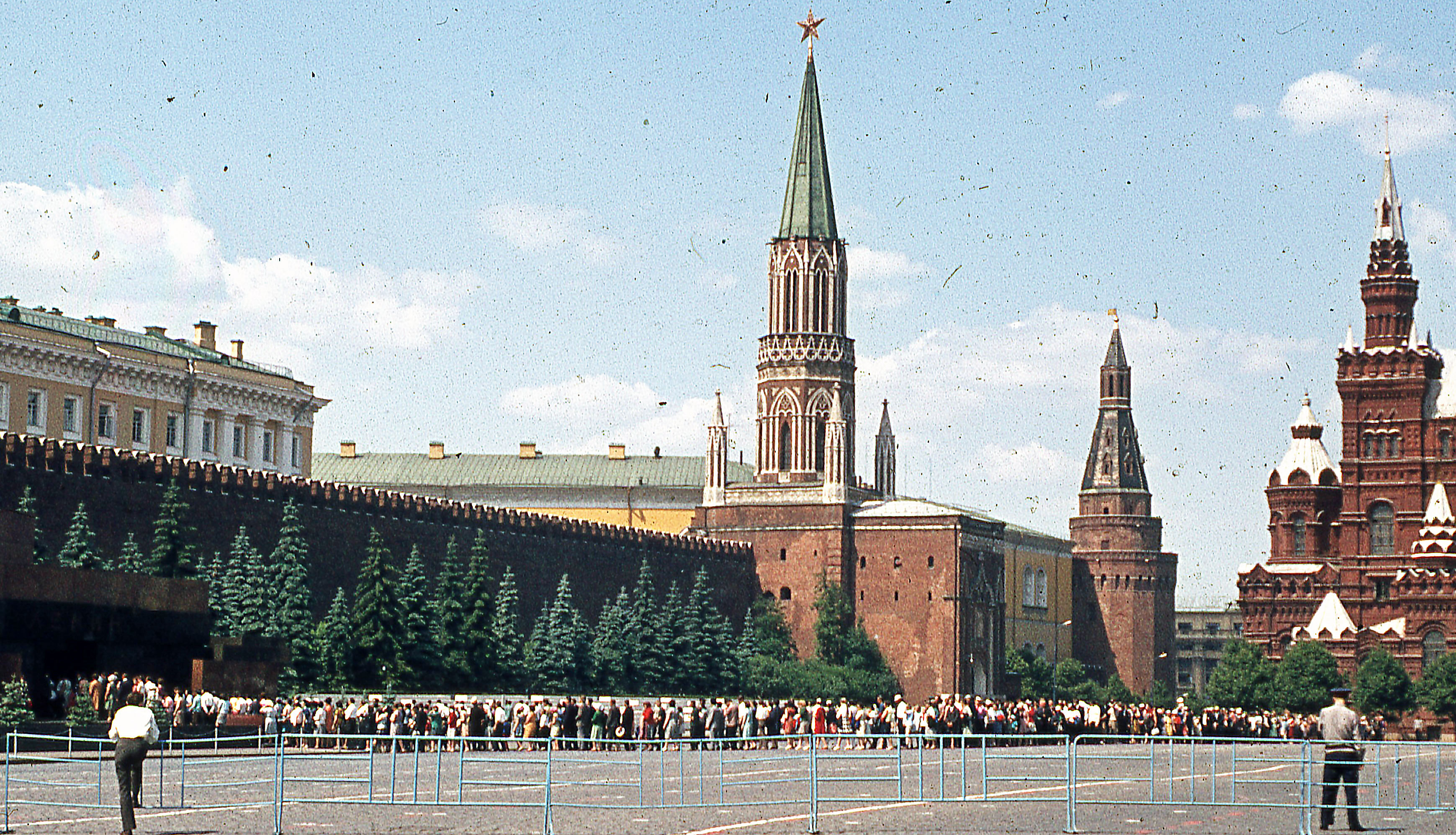
And naturally we visited the Kremlin and the monastery where Stalin’s wife is buried, though we could not face queueing for Lenin, even though tourists can get in at the head of the two or three kilometer queue [right]. The changing of the guards on the tomb is quite perfect in its quiet way, though nothing as pompous and splendid as Buckingham Palace.


The guard of two and its officer [left] leave the Kremlin a few minutes before the hour and goose-step with no accompaniment of military band across Red Square, coming to attention in front of the old guard right on the first stroke of the bell in the Kremlin tower. At the end of the peal they march back to the barracks and it is all over before one has time to focus one’s camera.


Our second contact in the film industry was at “Cinema Art“, the Soviet Film Magazine. They offered us all the facilities of a professional unit to help us with the film — lights, sound recordist, actors… but it would have taken us weeks longer to finish had we accepted. Deciding that they must do something for us as we had come all the way from Australia, they offered to show us some representative, modern Soviet films and we accepted eagerly. We carried on most of the conversation in French with an Armenian film critic who was amazed at Austra who was Latvian and could speak as many languages as he could and “looked so young!”

The film was one showing in Moscow at the moment: To Speak Again About Love. It was a very mediocre film really, in the style of the French cinema of the early fifties. It concerns the love between an air-hostess (played by the first lady of the Moscow theatre) and a scientist, engaged upon mysteriously dangerous work. An on-off affair. She: You don’t need anybody else — you are strong enough. He, coming to a realisation of how much he needs her but never able to express his feelings. The story is filled with unattached threads. In the end her job proves more dangerous — the plane crashes and she lives only long enough to ask a friend to meet him and tell hi and he walks off kicking the leaves on the footpath. The photography is ordinary but competent, the editing is classical but the style is uneven. The direction and photography of the actress gives the impression that the director was rather overawed by her. Her performance is interesting.

The second film was an editing exercise by film students, made from cuttings of the film “Simple Fascism“. It is completely Nazi-shot footage, used to make a film concerning the German soldiers at the siege of Leningrad and the last letters they wrote home, which Hitler was going to make into a book to inspire others with patriotism. Unfortunately, most of the letters were not patriotic and the project was abandoned. The film, called “The Last Letters” lasts 10 minutes and uses ten of these letters, illustrating them with this Nazi footage and music. A pointed, anti-Bavarian film. but no so Russia-oriented as one might expect. Again the editing is in the Eisenstein school, with freeze frames abounding and close-ups of faces most important.

The translator who had been recruited from an “Institute” especially for the purpose spoke English so fluently and with an American accent, that we thought he must have been a defector. Are you Russian? we asked him. Of course, he replied. You speak English so fluently you must have lived in the West for some time, we said. No, he replied, I lived in England for a few years when I was a boy, but since then I have not left the USSR. We could not believe it and we said so. It is my job, he said, simply.

It is something which must strike every foreign tourist: the standard of language teaching in the USSR. Those who do speak foreign languages are amazingly fluent without ever having been to a country which speaks the language.

The only other topic which is obligatory for the Moscow tourist is the traffic. They are amazed that in a city with so little traffic (comparatively) and such wide streets it can be such a problem. In the main streets one may see a huge transporter towing a whole house, or an aeroplane or another transporter and travelling at walking pace. Seeing one coming, one should not be too hasty to cross the road, estimating its speed sufficiently slow to allow one to traverse the 70 or 80 yards in safety, for at any moment a huge official “Chaika” is likely to whip around it at 100 km/hr. Driving is another problem as cars and trucks pass on both sides at breakneck speed, cross over in front to left and right and then 50 yds further on, turn to right and left. Truck drivers hanging out their doors are a signal that they are about to change direction. A truck stopped dead in the middle of the road simply means that the driver is carrying out some minor repairs, like dismantling the engine, or has abandoned it for the afternoon while he goes to one of the three or four garages in the city for spare parts or a mechanic or a tow.

Of course, it is impossible to do a left turn at an intersection. One has one of two alternatives: (1) One turns right and then does a “U” turn further along the road and continues down the originally-intended road, or (2) One continues past the intersections and then does a “U” turn, cutting across the traffic to turn right at the lights.

But the most famous turn of all, in the whole of Moscow, is a forbidden right-hand turn. It can really only be described by diagram (see supplement) but here is an attempt: (1) One stops at the traffic lights in the right-hand lane and when the light changes to green, does a half right then left turn to stop with the traffic going to the left. (2) When these lights change one proceeds along in the centre of the road (there are no marked lanes) and prepares for a “U” turn at the first opportunity. (3) “U” turn when the traffic allows and go back to the traffic lights. (4) When the lights turn green, go on. You have now turned to the right!

The militiamen [left] are on every corner, sometimes practising incomprehensible, virtuoso baton movements in the middle of the intersection, sometimes standing on the kerb, blowing a whistle occasionally, or just watching the cars. In any case they completely ignore the pedestrians, who wander across the roads, surviving miraculously, either ignoring the lights altogether or seeing the red light, and believing it to be the “glorious colour of Communism” cross in the assurance of absolute invulnerability.

A Dutch lady in the camping area, who told us how she had knocked down two pedestrians — one on a wobbly bicycle, one drunk — and had had “an experience” with a drunken militiaman who hitched a lift, recounted her experience crossing Moscow from the garage. She got lost, and after driving around in circles for hours, drove up to a militiaman on duty and stopped to ask him directions. He was so angry he fined her on the spot. In the end she had to hire a taxi to drive to the camp so that she could follow him.

And there is hardly one tourist who, in desperation, had not driven to the outer ring road and driven 50 to 100 kilometers around it as the simplest way to get home.


V. Conversations: (a) Old man (b) Student in Gorki Park (c) Latvian family (d) Latvian woman (Party member) (e) Tourists in the camping area

The first, short, conversation which we thought of recording was one of Austra’s attempts to hold “one conversation in Russian per day”. We chose for her the old, white-bearded Russian who sometimes worked the gate to the entrance to the camping area. He had come up onto the balcony, looked closely at my typewriter, admired my beard and had made the international borrowing sign for a cigarette from Laimons. When Austra trapped him, he was sitting on a chair, watching the sky, exhaling great wisps of American tobacco through his moustache.

— Hello, said Austra. Moscow is a beautiful city.

— Those buildings, he replied, after a long pause and pointing to a clot of new, five storey, white monstrosities on the opposite hill… Those buildings are for workers, not rich people. Five years ago there were only wooden huts. (He then pointed to the new motel, under construction). In one year that will be finished.

— Really?

— The Metro is better than anything you have in America.

— We have heard…

— The university… very big.

— Yes. We have heard it has 22,000 students.

— Very big. (Then a long pause. Topics of conversation seemed to be exhausted.)

— This camping area, he said, nodding to the tents, has only been open for one year.

— Really? What did you do before?

— I worked.

— Where did you work?

— In Moscow. (Silence. Then… ) In winter — it is very cold.

— Do you have snow?

— This camp is closed for six months.

— Yes? What do you do for a living then?

— I work.

— What do you do?

— In Moscow.

And this terminated this very dangerous conversation. The last words were said almost over his shoulder as he fled from this espionage interrogation.

————————

We had to shoot some film in Gorki Park and arrived early on Sunday to begin. By midday the grounds were crowded with a carnival atmosphere: ferris wheels, boats on the lake, ice-cream sellers, men and women crowded around the domino table, paper hats and loud-speakers blaring music and political slogans. At one o’clock there was a variety concert in a music shell which faced onto a hot dusty square and we joined the crowd in the shade of the trees beside the square.


It was a performance by dancers and singers [above] from the farms and factories in the Moscow area and Austra was trying to write down the essence of the introductory speech by the compere. A citizen behind her, who was looking over her shoulder, offered a few corrections and a young man on the other side assisted with some spelling mistakes. The middle-aged citizen was saying: Australia is a long way away! and began repeating, louder and louder, as though this would solve the problem, that these performers were amateurs, “self-doers”! And then he began shouting, the young man asked him to speak more quietly as his shouting seemed unnecessary. The citizen turned upon him:

— You are not a Russian, he accused.

— No, said the young man. I am Ukrainian. A Soviet.

Soon the citizen grew tired of us and left, but the young man introduced himself to us. He was a medical student at the Moscow Medical School and was very interested to be able to speak to students, or ex-students, from the West.

The talk wandered along on general topics for a while, to the accompaniment of accordion music and national dancing. What does he know about the West? we asked him. Several people we had talked to had some rather strange ideas, we said.

Yes, he knew about them. They are all “told” about the West at regular intervals and they all solemnly take note and agree, but the Ukrainian students, at least, have other information. Every evening they listen to a midnight broadcast in Ukrainian from Canada. Students know, though they don’t go around shouting it. He had heard, for example, about the recent wave of student unrest all over the world. We think there is no student unrest in the USSR, but it is just that we don’t hear about it. In the Ukraine lately there have been several marches and demonstrations. Perhaps they have been photographed and published as pictures of patriotic parades. In any case, they are very quickly suppressed.

He was the first of the man bitter patriots from the “republics” that we were to meet and in the Ukraine the sense of injustice at Russian exploitation runs very high. Russia can grow one potato for itself, he said, and all the food from the Ukrainian food basin goes straight to Moscow. The Ukrainians never have enough to eat even though they grow everything. It could be one of the richest agricultural countries in the world. Ukrainians are very patriotic and very bitter towards Russia and the Russians.

This is not all that he was bitter about. He was training to be a doctor for six years, on a scholarship of 35 roubles per month, which meant that his family had to support him. The only luxuries he could afford were occasional sweets. His entertainment was Gorki Park at the weekend. When he graduated as a doctor his wage would be 90 roubles per month. This is not his starting wage; he remains on it until he is promoted to head of a hospital or polyclinic. That ice cream seller, he said, pointing to the lady with her trolley, earns 140 roubles per month.

How can he be a student, knowing this? we asked. What is the use of studying? He shrugged his shoulders. For the soul? It is the policy of the state to pay “real workers” better than professionally qualified people, so that an engineer in a factory will always earn less that the worker on the floor. Some professions are better paid than others: engineers begin on about 120 roubles per month, schoolteachers on about 130. Doctors are the lowest paid profession in the USSR.


And these “amateurs” up on the stage… he gestured. Don’t think they are doing this for nothing! On a farm or in a factory one is supposed to do something extra, outside of working hours for the prestige of the establishment. If you dance or sing and show enthusiasm you might get to the head of a queue for an apartment or take your vacation when and where you like or get a promotion or a bonus on your wage. And see those men sitting at the side of the stage [above left] ? They are the judges. If they see someone with real talent he is whipped off to the dancing school or the circus school and if he succeeds there he never has to worry about anything again. The Soviet amateurs — sportsmen and performers are a joke even in the USSR.

Completely unprompted by us, the talk switched to Vietnam. He accepted that there was a great deal of opposition to American and Australian involvement in America and Australia and everywhere else. And he told us a few “anti-Vietnam” jokes or rude stories about the Imperialist Johnson; jokes about the USSR’s involvement directly in the war. Unfortunately they do not translate into English very humorously, but they are a scream in Russian!

(1) An American pilot, shot down over North Vietnam is interviewed about how he thinks the war is going. Well, he says, it wasn’t too bad at first — they just shot at us with pistols… now they have developed anti-aircraft guns! (i.e. Where did they get the guns?)

(2) And what is the first thing you heard when you landed? the pilot was asked. Well, I heard one North Vietnamese turn to another and say: (an untranslatable Russian idiom, roughly: “Give it to ‘im Ivan!”)

(3) Two North Vietnamese swimming in a swamp. One splashes up some water and says: Isn’t this just like home, on the Volga?

We offered him a cigarette, but he refused. I am not allowed to smoke, he said with a smile; medical students have to set an example. This sounded familiar, with Boris’ and Sergei’s story about drinking in public, so we asked him about this — is it a common rule? Yes, that’s what it is, he said. The Young Pioneers set an example to the young children; the Komsomol sets an example to the Young Pioneers; the Party sets an example to the Komsomol; and the Government sets an example to the Party. I shall smoke when I leave the school.

We told him we thought he had been rather frank, and we wondered how he could do it. Wasn’t he worried? (The conversation had been carried on, we noticed, only when there was music blaring out — between items he pretended he did not notice us. Even with the music he was always looking over his shoulder to see who might be listening in.) No, he was not worried. Nobody had been taking any notice. And even if someone noticed, he would only be warned not to do it again.

We parted with him offering to show us where we could eat for one rouble each and he could not believe that we could go back to our tents and have a meal for one rouble for the four of us. How he affords it we do not know; one of his shoes was falling apart at the seams.

——————

Austra, Inese and Laimons had heard some Latvians talking in the camp and summoned up the courage to speak to some women on a bus tour who were staying in the cabins. They had to leave, but were very disappointed we had not spoken to them earlier, and so, hearing a family later who were speaking Latvian together, we approached them and introduced ourselves. The first talk we had was with the husband on the steps and he did not seem very happy about being seen speaking with us. His wife refused to be introduced and would not even approach us while we were talking, so after this we did not try to get them into conversation again. However, the next nigh they came up and invited us to their tent where “we can have some privacy”. This time the wife sat with us and, although she was obviously still worried, joined in the conversation. We had been watched on both occasions, by one of the English-speaking Intourist guides from the office who kept walking past and trying to listen in or standing on the hill, some 50 meters away, and all but observing through binoculars.

All our conversations were noted in the camping areas, even when we began talking loudly with other Western campers — there was always the Intourist representative, trying to be inconspicuous, coming into the kitchen to wash a bottle or to pick up a piece of paper on the floor. Who knows whether they heard anything? But it was a sufficient constant reminder that if we ever did get into trouble, the authorities would never be short of evidence of one sort or another. Only recently a pair of young Americans had been brought before the head of Intourist for talking rather loudly and outspokenly to some Russian students. The things you are telling them, they were told, can do them no good at all.

But sometimes it is too hard to keep one’s voice down and the daredevil “What can they do to me for saying what I think!” attitude is difficult to resist.

This Latvian family had driven from Riga to Gorki and Moscow on a motorcycle with a sidecar for their holidays. It had not been entirely holiday: one of the main objects had been to try to get some spare tyres for the bike — completely unobtainable legally in Riga and Moscow at least. In Gorki a Jewish friend had spent the day telephoning his friends and had at last managed to get two spare tyres for them. He didn’t know, though, whether the bike would get them home — the generator was almost worn out and nowhere had he been able to get a new one. Without it, his bike was useless and he would have to put it up on blocks in the garage when he got home. They had saved for over a year for this trip and their friends had considered them very lucky to be able to go on such a “luxury” vacation. One son was with them; the other had to be left at home because he wouldn’t fit on the motor bike.

The first time they arrived in Moscow (on the way to Gorki) they tried to get into the Motel (50 meters away) but is was full. They tried the camping area, to see if they could hire a tent for the night and were refused again. This camping area is for foreigners and citizens on organised tours only, and what’s more they were rather dirty from the road. But they had nowhere to go, they told the administrator, and it was late. He relented a little. What time would they be leaving? Five o’clock. Very well, on the condition they left at five o’clock he would allow them to sleep on some open duckboards in the furthest corner of the camp. They had to pay the normal 90 kopeks each and 50 for the bike for the privilege.

This time, they looked a little more respectable and had been given a tent for a few days.

He was fascinated by our car and found it difficult to accept that we had paid only 400 roubles for it second-hand. His motor bike had cost 1,600 roubles. In the Baltic countries motorcycles are the main means of private transport, apart from a few pre-war German “Opel“, as he puts it “Raised from the dead”. Parts are virtually unobtainable, even for new cars, if one can afford them. A “Moscvich” costs 4,500 roubles and a new “Volga” costs nearly 7,000 roubles, and there is a two to six year waiting list for them. All through the conversation he kept coming back to this:

— And if you wanted a spare part, he would ask, what would you have to do?

— Why, we replied, just walk into the shop and ask for it. If you wanted a new or second-hand car, the main difficulty would be to fight off the salesman!

He kept asking to hear this like a child who wants to hear the same fairy story again and again. He would go home and tell his mates, he said, but they would not believe him.

He has a good job. He is a highly skilled mechanic in a small factory which is also an academy; perhaps a research institute. In any case, there is some security surrounding the work done there. When he applied for the job, his mail was checked for several years back, and if he had received any letters from outside the USSR he would not have got the job. If he received letters now, he would lose the job. He used to correspond with his wife’s cousin in Melbourne, but he has not done so for years.

He earns 130 roubles per month, 10 roubles more than the engineer he works with, but not as much as many of the ordinary “workers”. What did this represent? we wanted to know. Wages are meaningless unless they can be compared to the cost of living. A day’s wage would buy him a kilo of butter (about 5 roubles). For the three of them to go to a restaurant and buy a meal consisting of soup, a main course and desert, it would cost about 6 roubles, in any case more than most men could earn in a day. His wife also works and earns 90 roubles. An average wage is 110 to 120 roubles. A pair of ordinary shoes cost 40 roubles (and in Riga there is rarely any choice of styles), an ordinary, nylon raincoat, such as we buy in Woolworth’s for about £2, costs 70 roubles. Food is so expensive that even with their combined wage it is impossible to make ends meet by the end of the month if they want to buy any clothes at all or to save anything towards a holiday.

Traditional Latvian delicacies and cooking are unknown. Smoked eel has not been seen for years, and fish (which is one of Latvia’s main products) is too expensive to buy, when it is obtainable. Only five years ago the only bread available was heavy, black bread.

If a fisherman catches more than his quota, he cannot keep the fish or eels. He may be paid a bonus, but the fish must go to the factory. Blackmarketing of fish is looked upon as a very serious crime. Once, he had visited a fisherman friend and had been given a bucket of fish to take home and he knew that if he was stopped at one of the many checkpoints along the road and the fish were found, both he and the fisherman would get into trouble. He wrapped them in a blanket and sat the boy on them. He was stopped; he was searched, but the fish was not found. There might have been very serious consequences from this little escapade… “Serious consequences” seems inevitably to mean at least losing one’s job.

There are other, more simple ways of losing one’s job. A few years ago, for example, it was frowned upon for a married couple to wear wedding rings — “bourgeois sentimentality”. A Komsomol member who wore a ring to work was dismissed from the Komsomol and told that if he did it again he would be dismissed from his job. Today, rings are officially recognised and one month before marriage, the couple is given a form which allows them to buy the rings — gold is normally unobtainable. But two friends of his, recently married in the local “Palace of Weddings” drove 100 kilometers to have a secret wedding in a locked church. They wanted to keep their jobs.

There are no christenings. Several times every year the parents bring new children to a “party” with presents, where the children are all given names. There is a similar party when the children reach sixteen, a “coming of age”, where they all receive their identity cards.

All over the Soviet Union, housing is still a great problem, even though “The Book” tells us that, in Moscow, “some 400-500 housewarmings are celebrated every day”. In Riga the queue for apartments is from six to ten years long. If one considers that one’s quarters are too cramped, an inspector comes to measure the space, and if there is more than three square meters per person, the application is dismissed. Housing co-operatives are allowed, and one can pay 2,500 roubles down to join and 15 roubles per month for 20 years for an apartment, after which one owns it, and can re-sell. He described the apartments that were being put up — in huge, pre-fabricated slabs, crumbling as the crane lifted them up…

There are other ways to get an apartment, of course. One can be a member of the Party, or a “good worker”, or do extra outside Party work, then the queue is shortened for houses and cars. This is excused, the people are told, because these people are working for you and they deserve it.

All the top jobs in Latvia are held by Russians, although some Latvians are working their way up these days. We had heard, we said, that Latvians are getting to the top by co-operating with the system and once there trying to help the mass of people. He laughed. Those who get to the top do so for their own gain. We hate them more than the Russians. And they hate the Russians. They come here in the army, he says, get a cushy job and stay. They seem to have no home.

He was very proud of the nationalism of some of the other republics like Estonia and Georgia, where there are very few Russians because they have such a hard time. In these republics, shop assistants refuse to speak Russian to the Russians, although it is the official lingua franca. (If a Latvian first speaks his own language and then changes to Russian he will be served. If he speaks Russian first he will be ignored.) And in other ways there is a steady resistance. In Georgia there are always cases of Russian soldiers, out alone at night, disappearing and in the morning nobody has heard about anything.

Under the 1936 constitution (Article 17) there is provision for any republic to secede from the Union. In 1949 in Estonia a petition was signed by 80% of the population for the secession and presented to Moscow. It was followed by mass-arrests and deportations and the petition was never acknowledged.

After Stalin’s death the Georgians got up a petition which demanded more freedom of speech and the running of their own affairs. The petition was presented in Georgia, accompanied by a mass-demonstration in the square. After several hours, when those who presented the petition had not reappeared, the crowd began to get restless. Soldiers were called up and they fired into the crowd to disperse it. The petition was never mentioned again. But the Georgians still drink to Stalin, who at least looked after Georgia and the Soviet Union first, and his picture is on the wall where Lenin’s ought to be.

He is depressed about the Latvians and their way of making the best of the situation. The novelist Vilis Lacis, well-known before the war, saw the light after the revolution and re-wrote many of his earlier books. In one semi-autobiographical novel he had described how his father had been battered to death in Siberia and thrown into an ice-hole. In the rewritten version he is bringing home a cart through the forest on a stormy night and is crushed by a falling tree.


[above: bus from Latvia, with rear compartment kept open to cool the engine]

Any resistance that is offered is in a small humorous way. On annual festivals of traditional singing and dancing, when Latvians come to Riga from all over the country, pamphlets are circulated saying that a revolution is brewing and the Russians leave for their holidays… Out on a bus trip, when they pass a huge, patriotic sign, covered with an essay on Communism, they stage a well-rehearsed scene:


— Driver, stop the bus! did you read the sign?

— No, replies the driver. I was watching the road, like a driver should.

— Well then, the sign must have been for us to read. Back up the bus!

And they back up the bus and read the sign. While the traffic honks behind them.

On days of national celebration, when it is compulsory to march to the statue of Lenin and the Russian tank with the red star and lay wreaths of flowers [right], a bunch of red and white flowers (the old national colours) always appears surreptitiously under the one “pre-revolutionary” statue that is left standing and they nudge one another and point to it as they march past. This statue, a woman holding aloft a handful of stars, is the monument to the creation of Latvia as an independent state after the First World War. In 1945 the Russians pulled all the old statues down, except this one, because they feared a national uprising had they done so. It was excused because “the stars have five points, and can be thought of as stars of Lenin“.

He is depressed that the children get nothing but the straight party line at school and it is left to the parents to tell their children about the other side of the case. His sons know what is going on, he says, and his son was sitting with us throughout the conversation.

Do Latvians in Australia drink? he asked. And we, remembering the huge parties with the kegs on the back steps and the visitors remaining for the whole weekend, replied in the forceful affirmative. This is not what he meant. In some factories after pay day, work stops for a few days. The whole factory is too drunk to work. Wives who can, come to the factory to meet their husbands and rescue the pay packets if they want to live for the next month. Drunkenness is a huge problem. (Almost every other person we spoke to said the same thing. It is impossible to drive down some streets at night for the drunks wandering along the road or jumping out in front of the car to hitch a lift.) They are told that in the West things are ten times worse, and they can’t believe it — this was his question. To curb this most restaurants do not sell anything stronger than beer, if they sell it at all, and it is impossible to get a second glass. There are no “pubs” in the Soviet Union. But this does not stop them, he says. The Russians are the worst, they drink like animals, they drink anything — brew it themselves or water down methylated spirits or pure alcohol. This is why unsupervised Russians are not allowed into these camps — they would disgrace themselves.

The other great problem is theft. As so many things are unobtainable, the only way to get them is to steal. On their way they stopped the bike in front of a restaurant and were about to go in when a militiaman stopped them. He told them not to leave their bicycle unattended — when they came back it would be stripped bare. From no on one of them always stays with it. A friend’s daughter had the valve stolen from her bicycle. It was a major tragedy — to get a new valve, one must buy a complete new wheel. And bicycles are always being stolen. Any Russian lucky enough to have windscreen wipers on his car, takes them off when he parks and locks them in the car.

The official side of the story is hilarious, if one has a warped sense of humour. Several years ago a ferry-boat overturned in the Bay of Riga. Half the passengers were drowned and the other half struggled ashore, losing everything they had with then, including, in many cases, their papers. After a few days they went to the police station to get new papers, were given a form and told to state what had happened to them.

— Papers lost in recent ferry-boat disaster in the Bay of Riga, they wrote. The militiaman tore the forms up.

— No such thing happened, he said. They thought a bit.

— Could they have been stolen, perhaps? they asked.

— Of course not! (There is no theft, murder, rape, extortion, or any other kind of crime in the Soviet Union.) This went on.

At last it was decided that the papers had been “negligently lost” and they all had to pay a fine of 10 roubles.

Neither are there any natural disasters in the USSR. In the recent “little” Tashkent earthquake, no lives were lost; nobody was around at the time.

This Latvian, like the Ukrainian student expressed the same type of resentment which we are expressing at the spendthrift policies of the government — pouring arms into Vietnam and the UAR, expending a fortune on countries like China who then turn and spit in our faces, putting all their energies into a stupid race or the moon… When it is home which needs the money. A few years ago, they say, wherever you looked there were Chinese. You’d think we would have learned our lesson. Now wherever you look you see Africans and Arabs. Who will we have when they have taken all they can get from us?

We asked him about personal freedoms within the USSR. He is naturally not allowed to travel outside or to have dealings with the West, but where can he go within the country? Anywhere, naturally, he replied. We are constantly being told that this is our country. In 1969 identity cards would no longer say “Born in Latvia/Lithuania/Kazakhstan…” They would simply state “Soviet Citizen”. (Lenin’s theories of national identity take another beating?) But within Latvia itself there are many places they cannot visit. The whole town of Liepaja (a Baltic port) is a prohibited area. The train stops outside the city, passes are examined, non-residents must have a special “visa” to get in, like entering a foreign country, and the journey is continued by bus. All the beaches on the Baltic are closed at 8 pm and after that a machine comes along and ploughs them, presumably to show whether anyone has tried to escape by sea, or perhaps to keep the Westerners out.

He had many questions about the West and I must admit that we were cruel, often returning (under his questioning) to the ease with which one can get a motor car or medicines. In Riga, medicines are almost unobtainable and there is a special pharmacy for the Russians, as there is a special set of restaurants and shops, where things are available which cannot be bought in ordinary stores. We criticise South Africa all the time, he said, but there is racial discrimination here which could teach them a few things.

He knew that in the West there were no pensions and that old people were left to starve on the streets. The pension scheme in the USSR (a comparatively recent scheme in parts of Latvia — 1965) is the only such scheme in the world. At 60 years of age, if a person has worked for 30 years he or she is given a pension of half his wage. His father, retired, gets 20% extra as his wife has never worked. Should his father die first, the wife will receive a steady pension of 15 roubles per month.

If he were to go to the West could he get work? They were continually barraged by frightening unemployment figures and statistics on the number of people who starved to death. He knew that the worker could not afford to go to the doctor or to hospital in any Western country and that the child of a worker was denied anything but an elementary education. He had heard about the English universities (he even knew their names — Oxford and Cambridge) where the only students were the sons of Lords and millionaires. He was most surprised when we told him about our parents and the scholarships we had to the university.

He expressed frank incredulity about the letters his wife’s cousin used to send them from Australia. He had once sent them a photograph of himself out hunting with a bag or “at least seven rabbits”. And he was always telling then about the motor cars and the wages. Friends said, he is forced to tell you things like this — they aren’t true. Before the Melbourne and Tokyo Olympics the teams were told — Take no notice of all the motor cars, they have been brought from all over the country for show, they are not there all the time. The roads have been specially built for the games.

He was amazed at the low clearance of some of the Western cars he had seen. How can they manage the roads? Of course, he said, the main roads you travel on in the USSR are magnificent. We perhaps laughed to rudely at this. We can understand and believe things we are told like this, he said. So much here is only for show. The books we are allowed to send to relative in the West are printed on good, glossy paper and are only picture books of the beautiful countryside. The huge wedding-cakes of buildings are nothing more than show-pieces. One was built in Riga after the war to be used as a Palace of Culture — “A gift from the Russian People”. We refused to accept it — major restoration work was being carried on while it was being built. It is now an academy of sciences.

When we parted he did not tell us his name or anything about himself. He asked us not to write home saying we had met him: he was certain that all our mail would be read. His last comment was the most depressing of all: It has been an interesting conversation, he said, but it probably won’t do me any good. With a glance up the hill at the young man leaning against the wall.

————————-

This conversation was followed the next evening by a meeting with another Latvian, a woman and a Party member. She is on holidays with her family, on a bus tour to Moscow and she had to get to bed early because next morning they were all going into Red Square at 5 am to queue for Lenin’s tomb. They do it every time they come to Moscow.

She was trained as a schoolteacher but works at an institute of metallurgy for 100 roubles per month. In the evenings she lectures on Political Economics at an institute. This extra work, she insists, brings her no extra money.

It is the obligation of every Soviet citizen to take on some kind of patriotic activity. Folk dancing or sport did not appeal to her, so she lectures. How can she lecture on Political Economics when she has never seen any of the countries which she so blithely talks about? we wondered. We have textbooks, she replied.

Life is not too bad, she says. We have enough money to live on, we have an apartment and we only had to wait for it for a year. By 1971 we will have a 4,000 rouble car. We have holidays all over the USSR and every year we get a bonus of one month’s wage. At the moment they have a motorcycle and sidecar and have no trouble travelling.

We did not get the chance to ask anything else. The rest of the conversation was spent in eulogies over beautiful Moscow and the fantastic Exhibition of Economic Achievement [right]. They go there every year and stay until evening, when the lights make it look “just like a fairyland”. And the most beautiful area of Moscow, the Arbat district — all new, towering skyscrapers, all glass and aluminium!

—————————

The tourists in the camping areas are a mixed lot: innumerable family groups of Canadians in huge vans with camping bodies, doing Europe; groups of Americans, seemingly come to atone in public for Vietnam; young Swedes, travelling in couples, referring to one-another as “my fiancé”; the Dutch, travelling in convoy with the most elaborate camping gear, sitting in the area all day talking to their next-door neighbour from Amsterdam; people like us,, small groups in the inevitable VW Kombie van with tents; groups of 10-20 US students, in semi-organised tours, but completely disorganised as far as camping goes; young Czechs, anxious only to get into Red Square as quickly as possible and sell a few clothes; East Germans who talk to nobody and sun tan all day; Poles who seem to drive all the time, only over staying for one night.

Most of them you can talk to. Most have an interesting opinion to offer, though usually the talk is completely one-sided — incredulous at what they have seen. The young Americans and Swedes, much to their credit, seem to have made an effort to learn some Russian and are always anxious to talk to people. They don’t get their ballet tickets through Intourist, they queue for them at a kiosk, they go to the ordinary Russian cinema, they keep their eyes open and they get into trouble. They are just the type of tourist the Russians don’t want.

The type they welcome are the mini-bus tours of Australian girls, recruited in London on the back page of the “Times“. “See Europe for $70. 10 countries in 10 wks.” They are organised trips, nine to a mini-bus, with a driver who works for the company. They stay in Youth Hostels when they are available and camp in camping areas when they are not. They seem to be all the misfits of England, Australia, New Zealand and the USA, usually girls, collected together with their enormous Corn Flakes to keep them regular. They form a little ethnic group, with their own jokes, etiquette and mode of conversation. In a crowded camp kitchen they can take up three quarters of the cooking appliances without noticing the queue for the other quarter. Everyone else is “a local” or a Communist they assume, and cannot speak English anyway, so they talk at a shout, about the Berioska store and the price of American cigarettes at “the Gastronome”. they are surprised and distrustful if you speak to then in English, perhaps to tell them that they have just turned off the stove rather than on, and they quickly try to forget this piece of, possibly dangerous, contact with the world outside the group. Their Intourist guide, whom they picked up at one border and will leave at their point of exit, shepherds them through the dangerous waters, takes their cigarettes, makes sure what they don’t see and tries to blend into the merry group. He/she is often successful — such are they all misfits.

At the end of the trip they know three things about the USSR: the bad roads, the rude shop assistants, and “Nee Pannimayer” (That means “I don’t understand” they will tell you, “in Russian”.) which they use for chasing off the wolves, the militiamen, the drunks and the money-changers.

It is this type of tourist which Intourist loves. The organised tours of idiots with their guide and the good Communists whose first stop is at Friendship House and from there the guided tour all the way. The most lucrative, presumably most loved type we had little to do with — the well off American or British capitalist, despised but fêted in the luxury hotel and driven around by a chauffeur in a Chaika. We saw some of them in the hotels when we went to change a traveller’s cheque or, out of desperation, to buy a copy of the “Daily Worker”. They were sitting in the foyer or the bar, picking through the Berioska shop, waiting for their taxi, like prisoners, afraid to move outside.

Or am I being cruel? We decided in a kitchen conference that when we got home we would advise everyone to visit the USSR. Especially every little “textbook Communist”. Tell him only to bring roubles, make sure his car has a minor breakdown, make him find his way around on his own — no guides. Encourage everybody, to come and see for himself.


VI. Moscow to Leningrad


We had heard such horrific tales of Novgorod camping area that we set out early on the road to Leningrad to drive the whole 700 km. rather than stop there, with the mosquitoes and the toilets, which had been spoken about in hushed tones. It is a much more eventful road than the one from Minsk to Moscow, there is a little agriculture and some dairy industry on a small scale. The houses along the road are in traditional styles, made from logs, with carving around the windows and roofs [above]. But even if the scenery becomes boring, the road itself offered constant diversion: tempting one up to 100 km/hr and then forcing one to either slam on the brakes or break an axle.

Road works [right] were going on over the whole length at sporadic intervals, though more often than not nobody was in sight. Huge heaps of gravel stood in piles down the centre of the road at intervals of 20 meters, pots of smoking tar stood by the side of the road… When we came back along the road a fortnight later, the gravel was somewhat dispersed by the cars running over it, and the tar was no longer smoking.

100 kilometers short of Novgorod we were about to run out of petrol, so we stopped at a crossroad to ask some locals what we could do. Novgorod is the next, they said. But we did not have enough petrol to get there. Well, there is one in the village here, said an old citizen and he tried to explain how to get to it. It was too difficult: he said he would come with us and we could bring him back here. Accordingly, in he got and of we went, bumping up and down the streets of this village, through potholes feet deep that we drove into and out of, turning left and right and back upon ourselves until we reached the petrol station on the other side of the village. It was simply a fence with two pumps and a tank on the other side [below].

Our guide explained things to the lady attendant and a few locals came across to look at us. They were always interested, these old fellows who came up to have a few words — where were we from? Avstralia! We like your car. Where have you been? A few simple questions and a toothless smile, just to assure themselves that, probably, for the first time in their lives they had talked to foreigners. Talking to these people was always most gratifying for the sheer disinterested interest they showed. Our guide was the same: he asked where we had been and where we were going. The south of the USSR is very beautiful, he said. We asked: Do you go there for your holidays? Who, me? he looked at us in amazement. I am just a farm worker. I only earn 90 roubles per month…

On the way back from the petrol station, a motor scooter whizzed out from a side street with a militiaman on the back. It cut us off, like they do in the movies, and the militiaman leapt off and waved us to stop. Where were we going, he wanted to know. To get petrol, we told him. How did we know where to find it? His eyes were almost popping out as he peered suspiciously inside our car. Our Tavarisch here was kind enough to show us, we said, putting in our friend. Right, he said, follow me. And he leapt back onto the motorscooter, like Hopalong Cassidy, and it took off in a cloud of thick dust. We bumped along behind as he took us back to the road leading from the highway to the village [right, but rider is a local man]. We apologised to this little worker we seemed to have got into trouble. Will he do anything? we asked. He shrugged his shoulders as if to indicate that he had never heard of such a thing.

At the outskirts of the village, the militiaman was stopped and lying in wait for us (he had kept a good eye on us from the back of the motorcycle as we went along). He flagged us down again and hauled our friend from the car. That is the road, he said, pointing, then forgot us and began lecturing the old man. He was fully 20 years old with a brand new, bristling moustache and a shiny pistol holster. The man was sixty, bent and lined with work. The policeman was lecturing him like a kindergarten teacher lectures a child who has just pulled all the flowers out of the entire school garden, and the old man stood there and listened. We all got out of the car and shook his hand: “Bolshoi spaseba!” we said, and looked as evilly as we could on the militiaman.

It seems a little gauche, drawing morals from our little encounters, but this one was constantly with us: It is never we who get into serious trouble (all that can happen to us is that we get deported, we thought); it is always potentially the person we are talking to.

On every crossroad there is a militiaman, on every bridge there is a half-witted looking guard with a rifle and fixed bayonet — we always wave to him and he never know whether to wave back or shoot us straight out. The second time we were stopped by the militia was in a speed trap. We came over the hill at 80 km/hr and did not see the sign, on a perfectly straight, flat piece of road, 40 km for 1 km. We were stopped by a red-faced militiaman who began shouting louder and louder, when he discovered that we did not have a guide/translator. We understood that we were exceeding the speed limit; we think he said that if we did it again he would take our car away; then he said a word which Austra had never heard before, so she began leafing through the dictionary… You won’t find it in there! he choked, then waved us on and stalked back to his post behind the bushes.

We drove into Leningrad at 8 pm and began looking for the road to the camp. We knew that the camping area was at Repino, 40 km along the road to Viborg. There are no signs in Leningrad, hardly even street signs, and only one camping sign, which we missed. For two hours we drove around, finding likely-looking streets, asking likely-looking people the way [left]. They had never heard of Repino, so we asked for Viborg, and after this time, we found ourselves on a likely-looking road which headed out of the city. Just to make sure we asked an army officer. Yes, this was the Viborg road.

At about 20 km we saw our first sign — to Viborg — and our first militiaman, who, naturally, flagged us down. He came up, writing down our number-plate as he walked. Where were we going? To the camping area. This is not the way to the camping area! Isn’t this the Viborg road? This is not the way to the camping area. We were told this was the Viborg road. Who told you? An army officer… and it went on. This is not a tourist road, he told us. We apologised and said that we did not know, we were only trying to find the camp. You knew very well that this is not a tourist road! he said. Give me your passports.

[Below: inside capmpground, map of road to Viborg on billboard at left]


We felt impotent. Austra did not know enough Russian to be rude to him, though we made it very obvious that we were very angry. But what can you do when he has your passports and visas, and is carefully writing down all the information? We brought out our map (printed in the USSR) and asked him to show us where we were. He refused. He told us how to get to the correct road with impossible directions, and sent us off, not saying another word. At times like this one gets so screwed up with impotent fury one is shaking an hour afterwards. I wonder what would happen if one punched a militiaman?

Militiamen don’t wear numbers, or any means of identification, though one polite one who stopped us for a similar offence (being on a non-tourist road) saluted, smiled and gave his name and district. The locals seem to hate them — thugs, they say, recruited in the country. One can’t honestly say though, that our cross section was any worse than a cross section of Australian policemen I have met in my life.


VII. Leningrad

We had been corresponding with two schoolteachers [right] in Leningrad, whose address was given to us by a professor in Australia. In the first letter, we told them approximately when we were coming and they had replied. We had written two more letters from England but they had not replied and from Moscow we wrote again, giving definite dates — this was the next letter they receiver from us. The other two letters had “disappeared” in the mail.

Alex is an amazing fellow. An ex sailor, now a teacher of English, with post-graduate qualifications in navigation and engineering, and he has taught marine engineering, navigation and metallurgy at special schools during the day and at Pulkovo Observatory and at the airport at night. His wife, Tanya, teaches English and Geography (in English) at an “English school”, where all subjects are taught in English. Alex is also a climbing instructor, tennis player, skier, walker… an all-in enthusiast and admirer of Francis Chichester (he even looks like Chichester!) .

He corresponds with about half a dozen people in England and Australia — it is his major hobby — and for the third yea they have applied for permission to travel to England for their holidays. They apply at the first opportunity and at the last minute they are always refused. Alex thinks that perhaps it is because of his foreign correspondence, but hi won’t give it up. He was offered a lucrative teaching post at the naval academy, but to accept it he would have had to give up writing to his friends. He prefers to keep going as he is.

When we arrived, Alex had everything planned. First we would go to Pulkovo, where a “pupil” would show us around, then we would look at the things to see outside Leningrad — the famous summer palaces — then we would look at the things to see in the city — Peter and Paul Fortress, the museums, the Hermitage, the churches… it was all timetabled. We found later that they had postponed their holidays in the south so that they could meet us. Alex had returned their railway ticket and later would queue for another one (“Two or three hours, no more.”).

That afternoon we went to the observatory where we were met by Alex’s “pupil”, second-in-charge of Pulkovo, a brilliant astro-physicist who spoke English better than Alex. He took us around for two hours, showing us the museum, the old and new telescopes, the radio astronomy department and their newest “baby”, a huge interferometer. Pulkovo is the oldest observatory in the USSR and the headquarters of astronomy in the Soviet Union, though it only does photographic and astro-physical work and can only be used in the winter (the “white nights” make it impossible for observation in the summer). He described graphically the way the telescope housings must be the same temperature inside as outside and how the observer has to sit all night in his overcoat keeping an eye on things with the temperature around -20°C. As we parted, he invited us to dinner with him the next evening, where we would have some “real Russian food”.

Alex next rushed us off to Pushkin palace and inside the museum found us a guide who could speak French. The palace is nearly half restored after being nearly completely destroyed in the war. The Nazis, we were told in every room, stole even the wallpaper, used the furniture for firewood and stabled their horses in the chapel. In every room of every palace under restoration visitors were continuously reminded of the Fascists and the atrocities they perpetrated during the siege of Leningrad. And the Russians are slowly restoring the palaces to their former splendour, with woodcarving, silk painting, sculpting, gilding going on all the time. Many of the unique parquet floors [right] remain or are being restored with rosewood, walnut, ebony, teak, cedar… several complete floors were stolen by the Fascists.

The Germans are much more hated than the czars. In fact several czars are openly loved, especially Peter I, and they reconstruct his palaces with loving care, from old photographs and drawings. What a time these selected Russian craftsmen must be having! Being encouraged to practise these old “bourgeois” arts officially. One of the nice little contradictions of Russian life is the loving reconstruction which will only be used to demonstrate to the people the decadence of the royal house. These days, the intricate sculpture in semi-precious stone, the iron work, the woodcarving, are exhibited as the work of Russian craftsmen… workers.

The palace of Peterhof was again almost completely destroyed in the war. The Fascists dug trenches through the gardens and set up their guns on the shore to cover Leningrad and Kronstadt. It is Peter the Great‘s most famous palace and garden. Today it is like Gorki Park — Russians can come and tread the paths once trodden by the foreign ambassadors and the elegant ladies of the court, for 30 kopeks. Music shells blare out songs and by the lake we watched a ballet given by a local, amateur company. (Part of “Swan Lake“, naturally.)

The gardens are famed for their fountains[above and below] which are fed from a series of lakes up in the hills. The central complex is resplendent in gold — hundreds of gold figures and statues [above right: L to R in centre group Ian, Austra, Inese & Tanya, Alex bottom right], grouped around “Samson” in the centre. (The original Samson was stolen by the Fascists and the one there now is a copy. Nobody likes it very much — the original one, they say, was magnificent and is now gracing some German palace.)

From this complex, a canal leads down to the Gulf of Leningrad, lined with fountains [right]. It was one of Peter’s little jokes to let the barges come half way up the canal and then turn on the fountains! He seems to have had an unfortunate sense of humour about wetting people. There must be six or seven trick fountains, looking like innocent park benches or rotundas or trees, which tempt one to approach and then erupt into a shower of spray when one treads on a concealed device. The Russians go wild over them! Every second person in the park is dripping wet. “They are from the country,” said Alex, disapprovingly, “not Leningraders”.

We had lunch in a self-serve “Stolovaya” in the park — borscht, meatballs & potatoes and compote (a glass of weak fruit juice with a few pieces of stewed fruit in the bottom). Russians do not eat at home very much and are encouraged to eat in these places where such a meal costs about one rouble. I do not like them very much, says Alex, the menu has been the same since the war. I feel hungry, I walk into one and look at the menu and my appetite disappears. All the meals we did have in Stolovayas confirmed his opinion, I must say, though at the beginning they were sufficiently novel to be reasonably enjoyable.

Alex wanted to take us to a wonderful Chinese palace at Lomonsov, but we were stopped on the road by the polite policeman that I mentioned — it was not a tourist road, though we could have walked, or taken the train.

We then tried for the Pavlovska Gardens, but about two kilometers short the road was impassable, with a huge ditch right across it. We went back and found a clearly marked prohibited road through the trees and across the fields, and, as there were no militiamen in sight, we tried it. Miraculously, it took us to Pavlovsk without a sight of a tank, a missile base or even a soldier guarding a bridge.

We walked through the gardens a little, though it was beginning to rain, talking about the aristocracy and the palaces. Then the talk quietly changed. One never sees our new aristocracy here, we were told. They have their palaces out near Repino and in the trees beside the Neva and they go to them in their chauffeur-driven Chaikas. Last year the palaces were yellow; this year they are all painted green so that they are hard to distinguish. We pressed Alex on this: did he think it right to have such obvious privilege in evidence? No, he did not. If you are going to be a communist you must be a communist all the way.

This from a man with very high qualifications and 20 years teaching experience who earns 150 roubles per week (with extra work) and lives with his wife in a four room flat, shared with three other families.

In London their flat, like the scientist’s, which we visited the next night, would be considered almost a slum. They like it though, as it is near a park. They share the kitchen and toilet with the other families (one to a room), the lavatory looks like a converted cupboard, and was certainly added after the flats were built. There is no bathroom and no washing facilities other than a sink in the kitchen. But they consider themselves lucky to have it. Why, they have three rooms in one! says Alex: A bedroom, a study and a dining room.

The next day we slept in and arrived at our friends’ flat an hour late. They were worried. They thought the militia had been out to the camp checking up on us after yesterday’s adventures on non-tourist roads. They were serious.

It was Saturday, and as we drove into the city we passed a wedding party getting into taxis. That is our palace of weddings, said Alex. Would you like to see a wedding? We went into the spacious, marbled building and up the wide, impressive staircase, managing to get into the “Wedding room” just in time, behind a small wedding party. The bride in a simple, white dress with a veil, the groom in a suit, the relatives with hair slicked down, ties too tight on their necks, carrying bunches of flowers. We sat at the back on seats reserved for those who have come to watch, in the large, light, baroque room, designed a century ago. The only new piece of decoration was a huge bust of V.I. Lenin at the end, behind the desk.


The couple enters through the rear door, along the once-plush carpet, and into the room, to stand on a well-worn carpet in the centre of the room, in front of the carved desk at which sits the female registrar. A bored or sleeping photographer slouches on the chair in the corner, his Leica and flash hanging beside him. When everything is ready, the registrar pushes a button on her desk to stop the Wurlitzer music. She stands and begins her peroration, bored but smiling. She mentions Lenin, communism, Lenin, Leningrad, Lenin,… then asks the usual: Do you take…? and they reply: Da, in hushed whispers. The registrar pushes the button and the organ starts again mid-bar. She comes out from behind her desk and gives them the rings. The photographer checks that there is any film left in his camera, levers himself off the chair and flashes off a few photos as they exchange rings. The relatives come forward and give the flowers, flash, flash goes the photographer, then the music stops with a jolt. The registrar then gives a well-rehearsed, four minute sermon, reciting the duties of one to the other and both to the state, then presses the button again and the voice of a bass (with Wurlitzer accompaniment) blares out from the concealed speakers. The couple leave by the front door, followed by the scuttling photographer, while another couple are waiting at the rear door.

In the same pink, blue, gold and white interior of the building there is a reception room for those who can afford them, with an oak table, cut crystal, caviar and champagne [left]. Next to it is another room where wedding presents can be bought — amber, dolls and practical alarm clocks. Outside the building wait the “wedding taxis” — ordinary Leningrad taxis, newly washed with a red flag on the front.


Was it as a deliberate contrast that Alex took us next to a practising Orthodox church? There is no comparison between the simple tastelessness of the wedding ceremony and the mediaeval splendour of the service. The church was St. Nicholas‘ [right], the patron saint of seamen, Alex told us. It was dark and crowded and the smell of incense caught in the back of the throat. All around us were the shadowy figures of old ladies, bent double to cross themselves or lying prostrate on the marble floor. The priest in the sanctuary, dressed in an emerald green cloak, chanted an endless list of names of those to be remembered. At the other side of the church stood four open coffins where another priest swung a censer and intoned a funeral service. A choir to the side of the sanctuary made responses pure, timeless, stirring, Russian harmonies — singing it is a lifetime’s experience to hear! It is the beauty of the service and the purity of the singing which attracts even non-believing Russians and makes them stand quietly at the rear. Alex loves the church for the singing — “The most pure Russian!” Alex is a great respecter of pure Russian.

The great churches, like St. Isaac’s [left, L to R: Ian, Alex, Austra, Tanya, Inese, aunt Austra], the Kremlin churches and the Kiev monastery, have been turned into museums. Now, apart from the days that they are “closed for cleaning”, they are filled with endless tours of Russians from the country, off buses with their guides. Some churches bear huge signs: “The church is the enemy of science!” and have lurid documentation of the persecutions of the Inquisition and “hero portraits” of Galileo. To get their own back on the churches, those with magnificent domes are used for the demonstration of scientific principles — such is St. Isaac’s. From the centre of the dome is suspended a free-swinging pendulum and on the floor beneath is marked a large circle marked in degrees. The tourists huddle around as the guide explains the rotation of the earth, sets up a block of wood six inches from where he starts the pendulum, lets it go and they watch until, with a gesture of triumph from the guide, it knocks over the wood. Galileo was right! But in spite of everything, Isaac’s remains a splendid church and even they can’t resist showing off its treasures to the best advantage.

The Hermitage [right] is huge and rich and impressive as everyone knows and its collection is said to be unrivalled anywhere. This may be so — it was too huge for us to see anything but a fraction and we certainly were impressed. One grumble worth recording though, is the insane way in which so many of the treasures are displayed. Glass-covered pictures are hung facing a row of windows, so that it is impossible to see them from any angle whatsoever, and tiny, intricate brasses and carvings are mounted on pedestals in front of a window — the silhouettes are beautiful! But we can’t complain. The gallery is public property and the public certainly do visit it — by the busload, hauled from eh Renoirs to the Rembrants to the Vincis and out again, knocking down anyone who gets in their way…


The Peter and Paul fortress [left]is the same — one can look at nothing in peace and quiet. Tours are everywhere, everything has a slogan and a motto, the Fascists had something to do with its destruction. Outside, hundreds of people were swimming in the Neva and a sixteen stone woman changed out of her swimmers on the grass. “They are like that,” said Alex.

That evening we went to supper with the scientist. He has a small flat to himself which one approaches via backyards and up a set of grimy stairs with broken windows. He has been to Africa, China and the USA and he showed us his set of mementos, which came to life with his enthusiasm. We saw two home movies of the trip he had made on skis to a famous island with unique wooden churches and some transparencies on horrible ORWO colour of Tashkent and Soviet Asia. We managed to find some pictures of Sydney and they were as much impressed by the Kodachrome as by Sydney Harbour. Alex did not like the Opera House.

Dinner was, as promised, Russian. Spiced meatballs with peas, cucumber and dill salad and “pilmeni“, a Siberian specialty made of meat in a pastry case, something like ravioli or Chinese short soup. A huge plate of sour cream accompanied the meal, with kvass and vodka. We could be accused of being ungrateful, but one should mention that everything we ate could be bought pre-frozen in the shop around the corner, Russians just do not eat at home, and with his wife working too (she is a scientist) she has no time to cook. But the meal was delicious, helped along by the company ant the sense of humour of our host.

We arrived at the camping area very late, but it is still light in summer until after midnight. A busload of Finns had arrived and by this time they were all roaring drunk. We were told later that they all come to the USSR on bus trips to drink — alcohol is much cheaper in Leningrad than in Finland. The next morning, while we were sitting outside the tents we were witness to a strange sight: a woman, dressed in a black uniform was going through the garbage can. She pulled the papers out one by one, looked at them and put them in one of three piles. She even unwrapped the garbage to inspect it and pulled scraps out of boxes of Corn Flakes which people had used as a receptacle. Eventually she put one pile back into the can, burnt a second and carried off the third. Very sinister, we thought. The same evening we told an Australian couple with a small baby about it. I hope she didn’t get any of my Corn Flakes packet, said the mother. All the baby’s used paper nappies were in it!

Inese had written to her aunt [left] in Latvia when she was in Moscow, suggesting that she should reply care of Alex and Tanya. The aunt did not reply: she got on the first train available and came straight to Leningrad. Thank the lord she knocked on Alex’s door at 7.30 am and no-one else’s. We arrived at 11 and there was a tearful reunion — Inese had never seen her aunt before. In 1941 she had been deported to Siberia and remained there until 1956.

We spent the day out at Repino, Laimons and I swimming with Alex and Tanya, the aunt keeping Inese in tears at the tents. That night she stayed with us in the tent (quite illegally) and Alex was worried — If there is any trouble, he said, come to us straight away… at three o’clock in the morning if necessary. But there was no trouble and we got her onto the train the next evening loaded down with whatever we had with us that might have been useful. Of course, the only really useful thing is American dollars — with them they can buy decent clothes, otherwise unobtainable, medicines, food, in the foreign currency shops. It is even quite legal.

On our last night with Alex and Tanya we had dinner in their flat, toasted everything we could think of with vodka and Scotch and had a tearful parting. We made them a present of y 8mm movie camera which was “Even better than Dimitri’s!” (the scientist). But as we began to explain how it worked to Alex he found a Russian proverb to fit the situation: There was a woman who had no troubles; then she bought a pig.


VIII. Conversations: (a) Two schoolteachers (b) Inese’s aunt (Latvian) — Siberia and Riga today

(1) Alex and Tanya

This represents a summary, under subjects, of ten or more conversations we had with this couple over the ten days we were in Leningrad.

Alex’s first question, after five minutes’ acquaintance, took us off guard: And how do you find us? No shops, no businesses privately owned. Do you like Russia? How do you find the people? We smiled a few generalities. When in Amsterdam in 1936, he told us, it was as though he had come to the moon: everyone brightly dressed and bustling about — so much life; at home everyone was dressed in black. Are we still like this? We tried to answer politely and untruthfully, but the question kept recurring and on better acquaintance we became more frank and he wasn’t offended. To every question Alex asked, he wanted the truth.

He was by no means as naive as many of the Russians we met and in fact had very accurate views about the West on many subjects. Alex’s full-time hobby is meeting people. He had picked up our professor of education while he was in a group visiting the school and he knew several Western teachers. Last year an Englishman and his wife and daughter had come and stayed with them for a fortnight and Alex referred to him as “our Communist friend”. I have already mentioned his drawers full of correspondence.

Tanya, I have mentioned, is a teacher in an “English school”, where she works extremely hard, running an International Club and a puppet theatre (in English). She is applying for a transfer because of the pressure of work and the headmistress. Alex has no regard for the headmistress’ qualifications. She is a fool, he said, only there because she is a Party member. We couldn’t believe this. Was she a teacher? No, not a teacher certainly, a stupid woman. What is her educational background, then? we asked. Probably none. Then Tanya, luckily, came in. How can you say such a thing, Alex! Of course she is educated! Well, yes, she is probably educated… a concession.

Both of them have been in the type of selective school which is continuously visited by foreign delegations and both have found the strain too heavy. A teacher has a reasonably high status amongst the professions, but Alex’s normal teaching wage (without his extra work) is still lower than that of the woman across the corridor who works a lathe in a factory. Tanya has been offered work in an Institute, but she would get less there than she does at present — 130 roubles per month,

When she told the headmistress she was leaving, the woman took her aside and tried to persuade her against it: If you leave I will have to take on another Jew to replace you and half the staff are Jewish already. And there is an unofficial discrimination against Jews in education: only a certain percentage are allowed into special schools and universities. We would be swamped by them if we let them all in, Alex says.

Alex enjoys his extra work at the observatory, teaching the children of the employees, but before this he taught at a night school. The system is that if a child finished the eight year school and leaves at 15, not having been up to a satisfactory standard in some of his subjects, his employer may require him to continue his education at night school. If one is a conscientious teacher like Alex, one has to keep a roll, give continuous work and tests and keep up the reports on the pupils so that they can be presented to the factory at any time. But most teachers keep fictitious rolls, give fictitious examinations and present fictitious reports at the end of the year on fictitious pupils. Any other way is too hard. Alex found himself finishing work at 10 pm, then having to go by public transport to call on all the pupils who had been absent that evening and find the explanations. More often than not the pupil was not at home and father was interrupted from his television and abused Alex all the way down the stairs. And on the way home, dressed in a suit and carrying a briefcase, he had to suffer the insults of the “workers” on the street corners. He gave up night school after one year.

Hooliganism, crime and drunkenness were problems which Alex had a fixation about. Ten years ago, he said, the worker was invulnerable. There were cases of workers’ children bashing up pilots only a few years ago and nothing was done by the authorities. The only time they really acted was when a militiaman was killed by hooligans who were after his pistol. He knew about the problem with firearms in the USA but his only comment was: If we were allowed guns there would be civil war! Never, he stressed, pick up a hitch hiker. There have been cases recently of people being battered to death in their cars, for no reason whatsoever.

He was very scathing about the much-publicised, new ten-year education. It will just keep the hooligans at school for another two years, he says. It is just for Western consumption anyway. In the USSR children start school at the age of seven and stay for eight years (soon for ten). This is unique in the world, they are told. In no other country are children given such a free education. But they still buy their own text books and clothes for school. The bill for fountain pens alone is a problem, said another friend. They are not allowed to write with ball-points and Russian fountain pens might last for a day or a month — rarely longer!

But the Russians stress that they have free education and expect us to say that we have not. In secondary grades there are five 45 minute lessons with a ten-minute break between each (longer for lunch) per day, six days per week. Alex tells horrific stories of how he has to fight his way to the tuck shop and eat his lunch in ten minutes over the heads of the children. He talks about his schools full of thugs, which sound as bad as anything one could find in England or America.

Alex fought in the siege of Leningrad and almost starved to death. He was taken out to convalesce in Siberia, across the ice. He still cannot eat sale. His war stories would curdle the blood and tells them like a buccaneer — how he commanded a squad of cut-throats in the Ukraine after the war and the locals wrote to Kruschev saying that his squad had done more damage than the whole German army! The way he tells it, he was not entirely blameless. He has as much reason as anyone to hate the Nazis, yet he can see the other side — the side of the ordinary soldier, and he tells stories about drunken Russian soldiers after the war which equal most atrocity stories told about the Germans. But the anti-German propaganda which he is fed with daily make him completely blind to anything good we had to say about West Germany. He did not believe us when we said, for example, that the German roads were the best in Europe. The words “good” and “Germany” cannot be used in the same sentence. I know they all want to shoot us, he said.

We don’t think he will ever get his planned trip to England. His letters are probably the biggest factor against him. He was certain that his English “Communist friend” would never get permission to stay with them and another friend, a teacher of Russian in an English private school, who has been to the USSR three times, has just had her visa refused. She is certain that it is because she writes to Russia, so she has stopped corresponding with Alex.

For several years they have been trying to get a larger apartment. Officially they do not live together: Alex had an address with an old woman in the city. They have applied for at least two rooms as they are teachers and need space. But the inspector has already been and inspected “Tanya’s apartment” and has found it above the minimum. Their one hope is that Alex might get a room of his own. Then, with two rooms, one on each side of Leningrad, they might be able to swap for two rooms together. A Jewish friend who has a comfortable two room apartment had to effect ore than ten changes before he got it. Come over for a day, he told them, and I will tell you how I did it.

Another couple they know have another ruse for getting a larger apartment. They live in one room with a ten year old child. They are going to get divorced, then the state will be forced to give them another room, which they can swap… then they will re-marry.

Alex and Tanya cannot afford a car, though Tanya’s brother has one — in the garage for lack of spare parts. But friends of theirs, a pilot and his wife, saved the money and then took it in turns to queue for a fortnight in the snow. The queue was to get onto the queue for the list. Once they got onto the list they would have to wait for two years at least for the car, having paid for it in advance. And when it arrived they would have no choice in the matter — if it was green or black, no matter what colour they had wanted, they would have to take the one they got.

Tanya’s father, the head of a medical museum, needed a new suit, as he was to chair an international medical convention. In January he queued in the snow for several hours to order it. The conference was in May, but he still did not have the suit by July! He had to wear his son’s.

They listed for us some of their expenses. Their last dentist’s bill cam to 90 roubles. They go to the home of a dentist who has his own private (illegal) practice, rather than to the dental hospital where they fill all your teeth with silver and pull them out rather than take the trouble. Alex’s only suit (made of wool) cost 200 roubles — three meters of cloth at 35 roubles per meter, plus sewing. After their English friends had gone home, in order to take their holidays they had to pawn their winter clothes. A year later they still have not been able to afford to get then all out.

Teachers do not get school holidays with the children. In fact the only holidays they get are two to four weeks (depending on the school) in the summer. In the other vacations they attend school as usual, marking, making up reports or designing visual aids etc. or else they go to in-service courses.

We spent several evenings looking at school text books used for teaching English. They gave us some and other we bought for ourselves because we were so shocked at what we saw. In the 1968 edition of a text for 15 year olds, for example, it tells how workers in England work 12 hours per day, sometimes seven days per week; it goes on a tour of London… to the East end and the impoverished, out-of-work, starving citizens who have to draw on the pavement for a living; the “America” section gives an authoritative account of the American capitalist, war economy which thrives on boom periods and recessions (during which time the workers presumably starve); “Australia” tells about the maltreatment of the aborigines; etc. etc. etc. In the supplement I will include some quotations from texts supposedly meant for the teaching of English.

Alex told us more stories about the nationalistic Georgians. He had suffered there for being a Russian and had been refused service in the shops. He talks about Georgians as “Fat and rich, drinking to Stalin all the time”. And his little stories about the Jews show that there is a great deal of prejudice against their “natural ability” to prosper, even against the system. But it is an asset to know a Jew it seems.

He is also certain that the purges are still going on. He left the sea for a “safer” occupation in 1936, only just in time it seems, because his friends all disappeared a few months later. He told us the story about the Georgian demonstration, mentioned earlier, and of a recent demonstration in Moscow, by students, under the statue of Pushkin, for more freedom in Soviet art. It was quickly stopped by the militia and the leaders disappeared. In Leningrad, he told us, the partsofshchiki are disappearing. He is certain they have been sent away. Recently in a factory, the quota was lowered and the wages went down with it. The workers came to work but refused to do anything. It was quickly broken up and leaders arrested.

Their clever and humorous “Communist friend” found a picture of the Queen in a copy of English Woman they had. Underneath it he wrote in ink: “Royal parasites!” Vastly amusing. Their friend lives in a semi-detached house with a garden and works as a foreman in a recording studio.

We left them, as I have mentioned, with an evening of traditional Russian sentimentality. They bought and gave us books, we gave the few books we had and the camera. Real Russians, patriotic and proud of Leningrad; Russians who accepted us as humans and equals no matter what they were forced to “know” about us from the newspapers, books and radio programmes forced down their necks daily. They were not unique.

———————–

(2) Siberia

In 1941, when the Soviet Union occupied Latvia, they found it necessary to take action against all those who could be considered dangerous: known patriots, army officers, people in political positions. These days the expatriot Latvians remember June 14th as the day of the first of a series of mass deportations.

On June 14th, 1941, she [Erna’s sister, Austra] was at home with her three children, the youngest six months old, when the Russians called. Her husband was the mayor of the town and had been an officer in the national guard, and this evening, quite by chance, he was away. They took her and the children, giving them just enough time to pack a few belongings before they put them onto the trucks. She telephoned to her sister [Erna] who was living a few miles away and got what she could together. The truck got bogged and the delay gave the sister enough time to arrive by bicycle and see her in the truck. She picked a few flowers from beside the road and handed the through the bars, They were treasured for years.

After this they were loaded into railway cattle trucks [above] which were boarded up and a hole left in the floor to be used as a communal toilet. They were given nothing to eat for the six day journey — across Siberia, to a place somewhere near Lake Baikal, They arrived, starving. They were given a spade and told to dig. “You are here to work,” they were told/ “When you die there will be plenty to replace you.”

Soon after they arrived they were “asked” to sign two papers. One stated that they had come to Siberia as “voluntary workers”; the other stated that they willingly signed over 700  of their 900 roubles to the state towards a national loan. (This was their annual “wage” — 900 old roubles — worth one tenth of their value in new roubles. In this decade, Kruschev officially repudiated this “loan” and it was never returned.) Those who refused to sign were awoken at regular intervals for as many nights as it took them to break down.

It was continually stressed that they would never return, that they were to die here. “Remember who you are!” they were told.

At no time in the whole of the 16 years she was there was there ever any pretense of feeding them. Her staple diet was nettles, boiled with salt, which was available. Flour cost 1,000 (old) roubles per kilo and, consequently was unobtainable. A month’s wage bought two buckets of potatoes, which worked out at three thin slices per person per day. If they caught a rat or any other rodent they had meat in their soup.

The children went to school in a village several kilometers away, on foot, so that when it snowed the school was cut off. After a year the clothes they had were rags. The youngest child developed a rash which spread over her face and eye lids and they feared for her sight, and when the rash disappeared she came out in huge, blue cysts all over her body. There was no medical attention and no medicine. When people died, from overwork, from starvation or from punishment, or when they were suddenly sent away, their children were either looked after by others, or died.

Her saddest memory is coming home after dark to see her children waiting for her. She had no food to give them, so she could only put them to bed. It makes her sad to remember that they never complained.

Her job was minding calves in the spring, which involved her wading through swamps, often up to her waist in the water and mud. She worked from before dawn until after dark. One night coming home from work she saw a dog carrying something. She chased the dog and found it had a calf’s head. She took it from the dog and several families had meat for a week. Another time some cattle died and were dumped in the forest. They found the carcases and had meat again for months.

After five years, somebody decided that it was inhuman to treat children this way, so it was announced that the children were to be taken home. Someone had sent her 1,000 roubles, but all she could buy for it were some old army blankets which she made into some trousers and a coat for the boy and a skirt and coat for the eldest girl. She took the padding out of some pillows and made blouses for the girls from the material. The youngest child at least had some clothes to wear.

While the children were waiting for the train, a Russian woman going past was so overcome by the sight of the thin, shivering little girl that she took off her daughter’s coat and gave it to her. Another Russian woman went into her house and brought them a pot of boiled potatoes, telling them to keep the pot between them for warmth and to eat the potatoes on the journey.

When they reached Latvia they were put into orphanages, though later on, relatives were notified, or found out somehow and claimed many of the children. Any relatives who claimed the children were paid 50 (old) roubles per month for their board and the children had to work accordingly. It was many years before she re-established contact with her children and found that they were still alive.

After the children had gone they were told: Don’t think that this is the thin end of the wedge. Just because the children have gone, don’t imagine that you are next. You will never see them again.

For those who showed any resistance there were two favourite punishments. The first was marching. They were simply marched to death. Often this was done to the men just to remind them of where they were. She remembers the sight of a gang marching up and being allowed to sit down on a grass bank for a rest. When they left the ground was black: not a single stalk of grass remained.

The second, most terrible punishment was “sending North”. This was tantamount to execution as only 2% of those sent survived. In the summer the men were employed carting logs through the swamps, up to their necks in the water, attacked by the huge arctic mosquitoes which could kill men in their weakened condition. A friend of hers was sent North for stealing two handfuls of grain for her children, for two years, one for each handful. She was lucky: she got a job working in the kitchen, so she did not starve. In the evenings she and the other women collected the bodies of those who had died in the last 24 hours, loaded them onto a cart and hauled them out into the woods where they were dumped. All that remained of the previous night’s bodies were the bones — the wolves had finished them off.

At the time of the 1941 purges a class of children (aged 9-10 years) had been heard singing an “old” national song (I would rather sacrifice my head than my country, etc.). The whole class was deported to Siberia. They were marched to death. It was the normal practice to shoot anyone who dropped from exhaustion, so these columns of marchers were a pitiful sight — everyone helping everyone else to keep on his feet until the very last moment.

In 1956 they were released and sent home. The one suit of clothes she owned had fifty patches in it.

—————–

She now is home again, a free Soviet citizen, presumably grateful for all that communism has done for her. She lives with her eldest daughter and son-in-law and their three children in a two-room flat. You can touch the roof with your hand.

When she retired she went to the pensions office with her slip of paper to say that she had worked in Siberia for sixteen years. They would not accept it. She had to keep travelling into Riga for months, to hire a lawyer who sent a letter to Head Office for her. Letters went back and forth and after months of nervous and physical energy she got her pension. “Why didn’t you come straight to us, rather than hiring a lawyer?” they asked.

She gets 50 roubles per month on her pension and earns another 60 roubles, working in a plant nursery.

The impressions she gave us of Riga today confirmed and added to what we had been told by the other Latvians. Communism, she says, might be very good for the Russians, but it has bled all the other republics dry. All the top posts are held by Russians who keep a separate community with their own shop and entertainment, yet Russian is the official lingua franca. Very few Latvians are any better off than they were before the war, most are far worse off. The people who are satisfied with the new order had no shoes before the “revolution” and now they have two pairs.

Fish is unavailable as is fresh meat and milk products and until five years ago it was only possible to buy black bread. There is no traditional baking any more (there are no ingredients, even if one remembers how). There is no tradition left at all.

There is no sense of responsibility for anything, as no-one owns anything. A man goes out to fix a tractor and if you follow him you can collect a whole box of tools. The next time there are no tools and the tractor does not get fixed. Nobody will raise a hand to do a repair in a block of apartments — the attitude is: when it falls down the government will give us a new one. And the buildings do fall down — every day. Drunkenness is a terrible problem and she told us the same story about the wives going to the factories to meet their husbands.

But what else do these people have? What did they do before to amuse themselves? Is it any wonder that people take the opportunity to study in spite of the lack of reward? To give themselves something. More than often they hide their qualifications and work in a factory, denying that they ever had an education.

But she is not so depressed about the children as the other Latvian was. They have eyes, she says. Her two eldest children remember Siberia.

She was not worried about talking to us or being seen talking to us. What has she to lose? She has lost everything already and there is very little more they could do to her (though today in Riga there is a minister of religion who has twice recently been sent to Siberia for being outspoken). Inese looked at her aunt and kept seeing her mother — the clothes did not fit, neither did her shoes or her false teeth and she looked twenty years older than her sister in Australia.

We took her to the railway station to get a ticket. She queued at the window and handed over a ten rouble note for her ticket which cost 8.75. I have no change! screamed the woman across the counter and snatched back the ticket. So she had to go and change her note and queue again for the ticket.

——————————–


Extract from: The Struggle of the Latvian Nation in the Great Patriotic War, 1941-1945 (Published in Latvia, 1964)

(Our translation). p.38.

“When it became imminent in 1941 (the threat of German invasion) it became necessary to send all known counter-revolutionaries (police, mayors, partisans, etc.) and their families out of the country. To a certain extent this was justified. Unfortunately it was never explained fully to the people and they never really understood the reasons for the mass-deportations. Unfortunately some mistakes were made — some deported were innocent and many active anti-Soviets remained free. Not having been adequately explained, the West has used the deportations as anti-Soviet propaganda… During the occupation, German Fascists and Latvian bourgeois nationalists made wide use of these few mistakes in their anti-Soviet propaganda, thus slowing down the partisan and anti-Fascist activities in Latvia during the War… We must take into account that the dispossessed exploiters were still in the country, hoping to re-establish their power; whereas in older republics the exploiters had been liquidated and the people were politically and morally united. Because of the widespread, petit-bourgeois layer who were a consequence of the twenty years of injection of nationalist propaganda… all these factors had their effect on the political war.”

The twenty years are the years of independence of Latvia as a state between the wars. The only time the Latvians ever talk about.


IX. Leningrad to Moscow; Moscow again; Australian Embassy; Soviet youth

We drove back to Moscow over the same route. The piles of gravel were still there, but the pots of tar were no longer smoking. We missed Novgorod camp again, having heard confirmation of the distressing mosquito stories and a supplement of other camps to avoid if possible, such as Orel. So we got to Moscow tired, but at least knowing where the camp was.

If one travels in the USSR for long enough, one makes friends among the other travellers and keeps meeting them again and again. Everyone travels on the same roads. Our itinerary seemed to synchronise with several others and we became quite good friends with a Canadian family who exchanged notes with us most evenings. They had been to church on their last Sunday in Moscow — to the Baptist church. The Baptist congregation is growing amazingly quickly. There is only one church in Moscow, but it has a baptised congregation of about 5,000 and on the day they went there was to be a christening of 25 people, mostly men, mostly young. “People give up a great deal to become a Christian,” the minister told them. They have a choir and a Sunday School and three services every Sunday. All they don’t have is enough Bibles: the customs will not let them in. Under customs regulations each visitor is allowed one Bible. A friend of the minister had tried to bring in a suitcase full: they were confiscated and he was told: “We have no use for them in the Soviet Union.”

Another group we had come across several times was a semi-organised group of American students travelling in three VW Kombies boasting “McCarthy for President” stickers. All the men had scrubby beards or moustaches and they all spoke loudly and frighteningly like a TV series from Desilu. They appeared to be a mixed group of college students (they all wore different sweaters with their college names). We did not like them very much: they looked too well-off, too “social” looking, too forcedly over-casual. But they all spoke Russian very well and seemed interested in looking for themselves.

A very “social” South African girl with a cropped head and ten guinea playsuits in a Fiat sports car had “an experience” which will sum up Russia for her. She and her friend had gone to a restaurant (in a simple cocktail dress) and met two Russian girls who, after eating a 14 rouble meal, opened their handbags and passed around cucumbers and tomatoes to share. It was hilarious, they said. They had learned four Russian words, but forgot them on the way home.

An American boy, travelling with a Finnish friend, seemed determined to get into trouble somehow. He had gone through a red light, not stopped when the first militiaman waved him down and then his friend had taken a photograph of the second policeman who had all but set up a road block for them. That incident cost them four hours and the intervention of the police commissioner. Their second brush with the militia was in a restaurant when they demanded a receipt for their, very expensive, bill. The waiter called the militia after an hour of argument. They are convinced that they just escaped without a bashing. Two friends of theirs, architects, had been taking a photograph of a rather well-designed building they saw in the middle of Moscow. A citizen saw them and called the militia and their film was confiscated — it was an electronics factory, but there was nothing on it to say so.

Alex told us of a friend of his (Canadian) who took some photographs of men playing draughts in a park. [Left: players of chess, draughts, dominos, etc., is common in parks.] When they saw him they attacked him — one hit him with a briefcase, another tried to take his camera. Why? he asked Alex. It was quite simple: It was an off-season period (autumn) and he was quite recognisably a foreigner (he had white trousers), and these men knew that he would publish this photograph in a Western newspaper, saying that the Russians have nothing better to do than play draughts all day. They would get into trouble.

Our nastiest shock was still to come, however. Laimons [right] had decided that there was something wrong with our rear wheel bearing. It might get us 50 kilometers or 1,000, but it probably would not get us out of the USSR. We had heard of a couple who had to stay in Kiev for 27 days, waiting for a part for their Kombie and we were worried, so we went into the Australian Embassy to see what could be done. The Consul looked at our passports and pointed immediately to the “Place of Birth” section.

— You were born in Latvia, he said. You realise that if you get into trouble the Russians regard you as Soviet citizens. I can do nothing for you. They don’t recognise your Nationalisation. There are three of you right now who have been trying to get our for six years.

I must admit that we panicked for a few minutes. The best thing you can do, he said, is to get out of the country as quickly as you can. It turned out later that he was exaggerating slightly: the Latvians he was talking about had all come back giving indications that they wanted to stay. When they changed their minds they found that the door was closed behind them.

But it certainly had its effect on us. We kept our voices down rather more, did not attempt to sell anything or change any money, resolved to eat my notebooks rather than give them up at the border…

The spare parts were effected very quickly, with a Telex to Helsinki. Laimons spent a day servicing two of the Embassy cars and they did not charge us anything for the parts or the Telex. For a few days, we were on Australian soil again, reading in the library and having a beer with the staff in the little pub in the basement. What surprised us was that we could tell them things about Russian life. The Embassy staffs live in a closed community in Moscow. They meet no Russians unofficially — the Russians will not be seen talking to them — and unless they speak Russian, the only information they get is through the newspapers which come in the diplomatic bag.

We had set out with a “mandate” to speak to Russian youth; to find out what they thought about things, how they compared with the much-publicised Western youth. Wee did not meet very many at all, though not for want of effort on our part. But the ones we did meet fell into three quite clearly defined categories:

(1) The most noticeable are the “Partsofshchiki”, the organised money-changers and buyers of ball-points, chewing gum and clothes. They speak good English (German, French, Spanish and Italian) with extreme confidence, leaning on the window and peering into the car to see what they can make a bid for. A sub-group is the schoolboy with just eight or nine words of English: “Excuse me Mister… I would like to buy… (shirt, shoes, ball-point, chewing gum, dollars, etc.)” But these children do not know the fixed black-market prices and never offer enough to the experienced trader. They are not pleasant to talk to and are not interested in talking anyway, especially if you refuse to sell as we always did (having nothing to sell and a lot to lose).

(2) The second type is the student, such as the one we met in Gorki Park: desperately interested in communicating, wanting to know about the West, wanting to tell you about your misconceptions of the USSR (especially if he is not Russian). He is not the least interested in trade, except perhaps for swapping a badge. These students will be the future of the country, one hopes, and it is heartening to meet them, knowing that they think, that they listen and keep silent for the time being and that they are dissatisfied. “Students will break this system,” said the man in Gorki Park. But they will wait for their chance. Look at the example they have before their eyes night and day — V.I. Lenin himself! They seem more aware, more mature than many Western students.

(3) This is the Komsomol member, the student of languages who, in his vacation works as an Intourist guide. Sometimes one doubts his sincerity about Communism and sometimes the mask slips to reveal a smiling, human face underneath. Many are not interested in showing you Moscow or Leningrad or Kiev, they just want to talk about American Jazz, or borrow Agatha Christie novels. They are certainly the most pleasant officials to deal with in the whole of the USSR — if one is dissatisfied, they will even seem worried and try to help! There is hope here too, perhaps.

With the Olympic Games coming up, Soviet amateurism is a laugh (or grimace) on everyone’s lips, even the Russians themselves smile about it. But one amusing discovery in a non-sporting field was told to us by a ham radio enthusiast from Finland. The ham radio operators of the world are a strange and inbred community, talking to one-another across the ether every night, swapping postcards, playing chess… Apparently there is a well-known group of Soviet ham radio operators who invite others to write to them at Box 88 Moscow. This Finn, being in Moscow, decided to call on them personally and see their equipment, so he got in touch with them and went along.

He found a whole electronics factory! Precision radio equipment was made and loaned to radio operators who could come and use it. The whole thing was a prestige venture, with the most powerful equipment in the world. Ten secretaries were employed to process the postcards which arrived in their thousands from all over the world!


X. Moscow-KharkovZaporozheSimferopol

A few days behind schedule we set off South for the Crimea, through Tula, which revels in the story of how a blacksmith shoed a flea, missing Orel on the advice of all who had been there and into the Ukraine. It is amazing how the land changes almost immediately across the border. The vast, rolling steppes are intensively cultivated with everything from wheat to sunflowers [right]. The people are different — whole villages seemed entirely inhabited by film extras for an Eisenstein film; the whole atmosphere is rural.

There may be no more peasants in the Soviet Union, but going through one village on a Sunday and seeing the endless cartloads of people going to and fro the market [left] it was difficult to imagine a more mediaeval scene. We stopped by the road and picked apricots from the trees, spilling with fruit and bought some apples from the endless lines of women sitting by the road with fruit and vegetables for sale.

We were given five experiences of the militia on that one day. The first was very polite: he stopped us at one of the normal militia posts at crossroads, checked our papers and asked where we were going. The second, at about dusk stopped us to warn us that the road was wet and we must drive slowly. The third was just out of Kharkov — we wanted to know how to get to the camp on the other side of the city and he stopped us going on the diversion to Simferopol and sent us into the middle of Kharkov, where we promptly got lost.

It must have been payday, because almost everyone we saw from then on was quite drunk. We certainly got some interesting stories about how to get to the camp! Obviously on the wrong road, we stopped to ask three policemen who were standing by their motorcycles at the crossroads. They reeked of vodka and answered Austra (who had spoken in Russian) in a mixture of German and “foreignese”, sending us back the way we had come. While he was explaining at great length one of the militiamen was wandering about in the middle of the of the intersection, blowing his whistle and waving his baton. When we left, he had stopped two trucks and three cars and had them all lined up at the kerb while he looked for fresh victims.

Lost again, we asked another policeman who was standing by the road. By this time it was nearly 10 pm. He was rather far gone too but seemed to realise his inadequacy. He stopped a taxi and told the driver to take us to the camp. The taxi had a fare, but he led us to the correct road and told us clearly where to go. It was an interesting experience.

Kharkov, being a “great industrial centre”, we left the next morning for our next scheduled stop at Zaporozhe, a town made famous by Gogol’s story Taras Bulba. It was the ancient headquarters of the Zaporozhian Sech of Cossacks, on an island in the middle of the Dnepr River. The island now boasts two factories and several pioneer camps and rest homes for workers. All that remains of its history is a supposedly 500 year old oak tree. We did not stay in Zaporozhe for more than the night either. The city is now a “charming industrial centre and garden city”.

The next day we drove down through the Crimea, through Simferopol to Yalta [right], “the pearl of the Crimea” and one of the largest resort centres on the Black Sea.


XI. Yalta; More Latvians

It is difficult to know how to talk about Yalta without being rude. On the one hand one reads the guide books and absorbs the eulogies of praise and wonders how it will be possible to see everything in the few days at one’s disposal. But once there the problem is to spend the scheduled time, going into the place as little as possible. We were forced to go in as we had to shoot part of the film in a holiday resort.

The town itself is like any modern resort: crowded with people from the city on vacation; new jerry-built apartments side by side with the old house of Chekhov’s time, cramped into streets never designed for motor cars; cafes, souvenir shops, amusements. But it is dull, grey and dun-coloured, with few of the trappings we associate with the most painfully “jolly” of English resorts.


The beaches are rock [above]: not smooth round pebbles which the Australians laugh at; jagged rocks. And they are seething with, as some disillusioned Swedes put it, “tons of women” in skimpy bikini, lying on mattresses and pieces of wood. The sea laps in a desultory way on the shore and washes away the dirt. One of the most popular beaches is a construction site, with huge cranes, lumps of cement and piles of gravel all over it. And needles to say, we did not swim.


The only beautiful buildings [above] were built in the Czarist period and they are crumbling (no faster than the new buildings).


The famous “Swallow’s Nest” [left] nearly fell into the sea and is being propped up at the moment and the palace used for the Yalta Conference, which sealed the fate of the Baltic countries and part of Romania, is now a health resort. Yalta will have nothing at all to offer but its sunshine when these places fall down.


We met two young fellows on the beach who were trying their hardest to get into the film. How did we like Yalta? they asked us. Very lovely, we agreed. There are 10 million people in the Crimea at the moment, they assured us and 120,000 in Yalta. We told them that we were from Australia and that we thought we had more beautiful beaches and they weren’t as crowded as this [below].


— You don’t have any people on your beaches, they said, because in Australia workers don’t get any holidays. We couldn’t let this pass, so we set him quite definitely right. Very well, then, he continued. Even if they do get holidays they can’t afford to go on them. Everything is too expensive for the worker in the West. So we told them about our 400 rouble bus and his 4,000 rouble car. I think we left them wondering what kind of avenging furies they had come up against.

Our bad temper in Yalta made us resolve to let them get away with nothing. Austra was determined to refute every one of these warped, glib statements about “the West”, and she managed very well: cornering ladies in the kitchen who suggested that we were rich capitalists, telling them about the National Health in England (they couldn’t believe that medicine was free anywhere in the world), and the medical insurance schemes in Australia. But the most convincing and impressive story was about our car: they all knew it (it was bright red) and on one occasion one of Austra’s “victims” herself began cornering newcomers to the kitchen and saying: “You know their red bus, like our Riga Raf? They bought it for 400 roubles and will sell it for 300 roubles so their holiday will only cost them 100 roubles!”

The housewives, the people who probably know best about the hardships of the system, are certainly the most receptive. It is doubtful whether they ever believed what they were told about the West anyway.

We met another group of Latvians in the camp: two families who had travelled down by car for their vacation. It was an interesting mixture: one woman very voluble who would only give us the Party line straight as it was given to her and three quiet men who hardly opened their mouths until we succeeded in separating them on the pretext of Laimons showing them the car.

Their one piece of open rebellion was early in the conversation when we said that things were expensive in the USSR and that even petrol was the same price as it is in the West. Ah, she said, but our cars work on the cheapest petrol (66 octane) so they are much more economical with a much better engine. The men could not let this pass undisputed!

Wages and cars were again major topics of conversation. An average wage, according to them, is 70-100 rouble per month. One of the men, a first-class chauffeur, earns 130 rouble, another (engineer) and his wife (schoolteacher) earn less than 300 roubles between them. An engineer in a non-administrative post has a top salary of 150 roubles per month. All these figures are gross. Tax averages about 6% and there are other “non-compulsory” (their quotation marks) deductions, e.g. union fees, and various donations for funds and monuments. Some deductions for medical insurance are also made, we were never certain of the exact system, but free medicine is certainly more of an ideal than a practice — medicines themselves are very expensive and in short supply.

They bought a Moscvich car in 1958 for 1,500 (new) roubles, before the price went up. He could sell it now for 1,000 roubles — he has had it for the required amount of time before it can be resold.

When they go on organised tours to foreign countries (they quoted Czechoslovakia and Sweden) food and lodging is paid for in advance and they can bring a maximum of 100 roubles with them. They must keep together all the time and they are guided. If the trip is to a non-Communist country only one of a family can go: either the husband or wife. And there must be a very good reason to be allowed to travel abroad (if it is not an organised excursion). One good reason, surprisingly, was to visit relatives, but it is “not always granted”.

Earlier, the good Party woman had been saying: Oh, we can travel abroad with no problem at all! Money is the only objection, because travel in the West is so expensive! To go to Japan it would cost 8,000 roubles, though we could save it in two years… It was only after a considerable amount of questioning, browbeating almost, that the information from the last two paragraphs was wrung from her. And it seems to conflict somewhat… But we are not badly off, she said. We can afford clothes, though we have to go without a few things to buy something nice. And of course we can’t afford 30 pairs of shoes a month to have something different every day, but we do have one pair for work and another for going out.

Latvia is industrial now! she said proudly. It produces rolling stock, radio and electronic equipment, silk weaving and a vehicle, similar to the Kombie van called the Raf. She dismissed agriculture and fishing as unimportant bourgeois activities.

But the standards have not gone down by any means. There is a collective farm, “Lacplesis” (the showpiece, which tourists are taken to) which can lay a table equal to anything they had in the old days — in 1938! There are still some collectives which are still rather run down, she admitted. It depends on the Director.

The state farms have picked up over the last few years, since they were reorganised. Under the old system the arm rented the land and hired the equipment from the state and paid it back in produce. In bad years the farm got into debt and the workers were paid nothing, and even in good years they had hardly enough to live on. This discouraged the agricultural workers from working their hardest and encouraged them to spend their time on their own little plots of land. Under the reorganised system, the state owns the land and pays the workers a wage for piece work, to give incentives to work harder.

After they have been working for a few years, agricultural workers are allowed to own some land or a cow (which is very profitable: a good cow can bring in 100 roubles per month). But this is usually the way old people earn some extra money. It is more profitable today for the young person to work hard for bonuses and ensure his pension. Everywhere in the Ukraine, one sees old ladies, looking after one cow with as much care as a child.

In Riga there is a very flourishing “private market” where the old people bring their produce in for sale. There is no price control and with competition, prices are much lower than in the shops for better quality, fresher fruit and vegetables. She was very proud of this market: Russians are amazed at the variety of thing available! she said.

She is a schoolteacher, and as such has to visit the homes of truants. Later in the conversation, when she stopped the straight “Party line” she also admitted the drunkenness and the broken homes which these children come from. An even worse influence, she said, is the port of Riga, where the children go and ape the foreign sailors on their “days off from school”. The less academic children, she says, compensate for this by dressing up in dirty clothes and growing their hair because they have heard that this is what Western youth is like (from official channels). They think that to be dirty is to be Western! she sighed. (Which is surely a whimsical piece of feedback!)

She knew about Siberia: her mother and brother had been taken in 1941. But her mother was “a bourgeois”, she said. She owned a farm. Her brother died in Siberia, but “he would have been pardoned in 1956 had he lived”.

One of the men had been sent to Siberia in a deportation in 1949. The state had been having difficulty organising the countryside into collective farms, so they solved the problem by deporting everyone who owned any land at all. They had not necessarily shown any resistance. At this time whole families went and they stayed together. They were told that they were never to return, so many made their homes there and far fewer died.

They did not believe us when we told the about pension schemes in the West. They were not interested in ever going to the West because they knew they would never be able to get a job with the 50% unemployment. They spoke of the “democratic” and the “capitalist” countries; we made a point of saying the “communist” and the “free” countries.


XII. Kiev; Estonian woman; Uzhgorod

In Kiev it rained. By this stage in the trip we were so exhausted (having driven in the preceding days non-stop to Kharkov and then to Kiev) that we did not have the energy to do more than look at some of the more famous sights and do the obligatory shots for the film.

At the great monastery of Kiev we suffered claustrophobia in a trip through the catacombs [left], shoulder to shoulder with the touring Russians who reeked of alcohol, in an unending line underground through the twisting passageways no higher than six feet and as wide as a man, past chapels and coffins with the mummified corpses displayed in their priestly robes in the open coffins.

A picture of Lenin, picked out in different coloured flowers on a grass bank caught our attention [right]. And outside the railway station we met a little man with a huge moustache who thought we might be Austrians (with “AUS” on the back of the car). He worked a weighing machine at the entrance to the station. He had, he explained, been in the Ukraine since 1916, though he was born in Austria and spoke German very fluently. We thought it might be nice to film our two characters weighing themselves and asked his permission and he accepted “if it is approved”. But we lined up the shot and he stepped out of the picture. No, we said, we wanted you in it! He refused. I have no right to be in the picture. I am not a Soviet Citizen and for me it is strictly forbidden. We asked him why, and he just shrugged his shoulders. Fifty two years and he was still a foreigner.

There was a group of American girls in the camp, “mad and snaked” as someone put it. They were going to Moscow to do a course in Russian, they thought, or perhaps to Leningrad, or both. They already knew a few words: “Spasseyber” and “Horror show”. We met them in the kitchen, trying to cook their dinner, though they had not thought about bringing any utensils. They had borrowed a saucepan from a friendly Ukrainian and were eating out of glass jars. An English medical student “from Cambridge. Ever heard of it?” had been to the opera, but thought it was not as good as “the Garden“.

In the camping area at Lvov we met an Estonian family. Austra spoke to them in Russian, saying: We have heard so many conflicting stories about the Baltic states: some say things are not good, others say everything is very rosy.

Don’t you believe it, she said. Things are terrible. I have worked for 25 years and I have nothing. When I retire I will have half. I am spending my holidays in this track suit because when I want to buy a dress we don’t eat as much. They had hired a car to come for their holidays, a Moscvich at least five years old, for 200 roubles for month, and when they return it they will have to pay extra depending on the mileage. If one makes a few calculations, assuming that the State paid no more than 2,000 roubles for the car (more than it costs in England), it only has to hire it ten times to be making a profit. They could have hired a dacha for their holidays for 120 roubles per month (one room and a kitchen) if it was near transport and about 90 roubles if it was not.

Compare this to the West. Hire of a car costs one and a half times a man’s wage. Rent of a tiny holiday cottage costs about a man’s wage exactly. Would we pay it? Perhaps competition has its advantages.

An interesting piece of gossip about the tourist trade in Latvia: before the war, writers, painters and other artists put their money together and built a large house out of the city in a forest, which they could use as a club. It was apparently a very beautiful building. These days bus tours are taken past it and shown it as “the type of house the bourgeois exploiters built for themselves at the peoples’ expense”. One remembers the green-painted palaces Alex pointed out to us in Leningrad.

They hear broadcasts from the West. Many people listen to them, though it is strictly forbidden. They never discuss the broadcasts among themselves and they never mention that they have been listening. Somebody is always taking a note of what you say.

We arrived on the border at midday and customs formalities took three hours. Much of the time was spent waiting for the passports to be processed in the office — Heavens knows what they do to them for two hours. But the customs inspection was, if anything, more thorough than on coming in. We had met two Americans on the first visit to Moscow who had only recently been caught trying to smuggle some icons out in the panelling of the doors and some Chinese leaflets (from the Embassy in Moscow) under the matting. We had nothing to hide but these notes, written in several books in illegible handwriting. But we thought we were very clever, separating them into several plastic bags of books and pamphlets we had bought in Russian bookshops. The customs inspector saw them immediately and sent all the books and printed matter with our address book straight into the Customs House to be inspected, presumably by English speakers.

While he methodically pulled every bag apart, explaining with a smile that he was looking hard because we had so much to look at, an English “translator” stood beside us obviously to listen in on anything we might say about our concealed manuscripts and opium. Later he was called into the Customs House to help with the deciphering of the notebooks. We sat on the stone fence and listened to the chorus of machine gun fire from over the hill. Only the peace-loving Russians could devise such a fine psychological situation for anybody with a guilty conscience.

The books were returned to us, notebooks presumably untranslated, as I doubt they would have got through in an hour had the Russians suspected anything inflammatory in them, and we bumped over no-man’s land, inches deep in mud, to the Czechoslovak border.

It was like coming home. The border officials sat at a table in the shade and we laughed and joked with them. “Had a tough time over there did you?” And they tried to keep a bit of dignity as we recited our “time” to them. Two French boys arrived in a Citroen, going into the USSR. It appeared that they had overstayed their visas by about a week — the head of the customs wagged his finger at them and made them pay $5 each for the privilege and they all laughed. (The French boys not quite as hard as they could have, perhaps.)

Along the road we picked green apples and got out of the car to take deep breaths of the mountain air and it the evening camped by a forest and a stream with a castle high on the hill. Unsupervised, free of charge, quite legally.

The next day we sneered from the car at the 10 kilometers long line of Soviet Army armoured vehicles. But we didn’t take any photographs.


XIII. General notes: Intourist; Ideal tour; The System

Can it be possible that there exists in the world a monolithic organisation comparable to Intourist? An organisation so huge and so inefficient that not one tourist we have met has not had some trouble with it. Some rich Americans we met in Moscow had booked everything: hotels, tours, tickets to the ballet and the circus. In Leningrad, nothing was arranged and they had to take twelve single rooms rather than the six doubles they had booked, and they had to fight for anything they got. We met them in Moscow in the same situation — a woman at the desk was repeating over and over to the leader of the party: “I am sorry… It seems to me that it is impossible…”

We met a Swedish couple in Yalta who had left some medicine in the camp at Novgorod. They wanted to have it sent on. But Head Office of Intourist did not know the address of the camp (which it runs), nor could they find the phone number… Nje znaiju… We must have it, they persisted. Where can we look up the telephone number? At the Central Telecommunications Office (the only place with a telephone book in all of Moscow). Where is the Central Telecommunications Office?… Nje znaiju…

It is a phrase which hangs in the corridors of 16 Marx Prospect. That and “Ne panje maju” when they don’t want to be bothered, or, if they speak English: “It seems to me that it is impossible…”

—–

To amuse ourselves, we made a list of the “ideal tourist group” for a trip to the USSR. At the end it consisted of the following occupations:
Traffic policeman
Civil engineer
Efficiency expert
Manager of Marks and Spencers or Woolworths
Architect
Headmistress of a girls’ finishing school
Sydney beach inspector
Motor fanatic
Pure air society official
Health inspector
Social worker from Alcoholics Anonymous

———-

One wonders how there was ever a revolution in the USSR when one looks at the spinelessness of the people today. They will argue and fight with one another but never with the system; they will never even question the system. They have thrown over one oppressor for another: a czar and aristocracy for the most top-heavy of bureaucracies, and we had serious doubts whether they are any better off.

Anyone in authority, be he camp manager, militiaman or waitress has full licence to be rude, and usually is. A citizen will never be rude back, will never argue. This meekness carries over into their complete acceptance of the system as an instrument of divine guidance. Hence the queues, the inefficiency of the shops and the unbearable patience of the people. [Photo: typical food shopping queue, outside a dairy products shop]

One example: Austra was in the camp kitchen at Yalta when the fuse blew and lights and cooking rings went off (all connected to the one fuse). The ladies began to collect their things. “It is too late,” they said. “They have turned the electricity off.” “Nonsense,” said Austra, “the fuse is blown, we should go up and tell the office.” There was some discussion and they all put their pots down again and waited. “Perhaps it will come back again.” Austra had finished cooking but she stayed on: “Why don’t we all go up in a body and complain?” They smiled at this thought. “That would certainly be interesting,” they said. But they settled down and the queue formed outside the door…

Has it been instilled by fear? Or is it simple brain-washing? In the “republics” it most certainly is fear and it still exists today. The fear has been built up over a generation and the people aged thirty to forty feel it the most, with the deportations to remember and their pensions to anticipate. But how about the younger generation? We saw no signs of obvious rebellion, though most of the youth was out of the cities and on the farms when we were around. Most people hold out little hope. They have the same slanted text books as they always had, the Komsomol is as strong as it ever was and the newspapers carry the same rewritten and selected news. How can they be free to judge for themselves?

But they are learning. We know that people listen to Western radio, though they don’t make it public, they meet people like us who insist on seeking them out, somehow books and even films get in (a student at the Film Institute had seen “Blow Up“.)

We were told that Soviet citizens will never be allowed to travel until their standard of living is as high as that in the West. And this, in fact, was quoted as one of the reasons for the Berlin wallEast Germany was losing tangible assets in the people who were defecting in a huge “brain drain” and it was becoming a severe economic problem.

Why aren’t they honest with the people? Why must they lie about the West and say in one breath that we have everything they have and more and then go on to say that in 50 years we will have caught up with the USA? Every statistical figure produced for public consumption quotes the present figures (for doctors, for sheep, for tractors, for skyscrapers, for chocolates…) and compares them with 1912! What country has not developed since 1912? One absurd pamphlet we saw compared agricultural production and medical services in Siberia with 1860!

It may seem cruel to pointedly demonstrate to a Russian that he is badly off compared with the rest of Europe, especially when he has already been convinced that he has the highest standard of living of anywhere in the world. But it might be the honest thing to do for the cause of world revolution. Any shaking of complacency is good. Any argument against fascism is good. And without a doubt, the Soviet Union is the greatest fascist state in the world at present.

Surely the state must get in first and be honest with its people before they find out. Surely if the state were to shake their complacency it may help to put some sense of responsibility back into the “revolutionary spirit”.

The Soviet Union is a depressing place to be in at the moment, with its half-finished revolution, its poverty, its ignorance and above all its hypocracy. “The students will be the undoing of the system” said the man in Gorki Park. Perhaps. Something must happen.


XIV. Supplement: Signs and Slogans; Petrol station; Some quotations

(A) Signs and Slogans

(1) Two huge (20ft high) signs at the entrance to Gorki Park.

Toilers
Of the Soviet Union!
Raise the Soviet Flag
And Compete to complete
The Five Year Plan ahead of schedule
So that we may be worthy to celebrate
The centenary of the birth of
Vladimir Ilich
Lenin!

Inspired by Marxist-Leninism
Guided by the Communist Party
Forward to new victories,
Onward to new triumphs
Of Communism
In our country!

(2) Slogans on signs at the side of the road, on buildings and in camping areas.

Lenin was, Lenin is, Lenin shall be!
Our compass is Leninism.
The Soviet press it the mighty weapon of the Lenin Party!
Communism stands for… work/peace/freedom/equality/brotherhood/happiness!
  Communism is the forerunner of Peace!
Our Goal is Communism!
We shall make Communism succeed!
Forward to the victory of Communism!
The people and the party are one!

To peace and friendship among peoples!
To peace throughout the world!
World peace!
Peace conquers war!
Tourism — the pathway to peace!
(And huge signs with “Peace” in up to 10 languages)

SLAVA (Praise! or Long Live!) the following:
CPSU (Communist Party of the Soviet Union)
VLKSM (Leninist Young Communist League of the USSR)

Soviet people!
Workers!
Government!
Soviet Scientists!
Women!
Komsomol!
Cosmonauts!

(3) Signs on the back of the huge, green, dirty trucks. (The irony is lost without their presence.)

Do not overtake unless you can do so with safety.
Do not exceed the speed limit.
Do not brake suddenly!
Obey the rules of the road!
Drive carefully!

(4) Signs in petrol stations.

(a) Rules:
(i) Do not smoke (already mentioned)
(ii) Passengers must alight before vehicle refuels.
(This second rule is strictly observed with buses — there have been several cases recently of these vehicles catching fire in petrol stations.)

(b) Charges for services in the petrol station:
Petrol
Octane               Price per 10 l.
66                     47 kopeks
72                     55         “
76                     64         “
93                     89         “
98                     1.01      “
NB. These prices are cheaper than the prices of coupons, but petrol cannot be bought for cash.

Other Services (in English)                          Price
Front Glass wiping                                  15 k.
Side Glass wiping                                    21 k.
Back glass and turn indicators wiping          15 k.
Pouring the radiator full                            15 k.
Tyre pumping and pressure checking per each wheel                15 k.

———————


(B) Quotations

Moscow News (no.26, 1968) Students’ Page (for English students)

SOME FINER POINTS OF ENGLISH.
Terminology from the Press.
maladministration: The British Foreign Office was accused of injustice and maladministration.
to be at a dead end: US foreign policy is at a dead end.
on behalf of: On Monday the union’s executive will discuss tougher action on behalf of the 22,000 counter clerks .
to demonstrate against: In Beirut, over 20,000 people demonstrated against the Israeli parade.
to back away: From the moment the Government of North Vietnam declared its readiness to negotiate with the Americans, Johnson started to back away.
the key to success: Participation of workers at all levels of decision making is the key to success.
T.N.T.: The Stratofortresses frequently carry at least two 24-megaton bombs — each equivalent in explosive force to 24 million tons of T.N.T.

———–

From a report to the National Assembly of the Communist Party by the Minister for Health.

“The constant solicitude of the Communist Party and the Government for the health of the people, the speaker said, was vividly reflected in the rapid growth of the health services. In prerevolutionary Russia the expenditure on health protection totalled only 91 kopeks per capita per annum. In 1968 the allocations for health protection will reach more than 8,000 million roubles, and per capita expenditure will be nearly 34 roubles.

Illustrating this section of his report, Boris Petrovsky made a comparison between an average, well-cared-for Soviet man, supplied with free medical services, and the worried, ordinary people who fall sick, for example, in such an economically developed country as the USA. One single day in a hospital in New York costs about 60 dollars for an American patient, and the treatment of certain diseases, especially if an operation is necessary, reaches several thousand dollars…

The Minister said that as compared with the prerevolutionary times, the general death rate in the country has dropped by nearly four times (at present it is lower than in other countries); the child mortality rate has been reduced by more than 10 times, and the average life-expectancy had increased by 2.5 times, i.e. up to 75 years.

The health of the Soviet man, the prolongation of his life span and the increasing of his ability to work are connected with the protection of nature and the prevention of air and water pollution. The Soviet Union is the first country in the world where the limits for the concentration of harmful substances in the air have been established.” [right]

Inese’s letter extracts (Ķikure/Kikure)

EN ROUTE, AUSTRALIA TO EUROPE

9.01.68
[Postcard, left]
[London Court, Perth, West Australia. English style architecture in the heart of the City]

.


We’ve just arrived in Perth [right] as you can see. The picture shows a gorgeous arcade [above] all built in Old English style. Did you get the prints I sent? — I got most of them in Melbourne Art Gallery — the ones marked “gallery” are actual pictures in the place — they’ve got 2 Rembrants & some Picasso & I can’t remember the others — originals! We spent a most pleasant 1/2 day with Ivars & Vija Birze in Adelaide and now we’re about to leave this great continent for more distant shores. Last night we celebrated our anniversary in style! Me in cheong-sam, Laimons in dress shirt & bow tie drinking very good French Champagne and dancing to beaut jazz band that they’ve got on board!

—————


10.1.1968

[Fragment on torn piece of card, with Dzidra’s small sketch of 2 “cross-looking” gals faces propped on elbows, hands under chins.]

From wastepaper basket Museum.

D. DZELME — “MĀJĀ PALICĒJI” — “The leftovers.”

This is a greeting to you with one of Dzidra’s scribbles that I found discarded in the wastepap. basket. This is how we are feeling …
Dzidra is better [healthier] today, but now she looks lost. I also feel as if thrown out of the boat. But we will get over it soon. How are you? XXXM

—————————

18.01.68
[2 Postcards. Durban]
[Tourist Mecca. A fine aerial view of Durban’s popular beach front. With the harbour area in the background. Durban, South Africa.]

This is what the beachfront of Durban looks like [right] — our boat berthed where I have put the ring — it’s a sort of inlet harbour — All these buildings (or most) right on the beach are fancy hotels & apartment houses. The beach stretches for miles to the right. [Inese]

————–

[Flats and office blocks look out across the harbour to the green hills of the Bluff and Indian Ocean. Durban, South Africa.] [right]

Another view of Durban — foreground is main city area, stretching left — the beach on the other card is along the sea in the background, also stretching left, circled is the spot where we berthed. [Inese]


—————


21.1.68
[postcard, left]
[“Rhone” – Situated at Simondium, near Paarl, Cape.
A classic example of a graceful farm homestead.]


This is somewhere outside of Capetown – we didn’t actually see this house, but saw others like it – this particular style is quite common – except that doors & window frames are usually lighter – brown polished wood – they look beaut. Note the rocky hills in left hand corner – they seem to rise up rather majestically behind most of the towns etc. They sort of tower over the place.

———————-


26.01.68
[Postcard, left]
[Groot Constantia, Cape Peninsula. — photo of typical “Dutch” style building, white with curved front and end panels]


—————–


Dear Mum and Dzid,
The Officer of the Watch has just announced that we are just crossing the equator — so we’re on the other side of the world now. We had a marvellous time in S. Africa — In Durban we met Inara’s brother & wife.


In Durban & Capetown we took a couple of bus tours — saw the Natal Lion & Game reserve (including some lions!) [above]


went to a Zulu reserve & saw some native dancing [above] (I bought a beaded necklace) — In Capetown went to this fantastic mountain (flat on top) with views in all directions — had to go up in cablecar — it’s just behind the city & sort of hangs over it almost — most impressed by beautiful homes in S. Africa — lots like the one on this card [above] — immense gardens around them — but best of all, I like the thatched roofs (on some) & the wooden doors, window frames etc. (see pict) [left] most buildings have them — even in the city itself — they make modern aluminium look tinny. Love, I&L.
p.s. I know there’s been a mail strike — waiting for news most anxiously.


Series of 2 postcards from Inese [right] from Las Palmas, Canary Islands:

30.01.68
[Las Palmas de Gran Canaria. House of Colon, interior (courtyard) view of the well from 15.c.]

This is Columbus House [left] — belonged to the City Mayor at the time & Columbus apparently stayed there, before setting out on three of his four voyages of discovery — it is now a sort of Columbus museum, with maps, compasses & bits & pieces of the time. We only had a short time to spend in it — were going to take a shot of this very corner — it’s an inner courtyard of which there are several — but had to rush on, so I’ m glad I found this card — those cockatoos are real & were there — There seem to be a lot of them in Las Palmas, chained to perches like this in various tourist places — they are quite approachable & feedable.

This is the outside, front entrance to Columbus House [right].

————————-

Series of 7 postcards from Inese from Lisbon, Portugal:

2.02.68
[Lisbon. Restauradores Square, above left]

A square in the main part of the city — it’s quite big — with quite big shops & office blocks — it’s rather hilly with steep streets, many of them cobbled.
—-
[Lisbon. The old quarter of Alfama. Right: small cobbled square, with narrow street steps in back, and group around water fountain/well in one corner]

All these postcards of “Alfama” (old city)  are the old part of Lisbon — I’m glad I bought them, as our one good slide of a street just like this, but with more washing, kids & dogs, was ruined — so these are the only pictures we have. It’s a fabulous place & it’s all hilly — these lanes go up & down & around corners & as you can see, turn into steps every so often.

[narrow lane, washing poles, etc.]

This us just like the lane that we saw full of fish sellers, orange sellers & most other bits & pieces & full of people carrying their shopping in baskets on their heads — some quite immense.

[similar at night with old fashioned street lanterns]

We didn’t see them at night — but this gives a good idea of the washing hanging out everywhere — there was even more of it — even in the more main part of the city higher up above the shops, etc.

[narrow lane, steps, lanterns, sun, shadows

A lot of the lanes really are this narrow — we were there rather early in the day — less sunshine, more shadows & damp & most smelt of fish as all the women were out selling fish etc — the lanes were quite crowded.


[St. George’s castle above some ruins in garden with couple of b&w storks(?)]

This is the castle [right] in Lisbon that we went mad over — those birds: there were all kinds in the grounds, but mainly white peacocks, which spread out their gorgeous tails — This is the only postcard I bought of the castle, thinking that we’d have plenty of slides — but a lot of the ones we took seemed to be black on about 1/2 the picture — so no white peacocks.
—–


[Cascais. Museo de Castro Guimarães]

—————————-

We saw this place [left] on our bus tour, travelling from left to right along the road that you can see a bit of in the left corner — it was less colourful than this — the sea is all along the right side — the water is an inlet (or a creek) running under that bridge & forming a sort of moat around that building behind, which used to be some sort of palace, but is now a museum. The house in the foreground is probably a private home — this area seems to be a rather rich resort area. [It has one of the huge conical kitchen chimneys that we saw in one of the palaces/museums here — it extended down to the basement, and formed more or less the whole ceiling of the huge kitchen, with huge fireplace, also part of cooking arrangement…]


UNITED KINGDOM


Feb. 1968
[Postcard below left: Admiralty Arch, London]


I don’t know the history of this — just one of the places one is supposed to see in London — When we saw it it was a much greyer day — also trees were bare. [Inese]
—-

.


[Postcard below right: The Tower of London]


Visited 6th Feb. (trees bare) — little men in “yeomen’s” (I think — whatever that means) uniforms everywhere, who take you on guided tour & explain it all & show you where the chopping block was & who’s heads rolled etc. [Inese]

——————-


.

.


9.02.68
[Postcard left: National Gallery and St. Martin-in-the-Fields, London]

Again, when we went to the gallery it was a much greyer, drizzly day, because it was still late winter. Fountain in front is part of Trafalgar Square. [Inese]

——————-


12 Feb. 1968

Well here we are in “foggy London town.” Sorry I haven’t written for so long, but there has been so much to see that we absolutely collapse into bed every night – we are both well & happy & everything is beaut except that we are waiting most anxiously for news from you both – we haven’t had any letters from Australia since Perth (I know there was a strike on) […]

I’ll try to go back to Lisbon — Lisbon is a marvellous old city — we set off early in the morning and walked through the city to the old section of the town — all kinds of incredibly tiny winding cobbled streets that are about 6 foot wide in parts and steep & end up stairways leading to other levels, full of old ladies selling fish, bits of cloth and oranges, and scruffy kids and dogs & cats & washing hanging out over the alleys from every window and balcony — it was fantastic!… We also climbed the hill to the castle of St. George — built by the Romans (!) and captured by the Moors & then captured again by the 1st King of Portugal — it was our first real castle & we went mad climbing up and down the towers and ramparts and looking through the slits for arrow shooting till our legs nearly dropped off (literally, I could hardly walk back to the ship). It’s a sort of old fortress — no one lives there now, and there aren’t really any proper rooms left in it — it’s sort of semi-ruined and the grounds were full of white peacocks that spread out their magnificent tails — and swans & ducks etc.

In the afternoon we took a bus tour to the surrounding areas — Lisbon is about 10 miles from the sea on a river and all along are al sorts of old forts built centuries ago as defence against Spanish and other invaders — monument to the “Discoverers” such as Vasco da Gama — where he set out on his voyages to discover the “New World” etc.

We were shown over the Palace at Sintra — an old semi-Moorish palace, with all the rooms preserved, which was the summer palace for the various kings of Portugal — rather magnificent — each room built on a slightly different level, so that there are a couple of steps down/up to each.

Oh yes, before Lisbon, there was Las Palmas in the Canary Islands — it is a duty-free port, so we bought a portable tape recorder (£30) and a small slide viewer — we went on a coach tour to see the extinct volcano crater (most of the island seems to be volcanic) & at the bottom (inside) of the crater there is a farm!

In las Palmas there were fantastic woven rugs, fairly cheap, & I had to be physically restrained from buying one. We also saw what is called “Columbus House” — a place where Columbus stayed before setting out on his voyages to America.

Well, we arrived in London on Sunday morning & the sun was shining!!! We docked at a place called Tilbury, about 25 miles from London itself — & at about 11 am caught a special train to Liverpool Street Station – Austra & Ian had said they would meet us there – so there we were with our bags & baggage & up they came (Austra hasn’t grown any taller, but Ian has a beard which suits him) – But not only them, they had Tony Unwin with them (you may remember the Unwins, Tony & Jackie & three little boys […] friends of Austra’s parents and also came tour wedding) Well they came to London earlier last year […] well, they have given us a lovely room for as long as we like – Tony scooped up our bags & here we have been for a week, snug & warm and well fed!! London has been cold but no unbearable and we haven’t seen any snow yet – plenty of cloud & a bit of drizzly rain most days – it doesn’t usually rain hard here – I’ve bought a collapsable umbrella that goes with me everywhere & gloves & Laimons has a duffle coat (he looks gorgeous in it) [left] and gloves – my own boots have been warm enough.

Well, we‘ve spent a week sold sight-seeing, having tea at Austra’s place & yapping till 11pm nearly every night, when we rush off to get one of the last trains home. Poor old Ian has been able to take three days off from his Film School & so volunteered kindly to shepherd us on & off the Underground (the Tube) & show us the sights — well, we’ve nearly worn him out. It goes like this:

Monday. Met Ian in town at one of the stations (Covent Garden) and, actually we arrived a bit early and wandered around a bit on our own & in the middle of Covent Garden Markets, in among the carrots & Brussel sprouts, we found the Covent Garden Opera house! —

Then, with Ian… walked down the Strand (famous big street in business area) to Piccadilly Circus with its statue of Eros & on to Trafalgar Square & statue of Nelson & millions of pigeons — then looked at all the big shops in Oxford St (+ the fashion names: Bond St & Saville Row) & home to be fed by the Harts.

Tuesday. Met Ian again at St. Paul’s & went to see St. Paul’s Cathedral & climbed thousands of steps up into the dome — inside there is a circular gallery round the inside wall called the “Whispering Gallery” — if you whisper against the wall, someone on the other side can hear you distinctly & it’s quite huge, the sound apparently travels around the wall.

Wednesday. Met Ian again at Westminster & went to see Westminster Abbey, which is really fascinating — tombs absolutely everywhere. All sorts of kings, including Henry V & also poets, writers such as Dryden, Shelley, Keats, Jonson, Shakespeare, TS Eliot etc etc etc….

Thursday. Spent morning at home… Then met Ian & Austra & went to Madame Tussaud’s the famous waxworks, with models of all the famous people imaginable, including the London policeman that people are usually sent to go & ask the time or directions etc — they really are quite real-looking. Then to tea in a pub called the “Cockney Pride” — beaut old place — food in these cheap… one of the pubs — they are marvellous, they really have a nice atmosphere — warm & you can have things like “Bangers & Mash” (sausages & mashed potato) & beer —

Then we went to the Tower of London — old fortress near the Thames & near the Tower Bridge (the one that opens in the middle) — The Tower is the old prison where all kinds of famous people were imprisoned & some beheaded on the chopping block (Sir Walter Raleigh spent abt. 16 years here & in one part the boy Princes were murdered at the orders of Richard III etc etc). There were guards in beaut uniforms & beaverskin hats & guides in Medieval (beefeater) costumes …

To a jazz club in Soho (London’s King’s Cross type area) where we had our ears blasted off with very modern jazz.

Friday. This time we went into town alone & went to the National Portrait Gallery & spent hours looking at all the fabulous paintings — you would have gone nuts in this place — Renoir, Van Gogh, Cezanne & Italian & Flemish & Dutch & English etc. (including a room full of Rembrandts) — & walk along the Thames to the Tate Gallery — more of the same + Picasso, & the Moderns & Rodin etc — In both galleries I bought a lot of postcards of some of the pictures we saw…

Saturday. Went with Harts in bus to Windsor to see Windsor Castle — it’s fabulous — saw changing of the guards [right] — went through the State Rooms — saw collection of Da Vincis & Holbeins & some other drawings — walked to Eton & saw all the little boys walking around in their striped pants & tailed coats (they have to wear these)…

Impressions of London — it is terribly big — the Underground is fantastic — efficient, fast, cheap — at first I didn’t think I’d ever be able to follow all the lines etc, but they’re really quite simple, & now we feel quite confident.

People: on trains etc no one ever talks or makes a noise, it’s fantastic — even people together don’t talk or maybe a very discreet whisper, very rarely) — When Laimons walks down a tunnel to the station whistling, all heads turn — However, I think you could wear anything or nothing & they wouldn’t even bat an eyelid — outfits are certainly varied — from real British businessman in suit, bowler hat & furled umbrella (they do exist) to mini skirts or long skirts & cloaks & army cloaks, uniforms, braid, anything & everything imaginable.

Monday we’re at home having a rest & packing – Tomorrow we leave at 9am – we are taking a bus (all day journey, so that we see a bit of the countryside) to Manchester to stay with Jo & Ian Jolly – so that’s where we will be till we set off on our European/Russian trip – I think we may try & find a bit of work for a while – […]

It seems that we probably won’t go to Latvia as we can’t drive there in our own vehicle – Ian & Austra have been n touch with some people in Russia who seem anxious & glad to show us other parts – but all that is still not finalised. Please write – perhaps you have to the other address – will know tomorrow. Our future address will be the one on this letter.

Love,
Inese & Laimons

————————–

Feb. 1968
[Postcards from Inese]

[Greetings from London — Bobby directing traffic, big red double decker bus, large old Austin black cab]

London buses, cabs and Bobbies do look like this [left].
—-


Feb. 1968
[St. Paul’s Cathedral, London] [right top]

One of the coldest dreariest days in our visits to London — we climbed hundreds of spiral steps (inside) to come out on balcony just below dome — fabulous views of London in all directions, except for the cold & mist.


Feb. 1968
[Big Ben, The Houses of Parliament and Parliament Square, London] [right bottom]

1st visit, trees bare — day grey — April trees budding, days much nicer.

————

Frid. 1st March 1968

We went to Aberdeen, Scotland for 4 days. We did manage one castle [above left] (I souvenired an iron key) & one circle of Druid stone [above right] & a 12th century ruined abbey dedicated to St Thomas à Becket – we whizzed past literally dozens more castles – it’s heartbreaking, but couldn’t be helped. En route we stopped at a couple of pubs – one was a fabulous one with all kinds of antique stuff – to feed baby (not on grog – it was somewhere to warm her bottles).

————————-

4.03.68
[Postcard. Station Road, Cheadle Hulme]

This is one of a couple of nearby shopping centres where we buy our stuff. It’s about a quarter of a mile from Nursery Road — down the road you can see & left at the corner & left again further down. [Inese]
——

7.03.68
[Postcard. Old Shambles, Manchester. Big, half-timbered.]

This is what a lot of English pubs look like — This particular one — in the middle of Manchester (it has big grubby city buildings all around it) — is really a group of buildings — we saw it only from a distance on a rushed shopping trip one morning, so I don’t know anything about it, except that it caught my eye because all those houses seem to be leaning at different angles against each other (even more than you can see here) & the centre bulge looks as if it will collapse onto the road & the roof sags here & there. If we’re in Manchester again & have a bit of time, we’ll try & visit it. [Inese]

————————

18.03.68
[Postcard right: Hulme Hall, Cheadle Hulme — half timbered]

This place is about 200 yards from 25 Nursery Road — down the road & over the railway — it was probably once a private home — it is now an Old People’s Home — this type of black and white architecture seems to be peculiar to Cheshire — there are lots of old homes like that & even some more recent ones seem to favour bits of it… [Inese]

———————-

Mon. 18th March 1968

April 21st we set off by train for Germany (Köln) where we start looking for a van. We may have to hitch hike around a bit to find one, staying at Youth Hostels – when we buy a suitable one, Laimons will check it & do anything needed & then we set off – we have to reach the Russian border by May 31st – so that should give us time to see a bit of Europe – we haven’t got anything planned there, except that we are going through Czechoslovakia & Poland (Ian has some acquaintances in Prague who might be useful).

Russia – this part of the route has been sent to the Russian Intourist people who have to approve it – we’re waiting for their reply – in the meantime, this is our plan:

Lvov May 31 (stay 2 days}
Kiev June 2 (4 days)
Tchernovsky June 6 (2 days)
Odessa 8 (2)
Yalta 10 (½)
Sochi 11 (2)
These three are ports on the Black Sea – we board a ferry (vehicle & all) at Odessa – have ½ day stop in Yalta – leave ferry at Sochi.
Tblisi 13 (2)
Piatigorsk 15 (2)
Rostov on Don 17 (2)
Kharkov 19 (1)
Orjol 20 (1)
Moscow 21 (6)
Novgorod 27 (1)
Leningrad 28 (6)

We then enter Finland & should have time to see some of Scandinavia before heading South again.

————————

Series of postcards from Inese in England:

31.03.68
[Little Moreton Hall, Cheshire, South-West exterior. This fifteenth-century moated house is one of the finest and most elaborate examples of half-timbering in England. The moat, winter home of a pair of swans, left, is crossed by a charming stone bridge.]

One of the most famous of the “black & white” houses in Cheshire — note the uneven roof etc — all of it seems to be leaning in all directions, inside & out nothing is square — most of this is probably due to warping of timber beams with age, though some of it seems to have been rather uneven when built — staircases and all timber work is hand hewn.

[Little Moreton Hall, Cheshire, courtyard bay windows, right.

Carved at the top are the words: “God is Al in Al Thing: This windoves whire made by William Moreton in the yeare of Oure Lorde M.D.LIX.” Below, the carpenter adds his own claim.]

Inside courtyard — note bottom left windows crooked — inscription is along top of windows, just below the gables.


[Little Moreton Hall, Cheshire, Long Gallery interior. The Long Gallery was added, with some risk to structural stability, probably in mid-Elizabethan times. … The structural stresses involved in its addition here are reflected in the irregular floor boards, warped wainscotts, and the iron ties put in later to hold the walls together.]

Hall with inscribed wall bit at the end (one at each end actually) — note dips in floor & crooked walls [rght].

[Little Moreton Hall, Cheshire, Plasterwork in Long Gallery. … Panels of plasterwork probably executed c.1580 from designs in The Castle of Knowledge, printed in 1556.]

Triangle of wall with inscription & bit of ceiling.
—-

.

.

——————

6th April 1968

It’s spring here — or the beginning of it — there are daffodils out everywhere [above, Austra & Inese] & trees have buds on them — but one afternoon it suddenly snowed & for a short while everything was white. We’ve taken a couple of drives around the countryside to look at the famous Cheshire black & white houses — white with black beams everywhere.

———–

7.04.68
[Bramall Hall, Bramhall]

One of the most famous — probably the most famous — of the “black & white” houses of Cheshire.

—–
[The Flemish Bed]

Bedroom Bramall Hall — Flemish bed — climb into it up the steps — box attached top left of it is for wigs — put them in there overnight — wooden cradle & big 4 poster.

—–
[The Priest’s Hide]

This is one of secret entrances to priest’s hiding place — in Reformation times it was a crime of treason (I think) to be harbouring a priest.


[The Elizabethan Withdrawing Room]

The two rounded shapes & the low railing in front of fireplace are gorgeously worked brass — door handles surrounded by similar brasswork.

—-


Easter 13.04.68
[Elm Hill, Norwich]

With Bob & Penny — Elm Hill is old area, cobbled, narrow streets — Houses really were this colour. [white, pink, yellow, right]
—-
[The Presbytery Apse, Norwich Cathedral]

Visited with Bob & Penny — immense cathedral.


[Tombland Alley, Norwich]

With Bob & Penny — another old part of Norwich, near Cathedral. [half timbers, cobbles]


[St. Peter Mancroft Church and Market Place, Norwich]

With Bob & Penny — looked at small corner of market & went through church.


15.04.68
[Hampton Court Palace, Middlesex. Anne Boleyn’s Gateway and the Great Hall from the Base Court] [left]

The bricks is red — but looked slightly duller to me.


.

[Hampton Court — Air view from North-West]

Visit with Austra & Ian.

—-
[Hampton Court — The Pond Garden]

Only a few of the flowers were out.


[Hampton Court — The Astronomical Clock, made by Nicholas Oursian in 1540. Right]

Visit with Austra & Ian. Clock looks rather tinny here — it looked more shiny golden than colourful to me — situated above one of the arches.


CONTINENTAL EUROPE

20th April 1968

Well, we’ve just finished packing our bags — we’re taking them in today to book them onto train for Cologne — train leaves tomorrow morning & we arrive in Cologne late evening — we’re book into a Youth Hostel there, so it should be OK.

Our plans for Russia have been changed slightly, because the ferry across the Black Sea has been chartered by someone & the next one goes about fortnight later, which is too late. But anyway, here is he final, approved route. We enter Russia via Brest on 12th June.

Minsk June 12 (for 4 nights)
Smolensk 16 (1)
Moscow 17 (9)
Novgorod 26 (1)
Leningrad 27 (9)
Novgorod July 6 (1)
Orjol 9 (1)
Kharkov 10 (1)
Zaporozhe 11 (1)
Yalta 12 (3)
Zaporozhe 15 (1)
Kharkov 16 (1)
Kiev 17 (4)
Lvov 21 (1)

This means that we miss out on Georgia (east of Black Sea) which is rather a beautiful mountain area — also many of our stops have been reduced to 1 night which may mean we see less but we  have longer in Moscow & Leningrad. However, the section to & from Leningrad & Yalta covers the same ground, as you’re only allowed on certain roads.

We’ve been to see “A Man for All Seasons” & also visited Hampton Court — the big castle affair where it was filmed & where Cardinal Wolsley & Henry VIII actually lived once. Also spent the Easter weekend in Norwich with Bob Ewin (friend from Uni) & his wife & looked at cathedrals etc there — the weather was lovely & we wen for walks along the river & sat in the grass etc. Last night we went to hear a jazz concert by Count Basie & Georgie Fame (English singer) in the Royal Albert Hall — marvellous immense concert hall with balconies in tiers going up.

——————————–

Series of postcards from Inese in Germany:

21.04.68
[Köln am Rhein. Hautbahnhof]

Arrived here — main station — at about 10 p.m. — it was Hot — we would never have believed it! We were dressed in jumpers and duffle coats etc & loaded with rucksacks and 101 bags & parcels. The spot where this picture has been taken from is where Cologne Cathedral rises to all its grandeur [right] — it’s immense — We walked out of the doors in the centre & it loomed out of the darkness in front of us, towering up and almost seeming to overhang — a marvellous entry to Cologne really — most impressive.

—-


22.04.68
[Köln am Rhein. Dom]

Started in 1248, took 623 years to complete — compare size to several storey buildings on left — it really is immense.
—-
[Köln am Rhein. Altstadt mit Dom un Damfenanlegestellen]

Something like this was our view of the city in the morning — it’s taken from the bank of the Rhine where our YH was — it’s the old part of the city — houses on left really look a lot quainter (& there are more of them) — also, when we saw it, there were fewer ferries, But more Barges, which I think are more typical. — again Hot Hot Hot (about 800 I think & us still in jumpers etc) — setting off to look for VW Combi van — we eventually found one.
—-
[Köln am Rhein. Opernhaus un Schauspielhaus]

Haven’t been to look at this yet — saw it from a bird’s eye view from top of one of Cathedral spires — looked a rather impressive building.

—–

23.04.68


[Köln am Rhein. Dom von Osten] [left]

Back view — note flying buttresses — central spire being restored — note sections at back — the Gothic part has been destroyed & ordinary brick put in.
—-
[Köln am Rhein. Dom, Westportal] [centre]

Main entrance — quite a lot of it has been damaged in war — in fact it’s a miracle it survived as well as has — windows mostly replaced — only a few stained glass from early period — a lot of ornament bits broken off — but work still seems to be going strong to restore it.
—-
[Römisch-Germanisches Museum Köln. The Mosaic of Dyonisos near the Cathedral (about 220 AD][right]

This is one of 31 frames in a big mosaic floor which has been excavated right next door to the Cathedral — apparently part of a Roman building that stood there about 220 AD — various bits and pieces of statues etc have been found there (now small museum) — Cologne was once a Roman town (“Colonia” — presumably meaning “colony”) — Throughout the city there are bits of old Roman wall left.

—-

25.04.68
[Köln am Rhein. Hahnentor] [left]

One of several Roman-Medieval towers & sections of wall that once encircled the city — note restaurant (or something) built on to tower — This is an interesting feature here — we saw another tower today that had been extended to form a modern apartment — many new buildings also have old statues or decorative bits from old ones incorporated in them.


[Köln. Rautenstrauch-Joest Museum. Photo: small Mexican clay statuette] [right]

Absolutely marvellous museum — spacious, beautiful building — everything tastefully set out — colour schemes worked out to display each object to best advantage — attendants most pleasant & helpful, ethnological museum (old Indian, Polynesian, New G., African, American Indian, Asian & Austr. sections) — comfortable coffee lounge & theatre.

————————————

29.4.68

Dear Mum & Dzid,

Well, here we are in Köln, sitting in the railway waiting room, writing letters home, with the immense & beautiful Gothic cathedral looming just outside. Last Sunday (a week ago) — train to Dover (+ 2000 bits of luggage between us) — Ferry across Channel to Ostende (Belgium), continued by train (through Brussels & Aachen) to Köln, where we arrived about 10 pm and went straight to Youth Hostel we’d booked into beforehand.

Monday set off to find car dealer in Köln — much travelling on trams backwards & forwards (with tram driver hopping out of tram, leaving it in the middle of the street & showing us where we had to go) (&v lady passenger also doing same, but noting that we were “English” & promptly talking something that could only be called “foreign” — mixture of German, English, French etc) we finally found a combi van (VW) with windows that seemed suitable & signed for the deal with the salesman in a café over a cup of coffee — Austra & I being main translators (Austra really) — there was still a good deal of work to be done on the van, so we had the next few days to fill in sightseeing in between fixing up details about the car — today everything should be complete — final cost should be about £220 which is OK & we had a choice of colour (it needed respraying) — so: grey on top & bright orange lower half (!) […]

Sightseeing Monday pm. Cologne Cathedral — absolutely marvellous — one of the best (if not the best) example of Gothic — we climbed all of the 509 steps up (& down!) into one of the spires — beaut view of Cologne — Rhine + barges & ferries flowing almost directly below (also we walked across bridge over Rhine to & from our Y.H. to city).

Tuesday more sightseeing — old part of city — not much of it left — Cologne was almost completely flattened in war, so most buildings new & streets quite wide — but some old bits still left — a lot of the churches still being rebuilt — it’s a wonder (a miracle really) that the Cathedral managed to survive — it has suffered some damage, but mostly quite repairable (except for stained glass windows of course) — an interesting feature of rebuilding is that bits of the old building, such as the odd bit of decoration, statue, bits of old Roman walls, old towers (Cologne was once a Roman settlement) are being incorporated into the new buildings [above] — it looks beaut (one tower & bit of old wall has been bought by an architect who has converted the inside & added to it in modern style to make a fabulous apartment).

Then walk through beautiful park along Rhine [right] back to YH. In Germany Spring seems to be at least a month ahead of England & so there are flowers & blossoming trees everywhere (lots of chestnut trees in flower, tulips, nearly all trees are green — lovely.)

Wednesday more business with car & more sightseeing — took cable car across Rhine — beaut view — ends in park on the other side. Thurs. — off to other YH in Köln — visit to beaut museum (old civilizations) — beautiful modern building & exhibits perfectly displayed — spacious, tasteful, colour schemes all worked out — the Germans certainly have a flair for this sort of thing — living standard seems very high — everyone is perfectly dressed & always so — beautiful tailored suits — possibly conservative (no way out gear as in England) but certainly becoming.

————-


30.04.68
[Heidelberg. The Holy Ghost Church and Castle] [above left]

On way to München — (Koblenz  to Stuttgart & Ulm stretch) — stopped at Heidelberg to have lunch & look at castle.
—-
[Heidelberg. Partie am Neckar] [above centre and right]

Ruined castle — lots of styles in its architecture — old fortress type walls in parts — powder tower with walls 12′ thick — secret passages down to town (now closed) — much later sections (about 18.c.) — did not go inside to see any of preserved sections.

——————————-

Series of postcards from Inese, Southern Germany to Italy:

1.05.68
[München. Rathaus von der Rosenstrasse] [left]

This is the Town Hall — our view of this was more or less like this — evening — Marvellous building — this is only a small section — about as much again to left and right — The coloured sections near the light on the tower (1/2 way up) are a set of clockwork figures attached to clock — apparently they do some sort of little dance or something at 11 o’clock each day — we didn’t happen to see them perform.
—-
2.05.68
[München. Blick auf Frauenkirche, Peterskirche und Rathaus]

Another view of centre of München — churches and townhall.


3.05.68
[München. Blick in den Park von Schloss Nymphenburg] [left]

Visit to this place — gardens looked more or less like this, except that fountain was not working — to left & right, more paths leading off into the “woods”, to small palace buildings. This is view from centre of main building — great hall.


—–
[Schloss Nymphenburg. Deckenfresko des Grossen Saales von Johann Baptist Zimmerman 1756/57] [top right]

The ceilings really do look like this.

.


—-
[Schloss Nymphenburg. Grosser Saal] [lower right]

This is really a beautiful room — huge windows & glass doors at both ends, looking out onto parkland gardens in front of & back of building.

.

——————
4.5.68

Munich. Yesterday we looked at Nymphenburg Palace, a marvellous rococo palace & its gardens — one of those orderly, symmetrical types — hedges, walks, statues, ponds with ducks & swans — then another park — more foresty — with little squirrels in it — red ones — quite tame.

————–

4.5.68

[Card (Hümmel illustration): Zum Muttertag, herzliche Glückwünsche]

Dear Mum,

Happy Mother’s Day! from the Happy Wanderers — We drove from Köln down the Rhine) there really are castles, ruined, semi-ruined, more or less preserved, on every hilltop — vineyards on every square inch — barges & ferries steaming up and down) [below].

.


Marvellous scenery — stayed night at Koblenz, high on rocky hill overlooking city (junction of Rhine & Moselle), bridges & churches — the Youth Hostel where we stayed was in fact an old semi-ruined fortress — marvellous — then through Mainz, & east to Stuttgart — we only had time to have a meal & see a tiny bit of the city, not much at all — but I did see trams going to Fellbach! I felt like hopping on! but we didn’t really have time — still, we will get back there sometime — also, I’m busy noting all the things that I remember — people saying “gel?”, signs saying “Sprudel” everywhere etc — […]

For last 3 days we have been in München staying with Renate’s sister (married) (sleeping in our sleeping bags on lounge floor — it’s been beaut) — we’ve had a look around Munich, have bought a tent — have left some surplus luggage with a friend of Ingrid — so things are going well. […]

[…] Today we’re setting off towards Italy — I don’t know how much we’ll see — we have almost 4 weeks — then we’ll call here for mail before Russia & again afterwards — so you can write here.

Lots of love — we are well & happy
Inese & Laimons

————


5.05.68
[Tyrol. Hut in mountains]

I don’t think we actually saw this spot — but this is what southern Austria does look like — on way to Brenner Pass into Italy.


—-
6.05.68


[Verona. Arena] [left]

Stopped here on way to Trieste to buy food — out of sight in foreground, small tobacconist where we bought stamps and also asked directions to Market Place (Method: Ian picked out card with picture of market — Austra took it to lady and asked “Dove é?”, meaning “where is it?”) — anyway we found it ok — no time to look around city — looked very interesting — lots of old buildings, ranging from Roman remains, such as the arena pictured (it is still incomplete — apparently the inside has been fixed up & they stage plays & operas there) to all the centuries in between.

——————————————

Series of postcards from Inese on way to Greece:

9.05.68
[Zagreb. Panorama of city] [right top]

Cathedral, market & buildings out of sight on left = old town. Foreground row of buildings — some more recent = Revolutionary Square.

[Zagreb. Cathedral] [right middle]

Cathedral at Zagreb — round towers seem to be parts of old town walls or Cathedral fortifications — 4th rebuilding of cathedral — 1st destroyed by Turks (?) — 2nd & 3rd by earthquakes — cathedral & surrounding area on hill — old town.

[Zagreb. St. Marc’s church.] [right bottom]
(Roof: two coats of arms in checkered background — all in colourful roof tiles)

Historical church in old town — colours in roof are accurate — don’t know if they have historical significance or if they are a recent idea.

—-

10th May off to Belgrade — had lunch at small village full of horses & carts [above], cows, ducks — rather beaut. Countryside flattened out — immense fields of some sort of cereal crops — look like collective farms, but peasants still seem to use pretty primitive methods (I think the fields can only have been tractor ploughed & possibly sowed to begin with, but then the caring for then on seems to be done by hand) — groups of 20-30 farmers (men & women) hoeing & weeding. In small patches of green grass small flocks of sheep (5-10) or a few pigs or s couple of cows being looked after by a shepherd (often old grandmother).


11.05.68
[Belgrade. Church of St. Marc] [left]

Did not visit this church — dressed in slacks — didn’t really see much of Belgrade as couldn’t get map of city which included information on points of interest — only museums — visited one, but found the most interesting one (folk craft) closed!
—-


[Belgrade. National Museum. Katarina Ivanivic (1811-1882) Woman in Arabic costume] [right]

One of paintings by local artists.
—–

.


[Left: Belgrade. National Museum. Paul Gauguin (1848-1903) Nature morte. Cognac bottle with plate of fruit in front]


Belgrade Museum has quite a nice collection of originals by famous names — both paintings & sketches.

—-

12/13.05.68
[Macedonia. Folk round dance “Kalajdžisko”] [right top]

Camped in area that we think must have been part of Macedonia — camped in hills — just drove off the road — decided that if we could get away with it, it would be a lot better than paying about 5/6 each — saw some small girls in Niš wearing costumes a bit like these (not the same) — also peasant women wore something similar (or the odd one anyway) though of course not as elaborate — more workday versions.
—-
[Macedonia. Men’s folk dance from Milač, West Macedonia] [right centre]

Didn’t actually see any men dressed like this — but from the clothes some did wear, we could imagine it — just bought this (as were leaving Jugoslavia) for fun.
—-
[“Moreška” knight’s dance] [right bottom]

Didn’t see any of this at all — except costumes (less splendid versions) like that on the girl at the right (also no veil) — pantaloon affairs — Turkish influence I presume — quite strong in south of Jugoslavia — (usually fat old lady with an immense stomach that was wearing the outfit).

—-

.


13.05.68
[Thessaloniki. Rotunda] [left top]

St. George’s Church — originally intended as Mausoleum for Emperor Galerius (about 1st c. AD I think), then about 4th c. AD turned into Christian church — inside some interesting bits of early Christian mosaics.

—-
[Thessaloniki. St. George (Rotunda). Mosaic of the early 5th c.] [left]

One of the better preserved bits of mosaic.

————————-


17.05.68
1. Right [Athens. The Parthenon]

We spent a whole day inspecting every inch of the whole Acropolis area.

2. [Athens. The Propylaea]

Entrance part of Acropolis — Temple of Athena Nike to right.

3. [Athens. The Caryatids]

Beautiful bit of building called Erecthion, “designed to house the shrines of most ancient worship” — They are in the process of restoring this building (fragment by fragment). Acropolis.

—-
4. [Athens. Dionysos’ theatre]

This is on the side/base of the Acropolis (Parthenon roof visible at top) — round back edge of stage can see backs of marble thrones/chairs — they are all inscribed with names of donors — other (backless) seats used to extend up to last row of trees on right.

—-

.

18.05.68
[Ancient Corinth. Acropolis] [left]

Exactly this view is what we woke up to in the car — we had no idea it was there — had been driving around looking for somewhere to camp — gave up here and slept in the car — we knew there were some ruins somewhere nearby — but had no idea we had ended up at the very foot of them. Spent all day exploring the place — it’s big and on top of very steep rocks (can’t really see that here) — view for miles in all directions — farms, Corinth, Aegean & Adriatic seas.

—————————————-

19.5. 68

When we set off from Köln we went down the Rhine — we had to get to Munich in a couple of days, so didn’t have time to stop anywhere much, but we should have a chance to see that part of Germany later if we get work there. So we drove through Bonn (which is now more of less used as the capital of Germany, since Berlin itself is a bit difficult to reach, being in the Eastern Sector. Berlin is still the real capital, but Parliament etc has moved to Bonn).

Down along the Rhine to Koblenz — beautiful city at junction of Rhine & Mosel rivers — it’s the real wine growing district of Germany & very beautiful — hills all along the Rhine — there really is a castle or ruin of one on every hilltop [right] — every square inch of soil that isn’t rock & isn’t too steep (though some looked pretty steep) is covered with vineyards — when we were there it was still rather early & the grape vines were not really green yet. However plenty of flowering trees — chestnuts in flower, tulips, forget-me-nots, lilacs. We spent the night at Youth Hostel in Koblenz — it was a huge semi-ruined fortress, high on a rocky hill overlooking city & junction of two rivers — bridges, barges, ferries.

Then 30th April — on further down Rhine to Mainz & then turning east we had lunch at Heidelberg & looked at the castle there & went on further to have tea [dinner] at Stuttgart — didn’t have time for any sightseeing — (had to get to YH at Ulm by evening) — beautiful country around Stuttgart — hills covered in pine forests — lots of orchards — also saw a lot of signs advertising “Sprudel” which I remember from before.

Munich. Evening at Hofbräuhaus — a big beer hall — famous in Munich — waitresses wearing dirndls etc — huge wooden tables & beer in Steins — usually it crawls with tourists — but since tourist season was not yet in full swing, we did see some locals — still the place is too well known to be anything very authentic (Had Schweinefleisch mit Kraut un Kartoffeln.)

In Munich had a look at the city, Town Hall etc & discovered Market place — full of vegs, cheeses, sausages etc — fabulous.

Visited the Deutsche Museum — famous science museum — working models of everything from musical instruments to dams, bridges etc — in the mining section you actually walk through mines (models, but realistic)

4th May set off again heading south — beautiful countryside — mountains (Tyrol) — South Germany & Austria full of fantastic scenery [above, Inese’s sketches en route] — huge mountains & small villages (each with tall church spire) in valleys — houses often have outside mural paintings (usually religious in theme) or decorated shutters — there are small religious shrines everywhere along the roadside — often in middle of a field — usually in form of crucifix or saintly figure & roof over top & candles or lanterns burning in front (similar ones, though local differences, in Jugoslavia, Italy, Greece — in Greece they often have shape of church, but domed type) — everywhere green slopes of pastures & dotted around small wooden log huts — presumably to keep feed or something.

Camped for first time at Innsbruck, near river (fast flowing, cold, clean). In evening walked into the hills & sat in grass looking down at city. (Innsbruck is also the place where last winter Olympics took place — huge mountains around it, but when we were there, weather lovely, slight patches of snow only on tops of highest mountains).

5th May set off again — mountains all the way — through Brenner Pass by mid-morning into Italy — south to Lake Garda [left] — at northern end mountains go straight down into lake — we camped further south where there was space near lake’s edge. Up till then we had thought we’d try & see Italy — but then decided that since we had a bit of time on our hands we should try & head for somewhere further away as we’d probably be able to get to Italy while working in Germany. So we headed east for Jugoslavia & Greece.

Had lunch in Verona — beautiful old town (of Romeo & Juliet fame) — big Roman arena in centre — apparently they hold open air plays & things there — operas etc — we found Market Place… travelled through Italian landscape to Trieste — yellowish plaster houses — vineyards (already very green here — fruit trees also green — fields & fields of yellow dandelions [right] & red poppies) — dark green slender cypresses…

We stayed a couple of days (camping) in Trieste — beautiful, near sea — Italian (also Greek) toilets are a joy – they consist of a hole in the floor & two marked spots for your feet — one’s aim has to be pretty good — they do have water to flush them — but heaven’s know what the advantage of this type is supposed to be?


Again we shopped in the market [right] — doing fine till we went to buy 88 lire worth of apples — Austra held out 1000 lire note to gypsy-looking woman — she grabbed it all in process of serving 3 other customers — we waiting for our change — nothing happened — Austra asks for it & woman pretends she knows nothing about it — us in despair — Thank God for Austra — she got so angry that she kept shouting at the woman “I’m not leaving till I get my change” (in English) & appealing to the bystanders (in sign language + Eng + a few words of Italian) till the saleswoman thrust a handful of change at her — Austra counted out & finding not enough thrust it back — eventually we got the right change!

I’ve never seen so many cars in one town as in Trieste — + narrow streets [and lining the harbour, left]– Parking seems to be a matter of stop the car & get out! — there are plenty of No Parking signs, but they seem to be generally ignored — narrow streets, have double parking one side, single the other & two-way traffic on the one remaining lane — with a bit of hand-waving, stopping & backing occasionally, things seem to right themselves.

Then 8th May on to Jugoslavia — scene seems to change quite amazingly once over the border — trees seem to be different & countryside more rocky — probably because Italians have cleared & cultivated mor intensely for a longer period of time — between the border & Ljubljana (where we camped) lots of old farmhouses, horses & carts, old peasants (women in longish black skirts & scarves — tiny strips of cultivated land — they seem to suggest that these are plots for private use worked by older people, while younger ones work somewhere else — I don’t know if that’s true or not, but that’s what it looked like — gorgeous huge hay barns ( I seem to remember ones like that from way back, I don’t know where).

By now we had put two AUSTRALIA signs in our side windows, which created quite a lot of interest (we don’t want to be taken for Germans from our German number plate). Jugoslavia had fewer private cars but lots of big trucks — many of them quite old.

Before I forget — in Italy there seem to be few post offices — stamps are sold by tobacconists — they also sell postcards & matches (inch long plastic — almost impossible to light without burning fingers!) In Trieste we were trying to buy salt — went into grocer & tried the word “salt” on them — they kept saying “tobacconist”, we thought they couldn’t understand what we wanted & asked again — they insisted — si, si, tobacconist — we didn’t believe them – eventually, another grocer who spoke a bit of English explained that that was right because of some sort of state monopoly on salt.

 Postage in Europe is terribly expensive, particularly Italy (about 3/6 or more for air mail letters).

Then went on to Zagreb — again shopping in market & supermarket — food cheap in Jugoslavia (or at least the basic essentials are) — rather frustrated in Jugoslavia (& Greece a bit) when don’t speak the language — Austra’s bit of Russian didn’t help much — more German spoken than Russian — for getting around OK, but not sightseeing — hard to get info on places, so don’t really know what looking at.

Town rather depressing (so were the others e visited later) — lots of rather dilapidated old houses & lots of ugly “modern” concrete flat blocks & immense official buildings (huge, ugly, heavy) — In Jugoslavia pedestrians seem to own the place — walk on roads, cross wherever they feel like it.

However, camping ground with hot showers — marvellous (whole camping ground fenced, kept locked & guarded, which was rather good).

10th May off to Belgrade — had lunch at small village full of horses & carts [above], cows, ducks — rather beaut. Countryside flattened out — immense fields of some sort of cereal crops — look like collective farms, but peasants still seem to use pretty primitive methods (I think the fields can only have been tractor ploughed & possibly sowed to begin with, but then the caring for then on seems to be done by hand) — groups of 20-30 farmers (men & women) hoeing & weeding. In small patches of green grass small flocks of sheep (5-10) or a few pigs or s couple of cows being looked after by a shepherd (often old grandmother).

19.5.68

Dear Mum & Dzid,

Well here we are in Greece & loving it [right]. But I’ll go back & fill in the rest first. Before that however, Dzid, Happy Birthday! & Namesday to follow!

I hope by now you’ve acquired an atlas or map of Europe, because you’re going to need it —

[…] but first one small traveller’s experience from Münster — driving in the evening to this Latvian place where we were to spend the night — I had to go to the lav. — so we pulled up on a dark road & I hopped down the embankment & bobbed down — when I got up I felt a strange stinging sensation “somewhere” — STINGING NETTLES! (In nearly all places in Germany you have to pay a bit to go to the toilet. The best one was one Ian found: 30 Pfennig to go to the toilet & 50 Pfennig to wash hands afterward!!!) […]

[…] We left some of our luggage with a friend of Ingrid’s [left, L to R: Austra Inese, Ingrid, her friend, in Munich] — a German girl — beautiful house — we had afternoon tea there — prepared by her grandmother — real German type — fabulous cakes (tortes) with cream & strawberries — starched, embroidered tray-cloths etc — Then Ian was persuaded to get out guitar & we attempted a singing session of Eng/German songs — main problem was remembering words — […]

[…] Had a look at the city, town hall etc & discovered Market Place — full of vegs, cheeses, sausages etc — fabulous — we’ve been shopping at markets ever since. […]

[…] to Italy […] Had lunch in Verona […] We found market place like this: Austra & Ian had learnt a little bit of Italian on their ship but couldn’t remember the word for “Market”, so Ian picked out a postcard showing market & Austra asked “where is it?” — (we’ve got a beaut spirit stove & cook beaut meals with plenty of cheap vegetables — sandwiches & milk for lunch). […]

In Belgrade as we were wandering around looking for sights to see (the map of the place we got didn’t give any information except to locate museums, one of which we saw), Laimons became fascinated with an interesting sign that kept appearing at street corners “jedan smer” + arrow pointing down the street — decided to follow them & find out what this place was (must be good with so many arrows pointing to it). After a while light dawned — it meant “one way” streets!!

Then south through Niš to Skopje — all towns rather similarly depressing — people quite unfashionably & rather poorly dressed etc. The further south we went the more donkeys we saw — people riding the or walking beside them (donkey carrying load) & horses for ploughing seemed to gradually be replaced by buffalo (black) — small herds of buffalo being looked after by little kids — a lot more Mohammedans (men wearing skull caps & Mohammedan-type churches) — also Turkish ruins & influence in dress — some ladies in flowing pantaloon type outfits.

By now we were a bit sick of paying about 5/6 each at camping places & decided to try our luck on our own — camped on a Macedonian mountain [above left, L to R: Inese, Austra, Ian] — tried to keep out of sight of gypsy-type settlements in case they pinched our hubcaps etc — (there were quite a lot of gypsies in Jugoslavie — particularly south).– quite pleased with ourselves & decided to continue to camp on our own whenever possible, using official camping areas only when we needed a proper wash etc. In the morning we inspected the area more closely [above right] & had an interesting nature study session watching hairy grubs — there were thousands of them & they had eaten most of the shrubs around quite bare — forming up into long single file trains (head to tail) when they had finished one tree & setting off for the next. […]

13th May & Greece — first stop Thessaloniki (north-east on Aegean Sea) — people still pretty poor, but seemed much happier — most helpful & friendly & willing to communicate — Shopping in backstreet market — couldn’t quite make ourselves understood (we wanted bread) — up came a Doctor (as the shopkeeper kept impressing on us) who spoke English & who went out of his way to be helpful & show us where to go — Shopping in Greece is a bit confusing — milk seems to be confined to a few special milk shops, hard to find (in a big town sometimes seem non-existent — in smaller villages, no trouble) — then shops that sell cheese & sausages & a few olives or nuts & nothing else — bread at baker only, again have to search for it — grocers often have a very limited number of things — we do manage to get what we want, but it means a lot of trotting around & a lot of asking for directions.

Drivers in Greece are mad, particularly buses, they keep honking at everyone for no apparent reason etc. Greek highways are a bit of a trap — without any warning you find yourself faced with toll gates & paying out quite large sums of money for short stretches of road — then another toll gate for next stretch, etc (& there don’t seem to be any alternate routes except dirt roads) e.g. stretch of road starting some distance after Thessaloniki & going to Korinth eventually cost us 24/- for about 200 miles.

On night of 13th we camped at beaut camping area on the beach — called “Castle Camping” because on top of one headland there were ruins of old castle — towering behind campsite in distance was Mount Olympus, snow capped.

15th May set off for Athens — had lunch at a place called Thermopolai [right] which used to be a famous pass through the mountains where Greeks fought valiantly to hold off Persian invaders — the place is a old spa — had a sulphur spring — hot water smelling of sulphur.

Arrived at Athens — went straight up to Acropolis but too late to explore — camped just out of main part of city — more or less by roadside — between road & sea in a bit of waste land. (We had tried the hills — in Greece it’s almost impossible to find your own camping spot – it is either all olive groves or rock & thistles — literally — I don’t know how the farmers ever managed to find land — it seems to have been a process of centuries of shifting rocks & stones & carefully preserving he soil — it is all almost solid rock — beaut scenery however).

16th May up early & we were at the Acropolis by 7.15 am — nice surprise on Thursdays & Sundays it is free — spent whole day, armed with guide booklet [top left, Laimons, Inese & Austra] — explored every inch of Acropolis & its temples & two amphitheatres at the base [bottom left] — went through museum of bits left & inspected another nearby set of ruins — tired but happy — actually very little of the ruins have withstood time & various disasters — at various stages in the past most of the temples had been pulled down & the marble used as building material for other buildings — the Parthenon itself was used as an arsenal in 19th century (I think) & was hit by cannon ball & gunpowder in it exploded, blowing it (almost) to bits. Lord Elgin apparently carted off most of the friezes & statues to England etc — now slow, painful reconstruction work is in process & quite a bit has been restored. We were so glad we got there early — from about 9 am on, busload after busload of tourists & schoolchildren kept arriving — the place was crawling with them. We spent another day in Athens wandering around the back street shops, couldn’t resist a few souvenirs — we were hoping to see a “Sound & Light” performance in the evening, but it rained — Sound & Light means a combination of spotlighting various parts of the Acropolis with audience sitting on opposite hill & listening to recorded sound either giving bits of historical info or bits of suitable poetry etc — so we set off again for Corinth.


[Driving up mountain in dark] trying to find somewhere to camp — tried everywhere — just rock & thistles — gave up — slept in car. Next morning woke up to find ourselves right next to a ruined fortress rising still higher above us[above left], right on top of mountain with fantastic views in all directions [below] — Adriatic on left, Aegean on right & villages & farms below. Spent all day most happily exploring ruins, walking round walls, inspecting underground wells [above right] , watching bugs & lizards & photographing humming birds (first we’ve ever seen) — also saw quite a few grass snakes.

Lots of love to you both — keep writing to the München address so that we have lots of mail when we get back there (probably after Russia).

Inese & Laimons

—————

Series of postcards from Inese, Greece to Austria:

.


19.05.68
[Hydra. Photo: waterfront plaza]

This is a typical scene on the harbour’s edge — various fishing and other boats unload goods here & donkeys are more or less the only means of transport on the island, which is steep and rocky.
—-


[Hydra. Harbour]

This is what it looks like & the boat does exist — it seems to be some sort of exhibition of Greek ceramics — The island is inhabited by a lot of artists from everywhere, who exhibit & sell their goods in small shops along the harbourside to the thousands of tourists who flock here — the goods are actually very beautiful — handwoven cloths & clothes, ceramics, paintings, jewellery —
—-


[Picturesque road of an island.]
[Photo: narrow village street, woman, in black, hanging washing, etc.]

This seems to be an unspecified place — which is quite ok — it could in fact be any village in Greece — that’s what the houses, streets & people look like — it’s beaut — We are in fact on the island of Hydra.


[Picturesque corn [sic] of an island]
[Photo: Village street, donkeys, sellers of fruit, melons in huge baskets]

Again this is an unspecified place — but could be anywhere in Greece or the Greek islands.

—-


22.05.68
1. [Olympia Museum. Photo: group of assembled bits of statues, 3D, perhaps from a pediment ]
2. [Olympia Museum. Hermes of Praxiteles (back view)]

Museum at Olympia — a good one — not a great many items, but interesting & well preserved.

———————

27th May, 1968

Dear Mum & Dzid,

[…] In case Mum is wondering how we manage to eat, we’re doing very well, vegetables & eggs etc from the markets — we always head for a market when we get to a new place & shop. We’ve discovered beaut yoghurt in Greece (also in Bulgaria) & have it with most of our meals — bread everywhere has been lovely, fresh baked, bought straight from the baker, usually still warm. Also, we’ve discovered very cheap Greek wine called Retsina & apparently made from tree resin of some sort — 1/2 gallon, wicker-covered bottle, can be refilled for about 5/6 [left, Inese & Austra with wine bottle, Hydra harbour]– we have a bit of that with tea [supper] usually. […]

Monday 20th May — we wanted to visit a Greek island — so we set off, following a route that seemed to be a very round about way of getting to the coast, but apparently was the only reasonable road & roads in Greece are always a problem because it is so very mountainous. Anyway, we eventually got there (a very posh seaside resort) & took a boat across a fairly short distance to the island of Hydra [right, Inese & Austra with refillable wine bottle, Hydra harbour] — a fairly large, rocky island — only small scrubby vegetation, but it has a fair sized village-port (+ shepherd huts & monasteries in the hills). The village is apparently a favourite with artists & painters who come & stay there for various lengths of time to work. All along the quayside are small shops full of the most fascinating stuff produced by these people (probably selling this to the tourists who call there regularly on ferry tours they make enough money to enable them to live & possibly do more serious work). However, the goods were beautiful — all kinds of jewellery, ranging from the traditional Greek to very modern, hand-woven materials (again traditional & modern) made into rugs & gorgeous dresses, embroidery, pottery & paintings. I kept thinking that it would be a paradise for you two. The prices were quite reasonable for this sort of thing (about £3 for beaut gold necklace).

We wandered around looking at the displays & at people swimming, diving off the rocks into perfectly clear water, walked up & down narrow back streets & stairways — sunny & hot & whitewashed houses quite blinding in their brightness. Sat at an open air café & wrote a couple of letters & watched the tourists arriving in great boat-loads, staying for an hour or two & departing again. Our boat (a small one) was fairly late coming, so we had a chance to see a bit more local life after the tourists had gone in the evening — local Greeks sitting at the café tables on the wharf, sipping their wine or Turkish coffee (tiny little cups & glass of water). Donkey trains coming down to the harbour to collect or deliver goods — fishing boats coming in — an important looking priest, accompanied by two others, walking past in his flowing black robes + beard + squarish black cap, blessing all the people, who stood respectfully as he passed.

From about 1 pm to about 5 pm it is siesta time — all shops close & people either stay inside or sit at shaded tables outside cafés or under trees in their own yards — at about 5 pm, all comes to life again. And it really is hot during the day.

That evening we camped in an olive grove on the mainland.

21st May. Set off early, heading for Olympia (home of Olympic Games) — a rather long drive through very mountainous country, road winding backwards & forwards up mountain sides & down again [left] — mostly uninhabited except for a few shepherd huts made of stone.

.


Greece really does seem the rockiest place we’ve ever seen — there are fertile valleys, but mostly it seems to be mountains — inhabited by shepherds with small flocks of sheep [top right] or goats (an interesting thing: most sheep flocks seem to have a goat amongst them, which seems to act as a sort of leader, rather like a dog in fact!). From time to time there are villages on the hillsides [right, village fence made of rocks removed from fields, ubiquitous in Greece] — the fields must have taken centuries of back-breaking shifting of rocks to clear — there are piles of rock all round each small patch & sometimes boulders in the middle — & even then it looks so stony that you wonder how a plough ever survives in it.


Stopped for lunch near Tripoli — on the other side of Tripoli the scenery changes a bit — still very rocky & mountainous, but more meadows & fertile land & more forests instead of short scrubby bushes — quite beautiful & less stark.

As we were driving along, we accidentally came upon a village celebration — we heard music & saw a gathering — suddenly a shepherd hailed us & we were invited to join — 3 musicians under a tree (obviously locals) playing Greek music on home-made guitar/bazooki & clarinet-type instruments, outside a small shack that was the village pub. In the shade on a few chairs & on the grass were gathered the locals, including the village priest & policeman & in a clearing in the middle about a dozen dancers (mainly men) doing Zorba-type dances [top, Ian at right]. We were made to join in, much to the amusement of everyone [centre, Inese & Austra at left]. The Greek ladies at the side more or less adopted me [bottom, Inese sitting on ground in front] — I had to have photos taken with them & in sign language they indicated which were their children, admired my bracelets & insisted on pinning a St. Constantine’s badge on me (apparently it was a St. Constantine feast day). No one spoke a word of anything but Greek & we of course none of that, so all attempts at communication collapsed in laughter.


Later that evening we camped off the road near another village & were soon being closely observed in our tent-putting-up activities by serious local kids [right]. We shooed them away to have our supper & later up came two older boys (about 18, last year of school) with whom in their one-year-school English we managed to communicate a few basic facts, such as that we came from Australia & that one of them had a brother there (being Australians seems to be a great advantage to Greeks — they are immediately interested, probably as many of them seem to have friends/relatives there or are contemplating going there themselves). But, in general, Greeks are just such warm, friendly people that it’s wonderful being in Greece — this is probably why people rave about the place. Well, our two friends took us to a taverna (sort of café-pub-eating place with music) at nearby village & we were treated to more “Greek life” — the place really only starts coming to life at about 10 pm — everyone seems to come there, drink a bit, eat & listen to music (authentic Greek) — as the mood strikes them, Greek men get up, either alone or several, & do their slow dances in complete serious absorption with no participation (except respectful watching) from the audience.

Well, 22nd May, on to Olympia — looked at the ruins of the old town, including bits left of the temple of Zeus & the stadium where the original games were held & from where the torch is carried for the present ones [left]. The museum containing statues etc remaining is a very good one — included is a statue of Hermes of Praxiteles, well preserved & quite famous.

.


It was terribly hot here & so we decided to head for the coast (west) — had lunch near Pyrgos & then on to Patra — 40 km further at Egion we took a car ferry [above left] across to Itea at the foot of Delphi on mount Parnassus. By then it was getting dark & by the time we had driven up more winding roads, through olive groves, to DelphI, a tiny village, where there are the ruins of the famous Oracle of Delphi & the temple of Apollo — our usual problem of where to camp? Eventually we found some flat ground & as it was quite warm slept in our sleeping bags on our air-beds in the open [right]. Looking up at the stars, it suddenly struck me that I was looking at completely different skies with unfamiliar star formations.

23rd May. Went off to look at ruins & museum (which contains another famous statue: the bronze “charioteer”)

The sanctuary & all the temples are situated in a really magnificent spot. There is an amphitheatre built on the site [above] — looking down at the stage you realize why they didn’t use artificial scenery — just behind would have stood the temple of Apollo (just behind & a bit lower as it’s all on a steep slope) — then you gaze further at the beautiful valley below & the mountains opposite — it’s really breathtaking.

Then, after filling up our water can at the once sacred spring (where the priestesses & others used to cleanse themselves before entering the temple [right]) we set off on what was really a return journey to Thessaloniki & out of Greece. There are a lot of springs in Greece — most villages use spring water (that’s probably why they are built there) — otherwise water is very scarce — the ancient Greeks used to believe the springs were gifts from Gods & held them sacred & often built temples near them.

So, via Levadia, Atlanti — camp near sea, where we were nearly eaten alive by mosquitos — back to Castle Camping (our first spot by the sea) & on to Thessaloniki.

Then on to Bulgarian border — we didn’t need any visas or anything, so formalities consisted mainly of 3 Greek checkpoints, waiting for passports to be stamped & then on to Bulgarian side, where the same procedure. Here we tried to buy petrol coupons (cheaper prices) but they are sold for foreign money only — we had American traveller’s cheques, but apparently they don’t consider them as real money — they wanted “real” dollars (this is nonsense of course).

Then on into Bulgaria — 1st petrol station didn’t sell petrol, second one had closed ten minutes earlier — it was raining and water was rushing across the road in parts (thunderstorm) — peasants splashing home with bits of plastic over their heads (some lucky ones that is, the rest just soaked through — it must have been a surprise storm). Well, without petrol & too we to camp — so we simply parked outside the petrol station & slept in the car. We were up next morning (yesterday) in time for the first trucks arriving & lining up for petrol. When the petrol station opened (6 am) we had finished breakfast (to a few curious stares) & joined the queue — then off for Sofia through beautiful countryside — miles & miles of orchards — & just lovely hills & forests & streams — fields of grain & other crops — some already full of workers — other workers arriving by the cartload all along the roadside [left]. The only problem, the road — apart from usual bumps & potholes, every so often it changes from tar into stretches of cobblestones, guaranteed to rattle your teeth loose — we really do have the most patient little bus.

Arriving at Sofia (quite a pleasant city) we found the camping ground, set up tents & went to look at the city — looked at a beaut museum of local life — full of gorgeous embroidered national costumes, fam implements from the past, wood carvings & metal work. Looked at a huge golden domed basilica, the Alexander Nevsky memorial church — medieval & later religious painting museum in one section — filed through a Gerogi Dimitrio’s Mausoleum where he lies in state — ahead of us was a long crocodile of respectful schoolchildren in their Sunday best — queued for ice-creams in the park & gazed in wonder at the patience with which people queued for everything (we were to see & in our shopping efforts take part in lots of same type of queues) — in the park, there seemed to be lots of kiosks displaying books — all with long queues — on closer inspection, however, they seemed to sell only one or two types of book, brought out from under the counter at intervals (???)

[…] I think our further plans take us to Rumania, Hungary, Austria, Poland & Czechoslovakia, but we’re not sure.

Lots of love — please keep writing,
Inese & L.

————


27.05.68
[Sofia. “Alexander Nevski” Cathedral] [left top]

Fantastic huge building (much bigger than it looks here) — domes shine about that golden colour in the sun — could only catch glimpses of the interior (all walls covered in murals) — part of building a museum of religious paintings from medieval & other periods.
—-
[Sofia. National “Ivan Vazov” Theatre] [left bottom]

Walked past this theatre — the red colour is as dark as this — opposite the columned entrance is a park — bought ice creams & looked at little bookstalls which seemed to display a variety of books, but sell one type only to queues of waiting people.

——


29.05.68
[Romania. Folk costume of the Mureš valley (young couple)] [left]


In Bucharest we went to a museum that consisted of a whole lot of reconstructed village houses (quite authentic) — in the yard of one of them a local film production was in progress, using the farm house as background — in front of it was set up a wedding-type feast & people in national costumes, something like these, were busy acting & dancing — marvellous. The embroidery is fantastic & a lot of it very “Latvian”. [Photo of wedding feast, above right]

———-

1.06.68
[Budapest. Parliament] [right top]

Parliament House — fantastic Gothic building right on the edge of the Danube (this is back view) — it is quite a lot longer than shown here — done in centre & symmetrical towers (one is shown) both sides.
Reminds me a bit, both in style & position, of Houses of Parliament in London.

[Budapest. Millenium Memorial] [right centre]

Memorial to celebrate 1000 years of Hungary‘s existence — Centre base: 5 heroes on horseback — magnificent Magyars — curved colonnades behind show kings of Hungary from 900 to 1850 (approx.) — below each a relief, showing some aspect of their reign — many were warriors, others church builders & law-makers.

[Budapest. Matthias Church with St. Stephen’s Monument] [right bottom]

Fabulous church built by King Matthias in 15.c. — roof brightly coloured tiles — arch is part of Fisher’s bastion, a sort of decorative fortification — fabulous view of city across Danube below.


[Budapest. Fisher’s bastion] [right]

Series of towers & wall — a sort of decorative fortification around the Matthias church & some courtly houses/palaces on hill overlooking city — building across river is Parliament House.

Didn’t see it at night — but fabulous enough in daylight — Doubt if it ever served as real fortifications — looks more decorative than useful.

———-

2nd June 1968

Dear Mum & Dzid,

Well, as you can see we’ve moved on again — three countries further in fact [Rumania, Hungary, Austria] since you last heard. The closer we get to München, the more impatient we are becoming for news from home — so, in two days, I hope… […]

A few more impressions — shopping, even for food, was rather a disappointment in Bulgaria (also later in Rumania) — there are fairly large self-serve type stores for food. They are fairly modern looking & windows contain displays of various jars, tins, bottles, packets. However, once inside, the variety turns out to be very limited, both in the kinds of goods sold (jams, preserves, sugar, sausages, yoghurt, soap, wine, a bit of cheese & that’s about all) & also in choice of make or type (only a couple of types jam at the most). But the worst part is the system of purchasing which seems to involve endless queues — 1. queue to choose article & obtain its price, which is written on a piece of paper by the person behind the counter 2. you take the paper (but not the goods) over to the cashier & queue to pay & get receipt 3. back to the counter with the receipt to queue for your parcel of chosen goods. Sometimes you can’t even choose the goods first, you simply pay first & then get the article — we didn’t ever discover what happens if they’ve sold what you wanted in the meantime. Still, for our humble needs, we managed OK — I can’t say that I’d enjoy the queues as part of daily routine, though.

A word of advice — if you plan to travel — English does not get one everywhere in Europe. About the only English we’ve spoken has been to fellow English speaking campers at campsites — otherwise it seems to be French or German (surprisingly French was the main language in Bulgaria & Rumania, even Hungary — German seems the best standby anywhere else, including Greece) — so brush up on your school French (Ian manages some communication in his) & do some Beginners German (Laimons fares very well on his) — you enjoy things much more if you can communicate even the tiniest bit with the natives — most of the English-speakers we met seemed to complain of getting sick of talking to each other only. 

After Sofia, we set off for Rumania (28th May), heading for the border town Russe — only to find that we had to make a lengthy detour because roads were being repaired — this sort of thing just keeps happening & the roads at best of times are pretty bumpy — long stretches of cobblestones (apart from the usual patchy repairs in which potholes appear almost immediately). On our way we saw the usual small flocks of sheep or a couple of cows — but this time tended by ladies who were spinning wool by the good old fashioned method — lump of wool on staff in one hand, twirling thread with the other. Countryside (apart from one beautiful stretch on the detour of mountains & chalk cliffs amongst red cliffs & river in valley below, running red with the red clay) was just like one huge collective farm, stretching over miles & miles of flat or gently rolling countryside, with a lone tractor or a group of workers seeming quite lost & dwarfed in the huge expanse of fields — rather overwhelming & almost monotonous — I didn’t think I’d enjoy living on a collective farm — you don’t seem to be able to get away from it at all (though they’re supposed to have shops & even entertainment centres on the farms themselves.

[…] Across a huge span of bridge over the Danube into Rumania (the border is marked by a line across the centre of the bridge). On the Bulgarian side we were assured that we could change our money (the small amount that we had left) into Rumanian money on the Rumanian side — when we got there, they would have  none of it, sneering rather scornfully at the story the Bulgarians had told us (there seems to be no great love lost between any two of these countries!) Some of the coins we had were called Stutinkis, which we promptly labelled “Stinkies” (which term we have generalized to cover any small, more or less useless coins.) […]

More collective farms & flat country — but somehow Rumania is quite different to Bulgaria, despite these similarities — in the villages & towns you can see that they have kept a lot of their special character — particularly evident in style of housing — probably the most house-proud people we’ve seen, at least that was the impression we got as we passed — a lot of houses gaily painted in different colours, though very tastefully worked out — various combinations of what you might call mossy, corn etc shades of greens, browns, oranges, yellows — a lot quite definite, though palish, blue houses, which looked quite beaut with green vines & rose gardens & bits of woodwork (often carved eaves & verandah posts) [above, carving around an unusual type of well] & quite often thatched roofing — quite poor on the whole, but so neatly kept.

Nearly every farmyard has stables & hay sheds behind the house & most have a good old-fashioned well of the [balanced beam — left] type, or there is a community one nearby.

We drove straight to Bucharest, the capital & fell in love with it at first glance — it seems to have suffered less war damage than the Western European cities & has managed to preserve a lot of the beautiful big buildings — some of them look as if they’ve been some sort of princely palaces — towers & gables & domes — statues & friezes & other bits of ornamentation. Also lots of modern buildings — in particular some exhibition type halls etc, looking quite interesting. They seem to have put a lot of effort into making the city look beautiful — huge well-designed parks, ornamental lakes & various monuments (not all beautiful — some too much of he usual “workers forever” type, but much fewer of these than in Bulgaria.)

At our camping site for some reason the water had been stopped — in the course of various complaints about it (Austra is good at this sort of thing) we ended up having quite a pleasant conversation (in French — this is what I mean — particularly in Rumania this is the main foreign language) with a Rumanian engineer who treated us to a glass of Rumanian plum brandy & a local meat dish & told us a bit about Rumania’s history etc. (We eventually did get the water as well.)

Somehow, probably because of the older European-style buildings etc. Bucharest had a more European & cosmopolitan air about it (though Ian was the receiver of many stares in his shorts, thongs & beard!)

Next day we managed a bit of shopping with the help of some kindly French speakers, & Ian, Laimons & I got our hair cut for 2/6 each (though I must say I didn’t get much say in the style — it was a case of head under tap, out with the razor, then under the drier & lots of pulling & teasing) — still, it’s ok now.

We visited a museum that consisted of a whole lot of village houses gathered from all over the country & reconstructed with barns, churches, water mills & wells — all quite authentic — each house full of appropriate furniture, rugs etc — really fantastic — the kind of old farm dwellings that you see in pictures of old Latvian farmhouses — kitchens with big beams, huge pots over open hearth — sleeping room on top — carved chairs, bowls, spoons — butter churners — embroidered tablecloths, rugs, beautifully woven wall hangings & carpets — the patterns all look very “Latvian”– room with loom in it & usually a suspended cradle. While we were there, we accidentally came upon a film production in progress being filmed in one of the farmyards — some sort of old wedding-type feast, with everyone in national costume, feasting & dancing & the old farm buildings as backdrop — we of course clicked away merrily with our cameras.

Then on to look at the Folk Museum — a collection of folk art by a certain Dr. Munovici, who seems to really have loved the old Rumanian customs & traditions — embroideries, weaving, furniture, costumes, musical instruments, traditionally painted Easter eggs, plates etc. all housed in a beautiful gabled house, built in the style of a fortified farm building with a watch tower — here we were lucky in our guide — a charming little lady who explained it all to us lovingly (in German) & seemed to lament the passing of an age when people had time & patience for such crafts — next door, surrounded by a garden full of statues & reliefs stood the house of his nephew, also a collector (he, and old man now, was actually there, delighted that visitors from as far away as Australia had come to see his life’s work — insisted we sign the visitors’ book & put “Australia” in) — his collection was of European art — medieval to about 19th century — library, various bits or religious equipment, paintings, carvings, engravings, statues etc. All again beautifully housed in a house built especially for it (Tudor style).

30th May we moved on heading for Hungary — more collective farms & beaut villages — stopped to look at a 17th C. monastery on the way — countryside beautiful — mountains & forests — along river valley — as we moved north, the villages became more medieval-looking –houses on street front joined to each other, with big solid wooden gates leading into central courtyards (the kind of door/gate that carriages must have once driven through & which have a smaller door in them when people just want to go through) — cobbled streets etc. Also, the further north we went, the more often we saw people wearing work-day versions of national costume or part anyway — an embroidered blouse or a full skirt + apron or a “ņieburs”-type jacket [traditional sleeveless fitted vest] — men often in white tight pants with an embroidered smock-shirt & small black vest on top of that + black hat.

31st May. On through more villages of the Medieval type to another fairly large & again beautiful city with lots of big baroque style buildings & churches amongst the more modern ones. (An interesting feature here, which was beginning to strike us more & more, was the Russian war memorials, inevitably ugly & massive, usually placed, I’m sure intentionally, fair & square in front of some beautiful graceful old building!)

Finally arrived at border town of Ordea [left, street sign pointing to Oradea] — everything fine until discovered that needed two passport photos for visa into Hungary — we had some spares, the Harts didn’t — mad dash back into town (about 12 km) to find tourist office which could direct us to photographer who could do them in about an hour — got there 5 mins to spare before shops etc. closed at 1 pm, not to open till 4.30 pm. 

Back to border again & came across first bit of officialdom asserting itself — customs men searching the car. We of course don’t care & don’t feel or appear impressed, which probably makes them feel like putting on an even sterner air — so they crawled in & out & under & measured engine space & were going to ask us to open the big trunk, which of course had all our junk on top of it, but thought better of it as they got progressively dirtier — car was rather muddy, as we’d had some rain.

On the Hungarian side there was no searching at all — a rather nice bloke who helpfully gave us the words for essentials such as “bread”, “milk”, “vegetables”, “market” etc — Hungarian is an impossible language which corresponds to no other — we never did manage to work out any of it at all — all our communication was in French or German or English at campsite.

1st of June & Budapest, the most marvellous city of them all [right] — it somehow has remained as a bit of real old Europe — graceful, beautiful buildings — atmosphere so European — café life etc. We really were thrilled & happy — fantastic old buildings — & bits of luck. As we were driving around, trying to find the places of interest & work our way there + map — we had stopped on our way to a castle marked on the map & were peering at the map, trying to work out which turn to take, when up came a little, very Hungarian gentleman (grey-haired, spectacles, suit, umbrella, brief case, looking like a professor) & asked us in German what we were seeking – we told him & he insisted on taking us there & showing us what was the most “sehenswürdig” thing about it — showed us in, got us an interpreter etc — it turned out that he was someone quite important at the place, which is really a museum — most of it had been bombed in the last war & it’s in the process of being reconstructed (a baroque & later period palace) — as they started the reconstructions, they apparently came upon a much older section buried beneath (13-14 century) & this was what we had to look at — & it really was worth it — archeologists must have gone mad with excitement when they found it — now the digging is complete & the preserved bits have been marvellously set out & presented — with a modern museum section more or less incorporated & fitting so well with the ole — apparently they even consulted Peter Brueghel to get an idea of the type of garden favoured at the time — down to the detail of the kinds of plants popular — & have added a small reconstructed garden to complement the excavated halls. Our guide was an obvious expert — again a charming lady, obviously loving it all & pleased at our enthusiasm.

After such a fine start to our sightseeing, we continued on our own with much enthusiasm, looking at churches & other buildings, including Parliament house — a fantastic huge fine Gothic building, right on the edge of the Danube (the castle is high on a cliff opposite [left] — from it there’s a magnificent view down over the river & the city with all its domes & spires).

We really felt we could stay in Budapest quite happily for quite a long time — it’s really marvellous that so much of the old European Capital-type city has remained — Germany, of course, used to be like that too, but now is so modern because most of it was destroyed. Somehow, in Budapest we didn’t at all feel that we were in a communist country — & most difficult & upsetting was trying to imagine the terrible street fighting & tanks & all that had been there in the troubles of 1956 — it’s such a graceful city, that it’s hard to believe that things like that could have taken place — though there are plenty of bullet scarred housefronts to prove that it did.

Well, today, reluctantly we had to leave & set off for Austria & Vienna — the delights of the latter are in store for us tomorrow & there are plenty of them — this again is an old European capital that has managed to preserve much of its old beauty — magnificent baroque buildings & plenty of them.

Somehow, when we crossed the border into Austria, we all had a sense of “homecoming” & celebrated the fact by allowing ourselves a small feast of the fabulous cakes (tortes) that seem to be a specialty of Austria & Germany — the strawberries & cream + coffee variety, which we have so far been very good at resisting!

So Vienna tomorrow & back to our “real” home München the next day to collect lots of mail, we hope, & to stock up on goods which we found to be cheaper & more available in Germany than in the communist countries (though very basic food essentials tended to be quite cheap in the latter) — also things like extra film, hairspray & bits & pieces, before continuing on to Prague & a bit of Poland & Russia on the 12th.

So lots of love to you both — we are very well & very happy — our camping efforts are most successful in every way except that time for writing letters is very scarce — so if you see anyone who might be interested in this info, please pass it on — we don’t manage this sort of letter to friends — only “family”.

Love
Inese & Laimons

—————–

3.06.68
[Wien. Staatsoper] [top left]

Didn’t see it at night, but had guided tour through in day time — huge stage (50m x 50m) — small auditorium (1500 seated 500 standing) (cost 400schg — 20 schg) — hydraulic hoists for whole sections of stage & scenery — underground passage for scenery trucks from nearby storehouse, lift to stage.
Front part survived — rest of exterior restored — most of interior (apart from front section) modern.

[Wien. Rathaus mit Springbrunnen] [centre left]

Town Hall, wide symmetrical — tall tower in middle — hung with flags when we saw it.


[Wien. Michaelerplatz] [bottom left]

Hofburg behind — old palace of emperors etc (Franz Joseph — we looked at apartments) — foreground, one of less decorated fiacres (some had hood over back seat made of flowers & feathers) used for taking visitors around city — we didn’t try one for fear of expense.

.

.


[Wien. Schloss Schönbrunn] [top right]

Only had time for quick look at park around this castle — trees were much greener & quite thick, forming huge straight walls & smooth arches.


[Wien. Straussdenkmal] [centre right]

Didn’t see this one, saw Mozart & others — still this one seems to appear on all guide books etc.


[Wien. Stephansdom. Kancel von Anton Pilgram 1510, … mit dem Bildnis des Künstlers unter der Kanzelstiege aus einem Fenster blickend] [bottom right]

This was one of the most interesting bits of this church — sculptures so different from usual church stuff — so full of character. (Also visited catacombs below church — chambers full of human bones, some from last plague.)

———————————–


3.6.68


[Picasso. Pan] [left]
[Picasso. Faun with leaves] [right]


Picasso exhibition (+3 films) Vienna – didn’t actually see this, but others like it (esp. in film)


—————-

5.6.68

[part of letter lost, where stamp was torn off]

Vienna. — guided tour of Opera House [right] — […] things that strike one in it […] it has the features that Utzon planned [for Sydney Opera House] — which his bourgeois successors have managed to more or less wreck — huge stage (50 metres x 50 metres) with hydraulic hoists to move whole sections of the stage (scenery & all for quick scene changes) — small auditorium (seats only 1500 + 500 standing room) — special underground passage along which huge trucks can collect scenery from a nearby storehouse & take it direct to the Opera House & up in a lift onto backstage, avoiding city traffic, etc — the place is just so efficient — of course it runs at a deficit — no Opera House can really make money (so it’s state supported, which Australia can’t  yet manage — which seems the main reason the Sydney Op.H. is getting it all wrong). Even so, the best seats cost £7.

Part of the old Opera House was bombed — the front part has survived – the outside restored in old style — most of inside new, with some very modern sections, but as usual for the Germanic nations, all fits very well.

We also saw the old Hofburg [left] (Emperor’s palace) & had a guided tour through the apartments – huge Baroque rooms, hung with dreadful tapestries etc.

.


[photo below, L to R: Mozart, HC. Andersen, “Valkyrie” riding to battle]

Vienna is full of statues & memorials to all the composers [and writers, etc., above] — Mozart, Schubert & of course Strauss, all set in bits of parkland — big theatres with imposing fronts lined with statues of the muses & fountains leaping about in odd corners — a lot seems to have survived, making it again a beautiful old city (amongst all the modern as well, of course).

There seems to be a tradition of taking visitors around the city in open horse-drawn carriages [right], decorated with a canopy of flowers & feathers, with coachman high in front — we didn’t try one, fearing the expense, but they looked good along the cobbled (though wide) streets past stately buildings. Then by chance we came upon an exhibition of works by Picasso — quite a large collection, including a few of the of the well-known ones (eg boy + dove) + 3 short films on Picasso — quite a marvellous opportunity.

Finally, we had time enough to make a very quick visit to Schönbrunn castle grounds (palace itself already closed) — again a huge baroque place with symmetrical paths & patterned lawns & fountains & statues etc [left].

.


——————————

Series of postcards from Inese, Germany to Poland:

5.06.68
[Regensburg. Dom St. Peter und Brückentor]

Stopped here on way to Czech border — just long enough to buy some vegs & post some letters — marvellous place — old, full of narrow streets & interesting houses, gates, towers — on the Danube.

————–

9.06.68

[Czechoslovakia. Hradec u Opavy. Photo: castle in forest, fields in distance]

My “fairy castle” in Czechoslovakia — beautiful old towers with a later building inside walls (the white one) — apparently Beethoven had stayed here 1806-1811 and Liszt from 1846-48. Beautiful setting — pine forests on surrounding hills — village down below — beaut gardens & forest walks.

Another view of same “Fairy Castle” [right] — view of beaut old towers of entry gate, looking down garden from main (more modern) building.

————

11.06.68
[Warsaw]

Clock on corner of house (post office) in old part of Warsaw.

[Warsaw. Zygmunt’s Column]

Castle Square — old Warsaw behind — modern Cathedral building rising above roofs.

Partly reconstructed Barbicon around old town. [right]

———————————–

18.6.68

Well, we set off from München for Czechoslovakia, stopped at Regensburg to buy a few vegetables etc — it’s a lovely medieval town, hope we can visit it again & have a closer look — old bridges across the Danube, towers, churches, narrow streets etc. Camped that night on the German side of the border in a pine forest — marvellous — went for walks in it — part of the Böhmer Wald.

Got to Prague the next day — parts of it still very old [left] — like some beautiful old towers, presumably once fortifications — climbed up into one & looked all around the city — on to old town square with old houses & old town hall & down narrow back streets — the city seemed to be full of young people — lots of student types, girls in slacks etc — camp site by the river (Vistula) which seemed to be full of young people rowing in slim canoes (I think part of the camp was a rowing club).


.

.


Next day (7th June) went sightseeing in town [above, Ian, Austra, Inese in front of astronomical clock and clock before and immediately after WWII] — walk across a very old bridge (now closed to cars) which was lined on both sides with statues (saints & kings & others) [below] — bridge towers both ends & old city at the other end — looked marvellous — all sorts of old houses & towers everywhere — just above, on a hill, is the palace & all the surrounding area below is full of narrow streets & what must once have been noblemen’s houses with decorative fronts.


We walked up to the Palace itself which is a collection of all sorts of buildings within the outside walls — old, beautiful cathedral, some old halls, such as the Vladislav Hall, where twice (I think) in it’s history, now famous “defenestrations” have taken place — the best-known one was just before (it more or less led to its outbreak) the 30 years’ war. I can’t remember the dates, nor the accurate facts, but one of the princes/kings involved sent messengers to Prague with some sort of unacceptable compromise offers, whereupon the angry receivers at Prague threw the poor fellow out of the window! (“de-fenestrated” them!) I think there is a further touch added by history teachers (true/untrue) that to add to their hurt pride (but also saving their lives) they landed in a dung heap below! Well, so much for history — the palace grounds also include modern buildings where (I think) the Parliament now meets.

Prague us full of beaut Baroque churches — we visited several & in one of them accidentally walked into a rehearsal for an opera (religious — songs & music only I think) to be performed there that evening (a lot of churches seem to have concerts etc given in them) — well, we sat down & looked at the rich baroque interior & listened to the rich baroque music (singing + orchestra + organ music floating down from the organ part of the church) [left] — it fitted the place perfectly & really made our visit worthwhile — went later to visit old Jewish synagogue (apparently the oldest in central Europe) & Laimons & Ian had to borrow hats (L. borrowed Austa’s — a blue straw, sailor’s peaked cap type) in order to enter — by then it was unfortunately too late to visit the Jewish cemetery & museums, apparently fantastic collections of Jewish history. We’re hoping to manage to get back to Prague & see them on our return trip.

Sat 8th June. We set off for Polish border — through various towns, villages, some a bit interesting others not – one (Litomysl) the birthplace of what seems to be the most famous Czech composer Bedrich Smetana, there we looked at castle buildings which included rooms where this composer had worked — he seems to have been at the court for some time — the town itself has preserved a lot of its medieval character — housefronts on the main square all had arcaded walks below them — so that the footpath really goes under part of the first floor. Farm houses tended to be big solid plaster buildings, built around a courtyard which has stables etc at the back — little evidence of the primitive wells we’d seen in other places.

[near border] […] set off to look for a nearby castle [right] that they recommended — it turned out to be a beaut one near a village called Hranec [?]. The main building was more modern, but it was surrounded by beaut old walls with gate towers & watch towers etc. On the walls were plaques commemorating stays there by Beethoven (1806-11) & Liszt (1846-8) — beaut woodland park — walks through more or less natural forest with clearings & glimpses of the village & farms in the valley.


10th June off to border & then into Poland. Not far from the border we visited Auschwitz [below], the former concentration camp — it’s been well preserved & displays of evidence of all kins were quite horrifying — the watchtowers, the once electrified fences [left], the bunks & cells etc etc. + gas chambers & ovens [right] — unbelievable really — but strangely though, busloads of quite young schoolkids kept arriving to be taken on guided tours through the place — what this achieves I don’t know — probably more indifference than anything — they were obviously too young to understand or care much & spent most of the time being more interested in each other than anything else.


On through patchwork fields to Warsaw where we stayed at a youth hostel (it was raining) which turned out to be a boarding school — in the morning we were having our breakfast amongst dozens of young girls & boys & their supervisors, all busily scurrying about having theirs.

Down to shop for food — queues for everything — queue for basket, queue to choose goods & find out their price [etc etc, as already described earlier] — its “fun” — prices were almost impossibly high, so we decided to live on the stocks we’d brought from Germany till we got to somewhere better. Prices aren’t all that high for the locals, we’re discovering — it’s just that the amount of currency we get when we change our money makes them high for us. After our shopping efforts, we felt a bit sick of it all & only had a quick look around Warsaw — mainly the old part of the town which was quite beaut — again narrow streets, interesting shop signs hanging out in front [right].

Camped in a forest — the countryside was beaut there — rather what I imagine might be a bit Latvian — woods & patchwork fields — rather interesting wooden farmhouses, some thatched — birch trees everywhere, oaks, pines & others that I can’t name.


18th June. Moscow.

Dear Mum & Dzid,

Sorry I haven’t written for so long — I only just realized how quickly time has passed — I remembered writing from Warsaw to home, but I’ve just realized that that was to Dad! […]

[…] Sat 8th June, we set off [from Prague] for the Polish border […] We didn’t really have time to explore much of anywhere as we thought we should be at the border the next day — well we got there only to find we had to spend another day in Czechoslovakia, because we could not get transit visas (a short-stay type, costing less) for 48 hours in Poland only & had a fixed date (12th) for entering Russia (couldn’t enter earlier) — So there we were, regretting rather that we hadn’t known earlier & so been able to spend longer somewhere more interesting, like Prague.

However, we had to fill in the day somehow & so went off to the nearest town Ostrava — ugly industrial place — we were driving around feeling rather miserable — decided to try a cake shop to cheer ourselves up (such extravagances are limited to occasions like this one only) — there a fat, jolly, blond “Witwe” (widow — as she described herself) & young girl assistant went into raptures when they discovered we were from Australia — apparently they would love to go there — dream about it & collect pamphlets on it — however they need a relative or friend there, who can guarantee a place to live before they can consider going — well we had quite a mad, hysterical session (in German) talking about the place & what we were doing etc — Meantime the girl’s boyfriend (young engineer) also arrived & joined (he also wants to go to Aust.) the happy throng. Much later we finally departed after exchanging addresses & promises to write. They were really nice people (+ beaut cakes) — so we felt much happier & set off to look for a nearby castle that they recommended.

12th June — early start, up at 5 am, at the border by 6 am, only to find that it didn’t open until 7 am! Finally crossed into Russia (near Brest) — spent 4 hours with customs formalities & searches (even undid the some of the panelling in the car!) Finally, in our eagerness to set off, Ian forgot a folder full of important papers — had to turn back again (luckily hadn’t gone too far). People at the border had discovered it & had phoned police ahead of us who kept asking us if we had got our papers. Well, we finally arrived at camping ground in Minsk & discovered that Russian food prices for us were even wors (1/3 per egg £1 lb sausages!!) — our prospects for the next 40 days looked rather grim — our food stocks might last a week. That evening, while cooking our tea [supper] in the camp kitchen (one very good thing about Russian camping areas, they all have stoves for use by campers) in came three workers who were also staying there — one a Lithuanian, the other 2 Russians — jolly fellows — great shouting session — mainly via Austra’s Russian — spreading of maps to show where we’d been — they offering vodka, we offering them tea etc — Austra presented with a pair of calipers (measuring tool) — me with measuring tape as souvenirs etc. Then, when their boss had finally hauled them off to bed, we met a couple of young engineers — more communicating and invitation to visit their place (tent) next day at 9 am.

Next day, when we arrived, they weren’t there — we then discovered that our watches were an hour slow (time change as we’d driven east). Anyway, later they turned up at our camp site, armed with grog & bread & cheese & sausage — spent the rest of the day talking to them & drinking & eating. They both come from Archangel (the most northern port in Russia) — there for 3 months in the winter, not even ice breakers can get through. In the 3 months of summer they get, trees do turn green, but grass doesn’t manage to grow. It had been snowing when they left the day before (by plane — in Minsk it was hot). Apparently they’re sent to various places like Minsk to either work of observe etc. — all this communicating done mainly by Austra’s Russian & one of the bloke’s 1/2 dozen words of English — my Russian is limited to understanding bits & pieces (still a blessing) because I’ve neglected it completely since the ship. Next day another session of talking to them & sleeping off the grog.

15th June setting off for Smolensk — across Steppes (I think) — great undulating plain — collective farms alternating with forests — again lots of birches etc — wooden village houses (some actually log hut type) — huge statues & monuments here & there along roadside — usually some peasant or worker — quite ugly really — sometimes they seem to be there in the middle of nowhere — road straight (though a bit bumpy) going on for miles & miles — little traffic, apart from some big trucks (sometimes full of young pioneers going on some sort of excursion, all with little white caps on & red scarves around their necks) — also posters & other signs along the road celebrating 50 yrs of Sov. Union etc.

Smolensk itself proved a disappointment — little of old town left — factory chimneys, apartment blocks, posters of astronauts, huge bus stations, dug up roads, tram lines sticking out of deep ruts, statues & posters of Lenin smiling benignly over all. Camping are was even worse, there were so many mosquitoes that you literally couldn’t have a wash (let alone strip for a shower!) for fear of being eaten alive — we ate our meals hopping around — if you stood still, that was it! — we retreated into our tents & zipped them up! However, there’s one advantage — it’s still light here till after 9 pm — light enough to even read in the tent.

In the morning we packed up & fled to Moscow — here there are hot showers (which don’t go off at unpredictable moments) & there’s a huge kitchen with beaut big electric stoves. In our shared complaining about prices of food etc. we discovered from fellow sufferers that there’s a Gastronom (food store) in town which deals in foreign currency, where food is normally priced — we made a beeline for it & have been eating like kings ever since (eggs are 52¢ for 10, sausages 56¢ a kilo, vegetables, fresh & in tins, jams cheese, yoghurt, milk etc etc) — so we’re going to stock up here to last us to Leningrad & back & then stock up again for the south — a real life saver.

Looked at Moscow University [right] — huge wedding-cake building (there are about 8-10 such buildings in Moscow,, mostly hotels — something like this: [sketch] — I can’t really draw it — it’s huge — after some trouble with the “little” Russian lady guarding the entrance (you need a pass to get into anywhere like this — or else be a member of an organised tour or something) a German lecturer (kind lady) rescued us & got one of her students to show us around — big marble halls, quite impressive I suppose.


Looked at Red Square, next to the Kremlin, & watched a changing of the guard ceremony at Lenin’s tomb [left].

Streets in Moscow are very wide, but filled with huge old trucks & taxis — the streets aren’t marked out with lanes, so traffic tends to wander all over the place — traffic lights don’t seem to mean anything to pedestrians who cross no matter what is showing — still, Laimons has become such an expert at handling European traffic of every description that I guess we’ll make it.

18th June — decided to visit the Kremlin — quite beaut — churches with lots of really golden domes gleaming in the sun — the old walls with beaut towers (dark brick red) — various yellow coloured palaces — a modern concrete & glass Congress Hall etc — the churches have been opened to the public as museums + other museums — we looked at a couple of them — saw collection of gold & silver plate from former palaces.

In Red Square there was a queue of people literally hundreds of yards long [left], slowly moving forward to pass through the Lenin Mausoleum — lots of little pioneers among them & behind the fenced off area where the queue was, hundreds more people watching the people in the queue — none of us has thought of suggesting a visit — weather has been very hot & we’ve heard of people who get up at 4 am to get a place in the queue — these seem to be limited, as the tomb seems to be open to the public on certain days of the week only & then till 12 noon only.


Well, in the last week or so, we’ve taken things at a more leisurely pace — looked around a bit, without having to rush on again. […]

19th June. We went to a huge showground — the Economic Achievements Exhibition — full of pavilions [above left] of every description, both architecturally & in their contents — all rather grand, with statues & columns [above centre] & various other decorations (Ian’s comment: some archeologist of the future is going to go mad digging it all up & reconstructing it) — fountains & park areas [above right] — one fountain with golden states of ladies (larger than life) all around it, I think representing each of the Soviet Republics.


At the huge columned gates [right] flags of all the republics, including Latvia, but they are the new flags, not the old ones. The Latvian flag is something like this [below]:


It was rather interesting to pick out things that were Latvian in the exhibit — photos of actors, musicians etc, a group of folk dancers photographed in Moscow etc. We’ve heard a surprising number of people speaking Latvian — there was a whole busload of Lat. ladies on tour here, staying overnight at the camping area, also about 3 families (one had come on a motorbike for their holidays) — we haven’t had more than a few words with them, but are determined to speak more in the future.

20th June, went to Film school & got shown over it (after usual initial pass problems) — Ian was hoping to meet someone recommended to him, who didn’t happen to be there but we did manage to watch a play by the drama students, who were doing it before their examiners as part of their exams.

Yesterday we were up at 5 am to get into town & do some filming — Ian is making a film that is to go with a Russian language course [above] […] — it’s a sort of set of scenes involving a couple of young people doing all the sorts of obvious things such as catching trains, going to the theatre, seeing sights in Moscow, shopping — all the usual language teaching situations — and now, wait for it, Laimons & me (& later Austra too) are the big stars — rather a trial, but we’re doing our best. […]

———-

19.06.68

[postcard[
[Moscow. Kremlin church spires across river]

Dear Mum & Dzid,

“With Love from Russia” from us — spent yesterday wandering around the Kremlin — will write longer letter later — have been here 3 days and another week or so to go — huge wide streets full of trucks & taxis — weather hot — prices high & queues long, but ok in special Gastronom — food shop with foreign prices for foreign currency — stocking up on everything & will also call there on way back from Leningrad, so should be good. All well & healthy & happy. Doubt we’ll meet sister, but will send her a card — problem that we have no address.
Inese & Laimons

—————-

7.7.68

Before setting off for Leningrad we stocked up on all necessary food (except bread, which is cheap everywhere) in our foreign currency shop here, so we’ve been doing well, even indulging ourselves with pancakes now & again — in Leningrad we went for a swim in the Baltic (Finish Gulf) — our campsite was a few minutes’ walk from the water — the most amazing thing was that the water was completely fresh — not a bit of salt in it — must be the many rivers etc from Finland emptying into it — still it seemed odd. 

[…] writer Vilis Lācis — He seems to be about the most popular Latv. writer at the moment and is widely read in Russian translation — have also seen Russian translation of J.Rainis poetry.

Met some people that Ian knew about through Film School & they showed us a Russian film & provided us with a very good English interpreter who translated the film for us.

In Leningrad we found it very hard to get used to the “White Nights” — sun setting at about 10.30 and the night not even getting really dark — we’d be sitting around chatting or reading and sort of subconsciously waiting for dusk before starting tea [supper] — then discovering that it was 10 pm! One night we were reading till 11.30 pm!

[Photo L to R: Ian, Alex, Tanya, Austra, Inese at Peterhof]

However our stay was made really beaut by the people we met — a couple of school teachers (husb. & wife) — Russians who teach English […contacts Ian got in UK] — so we had a marvellous time, being taken to all the interesting places etc — their English was very good, so that communication was quite pleasant. Also they treated us to a couple of meals at their place & one at a friend’s (scientist who also speaks English) & so we sampled some typically Russian food — borscht, cabbage soup, “pilmeni” & sour cream, cheesecake, various cakes, biscuits & chocolates, Russian vodka. tea, and a drink called “kvass” made from bread.

The scientist (astronomer) showed us around the observatory he works in & told us how most of the work there is done in the winter, because that is when the nights are long, sometimes as long as 20 hours — & it’s cold work with the big telescopes, because the rooms can’t be heated as this would affect the lenses. Can’t say I’d like it.


From there we drove on to Pushkin, a town about 20 km out of Leningrad & there inspected Catherine II’s palace [left] — pretty well destroyed during the war, but now very well renovated — one of the best palaces we’ve seen, I was particularly impressed by the beautiful parquetry floors — the most intricate designs made from various coloured (natural) woods.

There too, was the room that is known as the “amber” room [above]– formerly it was apparently lined entirely with amber — now only a few decorative pieces — the rest were apparently removed by the Germans & so well hidden that no one has succeeded in locating it since.

Other things of interest — we saw a marriage — civil type, with woman official presiding, pressing button for “appropriate” music, standing behind desk in large marriage room in “Palace of marriages”. [Photo: Sample table for wedding toast celebrations available for rent]

And then of course looking at all the churches & domes (most of them golden) — the Winter Palace & the Hermitage — a rather rushed visit to the latter two — would have liked more time — fantastic rooms & fantastic collections of treasures of the past — also collection of paintings, including quite large section of foreign impressionists — some good Gauguins, rather indifferent Cézannes & very odd unsigned Picassos.

Visit to Peterhof [above] — palace & huge gardens outside Leningrad — most amazing collection of golden statues & fountains — on an artificial lake, watched performance by some ballet dancers on a platform jutting into the water in front of small palace building — looked beaut — reflecting in the water [below].

Visit to Peter & Paul fortress & church (golden spires) within it, view of Neva river & Leningrad from its walls — church containing huge gold altar.

Trip along the river on ferry boat — walks in parks on big islands in the river delta — river divides into about 4 or more major outlets — city full of bridges — one area of these parks is apparently turned into an ice skating rink in the winter, with more palace buildings for a backdrop.

It’s been a most informative & interesting trip — at first we thought 40 days would be too long, but now we’re glad, we really feel we’re getting to know the place a bit.

Today, we’re having one of our few luxury rest days — just sitting around, reading, writing — before we set off for the south, where it will probably be hotter still & more crowded with people, as that’s where everyone goes for their holidays.

We’ve been to a couple of bookshops & have bought a few books (books are very cheap here) that looked interesting, & were also given a few by our teacher friends as souvenirs.

Lots of love to you both,
Inese & Laimons

——————–

20.07.68

[Postcard]
[Kiev. The capital of the Ukranian SSR. Shevchenko State University (bright red!)]

Dear Mum & Dzid,

Crazy as it might seem, the building is more or less this colour! Unfortunately our two days in Kiev have been wet, so sight seeing has not been much fun — still we’ve managed a look at the huge, famous former monastery here, including miles of underground catacombs with mummified church dignitaries in coffins in alcoves — rather gruesome, but dry at least — above ground some quite wonderful churches with beaut gold domes. Before Kiev we were in Yalta for a couple of days & actually had a swim in the Black Sea — not much of a beach though — all covered in quite jagged fist-sized stones & thousands of outsized people covering every inch — still we’re adding to the list of seas we’ve bathed in. Tomorrow we’re off to Lvov & then border. We’re still healthy & well — eating well, including such things as stewed fruit! Lots of love from us all, waiting for news.
Inese & Laimons

———————-

21.07.68
[Postcard. Salzburg]

Had lunch here — drove around a bit, but no time for proper look. [Inese]

————————-

25.07.68
[Postcard left]
[München. Viktualienmarkt]

Dear Mum & Dzid,

Well we’re all out & safe & sound with all kinds of information which will fill up books rather than letters, but we have to organise our thoughts a bit — at the moment we’re busy with official things such as car registration — however, as soon as we’ve come down to earth a bit & got used to the pace of Western life again, you’ll get long, long letters.
Inese & Laimons

26.07.68
[Postcard left]
[München. Glockenspiel am Rathausturm]

Dear Mum & Dzid,

Well, I’ve just done a stupid thing — in my efforts to let you know that we’re all out and safe etc I’ve just posted you a card with the wrong postage on it, so you’ll probably get it months later — So I’m writing another — we’re busy with official things [etc…repeat of above]

München on return from Russia. [Inese]

———————————–

.

.

.

.


26.07.68
[Postcard right. München. Hofbräuhaus]

München on return from Russia — actually we visited this place with Regels & their friends previously — it’s a beer hall — the most famous in München, but usually too full of tourists. [Inese]


—–

———————

2.08.68
[Postcard right: Dümmersee]

Dear Mum & Dzid,

Still only a card, but be patient — the rest will come. Here we are camped by this small lake (about 30 km. north of Osnabrück & about 100 km south of Bremen) — in the meantime I’ve got my job as English teacher at Gymnasium (High  Sch.) Damme (small town near here) — start 27.08.68 — Yesterday went to see Headmaster (I was scared stiff & had been trying to swot some German) — he was very nice — also other official business — Laimons has been guaranteed a work permit, though pay for mechanics is very poor (very good for teachers) — Headmaster is looking for a flat for us — then we’ll have an address.

Meantime, Harts have gone back to England — in next few weeks before school starts. (I’m terrified) we hope to do a bit more travelling & both swot our German — Laimons is already doing very well. DZID buy mum an             ELECTRIC blanket!! 
Love Inese & L.

—————–

Series of postcards from Inese from Aachen:

5.08.68
[Bad Aachen. Kupferstich] [left]

Old print of Aachen — prob 14-15 c. or later (as Gothic but seems to be there already — on Cathedral).
—-

.


[Aachen. Charlhalle des Aachener Domes] [above left]

Visited Aachen — looked at Cathedral — built by Charlemagne (abt 800) — this Gothic section added later.
Shrine (under glass at back) contains Charlemagne’s bones!
—–
[Bad Aachen. Dom] [above centre]

Old parts of Cathedral are more or less towers & dome at back — Gothic additions 14-15 c.
—-
[Bad Aachen. Dom] [above right]

Dome as built by Charlemagne, but mosaic renewed from drawings.


[Bad Aachen. Dom. Kaiserstuhl im Hochmünster] [above left]

Didn’t actually see throne (on balcony above — needed to be part of guided tour to get there). Charlemagne had it made & used it himself (around 800) — later Kings sat there after their coronation below & received homage or bestowed knighthoods from it.
——
[Aachener Domschatz. St. Petrus] [above centre]

Statuette about 18″-2′ tall — rather beautiful piece of work — in Treasury of Aachen Cathedral.
—-
[Aachen. Domschatz — Karlsbüste ca.1350] [above right]

Gold, silver & bejewelled bust of Charlemagne — Cathedral treasury.

————————–

9th August 1968. Forest near Oldenburg

Dear Mum & Dzid,

This is going to be the mammoth letter promised & so will probably take quite a few days to complete.

We’re camping in the forest — 3 days waiting for our money to arrive from England — at the moment we are broke (can’t afford a camping area fee) but still have food stocks — money should be here today — so we’ll be OK & hope to take a trip to Denmark & maybe Scandinavia before we start WORK — Laimons starts on 26th me on 27th in Damme.


When we arrived in München, there was a beaut pile of letters — most from you, you beauts — our friends, apart from Helen, don’t seem to write! — Also letter about job at German school — really most terrifying. It’s all very ironic — Austra was the one who was really keen & brave about working here & I more or less tagged on behind — now I’ve got a job, she hasn’t. We took them to Köln station from where they caught the train back to England while we continued on to Damme. Ian had to go back anyway to process the film we made in Russia […] & Austra went back with him — they both hope to work for a few months in Eng., then come back over here […]

Well, about the job [… detailed description of all the steps involved in dealing with German bureaucracy for work for both Inese & Laimons…] Laimons is to start at a local garage […] wage is terrible. […] My wage however is going to be very good, I don’t yet know the exact amount. Meantime headmaster is looking for a flat for us — we’ve arranged an emergency room in a boarding house […]

Damme is really a small village sort of place, abt 10,000 people (Laimons says that’s about Windsor [Australia] size) — school has under 500 kids, co-ed. School building is very modern — only 3 yrs old & has all imaginable equipment in it, including dark rooms for photography (extra-curricular hobbies) — is in the process of building an indoors pool & assembly hall, not likely to see them finished though. Area is quite pleasant — farms, quite large, small hills, bits of forest nearby & of course other villages every dew kilometers — lake about 12 kilometers away — & outdoors swimming pool just over the hill (proudly shown by the head).

Laimons is to start at a local garage (Mercedes place but big trucks & farm machinery only) — wage is terrible. My wage however is very good.

In last week, we went to the Nürburg Ring — famous car racing track about 45 kms south of Bonn — to see a Grand Prix race — it was wet & foggy & not the best — returned via Aachen & visited he old Cathedral there (built by Charlemagne in 800 with later additions. That’s all.

Now for the long awaited news of the Russian Trip. [Had been advised not to write anything critical or suspect, such as meeting relatives while in Russia.] Things for us personally were fine, but news from Russia & Latvia is not very happy. Life seems pretty difficult etc. We went in feeling very light hearted about everything, thinking all the stories told by parents & migrants generally can’t be true anymore today — that was all wo years ago — but came in for quite a few eyeopeners as the trip progressed. We also felt that we had been fairly open-minded about Communism before, but now feel less sure & feel that at the moment we are probably too far biased against it. We know that the kind of information we got is rather one sided, as we were not especially interested in the “achievements” of the USSR, didn’t visit many of their showplaces etc — we were too busy getting the sort of information that isn’t passed on to the West.

Now, the rest will be rather disorganised, as at this stage I’ll have to use the tape material [made by Ian] & we’ve had no time to organise & draw general conclusions. So be patient — also some info may be wrong (Mum will probably know some details — we would be glad if you could send any comments, corrections of facts etc.)

We arrived at Polish border & crossing at Brest at 6.15 am — Had to wait till 7.00 for border to open (Polish side) & 7.30 to be able to change our money — crossed into Russia at 8.00 am.

A. Our passports taken for checking — us waiting in large room full of Intourist (Russ. State Tourist Organisation — the only organisation dealing with tourists) pamphlets and posters, books on Lenin, posters of the type: “Visitez l’USRS  en Auto”, showing charming French couple in VW with Tourist number plates like ours — waited 1 hour.

B. Intourist men approached us to give us our camping vouchers (pre-paid in London) & to sell us petrol coupons (can’t buy petrol with money & with coupons it’s supposed to be cheaper, actually isn’t, as we found out later) and to sell insurance (22 dollars) as, of course, the insurance card we already had, valid in most of Europe, is not valid in Russia.

C. Driver (Laimons) had to sign a pledge saying that he would take the car out of Russia again (i.e. not sell it there) & fill in customs declaration forms.

D. Car inspection by customs — pounced on tape recorder and sealed it up (tied with string & seal on knot) — not to be used inside Russia, though tape recorders can be bought at tourist foreign-currency shops for as little as $10 in Moscow (That’s probably the idea — Russia’s only interest in tourists seems to be the amount of dollars it can get from them & that’s not really an exaggeration). Vegetables (bag of onion tops & 2 cucumbers) — we were told that we could eat them there if we liked, so, as it was already past 11 am, we proceeded to do so. However, lady official was getting impatient (we were keeping her waiting, never mind the fact that we’d been kept there for 3 hours already) — twice she took them off us, twice we took them back, finally she managed to get them into the garbage tin while our backs were turned.

E. Car inspection proper — as Ian describes him “small cretin with torch & screwdriver, in overalls” came up — his job top check for secret hiding places in car & under it — proceeded to pull up seats & unscrew panelling on doors and ceiling, flashing torch inside. Another two officials meanwhile going through our luggage — particular interest in books, note books — went through all our (Austra’s & mine) Russian text & exercise books, great interest in Austra’s school mark book, which she happened to have along (full of lists of kids’ names with numbers & A’s & B’s etc!) — read all Ian’s letters. They made no comment on our binoculars, though we heard later of someone who had theirs taken from them & forwarded to their exit point to be collected when leaving the country.

F. Finally inspection over, Laimons and Ian went to change some traveller’s cheques — stood in queue (you queue for everything in Russia) & when their turn came, the officials were mystified by the Australian Commonwealth cheques (in Sterling) — they searched through their book containing photographs of all traveller’s cheques & couldn’t find a picture of one, so they refused to accept — Laimons stood his ground, saying “I’ve signed them, they’re no good to me now, you must accept them” — finally, after a phone call to someone, in which they read off every single word on the cheque to person at other end, they accepted — to the loud cheering of a group of Aussies, who were just leaving Russia after a mini-bus tour. All this took about 1 hour — Austra & me waiting in the car, with various officials coming up to ask us to move on. Finally an Intourist guide leant in and blew our horn — this was too much for me & I said rudely: “You must be joking!” — to which came the reply in good English (I nearly died!): “What’s this ‘Youmsky jumpsky’? It is new to me.” But I was still angry & replied rudely with “Well, it’s time you learnt!” — he slunk off — But really, that made four hours we had been there & we weren’t even obstructing the other traffic! So much for our entry.

About 40 km from the border, we discovered that Ian had left behind his folder (money, camping vouchers, passports) at the border — back we went — Intourist people had already sent out the alarm to police along our route (only one road we allowed to take) & they stopped us later to tell us that we had left our documents behind.

Arrived at Minsk camping ground — went to the office to ask if they had any pamphlets on the town — of course they had no information at all, But — if we would like to take a guided tour…? (costing dollars of course) — we declined.

That evening we were in the camp kitchen (one good thing about Russian tourist camps — most have cooking facilities — electric or gas rings) cooking our dinner, when in came 3 jolly Russian workers to heat their tin of pork — they learnt that we were from Australia & this brought on the usual reaction “Avstraalia! Wheeeew!!” — they were about to return to Tallin, having been sent to Minsk on some work project — one was the proud owner of a Moskvich car (Moskvich, Volga, Zaporoze, Chaika are the names of Russian cars — more about cars later — it is an achievement to own one) and had a daughter studying languages & was very interested in our travels. So out came the maps etc. (Austra’s Russian was beaut on the trip — it meant lots of interesting conversations with the locals, which we could not have had otherwise — mine extended to being able to get the general gist of the talks) — the second was a quiet, ultra polite Estonian, thrilled to discover Australian Latvians — the 3rd, as the other two explained, was a bit weak-minded, interested only in telling us how he’d been to Berlin in the war & been forced to shoot the Nazis and all he wanted was peace — he insisted we sing a song about peace, so we sang “Waltzing Matilda” (our repertoire is not that limited, but…)

[Inese & Laimons]

——————

31.8.68

Dear Mum & Dzid,

[… In Damme — Info about school, town, living, etc]

[…] On Sundays everyone gets dressed to the teeth, goes to church, & then parades around — jeans and jumper type gear just unheard of (I’m afraid they son will be though!) […]

[…] On Tuesday received a card from Austra. She’s here in Germany practically next door (about 25 kms away) in Vechta, the main village in this area, quite a bit bigger than ours, we’ve been there several times to settle official maters (endless in Germany — work permit, stay permit, medical tests etc etc) — fortunately may headmaster rang up all the people, made appointments for us, etc. I could never have managed it on my own. Austra’s also working in a high school (apparently her letter went to England to her old address, when she got it there, she decided she wanted the job after all & came back (!) on her own (!) Ian will probably come after Xmas — he’s busy with the film we made in Russia & apparently, so far, it looks good. […]

[…] About Russia — I’d like to send all the information on tape, so could you tell me the speeds of your tape recorder, so that we record it on the correct speed. […] News from Russia is not very happy — we had no trouble at all, but we met various people, Russian & Latvian, & managed to have some frank conversations with them — there is not much freedom, life is pretty hard (wages low, goods expensive etc).

[L to R: Inese, aunt Austra, Tanya Dukoff, Austra, Ian in Leningrad]

Meeting with Aunt was wonderful, but very upsetting for me — she told me all about Siberia — they are all well & happy enough at the moment, but a very important piece of information — there are shops in Riga where they can get goods for foreign currency much cheaper than anywhere else (e.g. a nylon all-weather coat costs them normally 70 Rubles (1R = 1$Aus.) & in this shop they cost only $3!!! — this is because Russia is trying to get all the foreign currency possible, especially American dollars) — Now, people in Latvia etc can’t get hold of foreign money, But it can be sent to them & receive coupons to shop in these special shops (we had about $40 between us & gave them to her, also various jumpers, shoes, blouses). The important thing is, could Mum write to Uncle Jaša in Canada & tell him, that if he wants to help (I think he’s said he does, but doesn’t know how) to send money, preferably in American dollars — parcels are useless, too expensive for the sender & usually not what the receiver wants (& there is little chance of re-selling goods, as other people can’t pay for them).


After we had made arrangements about jobs etc, we set off for 12 days [to Scandinavia] […] We  took a longish drive [Sweden to Norway] through some of the most magnificent mountain, lake, fjord scenery in the world [avove] — also bought souvenirs (some pewter-ware at reasonable prices) — loved it,

Camped mostly in forests & wherever we stopped there were berries to pick — raspberries, blueberries & some wild strawberries — marvellous — one day we accidentally found an amazing patch of blueberries & in 3/4 hour had picked 1/3 of plastic bucket!! [right]We ate them for the next 3 days. It was a rather mad trip, so close to school time etc, but probably much needed — I think it gave me a rest from thoughts about Russia etc.

We’ve bought a transistor radio & with picking up BBC & Voice of America & trying to read the local papers, have been trying to keep up with the terrible news about Czechoslovakia — it’s particularly real & upsetting for us — both because we’ve been to Russia itself & also because we’ve been to Czech. — we loved the country — we even made friends with a couple of people in a cake shop (they would love to come to Australia). Even then it was impossible for them, now, we don’t even know whether it would be wise to write to them as we had promised — even if they got the letters, it probably would do them no good to have Westerners writing to them. It’s unbelievable & ghastly.

—————————-

8.9.68

Dear Mum & Dzid,

Happy Namesday Mum (I think)!!

[…] We are still working on as best we can, I’m not learning much German as in class I’m supposed to speak English all the time & this is more of less possible (which I find rather amazing). […] they are only about 12 and 13 years old! And they’ve been learning English since they were about 10. I have 25 periods a week including 3 on Saturday morning  (which is normal in Germany, though I can’t say it appeals much to me!) — Laimons doesn’t work on Saturday morning & so he does the shopping instead. School starts at 8 am (!!) & Laimons starts at 7.30 (!) — so I’m always there early . The system is a bit different from home — you have all your periods in a row, one after the other (with a couple of short breaks) […] then when you’ve finished you go home […] the idea of going home for the afternoon sounds great […] but with all your periods in one after the other you end up pretty tired […]

[…] There are endless forms to fill for everything imaginable — the Germans leave the NSW Ed Dept for dead in this respect! […]

Meantime, we’ve been asking around for a flat — this place is so small that it doesn’t really cater for a transient population & most flats are too big for us & far too expensive (though compared to home rents are cheaper) and most are unfurnished, meant for those who are settling in for a while & therefor wanting their won furniture (& Germans have practically not heard of the good old second-hand furniture trade!) — still, we’ve found a room that will do us for a while — it’s just one room, but it has a wash basin with hot & cold water, heating, & the woman is putting in a couple of electric rings — we’ll sharing a bath & toilet, but what I like about it is that it has its own door opening out onto the back yard […] anyway I don’t think it matters much that it’s only one room — I’ll be there on my own all afternoon & at weekends we’re hoping to have the energy to get out & see places, so we’ll not be there most of the time. We’re hoping to move in next weekend.

Yesterday we went to Vechta & picked up Austra & a friend and all went shopping in Oldenburg — it’s really a very pleasant town — the central shopping area is compact & full of tiny narrow streets, some beaut old houses etc. All electronic goods etc are very cheap in Germany (e.g. we’ve bought a beaut steam iron for under £5 & a nice transistor/electric wireless for about £25) — as we’ve got most of our pots etc from our trip, we really don’t need much that’s new & can save our money for sightseeing etc. […]

[…] A bit about first impressions of Germans — can’t say I like them much — they are so status conscious & spend all their time, money, energy on what I think are just appearances that I find them rather boring — perhaps they’ll improve on closer acquaintance. (Teacher, by the way, especially Gymnasium teacher, rank pretty high. They’re all extremely well dressed & groomed & put any extra they have left over into their houses, cars & gardens. A Sunday-best parade in a tiny place like Damme is really quite hilarious — we are determined not to let it bother us & continue in thongs and slacks when off duty — school wear I have plenty of the right kind. Meantime, our present landlady has several apple trees & a huge pear tree in the garden — we are welcome to help ourselves & have been doing so liberally & cooking them up to have with porridge etc. […]

Inese & L.


———-

[Wollongong 9 Sept. 68]

Halo!
[from Erna…]

[note added by Dzidra]:

Dear both, I sit here chewing my pen and wondering what words of wisdom to write – I have been ordered to write… „WRITE – SOMETHING”.

School starts tomorrow – and the holidays have been beautiful – I revisited Newcastle and the heap of bricks that used to be 11 Parnell Place – but it didn’t really matter. My group of friends continues to grow wierder. One Berndt Apel, IQ of over 150 – who has been certified insane by Govt. doctors (because of his political views on New Guinea – where he was trying to get independence for the natives – so this is one way the govt can keep him out). He’s a strange character who fancies he can sing – in a sort of Al Martino style – & now is going to make his second attempt to crash show business — & next year wants to return to Europe to become tri lingual (he’s German – wants to learn French.)

Meanwhile I’ve gone mountain climbing with some mountain climbers — & I climbed DOWN a mountain & couldn’t get back up – so had to start along the long winding road to the top – in the end ended up hitching a ride – thought they’d have search parties out for me – but I got back before them – they were still doing proper climbing with ropes etc. Also I painted – one is an oil sketch of Hans which pleases me no end. Right now I’m attempting to make some sort of a Tax return — & it’s driving me up the wall. I’m rather curious to get back to school again – but no doubt one week of it will have me longing for more holidays AND I’m off to ski the weekend after next with the YHA group. Whoopee — but nothing to wear.

Anyway – love, DZID.

———————————–

15.9.68

Dear Mum & Dzid,

[…] About our room — calm down & don’t panic — we’ve just moved in & it’s quite beaut. It isn’t that there aren’t other flats around — we just can’t see the point of spending large sums of money for a flat (a) that we need for 9 months only (b) we’re not in most of the time (c) where we’d have to heat (& pay for heating) 3 rooms instead of one etc. This place is comfortable and has all we need — landlady is a business woman (owns shop in front) & is easy to get on with — she says just what she thinks & expects us to do the same, is busy herself & non-nosey — besides we have complete privacy & our own entrance. […]

[…] I think it’s time Mum stopped worrying about our food — believe you me, the thought is well inbred in me — we’re making porridge, eggs for breakfast, eating salads [… etc… more listing of food] […]

[…] Ian has written from England to say that the film we made in Russia has turned out beaut & people he made it for are pleased — only problem is that no-one seems to have money to make a commercial thing of it (for schools of course) — however negotiations are still in progress& Longmans (publishers) may be interested — I’m hoping we can manage a copy!

Ian will be coming over here at about Xmas — has been promised a teaching job — split between 2 schools (one a girls’ convent!) & is apparently (Austra reports) getting a bit neurotic about learning German — […]

If you get a chance, you might write Biddy a letter — about what you are doing, school, anything — maybe invite her to visit. She’s having a rather rough time. Earlier she wrote to us that she was having trouble with David — he left school after the Sch. Certif. (although he got a good pass) & got himself a dead-end job & dead-end friends — sole interest, motor bikes etc — got himself in & out of trouble with the police in the process. Now, she’s written that Hedley has just swallowed an overdose of sleeping pills & is recovering in hospital […] He seems to need psychiatric treatment but won’t agree to it — has been drinking heavily and doctors fell his character won’t respond to treatment much. It all sounds ghastly. […]

Lots of love from us — look after yourselves, especially you Mum!
Inese & Laimons

————-

——————–

24.9.68

Dear Mum & Dzid,

[…] Last weekend we set off on a rather long trip to visit Stuttgart & Würzburg (where Laimons used to live). We didn’t have much time — got to the outskirts of Stuttgart Sat night — was already dark, but we discovered that we were actually in Fellbach — so, happily slept in the car — next morning set off — I knew we lived near a vineyard-covered hill — so, seeing a hill, we set off towards it — then asked one person if they knew where Vordere Str. was — sure, just around the corner — off we went — past the tram stop (we’d been following the tram tracks as well). [below, tram at end of the street]

It was just as I remembered it — up a small hill & there was the baker’s shop on the corner [above right] & the milk shop down the lane [above centre] — Turned left — the blacksmith & his chestnut trees have gone […] — on to “our” house — it looked just the same — shutters, gate, backyard with cow sheds & small shed where there used to be pigs — When you look up towards the hill, there used to be a ruined house on the left, it has been rebuilt, the others were more or less as they were.

We met a fellow at the gate. I can’t quite work out who he is, but think he is an in-law of the Hummels & were invited for coffee a bit later (it was 8 am Sunday) — so we drove up the hill to where there is a fork in the road [above right] (we have a picture of Dzid & me there in the snow [left]) & went further on foot to the top — there used to be a lookout tower, which seems to have disappeared — however, the view across from the other side is still recognizable — a small chapel on a hill opposite is still there, though there seems to be a new housing settlement near it.

Then back down & to the cemetery — we’d almost given up, when we found grandmother’s grave [above] — there are lots of new ones in front of it — I didn’t know it had a headstone — the trees (birch & some sort of pine) are still there, only a little bigger.

Then back down for coffee — the old lady who lived downstairs has died — people upstairs are called Hauser (relatives of Hummels??) — man & wife & very old father (81) who produced a photo of dad’s of Dzid & me & the little girl, caps & stockings, eating sandwiches [right]. Downstairs, where we used to live, are a son of Hummel & his family — we didn’t meet them — the policeman & daughter are somewhere else (she is now a nurse) — they brought out two cardboard boxes which we’d left for someone to pick up, but no-one had come, so they’d kept them for 20 years!! — inside postcards (Mum’s tautu meitas) [below] — books of poems & pictures from Latvia — I don’t know what we’ll do with them — Anyway, it was all very exciting — we may have to go back for the Fellbach “Herbsttage” Oct 12-14 — presumably wine festival or something — I think the people would arrange a “family” gathering if we let them know — they were really nice & obviously please — we were sorry to have to rush away.

On return trip, we managed to find the place where the DP camp was at Würzburg — thrill for Laimons as here too, a lot of it had not changed much — it is now used as a police training centre. It was a marvellously successful trip. […]

[…] Mum, tell me all you can remember about the people, as I can’t work out who the Hausers are & where the Hummels fit in etc. […]

lots of love to you both — look after yourselves,
Inese & Laimons

P.S. Biddy has written that Hedley has recovered and has had treatment & they are both happier than the’ve ever been — really happy — miracles!

[Dzidra, Ilse(?), Inese]

—————

16.10.68

Dear Mum & Dzid,

Well, I’ve just finished making the promised tape [all about Russia] and will be sending it, possibly tomorrow, probably by airmail, so that you should have it soon. […]

[…] Now, a serious warning — don’t lend the tape itself to anyone, we don’t want any copies made of it because of the kind of information on it — this is quite serious — various people who know about things like that have warned us — the problem is that if the information gets into the wrong hands, the people who spoke to us in Russia, including our Aunt, can easily be traced — you may not think so, but there’s enough there to identify them, as there are records of all the people staying at the camping grounds etc — if found out, it could mean trouble for the people who spoke to us — and of course, if we ourselves are still entertaining vague thoughts about perhaps making a trip to Riga, it may be just as well not to go around sprouting anti-Russian type sentiments. It can’t really do any harm to let people listen to the tape, if there’s someone you think would be interested, but don’t let it out of your hands.

The information is all rather depressing and one sided, but it wasn’t all like that — we naturally enjoyed our trip and wouldn’t have missed it for anything — above all we feel it was educational and gave us a chance to see for ourselves — we are quite prepared to believe all kinds of stories about the great scientific and other progress that the Soviet Union has managed, but it seems that life is not as rosy as they like to make out in their publications to the West. No doubt Russia itself has gone a long way in improving the lot of the poor worker since the times before the Revolution, but we’re not so sure that the benefits have been all that great for some of the Republics, such as the Baltic States, the Ukraine etc. The most alarming thing perhaps is the suppression of truth or the outright falsification of it — the sort of rot they are told about the West is fantastic & not being allowed contact with the West themselves, they have little alternative but to believe it. Things like Siberia I feel are completely inexcusable and what really gets me is that so few people in the West know about it — in theory they do know about it — hence all the jokes about “the salt mines of Siberia”, which aren’t funny any more when you know the details. It can probably be explained by historical accident — Germany lost the war, so all its infamous concentration camp episodes etc have been dragged before the eyes of the world to be judged. Russia was on the winning side, so it did not need to justify, explain or account for anything it did. We’re in the process of watching Czechoslovakia being dragged back into line — and yet there’s not much that the West seems to be able to do about it, apart from ineffective protests. It really is quite terrible. […]

Love,
Inese & L.

———–

24.10.68

By now you must have received the tape — I hope. Meantime, it’s the last day of my short holidays and tomorrow, back to school till Christmas. Last weekend we managed a trip to Amsterdam. It was beaut. Holland is really the flattest country in the world & is full of people riding bicycles! Ideal for that! The only time there is any sort of rise in the road is to go over a bridge over a canal or to go up on an embankment or dyke [left]. Canals & waterways everywhere, a lot of them at different levels — there really seems to be little too much water and mud around and I’m not sure that some of the canals don’t get a bit smelly in the summer. Many country houses are completely surrounded by a small canal [below left], and access to them is over small bridges.


The work of reclaiming land seems to go on continuously — in the north there is an incredibly long dyke, about 20 miles long, across the gulf that was once the Zuider See & is now a huge lake [above centre] — we drove across the dyke on our way home — it’s hard to imagine just how much work must have gone into the building of it, truckload after truckload of earth, all the way across! We did see the occasional windmill, but I don’t know to what extent they are still used. A lot of people still wear clogs in the country [above right in Marken]. [On way home also stopped to look at Edam and its famous cheeses, left.]


On Saturday, we set out early, drove west and were in Amsterdam by midday. In Amsterdam we went off to find Rembrandt’s house, pretty well preserved and full of sketches and etchings (prints available, quite reasonably priced, but at this stage we only bought postcard variety). Then quite near there, we discovered a flea market [right] — we’ve never seen anything quite like it before! It really was a junk-collector’s paradise — but real junk — I think the people selling the things must have got them from dumps — no exaggeration — goods ranged from worn clothing & shoes (including moth-eaten old furs) to broken dolls, wireless sets, old phones, bits of cars, bikes — you name it & it was there — hundreds of salesmen & women each with their few bits junk spread out on the ground or on a table. And plenty of buyers, poring intently over rusty bike chains, chipped pots, etc. Incredible!

Then we went on to one of the big Museums of Art — this one was full of old Dutch Masters. We didn’t  have time to look at most of them, but they’re cunningly set out, so that you have to walk through dozens of rooms of all the others to get to the Rembrandts at the end — Rembrandt’s “Night Watch” displayed in full glory right at the end in a room to itself — it’s quite huge — also looked at the 3 Vermeers they had — a bit disappointed that there weren’t more. Then, again prints etc available at very reasonable prices — we picked out two — I chose Vermeer’s “Kitchenmaid” (near window, pouring milk into bowl, yellow bodice) & Laimons chose Rembrandt’s “Self-portrait as Apostle of St. Paul” — they’re about 12″ x 8″ mounted on masonite & are now adorning our room — beaut!

Then off to the City Museum — more modern art this time, but again had time to look at Van Gogh only — quite large collection, though not the very best-known ones, but therefore also interesting s some were earlier versions, painted sketches if you like, of later well-known painting — here again, bought some prints — one set of 8 sketches (drawings) — really beaut — you don’t often get prints of his drawings — and also two huge posters (prints on beaut firm paper) by Toulouse Lautrec for about 7/- each. Fabulous! — Doubt we’ll get round to framing them here — not really worth it, as they’ll be too bulky then.


Well, then we wandered round the city a bit, watched the lights come on along the canals and went to see and incredibly bad American movie on Vietnam (Green Berets) & drove a little way out of town to sleep in the car — cow paddock on one side, permanently moored house-boats along canal on the other — there seem to be hundreds of these — many look just like small modern houses [left].


Sunday we went back into town to take some photos of the fascinating houses along the canals — some date from 17th century — all are narrow, about 3-4 storeys high with facade fronts, all joined on to one another — in the middle of the top of each there is a protruding beam of wood with a hook on it — apparently the stairs inside are too steep & narrow to allow furniture to be carried up, so it was hauled up on ropes outside & pulled in the windows of the various floors.

[…] The German part of the trip was all foggy — then, when we crossed into Holland, it became a beautiful sunny day, quite clear and since the last time we were out for a drive, autumn has advanced in leaps and bounds and trees were marvellous and colourful. […]

[…] Well, that was our short, but beaut trip to Holland — next weekend we’re going to Münster to visit Vita Kristovskis.

Lots of love to you both — don’t be afraid to write about your hot summer!
Inese & Laimons

———–


25.11.68

A week ago, on Sunday, we went off to the Harz Mountains — more or less due east from here on the border with East Germany. On the way, we visited Hameln [right] (of Pied Piper fame) — short look at old part of town hall only — then on to Goslar [below left] — already a bit of snow  there — marvellous old town — arrived in time to hear a piece of the bells arranged on the outside wall of one of the old buildings (Glockenspiel) in the old market place — drove into the Harz mountains themselves & suddenly everything was white [below right] — not snow, but frost! All sort of fuzzy round each branch, twig, pine-needle! Fantastic!


—————


8.12.68
[Postcard]
[Traditional Xmas toy hedgehog characters (Meckis), tree, candle]

.

.

.

.


Dear Mum & Dzid,

Thanks for your letter, this time only a short card, as we’re trying to write a little bit to everyone before Xmas. Happy Xmas etc. to you & thanks for info on Austria — yesterday we bought ourselves skis and boots! (They’re cheaper here than back home). Your bushfires etc sound terrible — there has been TV coverage here but I haven’t watched any. We had a cold spell & then it got warmer & now it’s gradually getting colder again — today went walking in the forest — fabulous — all leaves are down & puddles frozen — mornings it’s dark till 8.15 — school starts at 8! Afternoon sun goes down at 4.15! Then you get that Xmas feeling — dusk & even dark, shops, houses all lit up & people hurrying about, cold in the streets, warm in shops — kids in colourful knitted hats, scarves, mittens, stockings, looking at toys & Xmas decorations in shop windows — Friday St. Nikolaus [students right] came and brought them all lollies, nuts, oranges, chocolate & marzipan — me too!
Lots of love,
Inese & Laimons

————————–

8.01.69
[Postcard: Area, town, kids on T-bar lift]
[Bruck an der Glockenstrasse, 758 m. Wintererholungsort.


Just a short note to let you know that we’re home safe & sound after a fabulous 2 weeks in the snow — will write more later — it was lovely — we headed towards the Grossglockner, but only got as far as this place (north of the mountain, Winklern is on the other side) because road was closed further down — is snowed Xmas Eve — beautiful — after one week here (including ski lessons) got itchy feet & headed for Switzerland & Liechtenstein, then home via Schwarzwald & Rhine — apparently they had some snow here (Damme) for about a week, but then it all melted (warm period in all of Germany) — no snow around now — glad we went South & had white Xmas.

——————-

18.2.69

We had a beaut holiday at Xmas. On way to Austria, called in and visited the Regels in München, then headed towards Grossglockner. We got as far as a place called Bruck (to the north of Gg.) for a week — took ski lessons (me black & blue & stiff) had a lovely Xmas Eve. Bruck is small village in valley — huge mountains around — it was snowing, we went for walk after dinner — all quiet, lights in windows, church bells — walked through local cemetery — all graves had lighted candles on them — snow falling silently — lovely.

After the week, we went up in a cable car to the top of some of the mountains to a glacier on which you could ski — all the way fine — very cold, but sunny — then took a smaller lift to the top of a fairly steep rise — suddenly, on top, I panicked — too scared to move in any direction, so I stood there & howled — tears freezing on the front of my parka — poor Laimons didn’t know what to do, but finally managed to talk me down!

From there we went east into Switzerland — went to St. Moritz — famous expensive ski resort, full of ex-film stars & other celebrities (Shah of Persia & family are there now) — Laimons had a ski (just to boast that we had) & we sent postcards to all our skiing friends at home. Then on to Liechtenstein — it really is tiny — had a ski there — & home via Schwarzwald and along Rhine.

A week ago we had Karneval celebrations here [right] — Damme is the centre for the celebrations in this area — for a week beforehand there are big gatherings in the local hall, where people (town celebrities and well to do locals) dressed in various costumes (basic themes fools’ & jesters’ costumes) — also other locals — get up and give witty speeches making fun of various local personalities and events. Then, private parties — we went to one at teacher’s place — Laimons dressed as Hippy (fantastically authentic-looking with long-haired wig), me, as Chinese in my cheong sam. Then a costume ball (we didn’t go to that). I forgot to mention that a Prince of Fools is chosen earlier, who reigns for the week & chooses his princess — they star at the ball. Then comes the Rosenmontag procession through the town with floats and costumes and lollies and sweets are tossed to the crowd by those taking part in the procession [above left].

———-

3.03.69
[Postcards above]
[Luftkurort, Damme i.O.]

Dear Mum & Dzid,
It’s just occurred to me that I said in the letter that the story would be that the money came from D. I think it would be better not to say anything about it at all. Otherwise it would be even more awkward if stories got around & someone told D — it is possible.

So here’s a few pictures of Damme. I walk home from school along the bottom left one, which continues down top right one & then a bit further (not much). Church is centre of Damme.
There will be tulips in Holland soon!
Love, I & L.

———————-

3rd March.

Dear Mum & Dzid,

[…] It has just occurred to us that if Mum is to get anything out of coming here, she’d better come straight away! I don’t know how your plans are progressing, Dzid, but unless you are setting a definite date before say about June, we’re going to run out of time to do anything in. Then, if Mum did come now and you did decide on a date before August, I guess Mum could go back for it. We definitely think Mum should come immediately and get here before Easter, if possible. That doesn’t mean much time at your end!! There are quite a few things to be done — passport, vaccinations etc. and these take some time. […]

[Long list of what needs to be done at various institutions — mostly in Sydney not Wollongong] […]

I think Mum should get in touch with Ojārs [Neimanis] as soon as she arrives in Sydney — he could go with her & sort things out — it’s near where he works & he can take time off & extended lunch hours etc. Also, if you’re married, you need husband’s permission to leave the country — I think a statutory declaration or something like that saying that they’re separated should do — Ojārs again could arrange that. […]

[…] If anything is to come of this, you must get cracking — Lots of love — it’s not extravagant, we don’t want a house — babies, yes, but later.

I & L

P.S. If passport ready in time, get plane to be in Frankfurt by 29.3. at latest, earlier if possible — if not, then ROME on 1, 2 or 3 of April.

P.P.S. DZID — Please send us your bank’s postal address (or whatever) & your account number, so that we can  send you the money.

————–

6.3.69

Dear Mum & Dzid,

We’ve just got your letter written on 28th Feb. — we’re very proud of you Mum! You’ve really been busy & got things organised! We’ve had another think about it all and the Al Italia group flight sounds like a good thing, so I hope you haven’t cancelled it since our last letter! We’ve rethought our plans and everything would now work out really beaut. We’ve decided not to do the French course this summer but to do it next summer instead, after Canada — this works out much better in every way & will give us a chance to see a bit more of Europe this summer & having extra time to travel around with you Mum will be just beaut. So go ahead with passports and everything and book the flight. I don’t think a ship would be any better at all & certainly not any of the Chandris Lines‘ Greek boats — we know all about them. […]

[…] As soon as things are more definite we’ll send you the money — you must tell us exactly when it is needed and how much.

Also, when you book the flight, find out about a train to Germany — Köln would probably be best, but if the line goes to Frankfurt or somewhere else, that’s OK too. I think for the train you should make sure that you get whatever is the most comfortable — the price difference isn’t worth worrying about — and after a long plane trip, which probably messes up your day/night rhythm, it would be silly to try anything at all uncomfortable — or you’ll be too worn out to even think straight. […]

[…] Well, I can’t think of anything else official for the moment […]

[…] Meantime, we’re both very happy with the way things are turning out — much better than we had thought at first — we’ve got the whole summer holidays & can feel nice and relaxed and not rushed about time to see places. […]

[…] Spring is coming!

Love,
Inese  & L.

————

25.03.69
[Postcard]
[Albrecht Dürer,
Hare]

Dear Mum & Dzid,

Happy Easter to you both! Thanks for B’day greetings. Last bits of snow are finally disappearing, though had another fall a couple of nights ago — apparently an unusually long winter in Europe this year. But to business: if Mum hasn’t been to Sydney, she can write to Ojārs & send him things to be signed. Apart from stamps (variety doesn’t matter, just quantity, I teach about 200 kids!) Could Mum also get following for me: 1.) Mitchum (or was it Mitchell?) Deodorant & Anti-Perspirant — not more than one (they cost about $3!) 2.) Some Revlon “Silicare” hand cream — used to be big flat plastic bottle at about $2.
Over Easter we + Harts are going with a group of Germans to Prague and are looking forward to it — about 10 days — then 3-4 days in Berlin + seeing Aunt.
How much money will Mum need? And what is your Bank’s name and address + your account number?
Love I & L.

————————-

15.4.69

Dear Mum & Dzid,

[…] School has just started, we’re back from our trip to Prague & Berlin […]

Mum, I think it would probably be simplest, if immoral, to sign the form yourself — Dzid cab probably do a fair imitation. If this doesn’t work, then I think that a New Zealand trip (Latvian writers or something) sounds a reasonable excuse, but Dzid would have to persuade Dad to sign it quickly — I rather imagine Dad dragging things out. […]

Our trip was very interesting — in Prague we were with a group of Germans who went there on a more or less official visit as members of a Czech-German friendship society — So, we met representatives from newspapers, unions, writers’ group etc for talks — most rewarding. In between we managed some tie looking at Prague and visiting some Czech friends of Ian’s who had been with him at the London Film School. So we felt the trip worthwhile and rewarding —


Things are not going well for Czechoslovakia — after the anti-Russian exuberance in Prague in the rejoicing about the ice-hockey results (Czechs beat Russia in both games 2:0 and 4:3) [above left on fountain in front of the National Museum, Wenceslas Square] the Russians are putting pressure on them again to conform to pro-Russian Party line – censorship has been re-introduced and security measures increases etc. People are not happy — [right: National Museum pillars pock-marked by bullets]


In Berlin, we stayed with Annā tante [right] — it seems that both she and I were rather terrified of the meeting — all unfounded, as it turned out — we got on very well, found we had lots in common and were very happy & will try to manage another visit.

She is at the moment a rather successful business woman, is well and full of life — after a period of extreme depression at her husband’s death — has now got over it and, together with a young secretary/companion, is working hard, but finding it satisfying. She is a sort of representative for a number of firms, mainly dealing in heavy machinery. She arranges sales, contracts of all kinds for these firms with interested buyers in East Germany — she’s sort of a go-between — travelling continually between East & West Berlin on these business deals — when a contract gets signed, she gets a percentage of it.

While there we were fed & fed & wined at her place — both of them cooking and serving and running about — and talking German! But it really was very nice. She send you both her love & is very human. Mum, you must find a copy of your book for her. I sent a copy to Latvia from Czechoslovakia — hope it gets through.


[Right: Office of Russian travel agency, Intourist, in Prague after it was vandalized]

Inese 1993-99 (Ķikure/Kikure)

[The first section are extracts from Inese’s diary concerning Erna’s stroke on March 10, 1993 and its aftermath.]

[INESE’S DIARY]

Sunday, March 7, 1993.

Went to work on book [mum’s: Būs skaista diena] in later afternoon.

Wednesday, March 10, 1993

Home and having supper – then, Mum got dizzy & it didn’t go away (after 7) – took her to lie down on carpet – still no good – then, she sitting up – sat her on chair – her speech incoherent – called hospital, no help – called 911 & they sent ambulance – Mum unable to form words – totally collapsing.

To hospital – her heart going wild – it seems it is a stroke. There for 3 hrs – she throwing up if moved – also peed – also almost choked on aspirin in water (guy said afterwards that this is what happens in stroke – swallowing muscles don’t work – could have killed him! But too stunned…)

She unable to see/focus, even open eyes – trying to form words – couldn’t understand them at all – Doc said she was “in trouble” – may be permanent. Heart and blood pressure haywire. Eventually in a ward bed. She kept trying to talk – figured out at one point that her feet were cold – put on her socks. Left after 11, felt that her efforts to speak were too much.
At one time, earlier, she managed to say: “Cik ātri tas uz reizi viss iet…”

Toward the end of the evening, had the impression that Mum was slightly better – was also sure that she could understand me, at least to some degree – so, at home, later, had a slight surge of optimism and strength.
Home & up the street to get cigs! (had quit before). Home & couldn’t settle down till 3. Finally, did sleep in bits.

Thursday, March 11, 1993

To hospital to see her – can’t remember if this was the time I had to wait, because she was off at a test? Maybe – but she could speak!! Still can’t see straight – sees double & everything swims. Doc came & said that the improvement was quite remarkable.

Went to work (had phoned N. at home – he said to do whatever I needed to…) mostly because can’t just sit at home…

Back to see her at noon & also in evening. Sometime there she asked if we had to pay for all this – assured her that didn’t – she commented that Kline [Alberta premier] hadn’t managed to screw that up yet! Amazing!
Nurse said that it was like night and day compared to yesterday.
To office to work on book – till late – home & slept like a log.

Friday, March 12, 1993

To see her in am – also at noon – took her other clothes (already yesterday) & glasses etc. – slept heavily & had a hell of a time getting up at 8!!

Sat. March 13, 1993

Had arranged with N. to go hunting for a day bed – spent all morning running around – back to my place to re-measure library space (Mum had said that she would have to stay there) – all the beds & sofas etc., are about 2” too long – the space is awkward – one folding cot at Woolco is 6’(not 6’3”) – so that will be it…
Piano supposed to be tuned at 1 – no sign of Chris. Phoned at about 2, left messages – he called back & was coming…
To visit Mum & home for bread and bits of food – trying to clear fridge [I had been away] – didn’t have energy to cook properly.
To office to work on book – diarrhea from food…

Sun. March 14, 1993

Spent morning cooking up all the extra fruit around – washing dishes, etc.
To visit Mum, she’s not feeling as well as yesterday.
To office to work on book. I declined dinner offer (from N.) – mostly I think because I’m smoking!! & don’t want to let on!

To visit mum at 7 or so – chatting away & suddenly I felt queasy & felt the blood draining from my head & eyes blurring!! I was going to faint!! Surprise! Managed to bob down & lower my head & it passed!

Mum today described a little about the “other world” – says there is nothing there – saw two paintings, one the dead, the other the live. Dead one just black with a few little lines/scratches in white – the other full, crammed, colourful, busy, frantic – said she could look at both & not care about either – just felt that the other was peaceful, this one an effort. [She said later that she had looked at both versions for some time, trying to decide which to choose. She was tempted by the peaceful one, liked it better. Found the chaotic one loud, annoying. However, in the end, she opted for the busy version!]

N. said his mother told him that his grandmother had had stroke five years ago (at 84) & been totally paralyzed on left side – that way for 3 months, no sensation – then, it went away!!

After supper, to office, thought I could arrange the page sequence (had sorted that out on paper this afternoon) – tried several times & it just didn’t work – quit and home to scribble here.
Friday, I was supposed to work on book all day – but Gail away & all that, it didn’t happen.

Mon. Mar. 15, 1993

Monday – rough, tough day at work [with regular jobs].
Asked Gail to help me figure out book file – she tried & all sorts of odd things were happening.
After work, asked if Gail wanted to go for “one beer & 5 cigarettes”!! She agreed willingly – so, went & had 1½ beers — & talked some – quite good. Drove her home & dashed to see Mum – she thought she had a cold – high temperature – however, didn’t feel so disoriented, because this kind of sickness was familiar!…

Home & gulped a heated up supper & dash back to office to tackle book – Gail had said to call her if it worked so that she would not worry about it. She had tried to explain two possibilities — one I could understand, the other was beyond me…
So, worked away at the version that I could understand… & it worked!! Phoned Gail – completed it and printed it out – there till 11 p.m. Realized that I had not got a return call for my next ISBN# (had called too late Friday, left message – the # I had been given was one I had already used) – at home, I figured out where the book files were: in the cabinet in my loft – shoved there and forgotten!

All evening, worried about Mum – she did not seem to have a cold – so, what was the fever? An infection? Her firs IV had gone wrong & been eventually removed & put in her other hand – 1st arm swollen & red & painful to touch –
Slept fitfully & woke early.

Tuesday March 16, 1993

It is only Tuesday night & it feels like three weeks!
Up early & off to see Mum – quite anxious – her fever is gone & she seems better – had used the bedpan I put out in the night – also towel etc. – I had found all that in her drawers – she assumed they were not hers – I had also found her a walker.
So, took her to toilet & then for a walk along the hall – realized we could do that on all my visits – don’t know why I didn’t think of it before – feel as I’m the one who is “brain damaged”… It was a big relief & help for her – I guess one figures out how to use each system, not necessarily very quickly! Felt elated!

After work, me home to wolf another warmed supper. Earlier, had got my ISBN# & made the changes to the text in book & taken it to be copied – a test run had the pages in the right sequence, but machine chewed up a page – back to office to re-output – back to deliver & check that sequence ok. The backing up is off by about ¼” – nothing we can do, the machine shifts by that much – too bad. However, the gal (Fay?) is back & I know that if she can, she is quite careful about stuff – have to keep my fingers crossed…

To see Mum at 2 – not much new, though she has been down to see therapist & seen a lot of old & not so old people, in worse shape, struggling away at trying to walk, etc. Has left some impression on her.  She has a new co-patient – came in while I was there – pain in the neck type of person – a complainer & user… Too bad.
Anyway, evening – to see Mum & to go for walk with her (found her in the “common room” listening to guy playing the piano…)

Wednesday, Mar. 17, 1993

Picked up book copies of Mum’s – spent evening inserting extra blank pages & packing the box. Utterly exhausted.

Thursday, Mar. 18, 1993

Up & to visit mum & to deliver box to bus depot for Edmonton bindery.
After work, home, rush to see mum & supper – this morning, got to talk to her doc & physio etc., so that was great – seems there may be some chance of after hospital help. Mum has charmed her physio & she is willing to help…

Saturday, March 20, 1993

To see mum & to cut her hair, nails & toenails – all that accomplished while her room-mate was elsewhere – so, that was good.


[After her stroke, Erna came home from hospital and attended several weeks of group physiotherapy. Then spent the next 7 years at home, with some home care assistance for morning rising, dressing and bathing, as well as breakfast and lunch (I was working full time, so could not be home during the day). Dinner and going to bed was on our own.

Gradually her hearing and eyesight deteriorated. She got a hearing aid, but the loss of eyesight badly affected her ability to read and to play the piano. We had not realized that she depended for that on being able to read the music — she did not play from memory. That was devastating. I had her music enlarged several times, but there is a limit to how large becomes too large to fit on the piano and be manageable and readable. Dzidra came from Australia to visit and help for several months every summer. That was a godsend in every way.

In 2000, Erna had a gall bladder attack at the end of summer and was hospitalized. After the operation, the doctors decided that she should not return home, but had to enter long term care in a seniors’ home. I visited her after work every day.]
— Inese


HONG KONG/SYDNEY POSTCARDS

[Inese and Nelson flew to Hong Kong. After a few days, Nelson continued on to India, Inese, a little later, flew to Sydney — postcards sent to Erna in Calgary]

Feb 17. 1996
[Calgary. The Olympic flame burns atop the Calgary Tower] [left]

Dear Mum!

Happy Chinese New Year!

Here we are at the airport — Looking at Calgary in the distance and the mountains behind.

The taxi driver said that he had driven you before. He was nice. I told him that if he drove you again to look after you.

We are having coffee and writing, Relax and be happy and calm. All good luck in the New Lunar Year.

Inese & N

———

Feb 17. 1996
[Vancouver, Canada. Alaska is the destination for this luxury cruise ship seen before passing beneath the Lions Gate Bridge] [right]

Hello Mum!

Here we are in Vancouver — at the airport, not the harbour — ready for the next stage — by plane, not by ship.

But you can remember your trip by ship!

xxx
Inese & N

———-

Monday Feb 19. 1996
[Hong Kong. Sunset over Western Harbour & Lantau Island] [left]

Hello!

This almost looks like the view from Austra’s flat.

Most shops are closed because of the New Year Holiday — so we have slept well, eaten well, talked a lot — gone for a drive and will go again.

Because of the holiday, this card will take longer to go…

By surprise, it is quite “cold” here — about 80!! But seems colder — and is cold to all the people here!

Inese

———

Tuesday Feb 20, 1996
[Hong Kong. The world’s most stunning harbour viewed from Lugard Road, The Peak] [right]

Hello Mum —

So, we are exploring Hong Kong. So far, Ian still has time off from work till tomorrow. Austra will have time off the whole time I’m here — so, we are doing the exploring together.

This evening we went down to the harbour downtown to watch the fireworks — it was quite nice, though still cool.

Lots of people — mostly Philippine (they work as maids here) — the Chinese mostly celebrate at home with their families at New Year.

Everything is really nice and comfortable and it is easy to get around etc.

Hope you are well & happy & OK.

Love to you,
Inese

———

Friday Feb 23, 1996
[Hong Kong. Trams and busses on Des Voeux Road, Central, in front of Chinese New Year decorations] [left]

Mum!

We took Nelson to the airport today, after having lunch with Ian at the University where Ian is teaching.

We have been having a very nice time. Some tourist activity, some dining out, lots of talking, sometimes late at night.

It is still unusually cold — but I am not sorry — it is easier to walk and travel when it is cooler.

Much love to you,
Inese

———–

Sunday 25th Feb, 1996
[Hong Kong. Statue Square and the Supreme Court surrounded by the Banks of Central] [right]

Hello Mum,

Nelson left for India on Friday afternoon — phoned yesterday to say that he is fine — but everything is quite the adventure & not all goes as expected always.

We are going to visit a village museum and some temples a little outside Hong Kong today.

Hope your shopping expeditions were OK and everything else is fine, including the weather — Here it is still cool — but OK for sightseeing.

Inese

———

Tuesday Feb 27, 1996
[Hong Kong. The floating seafood restaurants of Sham Wan, Aberdeen] [left]

Hello Mum!

Sorry that all my cards look the same — I bought a set of 12 and did not realize that they are very similar… Anyway, I am having a good time exploring the city — Ian is back at work — he only had 3 days holiday + weekends — we have been to some restaurants with him — Austra is still on holiday from work & sometimes comes with me. Michael, the son, works as a waiter at a restaurant and has varying shifts — sometimes day, sometimes evening — when he is home he sleeps or goes out with his friends.

There is a maid who lives here & cooks and cleans — they live in an apartment on 25 floor.

Inese

———

Wed Feb 28, 1996
[Hong Kong. Causeway Bay and the entrance to the Cross Harbour Tunnel] [right]

Hello Mum —

Well, it is the last day here — I’m not doing much — I have to go to town to pick up my slides and then just take it easy till Ian will drive us to the airport after 4 pm.

Well, it has been a nice visit and I have seen a lot of Hong Kong. It is very easy to get around with public transport here, so that means I can be independent. It also seems very safe. Chinese men do not harass women the way Western men do.

Love to you!
Inese

————

Monday March 4, 1996
[Sydney. Eating out] [left]

Hello Mum!

This is not quite a picture of us!! We are having a good time — We went on a tour of the Paddington galleries — also did the Paddington Market and I bought Dzid &b me some nice scarf/shawls — Clothes are incredibly expensive, but I am looking — bought one top here and a nice silk jacket in Hong Kong. We looked for pants for you, but it is the wrong season for wool.

Love to you,
Inese

————

Tuesday, Mar 5, 1996
[Sydney Opera House] [right]

Hello Mum —

Yesterday Dzid & I went to see a film, because it is cheaper on Mondays.

Today, we went to the Art Gallery of NSW and to the Museum of Sydney (historical stuff about Sydney, but well presented).

On Thursday we are going to Ida’s for a fondue — on Sunday, people are coming here for an “Open House” — I’ve been phoning to invite for 3 days…

Love to you — I’ll be home soon.
Inese

————-

Wednesday, March 6, 1996
[Sydney Opera House with commuter ferry and hydrofoil in the foreground] [left]

Hello Mum!

Today I went into town by myself. Dzid went to shop and to swim — and later to go to Miško’s course lectures —

I went to the University to go to some of the old places — and some of them have changed totally — I also went shopping and found some nice stuff that is not too expensive.

Inese

———

Thursday, Mar 7, 1996
[Sydney Harbour Bridge including old Australian terrace houses, viewed from Rocks area] [right]

Hello Mum —

We are just back from a lovely fondu lunch and afternoon at Ida’s place. She drove us back in her new car. She seems to be doing very well — has a few aches and pains, but otherwise is the same busy and involved Ida. Early next week she will probably drive us out to Windsor to visit Austra’s mum.

Nothing much else to report. It is quite warm (25-270) Sometimes I can bear it, sometimes I just melt & sweat!

Love,
Inese

—————

Sunday, March 10, 1996
[Sydney. The Rocks] [left]

Hello Mum —

Today, later, some of the old crowd of friends are dropping by for an Open House here. I made paté last night & still have to make a dip etc etc — We’ll see how it goes! It rained all night & still is raining — But it seems to be trying to clear up a bit — Went to the bookshop at Latviešu Nams yesterday — it has almost nothing in it — very poor!

Otherwise, we are all fine. See you soon,
Inese

———

Monday, March 11, 1996
[The majestic Sydney Opera House by the glow of night] [right]

Hello Mum —

So, the party went well & people seemed happy to see each other — Most of them do not keep in touch — So, Ojārs + Dagnija Greste, Sue Birstins, Sunny B. — Pat Mazoudier, Pete + Anda Garlick, Jānis Grauds, Maira + Johnny Kluina, Indulis + Liuki Masulāns, Imants Graudiņš, Ojārs + Renate Neimanis.

Some of them brought pictures of their kids — all grown up.

We had lots of food etc & so, it was OK — Now Dzid & I are going to the Art Gallery of NSW to see the Archibald Prize show.

Love,
Inese


[The following texts are extracts from letters by Inese to Dzidra, sections which concern Erna]

22.11.1993

[…] Mum got a part of my flu/cold, despite her flu shots — but less drastic than mine, so probably OK — We had a bout of early winter — temperatures to -32 at night — now it is milder & perhaps will stay that way for a while — it does not usually get vicious here till after the New year…

———

3.7.1995

[…] Rest of life plods on — Mum seems OK — We’ve had a letter back from Biruta that the “Power of Attorney” & its translation needs further validation from the Latvian Embassy — pain in the neck — But have spent the evening composing letter to send it off… Wonder what that is about. Bureaucracy or what…

[…] As far as I can tell, Mum’s commode is working well & is probably a big relief.

———–

4.5.1996
[sent by fax]

Hello Dzid —

Well, now I too am proud owner of a fax machine — and also don’t yet know how it all works. I’m not sure how may times it & all the phones ring when a fax is coming through — i.e. Will I fall out of bed & grab the phone in the middle of the night?? etc & what happens to the fax if I do?? — and what if Mum picks up the phone in the day, and it’s a fax etc etc —

[… in Erna’s writing in the middle of page: Halo! See you soon!!! Be happy. M.]

So Mum sends hello — but won’t write more at the moment — it is evening — we went shopping for food etc. — had artichokes for supper & other stuff, including trout for Mum (not for me!)

Dzid, I’m trying to be upbeat, but I am a little worried — Mum is more frail — a little so — and that is normal, I guess — However, I know she isn’t taking enough of her medicines (i.e. cutting back on it) — I’ve talked to her about it, showed her the info in a “pill book” on what it is supposed to do — to no avail — I don’t know what the real effects are —

She is supposed to go to the doctor before the next renewal (they will not give one without the doctor’s visit) — so, she has agreed to go “sometime soon” — last time the doctor didn’t give her a blood test — I had a fit — I’m sure she won’t ask — it’s the only way to know dosage….

…Anyway, I don’t know what else to do about Mum’s resistance — it is, of course, possible to do nothing, to acquiesce — to agree that it is her choice & her life — and she is no fool — though sometimes deluded by her own interpretations (as are we all) — Still, it is hard to be here, for her to say every day how hard her day has been — in terms of dizziness — failing eyesight etc — some of those can’t be helped or affected by medicine (as I understand it) — I’ve taken large print books out of the library — she can now again read them most of the day & evening. And that is a relief. Because there was a period where it was frantic, because she felt she couldn’t see… Unfortunately, the large print books are of poor selection — mostly popular pulp novels, mysteries and murder stories and Westerns. I had looked at the selection — then, later talked to the librarian, and she volunteered the same assessment, saying “Unfortunately…” She says it is changing (with the aging population) — but I suspect that will be a bit slow in this case. Of better literature, there is only the best known book by some of the best known — Librarian also told me that most are produced in England — So, found a Peter Carey book — i.e. Australia via England to here — Mum is reading it right now.

If you talk to Mum about her medicine etc, don’t in any way indicate you have my info —  we changed doctors 4 time because she thought they were (or I was) passing on previous information. Some of which was true! With the last doctor, I think that none of the information was given by me or previous doctor…

Anyway — you already have some sense of this —
Much love to you & Miško etc

————

6.5.1996
[sent by fax]

I have a new fax number — *****. It costs about $5 per month and is supposed to have a different ring from the phone — Don’t know what it sounds like yet. Also have some other questions about it (i.e. how it affects or links to the phone line — […])

Anyway, your short fax came through yesterday — Mum picked up the phone & figured out from the bips & squeaks that it must be the fax, laid the phone aside till it was over & then hung up — smart!

I assume you got mine, which went through with no problem from this end… I guess all of it will take some time to figure out.
Nothing else new — Mum said you called today and I’m glad.

————–­

15.5.1996
[by fax]

[…] Saturday night [before Mother’s Day] took Mum to the Banff Centre to see the ultra modern ballet (see article to follow) — all of that worked out very well & Mum felt good about it, despite the long ride both ways —

Got your article today — suspect that the print is a bit small for Mum — her eyes are not doing well lately…

[…] Your previous fax of drawing + letter & lovely “frieze” at the bottom was fine — the drawing came through twice, the letter once (since you asked).

—————-

3.8.1996
[by fax]

[…] Mum has watched a lot of the Olympics on TV (she never watches TV!) —

————

[no date]
[by fax]

[…] As to Mum’ s health — her doctor called for an ultrasound test for her liver — (from the blood tests you were part of) because the liver part was “not normal” .
Result — she has a gall-stone blocking part of the liver function.
Suggestion from Doctor — surgery to get rid of the stone…
Mum rejects the idea —
Doc says nothing about it — doesn’t push the surgery — though says he recommends a second opinion from the surgeon — not all treatments require surgery.

———-

[no date — Nov 1996?]
[by fax]

[…] Mum has been through a rough spot — am trying to figure out if medication (or lack of it) has something to do with it… We are doing some partial stuff on you liver book — good so far & I’ll do more with it next week.

We are in a sudden deep freeze — -20 in the day and -25 at night — all out of the blue…

Mum has watched the Piano Competition on TV (Lawna gave me tickets — no hope of going, partly weather, partly Mum’s not so good state) — Now I’ve asked for the rest of Cable channels, since one of the last ones (#36) is one that does music/theatre etc. — that all may work OK — it will be connected Thursday…

—————————

9.12.1996
[by fax]

[…] Got the dandelion stems in honey — they were beginning to ferment — container all puffed up — put them in the fridge for a day — then decided to “nuke” them in the microwave — that seems to have worked & got rid of the slightly fermented taste — Mum has been having them on her breakfast cereal.

Thank you for the liver cleansing book — I’ve read it and bought some of the stuff suggested (like tahini & lecithin spread & soya yoghurt) at health food stores — have been juicing vegetables & fruit — tried blending (bought a blender) but Mum can’t stand the thicker version — so, after a struggle, the “juice” version is OK — But almost nothing else — we tried soy milk etc etc — after a week, she asked one day if we were perhaps going “to go out” — and then said “I’m so hungry!” — it was pretty devastating — (visions of “elder abuse”!!) — most of the changed tastes she hates — and craves the old butter or “margarine” etc etc etc —

Anyway, the juice has taken and she dutifully drinks it every day. I eat the residue or bake it into bread. I’ve been making lots of vegetable soups, she’s using more bran (which she hated) on her cereal & ground up version of seeds &b nuts… & a bunch of herb supplements specifically for the liver.

I’ve given up on the “complete” version of the diet — I’ll be as careful as I can, but include some pleasure foods for her — it is too tough otherwise, since there is not much else left.

Winter struck early, by now a month ago… to -35… lots of snow… […] Also, Mum fell on her bum at the bottom of the stairs (not down the stairs) — she missed grabbing the rail hard enough & sat back. So, all that slowed everything down.

Now, all her fall “hurts” are over — we try to go for a walk most days — she holds on to my arm & we sit on all the benches — there is still snow & cold, but it is OK & we dress well.

This past Saturday, Mum came shopping with me for the first time in a while — holding on to the cart for a lot of it, but OK — Nelson had arranged to have lunch in a restaurant just off the Superstore lot & that was good — Also, she came to Khublai’s (the Mongolian place) a few days before… It’s a slow regaining of ground lost…

Nelson constructed  a brilliant gadget to support a book & a light, to swing out from the wall at her chair in the living room — Mum thought it was brilliant too — I’m not sure whether it isn’t too late — Mum tried it the other day — the contraption is OK, but she couldn’t see well enough — however, it is closer than anything we have for lining up the eye, the book & the magnifiers you bought (we haven’t tried them, but the physics make sense) — it includes the metal piece of a music stand to support the book (which she couldn’t hold any more). 

{sketch to illustrate device}

This probably doesn’t make sense, but if you imagine a music stand with a ledge on a moveable arm & a light (adjustable) that goes with it above… then that is it.

I have arranged to have her piano music enlarged — haven’t got all the bits in place yet, but soon will.

The TV bit, including your effort, has worked OK —

I bought an IKEA chair {sketch} & footstool — they are very comfortable — placed it in front of the TV — Mum has learned to channel-surf the cable version as well as anyone… Then, a couple of weeks ago, when I saw that she was taking to it, I extended the cable coverage to all the channels. This includes at least one channel that show reasonably good stuff… It all started with the broadcasting of the Esther Honens International Piano competition — the second — it happens every 4 years — Mum went to some of the concerts 4 years ago — now, she watched it all on TV (except the finals, which were not televised) — After that, I try to pick out programmes from the TV Guide that might be of interest & leave her a list daily — she watches some of that &v also “surfs” some of the time — & that is fine.

So, all your efforts re the TV were worthwhile — in fact, they may be the only thing left!

—————-

[spring 1997?]
[by fax]

[…] Mum is OK, though frailer. Her eyesight is worse. I’ve enlarged her music quite large, but she still has trouble with it. Has tried to learn some of the pieces a bit more by heart. Too bad she didn’t start earlier. However, the TV has worked well. Thank God for that.

[Dzidra helping Erna to learn her pieces by heart]

————

June 1997

[Ian Hart came to Calgary for a conference at the University. He stayed with Nelson. We shared some pleasant visiting time, both at Nelson’s and at my house. Inese]

———————-

[July 1997?]
[by fax]

Thursday night Nelson & Stephanie [left] came to dinner — Stampede breakfast dinner (sausages, pancakes, corn syrup etc) — then we watched a film on VCR — Mum didn’t watch all the film.

She has to check in with doctor (same or other) soon or her prescription won’t be renewed — she takes them according to her own system & I’ve stopped fighting it. She also needs to see an eye doc — New one, I guess — her eyes have deteriorated a lot this year — may manage it before you come or may not — may be glad of the help…
love xx
Inese

——————–

[no date — fall 1997?]
[by fax]

Dzid,

Thanks for your call & fax — haven’t read the letter to Mum yet (she’s napping) — will soon.

Mum is still doing well — despite her complaints — and, yes, her eyes are worse still — However, she seems to get on well with current lady — today I stayed home, but didn’t tell Mum (I didn’t want her to seem awkward with the helper) & I heard little bits of their upstairs interaction (mainly bathroom & shower) & it seems cheery, careful & fine. However, sometime soon, when winter sets in, there may be other care-givers — this gal has said she won’t be able to do it in the winter, as she has no car.

She offered her services to look after Mum for full days if necessary or to clean the house (she’s not supposed to offer that on her current contract — apparently the fine is some $2,000, of so she says in her note) — (I haven’t met her — all this is via notes & a few phone calls) — Anyway, Mum was pressing me to accept the cleaning offer & I ended up doing so — So, $10 per hour (which I remember Lawna & others paying) and two days of 4 hours each — so $80. It’s a big lump, but I am relieved — not much done, other than bits & pieces on the run, since you left. This time it was a lot — I know from Lawna & co form before that it takes about 4 hours to clean a place (& that is about what it takes me too) — Perhaps once a month. I’ll settle for it — it certainly is a temptation! — All these things are possible — all they take is money!!!

On Saturday shopping expeditions we now have lunch at some place or other — that is going well & Mum loves it & it’s easy on me!!
Love you muchly,
xxxxxxx Inese

————–

23.9.1997
[by fax]

[…] Both your fonts are fine — perhaps the first one is better (in my judgement) in that it is slightly more open & square — but both are great — and Mum is delighted to be able to read your letters.

She is also writing with her large letter files and that is great — she has written letters to all sorts of people & is now working on another piece of her own writing — the latter, her own writing, has only happened this year (i.e. the bits that I enlarged) — the computer large type is a nice solution & I am very happy that she is now using it — before, it was not a case of small or large type — she just couldn’t write — her last attempt was after her stroke, to write about that experience, and she found that so upsetting, that she stopped all of it. Now, it seems, that several things have come together — the piece (Doctor) that she wanted to do & that enlarging solved — today, she did another (re Ilya) — the letters have opened up a closed window — so, all of it sounds good.

By the way, her fax to you was sent in a regular font, which seems to come thicker than the Latvian version…

Other stuff — yesterday, in a kind of panic, I called the cemetery folk: “Here is paranoid Inese Birstins…” I said (I did!) — “but I have not received the invoice” etc — Well, this time I got someone who said — “Oh — um? Well, I will send you a copy.” (after I had offered to turn up wherever & pay on the spot — So, I asked her to fax the invoice — she did — I wrote the cheque & mailed it… So, I feel safe now. (P.S.) Today’s mail — I had the invoice!! Finally.

Still, it is done — by today, tomorrow or by the end of the week, they will have received the cheque (when I kept phoning, what encouraged me was that at some point of me saying it was “Birstins plot # so & so” & then, you could hear them turn pages & then they would say “Ineze” & I knew that it was right!! (since I had never said my first name!) It’s been a long haul, but finally, I think it is cased!!

[…] Much love to you & Miško — It is greyer without you,
xxx
Inese

—————

20.10.1997
[by mail]

[…]

By the way, did you get my brief E-mail — I sent a few lines with the address, which is info@think-design.com. (think-design is hyphenated because there is some other ThinkDesign in NY which got there ahead of us.)

I tried looking at the translation questions you sent for Mum’s book — found them way too hard and put them off for later.

[…] Received a formal letter/certificate from the City re cemetery plot ownership — so, that is done.

[…] You probably wonder how Mum is — she’s OK — your visit & time with her were certainly a “shot in the arm” and revived her. She has written some short pieces. So that’s nice — Her not doing any writing (as in “stories”) was not because of poor eyesight — she just couldn’t do it since her stroke, till now.

She has also gone for a walk around the block on her own — using her cane! Not easy, but she’s doing it. Other times, we go together. She came to a play, a one-woman effort, at the Small Theatre — the play was “Frida K.” — about Frida Kahlo — that was for her birthday.

[…] Well, it’s Oct. 26 — time flies — […] I bought & Nelson installed a new humidifier on the furnace — that should make the air less dry & make life more comfortable.

Hope the winter (with el Niño etc) will turn out to be milder — that would be nice. […]
Love to you all.

————–

6.2.1998 9.25 p.m.
[by fax]

Hello Dzid & Tanya [Hart, Austra’s daughter, helping with E-mail]

Received your e-mail of Mum’s stuff — it all came through fine, with a few quirks, but minor (eg, quotation marks as í — ) but it is readable — didn’t get a chance to print it out & bring it home [from work] yet… So, thanks! the system works.

Mum & I just watched the opening of the Olympics on TV — ended with a five-continent rendition of Beethoven’s “Ode to Joy“, conducted from Japan (Sydney, New York, Beijing, Berlin, Point Cape SA & Nagano) — all in sync — orchestras & choirs — perhaps you saw it — apparently it’s beyond normal TV technology, where there is a time lag — impressive use of Japanese know-how.

* All singing in German! — Beautiful, but with faint echoes of Nazi rallies!!

—————–

13.3.1998
[by fax]

Dzid,

Mum says you’ll come after your Film Festival in June — so, I assume that it will be about the same as last year — that is good, if we want to continue hiking & perhaps camping — not sure how much of the latter we’ll be able to do… Look forward to it!!!

Mum’s eyesight has taken a sudden turn for the worse about a week ago — we’re going to see a doc in the same place you took her — the woman she saw then, is gone — we’ll go next Thursday. All the rest wanes more slowly.

———–

.

July 1998

[Talis came to Calgary with Dzidra and spent a couple of weeks here. Dzidra stayed to the end of August.]

[photo: At Nelson’s place, Talis in background.]

.

—————–

7.9.1998
[by mail?]

[…] Yesterday went to Jan’s (farm) for a BBQ […] thought it was for lunch — turned out to be a BBQ cookout for some 40 people! not starting till about 4 pm!

We dashed off at about 6, since I had made no preparations for Mum’s supper, assuming I’d be home by about 4 at the latest!

[…] On Mum — all is fine —

About 2 weeks ago, first thing in the morning she fell beside her bed, full length — she said she was trying to stand up straighter, so that pee would go into the pad — maybe wasn’t holding on, I don’t know. Luckily, I was still home and managed somehow, to help her up — more or less lift her up & it’s quite the weight!! — I’m sure her care lady would not have been able to do it. She didn’t seem to be hurt, just shocked — So I got her changed and back to bed. Next day, she had a pain near her ribs — inside or outside was not clear, also if she breathed in too deep & fast — So, surely bruised and maybe cracked rib. She insisted she didn’t want to go to a doctor & I decided to wait a bit — in bits & pieces it seems to be getting better, so we have left it.

The care lady seems to be OK — same person every day, so Mum chats to her a bit & maybe there’s more of a relationship developing. I don’t know.

Mum is generally in quite good spirits and a lot stronger than she was. So your visit & care really helped her. On Saturday in the car (shopping) she was measuring her heartbeat & said that it was “much better, now that she was taking her medicines properly” (Yes! She said that!) — much more regular, apparently.

Also, your scrabble board is great! [Enlarged version created by Dzidra] We haven’t played scrabble, but Mum uses it every day, several times, like a large Xword or solo scrabble — i.e. she doesn’t try to add up her scores, though I think she still takes the high-scoring letters etc into some sort of incentive consideration — and puts out words till she runs out of bits. She asks questions about spellings & meanings and says she has thought a lot now about language, including Latvian… Anyway, she is engrossed for hours and although it may be tiring, it seems not to be bad at all.

Also, the going for lunch on Saturday shopping outings is working brilliantly!
So, for the moment, all seems well and her life has settled into an OK routine.

By the way, if you write faxes that are not enlarged (which is OK) — ones for me to read to Mum, try to keep your language simple — I know that is a pain in the neck, but it is very hard to try to read & when, not only she doesn’t hear it, but also she can’t understand what she hears — and my attempts at translating are not all that great — Try short sentences and somewhat simpler words then “overall concept & aim” “multitude of possibilities” “pristine environment” ” willingness to consider concept” “irrelevant stuff” “tedious” “instil” “debris” “residency”. I know this is a horrible thing to ask, but her aural comprehension does not match what she could once read — so, she loses the thread of the whole idea and, essentially, I have to translate it all. Perhaps just short sentences is enough, so we can deal with each idea separately. […]

P.S. Sept 12 is Mum’s namesday

——————

[no date — Sept 1998]
[by fax]

[…] P.S. Mum says her ribs are fine — so, it was probably a bruise.

————-

20.11.1998
[by fax]

Dzid,

[…] It was good to be able to tell you about Mum — have been thinking of faxing all the info, but, of course, that keeps getting sidelined.

The day programme has been an easy ride! First had to re-apply for the Handi-Bus, including going to see her doc for certification — several hours of waiting room (but just me — didn’t bring Mum).

Then and interview visit there with Mum — she seemed pleased enough, because the rooms are bright & airy. More forms to fill and payments to make. $15 per session, with 4 days notice if to cancel.

First day coming up, Mum develops earache day before (real, I think) & can’t sleep all night — So, we cancel bus, cancel session. Also had to re-arrange person to get her up to come earlier. Also bought boots that she can remove easily when she comes home.
2nd week — more struggle — I decided to drive her there & she took the bus home, though I was home to make sure she got in (driver unlocked the door) —
3rd week, I stayed long enough to see her on the bus in the morning — I think she is very brave to undertake it all — including all the anxiety.
4th week — Birthday dinner for Nelson night before — Decided not to go out of laziness and cold weather — But in the end she went — and said later, that “after all, she should go.” So goes the saga!!

——————

[Summer 1999]

[Horse races at Millarville Farmers’ Market & Fair]


——————

[Xmas 1999]

[At Nelson’s suggestion Inese bought Erna a small portable CD player, earphones and some classical music CDs, especially piano (Chopin, Mozart, etc.]

To/from Inese 1960-69 (Ķikure/Kikure)

Šodien saņēmām Tavu vēstuli. 20.7.60. [today I got your letter]
Dear Inesīt,

I would like to help you so much, but I think – you even have no time to read what I am writing – so – I start in English!
There may be only two reasons why you cannot write the terrible essay –
1) your home and kindness and friendship (what you needed and still need so badly) takes away some of your independence and ability to work properly
2) there are too much to do.
Which reason it is – consider it quickly and act – if it is the first be harsh against yourself cut out all happiness and softness and – do your work.
If it is the other – give some things from university up.
But before do it – try as I said – just like going over a river in a too narrow bridge – dont look back or round, look straight away and go and go – write just to try – and if you cannot – give up, and don’t worry!
I am worried about you and I need to think – you are all right.
Xxx M.

———————

[Early 1966? Newcastle.]


Dear Ini, this impressive lady is Dzidra, who is very beautifully busy studying to become a teacher and keeps one eye and one ear, (no with both ears), on the lookout for a particular volkswagen in case someone taller (in her opinion) than Laimons [my first husband] might come upstairs. The rest she will write to you herself.

————–

15.2.66.
[On back of page, from Dzidra]:
Dear Inny,

Hello, well mum’s written so much garbage that there’s not much for me to add, except come soon — & bring photos, and I’m going folk dancing, and I might even end up in New Zealand!

We have a black & white cat friend that is supposed to belong downstairs – but visits us quite often. I took out a book ‘The Philosophy of Buddha’ – mum’s comment – „you should read a bit about Christianity first before you start on any others.” Actually I thought Buddhism would be much closer to Christianity than it is – I thought it too would preach things like love you neighbour and all the rest of basic goodness – but it is terribly different in its whole attitude to the purpose of our existence – completely incompatible with Christianity.

Anyway, I’d better let you get back to looking after your husband & your school kids. And don’t strain yourself too hard – they’re not worth it – the school kids I mean.
Love,   Dzid.

————-

29. III. 66.
[Erna to Inese]

Glazed carrots
1 ½ lb carrots ½ pint stock or water + beef cube
1 tabl.spoon sugar 2 oz. butter, pepper.
Boil 30 m. till liquid reduced to syrup glazed, add little b. salt.
Carrots take small size and do not cut, leave them whole.

————–

8. dec.[nov.?] 1967.
[note added by Dzidra]:

Mother says I may add a few words – so I’m now adding a few words. Good grief! Cripes! Phew! Aaagghhh – are some of the only words I’m capable of. Hope you are both all right. I hope we are both all right… I’ve my final written exam tomorrow – but an essay & painting exhibition after that… and much needed party on Saturday. Lord, only just now I read mum’s report of my behaviour! Anyway, all I can add is that without mum’s support — & had Wendy & Leanna still been here – I swear I would not have survived the exams. As it is, I have hardly felt their passing. One splendid little touch from life… the night before my 1st exam, just opposite my window across the park – a woman got killed by a car – I went down & watched her last gurgles in her own pool of blood. Then next day I was required to go to the speech exam & show how nicely I could mouthe my vowels, & write what I would give kids to paint in lessons. The ambulance took ½ hour to arrive – it came nicely & sedately without haste, without sirens. No police came at all. Just a little group of us watched a woman die. I left in disgust while the ambulance men fumbled around getting her into the ambulance. But somehow all through I was more moved by the plight of the young nineteen year old boy into whose lap this accident had fallen. He was so numb, so stunned – felt so helpless – I felt helpless with him. One minute driving – next minute a killer – at 19! Now he’s got a manslaughter charge on his head. God…

But enough! There was a bomb scare at Art school a fortnight or so back. Some – I think extremely brilliant – person had phoned someone to say – „a bomb has been placed in Newcastle Technical College” – thereby, in one blow dismantling the 3 technical colleges, for no-one could be sure which one he meant. Now that I call superb!

Perhaps I ought to feel old since I don’t feel too wise, but Christine King is engaged to a Greg Collins who was in our class all through high school – who was her on & off boyfriend throughout — & who once, a long time ago told me that the first time he laid eyes on her in Mr. Botham’s class when we first assembled as 1A decided that that was for him. He told me this about 4th year – a boy who knows what he wants & apparently gets it.

I HOPE to be leaving for Adelaide about Dec. 23rd – so I’ll have to see you both before then, and being a veteran overseas traveller, give you all my words of wisdom… or something.
And now – having added these few words – I must continue on with my Constructivism, Symbolism, Gothic Cathedralism etceteraism all for the sake of wisdomism.

Dzid.
(child of mmmamma) – and all that, that, in this case, entails.

——————

[Inese and Laimons left on the Himalaya for England on Jan 2. 1968]

—————–

9.01.68
[Postcard, left]
[London Court, Perth, West Australia. English style architecture in the h

.


Dear Mum & Dzid,
Thanks for your letter — got it this morning — we’ve just arrived in Perth [right] as you can see. The picture shows a gorgeous arcade [above] all built in Old English style. Did you get the prints I sent? — I got most of them in Melbourne Art Gallery — the ones marked “gallery” are actual pictures in the place — they’ve got 2 Rembrants & some Picasso & I can’t remember the others — originals! We spent a most pleasant 1/2 day with Ivars & Vija Birze in Adelaide and now we’re about to leave this great continent for more distant shores. Last night we celebrated our anniversary in style! Me in cheong-sam, Laimons in dress shirt & bow tie drinking very good French Champagne and dancing to beaut jazz band that they’ve got on board! Don’t worry too much about where you get sent — just have a go at getting wherever you want to go & if you can’t, it will still be OK & try again next year. Lots of love to you both from us both,
Inny & Laimons

—————–

10.1.1968
[from Erna]


D. DZELME — “MĀJĀ PALICĒJI” — “The leftovers.”

This is a greeting to you with one of Dzidra’s scribbles that I found discarded in the waste pap. basket. This is how we are feeling …
Dzidra is better [healthier] today, but now she looks lost. I also feel as if thrown out of the boat. But we will get over it soon. How are you?
Sarma wrote and asked if we could publish my and his letters in a book? I think we could.
xxx m.
From wastepaper basket Museum

————-

[Postcards from Inese & Laimons on their way to UK and the Continent to Erna & Dzidra.]

18.01.68
[2 Postcards. Durban]
[Tourist Mecca. A fine aerial view of Durban’s popular beach front. With the harbour area in the background. Durban, South Africa.]

This is what the beachfront of Durban looks like [right] — our boat berthed where I have put the ring — it’s a sort of inlet harbour — All these buildings (or most) right on the beach are fancy hotels & apartment houses. The beach stretches for miles to the right. [Inese]

————–

[Flats and office blocks look out across the harbour to the green hills of the Bluff and Indian Ocean. Durban, South Africa.] [right]

Another view of Durban — foreground is main city area, stretching left — the beach on the other card is along the sea in the background, also stretching left, circled is the spot where we berthed. [Inese]


—————


21.1.68
[postcard, left]
[“Rhone” – Situated at Simondium, near Paarl, Cape.
A classic example of a graceful farm homestead.]


This is somewhere outside of Capetown – we didn’t actually see this house, but saw others like it – this particular style is quite common – except that doors & window frames are usually lighter – brown polished wood – they look beaut. Note the rocky hills in left hand corner – they seem to rise up rather majestically behind most of the towns etc. They sort of tower over the place.

———————-


26.01.68
[Postcard, left]
[Groot Constantia, Cape Peninsula. — photo of typical “Dutch” style building, white with curved front and end panels]


—————–


Dear Mum and Dzid,
The Officer of the Watch has just announced that we are just crossing the equator — so we’re on the other side of the world now. We had a marvellous time in S. Africa — In Durban we met Inara’s brother & wife.


In Durban & Capetown we took a couple of bus tours — saw the Natal Lion & Game reserve (including some lions!) [above]


went to a Zulu reserve & saw some native dancing [above] (I bought a beaded necklace) — In Capetown went to this fantastic mountain (flat on top) with views in all directions — had to go up in cablecar — it’s just behind the city & sort of hangs over it almost — most impressed by beautiful homes in S. Africa — lots like the one on this card [above] — immense gardens around them — but best of all, I like the thatched roofs (on some) & the wooden doors, window frames etc. (see pict) [left] most buildings have them — even in the city itself — they make modern aluminium look tinny. Love, I&L.
p.s. I know there’s been a mail strike — waiting for news most anxiously.


Series of 2 postcards from Inese [right] from Las Palmas, Canary Islands:


30.01.68
[Las Palmas de Gran Canaria. House of Colon, interior (courtyard) view of the well from 15.c.]

This is Columbus House [left] — belonged to the City Mayor at the time & Columbus apparently stayed there, before setting out on three of his four voyages of discovery — it is now a sort of Columbus museum, with maps, compasses & bits & pieces of the time. We only had a short time to spend in it — were going to take a shot of this very corner — it’s an inner courtyard of which there are several — but had to rush on, so I’ m glad I found this card — those cockatoos are real & were there — There seem to be a lot of them in Las Palmas, chained to perches like this in various tourist places — they are quite approachable & feedable.

This is the outside, front entrance to Columbus House [right].

——————-

2. febr. 1968
[from Erna]

Dear Inī and Laimon!!
Your letters still do not arrive, but I have to ask and tell things, so I just go on writing. I finished a letter for Dzidra in English, so that she has no trouble to read it, but for you es sāķšu lativski {I’ll start in Latvian]

—————-.

[Series of 7 postcards from Inese from Lisbon, Portugal]


2.02.68
[Lisbon. Restauradores Square, above left]

A square in the main part of the city — it’s quite big — with quite big shops & office blocks — it’s rather hilly with steep streets, many of them cobbled.
—-
[Lisbon. The old quarter of Alfama. Right: small cobbled square, with narrow street steps in back, and group around water fountain/well in one corner]

All these postcards of “Alfama” (old city)  are the old part of Lisbon — I’m glad I bought them, as our one good slide of a street just like this, but with more washing, kids & dogs, was ruined — so these are the only pictures we have. It’s a fabulous place & it’s all hilly — these lanes go up & down & around corners & as you can see, turn into steps every so often.

[narrow lane, washing poles, etc.]

This us just like the lane that we saw full of fish sellers, orange sellers & most other bits & pieces & full of people carrying their shopping in baskets on their heads — some quite immense.

[similar at night with old fashioned street lanterns]

We didn’t see them at night — but this gives a good idea of the washing hanging out everywhere — there was even more of it — even in the more main part of the city higher up above the shops, etc.

[narrow lane, steps, lanterns, sun, shadows

A lot of the lanes really are this narrow — we were there rather early in the day — less sunshine, more shadows & damp & most smelt of fish as all the women were out selling fish etc — the lanes were quite crowded.


[St. George’s castle above some ruins in garden with couple of b&w storks(?)]

This is the castle [right] in Lisbon that we went mad over — those birds: there were all kinds in the grounds, but mainly white peacocks, which spread out their gorgeous tails — This is the only postcard I bought of the castle, thinking that we’d have plenty of slides — but a lot of the ones we took seemed to be black on about 1/2 the picture — so no white peacocks.
—–

.


[Cascais. Museo de Castro Guimarães]

—————————-

We saw this place [left] on our bus tour, travelling from left to right along the road that you can see a bit of in the left corner — it was less colourful than this — the sea is all along the right side — the water is an inlet (or a creek) running under that bridge & forming a sort of moat around that building behind, which used to be some sort of palace, but is now a museum. The house in the foreground is probably a private home — this area seems to be a rather rich resort area. [It has one of the huge conical kitchen chimneys that we saw in one of the palaces/museums here — it extended down to the basement, and formed more or less the whole ceiling of the huge kitchen, with huge fireplace, also part of cooking arrangement…]

————————–

[Series of postcards from Inese in England]

Feb. 1968
[Postcard below left: Admiralty Arch, London]

I don’t know the history of this — just one of the places one is supposed to see in London — When we saw it it was a much greyer day — also trees were bare. [Inese]
—-

.

.


[Postcard right: The Tower of London]

Visited 6th Feb. (trees bare) — little men in “yeomen’s” (I think — whatever that means) uniforms everywhere, who take you on guided tour & explain it all & show you where the chopping block was & who’s heads rolled etc. [Inese]

—–

.

.

.


9.02.68
[Postcard left: National Gallery and St. Martin-in-the-Fields, London]

Again, when we went to the gallery it was a much greyer, drizzly day, because it was still late winter. Fountain in front is part of Trafalgar Square. [Inese]

—————–

.


Feb. 1968
[Postcards from Inese]

[Greetings from London — Bobby directing traffic, big red double decker bus, large old Austin black cab]

London buses, cabs and Bobbies do look like this [left].
—-


Feb. 1968
[St. Paul’s Cathedral, London] [right top]

One of the coldest dreariest days in our visits to London — we climbed hundreds of spiral steps (inside) to come out on balcony just below dome — fabulous views of London in all directions, except for the cold & mist.


Feb. 1968
[Big Ben, The Houses of Parliament and Parliament Square, London] [right bottom]

1st visit, trees bare — day grey — April trees budding, days much nicer.

——-———————

Mon. 12 Feb.

Dear Mum & Dzid,

Well, here we are in “foggy London town”. Sorry I haven’t written for so long, but there has been so much to see that we absolutely collapse into bed every night – we are both well & happy & everything is beaut except that we are waiting most anxiously for news from you both – we haven’t had any letters from Australia since Perth (I know there was a strike on) […]

I’ll try to go back to Lisbon — Lisbon is a marvellous old city — we set off early in the morning and walked through the city to the old section of the town — all kinds of incredibly tiny winding cobbled streets that are about 6 foot wide in parts and steep & end up stairways leading to other levels, full of old ladies selling fish, bits of cloth and oranges, and scruffy kids and dogs & cats & washing hanging out over the alleys from every window and balcony — it was fantastic!… We also climbed the hill to the castle of St. George — built by the Romans (!) and captured by the Moors & then captured again by the 1st King of Portugal — it was our first real castle & we went mad climbing up and down the towers and ramparts and looking through the slits for arrow shooting till our legs nearly dropped off (literally, I could hardly walk back to the ship). It’s a sort of old fortress — no one lives there now, and there aren’t really any proper rooms left in it — it’s sort of semi-ruined and the grounds were full of white peacocks that spread out their magnificent tails — and swans & ducks etc.

In the afternoon we took a bus tour to the surrounding areas — Lisbon is about 10 miles from the sea on a river and all along are al sorts of old forts built centuries ago as defence against Spanish and other invaders — monument to the “Discoverers” such as Vasco da Gama — where he set out on his voyages to discover the “New World” etc.

We were shown over the Palace at Sintra — an old semi-Moorish palace, with all the rooms preserved, which was the summer palace for the various kings of Portugal — rather magnificent — each room built on a slightly different level, so that there are a couple of steps down/up to each.

Oh yes, before Lisbon, there was Las Palmas in the Canary Islands — it is a duty-free port, so we bought a portable tape recorder (£30) and a small slide viewer — we went on a coach tour to see the extinct volcano crater (most of the island seems to be volcanic) & at the bottom (inside) of the crater there is a farm!

In las Palmas there were fantastic woven rugs, fairly cheap, & I had to be physically restrained from buying one. We also saw what is called “Columbus House” — a place where Columbus stayed before setting out on his voyages to America.

[…] Well, we arrived in London on Sunday morning & the sun was shining!!! We docked at a place called Tilbury, about 25 miles from London itself — & at about 11 am caught a special train to Liverpool Street Station – Austra & Ian had said they would meet us there – so there we were with our bags & baggage & up they came (Austra hasn’t grown any taller, but Ian has a beard which suits him) – But not only them, they had Tony Unwin with them (you may remember the Unwins, Tony & Jackie & three little boys […] friends of Austra’s parents and also came tour wedding) Well they came to London earlier last year […] well, they have given us a lovely room for as long as we like – Tony scooped up our bags & here we have been for a week, snug & warm and well fed!! London has been cold but no unbearable and we haven’t seen any snow yet – plenty of cloud & a bit of drizzly rain most days – it doesn’t usually rain hard here – I’ve bought a collapsable umbrella that goes with me everywhere & gloves & Laimons has a duffle coat (he looks gorgeous in it) [left] and gloves – my own boots have been warm enough.

Well, we‘ve spent a week solid sight-seeing, having tea at Austra’s place & yapping till 11pm nearly every night, when we rush off to get one of the last trains home. Poor old Ian has been able to take about three days off from his Film School & so kindly volunteered to shepherd us on & off the Underground (the Tube) & show us all the sights – well, we’ve nearly worn him out.

Monday. Met Ian in town at one of the stations (Covent Garden) and, actually we arrived a bit early and wandered around a bit on our own & in the middle of Covent Garden Markets, in among the carrots & Brussel sprouts, we found the Covent Garden Opera house! —

Then, with Ian… walked down the Strand (famous big street in business area) to Piccadilly Circus with its statue of Eros & on to Trafalgar Square & statue of Nelson & millions of pigeons — then looked at all the big shops in Oxford St (+ the fashion names: Bond St & Saville Row) & home to be fed by the Harts.

Tuesday. Met Ian again at St. Paul’s & went to see St. Paul’s Cathedral & climbed thousands of steps up into the dome — inside there is a circular gallery round the inside wall called the “Whispering Gallery” — if you whisper against the wall, someone on the other side can hear you distinctly & it’s quite huge, the sound apparently travels around the wall.

Wednesday. Met Ian again at Westminster & went to see Westminster Abbey, which is really fascinating — tombs absolutely everywhere. All sorts of kings, including Henry V & also poets, writers such as Dryden, Shelley, Keats, Jonson, Shakespeare, TS Eliot etc etc etc….

Thursday. Spent morning at home… Then met Ian & Austra & went to Madame Tussaud’s the famous waxworks, with models of all the famous people imaginable, including the London policeman that people are usually sent to go & ask the time or directions etc — they really are quite real-looking. Then to tea in a pub called the “Cockney Pride” — beaut old place — food in these cheap… one of the pubs — they are marvellous, they really have a nice atmosphere — warm & you can have things like “Bangers & Mash” (sausages & mashed potato) & beer —

Then we went to the Tower of London — old fortress near the Thames & near the Tower Bridge (the one that opens in the middle) — The Tower is the old prison where all kinds of famous people were imprisoned & some beheaded on the chopping block (Sir Walter Raleigh spent abt. 16 years here & in one part the boy Princes were murdered at the orders of Richard III etc etc). There were guards in beaut uniforms & beaverskin hats & guides in Medieval (beefeater) costumes …

To a jazz club in Soho (London’s King’s Cross type area) where we had our ears blasted off with very modern jazz.

Friday. This time we went into town alone & went to the National Portrait Gallery & spent hours looking at all the fabulous paintings — you would have gone nuts in this place — Renoir, Van Gogh, Cezanne & Italian & Flemish & Dutch & English etc. (including a room full of Rembrandts) — & walk along the Thames to the Tate Gallery — more of the same + Picasso, & the Moderns & Rodin etc — In both galleries I bought a lot of postcards of some of the pictures we saw…

Saturday. Went with Harts in bus to Windsor to see Windsor Castle — it’s fabulous — saw changing of the guards [right] — went through the State Rooms — saw collection of Da Vincis & Holbeins & some other drawings — walked to Eton & saw all the little boys walking around in their striped pants & tailed coats (they have to wear these)…

Impressions of London — it is terribly big — the Underground is fantastic — efficient, fast, cheap — at first I didn’t think I’d ever be able to follow all the lines etc, but they’re really quite simple, & now we feel quite confident.

People: on trains etc no one ever talks or makes a noise, it’s fantastic — even people together don’t talk or maybe a very discreet whisper, very rarely) — When Laimons walks down a tunnel to the station whistling, all heads turn — However, I think you could wear anything or nothing & they wouldn’t even bat an eyelid — outfits are certainly varied — from real British businessman in suit, bowler hat & furled umbrella (they do exist) to mini skirts or long skirts & cloaks & army cloaks, uniforms, braid, anything & everything imaginable.

Monday we’re at home having a rest & packing – Tomorrow we leave at 9am – we are taking a bus (all day journey, so that we see a bit of the countryside) to Manchester to stay with Jo & Ian Jolly – so that’s where we will be till we set off on our European/Russian trip – I think we may try & find a bit of work for a while – […]

It seems that we probably won’t go to Latvia as we can’t drive there in our own vehicle – Ian & Austra have been n touch with some people in Russia who seem anxious & glad to show us other parts – but all that is still not finalised. Please write – perhaps you have to the other address – will know tomorrow. Our future address will be the one on this letter.

Love,
Inese & Laimons

—————–

16th Feb. 1968

Dear Mum & Dzid,

Well we are now at Cheadle Hulme – we arrived on Tuesday evening & Jo & Ian & Fiona (the baby) picked us up in the car and brought us home to a dozen of your letters – I’ll first tell you about us & then I’ll try & answer your letters – This place is in the North of England a few miles from Manchester. The Jollys have half a two-storey house & we have a room upstairs – it is very nice here – since we’ve been here we’ve had sun most of each day – there is no more snow (we saw a few isolated patches of old snow on a few paddocks on our way here — but that was all) – Jo at the moment is feeding Fiona (2 months old now) – Yesterday, Laimons rang up 6 garages & they all said he could start work immediately – so he went to see one of them & is going to start on Monday – it will mean that we will be able to cover all our expenses while we are here – so I’m not looking very seriously for work at the moment (there seem to be plenty of various kinds of factory or shop positions, but there’s not  much chance of any decent teaching position as it is about half-way through the school term at the moment – so if I get sick of being at home I’ll do some odd job, if not I’ll just stay here & be a “housewife”. Now to answer your  letters –

Sarma’s & Mum’s letters – sounds like a good idea – also keep writing & get a book together & get it published – don’t put it off.

Dzid – keep seeing doctors etc. till you’re better – you’d be insane to try & cope with first year teaching if you’re not completely fit – Austra’s advice to me in 1st year teaching always was to get plenty of sleep each night – even if you don’t prepare the lessons to perfection & I think this is sound – what you need more than anything is energy & alertness (this sounds unbelievable & unimportant I know – I used to feel that if I could cope with going to Uni & lectures after 3 nights with no sleep, then surely teaching would be no different, but it is) – the kind of energy teaching requires is quite different – it is to be 100 % there all day – you can’t put it all into 1st lesson & then flake for the rest of the day – if you are all there, you can adapt quickly to situations that arise in classroom & be a step ahead of them, otherwise things just build up & kids take advantage of it. Even now, Austra doesn’t stay up late, or drink the night before – you just can’t cope if you do.

About Art books for History of Art – it’s no good looking for anything here, because schools here don’t set texts – they don’t have a syllabus – most schools do whatever they (head + teachers) decide is suitable (they can even choose subjects etc., etc) But at home you have a syllabus – the school should have one – if not write to Ed. Dept. – there’s absolutely no need to feel lack of confidence in the fact that you’re the only one doing art at the place – it’s a good thing […]

[… etc etc – much detailed advice about teaching, based on Inese’s experience, etc…] Well, that’s enough schoolmarmy talk for the moment, I don’t know if it helps, I hope it does.

Yes, we received the letter from the French Embassy.

Slides – if you can be bothered or want to – any slide that has not been mounted, you can take to a photographic shop & they’ll mount it for a couple of bob.

Our trip was very uneventful – seas were calm – and sunshine all the way & weather here is quite OK. Not nearly as cold as we had expected – in any case, inside is warm & outside you put on a coat, gloves & boots & it’s OK.

There is nothing you can send us.

Jo has just given me her sister’s address in Wollongong – if feeling lonely, can call in for a cup of tea – Jo says she would be glad – She’s married & has about 3 little boys & is I think a primary school teacher – she lives close to main shopping centre: [xxx – address] Jo says she’ll mention it in letter to her.

Glad to hear that mum has suitable boarder – Don’t work or worry too much!!

[… more advice for school]

Mum – don’t give away your neon light & ruin your own eyes!! And if you need money please say so, because we are O.K.

Mum – please send Laimon’s licence renewal to Sunny […]

Dzid – don’t panic & worry – all those terrible things you are feeling – everybody feels like that – things do improve — & don’t forget that some of the biggest clots & dills end up teaching — & if they can do it so can you – I know it’s not much use saying all this – I did not believe Austra when she used to tell me either – but it all proved true. Also, you and mum spend too much time turning it all into dramatics & tragedies – others have survived, you will too & better than most, I’m quite sure of that. […] I know this happens to be one of the burdens of our family […]

Anyway, enough moralizing – I don’t really want to sound like a maiden aunt. As Laimons says “She’ll be right” & things usually are.

We are both happy & well. In a fortnight’s time we are going to Scotland for a weekend with the Jollys to show Fiona to Ian’s parents & relatives – then the following week Austra & Ian are coming up for a weekend & we are all going to sit around getting down to finalizing plans for The Trip. [to Russia] […]

[…] Lots of love to you both – write soon – I want to hear more about school.

Inese & Laimons

————-

Frid. 1st March 1968

Dear Mum & Dzid,

[…] About going to Latvia – it just happens to be one of the rules there that you can’t bring in a car,  you can’t drive into the place – you have to fly or go by train or something in a more or less organised tour – this would probably be much too expensive – so we’re not considering it – as is, our timetable is going to be very hurried, as we will have enormous distances to cover in a very limited time. This weekend Austra & Ian are coming to visit us & we’ll finalise all plans then & I’ll write again.

[… more school advice…]

Last weekend we went to Aberdeen, Scotland for 4 days – to show baby Fiona […] We did not manage much […] we did manage one castle [above left] (I souvenired an iron key) & one circle of Druid stone [above right] & a 12th century ruined abbey dedicated to St Thomas à Becket – we whizzed past literally dozens more castles – it’s heartbreaking, but couldn’t be helped. En route we stopped at a couple of pubs – one was a fabulous one with all kinds of antique stuff – to feed Fiona (not on grog – it was somewhere to warm her bottles). Well that’s all for today – L’s first payday – waiting to see how much.

Love
Inny

P.S. Please keep writing about yourselves & about your life at home & school – once on the Trip we won’t be able to receive much news from you.

———–

Series of postcards from Inese in England:

4.03.68
[Postcard. Station Road, Cheadle Hulme]

This is one of a couple of nearby shopping centres where we buy our stuff. It’s about a quarter of a mile from Nursery Road — down the road you can see & left at the corner & left again further down. [Inese]
——

7.03.68
[Postcard. Old Shambles, Manchester. Big, half-timbered.]

This is what a lot of English pubs look like — This particular one — in the middle of Manchester (it has big grubby city buildings all around it) — is really a group of buildings — we saw it only from a distance on a rushed shopping trip one morning, so I don’t know anything about it, except that it caught my eye because all those houses seem to be leaning at different angles against each other (even more than you can see here) & the centre bulge looks as if it will collapse onto the road & the roof sags here & there. If we’re in Manchester again & have a bit of time, we’ll try & visit it. [Inese]

————————


18.03.68
[Postcard right: Hulme Hall, Cheadle Hulme — half timbered]

This place is about 200 yards from 25 Nursery Road — down the road & over the railway — it was probably once a private home — it is now an Old People’s Home — this type of black and white architecture seems to be peculiar to Cheshire — there are lots of old homes like that & even some more recent ones seem to favour bits of it… [Inese]

———————-

Mon. 18th March

Dear Mum & Dzid,

Mum, when it gets cold, light the oven in the kitchen & keep the door open – when we were in Scotland & stayed at a Youth Hostel, the man in charge told us to do that in the kitchen there – he said it was the cheapest way to keep ourselves warm – I’m sure he knows what he is talking about. Also, take your typewriter to a shop that sells that sort of thing & explain that it doesn’t keep the spaces between the lines even – they will either fix it or tell you where it can be fixed – if your typewriter is new, then the firm that made it will probably fix it for free. […]

[…] Anyway, before I run out of space I’d better give our plans for Russia etc. A fortnight ago Ian & Austra came to visit us & on Sat night we had the Big Six and a Half conference till 2am through the haze of cigarette smoke & rum fumes. We all sat around one of those tables that you can extend, with Ian presiding with his pipe & beard, a detailed agenda in front of him. We all planned, calculated, measured – maps spread all over the table, lists of equipment etc. The Jollys were not yet completely decided whether to attempt the trip with baby & all or not. […] Since then, they have decided that they won’t after all, but are returning to Australia instead. […]

Laimons & I are going to London on about April 9-10 – Austra will have finished school – we’ll have a last look at London & finalize arrangements, buy sleeping bags etc.

April 21st we set off by train for Germany (Köln) where we start looking for a van. We may have to hitch hike around a bit to find one, staying at Youth Hostels – when we buy a suitable one, Laimons will check it &b do anything needed & then we set off – we have to reach the Russian border by May 31st – so that should give us time to see a bit of Europe – we haven’t got anything planned there, except that we are going through Czechoslovakia & Poland (Ian has some acquaintances in Prague who might be useful).

Russia – this part of the route has been sent to the Russian Intourist people who have to approve it – we’re waiting for their reply – in the meantime, this is our plan:

Lvov May 31 (stay 2 days}
Kiev June 2 (4 days)
Tchernovsky June 6 (2 days)
Odessa 8 (2)
Yalta 10 (½)
Sochi 11 (2)
These three are ports on the Black Sea – we board a ferry (vehicle & all) at Odessa – have ½ day stop in Yalta – leave ferry at Sochi.
Tblisi 13 (2)
Piatigorsk 15 (2)
Rostov on Don 17 (2)
Kharkov 19 (1)
Orjol 20 (1)
Moscow 21 (6)
Novgorod 27 (1)
Leningrad 28 (6)

We then enter Finland & should have time to see some of Scandinavia before heading South again. Austra & I are enrolling in a course for foreigners at one of the Southern Unis in France & so have to get there by end of July – course lasts till about mid-August & then I guess it will have to be WORK of some kind – preferably in Germany – but it all depends on what is available & where – in any case we plan to keep the van for a while & the four of us try our luck together. Well such are our plans at the moment – write soon – once we leave you won’t be able to write to us probably. So

lots of love till then
Inese & L.

—————-

Series of postcards from Inese in England:

31.03.68
[Little Moreton Hall, Cheshire, South-West exterior. This fifteenth-century moated house is one of the finest and most elaborate examples of half-timbering in England. The moat, winter home of a pair of swans, left, is crossed by a charming stone bridge.]

One of the most famous of the “black & white” houses in Cheshire — note the uneven roof etc — all of it seems to be leaning in all directions, inside & out nothing is square — most of this is probably due to warping of timber beams with age, though some of it seems to have been rather uneven when built — staircases and all timber work is hand hewn.

[Little Moreton Hall, Cheshire, courtyard bay windows, right.

Carved at the top are the words: “God is Al in Al Thing: This windoves whire made by William Moreton in the yeare of Oure Lorde M.D.LIX.” Below, the carpenter adds his own claim.]

Inside courtyard — note bottom left windows crooked — inscription is along top of windows, just below the gables.


[Little Moreton Hall, Cheshire, Long Gallery interior. The Long Gallery was added, with some risk to structural stability, probably in mid-Elizabethan times. … The structural stresses involved in its addition here are reflected in the irregular floor boards, warped wainscotts, and the iron ties put in later to hold the walls together.]

Hall with inscribed wall bit at the end (one at each end actually) — note dips in floor & crooked walls [rght].

[Little Moreton Hall, Cheshire, Plasterwork in Long Gallery. … Panels of plasterwork probably executed c.1580 from designs in The Castle of Knowledge, printed in 1556.]

Triangle of wall with inscription & bit of ceiling.
—-
.


6th April, 1968

Dear Mum & Dzid,

[…] Thanks for birthday wishes & I’m glad you didn’t send anything else. Laimons’ mum sent us a couple of cartons of Styvesants — they cost her $7.70 (Aust) to buy $3.50 (Aust) to send & when they arrived here we had to pay £4/5/10 (Sterling) import and tax duty on them!! So that works out to about 10/- a packet! No more presents like that please — we can’ t afford them!

[…] About going to Latvia — we can’t change our route at the moment — however we may be able to take a trip from Finland across by boat, if we all want to. Ian has been busy getting in touch with all kinds of people (mainly Uni people who present courses in Russian) to try & interest them (& so get some sort of support, financial or otherwise) in a travelogue-type film on Russia. They all have been very interested & have given all sorts of contacts in Russia etc. — so Ian will probably spend the trip filming & we will spend it acting (hamming!)

About the flat at Roseville — I think it would be better to change it to Andy’s name etc & you, mum, get your deposit back & finish with it altogether — don’t forget to ask gas, electricity & telephone people for deposits (I think there should be some for all) — then Andy, if he wants to stay on, can fix all that up for himself.

[…] Soon I’ll be posting you a parcel of all kinds of junk — art pictures from papers & magazines, travel brochures on France & Germany & postcards & pictures of places we’ve been to or hope to go to & also letters I’ve received & can’t bring myself to throw out — if you have room, keep them for me — we don’t want to cart them around with us. They’ll probably take a month or more to arrive, as I’m sending them by sea.

You must buy an atlas so that you can follow our journeys.

Dzid — yes I have read “Catch 22” — read it last year. It’s certainly a depressing book, but in the end I felt it was a bit too clever & too long. […]

Well, we are now preparing to leave here — yesterday Laimons finished work & found that after averaging about £20 per week & paying £5 per week tax, he doesn’t get any of it back — so we’ve really been “backing Britain” without knowing it! It’s not exactly a country to get rich in — still, we’ve covered our expenses & that’s all that matters.

It’s spring here — or the beginning of it — there are daffodils out everywhere [above, Austra & Inese] & trees have buds on them — but one afternoon it suddenly snowed & for a short while everything was white. We’ve taken a couple of drives around the countryside to look at the famous Cheshire black & white houses — white with black beams everywhere. There will be some pictures in the parcel.

Love to you,
Inese

———–

7.04.68
[Bramall Hall, Bramhall]

One of the most famous — probably the most famous — of the “black & white” houses of Cheshire.

—–
[The Flemish Bed]

Bedroom Bramall Hall — Flemish bed — climb into it up the steps — box attached top left of it is for wigs — put them in there overnight — wooden cradle & big 4 poster.

—–
[The Priest’s Hide]

This is one of secret entrances to priest’s hiding place — in Reformation times it was a crime of treason (I think) to be harbouring a priest.


[The Elizabethan Withdrawing Room]

The two rounded shapes & the low railing in front of fireplace are gorgeously worked brass — door handles surrounded by similar brasswork.

—-


Easter 13.04.68
[Elm Hill, Norwich]

With Bob & Penny — Elm Hill is old area, cobbled, narrow streets — Houses really were this colour. [white, pink, yellow, right]
—-
[The Presbytery Apse, Norwich Cathedral]

Visited with Bob & Penny — immense cathedral.


[Tombland Alley, Norwich]

With Bob & Penny — another old part of Norwich, near Cathedral. [half timbers, cobbles]


[St. Peter Mancroft Church and Market Place, Norwich]

With Bob & Penny — looked at small corner of market & went through church.


15.04.68
[Hampton Court Palace, Middlesex. Anne Boleyn‘s Gateway and the Great Hall from the Base Court] [left]

The bricks is red — but looked slightly duller to me.


.


[Hampton Court — Air view from North-West]

Visit with Austra & Ian.

—-
[Hampton Court — The Pond Garden]

Only a few of the flowers were out.


[Hampton Court — The Astronomical Clock, made by Nicholas Oursian in 1540. Right]

Visit with Austra & Ian. Clock looks rather tinny here — it looked more shiny golden than colourful to me — situated above one of the arches.

——————————————

20th April 1968

Dear Mum & Dzid,

Well, we’ve just finished packing our bags — we’re taking them in today to book them onto train for Cologne — train leaves tomorrow morning & we arrive in Cologne late evening — we’re book into a Youth Hostel there, so it should be OK.

Our plans for Russia have been changed slightly, because the ferry across the Black Sea has been chartered by someone & the next one goes about fortnight later, which is too late. But anyway, here is he final, approved route. We enter Russia via Brest on 12th June.

Minsk June 12 (for 4 nights)
Smolensk 16 (1)
Moscow 17 (9)
Novgorod 26 (1)
Leningrad 27 (9)
Novgorod July 6 (1)
Orjol 9 (1)
Kharkov 10 (1)
Zaporozhe 11 (1)
Yalta 12 (3)
Zaporozhe 15 (1)
Kharkov 16 (1)
Kiev 17 (4)
Lvov 21 (1)

This means that we miss out on Georgia (east of Black Sea) which is rather a beautiful mountain area — also many of our stops have been reduced to 1 night which may mean we see less but we  have longer in Moscow & Leningrad. However, the section to & from Leningrad & Yalta covers the same ground, as you’re only allowed on certain roads.

However, I’m sure it will be OK. We have our visas & all seems to be in order. We have spent most of the time in London rushing about to Embassies fixing it all up. When we return from Russia, Austra & I are enrolled (we think) in a French course for foreign teachers at a Uni in Aix-en-Provence (a bit north of Marseilles) in the South of France. This lasts from 29th July till 24th August — then a quick dash to Germany, Coblenz or Mainz where we have applied for jobs as teachers & have a good chance of getting them. We’ll probably have to teach English, which is rather a terrifying thought — I’ve just bought a little booklet in German on “English Verbs”!! Laimons bought himself a little technical dictionary to help with “gear boxes & fan belts” etc. in German. Actually his German is coming on very well, we’re all proud of him. I haven’t done any Russian for ages, but Austra has been working very hard & is doing very well. […]

[…] I’ll try to write to mum’s sister, or better if she wrote, since you have the dates of where we’ll be when, but I doubt if they’ll be able to meet us — I don’t know where the camping grounds are in these places.

If we get a job in Germany in August, we will probably have to work there for a year.

[…] We are both very well & healthy, so don’t worry. England is a terrible place to for earning money — small wages, enormous taxes etc but it doesn’t really matter to us.

We’ve been to see “A Man for All Seasons” & also visited Hampton Court — the big castle affair where it was filmed & where Cardinal Wolsley & Henry VIII actually lived once. Also spent the Easter weekend in Norwich with Bob Ewin (friend from Uni) & his wife & looked at cathedrals etc there — the weather was lovely & we wen for walks along the river & sat in the grass etc. Last night we went to hear a jazz concert by Count Basie & Georgie Fame (English singer) in the Royal Albert Hall — marvellous immense concert hall with balconies in tiers going up. […]

Love
Inese & L.

—————————–

[Series of postcards from Inese through Germany]

21.04.68
[Köln am Rhein. Hautbahnhof]

Arrived here — main station — at about 10 p.m. — it was Hot — we would never have believed it! We were dressed in jumpers and duffle coats etc & loaded with rucksacks and 101 bags & parcels. The spot where this picture has been taken from is where Cologne Cathedral rises to all its grandeur [right] — it’s immense — We walked out of the doors in the centre & it loomed out of the darkness in front of us, towering up and almost seeming to overhang — a marvellous entry to Cologne really — most impressive.

—-


22.04.68
[Köln am Rhein. Dom]

Started in 1248, took 623 years to complete — compare size to several storey buildings on left — it really is immense.
—-
[Köln am Rhein. Altstadt mit Dom un Damfenanlegestellen]

Something like this was our view of the city in the morning — it’s taken from the bank of the Rhine where our YH was — it’s the old part of the city — houses on left really look a lot quainter (& there are more of them) — also, when we saw it, there were fewer ferries, But more Barges, which I think are more typical. — again Hot Hot Hot (about 800 I think & us still in jumpers etc) — setting off to look for VW Combi van — we eventually found one.
—-
[Köln am Rhein. Opernhaus un Schauspielhaus]

Haven’t been to look at this yet — saw it from a bird’s eye view from top of one of Cathedral spires — looked a rather impressive building.

—–

23.04.68


[Köln am Rhein. Dom von Osten] [left]

Back view — note flying buttresses — central spire being restored — note sections at back — the Gothic part has been destroyed & ordinary brick put in.
—-
[Köln am Rhein. Dom, Westportal] [centre]

Main entrance — quite a lot of it has been damaged in war — in fact it’s a miracle it survived as well as has — windows mostly replaced — only a few stained glass from early period — a lot of ornament bits broken off — but work still seems to be going strong to restore it.
—-
[Römisch-Germanisches Museum Köln. The Mosaic of Dyonisos near the Cathedral (about 220 AD][right]

This is one of 31 frames in a big mosaic floor which has been excavated right next door to the Cathedral — apparently part of a Roman building that stood there about 220 AD — various bits and pieces of statues etc have been found there (now small museum) — Cologne was once a Roman town (“Colonia” — presumably meaning “colony”) — Throughout the city there are bits of old Roman wall left.

—-

25.04.68
[Köln am Rhein. Hahnentor] [left]

One of several Roman-Medieval towers & sections of wall that once encircled the city — note restaurant (or something) built on to tower — This is an interesting feature here — we saw another tower today that had been extended to form a modern apartment — many new buildings also have old statues or decorative bits from old ones incorporated in them.


[Köln. Rautenstrauch-Joest Museum. Photo: small Mexican clay statuette] [right]

Absolutely marvellous museum — spacious, beautiful building — everything tastefully set out — colour schemes worked out to display each object to best advantage — attendants most pleasant & helpful, ethnological museum (old Indian, Polynesian, New G., African, American Indian, Asian & Austr. sections) — comfortable coffee lounge & theatre.

—-


Mon. 29.4.68

Dear Mum & Dzid,

Well, here we are in Köln, sitting in the railway waiting room, writing letters home, with the immense & beautiful Gothic cathedral looming just outside. Last Sunday (a week ago) — train to Dover (+ 2000 bits of luggage between us) — Ferry across Channel to Ostende (Belgium), continued by train through Brussels & Aachen) to Köln, where we arrived about 10 pm and went straight to Youth Hostel we’d booked into beforehand.

Monday set off to find car dealer in Köln — much travelling on trams backwards & forwards (with tram driver hopping out of tram, leaving it in the middle of the street & showing us where we had to go) (&v lady passenger also doing same, but noting that we were “English” & promptly talking something that could only be called “foreign” — mixture of German, English, French etc) we finally found a combi van (VW) with windows that seemed suitable & signed for the deal with the salesman in a café over a cup of coffee — Austra & I being main translators (Austra really) — there was still a good deal of work to be done on the van, so we had the next few days to fill in sightseeing in between fixing up details about the car — today everything should be complete — final cost should be about £220 which is OK & we had a choice of colour (it needed respraying) — so: grey on top & bright orange lower half (!) […]

Sightseeing Monday pm. Cologne Cathedral — absolutely marvellous — one of the best (if not the best) example of Gothic — we climbed all of the 509 steps up (& down!) into one of the spires — beaut view of Cologne — Rhine + barges & ferries flowing almost directly below (also we walked across bridge over Rhine to & from our Y.H. to city).

Tuesday more sightseeing — old part of city — not much of it left — Cologne was almost completely flattened in war, so most buildings new & streets quite wide — but some old bits still left — a lot of the churches still being rebuilt — it’s a wonder (a miracle really) that the Cathedral managed to survive — it has suffered some damage, but mostly quite repairable (except for stained glass windows of course) — an interesting feature of rebuilding is that bits of the old building, such as the odd bit of decoration, statue, bits of old Roman walls, old towers (Cologne was once a Roman settlement) are being incorporated into the new buildings [above] — it looks beaut (one tower & bit of old wall has been bought by an architect who has converted the inside & added to it in modern style to make a fabulous apartment).

Then walk through beautiful park along Rhine [right] back to YH. In Germany Spring seems to be at least a month ahead of England & so there are flowers & blossoming trees everywhere (lots of chestnut trees in flower, tulips, nearly all trees are green — lovely.)

Wednesday more business with car & more sightseeing — took cable car across Rhine — beaut view — ends in park on the other side. Thurs. — off to other YH in Köln — visit to beaut museum (old civilizations) — beautiful modern building & exhibits perfectly displayed — spacious, tasteful, colour schemes all worked out — the Germans certainly have a flair for this sort of thing — living standard seems very high — everyone is perfectly dressed & always so — beautiful tailored suits — possibly conservative (no way out gear as in England) but certainly becoming — they look at us poor birds in our grubby slacks and jumpers — but we don’ t care a bit. Friday & Sat more business (Laimons also doing bits to car) more walking — we seem to have walked through, round, across every conceivable bit of Cologne, we’re not even using a map any more! Sat. about 5 pm car roadworthy — so packed it full of luggage & set off to visit a Latvian friend (Vita Kristovskis) in Münster (she’s from Sydney & is teaching at the Latv. High School in Münster) — Laimons driving, the rest of us saying THINK RIGHT at every corner (driving on right side) & reading maps on our knees & giving instructions — at first it was rather frightening, but by the time we got back (this morning) Laimons feeling quite confident. (Ian’s turn when we get to some quieter place as he hasn’t driven for a while) — you get used to it quite soon. Sunday a look around Münster & stayed with some Latvians — there seem to be quite a few in Münster — all beer drinkers etc, folk dancers, but all rather hysterical about being faithful to Latvia (whatever that means) & being morbidly anti-communist etc. — didn’t like them at all. […]

[…] Laimons is doing marvellously with his German — he & mechanic get on fine — common knowledge of cars, technical dictionary, pointing & bits of German etc. […]

Love,
Inese

———


30.04.68
[Heidelberg. The Holy Ghost Church and Castle] [above left]

On way to München — (Koblenz  to Stuttgart & Ulm stretch) — stopped at Heidelberg to have lunch & look at castle.
—-
[Heidelberg. Partie am Neckar] [above centre and right]

Ruined castle — lots of styles in its architecture — old fortress type walls in parts — powder tower with walls 12′ thick — secret passages down to town (now closed) — much later sections (about 18.c.) — did not go inside to see any of preserved sections.

——————————-

Series of postcards from Inese, Southern Germany to Italy:

1.05.68
[München. Rathaus von der Rosenstrasse] [left]

This is the Town Hall — our view of this was more or less like this — evening — Marvellous building — this is only a small section — about as much again to left and right — The coloured sections near the light on the tower (1/2 way up) are a set of clockwork figures attached to clock — apparently they do some sort of little dance or something at 11 o’clock each day — we didn’t happen to see them perform.
—-
2.05.68
[München. Blick auf Frauenkirche, Peterskirche und Rathaus]

Another view of centre of München — churches and townhall.


3.05.68
[München. Blick in den Park von Schloss Nymphenburg] [left]

Visit to this place — gardens looked more or less like this, except that fountain was not working — to left & right, more paths leading off into the “woods”, to small palace buildings. This is view from centre of main building — great hall.


—–
[Schloss Nymphenburg. Deckenfresko des Grossen Saales von Johann Baptist Zimmerman 1756/57] [top right]

The ceilings really do look like this.

.


—-
[Schloss Nymphenburg. Grosser Saal] [lower right]

This is really a beautiful room — huge windows & glass doors at both ends, looking out onto parkland gardens in front of & back of building.

.

——————

4.5.68

Munich. Yesterday we looked at Nymphenburg Palace, a marvellous rococo palace & its gardens — one of those orderly, symmetrical types — hedges, walks, statues, ponds with ducks & swans — then another park — more foresty — with little squirrels in it — red ones — quite tame.

————

4.5.68

[Card (Hümmel illustration): Zum Muttertag, herzliche Glückwünsche]

Dear Mum,

Happy Mother’s Day! from the Happy Wanderers — We drove from Köln down the Rhine) there really are castles, ruined, semi-ruined, more or less preserved, on every hilltop — vineyards on every square inch — barges & ferries steaming up and down) [below].

.


Marvellous scenery — stayed night at Koblenz, high on rocky hill overlooking city (junction of Rhine & Moselle), bridges & churches — the Youth Hostel where we stayed was in fact an old semi-ruined fortress — marvellous — then through Mainz, & east to Stuttgart — we only had time to have a meal & see a tiny bit of the city, not much at all — but I did see trams going to Fellbach! I felt like hopping on! but we didn’t really have time — still, we will get back there sometime — also, I’m busy noting all the things that I remember — people saying “gel?”, signs saying “Sprudel” everywhere etc — […]

For last 3 days we have been in München staying with Renate’s sister (married) (sleeping in our sleeping bags on lounge floor — it’s been beaut) — we’ve had a look around Munich, have bought a tent — have left some surplus luggage with a friend of Ingrid — so things are going well. […]

[…] Today we’re setting off towards Italy — I don’t know how much we’ll see — we have almost 4 weeks — then we’ll call here for mail before Russia & again afterwards — so you can write here.

Lots of love — we are well & happy
Inese & Laimons

————


5.05.68
[Tyrol. Hut in mountains]

I don’t think we actually saw this spot — but this is what southern Austria does look like — on way to Brenner Pass into Italy.


—-
6.05.68


[Verona. Arena] [left]

Stopped here on way to Trieste to buy food — out of sight in foreground, small tobacconist where we bought stamps and also asked directions to Market Place (Method: Ian picked out card with picture of market — Austra took it to lady and asked “Dove é?”, meaning “where is it?”) — anyway we found it ok — no time to look around city — looked very interesting — lots of old buildings, ranging from Roman remains, such as the arena pictured (it is still incomplete — apparently the inside has been fixed up & they stage plays & operas there) to all the centuries in between.

——————————————

Series of postcards from Inese on way to Greece:

9.05.68
[Zagreb. Panorama of city] [right top]

Cathedral, market & buildings out of sight on left = old town. Foreground row of buildings — some more recent = Revolutionary Square.

[Zagreb. Cathedral] [right middle]

Cathedral at Zagreb — round towers seem to be parts of old town walls or Cathedral fortifications — 4th rebuilding of cathedral — 1st destroyed by Turks (?) — 2nd & 3rd by earthquakes — cathedral & surrounding area on hill — old town.

[Zagreb. St. Marc’s church] [right bottom]
(Roof: two coats of arms in checkered background — all in colourful roof tiles)

Historical church in old town — colours in roof are accurate — don’t know if they have historical significance or if they are a recent idea.

—-

.


11.05.68
[Belgrade. Church of St. Marc] [left]

Did not visit this church — dressed in slacks — didn’t really see much of Belgrade as couldn’t get map of city which included information on points of interest — only museums — visited one, but found the most interesting one (folk craft) closed!
—-


[Belgrade. National Museum. Katarina Ivanivic (1811-1882) Woman in Arabic costume] [right]

One of paintings by local artists.
—–

.


[Left: Belgrade. National Museum. Paul Gauguin (1848-1903) Nature morte. Cognac bottle with plate of fruit in front]


Belgrade Museum has quite a nice collection of originals by famous names — both paintings & sketches.

—-

.


12/13.05.68
[Macedonia. Folk round dance “Kalajdžisko”] [right top]

Camped in area that we think must have been part of Macedonia — camped in hills — just drove off the road — decided that if we could get away with it, it would be a lot better than paying about 5/6 each — saw some small girls in Niš wearing costumes a bit like these (not the same) — also peasant women wore something similar (or the odd one anyway) though of course not as elaborate — more workday versions.
—-
[Macedonia. Men’s folk dance from Milač, West Macedonia] [right centre]

Didn’t actually see any men dressed like this — but from the clothes some did wear, we could imagine it — just bought this (as were leaving Jugoslavia) for fun.
—-
[“Moreška” knight’s dance] [right bottom]

Didn’t see any of this at all — except costumes (less splendid versions) like that on the girl at the right (also no veil) — pantaloon affairs — Turkish influence I presume — quite strong in south of Jugoslavia — (usually fat old lady with an immense stomach that was wearing the outfit).

—-

.

[Series of postcards from Inese in Greece]


13.05.68
[Thessaloniki. Rotunda] [left top]

St. George’s Church — originally intended as Mausoleum for Emperor Galerius (about 1st c. AD I think), then about 4th c. AD turned into Christian church — inside some interesting bits of early Christian mosaics.

—-
[Thessaloniki. St. George (Rotunda). Mosaic of the early 5th c.] [left]

One of the better preserved bits of mosaic.

————————-


17.05.68
1. Right [Athens. The Parthenon]

We spent a whole day inspecting every inch of the whole Acropolis area.

2. [Athens. The Propylaea]

Entrance part of Acropolis — Temple of Athena Nike to right.

3. [Athens. The Caryatids]

Beautiful bit of building called Erecthion, “designed to house the shrines of most ancient worship” — They are in the process of restoring this building (fragment by fragment). Acropolis.

—-
4. [Athens. Dionysos’ theatre]

This is on the side/base of the Acropolis (Parthenon roof visible at top) — round back edge of stage can see backs of marble thrones/chairs — they are all inscribed with names of donors — other (backless) seats used to extend up to last row of trees on right.

—-

.


18.05.68
[Ancient Corinth. Acropolis] [left]

Exactly this view is what we woke up to in the car — we had no idea it was there — had been driving around looking for somewhere to camp — gave up here and slept in the car — we knew there were some ruins somewhere nearby — but had no idea we had ended up at the very foot of them. Spent all day exploring the place — it’s big and on top of very steep rocks (can’t really see that here) — view for miles in all directions — farms, Corinth, Aegean & Adriatic seas.

——————————-

19.5. 68

When we set off from Köln we went down the Rhine — we had to get to Munich in a couple of days, so didn’t have time to stop anywhere much, but we should have a chance to see that part of Germany later if we get work there. So we drove through Bonn (which is now more of less used as the capital of Germany, since Berlin itself is a bit difficult to reach, being in the Eastern Sector. Berlin is still the real capital, but Parliament etc has moved to Bonn).

Down along the Rhine to Koblenz — beautiful city at junction of Rhine & Mosel rivers — it’s the real wine growing district of Germany & very beautiful — hills all along the Rhine — there really is a castle or ruin of one on every hilltop [right] — every square inch of soil that isn’t rock & isn’t too steep (though some looked pretty steep) is covered with vineyards — when we were there it was still rather early & the grape vines were not really green yet. However plenty of flowering trees — chestnuts in flower, tulips, forget-me-nots, lilacs. We spent the night at Youth Hostel in Koblenz — it was a huge semi-ruined fortress, high on a rocky hill overlooking city & junction of two rivers — bridges, barges, ferries.

Then 30th April — on further down Rhine to Mainz & then turning east we had lunch at Heidelberg & looked at the castle there & went on further to have tea [dinner] at Stuttgart — didn’t have time for any sightseeing — (had to get to YH at Ulm by evening) — beautiful country around Stuttgart — hills covered in pine forests — lots of orchards — also saw a lot of signs advertising “Sprudel” which I remember from before.

Munich. Evening at Hofbräuhaus — a big beer hall — famous in Munich — waitresses wearing dirndls etc — huge wooden tables & beer in Steins — usually it crawls with tourists — but since tourist season was not yet in full swing, we did see some locals — still the place is too well known to be anything very authentic (Had Schweinefleisch mit Kraut un Kartoffeln.)

In Munich had a look at the city, Town Hall etc & discovered Market place — full of vegs, cheeses, sausages etc — fabulous.

Visited the Deutsche Museum — famous science museum — working models of everything from musical instruments to dams, bridges etc — in the mining section you actually walk through mines (models, but realistic)

4th May set off again heading south — beautiful countryside — mountains (Tyrol) — South Germany & Austria full of fantastic scenery [above, Inese’s sketches en route] — huge mountains & small villages (each with tall church spire) in valleys — houses often have outside mural paintings (usually religious in theme) or decorated shutters — there are small religious shrines everywhere along the roadside — often in middle of a field — usually in form of crucifix or saintly figure & roof over top & candles or lanterns burning in front (similar ones, though local differences, in Jugoslavia, Italy, Greece — in Greece they often have shape of church, but domed type) — everywhere green slopes of pastures & dotted around small wooden log huts — presumably to keep feed or something.

Camped for first time at Innsbruck, near river (fast flowing, cold, clean). In evening walked into the hills & sat in grass looking down at city. (Innsbruck is also the place where last winter Olympics took place — huge mountains around it, but when we were there, weather lovely, slight patches of snow only on tops of highest mountains).

5th May set off again — mountains all the way — through Brenner Pass by mid-morning into Italy — south to Lake Garda [left] — at northern end mountains go straight down into lake — we camped further south where there was space near lake’s edge. Up till then we had thought we’d try & see Italy — but then decided that since we had a bit of time on our hands we should try & head for somewhere further away as we’d probably be able to get to Italy while working in Germany. So we headed east for Jugoslavia & Greece.

Had lunch in Verona — beautiful old town (of Romeo & Juliet fame) — big Roman arena in centre — apparently they hold open air plays & things there — operas etc — we found Market Place… travelled through Italian landscape to Trieste — yellowish plaster houses — vineyards (already very green here — fruit trees also green — fields & fields of yellow dandelions [right] & red poppies) — dark green slender cypresses…

We stayed a couple of days (camping) in Trieste — beautiful, near sea — Italian (also Greek) toilets are a joy – they consist of a hole in the floor & two marked spots for your feet — one’s aim has to be pretty good — they do have water to flush them — but heaven’s know what the advantage of this type is supposed to be?


Again we shopped in the market [right] — doing fine till we went to buy 88 lire worth of apples — Austra held out 1000 lire note to gypsy-looking woman — she grabbed it all in process of serving 3 other customers — we waiting for our change — nothing happened — Austra asks for it & woman pretends she knows nothing about it — us in despair — Thank God for Austra — she got so angry that she kept shouting at the woman “I’m not leaving till I get my change” (in English) & appealing to the bystanders (in sign language + Eng + a few words of Italian) till the saleswoman thrust a handful of change at her — Austra counted out & finding not enough thrust it back — eventually we got the right change!

I’ve never seen so many cars in one town as in Trieste — + narrow streets [and lining the harbour, left]– Parking seems to be a matter of stop the car & get out! — there are plenty of No Parking signs, but they seem to be generally ignored — narrow streets, have double parking one side, single the other & two-way traffic on the one remaining lane — with a bit of hand-waving, stopping & backing occasionally, things seem to right themselves.

Then 8th May on to Jugoslavia — scene seems to change quite amazingly once over the border — trees seem to be different & countryside more rocky — probably because Italians have cleared & cultivated mor intensely for a longer period of time — between the border & Ljubljana (where we camped) lots of old farmhouses, horses & carts, old peasants (women in longish black skirts & scarves — tiny strips of cultivated land — they seem to suggest that these are plots for private use worked by older people, while younger ones work somewhere else — I don’t know if that’s true or not, but that’s what it looked like — gorgeous huge hay barns ( I seem to remember ones like that from way back, I don’t know where).

By now we had put two AUSTRALIA signs in our side windows, which created quite a lot of interest (we don’t want to be taken for Germans from our German number plate). Jugoslavia had fewer private cars but lots of big trucks — many of them quite old.

Before I forget — in Italy there seem to be few post offices — stamps are sold by tobacconists — they also sell postcards & matches (inch long plastic — almost impossible to light without burning fingers!) In Trieste we were trying to buy salt — went into grocer & tried the word “salt” on them — they kept saying “tobacconist”, we thought they couldn’t understand what we wanted & asked again — they insisted — si, si, tobacconist — we didn’t believe them – eventually, another grocer who spoke a bit of English explained that that was right because of some sort of state monopoly on salt.

 Postage in Europe is terribly expensive, particularly Italy (about 3/6 or more for air mail letters).

Then went on to Zagreb — again shopping in market & supermarket — food cheap in Jugoslavia (or at least the basic essentials are) — rather frustrated in Jugoslavia (& Greece a bit) when don’t speak the language — Austra’s bit of Russian didn’t help much — more German spoken than Russian — for getting around OK, but not sightseeing — hard to get info on places, so don’t really know what looking at.

Town rather depressing (so were the others e visited later) — lots of rather dilapidated old houses & lots of ugly “modern” concrete flat blocks & immense official buildings (huge, ugly, heavy) — In Jugoslavia pedestrians seem to own the place — walk on roads, cross wherever they feel like it.

However, camping ground with hot showers — marvellous (whole camping ground fenced, kept locked & guarded, which was rather good).

10th May off to Belgrade — had lunch at small village full of horses & carts [above], cows, ducks — rather beaut. Countryside flattened out — immense fields of some sort of cereal crops — look like collective farms, but peasants still seem to use pretty primitive methods (I think the fields can only have been tractor ploughed & possibly sowed to begin with, but then the caring for then on seems to be done by hand) — groups of 20-30 farmers (men & women) hoeing & weeding. In small patches of green grass small flocks of sheep (5-10) or a few pigs or s couple of cows being looked after by a shepherd (often old grandmother).

——–

19.5.68

Dear Mum & Dzid,

Well here we are in Greece & loving it. But I’ll go back & fill in the rest first. Before that however, Dzid, Happy Birthday! & Namesday to follow!

I hope by now you’ve acquired an atlas or map of Europe, because you’re going to need it —

[…] but first one small traveller’s experience from Münster — driving in the evening to this Latvian place where we were to spend the night — I had to go to the lav. — so we pulled up on a dark road & I hopped down the embankment & bobbed down — when I got up I felt a strange stinging sensation “somewhere” — STINGING NETTLES! (In nearly all places in Germany you have to pay a bit to go to the toilet. The best one was one Ian found: 30 Pfennig to go to the toilet & 50 Pfennig to wash hands afterward!!!) […]

[…] We left some of our luggage with a friend of Ingrid’s [left, L to R: Austra Inese, Ingrid, her friend, in Munich] — a German girl — beautiful house — we had afternoon tea there — prepared by her grandmother — real German type — fabulous cakes (tortes) with cream & strawberries — starched, embroidered tray-cloths etc — Then Ian was persuaded to get out guitar & we attempted a singing session of Eng/German songs — main problem was remembering words — […]

[…] Had a look at the city, town hall etc & discovered Market Place — full of vegs, cheeses, sausages etc — fabulous — we’ve been shopping at markets ever since. […]

[…] to Italy […] Had lunch in Verona […] We found market place like this: Austra & Ian had learnt a little bit of Italian on their ship but couldn’t remember the word for “Market”, so Ian picked out a postcard showing market & Austra asked “where is it?” — (we’ve got a beaut spirit stove & cook beaut meals with plenty of cheap vegetables — sandwiches & milk for lunch). […]

[…] In Belgrade as we were wandering around looking for sights to see (the map of the place we got didn’t give any information except to locate museums, one of which we saw). Laimons became fascinated with an interesting sign that kept appearing at street corners “jedan smer” + arrow pointing down the street — decided to follow them & find out what this place was (must be good with so many arrows pointing to it). After a while light dawned — it meant “one way” streets!!

Then south through Niš to Skopje — all towns rather similarly depressing — people quite unfashionably & rather poorly dressed etc. The further south we went the more donkeys we saw — people riding the or walking beside them (donkey carrying load) & horses for ploughing seemed to gradually be replaced by buffalo (black) — small herds of buffalo being looked after by little kids — a lot more Mohammedans (men wearing skull caps & Mohammedan-type churches) — also Turkish ruins & influence in dress — some ladies in flowing pantaloon type outfits.

By now we were a bit sick of paying about 5/6 each at camping places & decided to try our luck on our own — camped on a Macedonian mountain [above left, L to R: Inese, Austra, Ian] — tried to keep out of sight of gypsy-type settlements […] — quite pleased with ourselves & decided to continue to camp on our own whenever possible, using official camping areas only when we needed a proper wash etc. In the morning we inspected the area more [above right] closely & had an interesting nature study session watching hairy grubs — there were thousands of them & they had eaten most of the shrubs around quite bare — forming up into long single file trains (head to tail) when they had finished one tree & setting off for the next. […]

13th May & Greece — first stop Thessaloniki (north-east on Aegean Sea) — people still pretty poor, but seemed much happier — most helpful & friendly & willing to communicate — Shopping in backstreet market — couldn’t quite make ourselves understood (we wanted bread) — up came a Doctor (as the shopkeeper kept impressing on us) who spoke English & who went out of his way to be helpful & show us where to go — Shopping in Greece is a bit confusing — milk seems to be confined to a few special milk shops, hard to find (in a big town sometimes seem non-existent — in smaller villages, no trouble) — then shops that sell cheese & sausages & a few olives or nuts & nothing else — bread at baker only, again have to search for it — grocers often have a very limited number of things — we do manage to get what we want, but it means a lot of trotting around & a lot of asking for directions.

Drivers in Greece are mad, particularly buses, they keep honking at everyone for no apparent reason etc. Greek highways are a bit of a trap — without any warning you find yourself faced with toll gates & paying out quite large sums of money for short stretches of road — then another toll gate for next stretch, etc (& there don’t seem to be any alternate routes except dirt roads) e.g. stretch of road starting some distance after Thessaloniki & going to Korinth eventually cost us 24/- for about 200 miles.

On night of 13th we camped at beaut camping area on the beach — called “Castle Camping” because on top of one headland there were ruins of old castle — towering behind campsite in distance was Mount Olympus, snow capped.

15th May set off for Athens — had lunch at a place called Thermopolai [right] which used to be a famous pass through the mountains where Greeks fought valiantly to hold off Persian invaders — the place is a old spa — had a sulphur spring — hot water smelling of sulphur.

Arrived at Athens — went straight up to Acropolis but too late to explore — camped just out of main part of city — more or less by roadside — between road & sea in a bit of waste land. (We had tried the hills — in Greece it’s almost impossible to find your own camping spot – it is either all olive groves or rock & thistles — literally — I don’t know how the farmers ever managed to find land — it seems to have been a process of centuries of shifting rocks & stones & carefully preserving he soil — it is all almost solid rock — beaut scenery however).

16th May up early & we were at the Acropolis by 7.15 am — nice surprise on Thursday & Sundays it is free — spent the whole day, armed with guide booklet [top left, Laimons, Inese & Austra] — explored every inch of Acropolis & its temples & its two amphitheatres at the base [bottom left] — went through museum of bits left & inspected another nearby set of ruins — tired but happy — actually very little of the ruins have withstood time & various disasters — at various stages in the past most of the temples had been pulled down & the marble used as building material for other buildings — the Parthenon itself was used as an arsenal in 19th century (I think) & was hit by cannon ball & gunpowder in it exploded, blowing it (almost) to bits. Lord Elgin apparently carted off most of the friezes & statues to England etc — now slow, painful reconstruction work is in process & quite a bit has been restored. We were so glad we got there early — from about 9 am on, busload after busload of tourists & schoolchildren kept arriving — the place was crawling with them. We spent another day in Athens wandering around the back street shops, couldn’t resist a few souvenirs — we were hoping to see a “Sound & Light” performance in the evening, but it rained — Sound & Light means a combination of spotlighting various parts of the Acropolis with audience sitting on opposite hill & listening to recorded sound either giving bits of historical info or bits of suitable poetry etc — so we set off again for Corinth.

[Driving up mountain in dark] trying to find somewhere to camp — tried everywhere — just rock & thistles — gave up — slept in car. Next morning woke up to find ourselves right next to a ruined fortress rising still higher above us[above left], right on top of mountain with fantastic views in all directions [below] — Adriatic on left, Aegean on right & villages & farms below. Spent all day most happily exploring ruins, walking round walls, inspecting underground wells [above right] , watching bugs & lizards & photographing humming birds (first we’ve ever seen) — also saw quite a few grass snakes.

Lots of love to you both — keep writing to the München address so that we have lots of mail when we get back there (probably after Russia).

Inese & Laimons

—————

Series of postcards from Inese, Greece to Austria:

.


19.05.68
[Hydra. Photo: waterfront plaza]

This is a typical scene on the harbour’s edge — various fishing and other boats unload goods here & donkeys are more or less the only means of transport on the island, which is steep and rocky.
—-


[Hydra. Harbour]

This is what it looks like & the boat does exist — it seems to be some sort of exhibition of Greek ceramics — The island is inhabited by a lot of artists from everywhere, who exhibit & sell their goods in small shops along the harbourside to the thousands of tourists who flock here — the goods are actually very beautiful — handwoven cloths & clothes, ceramics, paintings, jewellery —
—-


[Picturesque road of an island.]
[Photo: narrow village street, woman, in black, hanging washing, etc.]

This seems to be an unspecified place — which is quite ok — it could in fact be any village in Greece — that’s what the houses, streets & people look like — it’s beaut — We are in fact on the island of Hydra.


[Picturesque corn [sic] of an island]
[Photo: Village street, donkeys, sellers of fruit, melons in huge baskets]

Again this is an unspecified place — but could be anywhere in Greece or the Greek islands.

—-


22.05.68
1. [Olympia Museum. Photo: group of assembled bits of statues, 3D, perhaps from a pediment ]
2. [Olympia Museum. Hermes of Praxiteles (back view)]

Museum at Olympia — a good one — not a great many items, but interesting & well preserved.

——

27th May 1968

Dear Mum & Dzid,

[…] In case Mum is wondering how we manage to eat, we’re doing very well, vegetables & eggs etc from the markets — we always head for a market when we get to a new place & shop. We’ve discovered beaut yoghurt in Greece (also in Bulgaria) & have it with most of our meals — bread everywhere has been lovely, fresh baked, bought straight from the baker, usually still warm. Also, we’ve discovered very cheap Greek wine called Retsina & apparently made from tree resin of some sort — 1/2 gallon, wicker-covered bottle, can be refilled for about 5/6 [left, Inese & Austra with wine bottle, Hydra harbour]– we have a bit of that with tea [supper] usually.

Monday 20th May — we wanted to visit a Greek island — so we set off, following a route that seemed to be a very round about way of getting to the coast, but apparently was the only reasonable road & roads in Greece are always a problem because it is so very mountainous. Anyway, we eventually got there (a very posh seaside resort) & took a boat across a fairly short distance to the island of Hydra [right, Inese & Austra with refillable wine bottle, Hydra harbour] — a fairly large, rocky island — only small scrubby vegetation, but it has a fair sized village-port (+ shepherd huts & monasteries in the hills). The village is apparently a favourite with artists & painters who come & stay there for various lengths of time to work. All along the quayside are small shops full of the most fascinating stuff produced by these people (probably selling this to the tourists who call there regularly on ferry tours they make enough money to enable them to live & possibly do more serious work). However, the goods were beautiful — all kinds of jewellery, ranging from the traditional Greek to very modern, hand-woven materials (again traditional & modern) made into rugs & gorgeous dresses, embroidery, pottery & paintings. I kept thinking that it would be a paradise for you two. The prices were quite reasonable for this sort of thing (about £3 for beaut gold necklace).

We wandered around looking at the displays & at people swimming, diving off the rocks into perfectly clear water, walked up & down narrow back streets & stairways — sunny & hot & whitewashed houses quite blinding in their brightness. Sat at an open air café & wrote a couple of letters & watched the tourists arriving in great boat-loads, staying for an hour or two & departing again. Our boat (a small one) was fairly late coming, so we had a chance to see a bit more local life after the tourists had gone in the evening — local Greeks sitting at the café tables on the wharf, sipping their wine or Turkish coffee (tiny little cups & glass of water). Donkey trains coming down to the harbour to collect or deliver goods — fishing boats coming in — an important looking priest, accompanied by two others, walking past in his flowing black robes + beard + squarish black cap, blessing all the people, who stood respectfully as he passed.

From about 1 pm to about 5 pm it is siesta time — all shops close & people either stay inside or sit at shaded tables outside cafés or under trees in their own yards — at about 5 pm, all comes to life again. And it really is hot during the day.

That evening we camped in an olive grove on the mainland.

21st May. Set off early, heading for Olympia (home of Olympic Games) — a rather long drive through very mountainous country, road winding backwards & forwards up mountain sides & down again [left] — mostly uninhabited except for a few shepherd huts made of stone.

.


Greece really does seem the rockiest place we’ve ever seen — there are fertile valleys, but mostly it seems to be mountains — inhabited by shepherds with small flocks of sheep [top right] or goats (an interesting thing: most sheep flocks seem to have a goat amongst them, which seems to act as a sort of leader, rather like a dog in fact!). From time to time there are villages on the hillsides [right, village fence made of rocks removed from fields, ubiquitous in Greece] — the fields must have taken centuries of back-breaking shifting of rocks to clear — there are piles of rock all round eac


Stopped for lunch near Tripoli — on the other side of Tripoli the scenery changes a bit — still very rocky & mountainous, but more meadows & fertile land & more forests instead of short scrubby bushes — quite beautiful & less stark.

As we were driving along, we accidentally came upon a village celebration — we heard music & saw a gathering — suddenly a shepherd hailed us & we were invited to join — 3 musicians under a tree (obviously locals) playing Greek music on home-made guitar/bazooki & clarinet-type instruments, outside a small shack that was the village pub. In the shade on a few chairs & on the grass were gathered the locals, including the village priest & policeman & in a clearing in the middle about a dozen dancers (mainly men) doing Zorba-type dances [top, Ian at right]. We were made to join in, much to the amusement of everyone [centre, Inese & Austra at left]. The Greek ladies at the side more or less adopted me [bottom, Inese sitting on ground in front] — I had to have photos taken with them & in sign language they indicated which were their children, admired my bracelets & insisted on pinning a St. Constantine’s badge on me (apparently it was a St. Constantine feast day). No one spoke a word of anything but Greek & we of course none of that, so all attempts at communication collapsed in laughter.


Later that evening we camped off the road near another village & were soon being closely observed in our tent-putting-up activities by serious local kids [right]. We shooed them away to have our supper & later up came two older boys (about 18, last year of school) with whom in their one-year-school English we managed to communicate a few basic facts, such as that we came from Australia & that one of them had a brother there (being Australians seems to be a great advantage to Greeks — they are immediately interested, probably as many of them seem to have friends/relatives there or are contemplating going there themselves). But, in general, Greeks are just such warm, friendly people that it’s wonderful being in Greece — this is probably why people rave about the place. Well, our two friends took us to a taverna (sort of café-pub-eating place with music) at nearby village & we were treated to more “Greek life” — the place really only starts coming to life at about 10 pm — everyone seems to come there, drink a bit, eat & listen to music (authentic Greek) — as the mood strikes them, Greek men get up, either alone or several, & do their slow dances in complete serious absorption with no participation (except respectful watching) from the audience.

Well, 22nd May, on to Olympia — looked at the ruins of the old town, including bits left of the temple of Zeus & the stadium where the original games were held & from where the torch is carried for the present ones [left]. The museum containing statues etc remaining is a very good one — included is a statue of Hermes of Praxiteles, well preserved & quite famous.

.


It was terribly hot here & so we decided to head for the coast (west) — had lunch near Pyrgos & then on to Patra — 40 km further at Egion we took a car ferry [above left] across to Itea at the foot of Delphi on mount Parnassus. By then it was getting dark & by the time we had driven up more winding roads, through olive groves, to DelphI, a tiny village, where there are the ruins of the famous Oracle of Delphi & the temple of Apollo — our usual problem of where to camp? Eventually we found some flat ground & as it was quite warm slept in our sleeping bags on our air-beds in the open [right]. Looking up at the stars, it suddenly struck me that I was looking at completely different skies with unfamquite warm slept in our sleeping bags on our air-beds in the open [right] — looking up at the stars it suddenly struck me that I was looking at completely different skies with unfamiliar star formations. We didn’t know where we were & were expecting to wake up among ruins with busloads of tourists around us, but as it turned out, it was just a piece of waste land.

23rd May. Went off to look at ruins & museum (which contains another famous statue: the bronze “charioteer”)

The sanctuary & all the temples are situated in a really magnificent spot. There is an amphitheatre built on the site [above] — looking down at the stage you realize why they didn’t use artificial scenery — just behind would have stood the temple of Apollo (just behind & a bit lower as it’s all on a steep slope) — then you gaze further at the beautiful valley below & the mountains opposite — it’s really breathtaking.

Then, after filling up our water can at the once sacred spring (where the priestesses & others used to cleanse themselves before entering the temple [right]) we set off on what was really a return journey to Thessaloniki & out of Greece. There are a lot of springs in Greece — most villages use spring water (that’s probably why they are built there) — otherwise water is very scarce — the ancient Greeks used to believe the springs were gifts from Gods & held them sacred & often built temples near them.

So, via Levadia, Atlanti — camp near sea, where we were nearly eaten alive by mosquitos — back to Castle Camping (our first spot by the sea) & on to Thessaloniki.

Then on to Bulgarian border — we didn’t need any visas or anything, so formalities consisted mainly of 3 Greek checkpoints, waiting for passports to be stamped & then on to Bulgarian side, where the same procedure. Here we tried to buy petrol coupons (cheaper prices) but they are sold for foreign money only — we had American traveller’s cheques, but apparently they don’t consider them as real money — they wanted “real” dollars (this is nonsense of course).

Then on into Bulgaria — 1st petrol station didn’t sell petrol, second one had closed ten minutes earlier — it was raining and water was rushing across the road in parts (thunderstorm) — peasants splashing home with bits of plastic over their heads (some lucky ones that is, the rest just soaked through — it must have been a surprise storm). Well, without petrol & too we to camp — so we simply parked outside the petrol station & slept in the car. We were up next morning (yesterday) in time for the first trucks arriving & lining up for petrol. When the petrol station opened (6 am) we had finished breakfast (to a few curious stares) & joined the queue — then off for Sofia through beautiful countryside — miles & miles of orchards — & just lovely hills & forests & streams — fields of grain & other crops — some already full of workers — other workers arriving by the cartload all along the roadside [left]. The only problem, the road — apart from usual bumps & potholes, every so often it changes from tar into stretches of cobblestones, guaranteed to rattle your teeth loose — we really do have the most patient little bus.

Arriving at Sofia (quite a pleasant city) we found the camping ground, set up tents & went to look at the city — looked at a beaut museum of local life — full of gorgeous embroidered national costumes, fam implements from the past, wood carvings & metal work. Looked at a huge golden domed basilica, the Alexander Nevsky memorial church — medieval & later religious painting museum in one section — filed through a Gerogi Dimitrio’s Mausoleum where he lies in state — ahead of us was a long crocodile of respectful schoolchildren in their Sunday best — queued for ice-creams in the park & gazed in wonder at the patience with which people queued for everything (we were to see & in our shopping efforts take part in lots of same type of queues) — in the park, there seemed to be lots of kiosks displaying books — all with long queues — on closer inspection, however, they seemed to sell only one or two types of book, brought out from under the counter at intervals (???)

[…] I think our further plans take us to Rumania, Hungary, Austria, Poland & Czechoslovakia, but we’re not sure.

Lots of love — please keep writing,
Inese & L.

————

Series of postcards from Inese, Greece to Austria:


27.05.68
[Sofia. “Alexander Nevski” Cathedral] [left top]

Fantastic huge building (much bigger than it looks here) — domes shine about that golden colour in the sun — could only catch glimpses of the interior (all walls covered in murals) — part of building a museum of religious paintings from medieval & other periods.
—-
[Sofia. National “Ivan Vazov” Theatre] [left bottom]

Walked past this theatre — the red colour is as dark as this — opposite the columned entrance is a park — bought ice creams & looked at little bookstalls which seemed to display a variety of books, but sell one type only to queues of waiting people.

——


29.05.68
[Romania. Folk costume of the Mureš valley (young couple)] [left]


In Bucharest we went to a museum that consisted of a whole lot of reconstructed village houses (quite authentic) — in the yard of one of them a local film production was in progress, using the farm house as background — in front of it was set up a wedding-type feast & people in national costumes, something like these, were busy acting & dancing — marvellous. The embroidery is fantastic & a lot of it very “Latvian”. [Photo of wedding feast, above right]

———-

1.06.68
[Budapest. Parliament] [right top]

Parliament House — fantastic Gothic building right on the edge of the Danube (this is back view) — it is quite a lot longer than shown here — done in centre & symmetrical towers (one is shown) both sides.
Reminds me a bit, both in style & position, of Houses of Parliament in London.

[Budapest. Millenium Memorial] [right centre]

Memorial to celebrate 1000 years of Hungary’s existence — Centre base: 5 heroes on horseback — magnificent Magyars — curved colonnades behind show kings of Hungary from 900 to 1850 (approx.) — below each a relief, showing some aspect of their reign — many were warriors, others church builders & law-makers.

[Budapest. Matthias Church with St. Stephen’s Monument] [right bottom]

Fabulous church built by King Matthias in 15.c. — roof brightly coloured tiles — arch is part of Fisher’s bastion, a sort of decorative fortification — fabulous view of city across Danube below.


[Budapest. Fisher’s bastion] [right]

Series of towers & wall — a sort of decorative fortification around the Matthias church & some courtly houses/palaces on hill overlooking city — building across river is Parliament House.

Didn’t see it at night — but fabulous enough in daylight — Doubt if it ever served as real fortifications — looks more decorative than useful.

—————-

2nd June. Vienna

Dear Mum & Dzid,

Well, as you can see we’ve moved on again — three countries further in fact [Rumania, Hungary, Austria] since you last heard. The closer we get to München, the more impatient we are becoming for news from home — so, in two days, I hope… […]

A few more impressions — shopping, even for food, was rather a disappointment in Bulgaria (also later in Rumania) — there are fairly large self-serve type stores for food. They are fairly modern looking & windows contain displays of various jars, tins, bottles, packets. However, once inside, the variety turns out to be very limited, both in the kinds of goods sold (jams, preserves, sugar, sausages, yoghurt, soap, wine, a bit of cheese & that’s about all) & also in choice of make or type (only a couple of types jam at the most). But the worst part is the system of purchasing which seems to involve endless queues — 1. queue to choose article & obtain its price, which is written on a piece of paper by the person behind the counter 2. you take the paper (but not the goods) over to the cashier & queue to pay & get receipt 3. back to the counter with the receipt to queue for your parcel of chosen goods. Sometimes you can’t even choose the goods first, you simply pay first & then get the article — we didn’t ever discover what happens if they’ve sold what you wanted in the meantime. Still, for our humble needs, we managed OK — I can’t say that I’d enjoy the queues as part of daily routine, though.

A word of advice Dzid, if you plan to travel — English does not get one everywhere in Europe. About the only English we’ve spoken has been to fellow English speaking campers at campsites — otherwise it seems to be French or German (surprisingly French was the main language in Bulgaria & Rumania, even Hungary — German seems the best standby anywhere else, including Greece) — so brush up on your school French (Ian manages some communication in his) & do some Beginners German (Laimons fares very well on his) — you enjoy things much more if you can communicate even the tiniest bit with the natives — most of the English-speakers we met seemed to complain of getting sick of talking to each other only. […]

After Sofia, we set off for Rumania (28th May), heading for the border town Russe — only to find that we had to make a lengthy detour because roads were being repaired — this sort of thing just keeps happening & the roads at best of times are pretty bumpy — long stretches of cobblestones (apart from the usual patchy repairs in which potholes appear almost immediately). On our way we saw the usual small flocks of sheep or a couple of cows — but this time tended by ladies who were spinning wool by the good old fashioned method — lump of wool on staff in one hand, twirling thread with the other. Countryside (apart from one beautiful stretch on the detour of mountains & chalk cliffs amongst red cliffs & river in valley below, running red with the red clay) was just like one huge collective farm, stretching over miles & miles of flat or gently rolling countryside, with a lone tractor or a group of workers seeming quite lost & dwarfed in the huge expanse of fields — rather overwhelming & almost monotonous — I didn’t think I’d enjoy living on a collective farm — you don’t seem to be able to get away from it at all (though they’re supposed to have shops & even entertainment centres on the farms themselves.

Across a huge span of bridge over the Danube into Rumania (the border is marked by a line across the centre of the bridge). On the Bulgarian side we were assured that we could change our money (the small amount that we had left) into Rumanian money on the Rumanian side — when we got there, they would have  none of it, sneering rather scornfully at the story the Bulgarians had told us (there seems to be no great love lost between any two of these countries!) Some of the coins we had were called Stutinkis, which we promptly labelled “Stinkies” (which term we have generalized to cover any small, more or less useless coins.) […]

More collective farms & flat country — but somehow Rumania is quite different to Bulgaria, despite these similarities — in the villages & towns you can see that they have kept a lot of their special character — particularly evident in style of housing — probably the most house-proud people we’ve seen, at least that was the impression we got as we passed — a lot of houses gaily painted in different colours, though very tastefully worked out — various combinations of what you might call mossy, corn etc shades of greens, browns, oranges, yellows — a lot quite definite, though palish, blue houses, which looked quite beaut with green vines & rose gardens & bits of woodwork (often carved eaves & verandah posts) [above, carving around an unusual type of well] & quite often thatched roofing — quite poor on the whole, but so neatly kept.

Nearly every farmyard has stables & hay sheds behind the house & most have a good old-fashioned well of the [balanced beam — left] type, or there is a community one nearby.

We drove straight to Bucharest, the capital & fell in love with it at first glance — it seems to have suffered less war damage than the Western European cities & has managed to preserve a lot of the beautiful big buildings — some of them look as if they’ve been some sort of princely palaces — towers & gables & domes — statues & friezes & other bits of ornamentation. Also lots of modern buildings — in particular some exhibition type halls etc, looking quite interesting. They seem to have put a lot of effort into making the city look beautiful — huge well-designed parks, ornamental lakes & various monuments (not all beautiful — some too much of he usual “workers forever” type, but much fewer of these than in Bulgaria.)

At our camping site for some reason the water had been stopped — in the course of various complaints about it (Austra is good at this sort of thing) we ended up having quite a pleasant conversation (in French — this is what I mean — particularly in Rumania this is the main foreign language) with a Rumanian engineer who treated us to a glass of Rumanian plum brandy & a local meat dish & told us a bit about Rumania’s history etc. (We eventually did get the water as well.)

Somehow, probably because of the older European-style buildings etc. Bucharest had a more European & cosmopolitan air about it (though Ian was the receiver of many stares in his shorts, thongs & beard!)

Next day we managed a bit of shopping with the help of some kindly French speakers, & Ian, Laimons & I got our hair cut for 2/6 each (though I must say I didn’t get much say in the style — it was a case of head under tap, out with the razor, then under the drier & lots of pulling & teasing) — still, it’s ok now.

We visited a museum that consisted of a whole lot of village houses gathered from all over the country & reconstructed with barns, churches, water mills & wells — all quite authentic — each house full of appropriate furniture, rugs etc — really fantastic — the kind of old farm dwellings that you see in pictures of old Latvian farmhouses — kitchens with big beams, huge pots over open hearth — sleeping room on top — carved chairs, bowls, spoons — butter churners — embroidered tablecloths, rugs, beautifully woven wall hangings & carpets — the patterns all look very “Latvian”– room with loom in it & usually a suspended cradle. While we were there, we accidentally came upon a film production in progress being filmed in one of the farmyards — some sort of old wedding-type feast, with everyone in national costume, feasting & dancing & the old farm buildings as backdrop — we of course clicked away merrily with our cameras.

Then on to look at the Folk Museum — a collection of folk art by a certain Dr. Munovici, who seems to really have loved the old Rumanian customs & traditions — embroideries, weaving, furniture, costumes, musical instruments, traditionally painted Easter eggs, plates etc. all housed in a beautiful gabled house, built in the style of a fortified farm building with a watch tower — here we were lucky in our guide — a charming little lady who explained it all to us lovingly (in German) & seemed to lament the passing of an age when people had time & patience for such crafts — next door, surrounded by a garden full of statues & reliefs stood the house of his nephew, also a collector (he, and old man now, was actually there, delighted that visitors from as far away as Australia had come to see his life’s work — insisted we sign the visitors’ book & put “Australia” in) — his collection was of European art — medieval to about 19th century — library, various bits or religious equipment, paintings, carvings, engravings, statues etc. All again beautifully housed in a house built especially for it (Tudor style).

30th May we moved on heading for Hungary — more collective farms & beaut villages — stopped to look at a 17th C. monastery on the way — countryside beautiful — mountains & forests — along river valley — as we moved north, the villages became more medieval-looking –houses on street front joined to each other, with big solid wooden gates leading into central courtyards (the kind of door/gate that carriages must have once driven through & which have a smaller door in them when people just want to go through) — cobbled streets etc. Also, the further north we went, the more often we saw people wearing work-day versions of national costume or part anyway — an embroidered blouse or a full skirt + apron or a “ņieburs”-type jacket [traditional sleeveless fitted vest] — men often in white tight pants with an embroidered smock-shirt & small black vest on top of that + black hat.

31st May. On through more villages of the Medieval type to another fairly large & again beautiful city with lots of big baroque style buildings & churches amongst the more modern ones. (An interesting feature here, which was beginning to strike us more & more, was the Russian war memorials, inevitably ugly & massive, usually placed, I’m sure intentionally, fair & square in front of some beautiful graceful old building!)

Finally arrived at border town of Ordea [left, street sign pointing to Oradea] — everything fine until discovered that needed two passport photos for visa into Hungary — we had some spares, the Harts didn’t — mad dash back into town (about 12 km) to find tourist office which could direct us to photographer who could do them in about an hour — got there 5 mins to spare before shops etc. closed at 1 pm, not to open till 4.30 pm.

Back to border again & came across first bit of officialdom asserting itself — customs men searching the car. We of course don’t care & don’t feel or appear impressed, which probably makes them feel like putting on an even sterner air — so they crawled in & out & under & measured engine space & were going to ask us to open the big trunk, which of course had all our junk on top of it, but thought better of it as they got progressively dirtier — car was rather muddy, as we’d had some rain.

On the Hungarian side there was no searching at all — a rather nice bloke who helpfully gave us the words for essentials such as “bread”, “milk”, “vegetables”, “market” etc — Hungarian is an impossible language which corresponds to no other — we never did manage to work out any of it at all — all our communication was in French or German or English at campsite.

1st of June & Budapest, the most marvellous city of them all [right] — it somehow has remained as a bit of real old Europe — graceful, beautiful buildings — atmosphere so European — café life etc. We really were thrilled & happy — fantastic old buildings — & bits of luck. As we were driving around, trying to find the places of interest & work our way there + map — we had stopped on our way to a castle marked on the map & were peering at the map, trying to work out which turn to take, when up came a little, very Hungarian gentleman (grey-haired, spectacles, suit, umbrella, brief case, looking like a professor) & asked us in German what we were seeking – we told him & he insisted on taking us there & showing us what was the most “sehenswürdig” thing about it — showed us in, got us an interpreter etc — it turned out that he was someone quite important at the place, which is really a museum — most of it had been bombed in the last war & it’s in the process of being reconstructed (a baroque & later period palace) — as they started the reconstructions, they apparently came upon a much older section buried beneath (13-14 century) & this was what we had to look at — & it really was worth it — archeologists must have gone mad with excitement when they found it — now the digging is complete & the preserved bits have been marvellously set out & presented — with a modern museum section more or less incorporated & fitting so well with the ole — apparently they even consulted Peter Brueghel to get an idea of the type of garden favoured at the time — down to the detail of the kinds of plants popular — & have added a small reconstructed garden to complement the excavated halls. Our guide was an obvious expert — again a charming lady, obviously loving it all & pleased at our enthusiasm.

After such a fine start to our sightseeing, we continued on our own with much enthusiasm, looking at churches & other buildings, including Parliament house — a fantastic huge fine Gothic building, right on the edge of the Danube (the castle is high on a cliff opposite [left] — from it there’s a magnificent view down over the river & the city with all its domes & spires).

We really felt we could stay in Budapest [right] quite happily for quite a long time — it’s really marvellous that so much of the old European Capital-type city has remained — Germany, of course, used to be like that too, but now is so modern because most of it was destroyed. Somehow, in Budapest we didn’t at all feel that we were in a communist country — & most difficult & upsetting was trying to imagine the terrible street fighting & tanks & all that had been there in the troubles of 1956 — it’s such a graceful city, that it’s hard to believe that things like that could have taken place — though there are plenty of bullet scarred housefronts to prove that it did.

Well, today, reluctantly we had to leave & set off for Austria & Vienna — the delights of the latter are in store for us tomorrow & there are plenty of them — this again is an old European capital that has managed to preserve much of its old beauty — magnificent baroque buildings & plenty of them.

 […] Somehow, when we crossed the border into Austria, we all had a sense of “homecoming” & celebrated the fact by allowing ourselves a small feast of the fabulous cakes (tortes) that seem to be a specialty of Austria & Germany — the strawberries & cream + coffee variety, which we have so far been very good at resisting!

So Vienna tomorrow & back to our “real” home München the next day to collect lots of mail, we hope, & to stock up on goods which we found to be cheaper & more available in Germany than in the communist countries (though very basic food essentials tended to be quite cheap in the latter) — also things like extra film, hairspray & bits & pieces, before continuing on to Prague & a bit of Poland & Russia on the 12th.

So lots of love to you both — we are very well & very happy — our camping efforts are most successful in every way except that time for writing letters is very scarce — so if you see anyone who might be interested in this info, please pass it on — we don’t manage this sort of letter to friends — only “family”.

Love
Inese & Laimons

—————–


3.06.68
[Wien. Staatsoper] [top left]

Didn’t see it at night, but had guided tour through in day time — huge stage (50m x 50m) — small auditorium (1500 seated 500 standing) (cost 400schg — 20 schg) — hydraulic hoists for whole sections of stage & scenery — underground passage for scenery trucks from nearby storehouse, lift to stage.
Front part survived — rest of exterior restored — most of interior (apart from front section) modern.

[Wien. Rathaus mit Springbrunnen] [centre left]

Town Hall, wide symmetrical — tall tower in middle — hung with flags when we saw it.


[Wien. Michaelerplatz] [bottom left]

Hofburg behind — old palace of emperors etc (Franz Joseph — we looked at apartments) — foreground, one of less decorated fiacres (some had hood over back seat made of flowers & feathers) used for taking visitors around city — we didn’t try one for fear of expense.

.

.


[Wien. Schloss Schönbrunn] [top right]

Only had time for quick look at park around this castle — trees were much greener & quite thick, forming huge straight walls & smooth arches.


[Wien. Straussdenkmal] [centre right]

Didn’t see this one, saw Mozart & others — still this one seems to appear on all guide books etc.


[Wien. Stephansdom. Kancel von Anton Pilgram 1510, … mit dem Bildnis des Künstlers unter der Kanzelstiege aus einem Fenster blickend] [bottom right]

This was one of the most interesting bits of this church — sculptures so different from usual church stuff — so full of character. (Also visited catacombs below church — chambers full of human bones, some from last plague.)

———————————–


3.6.68


[Picasso. Pan] [left]
[Picasso. Faun with leaves] [right]


Picasso exhibition (+3 films) Vienna – didn’t actually see this, but others like it (esp. in film)


—————-

5.6.68

[part of letter lost, where stamp was torn off]

Vienna. — guided tour of Opera House [right] — […] things that strike one in it […] it has the features that Utzon planned [for Sydney Opera House] — which his bourgeois successors have managed to more or less wreck — huge stage (50 metres x 50 metres) with hydraulic hoists to move whole sections of the stage (scenery & all for quick scene changes) — small auditorium (seats only 1500 + 500 standing room) — special underground passage along which huge trucks can collect scenery from a nearby storehouse & take it direct to the Opera House & up in a lift onto backstage, avoiding city traffic, etc — the place is just so efficient — of course it runs at a deficit — no Opera House can really make money (so it’s state supported, which Australia can’t  yet manage — which seems the main reason the Sydney Op.H. is getting it all wrong). Even so, the best seats cost £7.

Part of the old Opera House was bombed — the front part has survived – the outside restored in old style — most of inside new, with some very modern sections, but as usual for the Germanic nations, all fits very well.

We also saw the old Hofburg [left] (Emperor’s palace) & had a guided tour through the apartments – huge Baroque rooms, hung with dreadful tapestries etc.

.


[photo below, L to R: Mozart, HC. Andersen, “Valkyrie” riding to battle]

Vienna is full of statues & memorials to all the composers [and writers, etc., above] — Mozart, Schubert & of course Strauss, all set in bits of parkland — big theatres with imposing fronts lined with statues of the muses & fountains leaping about in odd corners — a lot seems to have survived, making it again a beautiful old city (amongst all the modern as well, of course).

There seems to be a tradition of taking visitors around the city in open horse-drawn carriages [right], decorated with a canopy of flowers & feathers, with coachman high in front — we didn’t try one, fearing the expense, but they looked good along the cobbled (though wide) streets past stately buildings. Then by chance we came upon an exhibition of works by Picasso — quite a large collection, including a few of the of the well-known ones (eg boy + dove) + 3 short films on Picasso — quite a marvellous opportunity.

Finally, we had time enough to make a very quick visit to Schönbrunn castle grounds (palace itself already closed) — again a huge baroque place with symmetrical paths & patterned lawns & fountains & statues etc [left].

.


—————-

Series of postcards from Inese, Germany to Poland:

5.06.68
[Regensburg. Dom St. Peter und Brückentor]

Stopped here on way to Czech border — just long enough to buy some vegs & post some letters — marvellous place — old, full of narrow streets & interesting houses, gates, towers — on the Danube.

————–

9.06.68

[Czechoslovakia. Hradec u Opavy. Photo: castle in forest, fields in distance]

My “fairy castle” in Czechoslovakia — beautiful old towers with a later building inside walls (the white one) — apparently Beethoven had stayed here 1806-1811 and Liszt from 1846-48. Beautiful setting — pine forests on surrounding hills — village down below — beaut gardens & forest walks.

Another view of same “Fairy Castle” [right] — view of beaut old towers of entry gate, looking down garden from main (more modern) building.

————

11.06.68
[Warsaw]

Clock on corner of house (post office) in old part of Warsaw.

[Warsaw. Zygmunt’s Column]

Castle Square — old Warsaw behind — modern Cathedral building rising above roofs.

Partly reconstructed Barbicon around old town. [right]

———————————–

18.6.68

Well, we set off from München for Czechoslovakia, stopped at Regensburg to buy a few vegetables etc — it’s a lovely medieval town, hope we can visit it again & have a closer look — old bridges across the Danube, towers, churches, narrow streets etc. Camped that night on the German side of the border in a pine forest — marvellous — went for walks in it — part of the Böhmer Wald.

Got to Prague the next day — parts of it still very old [left] — like some beautiful old towers, presumably once fortifications — climbed up into one & looked all around the city — on to old town square with old houses & old town hall & down narrow back streets — the city seemed to be full of young people — lots of student types, girls in slacks etc — camp site by the river (Vistula) which seemed to be full of young people rowing in slim canoes (I think part of the camp was a rowing club).


.

.


Next day (7th June) went sightseeing in town [above, Ian, Austra, Inese in front of astronomical clock and clock before and immediately after WWII] — walk across a very old bridge (now closed to cars) which was lined on both sides with statues (saints & kings & others) [below] — bridge towers both ends & old city at the other end — looked marvellous — all sorts of old houses & towers everywhere — just above, on a hill, is the palace & all the surrounding area below is full of narrow streets & what must once have been noblemen’s houses with decorative fronts.


We walked up to the Palace itself which is a collection of all sorts of buildings within the outside walls — old, beautiful cathedral, some old halls, such as the Vladislav Hall, where twice (I think) in it’s history, now famous “defenestrations” have taken place — the best-known one was just before (it more or less led to its outbreak) the 30 years’ war. I can’t remember the dates, nor the accurate facts, but one of the princes/kings involved sent messengers to Prague with some sort of unacceptable compromise offers, whereupon the angry receivers at Prague threw the poor fellow out of the window! (“de-fenestrated” them!) I think there is a further touch added by history teachers (true/untrue) that to add to their hurt pride (but also saving their lives) they landed in a dung heap below! Well, so much for history — the palace grounds also include modern buildings where (I think) the Parliament now meets.

Prague us full of beaut Baroque churches — we visited several & in one of them accidentally walked into a rehearsal for an opera (religious — songs & music only I think) to be performed there that evening (a lot of churches seem to have concerts etc given in them) — well, we sat down & looked at the rich baroque interior & listened to the rich baroque music (singing + orchestra + organ music floating down from the organ part of the church) [left] — it fitted the place perfectly & really made our visit worthwhile — went later to visit old Jewish synagogue (apparently the oldest in central Europe) & Laimons & Ian had to borrow hats (L. borrowed Austa’s — a blue straw, sailor’s peaked cap type) in order to enter — by then it was unfortunately too late to visit the Jewish cemetery & museums, apparently fantastic collections of Jewish history. We’re hoping to manage to get back to Prague & see them on our return trip.

Sat 8th June. We set off for Polish border — through various towns, villages, some a bit interesting others not – one (Litomysl) the birthplace of what seems to be the most famous Czech composer Bedrich Smetana, there we looked at castle buildings which included rooms where this composer had worked — he seems to have been at the court for some time — the town itself has preserved a lot of its medieval character — housefronts on the main square all had arcaded walks below them — so that the footpath really goes under part of the first floor. Farm houses tended to be big solid plaster buildings, built around a courtyard which has stables etc at the back — little evidence of the primitive wells we’d seen in other places.

[near border] […] set off to look for a nearby castle [right] that they recommended — it turned out to be a beaut one near a village called Hranec [?]. The main building was more modern, but it was surrounded by beaut old walls with gate towers & watch towers etc. On the walls were plaques commemorating stays there by Beethoven (1806-11) & Liszt (1846-8) — beaut woodland park — walks through more or less natural forest with clearings & glimpses of the village & farms in the valley.


10th June off to border & then into Poland. Not far from the border we visited Auschwitz [below], the former concentration camp — it’s been well preserved & displays of evidence of all kins were quite horrifying — the watchtowers, the once electrified fences [left], the bunks & cells etc etc. + gas chambers & ovens [right] — unbelievable really — but strangely though, busloads of quite young schoolkids kept arriving to be taken on guided tours through the place — what this achieves I don’t know — probably more indifference than anything — they were obviously too young to understand or care much & spent most of the time being more interested in each other than anything else.


On through patchwork fields to Warsaw where we stayed at a youth hostel (it was raining) which turned out to be a boarding school — in the morning we were having our breakfast amongst dozens of young girls & boys & their supervisors, all busily scurrying about having theirs.

Down to shop for food — queues for everything — queue for basket, queue to choose goods & find out their price [etc etc, as already described earlier] — its “fun” — prices were almost impossibly high, so we decided to live on the stocks we’d brought from Germany till we got to somewhere better. Prices aren’t all that high for the locals, we’re discovering — it’s just that the amount of currency we get when we change our money makes them high for us. After our shopping efforts, we felt a bit sick of it all & only had a quick look around Warsaw — mainly the old part of the town which was quite beaut — again narrow streets, interesting shop signs hanging out in front [right].

Camped in a forest — the countryside was beaut there — rather what I imagine might be a bit Latvian — woods & patchwork fields — rather interesting wooden farmhouses, some thatched — birch trees everywhere, oaks, pines & others that I can’t name.


18th June. Moscow.

Dear Mum & Dzid,

Sorry I haven’t written for so long — I only just realized how quickly time has passed — I remembered writing from Warsaw to home, but I’ve just realized that that was to Dad! […]

[…] Sat 8th June, we set off [from Prague] for the Polish border […] We didn’t really have time to explore much of anywhere as we thought we should be at the border the next day — well we got there only to find we had to spend another day in Czechoslovakia, because we could not get transit visas (a short-stay type, costing less) for 48 hours in Poland only & had a fixed date (12th) for entering Russia (couldn’t enter earlier) — So there we were, regretting rather that we hadn’t known earlier & so been able to spend longer somewhere more interesting, like Prague.

However, we had to fill in the day somehow & so went off to the nearest town Ostrava — ugly industrial place — we were driving around feeling rather miserable — decided to try a cake shop to cheer ourselves up (such extravagances are limited to occasions like this one only) — there a fat, jolly, blond “Witwe” (widow — as she described herself) & young girl assistant went into raptures when they discovered we were from Australia — apparently they would love to go there — dream about it & collect pamphlets on it — however they need a relative or friend there, who can guarantee a place to live before they can consider going — well we had quite a mad, hysterical session (in German) talking about the place & what we were doing etc — Meantime the girl’s boyfriend (young engineer) also arrived & joined (he also wants to go to Aust.) the happy throng. Much later we finally departed after exchanging addresses & promises to write. They were really nice people (+ beaut cakes) — so we felt much happier & set off to look for a nearby castle that they recommended.

12th June — early start, up at 5 am, at the border by 6 am, only to find that it didn’t open until 7 am! Finally crossed into Russia (near Brest) — spent 4 hours with customs formalities & searches (even undid the some of the panelling in the car!) Finally, in our eagerness to set off, Ian forgot a folder full of important papers — had to turn back again (luckily hadn’t gone too far). People at the border had discovered it & had phoned police ahead of us who kept asking us if we had got our papers. Well, we finally arrived at camping ground in Minsk & discovered that Russian food prices for us were even worse (1/3 per egg £1 lb sausages!!) — our prospects for the next 40 days looked rather grim — our food stocks might last a week. That evening, while cooking our tea [supper] in the camp kitchen (one very good thing about Russian camping areas, they all have stoves for use by campers) in came three workers who were also staying there — one a Lithuanian, the other 2 Russians — jolly fellows — great shouting session — mainly via Austra’s Russian — spreading of maps to show where we’d been — they offering vodka, we offering them tea etc — Austra presented with a pair of calipers (measuring tool) — me with measuring tape as souvenirs etc. Then, when their boss had finally hauled them off to bed, we met a couple of young engineers — more communicating and invitation to visit their place (tent) next day at 9 am.

Next day, when we arrived, they weren’t there — we then discovered that our watches were an hour slow (time change as we’d driven east). Anyway, later they turned up at our camp site, armed with grog & bread & cheese & sausage — spent the rest of the day talking to them & drinking & eating [left]. They both come from Archangel (the most northern port in Russia) — there for 3 months in the winter, not even ice breakers can get through. In the 3 months of summer they get, trees do turn green, but grass doesn’t manage to grow. It had been snowing when they left the day before (by plane — in Minsk it was hot). Apparently they’re sent to various places like Minsk to either work of observe etc. — all this communicating done mainly by Austra’s Russian & one of the bloke’s 1/2 dozen words of English — my Russian is limited to understanding bits & pieces (still a blessing) because I’ve neglected it completely since the ship. Next day another session of talking to them & sleeping off the grog.

15th June setting off for Smolensk — across Steppes (I think) — great undulating plain — collective farms alternating with forests — again lots of birches etc — wooden village houses (some actually log hut type) — huge statues & monuments here & there along roadside — usually some peasant or worker — quite ugly really — sometimes they seem to be there in the middle of nowhere — road straight (though a bit bumpy) going on for miles & miles — little traffic, apart from some big trucks (sometimes full of young pioneers going on some sort of excursion, all with little white caps on & red scarves around their necks) — also posters & other signs along the road celebrating 50 yrs of Sov. Union etc.

Smolensk itself proved a disappointment. […] Camping are was even worse, there were so many mosquitoes that you literally couldn’t have a wash (let alone strip for a shower!) for fear of being eaten alive — we ate our meals hopping around — if you stood still, that was it! — we retreated into our tents & zipped them up! However, there’s one advantage — it’s still light here till after 9 pm — light enough to even read in the tent.

In the morning we packed up & fled — to Moscow. Here at least there aren’t any mosies, there are hot showers (which don’t go off at unpredictable moments) & there’s a huge kitchen with beaut big electric stoves. In our shared complaining about prices of food etc. we discovered from fellow sufferers that there’s a Gastronom (food store) in town which deals in foreign currency, where food is normally priced — we made a beeline for it & have been eating like kings ever since (eggs are 52¢ for 10, sausages 56¢ a kilo, vegetables, fresh & in tins, jams cheese, yoghurt, milk etc etc) — so we’re going to stock up here to last us to Leningrad 7 back & then stock up again for the south — a real life saver.

Looked at Moscow University [right] — huge wedding-cake building (there are about 8-10 such buildings in Moscow,, mostly hotels — something like this: [sketch] — I can’t really draw it — it’s huge — after some trouble with the “little” Russian lady guarding the entrance (you need a pass to get into anywhere like this — or else be a member of an organised tour or something) a German lecturer (kind lady) rescued us & got one of her students to show us around — big marble halls, quite impressive I suppose.


Looked at Red Square, next to the Kremlin, & watched a changing of the guard ceremony at Lenin’s tomb [left].

Streets in Moscow are very wide, but filled with huge old trucks & taxis — the streets aren’t marked out with lanes, so traffic tends to wander all over the place — traffic lights don’t seem to mean anything to pedestrians who cross no matter what is showing — still, Laimons has become such an expert at handling European traffic of every description that I guess we’ll make it.

18th June — decided to visit the Kremlin — quite beaut — churches with lots of really golden domes gleaming in the sun — the old walls with beaut towers (dark brick red) — various yellow coloured palaces — a modern concrete & glass Congress Hall etc — the churches have been opened to the public as museums + other museums — we looked at a couple of them — saw collection of gold & silver plate from former palaces.

In Red Square there was a queue of people literally hundreds of yards long [left], slowly moving forward to pass through the Lenin Mausoleum — lots of little pioneers among them & behind the fenced off area where the queue was, hundreds more people watching the people in the queue — none of us has thought of suggesting a visit — weather has been very hot & we’ve heard of people who get up at 4 am to get a place in the queue — these seem to be limited, as the tomb seems to be open to the public on certain days of the week only & then till 12 noon only.


Well, in the last week or so, we’ve taken things at a more leisurely pace — looked around a bit, without having to rush on again. […]

19th June. We went to a huge showground — the Economic Achievements Exhibition — full of pavilions [above left] of every description, both architecturally & in their contents — all rather grand, with statues & columns [above centre] & various other decorations (Ian’s comment: some archeologist of the future is going to go mad digging it all up & reconstructing it) — fountains & park areas [above right] — one fountain with golden states of ladies (larger than life) all around it, I think representing each of the Soviet Republics.


At the huge columned gates [right] flags of all the republics, including Latvia, but they are the new flags, not the old ones. The Latvian flag is something like this [below]:


It was rather interesting to pick out things that were Latvian in the exhibit — photos of actors, musicians etc, a group of folk dancers photographed in Moscow etc. We’ve heard a surprising number of people speaking Latvian — there was a whole busload of Lat. ladies on tour here, staying overnight at the camping area, also about 3 families (one had come on a motorbike for their holidays) — we haven’t had more than a few words with them, but are determined to speak more in the future.camping area, also about 3 families (one had come on a motorbike for their holidays) — we haven’t had more than a few words with them, but are determined to speak more in the future.

20th June, went to Film school & got shown over it (after usual initial pass problems) — Ian was hoping to meet someone recommended to him, who didn’t happen to be there but we did manage to watch a play by the drama students, who were doing it before their examiners as part of their exams.

Yesterday we were up at 5 am to get into town & do some filming — Ian is making a film that is to go with a Russian language course [above] […] — it’s a sort of set of scenes involving a couple of young people doing all the sorts of obvious things such as catching trains, going to the theatre, seeing sights in Moscow, shopping — all the usual language teaching situations — and now, wait for it, Laimons & me (& later Austra too) are the big stars — rather a trial, but we’re doing our best. […]

[…] Lots of love to you — pass news to Dad, I think he’d rather I didn’t write.

Inese & Laimons

———-

[Postcards from Inese in Russia]

19.06.68

[postcard[
[Moscow. Kremlin church spires across river]

Dear Mum & Dzid,

“With Love from Russia” from us — spent yesterday wandering around the Kremlin — will write longer letter later — have been here 3 days and another week or so to go — huge wide streets full of trucks & taxis — weather hot — prices high & queues long, but ok in special Gastronom — food shop with foreign prices for foreign currency — stocking up on everything & will also call there on way back from Leningrad, so should be good. All well & healthy & happy. Doubt we’ll meet sister, but will send her a card — problem that we have no address. Love
Inese & Laimons p.s. Pass news on to Dad please.

——————-

7.7.68. Moscow

Dear Mum & Dzid,

Well, we’re back in Moscow again after a most interesting visit to Leningrad — you’ve probably heard about it already, so I won’t say much now.

Before setting off for Leningrad we stocked up on all necessary food (except bread, which is cheap everywhere) in our foreign currency shop here, so we’ve been doing well, even indulging ourselves with pancakes now & again. Yesterday we stocked up again for our trip south. Weather has been very hot, though in Leningrad we went for a swim in the Baltic (Finnish Gulf) — our campsite was a few minutes’ walk from the water — the most amazing thing was that the water was completely fresh — not a bit of salt in it — must be the many rivers etc from Finland emptying into it — still it seemed odd.

Mum, so you remember a writer Vilis Lācis? He seems to be about the most popular Latv. writer at the moment and is widely read in Russian translation — have also seen Russian translation of J.Rainis poetry.

Met some people that Ian knew about through Film School & they showed us a Russian film & provided us with a very good English interpreter who translated the film for us.

In Leningrad we found it very hard to get used to the “White Nights” — sun setting at about 10.30 and the night not even getting really dark — we’d be sitting around chatting or reading and sort of subconsciously waiting for dusk before starting tea [supper] — then discovering that it was 10 pm! One night we were reading till 11.30 pm!

[Photo L to R: Ian, Alex, Tanya, Austra, Inese at Peterhof]

However our stay was made really beaut by the people we met — a couple of school teachers (husb. & wife) — Russians who teach English […contacts Ian got in UK] — so we had a marvellous time, being taken to all the interesting places etc — their English was very good, so that communication was quite pleasant. Also they treated us to a couple of meals at their place & one at a friend’s (scientist who also speaks English) & so we sampled some typically Russian food — borscht, cabbage soup, “pilmeni” & sour cream, cheesecake, various cakes, biscuits & chocolates, Russian vodka. tea, and a drink called “kvass” made from bread.

The scientist (astronomer) showed us around the observatory he works in & told us how most of the work there is done in the winter, because that is when the nights are long, sometimes as long as 20 hours — & it’s cold work with the big telescopes, because the rooms can’t be heated as this would affect the lenses. Can’t say I’d like it.


From there we drove on to Pushkin, a town about 20 km out of Leningrad & there inspected Catherine II’s palace [left] — pretty well destroyed during the war, but now very well renovated — one of the best palaces we’ve seen, I was particularly impressed by the beautiful parquetry floors — the most intricate designs made from various coloured (natural) woods.

There too, was the room that is known as the “amber” room [above]– formerly it was apparently lined entirely with amber — now only a few decorative pieces — the rest were apparently removed by the Germans & so well hidden that no one has succeeded in locating it since.

Other things of interest — we saw a marriage — civil type, with woman official presiding, pressing button for “appropriate” music, standing behind desk in large marriage room in “Palace of marriages” — [Photo: Sample table for wedding toast celebrations available for rent] […]

And then of course looking at all the churches & domes (most of them golden) — the Winter Palace & the Hermitage — a rather rushed visit to the latter two — would have liked more time — fantastic rooms & fantastic collections of treasures of the past — also collection of paintings, including quite large section of foreign impressionists — some good Gauguins, rather indifferent Cézannes & very odd unsigned Picassos.

Visit to Peterhof [above] — palace & huge gardens outside Leningrad — most amazing collection of golden statues & fountains — on an artificial lake, watched performance by some ballet dancers on a platform jutting into the water in front of small palace building — looked beaut — reflecting in the water [below].

Visit to Peter & Paul fortress & church (golden spires) within it, view of Neva river & Leningrad from its walls — church containing huge gold altar.

Trip along the river on ferry boat — walks in parks on big islands in the river delta — river divides into about 4 or more major outlets — city full of bridges — one area of these parks is apparently turned into an ice skating rink in the winter, with more palace buildings for a backdrop.

It’s been a most informative & interesting trip — at first we thought 40 days would be too long, but now we’re glad, we really feel we’re getting to know the place a bit.

Today, we’re having one of our few luxury rest days — just sitting around, reading, writing — before we set off for the south, where it will probably be hotter still & more crowded with people, as that’s where everyone goes for their holidays.

We’ve been to a couple of bookshops & have bought a few books (books are very cheap here) that looked interesting, & were also given a few by our teacher friends as souvenirs.

Lots of love to you both,
Inese & Laimons

——————–

20.07.68

[Postcard]
[Kiev. The capital of the Ukranian SSR. Shevchenko State University (bright red!)]

Dear Mum & Dzid,

Crazy as it might seem, the building is more or less this colour! Unfortunately our two days in Kiev have been wet, so sight seeing has not been much fun — still we’ve managed a look at the huge, famous former monastery here, including miles of underground catacombs with mummified church dignitaries in coffins in alcoves — rather gruesome, but dry at least — above ground some quite wonderful churches with beaut gold domes. Before Kiev we were in Yalta for a couple of days & actually had a swim in the Black Sea — not much of a beach though — all covered in quite jagged fist-sized stones & thousands of outsized people covering every inch — still we’re adding to the list of seas we’ve bathed in. Tomorrow we’re off to Lvov & then border. We’re still healthy & well — eating well, including such things as stewed fruit! Lots of love from us all, waiting for news.

———————

[Series of postcards from Inese after Russia on way to Damme, Germany, to start teaching at Gymnasium Damme]

21.07.68
[Postcard. Salzburg]

Had lunch here — drove around a bit, but no time for proper look. [Inese]

————————-

.

25.07.68
[Postcard left]
[München. Viktualienmarkt]

Dear Mum & Dzid,

Well we’re all out & safe & sound with all kinds of information which will fill up books rather than letters, but we have to organise our thoughts a bit — at the moment we’re busy with official things such as car registration — however, as soon as we’ve come down to earth a bit & got used to the pace of Western life again, you’ll get long, long letters. In the meantime, our French course is off (probably bec. of troubles in France) but I have a job in Germany (North, near Osnabrück) to start in September — I’m terrified — have to go & see them next week — can’t speak German, but hope that will be able to practise some in the next 4 weeks — write to same address — lots of love.
Inese & Laimons

26.07.68
[Postcard left]
[München. Glockenspiel am Rathausturm]

Dear Mum & Dzid,

Well, I’ve just done a stupid thing — in my efforts to let you know that we’re all out and safe etc I’ve just posted you a card with the wrong postage on it, so you’ll probably get it months later — So I’m writing another — we’re busy with official things [etc…repeat of above]

München on return from Russia. [Inese]

———————————–

.

.

.

.


26.07.68
[Postcard right. München. Hofbräuhaus]

München on return from Russia — actually we visited this place with Regels & their friends previously — it’s a beer hall — the most famous in München, but usually too full of tourists. [Inese]
—–

.

2.08.68
[Postcard right: Dümmersee]

Dear Mum & Dzid,

Still only a card, but be patient — the rest will come. Here we are camped by this small lake (about 30 km. north of Osnabrück & about 100 km south of Bremen) — in the meantime I’ve got my job as English teacher at Gymnasium (High  Sch.) Damme (small town near here) — start 27.08.68 — Yesterday went to see Headmaster (I was scared stiff & had been trying to swot some German) — he was very nice — also other official business — Laimons has been guaranteed a work permit, though pay for mechanics is very poor (very good for teachers) — Headmaster is looking for a flat for us — then we’ll have an address.

Meantime, Harts have gone back to England — in next few weeks before school starts. (I’m terrified) we hope to do a bit more travelling & both swot our German — Laimons is already doing very well. DZID buy mum an ELECTRIC blanket!!

Love Inese & L.

——————-

Series of postcards from Inese from Aachen:

5.08.68
[Bad Aachen. Kupferstich] [left]

Old print of Aachen — prob 14-15 c. or later (as Gothic but seems to be there already — on Cathedral).
—-

.


[Aachen. Charlhalle des Aachener Domes] [above left]

Visited Aachen — looked at Cathedral — built by Charlemagne (abt 800) — this Gothic section added later.
Shrine (under glass at back) contains Charlemagne’s bones!
—–
[Bad Aachen. Dom] [above centre]

Old parts of Cathedral are more or less towers & dome at back — Gothic additions 14-15 c.
—-
[Bad Aachen. Dom] [above right]

Dome as built by Charlemagne, but mosaic renewed from drawings.


[Bad Aachen. Dom. Kaiserstuhl im Hochmünster] [above left]

Didn’t actually see throne (on balcony above — needed to be part of guided tour to get there). Charlemagne had it made & used it himself (around 800) — later Kings sat there after their coronation below & received homage or bestowed knighthoods from it.
——
[Aachener Domschatz. St. Petrus] [above centre]

Statuette about 18″-2′ tall — rather beautiful piece of work — in Treasury of Aachen Cathedral.
—-
[Aachen. Domschatz — Karlsbüste ca.1350] [above right]

Gold, silver & bejewelled bust of Charlemagne — Cathedral treasury.

——————————-

9th August 1968. Forest near Oldenburg

Dear Mum & Dzid,

This is going to be the mammoth letter promised & so will probably take quite a few days to complete.

We’re camping in the forest — 3 days waiting for our money to arrive from England — at the moment we are broke (can’t afford a camping area fee) but still have food stocks — money should be here today — so we’ll be OK & hope to take a trip to Denmark & maybe Scandinavia before we start WORK — Laimons starts on 26th me on 27th in Damme.


When we arrived in München, there was a beaut pile of letters — most from you, you beauts — our friends, apart from Helen, don’t seem to write! — Also letter about job at German school — really most terrifying. It’s all very ironic — Austra was the one who was really keen & brave about working here & I more or less tagged on behind — now I’ve got a job, she hasn’t. We took them to Köln station from where they caught the train back to England while we continued on to Damme. Ian had to go back anyway to process the film we made in Russia […] & Austra went back with him — they both hope to work for a few months in Eng., then come back over here […]

Well, about the job [… detailed description of all the steps involved in dealing with German bureaucracy for work for both Inese & Laimons…] Laimons is to start at a local garage […] wage is terrible. […] My wage however is going to be very good, I don’t yet know the exact amount. Meantime headmaster is looking for a flat for us — we’ve arranged an emergency room in a boarding house […]

Damme is really a small village sort of place, abt 10,000 people (Laimons says that’s about Windsor [Australia] size) — school has under 500 kids, co-ed. School building is very modern — only 3 yrs old & has all imaginable equipment in it, including dark rooms for photography (extra-curricular hobbies) — is in the process of building an indoors pool & assembly hall, not likely to see them finished though. Area is quite pleasant — farms, quite large, small hills, bits of forest nearby & of course other villages every dew kilometers — lake about 12 kilometers away — & outdoors swimming pool just over the hill (proudly shown by the head).

Laimons is to start at a local garage (Mercedes place but big trucks & farm machinery only) — wage is terrible. My wage however is very good.

In last week, we went to the Nürburg Ring — famous car racing track about 45 kms south of Bonn — to see a Grand Prix race — it was wet & foggy & not the best — returned via Aachen & visited he old Cathedral there (built by Charlemagne in 800 with later additions. That’s all.

Now for the long awaited news of the Russian Trip. [Had been advised not to write anything critical or suspect, such as meeting relatives while in Russia.] Things for us personally were fine, but news from Russia & Latvia is not very happy. Life seems pretty difficult etc. We went in feeling very light hearted about everything, thinking all the stories told by parents & migrants generally can’t be true anymore today — that was all wo years ago — but came in for quite a few eyeopeners as the trip progressed. We also felt that we had been fairly open-minded about Communism before, but now feel less sure & feel that at the moment we are probably too far biased against it. We know that the kind of information we got is rather one sided, as we were not especially interested in the “achievements” of the USSR, didn’t visit many of their showplaces etc — we were too busy getting the sort of information that isn’t passed on to the West.

Now, the rest will be rather disorganised, as at this stage I’ll have to use the tape material [made by Ian] & we’ve had no time to organise & draw general conclusions. So be patient — also some info may be wrong (Mum will probably know some details — we would be glad if you could send any comments, corrections of facts etc.)

We arrived at Polish border & crossing at Brest at 6.15 am — Had to wait till 7.00 for border to open (Polish side) & 7.30 to be able to change our money — crossed into Russia at 8.00 am.

A. Our passports taken for checking — us waiting in large room full of Intourist (Russ. State Tourist Organisation — the only organisation dealing with tourists) pamphlets and posters, books on Lenin, posters of the type: “Visitez l’USRS  en Auto”, showing charming French couple in VW with Tourist number plates like ours — waited 1 hour.

B. Intourist men approached us to give us our camping vouchers (pre-paid in London) & to sell us petrol coupons (can’t buy petrol with money & with coupons it’s supposed to be cheaper, actually isn’t, as we found out later) and to sell insurance (22 dollars) as, of course, the insurance card we already had, valid in most of Europe, is not valid in Russia.

C. Driver (Laimons) had to sign a pledge saying that he would take the car out of Russia again (i.e. not sell it there) & fill in customs declaration forms.

D. Car inspection by customs — pounced on tape recorder and sealed it up (tied with string & seal on knot) — not to be used inside Russia, though tape recorders can be bought at tourist foreign-currency shops for as little as $10 in Moscow (That’s probably the idea — Russia’s only interest in tourists seems to be the amount of dollars it can get from them & that’s not really an exaggeration). Vegetables (bag of onion tops & 2 cucumbers) — we were told that we could eat them there if we liked, so, as it was already past 11 am, we proceeded to do so. However, lady official was getting impatient (we were keeping her waiting, never mind the fact that we’d been kept there for 3 hours already) — twice she took them off us, twice we took them back, finally she managed to get them into the garbage tin while our backs were turned.

E. Car inspection proper — as Ian describes him “small cretin with torch & screwdriver, in overalls” came up — his job top check for secret hiding places in car & under it — proceeded to pull up seats & unscrew panelling on doors and ceiling, flashing torch inside. Another two officials meanwhile going through our luggage — particular interest in books, note books — went through all our (Austra’s & mine) Russian text & exercise books, great interest in Austra’s school mark book, which she happened to have along (full of lists of kids’ names with numbers & A’s & B’s etc!) — read all Ian’s letters. They made no comment on our binoculars, though we heard later of someone who had theirs taken from them & forwarded to their exit point to be collected when leaving the country.

F. Finally inspection over, Laimons and Ian went to change some traveller’s cheques — stood in queue (you queue for everything in Russia) & when their turn came, the officials were mystified by the Australian Commonwealth cheques (in Sterling) — they searched through their book containing photographs of all traveller’s cheques & couldn’t find a picture of one, so they refused to accept — Laimons stood his ground, saying “I’ve signed them, they’re no good to me now, you must accept them” — finally, after a phone call to someone, in which they read off every single word on the cheque to person at other end, they accepted — to the loud cheering of a group of Aussies, who were just leaving Russia after a mini-bus tour. All this took about 1 hour — Austra & me waiting in the car, with various officials coming up to ask us to move on. Finally an Intourist guide leant in and blew our horn — this was too much for me & I said rudely: “You must be joking!” — to which came the reply in good English (I nearly died!): “What’s this ‘Youmsky jumpsky’? It is new to me.” But I was still angry & replied rudely with “Well, it’s time you learnt!” — he slunk off — But really, that made four hours we had been there & we weren’t even obstructing the other traffic! So much for our entry.

About 40 km from the border, we discovered that Ian had left behind his folder (money, camping vouchers, passports) at the border — back we went — Intourist people had already sent out the alarm to police along our route (only one road we allowed to take) & they stopped us later to tell us that we had left our documents behind.

Arrived at Minsk camping ground — went to the office to ask if they had any pamphlets on the town — of course they had no information at all, But — if we would like to take a guided tour…? (costing dollars of course) — we declined.

That evening we were in the camp kitchen (one good thing about Russian tourist camps — most have cooking facilities — electric or gas rings) cooking our dinner, when in came 3 jolly Russian workers to heat their tin of pork — they learnt that we were from Australia & this brought on the usual reaction “Avstraalia! Wheeeew!!” — they were about to return to Tallin, having been sent to Minsk on some work project — one was the proud owner of a Moskvich car (Moskvich, Volga, Zaporoze, Chaika are the names of Russian cars — more about cars later — it is an achievement to own one) and had a daughter studying languages & was very interested in our travels. So out came the maps etc. (Austra’s Russian was beaut on the trip — it meant lots of interesting conversations with the locals, which we could not have had otherwise — mine extended to being able to get the general gist of the talks) — the second was a quiet, ultra polite Estonian, thrilled to discover Australian Latvians — the 3rd, as the other two explained, was a bit weak-minded, interested only in telling us how he’d been to Berlin in the war & been forced to shoot the Nazis and all he wanted was peace — he insisted we sing a song about peace, so we sang “Waltzing Matilda” (our repertoire is not that limited, but…)

[Inese & Laimons]

—————

31.8.68

Dear Mum & Dzid,

[… In Damme — Info about school, town, living, etc]

[…] On Sundays everyone gets dressed to the teeth, goes to church, & then parades around — jeans and jumper type gear just unheard of (I’m afraid they son will be though!) […]

[…] On Tuesday received a card from Austra. She’s here in Germany practically next door (about 25 kms away) in Vechta, the main village in this area, quite a bit bigger than ours, we’ve been there several times to settle official maters (endless in Germany — work permit, stay permit, medical tests etc etc) — fortunately may headmaster rang up all the people, made appointments for us, etc. I could never have managed it on my own. Austra’s also working in a high school (apparently her letter went to England to her old address, when she got it there, she decided she wanted the job after all & came back (!) on her own (!) Ian will probably come after Xmas — he’s busy with the film we made in Russia & apparently, so far, it looks good. […]

[…] About Russia — I’d like to send all the information on tape, so could you tell me the speeds of your tape recorder, so that we record it on the correct speed. […] News from Russia is not very happy — we had no trouble at all, but we met various people, Russian & Latvian, & managed to have some frank conversations with them — there is not much freedom, life is pretty hard (wages low, goods expensive etc).

[L to R: Inese, aunt Austra, Tanya Dukoff, Austra, Ian in Leningrad]

Meeting with Aunt was wonderful, but very upsetting for me — she told me all about Siberia — they are all well & happy enough at the moment, but a very important piece of information — there are shops in Riga where they can get goods for foreign currency much cheaper than anywhere else (e.g. a nylon all-weather coat costs them normally 70 Rubles (1R = 1$Aus.) & in this shop they cost only $3!!! — this is because Russia is trying to get all the foreign currency possible, especially American dollars) — Now, people in Latvia etc can’t get hold of foreign money, But it can be sent to them & receive coupons to shop in these special shops (we had about $40 between us & gave them to her, also various jumpers, shoes, blouses). The important thing is, could Mum write to Uncle Jaša in Canada & tell him, that if he wants to help (I think he’s said he does, but doesn’t know how) to send money, preferably in American dollars — parcels are useless, too expensive for the sender & usually not what the receiver wants (& there is little chance of re-selling goods, as other people can’t pay for them).

After we had made arrangements about jobs etc, we set off for 12 days [to Scandinavia] […] We  took a longish drive [Sweden to Norway] through some of the most magnificent mountain, lake, fjord scenery in the world [above] — also bought souvenirs (some pewter-ware at reasonable prices) — loved it.

Camped mostly in forests & wherever we stopped there were berries to pick — raspberries, blueberries & some wild strawberries — marvellous — one day we accidentally found an amazing patch of blueberries & in 3/4 hour had picked 1/3 of plastic bucket!! [right] We ate them for the next 3 days. It was a rather mad trip, so close to school time etc, but probably much needed — I think it gave me a rest from thoughts about Russia etc.

We’ve bought a transistor radio & with picking up BBC & Voice of America & trying to read the local papers, have been trying to keep up with the terrible news about Czechoslovakia — it’s particularly real & upsetting for us — both because we’ve been to Russia itself & also because we’ve been to Czech. — we loved the country — we even made friends with a couple of people in a cake shop (they would love to come to Australia). Even then it was impossible for them, now, we don’t even know whether it would be wise to write to them as we had promised — even if they got the letters, it probably would do them no good to have Westerners writing to them. It’s unbelievable & ghastly.

[Inese & Laimons]

———————————–

8.9.68

Dear Mum & Dzid,

Happy Namesday Mum (I think)!!

[…] We are still working on as best we can, I’m not learning much German as in class I’m supposed to speak English all the time & this is more of less possible (which I find rather amazing). […] they are only about 12 and 13 years old! And they’ve been learning English since they were about 10. I have 25 periods a week including 3 on Saturday morning  (which is normal in Germany, though I can’t say it appeals much to me!) — Laimons doesn’t work on Saturday morning & so he does the shopping instead. School starts at 8 am (!!) & Laimons starts at 7.30 (!) — so I’m always there early . The system is a bit different from home — you have all your periods in a row, one after the other (with a couple of short breaks) […] then when you’ve finished you go home […] the idea of going home for the afternoon sounds great […] but with all your periods in one after the other you end up pretty tired […]

[…] There are endless forms to fill for everything imaginable — the Germans leave the NSW Ed Dept for dead in this respect! […]

Meantime, we’ve been asking around for a flat — this place is so small that it doesn’t really cater for a transient population & most flats are too big for us & far too expensive (though compared to home rents are cheaper) and most are unfurnished, meant for those who are settling in for a while & therefor wanting their won furniture (& Germans have practically not heard of the good old second-hand furniture trade!) — still, we’ve found a room that will do us for a while — it’s just one room, but it has a wash basin with hot & cold water, heating, & the woman is putting in a couple of electric rings — we’ll sharing a bath & toilet, but what I like about it is that it has its own door opening out onto the back yard […] anyway I don’t think it matters much that it’s only one room — I’ll be there on my own all afternoon & at weekends we’re hoping to have the energy to get out & see places, so we’ll not be there most of the time. We’re hoping to move in next weekend.

Yesterday we went to Vechta & picked up Austra & a friend and all went shopping in Oldenburg — it’s really a very pleasant town — the central shopping area is compact & full of tiny narrow streets, some beaut old houses etc. All electronic goods etc are very cheap in Germany (e.g. we’ve bought a beaut steam iron for under £5 & a nice transistor/electric wireless for about £25) — as we’ve got most of our pots etc from our trip, we really don’t need much that’s new & can save our money for sightseeing etc. […]

[…] A bit about first impressions of Germans — can’t say I like them much — they are so status conscious & spend all their time, money, energy on what I think are just appearances that I find them rather boring — perhaps they’ll improve on closer acquaintance. (Teacher, by the way, especially Gymnasium teacher, rank pretty high. They’re all extremely well dressed & groomed & put any extra they have left over into their houses, cars & gardens. A Sunday-best parade in a tiny place like Damme is really quite hilarious — we are determined not to let it bother us & continue in thongs and slacks when off duty — school wear I have plenty of the right kind. Meantime, our present landlady has several apple trees & a huge pear tree in the garden — we are welcome to help ourselves & have been doing so liberally & cooking them up to have with porridge etc. […]

Inese & L.


———-

[Wollongong 9 Sept. 68]

[note added by Dzidra to Erna’s letter to Inese & Laimons]:
Dear both, I sit here chewing my pen and wondering what words of wisdom to write – I have been ordered to write… „WRITE – SOMETHING”.

School starts tomorrow – and the holidays have been beautiful – I revisited Newcastle and the heap of bricks that used to be 11 Parnell Place – but it didn’t really matter. My group of friends continues to grow weirder. One Berndt Apel, IQ of over 150 – who has been certified insane by Govt. doctors (because of his political views on New Guinea – where he was trying to get independence for the natives – so this is one way the govt can keep him out). He’s a strange character who fancies he can sing – in a sort of Al Martino style – & now is going to make his second attempt to crash show business — & next year wants to return to Europe to become tri lingual (he’s German – wants to learn French.)

Meanwhile I’ve gone mountain climbing with some mountain climbers — & I climbed DOWN a mountain & couldn’t get back up – so had to start along the long winding road to the top – in the end ended up hitching a ride – thought they’d have search parties out for me – but I got back before them – they were still doing proper climbing with ropes etc. Also I painted – one is an oil sketch of Hans which pleases me no end. Right now I’m attempting to make some sort of a Tax return — & it’s driving me up the wall. I’m rather curious to get back to school again – but no doubt one week of it will have me longing for more holidays AND I’m off to ski the weekend after next with the YHA group. Whoopee — but nothing to wear.
Anyway – love, DZID.

——————–

15.9.68

Dear Mum & Dzid,

[…] About our room — calm down & don’t panic — we’ve just moved in & it’s quite beaut. It isn’t that there aren’t other flats around — we just can’t see the point of spending large sums of money for a flat (a) that we need for 9 months only (b) we’re not in most of the time (c) where we’d have to heat (& pay for heating) 3 rooms instead of one etc. This place is comfortable and has all we need — landlady is a business woman (owns shop in front) & is easy to get on with — she says just what she thinks & expects us to do the same, is busy herself & non-nosey — besides we have complete privacy & our own entrance. […]

[…] I think it’s time Mum stopped worrying about our food — believe you me, the thought is well inbred in me — we’re making porridge, eggs for breakfast, eating salads [… etc… more listing of food] […]

[…] Ian has written from England to say that the film we made in Russia has turned out beaut & people he made it for are pleased — only problem is that no-one seems to have money to make a commercial thing of it (for schools of course) — however negotiations are still in progress& Longmans (publishers) may be interested — I’m hoping we can manage a copy!

Ian will be coming over here at about Xmas — has been promised a teaching job — split between 2 schools (one a girls’ convent!) & is apparently (Austra reports) getting a bit neurotic about learning German — […]

If you get a chance, you might write Biddy a letter — about what you are doing, school, anything — maybe invite her to visit. She’s having a rather rough time. Earlier she wrote to us that she was having trouble with David — he left school after the Sch. Certif. (although he got a good pass) & got himself a dead-end job & dead-end friends — sole interest, motor bikes etc — got himself in & out of trouble with the police in the process. Now, she’s written that Hedley has just swallowed an overdose of sleeping pills & is recovering in hospital […] He seems to need psychiatric treatment but won’t agree to it — has been drinking heavily and doctors fell his character won’t respond to treatment much. It all sounds ghastly. […]

Lots of love from us — look after yourselves, especially you Mum!
Inese & Laimons

————-

[18 Sept. 68]

[Dz’s handwritten addition to Erna’s letter]:
Ich bin ein Mädchen. Ich habe nicht das Geld. Hi! Today I received a statement of Indebtedness from the Education Dept! – apparently both my Newcastle dentist and the Gas Co. got in touch with them about uncompleted payments. So I’ve $22 to find somewhere. Otherwise life is beaut – and if I can remember not to be too impatient about Die, Das, Den, Dem, Der, Des – though so help it’s not easy to remain calm about them – then perhaps I’ll enjoy German. I’ve got one of those books with pictures – and it’s rather fun – and a suitable thing to do a bit of on the way to school in the morning. We’re going on strike next Thursday – goody – I’ll be able to shop around for wood for frames. Ich habe zwei Ohren un einen Mund. Oh boy               love, Dzid.

————–

24.9.68

Dear Mum & Dzid,

[…] Last weekend we set off on a rather long trip to visit Stuttgart & Würzburg (where Laimons used to live). We didn’t have much time — got to the outskirts of Stuttgart Sat night — was already dark, but we discovered that we were actually in Fellbach — so, happily slept in the car — next morning set off — I knew we lived near a vineyard-covered hill — so, seeing a hill, we set off towards it — then asked one person if they knew where Vordere Str. was — sure, just around the corner — off we went — past the tram stop (we’d been following the tram tracks as well).

It was just as I remembered it — up a small hill & there was the baker’s shop on the corner [above right] & the milk shop down the lane [abovre centre] — Turned left — the blacksmith & his chestnut trees have gone […] — on to “our” house — it looked just the same — shutters, gate, backyard with cow sheds & small shed where there used to be pigs — When you look up towards the hill, there used to be a ruined house on the left, it has been rebuilt, the others were more or less as they were.

We met a fellow at the gate. I can’t quite work out who he is, but think he is an in-law of the Hummels & were invited for coffee a bit later (it was 8 am Sunday) — so we drove up the hill to where there is a fork in the road [above right] (we have a picture of Dzid & me there in the snow [left]) & went further on foot to the top — there used to be a lookout tower, which seems to have disappeared — however, the view across from the other side is still recognizable — a small chapel on a hill opposite is still there, though there seems to be a new housing settlement near it.

Then back down & to the cemetery — we’d almost given up, when we found grandmother’s grave [above] — there are lots of new ones in front of it — I didn’t know it had a headstone — the trees (birch & some sort of pine) are still there, only a little bigger.

Then back down for coffee — the old lady who lived downstairs has died — people upstairs are called Hauser (relatives of Hummels??) — man & wife & very old father (81) who produced a photo of dad’s of Dzid & me & the little girl, caps & stockings, eating sandwiches. Downstairs, where we used to live, are a son of Hummel & his family — we didn’t meet them — the policeman & daughter are somewhere else (she is now a nurse) — they brought out two cardboard boxes which we’d left for someone to pick up, but no-one had come, so they’d kept them for 20 years!! — inside postcards (Mum’s tautu meitas) — books of poems & pictures from Latvia — I don’t know what we’ll do with them — Anyway, it was all very exciting — we may have to go back for the Fellbach “Herbsttage” Oct 12-14 — presumably wine festival or something — I think the people would arrange a “family” gathering if we let them know — they were really nice & obviously please — we were sorry to have to rush away.

On return trip, we managed to find the place where the DP camp was at Würzburg — thrill for Laimons as here too, a lot of it had not changed much — it is now used as a police training centre. It was a marvellously successful trip. […]

[…] Mum, tell me all you can remember about the people, as I can’t work out who the Hausers are & where the Hummels fit in etc. […]

lots of love to you both — look after yourselves,
Inese & Laimons

P.S. Biddy has written that Hedley has recovered and has had treatment & they are both happier than the’ve ever been — really happy — miracles!


[Dzidra, Ilse(?), Inese]


———–

16.10.68

Dear Mum & Dzid,

Well, I’ve just finished making the promised tape [all about Russia] and will be sending it, possibly tomorrow, probably by airmail, so that you should have it soon. […]

[…] Now, a serious warning — don’t lend the tape itself to anyone, we don’t want any copies made of it because of the kind of information on it — this is quite serious — various people who know about things like that have warned us — the problem is that if the information gets into the wrong hands, the people who spoke to us in Russia, including our Aunt, can easily be traced — you may not think so, but there’s enough there to identify them, as there are records of all the people staying at the camping grounds etc — if found out, it could mean trouble for the people who spoke to us — and of course, if we ourselves are still entertaining vague thoughts about perhaps making a trip to Riga, it may be just as well not to go around sprouting anti-Russian type sentiments. It can’t really do any harm to let people listen to the tape, if there’s someone you think would be interested, but don’t let it out of your hands.

The information is all rather depressing and one sided, but it wasn’t all like that — we naturally enjoyed our trip and wouldn’t have missed it for anything — above all we feel it was educational and gave us a chance to see for ourselves — we are quite prepared to believe all kinds of stories about the great scientific and other progress that the Soviet Union has managed, but it seems that life is not as rosy as they like to make out in their publications to the West. No doubt Russia itself has gone a long way in improving the lot of the poor worker since the times before the Revolution, but we’re not so sure that the benefits have been all that great for some of the Republics, such as the Baltic States, the Ukraine etc. The most alarming thing perhaps is the suppression of truth or the outright falsification of it — the sort of rot they are told about the West is fantastic & not being allowed contact with the West themselves, they have little alternative but to believe it. Things like Siberia I feel are completely inexcusable and what really gets me is that so few people in the West know about it — in theory they do know about it — hence all the jokes about “the salt mines of Siberia”, which aren’t funny any more when you know the details. It can probably be explained by historical accident — Germany lost the war, so all its infamous concentration camp episodes etc have been dragged before the eyes of the world to be judged. Russia was on the winning side, so it did not need to justify, explain or account for anything it did. We’re in the process of watching Czechoslovakia being dragged back into line — and yet there’s not much that the West seems to be able to do about it, apart from ineffective protests. It really is quite terrible. […]

Love,
Inese & L.

——————

24.10.68

By now you must have received the tape — I hope. Meantime, it’s the last day of my short holidays and tomorrow, back to school till Christmas. Last weekend we managed a trip to Amsterdam. It was beaut. Holland is really the flattest country in the world & is full of people riding bicycles! Ideal for that! The only time there is any sort of rise in the road is to go over a bridge over a canal or to go up on an embankment or dyke [left]. Canals & waterways everywhere, a lot of them at different levels — there really seems to be little too much water and mud around and I’m not sure that some of the canals don’t get a bit smelly in the summer. Many country houses are completely surrounded by a small canal [below left], and access to them is over small bridges.


The work of reclaiming land seems to go on continuously — in the north there is an incredibly long dyke, about 20 miles long, across the gulf that was once the Zuider See & is now a huge lake [above centre] — we drove across the dyke on our way home — it’s hard to imagine just how much work must have gone into the building of it, truckload after truckload of earth, all the way across! We did see the occasional windmill, but I don’t know to what extent they are still used. A lot of people still wear clogs in the country [above right in Marken]. [On way home also stopped to look at Edam and its famous cheeses, left.]


On Saturday, we set out early, drove west and were in Amsterdam by midday. In Amsterdam we went off to find Rembrandt’s house, pretty well preserved and full of sketches and etchings (prints available, quite reasonably priced, but at this stage we only bought postcard variety). Then quite near there, we discovered a flea market [right] — we’ve never seen anything quite like it before! It really was a junk-collector’s paradise — but real junk — I think the people selling the things must have got them from dumps — no exaggeration — goods ranged from worn clothing & shoes (including moth-eaten old furs) to broken dolls, wireless sets, old phones, bits of cars, bikes — you name it & it was there — hundreds of salesmen & women each with their few bits junk spread out on the ground or on a table. And plenty of buyers, poring intently over rusty bike chains, chipped pots, etc. Incredible!

Then we went on to one of the big Museums of Art — this one was full of old Dutch Masters. We didn’t  have time to look at most of them, but they’re cunningly set out, so that you have to walk through dozens of rooms of all the others to get to the Rembrandts at the end — Rembrandt’s “Night Watch” displayed in full glory right at the end in a room to itself — it’s quite huge — also looked at the 3 Vermeers they had — a bit disappointed that there weren’t more. Then, again prints etc available at very reasonable prices — we picked out two — I chose Vermeer’s “Kitchenmaid” (near window, pouring milk into bowl, yellow bodice) & Laimons chose Rembrandt’s “Self-portrait as Apostle of St. Paul” — they’re about 12″ x 8″ mounted on masonite & are now adorning our room — beaut!

Then off to the City Museum — more modern art this time, but again had time to look at Van Gogh only — quite large collection, though not the very best-known ones, but therefore also interesting s some were earlier versions, painted sketches if you like, of later well-known painting — here again, bought some prints — one set of 8 sketches (drawings) — really beaut — you don’t often get prints of his drawings — and also two huge posters (prints on beaut firm paper) by Toulouse Lautrec for about 7/- each. Fabulous! — Doubt we’ll get round to framing them here — not really worth it, as they’ll be too bulky then.


Well, then we wandered round the city a bit, watched the lights come on along the canals and went to see and incredibly bad American movie on Vietnam (Green Berets) & drove a little way out of town to sleep in the car — cow paddock on one side, permanently moored house-boats along canal on the other — there seem to be hundreds of these — many look just like small modern houses [left].


Sunday we went back into town to take some photos of the fascinating houses along the canals — some date from 17th century — all are narrow, about 3-4 storeys high with facade fronts, all joined on to one another — in the middle of the top of each there is a protruding beam of wood with a hook on it — apparently the stairs inside are too steep & narrow to allow furniture to be carried up, so it was hauled up on ropes outside & pulled in the windows of the various floors.

[…] The German part of the trip was all foggy — then, when we crossed into Holland, it became a beautiful sunny day, quite clear and since the last time we were out for a drive, autumn has advanced in leaps and bounds and trees were marvellous and colourful. […]

[…] Well, that was our short, but beaut trip to Holland — next weekend we’re going to Münster to visit Vita Kristovskis.

Lots of love to you both — don’t be afraid to write about your hot summer!
Inese & Laimons

———–

13.11.68

Dear Mum & Dzid,

[…] We’ve both given up smoking (!!). It saves us £2-3 a week (+ health of course!) About a week ago the weather suddenly cooled down & one morning we had snow falling!! very light and it melted immediately, but it was exciting. Even all the naughtiest boys in my naughtiest class were thrilled & kept looking out the window and telling me, all shiny-eyed, that when the snow starts to fall Xmas gets nearer. […]

[…] We’ve been getting an invitation now & again from various teachers to come for coffee & cakes & have been accepting them all […] partly in an effort to get to know some people. […] For the same reason I’m attending an “art for beginners” painting class once a week and am enjoying it more than I expected to — once a fortnight I go bowling with a group of teachers’ wives (husbands can come once in 4 weeks) & both of us are going to a series of 5 biology lectures […]

End of last month we went to Münster to visit Vita Kristovskis & stayed overnight with a Latvian lady (Mrs Roga) who makes Latvian jewellery. In the evening, went to see a a play in a small theatre. Austra came too. […]

By the way, thanks for the Namesday greetings for Laimons — Our Aunt also remembered him and sent him a card — we wrote a while back, sending the photos from Leningrad — the letter was returned — apparently the German stamp on it (one showing the Brandenburger Tor, which is now in East Berlin) is not acceptable to the Russians — so I put everything into a new envelope, new stamps & sent it off again — haven’t heard yet if they have been received. […]

[…] I’ve been spending all my spare time reading as much German as possible — I keep getting books out of the local library — nothing with much value, but it’s German anyway — also, I’ve discovered that teachers here can get a certain number of text books etc free from publishers — within their teaching subjects, that is — I’ve given my teaching subjects as English, French & German [back home] — and have acquired quite a few German books — they’re intended as readers for various levels, but are rather beaut books — hard covers, decent authors (short stories, extracts, poems) and all the books are full of beaut reproductions of paintings and drawings as their illustrations — marvellous. Actually, it’s quite nasty in a way, the teachers get copies for free or at cut prices, the kids pay full prices for these luxury editions — they have to buy their text books here — I guess it pays the publisher to indulge the teacher with sample copies in the hope that his particular book will be recommended to the kids & so bought in large numbers — meantime, I’m profiting by it — I think the Germans are bastards!

Love,
Inese & Laimons

——–

25.11.68

Dear Mum & Dzid,

A week ago, on Sunday, we went off to the Harz Mountains — more or less due east from here on the border with East Germany. On the way, we visited Hameln [right] (of Pied Piper fame) — short look at old part of town hall only — then on to Goslar [below left] — already a bit of snow  there — marvellous old town — arrived in time to hear a piece of the bells arranged on the outside wall of one of the old buildings (Glockenspiel) in the old market place — drove into the Harz mountains themselves & suddenly everything was white [below right] — not snow, but frost! All sort of fuzzy round each branch, twig, pine-needle! Fantastic!


[…] Talking about Xmas, for heaven’s sake don’t send us anything — the idea is nice etc & we appreciate it, but save it for when we get back! The less of anything we have the better while we’re still trying to keep mobile and in any case, we should be buying things here, since we’re not likely to be coming back, but at the moment, we’re trying to save for skiing and other trips, so you’ll have to understand if we send you lots of love & not much else for Xmas — souvenirs later! Mum, thank you, but don’t send wool, I’m not going to do any knitting. The thing that would make us happiest would be if you both saved some money! We ourselves are not short of money, but we are trying to save some for more travel — next summer, etc. […]

Last Friday we had the German equivalent of an Inspection at school — were visited by the Oberschulrat, who seems to think he’s a very important gentleman — and none of the teachers do anything to dispel this view — I’ve never seen so much bowing and scraping in all my life — Germans go quite silly before authority — all Thursday everyone, including the headmaster, ran around in a flap — some of this feeling must have communicated itself to me — Friday morning I awoke with stomach cramps — eventually, of course, the inspection was fairly uneventful, except that I was perhaps mor nervous than I might have been.

About your flat etc — for heaven’s sake keep playing the piano, & often, when the new people move in — since they’re the new ones they’ll have to assume you’ve been doing it all along & will have to accommodate themselves to you, not the other way around! […]

[…] Well, now I know what it’s like to go to school in the dark! At the moment, the sun rises shortly before 8 am, but as I’m already there before 7.30, it’s quite dark — by mid-December it will still be dark by 8 am! — Sun goes down soon after 4 pm — shop windows starting to look Xmasy — about 5 pm, people shopping, lights in windows, fairly cold…

Inese

———-

8.12.68
[Postcard]
[Traditional Xmas toy hedgehog characters (Meckis), tree, candle]

.

.


Dear Mum & Dzid,
Thanks for your letter, this time only a short card, as we’re trying to write a little bit to everyone before Xmas. Happy Xmas etc. to you & thanks for info on Austria — yesterday we bought ourselves skis and boots! (They’re cheaper here than back home). Your bushfires etc sound terrible — there has been TV coverage here but I haven’t watched any. We had a cold spell & then it got warmer & now it’s gradually getting colder again — today went walking in the forest — fabulous — all leaves are down & puddles frozen — mornings it’s dark till 8.15 — school starts at 8! Afternoon sun goes down at 4.15! Then you get that Xmas feeling — dusk & even dark, shops, houses all lit up & people hurrying about, cold in the streets, warm in shops — kids in colourful knitted hats, scarves, mittens, stockings, looking at toys & Xmas decorations in shop windows — Friday St. Nikolaus [students right] came and brought them all lollies, nuts, oranges, chocolate & marzipan — me too!
Lots of love,
Inese & Laimons

————-

8.01.69
[Postcard: Area, town, kids on T-bar lift]
[Bruck an der Glockenstrasse, 758 m. Wintererholungsort.

Dear Mum & Dzid,

Married 3 years!!!
School tomorrow, ugh!!!
Just a short note to let you know that we’re home safe & sound after a fabulous 2 weeks in the snow — will write more later — it was lovely — we headed towards the Grossglockner, but only got as far as this place (north of the mountain, Winklern is on the other side) because road was closed further down — is snowed Xmas Eve — beautiful — after one week here (including ski lessons) got itchy feet & headed for Switzerland & Liechtenstein, then home via Schwarzwald & Rhine — apparently they had some snow here (Damme) for about a week, but then it all melted (warm period in all of Germany) — no snow around now — glad we went South & had white Xmas. Love.
Inese & Laimons

——————-

Damme 18.2.69
[From Inese to Dzidra]

Dear Dzid,

I am starting this letter at school, so I don’t have your letter here to answer — I’ll do that later. Meantime, it has occurred to me that if possible we ought to try to work out soon when Mum can come — she has written saying that she’d like to, & sounding happy about it, so I’m assuming that we go ahead. Now, this is not meant to be pressure on you with your decisions, but it might help if you know our dates as well. For us it would probably be better if Mum came fairly soon, mid-March sort of thing & stayed till we left for Canada toward the end of August. But this is the ideal picture, which can be modified in any number of ways. It would be ideal because of our holiday dates — we plan to use every available free day to get about seeing places. 1. Easter 29th March to 14th April (both days inclusive). 2. May 24-28th (could extend it to 1st June). 3. End of school 29th June — 5th July. 4. Then Austra and I are applying to do a French course in France in Vichy — [I did not enrol, though sat in on a few bits when we visited Austra there] — The course lasts 6th July to 30th August, but we may have to leave early because of Canada. For this period, we would probably be rather stationary apart from organized weekend tours — I really don’t know enough about it yet.

Well, those are our dates — get out a calendar and mark them on it and see how it looks. At Easter we are planning to go south to Italy/Spain — if you were able to decide on April 5th, it wouldn’t matter much as I’m sure we could arrange to pick Mum up somewhere en route!
[Inese]

—————

18.2.69

Dear Mum & Dzid,

Well, Mum, we’re glad that you are happy about the thought of coming here — I think Dzid, that pretty soon, even if you haven’t worked out the dates yet, you should go to a largish travel agent and ask about price, bookings, how often flights go, where they stop over, how long it takes, how soon one has to book, how long a return ticket is good for, etc. We’ve got probably enough money, though we may have to ask dad to send us some from our bank at home to help out as well — anyway more of that when it’s more definite. In the meantime I think you should keep quiet about it all — stories have a strange way of getting around and we wouldn’t like to upset Laimon’s mother — we’ll think of something for her later.

Meantime, I think Mum should get herself off to Melbourne instead of just talking about it! And as for nonsense about trying to earn some money for the trip!! That really is not necessary — the money is not such a large sum, and in any case, not so important. You would be much better off & we would be happier if you did finish writing  those letters & get them published and did some writing of your own!

News from us — We had a beaut holiday at Xmas. On way to Austria, called in and visited the Regels in München, then headed towards Grossglockner. We got as far as a place called Bruck (to the north of Gg.) for a week — took ski lessons (me black & blue & stiff) had a lovely Xmas Eve. Bruck is small village in valley — huge mountains around — it was snowing, we went for walk after dinner — all quiet, lights in windows, church bells — walked through local cemetery — all graves had lighted candles on them — snow falling silently — lovely.

After the week, we went up in a cable car to the top of some of the mountains to a glacier on which you could ski — all the way fine — very cold, but sunny — then took a smaller lift to the top of a fairly steep rise — suddenly, on top, I panicked — too scared to move in any direction, so I stood there & howled — tears freezing on the front of my parka — poor Laimons didn’t know what to do, but finally managed to talk me down!

From there we went east into Switzerland — went to St. Moritz — famous expensive ski resort, full of ex-film stars & other celebrities (Shah of Persia & family are there now) — Laimons had a ski (just to boast that we had) & we sent postcards to all our skiing friends at home. Then on to Liechtenstein — it really is tiny — had a ski there — & home via Schwarzwald and along Rhine.

A week ago we had Karneval celebrations here [right] — Damme is the centre for the celebrations in this area — for a week beforehand there are big gatherings in the local hall, where people (town celebrities and well to do locals) dressed in various costumes (basic themes fools’ & jesters’ costumes) — also other locals — get up and give witty speeches making fun of various local personalities and events. Then, private parties — we went to one at teacher’s place — Laimons dressed as Hippy (fantastically authentic-looking with long-haired wig), me, as Chinese in my cheong sam. Then a costume ball (we didn’t go to that). I forgot to mention that a Prince of Fools is chosen earlier, who reigns for the week & chooses his princess — they star at the ball. Then comes the Rosenmontag procession through the town with floats and costumes and lollies and sweets are tossed to the crowd by those taking part in the procession [above left].

[ …] Since Xmas we have had a T.V. — a teacher lent us a spare set which one of his relatives had left him — it’s rather beaut, except for time. […]

[…] When we went back to school after Xmas, our Aunt, Dad’s sister, rang me up at school from Berlin (I wrote to her at Xmas) — we arranged that we’d visit her sometime when the weather got warmer — it was funny talking to her, because she soon gave up trying to cope in Latvian and we ended up in German! […]

Love,
Inese & L.

P.S. For St. Valentine’s Day I got a red rose & a card saying “Du bist meine geheime Valentine” from L.

————–

3.03.69
[Postcards above]
[Luftkurort, Damme i.O.]

Dear Mum & Dzid,
It’s just occurred to me that I said in the letter that the story would be that the money came from D. I think it would be better not to say anything about it at all. Otherwise it would be even more awkward if stories got around & someone told D — it is possible.
So here’s a few pictures of Damme. I walk home from school along the bottom left one, which continues down top right one & then a bit further (not much). Church is centre of Damme.
There will be tulips in Holland soon! Love, I & L.

3rd March.

Dear Mum & Dzid,

[…] It has just occurred to us that if Mum is to get anything out of coming here, she’d better come straight away! I don’t know how your plans are progressing, Dzid, but unless you are setting a definite date before say about June, we’re going to run out of time to do anything in. Then, if Mum did come now and you did decide on a date before August, I guess Mum could go back for it. We definitely think Mum should come immediately and get here before Easter, if possible. That doesn’t mean much time at your end!! There are quite a few things to be done — passport, vaccinations etc. and these take some time. […]

[Long list of what needs to be done at various institutions — mostly in Sydney not Wollongong] […]

I think Mum should get in touch with Ojārs [Neimanis] as soon as she arrives in Sydney — he could go with her & sort things out — it’s near where he works & he can take time off & extended lunch hours etc. Also, if you’re married, you need husband’s permission to leave the country — I think a statutory declaration or something like that saying that they’re separated should do — Ojārs again could arrange that. […]

[…] If anything is to come of this, you must get cracking — Lots of love — it’s not extravagant, we don’t want a house — babies, yes, but later.

I & L

P.S. If passport ready in time, get plane to be in Frankfurt by 29.3. at latest, earlier if possible — if not, then ROME on 1, 2 or 3 of April.

P.P.S. DZID — Please send us your bank’s postal address (or whatever) & your account number, so that we can  send you the money.

————–

6.3.69

Dear Mum & Dzid,

We’ve just got your letter written on 28th Feb. — we’re very proud of you Mum! You’ve really been busy & got things organised! We’ve had another think about it all and the Al Italia group flight sounds like a good thing, so I hope you haven’t cancelled it since our last letter! We’ve rethought our plans and everything would now work out really beaut. We’ve decided not to do the French course this summer but to do it next summer instead, after Canada — this works out much better in every way & will give us a chance to see a bit more of Europe this summer & having extra time to travel around with you Mum will be just beaut. So go ahead with passports and everything and book the flight. I don’t think a ship would be any better at all & certainly not any of the Chandris Lines‘ Greek boats — we know all about them. […]

[…] As soon as things are more definite we’ll send you the money — you must tell us exactly when it is needed and how much.

Also, when you book the flight, find out about a train to Germany — Köln would probably be best, but if the line goes to Frankfurt or somewhere else, that’s OK too. I think for the train you should make sure that you get whatever is the most comfortable — the price difference isn’t worth worrying about — and after a long plane trip, which probably messes up your day/night rhythm, it would be silly to try anything at all uncomfortable — or you’ll be too worn out to even think straight. […]

[…] Well, I can’t think of anything else official for the moment […]

[…] Meantime, we’re both very happy with the way things are turning out — much better than we had thought at first — we’ve got the whole summer holidays & can feel nice and relaxed and not rushed about time to see places. […]

[…] Spring is coming!

Love,
Inese  & L.


———————-

25.03.69
[Postcard]
[Albrecht Dürer,
Hare]

Dear Mum & Dzid,

Happy Easter to you both! Thanks for B’day greetings. Last bits of snow are finally disappearing, though had another fall a couple of nights ago — apparently an unusually long winter in Europe this year. But to business: if Mum hasn’t been to Sydney, she can write to Ojārs & send him things to be signed. Apart from stamps (variety doesn’t matter, just quantity, I teach about 200 kids!) Could Mum also get following for me: 1.) Mitchum (or was it Mitchell?) Deodorant & Anti-Perspirant — not more than one (they cost about $3!) 2.) Some Revlon “Silicare” hand cream — used to be big flat plastic bottle at about $2.
Over Easter we + Harts are going with a group of Germans to Prague and are looking forward to it — about 10 days — then 3-4 days in Berlin + seeing Aunt.
How much money will Mum need? And what is your Bank’s name and address + your account number?
Love I & L.

————————-

15.4.69

Dear Mum & Dzid,

[…] School has just started, we’re back from our trip to Prague & Berlin […]

Mum, I think it would probably be simplest, if immoral, to sign the form yourself — Dzid can probably do a fair imitation. If this doesn’t work, then I think that a New Zealand trip (Latvian writers or something) sounds a reasonable excuse, but Dzid would have to persuade Dad to sign it quickly — I rather imagine Dad dragging things out. […]

Our trip was very interesting — in Prague we were with a group of Germans who went there on a more or less official visit as members of a Czech-German friendship society — So, we met representatives from newspapers, unions, writers’ group etc for talks — most rewarding. In between we managed some tie looking at Prague and visiting some Czech friends of Ian’s who had been with him at the London Film School. So we felt the trip worthwhile and rewarding —


Things are not going well for Czechoslovakia — after the anti-Russian exuberance in Prague in the rejoicing about the ice-hockey results (Czechs beat Russia in both games 2:0 and 4:3) [above left on fountain in front of the National Museum, Wenceslas Square] the Russians are putting pressure on them again to conform to pro-Russian Party line – censorship has been re-introduced and security measures increases etc. People are not happy — [right: Narional Museum pillars pock-marked by bullets]

In Berlin, we stayed with Annā tante [right] — it seems that both she and I were rather terrified of the meeting — all unfounded, as it turned out — we got on very well, found we had lots in common and were very happy & will try to manage another visit.

She is at the moment a rather successful business woman, is well and full of life — after a period of extreme depression at her husband’s death — has now got over it and, together with a young secretary/companion, is working hard, but finding it satisfying. She is a sort of representative for a number of firms, mainly dealing in heavy machinery. She arranges sales, contracts of all kinds for these firms with interested buyers in East Germany — she’s sort of a go-between — travelling continually between East & West Berlin on these business deals — when a contract gets signed, she gets a percentage of it.

While there we were fed & fed & wined at her place — both of them cooking and serving and running about — and talking German! But it really was very nice. She send you both her love & is very human. Mum, you must find a copy of your book for her. I sent a copy to Latvia from Czechoslovakia — hope it gets through.


[Right: Russian Intourist travel office boarded up in Prague to prevent it from getting vandalized]

Love
Inese & L.

————–

7.5.69

Dear Mum & Dzid,

Well, I’m expecting a letter from you […] if you have sent off a letter to us which will reach us before Tuesday 13th, saying that all is OK, then it’s all right. If not send a telegram (or whatever the Post Office suggests) & let us know if the flight 15-16th is on of not — actually you only need to let us know if you are not coming by that flight — we must know on the 13th if we have to cancel.

I hope everything is OK though. Be prepared — it will be a long flight — if you get a headache or anything, or want to know anything at all, don’t forget that that is exactly what the hostesses are there for — ask! You seem to have several stops of approximately 1 hour at places like Singapore, 2 cities in India (can’t remember which ones) Bahrain in the Persian Gulf and Rome — I don’t think this can mean more than a possible stretching of legs at the airport — But if you get out anywhere & get on a street, please remember that traffic is likely to be coming from the other side, so don’t step off automatically, as one normally does — this is quite serious — I had trouble remembering at first when we came.

I think I mentioned that we are planning to go to Holland at Pfingsten (May 24th to 28th) & hope to do the trip camping — so have something not too fancy to wear, but don’t bring much, as I said — I’ve got jumpers & cardigans, if it gets cool. Don’t even bring a towel — we’ve got some.

I’ve spoken to my landlady & she has offered a room here in the same building as we’re in — so that’s OK. […]

[…] Oh yes, Laimons just reminded me that you probably don’t know much of our plans. Well, we go on working till end of June — you can go for walks in the countryside, especially the beaut forests & enjoy the Spring. We may take a weekend trip somewhere, though this is limited as I work Saturday mornings. We’ll see a bit of the Harts. Then from beginning July to more or less end of August (when we have to leave for Canada & I guess you will be heading home (unless the travelling bug gets you!) We plan to spend the time travelling & camping. Basically, I want to see France & then whatever is possible of Spain and/or Italy. We’ll probably head South first, along the Rhine — have a look at Fellbach & on through the Schwarzwald to Switzerland & then I presume on to France. We don’t have a fixed plan.

Don’t forget your glasses & sunglasses & maybe swimmers. I really can’t think of anything else. […]

Love
Inese & L.

—————

Sat. 27th Sept. 1969 [Cochrane, Ontario]

Dear Mum & Dzid,

Hope you got home OK Mum, and have been resting properly to get over the time change — NB Dzid — make sure Mum does get sufficient rest, and doesn’t spend her time shopping & cooking to feed you!! — the change of time is pretty rough on the system & it takes a couple of weeks to recover!

Well, about us — I’ve been “teaching” for a week now […] Laimons has been out looking for a job — nothing very definite yet — he’s sure to get something — has had some offers.

We should be able to move into our flat next week — the flat is beaut! — bedroom, living room. kitchen, bathroom, small hall — upstairs section of house, outside staircase — i.e. completely self-contained & private — someone had been there before and now it’s being renovated, painted, etc — it will be like new — it is heated. We’ve put deposits on 2nd hand fridge & electric stove and the teachers seem to be willing to lend us other furniture (bed, tables, chairs) — there’s plenty of cupboard & wardrobe space built in. Right now we are still with the family I started with — full board (all meals etc) — nice people — a real help for getting used to the place.

The town itself is rather like Wyong — one main street of shops & scattered houses — very “small town” sort of place — everyone knows everyone (& all their business). Parts of the town are quite pretty — school is on bank of small lake (about 5 mins from flat) — last week trees all suddenly turned yellow & red pretty well overnight. […]

[…] No sign of the rest of our luggage yet — I think we’ll have to write to Paris and ask.
Rang up Lācis last night — they’re setting off for their 2 weeks today — said they had a card from Mum.

Mum, slippers are beaut, both of us wearing them around the house. If you want to make vest — off-white or bone-type — V neck + buttons — fairly long seems to be the style — don’t make it too thick wool. [sketch of vest, right] […]

Austra & Ian should be home by now.

Lots of love
Inese & Laimons

———-

14th Oct. 1969

Dear Mum & Dzid,

A very belated Happy Birthday — […]

[…] Been very busy — school is pretty horrible — I sympathise a lot more with you in Wollongong now — I’ve got real hillbillies here — but I mean real — long hair, beards — most of them aren’t really bad — it’s just that school doesn’t interest them etc etc —


.


Anyway, we’ve moved into our flat [upstairs of house, left] — it’s beaut — bought second-hand fridge & electric stove — just had Thanksgiving Weekend & we roasted a traditional Thanksgiving Turkey in the oven — all 13 lbs of it! & stuffing!! all by our two selves!! — (turkey here is the cheapest meat — we’ll still be on this one next week!). The flat was unfurnished, but in typical frontier fashion, teachers & people we started out with all lent us bits & pieces — and now we have a furnished flat, including a desk for me! [right]

Guess what — yesterday morning we looked out of the window & all was white!! — snow!! Same today — […] Mum, don’t worry about the cold! Flat is heated, car is heated, Laimon’s workshop (he got a job here in town) is heated, school is over-heated — I’m forever rushing around opening windows and turning heaters down & I’m going to get a good winter coat and a pair of boots — for the very few occasions I’ll be outside […]

Laimons caught his first pike (līdaka) the other day (& boy, was he happy! — he’s been trying ever since, without success so far) & we had it for tea [dinner] — even I had to admit that it was nice!

Well, the “town” here is full of hunters — all in red coats and caps — nevertheless reports still keep coming in of accidents etc — they seem to blast anything that moves, wearing horns or red coat doesn’t seem to matter — some bloke even empties a few barrels into his own car, which he’d driven into the bush…

We’re steering clear — this is the big moose district, but apparently fewer around this year — other possibilities are bears (haven’t heard of anyone getting one yet) & lots of partridge —

Well, I don’t really know much about all that — I’ll have to get in touch with my uncle & see how they fared in their 2 weeks.

We’ve got a phone.

Birstiņa kundze (not me!) has written Mum a letter to here! wishing happy birthday etc — I’ll send it on with next letter in envelope {i.e. not aerogram]. Lots & lots of love from us both! Mum, look after your health & Dzid you make sure she does! […]

I & L

———–

9.11.69

Dear Mum & Dzid & Clive,

So nice to hear that you’re happy and well & got some poems sent off etc — Glad you’re happy about trip — we are! […]

[…] We rang up Toronto — apparently they managed 2 moose between 6 of them & so were pretty happy, I guess. […]

[…] Today, Sunday, went for a drive to one of the rivers here & Laimons tried his luck with the line again — caught an 8 lb pike — he’s so proud of it you’d think he was the father! — He’s busy cleaning it at the moment.

Yesterday did a bit of hunting of my own & came home with a skin — don’t panic — I’d ordered from catalogue [right], from Eaton’s in Toronto… a fur coat!! And got it yesterday — an opossum skin — sending picture — price works out to a fortnight’s wage… have a new pair of boots, cap & scarf — Let the winter roll! — Laimons has jacket similar to one pictured — his is brown — under waterproof outside jacket there is a separate white wool one, which has the fur trim on cap — […]

[…] Our luggage still hasn’t arrived — no sign at all so far — Laimons has written twice now, so either it shows up soon or we’ll have to get nasty… It’s pretty annoying, but no drastic yet as there’s nothing that is essential in there — just like to have it!

Did Laimons’ mum like the Spanish shawl??


Our flat is rather beaut — most comfortable & convenient etc — I’ve framed the prints I bought in Paris (Picasso & Gaugin & boy with flute — Manet?) — we’ve draped & hung our Spanish rug and castanets & leather wine bottle & bullfight poster [right] — very Spanish at the moment.

For Xmas we’ll probably go to Toronto. […]

Lots of love
I & L

———————-


30.11.69

Dear Mum & Dzid & Clive,

Absolutely nothing new to report — writing just so you won’t get anxious about no letter…

Snow has been with us for at least a month and is obviously here to stay [right] — for last couple of weeks temperatures have rarely risen to freezing (320) — at night go down to below zero, during the day somewhere between zero and about 250. But so far the cold has been no problem at all. […]


[…] As the snow is starting to pile up (still only about 1 foot) — all the locals are starting to use snowmobiles [left] — small machines, cross between gogomobile car and scooter with engine & skis — look like a lot of fun.

Have heard that our luggage has finally arrived in Canada this week, so maybe we’ll get it before Xmas. Have ordered and paid for Russian film, but not yet received. you must ask Austra & Ian to arrange some way for you to see their copy. They are staying at Ida’s place and were saying that they intended visiting you. […]

[…] We’ll be going to Toronto for a week at Xmas. […]

[…] I’m not really at all happy teaching here, so if I last the year, I can’t really see me staying for another, unless there are lots of Big Changes. It would of course be sensible to stay in Canada one more year and here in the North you get better paid than anywhere else — just to save up and be able to make a decent start at home, but I don’t know about that yet… at the moment I can’t see us staying another year. […]

[…] Laimons says that his 8 lb fish was 2′ 9″ long — in any case it fed us for a whole week — last week was again turkey week — one bird really keeps us going —

And you, Mum, stop your knitting and fiddling and dithering and get some writing done […]

Lots of love
Inese & L.

————–

To/from Dzidra 1959-84 (Ķikure/Kikure)

1st May 1959

Dear Inese,

[…] We went & saw “Sayonara” at the Savoy Theatre. Marlon… oh, he’s terrific. […]
{sketch of Erna in black skirt & sweater}
This is how nice Mum looked.
Send Mum a letter, she hasn’t been very cheerful lately. She’s always waiting for a letter from you.
I don’t know about dad.
Love,
Dzid xxx

————

29. 12. 60. 2 p.m.

Mīļo Dzid!

Jāraksta Tev būs angliski lai Tu saproti. [I will have to write to you in English, so that you can understand.]
We are sitting in a pretty train with Inese and going to – Melbourne! We just passed the place where your teacher Miss Ryen is living – a [..]oking small town with very dry country round.

[sketch of hills with scraggy trees scattered about] and so on.


There was a hill like this: [sketch of rocky outcrop] probably Miss Ryen goes there for a walk.
We both with Inese are very sleepy – we went to sleep 1 a.m. and got up at 5.30 a.m. Johny did not drive very fast, but really smooth and good. The last half of the way he was driving pretty fast too.

I ironed my skirt in the morning and Inese made me a cup of coffé. And I had nice showers. Now I feel clean and fresh – except that I am falling asleep sometimes, there is nothing much to see – all the country about the same as I tried to draw, and between there are coming some small towns (one horse towns!) and in some places the trees are more green, in some quite dried out, in some places are more flat some with lovely hills – but all of them not cultivated – that means – no crop, no beans and peas or so. We passed some pasture of cuttle and some of sheep. The sheep were lovely in the sun.

Our carrige is airconditioned and cool.
As I could not fight any more my sleep (and when I am falling asleep my mouth opens…) we went to the dining wagon with Ines and had a cup of coffé and a raisin toast (6/- !) The train was running very fast and it was like on a ship. In the dining wagon there is one long table (not many small ones as it was in Latvia) – on the one side of the table the people are sitting and taking their meals, from the other side they are served by the girls:

[sketch of girl handing cup of coffee to one of 5 diners, seated at table with backs to us – arrows pointing to last two, one shorter fatter the other taller thinner person: ‘me and Inese’]

Sorry I could not draw Inese’s head because the train is running madly.
How are you, dear?!
How are the ducks? How is DAD?

6 p.m.

Now we are in Victorias territory. We changed the train. Our carrige here looks more elegant, but no so good air condition, it is much warmer, and we can imagine that outside is still hot at 6. p.m.
Albury ooked beautiful, the hills round and a river through it.
Here the seats are softer, we can change them lower if we feel like sleeping, they are from leather exactly the same color as my shopping bag, only softer.
We never had seats together with Inese, but in the same carrige and we changed them with other people so that we can seat nearer, one behind the other we feel really good.
And I wander how you can manage your duties. I suppose dad is helping you and then you have – ice cream!
Lots of love Xxxxx Mā!

———————

30. 12. 60.

Mīļo Dzid!
Dear Dzid!

We are in our new home by Mrs. Kreišmanis. She met us at the station and took home in a taxi. They have a wonderful, big home, they have bought only 3 month ago. We had a small supper in the garden, there is a 6 feet long and 3 feet deep cemented pool, like this [sketch of roundish pool] shaped, this is green grass. They have a girl 11 years old and she was very happy to meet Inese, mother had said to her – dont think of playing with the young lady, she is not a little girle any more, — but the girl Baiba – had said – but I will wait her, anyway she is just a girl!

They have a very nice big dog dark brown like Lassy his name is Nuldis – (like Uldis)
We slept in one room with Inese.
It is very hot. Yesterday in Melbourne had been temp. over 100° —
That’s all. We have to hurry, to iron dresses and so on.
Ines goes to sports grounds. I will stay at home to finish the story I have to read.
I hope you are all wright
Best wishes dear darlings!
Xxxx Mumm.

—————–

[note added by Inese to letter of 24.4.1962]:

Guess what – I went to see Margot Fonteyn (it cost me a fortune – but it was worth it) – she was fantastic –

The confirmations were O.K. but not anything terribly exceptional – I don’t like confirmations very much. – Must hurry now – I’ve wasted all Easter with all this rushing around.

I hope you guys are still alive & that Mrs. K. is back & liked her egg etc.
Give my love to everyone
& bye now
Inese.

———————

[letter typed]          22. jūl. 1962.

My dear Dzidrulīt,

I will try to write a letter to you in English, or what suppose to be English… It is sunday and the weather is cold and wet, Inese is studiing (wrong spelling?) in her room and I am all the day through and make exercises. Inese bought a very good book for me – Pitman’s Commercial Typewriting, (in University Book sells, reduced from 19.6 to 5/- ) It is a very good book, there is everything in how to write commercial letters, how to read manuscripts etc…

I don’t know if I will have a job at Readers Digest or not, but I am preparing very carefully for it.
I was there in Readers Digest Office to speak about the job, and the ‘Latvian Leader’, Mr. Ronis said that they are waiting for some Americans to come here next week, if they will decide and give a job. If no then I might have something else, not typing, to do in office, to put some cards with names in alphabetical order or so. But still it is not 100% sure that I can have the job, so I don’t know what I will do after Terlys will go away from here. But I think that I won’t go with them, because I am expecting more money somewhere else.

It is not very happy to live without you, and I don’t know how it will be in case Inese will have her room somewhere away from me. But there is nothing to do, but live and fight for better.
Since I know that you have to do all the work at home, my head is going round from thinking – what to do, but there is no answer. Just to hope – that a woman will arrive there and it all will be good at last.

When will you come to Sydney? Are there no sports at all this year? I would like to meet you very much. But I understand that it would be almost impossible for you to come here and waste the time. Arn’t you angry with me that I cannot help you? And can you keep up in school with everything you have to do? I pray you would have a help soon.

When you take all the things to the new house, please put all my ‘grabažas’ somewhere together. Please take care of my Diploma of Academie [right] and a small piece of wood, where there is the letter of my father written when he was in jail. Do you know this piece of wood?

.


Oh, you will have a owful time to carry all the things over, but at least in the new house it will be beautiful!
Please put all may lupatas and grabažas in some boxes and leave somewhere in safe place near you, will you my dear girl?
Xxxxx M.


———————–

[fragment – undated] — may be late 1965

(never force them to accept things where there are the slightest doubt — ) the instincts will be the better leaders all your life. Ones practical mind is narrow and cruel comparatively with ones feelings. But feelings (instincts could say too) must be kept clean by following them.

About the concert I am very very glad – you really have had a good experience – you have watched the musicians discovering them by their way of playing, this is good experience to juge people and for you could be useful also when you draw people and want to express their caracters.
Inese and Laimons were here. We had a cup of coffé and a peace or rum cake which I bought today.

You know what happened – yesterday: the machine I worked at, caught my glove and my hand and turned round the borer (stick that turns round and bores holes) and my left hands little finger is a little broken in the first joint. The hand was badly twisted and I had a bad shock seeing how my hand goes to peaces and I thought – I will never play again. When I was released – I massaged so hopefully and violently – that all the first pain and red patches were gone – and the doctor to whom I was brought was doubtful if to take an exray or no – and I thought – no. He said – if I feel bad – I can go to a doctor later on.
So I did, because in the evening the other fingers recovered, but the little finger went stiff and red and painful.
Today I had an exray – it’s – painful only when I touch it, otherwise it’s not very bad. I might have a couple of weeks no playing with the left hand and maybe not work.

With Moris (or Mouric) it is finished (I hope) the most unbelievable story.
Do you know what he really was? A boy that kills every girls love! Lets fall her in love – and then just like taking a knife, he takes his cigarette in the mouth, goes to her and says her something in a cold voice – till she is dead – her love dies just before his eyes – her heart breaks – and she must accept that he does not love her any more.

I sow him do this with two girls – exactly at the same machine. After the one I saw him go, and drink a glass of water (and look at me!). The one girl left the next day and never returned (her cardigan still is hanging behind the machine) she probably was a stupid (but not too stupid) sexy and very self assured beautiful Irish girl, married to a Yougoslav she said. The other is an older (about 40) very sympathetic cheerful divorcée. She is still there, I do not know at the moment how are they connections, she was not at the job lately. Both their romances if you could call so – were very short, may be just a day, or hours – just an offer of a love game (the same as he did to me) and when the girl is burning for him – he goes and kills. When I remember this – my hair goes up from horror.
So – he has offered me the game for the same reason – to see how I love him and how I die.

I was at the same machine when he came to me – very pale, absolutely white, the eyes black behind the smoke of the cigarette – there was no smile, only cold voice (to test the screws I made). I knew what he is doing, and somehow did not know. I did not believe it, because I believed he loves me, he has something sincere towards me. When he finished the testing and still were standing there I said „could you pleas shut the window. Just the one side may be.” He was already looking at the window, because couple of minutes ago I tried to shut the window, but I was to short, and could not reach it. I saw also, that he saw this.

He went and shut the window, both sides, and I felt only – that he did it for me – and actually had come to me more for the reason to shut the window (what I could not do myself) as to – kill my love. That was my triumph. And so it went. And writing this I also understand – that he is less guilty (not so much as I thought) of having pleasure to kill souls, then the women are guilty, because all what he has seen from them is – the shameless offer of sex! And he is so far fed with it – that despises them and kicks them like rats out of his way.

Very like what you wrote about the men – big fat pigs! If you have seen this beautiful young Irish women – how she had dressed the last day (when she was thrown over the bord) – hands bare, neck bare, her soft nice busts all in a white soft little bits of something knitted, one on the other, like an old two peace, so that you can take the more covering cardigan away – and stand like a cheese cake all offered… I think he asked her to go outside the factory – there are plenty of place, where he could put his hands on the offered things – because later on when he came in, he had very red lips, he went round for a while brisque and straight – and later went to the girl – and probably said the death sentence of her very effectively.

I think – he demonstrated for me it – or if not exactly so – he did not mind seeing me this – I was working at a machine in the middle of the room and could see everything —
Such is life.

Well – then there came Helga in. She wanted to do it so – long time ago. And the Bob – the production manager, a German, protects her as if she were his daughter. But what happened in this game (that would come out quite fair – for she is young, and I am old – and naturally I must give the play up – and she may have the reality — ) What happened is – that nobody of us (me, Bob Moris) did see (in time) that she is a subnormal kid – a woman of 22 with the mind of a girl 13-15, but very nasty little mind – and so it all went to an ugly end for Helga, who was sitting and almost weeping like a stupid animal there for many days. And we who had played like mad – had to help her out.

The end for my role was so – that I did not accept my substitute for Moris, not David they offered, nor anyone else, I stayed alone letting everybody know – I was involved with Moris, he has gone – I accept my loneliness and I am proud that I loved him, and I am sure he – loved me. And Moris is finished. Showing – I loved her and in front of the girl who comes now in my life – I show that she is still dear to me, and even the greatest par of my heart belongs still to her…

Helga was showed this. She had time to play – that she respects our feelings and come just to wait some days, be friendly and graceful – instead she sat there helpless and when everybody went home – stayed to see Moris, to wait for his affection behind my back – when there was clear to see – that he does not want to see her.

It’s not to long for you? It is. And now I don’t like to send it to you – because it’s not written in a stile short enough to enjoy it – and my spelling gets terrible.
O Dzid – I feel bad. I have to write it – it’s all happened to make a better man of Mouric and to make an author of me. I know. But at the moment, I am so mad as to think – couldn’t I write in English!!! ???

My dear Dzid! What else has happened, and still happens to me – is, that I rebuilding my caracter as well. From a kind, helpless mummy, who dared to lough only when allowed, to be earnest when allowed – to obey in everything – to accept everything – to be a nice nuisance. From this stage – I recovered slowly in the young mans affection for me, by daring to be a person again, by daring imagine that I am strong, attractive, wise, etc. hundred little things, that came more like the woman I was before my marriage. I will keep this feeling as hard as I can. I am also 5 years younger by my looks as I was when I started to work in the factory. (Men see me again.) It’s a great thing. It’s not finished yet, I have to grow, to grow back, what I was and to grow further, what I have to be.

Dear Dzid – don’t think this too foolish – but this boy (man sure…) let me feel – what a husband is. I never knew it. I read in books sometimes about the sorrows of women who looses their husbands – I read and tried to imagine how it is to loose a husband? How sad and bad and terrible it is??? – I could not. There was no in me the feeling, the experience, the knowledge – what a husband is.

Now, when Mourice came to work at the machine next to me, to show everybody that he stays with me, and we worked in complete silence and peace, just feeling each others kindness and gentleness and somewhere hidden great force, that suddenly could wake up and throw us together in the fireful great passion – then I knew what a husband and wife is.

Yes – it’s my imagination. But it’s also Mouric’s imagination. And even David has got under the force of this imagination. He is the young man who had in our play the second best man’s role. He made Mourice jealous when I needed it. He was my friend.

Now, when I broke my finger, and came back from doctor – I sow him at the machine next to me (where Mourice once had been and usually one or another boy is working without any meaning in our game) David’s face had such an expression (it’s about the third time I have seen it on his face) that showed how deeply he feels my trouble, how he stands by me with all his heart full of gentleness if not to say more.

I do not think he would like a play with me – he would not like it because of all the trouble it can give him and me and many others may be – but he still is involved in our play and unconsciously (?) lives the play further. I would like to have his friendship. It would not be love, it would be friendship – but sure – it could turn to the same – love. And have to keep out of it. I would like to exchange letters with him – but he might not be so intelligent to cop with it. So better nothing – except little talk, we are on speaking terms, with Moric we were not. We spoke only with the eyes, cigarettes, coughing, going and coming etc.

Do you still think I am of my full mind?
I could not persuade myself to believe in all what had happened, yesterday when after seeing my doctor about the finger, I walked home and thought it all over.
I accept that what had happened is – that my talent of writing have burst out of a talent of letting them live with me, what I have not had time to write. They all accepted the roles and we played – lived a story!

Pirmdiena. [Monday]

Laimons’ mother phoned me from Strathfieldas — she had finished singing and was going to come to visit me.] Very well! But – all my day is gone! All my mad wishes to write, to write to express myself gone under the stream of the everyday’s chatter clatter, under the evil mediocrity way of thinking she brought with her.
Nothing doing!
Tell me should I try to write to you in English and is there any hope that I could write in English?
Sure you will say – yes, mā! But how can I know if it is worth trying? I love you I love you
I love you                             XXXX M.

———–

Trešdiena 3. nov. 1965.

English section of letter (Morris St.)

My garden looks very unkept – I cannot move the lawncutter. Strawberries suffer from dry weather. But I will fix it all up again!

Helga yesterday was not at factory and said to me, that today she will be there the last day!!!
I don’t know what’s going on there? If she leaves on her own will or is she dismissed? And why?
She said one boy was dismissed – there were missing some things – the factory is making, some expensive machine parts in brass! And from one’s workers pocket was disappiered 15 pounds! It’s owful!
I don’t know what will happen to me, if they still would like me to go to work or no??? When Helga is dismissed – it may be question about me to? But Helga is terribly lazy there!
I do not talk to Helga much, because she upsets me so, that I cannot sleep, she has been to nasty, and she is always telling lies so that I simply keep out of her way.

———————–

[Note to Dzidra from Inese: plans for wedding clothes. No date, later 1965]


GROW HAIR – DON’T CUT

Hair up somehow, possibly a band thing of dress material in it or flowers to match the sleeves or something like that.

Flowers to carry – probably browny/beigy orchids.

I’m not real sure how final all this is, but it will be something like this & I think it will be quite fabulous – Austra’s mother will probably make the dresses. All the colours are different shades of the same basic thing (dress) – sleeves slightly lighter, gloves/shoes lighter still.

I haven’t a clue yet what my own dress will be – but I’m trying out ideas thinking about it & looking for it…

Probably basically straight. [Inese]

——————————————-

[8.1.1966 Inese’s Wedding Day]:


[Photos clockwise: 1. Inese’s wedding party. L to R: Back row: Billy and Sunny. Front: Dzidra, Austra, Inese, Laimons Mr. & Mrs Ērglis. 2. Dzidra and Laimons. 3. Mrs & Mrs Ērglis]


——————

In Vaucluse — 1966?
Sestdiena [Saturday]

Hello Dz!

Tā kā vakar nebij no Tevis vēstules [since there was no letter from you yesterday] I was thinking about going to Newc. tonight. But your letter arrived this morning, and you have told me everything, or at least this and that – and so I will keep the money for your dress. It might be very interesting if you print it really – mad + nice. And when there is a design printed on it, so the pattern, the stile may be very simple. Make it great!

I am tired of ‘money making’ and I would like to be in my own house that is – with you again. But it is still too early. I have got only £40. It is saturday and maybe it is the all weeks – heaviness that is pushing my spirits down at the moment, and therefor I do not feel like working any more. But tomorrow is off and I will go to Austras place and play a little (and will be annoyed that my fingers are not moving quickly…)

Oh, Dzid! It’s funny to be a cook! Some things I can do very fine, but in a terrible fear I am every time when I am making the meals.
I made an other cake, a chocolate cake, but this one is not so good as the first one, it is a little bit dry. These people here do not eat ‘garozas’ and do not eat much fruit, but they eat much meat and icecream, and all together they do not eat anything else, but what is tasty, that is – what they really like, never just to satisfy the hunger. So I have to make good, tasty meals. I made a curry (lamb chops) – I had never made before. It was not bad. I cook the fish and chips in oils and so on.

If I know that you are all wright, then I can go on here being a domestique – these people are kind with me and I am learning a lot how to prepare and serve Austr. food and – how to keep myself together, that means not to give up doing everything how it must be done.
The mother, Mrs. Moore is very sick, she does not seem to get better.

Sestdiena 13. aug. 66.

There is no letter from you this week and I feel a little sad, but I hope, the letter is on the way. You have plenty to do, I know! Today I got again my £12/-/- . And so if I do not spend – there will be on Monday (when I put the money in Bank) £52/-/- And thats the consolation for being alone. Anyway – the people are kind and I am trying to do my best. I think it is good for me once again – to keep myself in hands and to be prime and proper.

Tomorrow I would like to meet Inese and ask her about taxation forms, but I would like also to go and have a little practise on piano. May be I will just go to Austras flat and may be Inese can meet me there – they always are going somewhere near along. I hope you will have a good time tonight. I wish I could assist you when you will get dressed for the ball. But I cannot – so I will think about you. Though I will have to think about Wienna snitzel + Latvian salad what I have to prepare for tonight’s guests. Only girls will be there – and the dinner will be light – weal, salad, vegetable and baked apples. God help me! I hope the best.
Yesterday I made an orange cake and it was – success. So it goes.

Now, when we will be together again, you will have to prepare meals and I will assist! All wright? It’s easy when you know how. And when you are very very careful, watchful and so on.
Please write me – when your holidays start, and how much of them you will spend in Sydney.
I wonted to go to Ensemble theatre, but postponed it till you will be here. I want to be with you in this theatre. I know you will enjoy it.

Otrdiena 16. Aug. 66.

Thank you for your nice long letter very much! You are wright there is no need for these letters when you just write and moan about being alone.
Why I do this it’s because I am frightened you will forget me and I will be only one other old woman to you. And I am regretting in a way, that I came to Sydney, and still – I am not, because I had to. But it’s [line cut off] only one, who still needs you a bit and who will grow out of it and you will be useless, forgotten. But – as I said – I had to come. you are a grown up, nice woman, I will try to be your dear mother however far away.

Now! How was the ball? About the next ball – do not worry at all – it will be a success! Juris is a really intelligent block. You can take and you must take him seriously and nicely as young nice man – and he will respond. Rely on him how to behave and what to do. Be happy and gay, but do not force yourself in anything. Do not try to catch Juris or anyone else – they will come to you without catching.

Be sure that your dress is good, because – it will be good. You cannot fail making a dress when you can make pictures and compositions etc. I really am very pleased that Juris has choosen you for that ball. I know that his father is an intelligent man, and is not a Latvian only in words and in boasting, but he knows what he is looking for in this country and he knows what he has got with him from his native country. Do speak with Juris as you can speak – with all your heart and intelligence about everything and I believe you will have a good time together. And dance! Yes – dance as you love it to do! Oh, Dzid! You are doing fine! Do not worry – be happy!!

I am quite sure that in this coming ball you cannot fail and I am quite sure that you have an excellent partner. None of you are madly in love with each other, but free and expecting good time!
Well – good luck! I hope to hear from you before the ball, but write only when you feel like doing it. Of course – I am looking always in the mailbox with hungry eyes!

I am doing quite fine too – as a cook, I mean!
Last friday night there were fish, as usually on fridays, and young Mr. Moore asked for a second helping. I was very pleased and said – „At least one in the family appreciates food!” And they laughed and became more free with me. Hendra said that she will have some guests on Saturday night – could I make a Latvian supper! I made – weal snitzel (the same as Vienna snitzel) with really rich Latvian way green salads – cucumber, lettuce, tomatoes in sour cream and mayonase – for desert – baked apples + almonds!

When the supper was finished Hendra said – „it was absolutely gorgeous.” And I was happy. Next Saturday they will make a party of 20 people! I dont know how I will manage. But Hendra will take the charge of everything. Actually they said – they will make a party and could I give the hand?
So – your mother plays a continental hostess-cook!

I played the piano on 14.th. and spend the night at Inese. [line cut off]
P.S. Dzid, do keep the silk screen – you can use it for an other dress on different material with different colors. Or still to mix this pattern with an other – I think there are many possibilities. I hope you will be beaut! Have you got good gloves? Think about everything make yourself look splendid! What about shoes? You know this week I am working for the dress. And then I will start to think about my debts and my – dentist… Weh!

When I was at Ineses place and In + Laim were away at Billies Imants rang, and said goodby (to me) he said he is leaving next sunday. I thought if you were here, you could go and see him fly away. He sounded a little lost…

Oh Dzid – I hope the ball will be a success for you! That is good – that Inārs Kalninš is also there and Juris will sure be a good [text missing?] be a belle for your table and everywhere! Jancis likes you too – and And. and Juris – if you just be yourself, nice girl!!! If it is a Fraternities (corporation) ball, there is no such girls as Fraternities – because it’s a men’s corporācija. Bet the girls mostly can be from some women corporācijas. But it does not matter at all if you are not, because if one of ‘corporelis’ like Juris, takes a girl who is not a ‘corporelene’, he knows very well what he is doing – he takes a girl that he has seen to be the right girl for him in such a ball!
Excuse my enthusiasm about you, but I think you are grand, to go over all those love things about And + Jancis and be fair and with open eyes for things that is coming –
Xxx M.

——————————-

[two gum leaves attached]         14. Sept. 1966.

Trešdiena klāt bet no Tevis vēstules nav. [Wednesday has arrived but no letter from you.] I suppose you are very busy, but drop some words for me, so that I know you are all wright!

I don’t know yet, if I will be able to get free on Saturday and to go with Inī + Laimons on the way to Newcastle. If no – I don’t know what to do? I would like to be there, and see you very much, but if its only for a couple of hours, I don’t know if its wise to go or not? I would like to see you very much, you know, to have a little rest from being alone, to talk to you and if possible, to help with some small things. Sure – its of no importance, if you have to live and manage alone all the time now, but still…
If I will be able to go – I suppose I will arrive Saturday night at you! I have my key.

Here everything goes all wright – they are kind all the time and I am working hard, doing practically all they are asking. There was the party, I made the small sandwiches (quite nice!) and washed up, at 12 pm. was in bed. It was not to hard for me. But I slept all the sunday, only went for a little walk in the afternoon, the leaves I am sending you seemed to me very beautiful.

I hope you are all wright – [line cut off] serious with your many admirers!! Be happy but watchful. And do not waste too much time with ‘Dzintars’.
I don’t know what will happen to me after the job will come to an end here in October?
Shall I go in pension?

Then I could live with you (sleep in the dining room, as it will be warm) and cook again (better) for you until you have done your both colleges this year. Maybe it would help you, if I wash and iron, and make a cup of tea while you are working. Sure I would keep out of your way when you will work, and also I would be cheerful, as the money troubles would not be so hard any more. But that could be so, only if I have the pension money coming every week, and then afterwards I could earn a little here and [line cut off]. All those things we could talk over a little if I would go to Newcastle this weekend. There are some nice orchids blooming, and other flowers, but no many. Sometimes I am going to Vaucluse for shopping, and then I see the world around, all full of spring.

How are you? What will you need for New Zeeland? Are you looking for it to go there? Could nobody from the ‘Dzintarieši’ go too? How are your money things going?
It’s too long I have not herd from you.
Just to live and live with pots and pans!…
Rakstnieku dienas [Writers’ Days] will be on 2. oct. I could not possibly go to Melbourne.
I hope you are happy!
Xxxx M.
Sveicini [give my greetings to] Mrs. Berziņš + Mrs. Svirskis!

————————

Piektdiena, 16. Sept. 1966

Dear Dzid!

Thank you for the letter, it’s quite different feeling again, when I have had a few words from you. I was a little worried how you are. I guessed it’s Mike… and not that I mind, only – be sensible as you have been. I mean – do not hurt and don’t get hurt. It’s for nothing my speech, but there it comes as usually from the ‘dear mother’. Sure – I will postpone my trip to Newcastle. I hardly could join Ines and Laimons, but I was planing to ask my bosses to give me a free day. So I will do something an other weekend. You tell me when it would be more convenient for you. I am             happy you have a good sunday ahead. Enjoy yourself, make friends, look at people – listen to what Mike’s thinks, listen to others, pick out what is you like to hear. ‘Chercher la femme’ the French said. ‘Chercher le man’, — ‘Chercher the life’ – it means.

Ah, it’s good to have a few words from you! It was to long a time without them.
I will sit quietly this weekend. No, it will be hard! The spring is there. Thank Heavens these people are kind with me. Lately I am starting to be absent minded because I think of writing stories etc. Best wishes in your work and play!
Xxx M.

—————————————————-
———————————–
[postcards to Dzid in Wollongong]

[Groeten uit Amsterdam]

26.5.69

Dear Dzid,

[Inese’s writing] Happy Namesday tomorrow – Saturday we went to Amsterdam – ride along the canals in sight-seeing boat – Sunday in the Hague – Art Gallery & visit to tulip gardens near the town. Afternoon, visit to mum’s friend of 30 or so years ago, Dick – great exchanges of past memories etc. – Today in Rotterdam, more galleries etc. – at the moment are celebrating in a Chinese Restaurant (our first Chinese meal since Sydney) – about to head in general direction of Antwerp. Camping is working out fine. [I & L & M]

——

[Grosse Wiesel – Brown and beige weasel in forest]

[to Dzidra]

Here we are on the border of Switzerland. Yesterday evening came at Fellbach (at Stuttgart) went to cemetery, camped at the hilltop where you kids used to play. This morning went once more to mother’s grave – put some violet (from the forest) plants on it and came through Black Forest, Schwarzwald, to Basel. [xxx M]

[Inese adds] Everything is beaut – camping is working out well – from here we cross Switz. to Austria & try to visit place where we used to live.

P.S. Don’t be amazed if in 5-6 weeks’ time parcels start arriving – sent home books & other excess junk.

———-

[Les Gorges du Tarn. La route sur le Causse Méjean entre Meyruels et Ste-Enimie]

24.7.69

Dear Dzidra!

We left Vichy Wednesday morn. and going over Massif Central mountains and Cevennes Mountains, towards sea and then Spain. We went through the little tunnel in the rocks (see on this card [centre right]) to a place where there were many rocks turned like [into] sculptures of all kind of faces and animals. We are camping in bush and flowers.

We eat French bread and French cheeses, but our French speeking does not improve much. The world is very wide and there are many fabulous countries, roads, rocks, towns – castles like rocks, rocks and rocks like castles etc. I would like to know – how are you? [xxx M]                 

——————

3.8.69
[Roma. Pinacoteca Capitalina. Mosaico della Colombe]
Dear Dz!

We arrived in Rome 1.08. Next morning went to Coloseum (– really collosal!) Forum, St. Peters Church. Catacombs in via Appia. At night (9 p.m.) attended the Opera in open air in the Old Roman Baths! Opera — Aïda. Could not hear much, but was — fine. Today saw the old (ancient) Roman art in Hill of Capitolin. Then went for a flea market. Came back to van — found all good things stolen!!! 2 suitcases with cloth[es], radio, Ian’s typewriter, binocles etc. We are laughing and sighing etc. I am tired of looking, but till this afternoon (with the robbery) all went fine! I miss you very much! We have no paper (all stolen) where to write a letter (today is Sunday). How are you? xxx In. L. M.

————-

30.8.69
[GOYA. Pepe Illo haciendo et recorte al toro. MUSEO DEL PRADO. MADRID]
Dear Dzidra!

We are having good time in Spain, Madrid at the moment. Spain is very beautiful country. Marvellous colours, even the earth (zeme) has hundreds of bright tones. (Silvery green olive trees on “terra sienna” ground, and on ochre — etc.) The cities are big, the people mouve free and look soupple. You would make a fine Spanish senioritta! The painting I like better than Italians. Fine, caracteristic, real personalities — Goya, Velasquese, El Greko, and many others. Its very hot in the middays, nice evenings. People start day’s most enjoiable time at 6 p.m. even later. We have plenty of adventures.

Hope — you are happy! Wait for me!! How is everything?!
Lots of love to you + Clive _+ friends.
xxxxxxxxx M. I. L.

————————-

[EL ESCORIAL. Monastery Sacristy. “St. Eugene, Archbishop in Toledo.” Dominicus Theotocopulis (El Greco). 1547-1614.]
Toronto
15. sept. 1969

High! I don’t know yet when I will come home! Maybe a little longer will stay here. Inese got a full time teachers job in Cochrane 450 miles north from Toronto. She will write you from there.
xx M

.

.


————-


Monday 1st Dec. 1969
[to Inese from Dzidra]

Dear Inny,

Troubles with Mum have begun again. It has been so good for so long — and I was even surprised that before and after the trip, since the coming of Clive [right] — she’s hung on so well. But now its started — or at least it’s boiling to the surface — and I’m terrified. Things were better — you went off to marriage, and there was still me to need Mum — … now I’ve got Clive, & there’s no one left who can take care of her. The “institution” bit has started — & people are leaving messages etc — & testing her & judging her again.

She picks on any male she can see regularly — to idealize — this year it’s been a bus driver. Things go all right for a while — but she’s not game to meet some fellow in her walks to the beach & up the mountain who would like to take her out or whatever — she can’t do it, & runs away. Hence her frustrations build up to breaking point — & any approach or people who look at her become members of the institution — out to get her & punish her for liking or having designs on the young bus driver. Age is driving her mad. She doesn’t feel or look or act 63, people don’t take her for being 63 — there’s the eternal irrevocable thing that she was talking to me about just recently — the most normal, natural desire for sex & love — something she feels she’s been cheated of all her life — & yet her inability to do anything about it. It’s got to be ideal — it never is; she lives in her own world — but somehow it’s not enough. This morning I sat down in front of her typewriter while she tied my bow — & in the typewriter was a letter in English to some “Dear Sir” about him being the only one that talked to her as a human being last time — through all the horror & terror of it — & that she has no other way of expressing her gratitude but through begging him to read this letter — & hope that he will help her again. But that she is annoyed by the methods of the institution in watching her. That they were completely wrong in guessing that her reason for taking the bus trip up mount Kiera (a mountain at the back of Wollongong) was to see the young bus driver… that’s about all she had written — I don’t know who she’s sending it to — she wrote also in one of the paragraphs about him being able to make her a normal woman again.

Whether it’s someone local, or whether she’s connected to that other time — and is writing to someone from those times I don’t know.

But what am I to do? In a way she knows what’s happening to her — that’s what’s terrifying — her absolute sanity at times — how she can say “I’ve got to take hold of my whole situation and accept it & fight it.” She herself mentioned a schizophrenic tendency… but she was more referring to her life as a mother at home, and then her wild young pretentions & flirtations with people during her walks etc. — and it’s true, she can be really sane, & you’re convinced she realizes that it’s nothing but herself, she seems to agree it’s her own imagination, etc etc — & then next thing she’s not anymore, she’s writing letters, and is being followed & victimized — & all the rest — & I can’t decide whether it’s schizo — or whether it’s just so close to normalness as to pretend she agrees it’s only her — because she doesn’t want to upset me — even while she’s very convinced that it’s all really true. She’s just so alone in this fight. We talked about it on Saturday morning — & decided she should try another live-in job — because as she so sanely knew — she needs somewhere where there’s a male — like Warren (Vaucluse) — where there’s just that element of stimulation & inspiration to keep her happy. This is why one of those jobs where you just look after an old sick lady would be no good. She needs that bit of attraction. Well, after the talk I felt there’s hope but I’d come out in one of those old rashes all over my face — & she saw it — & as soon as she saw someone still cared for her & worried so much — she felt guilt stricken at having burdened me with all her “games she plays”, as she put it — & she seemed to take heart & strength. But Sat. night & on Sunday, Clive & I went out — & mum went to Sydney to see some Latvian theatre last night, coming home at about 2 am as she said she would. In Sydney, she met Mrs. Freimanis — wife of the pianist who died last year I think. He used to have a music school — & his wife is carrying on with it — but Mum says she can play better than Mrs. Freimanis, & Mrs. F. asked Mum to come & help her teach — as she’s got more pupils than she knows what to do with. Well — this could be OK, but I don’t think it will be. She’s asked Mum to live with her even — & there’s nothing Mum needs less now than to be living with a socialite (I don’t mean it nastily) of the Latvian society — not a woman anyway. She was in a similar position when we left her in Summer Hill — being with a girl (who soon became part of the institution bit) and had a job & all… Mum would be restricted in her ideal love life etc — it might sound harsh & Freudian & too much concerned with sex etc — but I’ve lived with Mum long enough now to know what sort of things are needed in her life. At home here she is restricted too — she feels she can’t bring any friends she meets home — she feels guilty even about needing such friends — & feels it cheap to make these searches & lovelifes into actual pick-ups — she’s afraid of strangers, she always looks so young — & they take her for being young — how, she asks, can she tell them she’s sixty three. So the frustration & loneliness becomes unbearable. And how to advise her? Should she go into the Latvian society… she will feel too exposed there, & restricted — & I fear she’ll just break down completely so soon.

This morning she came & she said she feels ready to fight, & thinks she will win — but she looked so pallid & white & drawn, that I knew she’s been having a horrible time with herself again… and I heard her typing — & when I accidentally read what she was writing about — I knew it was the same as last time — she’s receding right into this other terrible world — even while she’s begging more phantom than real figure to help her become a normal woman again.

I’m terrified — I can’t just let her go on living in this terrible world — to speak to her seems so sane — & it’s so horrible to know that all this same discussion IS NOT getting anywhere — that this other thing is bigger & more consuming & is taking her over — and it’s not beyond possibility that in her loneliness if we can’t provide an answer — we too may be included in this institution — in league against her. That hasn’t happened yet — but O God… Clive & I aren’t, or  haven’t yet officially married, but I suppose we’re just as though married — & whether we do officially marry or not before going overseas — we still ARE going overseas — I don’t know when. WHEN ARE YOU COMING HOME? God only knows what’s going to happen in the 7 long months between now & our departure date — 1st of July — but I don’t fancy leaving mum alone in Australia in this state if you haven’t returned. Mum, when she returned from her trip, felt guilty & angry with herself at how she’d often behaved with you two, how she’d made more trouble than good, & even taken sided & worried etc, & worse how she’d always seemed to be thinking about ME, & home, & yet ever since you’ve been away — she’s always been worrying about you — & as soon as she came back, all we heard about was you — as she admitted — she always gives the one she’s with a rougher time by worrying about the other one. & Now she feels she’s lost us both. I cannot stand it much longer — I’m being irritable, tending to burst into tears etc & just simply terrified about what will happen. I don’t suppose I can say hurry up & come home & start having kids — but I’ve got to say something… I know that probably won’t save anything much — they’ll be your kids, & you won’t need baby sitters or interfering mothers all that much — but I’m desperate. Last time I was unattached & willing to look after her while you began your married life. Now I’ve already begun mine — & I don’t want it wrecked. We’ll have trouble enough with Clive’s parents — they still haven’t replied to Clive’s last letter about living together.

I can’t just ignore it — you can’t watch your mother crack up & pretend it’s not happening.

I don’t know how important this all will sound to you overseas, but I’m desperate — and it’s not enough just to look after & make her feel needed. We’ve done that as much as we can, &she won’t be “fooled” by it. She knows we’re making lives for ourselves — permanently — that her job finished, but she can’t accept old age, & still wants to live a second, young life with a man — but is simultaneously unable to do it. Please help — somehow!

Love,
Dzid.

———-

Thursday Jan 15 [1970]
[to Inese from Dzidra]

[…] As for her other troubles — I try to ignore it as much as possible — she’s been cornering me to talk about it more often — which I hate because it upsets me — but I know it’s good for her — because it’s such a lonely fight she has to put up — and the symbol of all her Wollongong trouble — the red buses which she became involved with — or one of the drivers — come hurtling past her window every 10 minutes — & I know it’s hard for her to ignore it — & she already tenses up almost before the buses come in sight — & you can always tell the sound of them — even when you’re not looking. […]

————–

Sunday, 12th April 1970
[to Inese from Dzidra]

[…] Meanwhile Mum is writing — & reading about the places she visited in France etc., She still does get mild depressions whenever she lets herself think about the reality of our going away etc. but then she doesn’t seem to let herself ponder that fact much, and I think I’m really doing a marvellous job of trying to keep her spirits up, &b herself as busy with writing as possible. Biggest problem before s is still what to do with the flat after we go. If we could successfully get someone to share it with Mum — OK — but that’s now always possible, or reliable — and it still will leave Mum in a town where there isn’t really anyone she knows. To move again costs money, & more important — where to? because any place is bound to cost something, & this place is at least big enough to share — plus the fact that there are piano & other furniture to try to fit into wherever else we would find. […]

—————–

Tuesday, 16th [October, 1973]
[to Inese from Dzidra]

[…] [Tālis was born September 7] Meanwhile my new life has been unbelievably marred by an incredible, silly, sad sad sad and by now seemingly insolvable misfiring with mum. For the first time in her or my life, she simply did not trust me. Subject — Talis. In all the other escapades of my life, foolish or wise — I have always felt her ultimate support. And that precious laissez faire. Probably feeling a lack of basis upon which to give advice. But she HAS had children. And her natural love and concern for Talis made her want to help and give advice. Fair enough. But then another well established point of contention interfered. Her obsession with food. And the more it went on, the more I got to think that the origin of it in her began with you — her own horror of how she had not fed you enough, how she had left you to cry having milked off an amount of milk BEFORE putting you to the breast — and only later finding out that there was hardly any left. So commenced her concern as to whether Talis was getting enough… Getting breast feeding established is a tense enough thing anyway — but when came the daily CONCERN from Mum as to whether I had enough milk… after my birth/hospital stay experience, I was dying to get home away from it all — just to be at home alone with my baby… to get some rest, to begin to know and feel and love my new child — away from all that the hospital meant… to come home and be faced with Mum haranguing me to “milk myself to check how much milk I have”… to weigh him, to see if he’s gaining enough… and she was incapable of coming anywhere near him without grabbing each limb in quick succession to feel if he was too cold. She has never heard of — not only colic, but WIND at all. Neither of us had it, she declared, so it’s something unnatural — something wrong with the baby, the baby is sick. I know I should have been calmly able to rise above it, not to react — to have the strength of my own convictions — my excuse? true fatigue — when I came home from hospital I had had nearly two weeks of virtual sleeplessness. And I was a new mother — needing all the support and very much feeling my way slowly. So I bit back. My defence — hoping to quickly get Mum off my back — was to call some of her advice “old wives’ tales”. She was deeply hurt. She hasn’t, and never will, forgive me for treating her in such a manner. And from there it snowballed. She imagined that I considered all her opinions old wives’ tales, and felt all the more duty bound, for Talis’s sake to tell me that he was hungry every time he opened his mouth… to wrap him up in bits of her own clothing as well as all his blankets any time she nursed him, till only his nose was left out… to surreptitiously put booties and extra cardigans on him whenever she got the chance… all this, mind you, in a genuine attempt to show me how to look after him. And nothing LESS conducive toward a good milk supply and a happy baby than a tense mother. I mean it when I say that Sue had it lucky with Mrs. Birstins, for she is a figure you can be against — that you can regard as an enemy — and however much she tries to hurt and upset you, you can add to your weapons your opinion of her as a stupid twit of a woman whom you don’t respect. But Mum is someone whom I have been prone to love, respect, be perhaps too close to for my own good. And powers of selfdoubt are huge. So that when I’m tense, I do start worrying about my milk supply, and the next time she says something about it, I begin to wonder if what she says has come true… etc. etc. It’s all an impossible horror story… with no-one, but no-one benefitting. We did talk it out and cleared up some points — but my shock that she should have so little faith in my ability and even desire! to do the best for my son, and her hurt at my overt rejection of her advice (I believe she still doesn’t know how much I brooded and worried over her implications of my inadequacies — which of course were never intended as a personal insult, but just supposed incentives to check to make sure they weren’t true, FOR TALIS’S SAKE) that was the whole point. Everything was for Talis’s sake, and Mum in her own inimitable blithely undiplomatic way, for Talis’s sake, hit his new mum where mums hurt most, so that every time she opened her mouth about my milk supply I began to see red.  Today, when he was crying — about to be attended to with a change and feed, mum said that she had never heard such unhappy crying. I asked her to describe to me what happy crying was like…!

Among other FACTS are these:- that he is now over 11 pounds in weight, that at the age of TWO WEEKS he began to give up his night feed, that the health visitor thinks he’s in marvellous condition.
Oh shit!
Yes, that’s another bone of contention… Mum thinks the turds should be creamy and turn brown… the health visitor said that while he’s breast fed, the turds will be like scrambled eggs and bright yellows — the yellower the better. Mum looks at the perfect turd and says with such suffering as only she can manage that “viņam ir slikts vēderiņš”. Luck was actually my way that day, for that very nappy that mum had declared sick and the wrong colour was there to be seen by the health visitor who arrived moments later and was able to put my already mounting worry to rest. […]

[…] The saddest bit of it all is that the situation is so inflexible. She is very sorely feeling the upcoming separation with Talis — the feeling that next time she sees him he will be a shy stranger to her… I don’t envy her at all — I think it really is going to be hard for her to go from him. It would be so good if it was like the usual grandmother/grandmother-in-law type of situation where you can go and visit for a weekend, have her visit, leave the child there at times… but not be constantly on each other’s necks. Yet for us, now when she goes — it will be literally to the other side of the world…

——————————————————————————

[Jan 1974]

Dear Dzid!

You have your own family to look after, but — gosh — I would like you to be here. I really think — Inese sits in a crap and all she knows is to “boose” — suck her beer. She is the only woman with her bottle all the evenings long, and as one is empty (and even not yet) her escort is eager to bring her a full one. Yesterday for the first time maybe in my life, I really had enough of those english speaking people. I don’t know where I wanted to be — but — to spend a Xmas in 6, no 7! parties and not to hear a single Xmas song, and to… no — I do not see how these people differ from Americans however they hate Americans. There are no traditions, or customs — no, it’s not true — there are customs, the houses are all illuminated with electric lamps. They all have turkeys roasted (30-35lb. big) they drive in they enormous cars and they have their “grogs”, and jocks and — they are nice people. And they all drive to hell. Pardon me.

If you feel alone in England, you will be twice as alone here. Those beautiful pines and grandious mountains cannot consolate. Something is missing here, what is important. I hated Englands class system — but still — there is some grace and some thoughts in people — here they are great big slobs mentally — No probably I am wrong. I am very wrong. And I might be wrong about Gordon too — but I do not like him, as I should. He is quite sweet and patient at home — cooks, washes, cleans, is nice to people, probably is an excellent lover, would hand me a bottle of beer every minute, if I wonted it.

Thursday, when the children (and teachers!) go back to school.
No letter from you. I was waiting so much. I could not sleep. For a week, or more, I am going, it means falling asleep only about 3-4 in the mornings. I cannot clam down after the days experience.

In two of the parties (there might be in all 7 of them) I sow young, beautiful women attacking Gordon — his old “flames” — one with anger, like little snake, the other with tenderness, like a protect over bird — Inese went white with rage, I calmed down — what I should not have done, (but my stupid peace loving nature…) — the other morning Inese did not want to start the day, did not come out of the bed — again — I was who changed her mind by presenting her with the new west, I made on the handloom — It’s owful to be here, mix in all that, turn things one direction or other — not knowing what side would be the right one. And still may be impress too much. Gordon still asks me “What do you think of us, as a couple?” … I dare not say — I hate all the thing, and I dare not to do so, either, to hate — but I somehow do.

And — to see Inese drinking and getting cheerful, loud, like a little idiot… And no help, no way of escape.
Once she talked to me (pleaded to excuse her, later for shouting, she said — she cannot speak about all that but shouting and crying) she does not talk more. But of what Gordon says — I am here to support her, to calm her down!? How? To agree with all what happens? Or not to agree? I don’t agree with her drinking — she somehow — took it as a must — not to drink so much, but next — she thinks that she does not drink too much and goes on, and it is too much or it will be!

New Years day, we were for supper at Jow’s place. (Garth is away with his mother) there came for a short time Laimons. Unhappy, drunk (so not to badly) went away after some minutes. Ines did not move from the table to speak to him. Gordon did. Then I did. But — what’s the use. He is beaten, but goes on working. He might be in the state, where he does not want to go back to live with Inese…

O, heavens — to see the mess Inese and Gordon has behind them — and then to see them “boose” and not to be able to make their lives happy! Mostly because Gordon’s crippled kind of state, Inese does not trust him, he says so to me and asks — “why she does not?” How the hell can I know? I do not trust him either. He speaks compliments to every person in such a way — that the person starts to build things on that — and not take them as compliments. Yesterday there was an artist — Australian born (6 years here) works as a teacher (has been a teacher for a while in school where Gordon has been a principal). Gordon prices him as an artist, encourages him to work etc., even if the woman with whom he lives should be abandoned, just to go on with painting, make exhibitions, he — Gordon would help etc. Then Gordon went to play hockey — the artist stayed with Inese + me — and we spoke more definitely about his exhibition, supported and led by Gordon. When Gordon later returned from sports, and the artist left us — Gordon quite disappointed exclaimed — “and now I really have to arrange the exhibition for him!!?”

So — if his words (loud and convincing and repeated many times) have to be realised — now he is surprised and annoyed! So — what???
If it realises (but I doubt — if Gordon will put effort in it) then Brians (the Australian artist) exhibition here (somewhere) will take place, then yours Dzid — you will send your work here — Inese thinks. It might work! So do paint — just go on, and on.

I have not seen Brian’s work, he seems to be a tender person (a cross between Ray and Karl + something stronger maybe), he teaches for 6 years now. His wife have left him. He lives with an other woman who has 2 girls (9, and 10). What happened to her marriage, I dont know. Now Brian has not painted seriously about a year — he cannot go on anymore — school — buying, rebuilding house — no time, no place, no real support and encourigement and no forces to go on painting — even no money and studio. Gordons suggestion — get out of it (woman, children life) and paint!
Is it possible?

You paint your life. How one can leave his life — and paint? Sure — money would help. He might go back to Australia, for a year — to relax. But is it possible — who can tell. So — there are other frustrated people round. I would like to be with you for a while.
Lucky — you have Tālis. What ever happens, how life is — Tālis will help you. You will not take the bottle of beer to cheer you up. Look that Clive does not do it either — only people who have given up, can do it.
I would like to hear from you. xxx M.
P.S. This is a useless letter, not fair, but still some truth in it.

———————————————————-

[Jan 1974]
Monday

Dearest kids.

Monday morn. It’s snowing. All white. Visibility about 100 yards. All world — sky and earth — one colour, all one big bag full of moving snowflakes, all the spacy Canadian landscape disappeared, all lulled in thouse snowflakes.

On Saturday — we (In. + I) went to Vanc. for shopping — tools for Ineses juwelry class. She also bought tickets for a theatre show — next saturd. afternoon. (I am the theatergoer devil — all the time complaining that there is no culture…). Came late for supper, after having only breakfast that day at 11 am. I slept that night sound first time for a long time.

There was, as you know, their little owful fight on Thursd. evening, I could not sleep (lumps coming on my head) then I wrote you the letter. Wrote a letter to Laimons, because I wanted to meet him — but I did not send that letter — what can I speak? I just wanted to find out more about In + Gord. But there is no use.

Friday evening, at supper (they came later as usual from the boose in pub with teachers, what they have on fridays, and they have had more boose…) I blurred out my opinion about Gordons behavior. I said him straight on eyes, how he treated Inese and what I feel about that. Inese, after some hesitation what to say — agreed with me. Spoke also about other cases like mine… But what’s the use — they were kind of very satisfied to heard me talking things out — but no one of them think — that there is no future for them. I just fell in a roll as to help Ines — to “rebuild” Gordon. Gord. himself says — he won’t change. Inese thinks — she will change him. Because she clings to him, she can not — just give up. Now less than some month ago, because Laimons may be is not waiting for her anymore, and also, because — she gives more and more of her life, hopes, love to Gordon.
So — once more — I have to submit. Maybe In. will have powers in her — to go on, to survive, to live. May be — that’s what she wants — fight, work with just one man, not with family.

I would like to leave. Not to disturb. them. but Inese — seems to appreciate (till tears) that I watch and juge and talk to her — what’s going on. She sees help in me to mend, to build that life — but I hardly believe in that. I only should stay — to support her strength. But — is it right? May be she had to be left alone with all that? I am the peacemaker even when I speak out all my sharper criticism.
May be after all — Gordon is not a monster — but he fights hard for himself, for what he thinks — are his position, his place. —
So it goes on — and where too? what for? A life with just one perspect. — to live, make love, disappear. —

Its early afternoon. The snow is still coming. The roads probably will be cleaned by snowploughs, otherwise nobody will be able to come home from the jobs.
I am waiting for the mailman (1.30 pm), longing to have a letter from you. Have most owful mood. What I am here for? To witness the desperate fight of Inese? To see her alone, just with that uncerten friend of hers? No people round — exept her school. What does she love in this country (cold streams, no swimming in sommer not in the ocean, not in the rivers)? Just the dollar. Which will stop coming in, when she will leave school, so or so. And she is frightened of that too. I feel that people are more “uncultured” here, even then in Australia — you should see those enormous shops with kind of “arts and crafts” — (Indians or what) dogs, cats, bulls — sculptured (in what) painted in gold and silver, plastic things all round — heaps and piles of them, we were in a juwelry shop, to buy things for Ines. class — thousands of rings and pendants of semi-precious stones (beautiful stones) most tasteless sets — cheep as hell — for everybody. Who will buy a thing Inese will make 1 – 2 in a fortnight with care and pain? May be, may be. Shop would be nice, of course, but if the monthly rent will eat them up? No — I do not mean its false to try — but the country seems so ugly cold in that way — and overcrowded in handycrafts from Indians and Eskimos — also in better quality then those plastics I mentioned.
No letter from you. No letter from anybody.
How is Talis? Tell me something about him, please! Write something.
xxx M.
Well — have to — cheer up! Have to do something. Finish my west. Have to start a new one… Have to write. Be kind. Clever. etc. xx
When all will be all right (if it will be) I will probably price this country as the most beautiful etc.
Stupid human being.

——————————————————

Wenesday

Dear kids!

Today is the day Gordons children come for supper. The girl — Lorel, has birthday today. Gordon went to Vancouver for a present with her. He is making supper now — hamburger, and some sweet afterwards. Festival. Happy. Where Inese comes there in? Almost as young (juging by her cheerful jabbering) as they. Some quarells sometime happen, but not much since Xmastime, and then all was accepted, forgiven — how else you could go on? Gordon is quite patient, sweet etc., when all goes as he suspects. Inese? Who knows? She, in a way submits, wants to go on. She said — she does not think of marriing him, it does not matter to her etc. She bursts out sometimes here and there, but all together, inside her, she might be far more shy than I ever imagine her to be. Yesterday after your letter, she (when we were alone) suddenly said to me “Now — do you want to go back to England?” … I was wondering — “Why?” … “Nu — maybe you want Talis…?” I said — “Yes, I would like to see Talis, very much so, but I am not going, or wishing to go back to England now. I want to stay with you — for a while, as long as I can and as long as you want me…” Sure, she said, she would like me to stay those 6 months, I can stay… So she somehow does not know, what is going even in me. I care for her very much — however I cannot accept happily what she does, or what she has done, and does not see a way out. About the children etc., I also cannot insist and press her — who knows may be she has some deeper reasons for her doubts about having a child. May be she is, she is not sure if she can have children, when she has such doubts, even kind of fright to have them after having them, wishing them. She will still go to 2 courses — continue juwelry and weaving.

There will be ceramic course in Abbotsford (once a week) they think I could go, if I wish. May be I will. Its cheep. Actually — I am busy with weaving now. Its a very slow work, about the same as knitting — and what one could knit for — selling? But… Something. Working with 4 colours (basic) and some fine lighter colour stripes — I have learned to understand more of — abstract art! Ha! to see things, to feel things may be, just in colour, and shapes how they agree or fight each other, how there is constant movement, actually, life in them. Also I discover from the material, that I could weave kind of lacy things — wests, or tops, just — its slow. For me — it’s almost only for the family.
I have to write some stories now very soon…

Yes, your Xmas card with the animals is gorgeous. It’s complete little picture — miniature, to put a wide gold frame (oxidated) and put on the wall. But unless it’s done, there are not many people who would see in it more the — just a Xmas card. But it is a painting, very, very tender. I was afraid — you might freeze like the animals in snow. But I hear — you are busy. However — I am waiting the time you will be finishing the house, and do some painting, and don’t neglect Talis — speak, sing, smile, look at him, he is the most communicating baby I have seen. Did he go to much suffering till you changed to bottle? I expected you will have to do it, you could not go on drinking the cups and cups of tea and forcing yourself on food. But look well after him (and you all) he has to build bones, nerves, blood, brain etc etc. etc.

[Next section typed]

Today m thursday, Inese in the evening will go to Wanc. to juwel. course. Yesterday evening G. children came for supper and also Lorels girlfriend. Stayed a short time. Everybody was offered liquer (made of plums soaked in rum. Ineses recepy. ?…) The children do not drink, “viebjas”, but just to be polite, swallowed a drop. Gord. allowed himself a half hidden half showed (to the boy) dirty joke. Why? To educate? To show the Atmosfaire of this house? I am so nasty, that I would be able to accuse him of every dirty trick. Why? Did I ever accuse people of that?

When in the afternoons Gord. comes home. he is nice and charmant etc. and accept him. When I spend the night thinking little things over — I see him not suitable for Inese future, rather see him as a well of possible great fall and unhappiness for her. Why?

His girlfriend, before Inese — (Inese told me) had been a good drinker, and with such a peculiarity — as soon as she got some drink, she had to rush to bed with the first man who was near her. So Gord. had to watch to be — near her. Was it like that? Is it possible that other woman also an get to such bad habit? I wonder. And so I wonder — why the alcohol is offered so amiably?

I warned Inese, that she is drinking to much, by my opinion. She thinks, that she has been drinking since Uni time, that she does not drink more, that she did with Laimons, that she can drink, and not get drunk as good as the men, that she can take more than Gord. etc. I told her only my opinion, that being with Laimons was different, secure position for her (7 years marrige, common youth), and now she is on her own, given to all bad influences what drinking could cause (for her health and her social situation) much more trouble. Sure — she denies it. Sometimes I think, she somehow refuses more often the drink, but I do not think there is a change. I also do not know, if she should drink less, but I think she should think of it a little what she does.

I will try to describe all the social life we attended on Xmas time, and what about In. Gord. situation I saw. Yes — first of all — Laimons opinion: when he came here for divorce documents, took me in his lorry to his place to ply the piano, we talked a little on the way there. I mentioned, that I see in Gord. a flatterer and do not really know what to think of all what has taken place and is going on. He exclaimed right away, that that is what he saw in Gord. and that Gord. has made fool of some other women, left them more the one. I said only — that with Inese he is now in such a position, that if he will leave her unhappy, he might hurt his status in his social life and position, and if he lets Inese leave him — he will loose his name as a irresistible man. Laimons only exclaimed that that want stop him. The rad was to short to talk more, also — I do not dare to talk too much one or the other side. I only said that I am worried about Inese future, and do not see any help, or advice, and that I think, she herself is just going ahead stubbornly the way she by some accident has started. That I think is why Laimons was at newyears day at Jo’s place to meat Inese again, but she just sat with her back turned to him, and did now move, not to Gord. nor to him. So he left.

Yes — the Xmas parties.
On 27. Dec. In. Gord. planned their “open house”, they called it, when all the guests they asked, will be able to drop in for a drink all the day long. They bought drinks. I made piparkukas, two lots of them — a big box full (they expected more then 50 people).

I made speka rausi, kimen kukeas and cinamon maisites — piparkukas were very good, the other things just medium. They had cheese (not very carefully arranged, just one peace, on simple board, they had one dip and potato chips, and some more little nibbles.

People started to come about 3 p.m. finished after midnight. In. and Gord. sure were very worn out by entertaining, drinking etc., for a while Inese looked very drunk, and I tried to keep her conscious of her position as hostess. It ended alright. The people who stayed late were mostly young people, who can take more themselves and criticise less. Altogether it was a very successful party and In. and Gord. were very happy — I think they were a little worried how it all will go in their three dimension home. It was O.K. They got invitations to visit and take me with them. I think, I did my best as Inese mum — I had on the light bluish green patterned with brown buttons suit on, had the hair freshly, but well cut, could speak intelligebly to people, did not drink etc.

Next day we went to a teachers home to a party (not just us). Inese drink the beer, got pretty loud, I was worried already, said something to her, she got a little angry with me, but we left very soon after that — and it was good. It could be not so good, if we stayed longer, There is a funny mood in the air — Inese does not feel it, but it would be good, if she did. So I think, it was not to bad, if I helped with my old fashioned watchfulness. I really think it was not bad.

Next day we went to visit a teacher — lives out of town, in a beautiful old fashioned house, with his wife and 3 teenagers. It might be that I told you about them. There were only us. The teacher is very sympathetic, earnest man, feminine, nice wife. There, pretty late, arrive a bunch of school kids — girls and boys. Just came in where we were sitting in the drawing room, stayed at the door, came a little further, round Gordon, then one (fair lad, with very long hair and tiny blond face, but not childish) sat near Inese, started to talk

[unfinished — rest handwritten]

The letter — un finished. No time, no mood for long writing, would like to — talk, talk… But you are there…
Yes, I just wanted to illustrate all the Xmas parties, but it takes so long.

In the next party there was the girl who wanted to “stir” (?) Gordon, it seamed to me, for some of his former behaving. She went really shamelessly and definite on him. How it started — I did not see, they were in the other room — I only saw Inese rushing in from there alone, all white with rage, she sat on a coach all “clenched” and ready to burst. then Gordon came in sat somewhere opposite her, one of the teachers (good older man) went and kept position behind Inese, it seamed to me — to calm her down, if they would start a “fight”. Inese luckily left the seat there, joined some ladies on my side. Then the young thing — beautiful, very nicely shaped blondine came in, her chair moved in the middle of the room opposite me. Gordon came, sat next to me — then the girl started to attack, her cheeks burning with red spots, eyes getting black, putting her long blond, blond hair in and out of her high collar dress, slipping with legs apart down the chair (she had along dress on) in between she went to show something to a man sitting on the coach, where Inese formerly sat, there she bent her nice bottom like a “lielgabals” back to Gordon, swaying it etc. Then came back to her chair, by this time Gordon started to speak to me — And how he can make it, took me in a deep conversation — and all the performance from the girl was probably stopped, I took Gordon busy with our talk and we did not lift our heads for maybe 15 minutes, When we looked up everybody were ready to leave. Inese was calm, her face normal again. It was like a storm had been pushed aside. Next day at breakfast Inese only — flashed up and said to Gordon “Only I have been the fool to believe everything you say…” It was kind of beginning of fight. but — I calmed her down.

In the evening — a party to a group of some teachers and cleaners of the school where Gordon has worked before.
There — I noticed a young (little nice woman) sister of the school cleaners wife — she was “the one”. You could say it soon, she eyed Gordon all the time, she was without her husband, eyes a little read, as if from crying. There was dansing. After dansing with others — Gordon “at last” took her for a dance. I did not look how it went, Inese dansed too, when she returned — she was again in “that state”, pale, savage etc. Again I calmed her down. But what I saw in that girls face, was quite the opposite from that other girl — instead of anger, just broken heart pleading etc. To think — that Gord. has been “bad” to her, his school cleaners wifes sister.. It was disgusting. The other morning Inese did not want to wake up, to go out of the bed, to start the day. Again I was the stupid peacemaker. I just had made ready her west — I wanted to give it to her and to see it — how it looks. I even said — “come on, you are the winner”… She came up. But — should I calm her??

[Note on side of page]

All that crap here — is for nothing — But Laimons said “He (Gord.) has left many girls…” Well — thats the one trouble more with G. and shy for what “happening”?
xx M.

——————————-

[Extract from Dzidra’s diary]:
Wednesday 29th June 83.

Mum and I just had a good day — lunching in the Botanic Gardens, seeing the Free Concert (a young clarinetist at the Conservatorium and then talking for ages about all the exit from Latvia in a coffee lounge in the MLC complex

So. When first the war came — Mum went back to the country — and Dad went too.

Out of context: When they arranged to meet, by letter — mum responding to Dad’s newspaper ad — he put in his letter that if they catch sight of each other and don’t like the look of each other — or one of the other — they must still go through with the meeting — and NOT run (or pretend that they aren’t the one.) That sort of instructions can only have come from experience on his part of somebody having done that to him. And Mum says that if she had not had such instructions — that based on her initial reaction to seeing him — she would have “run”. She didn’t like him. But she “went through with it” — and later still made herself continue and toe the line denying feelings of dissatisfaction with him.

Anyway — the rumours of Jewish hardships — there were lots of Jews — some in more lower class shop owning groups — others rich and big shop owners. Rumours of them having being herded together — starving. Some people gave them food. Beliefs — that they were connected with Communism — … they were made to wear the star of David.

Mum’s mother didn’t shop in the Jewish areas — they were known to be great ones for bargaining and taking advantage of unwary shoppers. But some others enjoyed the interactions.

Mum had had one “boyfriend” who expressed his anti-semitism in such terms that “we will wipe them out so hard that you won’t even be able to scrape the remains off the wall with a knife.”…

Back on the farm — the Germans had already gone through — and the “war” came when the Russians began pushing the Germans back — so the front line began approaching.

Then the German extract people were given and opportunity to return to Germany. Some went — some didn’t — the two ugly German daughters — who had been so retiring, isolated — not integrated — one had asked some Latvian lady known to Mum whether the daughter could possibly go & travel by train to Berlin (i.e. wasn’t she too unpresentable — too ugly!!!!)

The daughter went — the old father stayed.

Jaša rang and said — shoe [harness?] the horses — and for real prepare to leave. He drove all the way from Riga to offer to take Mum, Grandmother & Inese — (Dad seems to be busying himself among the Germans & not always present) AND MUM DIDN’T UNDERSTAND and Grandmother assumed she did understand. And she says if she had understood that he’d come for that — she would have gone.. —

So — Jaša drove back.

Mum & Dad packed 3 carts — (one Dad got by some bullying of some neighbour who was staying). They buried much stuff around the place — Mum wanted to take the a little bound packet of photos — Dad wouldn’t let her — too heavy — himself had packed these great balls of leather belts…

Other stuff wa bags of oats etc, dried meat, dried other foodstuffs — one roll of Mum’s good etchings etc was allowed.

They drove 20 kilometres to some neighbouring barn — deposited Gran & Inese there, un loaded one cart — went back. Mum tidied up the place, put up her drawings that were still there — they still took a walk around the whole place — almost felt as though there was no danger — should they really go — when they heard the zing of bullets. They had even the previous days on Dad’s suggestion made love there outdoors.

They packed the horse — Mum still looked back at the house and privately asked it — is this it — will I see you again — an open ended question. Que sera. You choose.

They went bad — buried more stuff. In all Mum counted 7 barn stopovers.

At some stage one of the carts overturned — she saw the roll of drawings — even was aware of a moment where she could grab them — and yet that choice — that they were HER things, & so didn’t matter…

In one of the places Dad would be off among the Germans by day — Mum was milking the 2 cows they took with them. Gran & Inny stayed in the house — Mum was 1/2 kilometre away in the barn with the horses & cow. She had too much milk — decided to go back to the house or somewhere where there were German soldiers. Offered them milk — they were still well supplied at that stage — but 2 of them came back with her. Subsequently one returned at some later stage — mum registered a moment of — possible personal encounter — she says it would not have been rape — she was attracted too — but she was afraid — & he sensed that fear — and it dissipated into him telling her she (and the situation — the barn, the horses) reminded him of his sister & home. Mum remembers it as a poignantly human situation — one where he valued the human being more than any desire to take advantage of a situation.

Finally they were down to one horse and cart (other foodstuffs etc had been used up). They went through Riga — Mum remembers someone observing them & crying at the sight — that Latvia had come to this.

They went on to some sea port further than Riga [Liepāja] — and thence sailed to some German port [Gottenhaven]. Then by train to Bransdorf (?) and then Jägerndorf 12 kilometres outside that was a camp (refugee). Somewhere near the Czech border. There the train journey had been freezing — Grandmother became ill & so did Inese. They both went to hospitals. Inese went to the Czech (?) one — and she had pneumonia etc — and diphtheria broke out — so Mum & Dad grabbed her — even though they weren’t supposed to and raced her off to the German hospital. She was refusing to eat — one German lady, whose husband had taken her kid because he was true German & she was one of those Germans who had come from stock (!!) who’d settled outside Germany — & so this lady was probably just in hospital through a nervous breakdown — she took on the task of looking after Inese — because the German nurses weren’t going to accept her — they had no time. Inny was refusing food etc.

So this lady took it upon herself to coax Inese into eating. She was there maybe a month while Mum was still able to visit — but it got so she’d cry so, that after a while Mum would just go and look through the curtains so that Inese would not catch sight of her.

Inese would have only been 2. Then some sort of word came from Dad’s sister Anna that they could go stay with her — so — Gran, Mum & Dad went the 12 hour train journey — leaving Inese in the hospital. Finally 2 letters came, saying she was getting better. But Mum could hear how people were coming by train from those parts — she knew there would not be much time to go back & get Inese. She went to find where she could get a pass to catch the train back. Some German woman official said — but from this letter we don’t even know if it’s your child. You can’t go — if you can bring a telegram showing evidence that it’s your child — she’s well — you can go get her. Mum pleaded — the woman got some other official who said “No chance.” — & then Mum just grabbed hold of the edge of the table — as though not to be moved from there. The woman saw the look on her face — didn’t say more — went into another room — and brought back the pass. Mum — grateful (!) gave her the only 2 cigarettes she had & promised more when she returned.

She went & got Inese. When Inese saw her (a month since she’d seen her — or maybe even more) — she just clung around her neck & wouldn’t let go — such that the other women were moved — & made Mum a bed there so that she could spend the night there & go back next morning (to Berlin).

Catching the train — it was 200% over crowded. Some woman on the train beckoned indicating she was prepared to take Mum & child — some 15 year old young thing took it upon herself to look after Mum. The woman on the train indicated she wouldn’t open the carriage door to the huge (either one or two) fat man with bulging suitcases who were batting the door & trying to get on the train. Mum says she doesn’t know where the young girl got the police man — but she did — & he just grabbed the man & suitcases literally by the scruff of the neck and got him out of the doorway — the woman got Mum on & the door closed and the train was off.

Mum & Inese had a horrific 29 hour train journey back to Berlin — the train being held up all the time.

But they didn’t even feel like eating the sandwiches they’d been given by the hospital.

Then came notices that things were good in Austria. So, Mum, Dad, Gran & Inese went to Austria. They were in an English camp — and while earlier there had been possible movement between the allied refugee camps — some ruling had come preventing this — but still on talk that the American camp was richer, with better provisions, some 40 families took flight from the English & went to the American camp [Sillenbuch]. There for a while it was good — and I was BORN! It was a brief time of plenty — chocolate milk powder etc.

However it came to light that our entry (along with those others) had been illegal — that dates had been changed — & that we’d arrived after some cut-off date — so there was a court case (?!) and we were all thrown out — returned to German territory! Here times were bitter. First we went to some place where there was some cripple with two daughters who complained about our presence (we were farmed out to German families) — so we only stayed there about a week — finally after sleep in a school house we got one big room somewhere else [Fellbach]. There was talk that we were all going to be sent back to Russia!

Along the way — somewhere Dad started some sort of shop [Fellbach] — selling sardines and other bits & pieces. He was doing quite well. An incident — at some stage Mum was stuck with Grandmother & child hard up — and Dad was off among the Germans — & he sent her via a German a ring for her birthday. She looked at it in dismay — a ridiculous gesture when they didn’t have enough to eat. Also around there there was a somewhere where they got word from Jaša that there would be more famine. Whereas in fact the letter came when things were not really going to get worse — the worst was over — but Dad got extra scared — & they just had some sort of dried bread that Mum had prepared — and Dad wouldn’t give any to Mum or Grandmother. He figured only some would survive — so he fed himself & Inese. I hate him for that. I hate him for that. Mum pulled out some bits of bread from the sack’s stitching at times… — Jesus!

Anna came from Berlin to visit — Dad managed to get bacon & cabbage — Mum prepared cabbage, & cabbage & cabbage — it was better than they’d had before. Anna said but I really need some greens & started finding elsewhere to eat — thinking probably that Mum was some sort of dumb wife — not even really comprehending any of the situation at all!

Grandmother got sick — went to hospital — came back — one night some tiff between Mum and Dad — she pushed him as he was leaving to go out somewhere — he turned in a rage of “You’ll push me??!” and shoved the door back into Mum’s face — her nose began to bleed. So when Mum went back to her mother with bleeding face the older woman became distraught and yelled & couldn’t sleep — and Mum thinks the landlady called the ambulance or police or whatever that she should be taken to hospital. By which time Grandmother was feeling better — and she clung to the wall protesting not to be sent to hospital — but off she was carted — Mum again powerless…

Within a few days at hospital she was better.

However there came a letter that Austra (Mum’s sister) was alive — & Mum took that letter & read it to her mother — who right then had a stroke — one side of her face — one side paralysed. She lay in a coma for a few more days & died.

The way Mum can recount it now indicates her coming to terms with it.

Moments when they were travelling through Latvia with carts — Grandmother still in the woods with hers — Mum & Dad already further — they hear an explosion behind them during an air raid (?) and the feeling — that they must just go on — maybe she’s injured, or the horses are injured — but that helpless felling by Mum that there is no choice (under the pressure of Dad and the whole situation) — that you just keep going. And then she drives safely out of the woods unharmed. Then Mum when they stopped by a stream — fell to drinking at it, she says, like an animal.

—————

Wednesday 25 July 1984
[to Inese from Dzidra]

Dear Inny,

Hi. Important things first — another cheque came HERE for mum — did she get my letter? And has she done what I wrote her she must do? i.e. WRITE to the
ACCOUNTING OFFICE
AUST. DEPT. OF FINANCE
AUSTRALIAN EMBASSY
1601 Massachusetts Ave.
WASHINGTON D.C. 20036 USA

— she must write from Canada to let them know she’s arrived or they’ll keep sending cheques here. She may well have done that by now — however — anyway… check up on her! I know she went in good time here to fill in all the forms — but they still wait for written indication from her that she has actually arrived — and giving the address where she wants the cheques to go. If you’re likely to be moving around a lot you might be better off getting her to ask them to pay it straight into a bank account so that she can take it out whenever she likes, wherever she is. That’s what I do — it saves waiting for the silly cheque like she always did here on Wednesdays & then having to go & bank it. So! I’ll send over some of the Commonwealth Bank withdrawal slips — if she wants the money to be taken out — I’ll need her account book (I don’t know why she took that with her) and one of the slips signed by her — then I can take it out cash at this end. Otherwise it can sit in the account. Though she could send over her book and a slip signed but NOT DATED so I can take out whatever is in the account if that’s ever needed. If she sends the book & slip over — I’ll just keep both (unused) till she indicates she wants the money out — comprenez?!

Meanwhile life continues much as before…
… Write Mum or ring or whatever — see if she HAS written them.

Lots of love. Dzid.

Biruta Birnīte (Ķikure/Kikure)

Jokās, 2-8-92.

Labdien Krustmāt,  

Liels paldies par vēstuli. Ļoti jau gaidīju. Siena laiks ir jau pagājis. Tagad ogu laiks līdz ražas novākšanai.

Pie mums ir sausums. Ziemas rudzi jau dos labāku ražu, bet vasaras labība apm pusi no parastās ražas. Tāpat sausums ietekmēs arī kartupeļu un sakņaugu ražu. Arī cenas aug.

Tā jau ir, ka dzīvē daudzus vairs nevar satikt un daudz ko vēl gribētos pajautāt, bet nav vairs kam jautāt. Ir palikušas atmiņas. Par katru cilvēku atsevišķi. Par dažu spilgtākas par dažu bālākas. Tā manā atmiņā Jūsu māte, kā mēs saucām Ķikuru māte ir palikusi atmiņā kā ļoti gaišs tēls, liela personība. Jaundzumu, Kaminsku māte, ar savu bezgala smago nastu vecuma dienās, neizdzīvojot meitas un mazmeitas nāvi.

No Joku Liventāla dzīves esot dēls Haralds.
No Pakalnu Liventāla dēls Zigurds.
Arvīds, Emīlija un Osvalds miruši.

Par manu ģimeni: Vīrs ir amatnieks. Viņš prot galdnieka un namdara darbus. Dēls beidza Priekuļu Lv. Tehnikumu. Strādā traktoru valsts saimniecībā. Meita vēl strādā Jēkabpils pienotavā, bet uz kartupeļu laiku nāks uz māju. Znots Ivars strādāja Jēkabpilī Lauktehnikā, tagad strādā mājās. Viņi abi ar Astrīdu saimniekos ‘Jokās’. Mazbērnu man vēl nav. Šogad, neskatoties uz lielo sausumu jāņogas un upenes deva labu ražu. Āboli dažām ābelēm ir dažām nav. Pašu vajadzībai būs diezgan. Meža ogas tikai mitrās vietās, sausās nobirušas.

Trīs nedēļas atpakaļ Latvijas radio raidīja par Jums, īsu biogrāfiju un fragmentus no grāmatas ‘Kā plūsti Aiviekste’. Arī dzeju. Pirms tam bijis raidījums arī pa televizoru, bet to es nebiju ievērojusi. Brāļa sieva bija skatījusies. Visas Jūsu grāmatas vēl neesmu izlasījusi. Pietrūkst laika.

Nu šo reizi beigšu. Mīļš sveiciens no mums visiem. Gaidīšu vēstuli.
Biruta

——————

Jokās 19. 29. 9. 92

Mīļā krustmāt!

Šodien īsti rudenīga diena. Mirgo lietiņš, neliels vējš. Rudens nāk ar saviem darbiem. Vajadzēja man ātrāk uzrakstīt, bet nevaru vien saņemties. Šodien tāda mierīgāka diena. Vienreiz jāķeras pie rakstīšanas.

Šāgada sausums stipri iespaidoja rudens devumu. Labības raža apm. uz pusi mazāka, arī kartupeļi un dārza saknes nedos lielu ražu. Lai nu kā būs jāizdzīvo. Iesējām trīs ha rudzu un nedaudz ziemas kviešu. Sausajos gados ziemāji padodas labāk. Nezinām gan pagaidām kur var samalt miltus maizei, un baltmaizei. Padomju valsts visu ir likvidējusi. Maize bija veikalos, mājās nebija no kā cept. Tagad visas maizes krāsnis arī ir nojauktas. Būs jāceļ atkal no jauna. Maize ir dārga. Lētāk būtu cept mājās. Es arī cepšu maizi apaļās krāsnīs. Miltus pērkam.

Vispār cenas aug tik strauji nevar vairs orientēties. Nezinu, cik tālu tas aizies. Ar 1. okt. gaida atkal jaunu cenu pacēlumu. Tautai daudz jāiztur. Kaut tikai pietiktu spēka izdzīvot. Lai komunisti neņemtu virsroku.

Kartupeļus gandrīz esam norakuši. Vēl lopb. bietes, cukurbietes cukuram. Nekāda lielā raža nav gaidāma sausuma dēļ. Pašlaik bietes vēl aug, bet ziemu jau arī nevar gaidīt.

Šogad, kaut gan sauss laiks, lietus maz līst, sēnes aug neiedomājamā ātrumā. Tā arī mēs cenšamies kaut ko sagādāt ziemai. Baravikas un beciņas vienu daļu konservējam ziemai. Tagad žāvējam un sālījam. Sēnēs var iet katru dienu, kad tikai iznāk laiks. Pagājušo nedēļu tikai sākās salnas. Visu laiku bija silts. Man jāatvainojas ka neapsveicu vārda dienā. Ieraudzīju kalendārā, kad jau bija pagājusi. Var jau būt ka arī dzimšanas dienas apsveikumus nokavēsies.

Tā nu es novēlu no sirds visu to labāko dzimšanas dienā. Vēl daudz uzrakstīt, un apciemot dzimteni. Ļoti vēlētos satikties.
Sveicienu no mums visiem un laba novēlējumi.
Biruta

——————–

Mīļā krustmāt!

Esmu atkal nokavējusies ar rakstīšanu. Liels paldies par vēstuli kuru ļoti gaidīju.

Atkal viens gads būs pagājis mūžībā. Jūs rakstiet par zemi. To pagaidām apsaimnieko saimniecība, kura arī gatavojas likvidēties, tā kā par zemes piešķiršanu nebūtu nekādu šķēršļu. Žēl, Jūsu vēstuli saņēmu, braucot mājās no pagasta mājas. Būtu viņiem atgādinājusi. Pie pirmās izdevības centīšos atgādināt. Nu mēs dzīvojam pamazām. Par jaunu tehnikas iegādi pašlaik nevar domāt. Jāiztiek ar to kas ir. Jā nu par nopelnītam pajām, kad likvidēsies saimniecība, kaut ko varēs iegādāties. Saimniecība nedod tādu ienākumu lai visam iznāktu nauda. Paēduši esam, un strādnieks arī vairāk nenopelna. Esam iesējuši trīs ha rudzus un kādu pus ha kviešu. Maize būs, bet nezinu kur tādas dzirnavas lai varētu samalt maizei miltus. Mājās ir vecās rokas dzirnavas, būs jāizmanto tās pašas. Arī putraimus nav kur samalt. Padomju vara ļoti rūpējās lai cilvēkam nekā nebūtu. Tagad tik ātri nevar neko atjaunot.

Vasarā bija atbraucis Tikiņu Voldemārs. Viņi netaisās nākt dzīvot savās mājās. Būtu jau ļoti jauki, ja Ķikuri vēl atdzimtu. Kaut ko jau domāju mans vīrs varētu palīdzēt. Būvinženieris jau viņš nav, bet būvdarbus pārzina. Sakarā ar sauso vasaru, ražas šogad, apm uz pusi zemākas kā normāli. Bet cik būs ar to jāiztiek. Pārdzīvot jau pārdzīvosim.

Nu šo reizi beigšu. Gaidīšu atkal vēstuli. Sveicienu Jūsu visiem mīļajiem un Jums. Priecīgus Ziemas svētkus, Laimīgu Jauno gadu un par visu vairāk labu veselību, lai varam vēl satikties dzimtenē.
Ar sveicienu
Biruta

——————

13.V.93.

Mīļā krustmāte!

Liels paldies par sūtijumu. Izmeklēju, bet vēstules iekšā neatradu. Bieži domāju par Jums, nevaru vien sataisīties rakstīt. Domāju ka kāda vēstule gājusi zudumā un mūsu sarakste pārtrūkusi. Tāpēc arī domāju rakstīt. Jūsu pēdējo vēstuli saņēmu pirms Ziemassvētkiem uz kuru uzrakstīju atbildi. Tā ir pagājušas lieldienas. 30 maijā ir Vasaras svētki.

Kad Jūs taisāties braukt uz dzimteni? Pie mums aprīlis bija vēss un sākot ar Jurģu dienu iesākās vasara. Ta pār 20°C un tai siltumā viss sasteidzās. Iesāka ziedēt kļavi, turpat arī ievas, ķirši, tagad jau pārzied ābeles. Viss reizē ir karsts un sauss. Viens pērkona lietus uznāca 9 vai 10 maijā. Tagad labība sadīga, citādi baidījamies ka sausuma pēc sējumi var nesadīgt. Tagad jau atkal viss sauss. Kur zemi strādā, gaisā vesels putekļu mākonis.
Tagad viss Dieva rokā. Vai mūs pārmācīs vai pažēlos.

Mums 5 un 6 jūnijā būs saeimas vēlēšanas. Ir kādi 23 saraksti. Tagad tāpat kā Latvijas laikā katra partija sniedz savu vēlēšanu sarakstu katrā vēlēšanu apgabalā. Katrs savu slavē un otru aplej. Kā jau partiju laikos. Tautā noskaņojums nav optimisks. Uz vēlēšanām jāiet, lai komunisti netiktu pie teikšanas.

Jūsu grāmatu iesāku gan lasīt, bet pašlaik maz laika. Varbūt nedaudz vēlāk varēs pa brītiņam atlicināt.
Kā Jūs dzīvojiet, kā ar veselību un rakstīšanu. Ļoti gaidu no Jums vēstuli.
Sveicieni no mums visiem. Liels paldies par grāmatu.
Visu to labāko!
Biruta

——————————–

Mīļo krustmāt!

Liels paldies par grāmatām. Vīrs ar znotu aizgāja dažas dienas pelņā un es pa māju tikai to nepieciešamo padarīju un izlasīju ‘Kā plūsti Aiviekste’. Tas bija tik ļoti interesanti. Tā jau ir vēsture. Daudz kas ir pazīstams.

Par Miķelsonu Arnoldu daudz neko nevaru pateikt. Pēc kara viņa te nebija. Vai viņš kritis karā, vai atrodas kaut kur ārzemēs. Mājnieki neko nezināja. Varbūt brauca uz mājām bet aizbrauca uz Sibīriju. Neviens jau to vairs nepateiks. Zinu, ka Kuncu Kalniņa dēls Arnolds braucot mājās tā arī pazuda. Pazīstu Jaunzemus, Aukstkalnus, Upes-Dzīslus, Vārdaugalus, Grīvniekus un viņu cilvēkus, kā arī Ķikuru ļaudis. Nevaru atšifrēt kas ir Jūsu Vilma. Jo es laikam tad vēl nebiju pasaulē. Mums ir divdesmit gadu starpība. Tā es neko nevarēju iedomāt. Uzrakstiet drusku tuvāk par Vilmu. Varbūt ka es viņu vēl atradīšu.

Matilde man liekās Marija kas dzīvoja pie Stiliņa. Jā tā ir tā tad viņa apprecējās ar ceļa meistaru Rudzīti dzīvoja Kamoliņu mājā Ķikuros. Viņiem ir dēls Andris. Marija ar vīru jau miruši.
Krustmāt, jā vēl kaut kas interesē uzrakstiet, es ko zināšu to uzrakstīšu.
Miķelsoni abi ir miruši. Pie viņiem mājas otrā pusē ceļam uzcelta liela govju ferma Upesgrīšļi. Miķelsona un Cera mājās dzīvo lopkopēji.

Pie mums ir atnācis ļoti karsts laiks temp. 28°C dienā. Lietus nav lijis trīs nedēļas. Gaidām lietu ar ilgošanos. A.S.V. dzīvo manas mātes māsas Lidijas vīrs. Lidija jau apm. 10 mēnešus kā mirusi. Onkuls mani uzmeklēja un tagad sarakstāmies. Tante Lidija slimojusi 4 gadus. Bijis liels spiediens acīs. Onkuls ir viņu kopis. Tagad dzīvo viens pats un katru pārdienu iet tanti apciemot. Onkulim tur ir sava māja. Viņš ir ļoti labs cilvēks, dzīvo Ohio štatā Columbus pilsētā. Jūs apm. esiet viena vecuma. Viņš par tanti ir deviņus gadus jaunāks. Emīls Jansons.

Liels paldies par grāmatām. Pie [rest lost]

———————–

22.IX.93.

Mīļā krustmāte!

Vēl arvien neesmu no Jums saņēmusi nevienu vēstuli. Liels paldies par grāmatām. Tas atsauc atmiņā tos laikus, kad braucām bēgļu gaitās. Tā ir vēsture. Šodien gribējām nokult labību, kura stāv sakrauta vārtos, bet uznāca atkal lietus un visas cerības vējā. Nezinu, kad atkal varēs nokult. Reta diena kad nelīst. Dzīvojam un strādājam kā nu varam. Nopļauj labības gabaliņu lai tai dienā varētu sakraut, bet uznāk lietus un pēc tam jākaltē lai varētu sakraut. Tagad visas gubas no virsas zaļo, graudi pa virsu sadīguši. Tāda ir dzīve, neko nevar izdarīt.
Uz laukiem darba vienmēr pietiek. Nevar vien padarīt.

Mans brāļa Jāņa dēls Juris arī man palūdza Jūsu adresi, es viņam iedevu Jūsu grāmatas izlasīt un viņš gribēja Jums uzrakstīt vēstuli. Juris tāpat kā mans brālis nodarbojas brīvā laikā ar dambretes spēlēšanu. Jurim vēl pamatskolas piektā klasē notika virs ceļa stilba kaula lūzums un viņam bojātā kaula vietā ielika konservētu kaulu kurš pieauga bet augt jau neaug. Līdz ar to viņš fiziski smagu darbu nevar strādāt. Juris beidza Jēkabpils tehnikumu un tagad strādā spirta rūpnīcā par sargu. Viņam daudz brīva laika, tāpēc vēstuļu rakstīšanai un grāmatu lasīšanai laika pietiek. Es šodien iejaucu maizi. Rītu būs jācep. Rudzus nokūla un arī iesējām. Cerams bez maizes nebūsim. Kviešus gan cūkas noēda. Nokūlām tikai sēklu. Sestdien pa radio pārraidīja Jūsu rakstu, ‘Es stāstu par sevi’.

Gaidīju ka Jūs atbrauksiet uz dzimteni. Šeit gan dzīve ir smaga. Bet nu tomēr dzimtene. Ļoti slikti ka Ķikuri ir nojaukti. Uzcelt māju nav viegli.
Nu šo reizi beigšu. Gaidīšu vēstuli.
Sveicieni no visas manas ģimenes.
Biruta.

—————————–

30.08.94.

Mīļā krustmāte!

Nu jau apm mēnesis kā saņēmu Jūsu vēstuli. Braucu uz Ļaudonu savās darīšanās, bet pagasta mājā nesatiku nevienu ar ko parunāt. Atvaļinājumā. Pieņemamā diena pirmdiena. Ta nu beidzot aizbraucu pirmdien un izdevās noskaidrot.

Ķikuru māja (pēc arhīva izziņas) pieder Jūsu mātei Alvīnei Bērziņai. Tāpēc nepieciešams atsūtīt dzimšanas apliecības norakstu lai atjaunotu īpašuma tiesības uz ‘Ķikuru’ mājas zemi un ar Jūsu pases koda No. Jūsu personīgais kods. (Nu domāju ka Jūsu Latvijas pilsonība ārzemēs droši nokārtota).

Valsts (sauktā pašu sabiedrība) pasludināja likvidāciju jo katra nodzīvota diena nes zaudējumu Ls. 100,- Tas viss nesabalansēto cenu dēļ. Tā arī govju ferma Ķikuros (Dokīna mājā) tiek likvidēta. Zeme paliek atmatā (lai aug zāle un nezāles). Zeme pāriet pagasta pārziņā.

Tad vēl Ķikuru mājas zemei ir arī citi mantinieki. Ir pieteikusies Jūsu māsas meita Gunta Lāce. Gadījumā ja Jūs no tās zemes atteiktos. Mantojuma tiesības ir arī Dzintrai Iesalniecei Guntas māsai.

Tagad savas mantojuma tiesības uz Ruķu mājas daļu pieteikusi arī Jūsu māsas dēla Zigurda sieva. Zigurds esot miris. Tad vēl pagastā teica ka viņiem nav naudas ar ko samaksāt mērniekam par robežu nospraušanu. (Lai gan atgriežot īpašumā zemi mērniecības darbi jāsedz valstij). Vēl vajadzētu pilnvarot šeit kādu personu kas būtu tiesīga piedalīties zemes iemērīšanā. Jeb arī to izdarītu kad Jūs atbrauktu. Tikai tas jāzina iepriekš, lai var izsaukt mērnieku. Pašlaik visi mērniecības darbi pagastā apsīkuši, jo kam mērī no jauna tam jāmaksā, bet kuram atgriež īpašumu, valstij nav naudas ar ko samaksāt. Naudas nav nevienam. Jūsu zemes iemērīšanai esot vajadzīgi apm. 80 dolāri.
Tā nu par to pagaidām būtu viss.

Mīļā krustmāte, es paliku galīgā nesaprašanā, kad Dzintra man pateica ka bijušas abas ar Guntu Kanādā un nav satikušās ar Jums. Gunta gan esot rakstījusi un aicinājusi uz satikšanos, bet neesot saņēmusi atbildi un arī uz satikšanos neviens neesot ieradies. Bet vai tad viņa nevarēja aizbraukt pie Jums?

Tā nu mīļā krustmāte, jā Jūs brauciet uz Latviju, uz savas zemes Jūs varat apmesties, bet apmesties var arī pie manis. Šeit ‘Jokās’ un ‘Zeltiņos’ vienu istabiņu varam izbrīvēt un uzņemt ciemiņus (pie tam vēl ļoti gaidītus) es jau domāju ka Jūs apmetīsities pie saviem tuvākiem radiem. Nezināju ka Jūsu attiecībās ir radušies sarežģījumi.

Liels paldies par fotogrāfiju. Lai gan man grūti pazīt. Bet mani jau tagad nevar ne tik pazīt. Esmu ļoti novecojusi.
Jā Jūs brauksiet uz dzimteni, mēs ar dēlu ar mašīnu aizbrauksim Jums pretim uz staciju. Tikai tad jānorunā kāda pazīšanās zīme.

Vasara nav neko bagāta. Vasarā bija liels sausums. Graudi diezgan sīki, bet nu pašu vajadzībai pietiks. Kartupeļi tagad vēl paaugs. Agrie gan sīki, bet vēlie varbūt padosies. Tāpat bietes lopiem arī nesola labu ražu. Ceru ka pārdzīvosim. Sienu savācām daudz, bija labs siena laiks un lielā saimniecība vairs sienu saviem lopiem nepļāva. Labība visa ir nopļauta. Jānokārto graudi. Pašlaik ved mēslus rudziem.
Tā visi dzīvojam un strādājam.

Vēl par zemi. Kad iegūst īpašumā, tad ar zemi var darīt ko grib. Nu ar mantiniekiem jāvienojas par mantojuma sadali.

Nu šo reizi beigšu. Mīļi sveicieni no manis un visiem pārējiem. Gaidīšu vēstuli (Tas Silkalns no Jaunkalsnavas ir mans brāļa dēls. Jāņa dēls.[see below, at end]) Viņš jau vēl gaida atbildi.
Daudz laimes vārda dienā!


Biruta.

——————

20.XI.94.g.

Mīļā krustmāte!

Liels paldies par vēstuli un atvainojos ka tik ilgi neatbildēju. Rudens laiks pagāja tik ātri ka aptvert. Tagad jau visi rudens darbi padarīti. Mēsli izvesti, zeme aparta rudzi iesēti. Paliek ziemas darbi. Pašlaik ārā liels vējš un putina. Tomēr aukstu laiku vēl nesola.

Esmu runājusi ar savu ģimeni par Jūsu priekšlikumu un saņemu pozitīvu atbildi. Vīrieši man palīdzēs veikt mērniecības lietas Ķikuros. Par maksu jau vēlāk, jā mums paliek tie stigās nocirstie materiāli tad jau to visu vēlāk noskaidrosim. Varbūt var cirst stigu drusku platāku, lai var ar traktoru izvest materiālus. Mežs jau galveno kārt gar Golma robežu un gar Baltnieka zemi. Ziemeļu pusē jau klajums un gar Kalsnavas robežu novadgrāvis. Tā kā pārāk daudz darba domāju ka nebūs. Golmu Gaidas meitai jau ir izsniegta zemes grāmata. Tur jau robežai jābūt. Dēlam ir motorzāģis un tas to darbu solījās izdarīt.

Tad vēl dažas dienas atpakaļ dzirdēju ka arī ārzemēs dzīvojošie latvieši varot saņemt sertifikātus par nodzīvoto laiku Latvijā. Par vienu gadu dod vienu sertifikātu un par piedzimšanu Latvijā 15. Sertifikātus. Sertifikāta vērtība skaitās 28 lati. Tas viss jādara ļoti ātri jo sertifikātus izsniedz tikai līdz jaunam gadam. Nesaprotu kāpēc par to nevarēja informēt ātrāk. Es drīzumā braukšu uz pagasta māju un parunāšu. Varbūt es varu kaut ko izdarīt.

Tā šāgada sausā vasara nemaz tik nabadzīga nav. Graudu birums pat labāks kā iepriekšējo gadu. Arī kartupeļi paauga, bet puvīgi gan. Bietes jau nu lielu ražu nedeva, bet tā kā bija liels gabals, iztikšana būs. Ar veselību turos puslīdz. Labi ka jaunie lielo darbu padara.

Mīļā krustmāt, turies. Ļoti jau gribētos tikties. Gaidīšu Jūsu meitas un mazdēlu. Varbūt ka vēl redzēsimies.
Nu šo reizi beigšu. Ar mīļu sveicienu no mums visiem.
Biruta

P.S. Varbūt varat atsūtīt telefona numuru. Brāļa sievai ir Jaunkalsnavā telefons.

————————

6.XII.94.g.

Mīļā krustmāte!

Liels paldies par paciņu. Necerēju ka saņemšu tik ātri. Man kādreiz atsūta arī onkuls no ASV. Viņš ir manas mammas māsas Lidijas vīrs. Mammas māsa Lidija jau ir mirusi bet viņas vīrs reizēm atsūta paciņu, arī naudu, kuru mēs tūlīt ieguldām lauksaimniecības inventārā. Tā esam iegādājušies mēslu ārdītāju un graudu tīrāmo-vētijamo mašīnu. Vajadzību ir daudz, tikai vajadzīga nauda. Vīrieši ies meža darbos lai varētu nopelnīt naudu. Mums par zemes mērīšanu arī jāmaksā, arī par zemes grāmatu jāmaksā. Tā mums pašlaik nauda visvairāk vajadzīga. Es jau domāju ka mērīs Ķikuru zemi, varēs arī mūsu zemi iemērīt. Mēs zemi pirksim par sertifikātiem. Meža arī ir diezgan daudz un vēl nezinām cik tas maksās. Kad es biju pagasta mājā, nokārtoju arī sertifikātu pieteikumu Jums. Sertifikātus dod tikai tiem kam Latvijas pase. Rītu braukšu uz pagasta māju kārtot zemes lietas, samaksāšu naudu par zemes mērīšanu. Jums jau nebūtu jāmaksā. Pagastā teica ka viņiem neesot naudas. Bet nu varbūt rītu parunāšu, ka varēs kaut kā sagrabināt.

Pie mums šorīt uzsniga sniegs, bet tas jau laikam nokusīs. Vispār laiks ir nedaudz virs 0°C dienā nakti ap nulli vai drusku zem tās. Nekāda aukstuma vēl nav. Vismaz šonedēļ vēl lielu salu nesola. Vispār pēc maniem laika novērojumiem šogad auksta ziema nebūs. Nu varbūt pāris nedēļas būs aukstāks laiks. Ziema paliek ziema.

Par Grīvniekiem mežniecība sola dot mežu. Tikai man jādabū no arhīva izziņa par zemes platību, jo tā dalīšanas līgumā nav pieminēta.

Tā nu šo reizi beigšu. To pilnvaru vēl neesmu saņēmusi. Kad saņemšu rakstīšu. Jā kādreiz kaut kas steidzams būtu man jāpaziņo, Jaunkalsnavā manai brāļa sievai ir telefons Jaunkalsnava 37496. Arī Jūs varētu man atsūtīt savu telefona No. Ar onkuli jau es kādreiz sazvanos. Nu mīļi sveicieni Jums no mums visiem.

  Biruta.

———————-

6.I.95.

Mīļā krustmāte!

Jūsu vēstuli saņēmu īsi pirms Ziemas svētkiem. Liels paldies. Tagad pēc 9. janvāra ceru, ka būs mērnieks. Tad ceru ka arī mums pašiem iemērīs zemi. Rītu brauks mans vīrs saņemt savu tēva zemi Rubeņos. Mēs Ziemas svētkus un Jauno gadu sagaidījām mājās. Svētvakarā gan bijām Ļaudonā baznīcā. Luterāņu baznīcas nav. To uzspridzināja vācieši, bet katoļu baznīcu atjaunoja un tur tagad notiek dievkalpojumi visām trim ticībām, katoļiem, luterāņiem un pareizticīgiem. Visi satiek ļoti labi.

Manas ģimenes vīrieši raujas pa mežu, izpirka kokus no celma un tagad, kas der pārdošanai to pārdod, pārējais malkai. Tā vienīgi var tikt pie naudas, lai varētu tikt galā ar izdevumiem. Par zemes mērīšanu jāmaksā, valstij nav naudas. Tāpat par mūsu zemes taksāciju būs jāmaksā. Mums diezgan daudz meža iedeva lietošanā. Tas arī būs jāiepērk. Par sertifikātiem es jau iesniedzu deklarāciju. Tagad dzirdēju ka arī par nopostītām mājām var pieprasīt atlīdzību, jā tas izdarīts padomju varas gados, tā kā arī par Ķikuriem var pieprasīt atlīdzību. Grīvniekus nopostīja vācieši un par to pagaidām neko nevar saņemt.

Čečenijā karo, bet ne jau pret noziedzniekiem, bet pret čečenu tautu. Vai tiešām pasaule ir kurla un akla, ka neredz kas tur notiek.

Ķikuros tie mērīšanas darbi būs vienkārši. Gar Golma robeža jau nosprausta. Gar Kalsnavas robežu ir grāvis un pārējo pēc plāna var sameklēt. Dēls jau bija tur aizbraucis un apskatīja. Arī mežs vairāk nebūs jācērt, varēšot izbraukt. Par pārējā meža ciršanu sarunāsim kad atbrauksiet. Nu šo reizi beigšu. Mīļš sveiciens no mums visiem.

Uz svētkiem izcepām ļoti garšīgu plāceni. Liels paldies!
Biruta

———————–

25.IX.95.g.

Mīļā krustmāte!

Tad nu beidzot zemes grāmata ir dabūta. Kamēr pienāca man pilnvara zemes komisija aizgāja atvaļinājumā. Kā atsāka strādāt iesniedzu dokumentus. Arī meža apsaimniekošanas plāns ir uz rokas.
Pašlaik man dēls strādā Ķikuros un izcērt robežas stigas.

Ar rudens darbiem iet jau uz otru galu. Kartupeļi norakti, daļa biešu arī noņemta. Bija lielas salnas, bietēm gali drusku apsaluši ne visām, dažām. Tagad atkal siltāks laiks. Cerams ka ziema vēl tik ātri nebūs.

Graudi arī nokulti iztīrīti un izkaltēti. Kartupeļi gan vēl jāsaber pagrabā. Tagad sabērti gubās. Jāatlasa sēkla. Tā jau par vasaru nevar žēloties. Kartupeļi auguši labāk kā pagājušo gadu. Saknes arī labi augušas lopiem. Mieži ne sevišķi, bet tāds jau šogad tas gads. Iztikšana jau būs. Rudzus iesējām un iemainīsim savu [..] kviešu sēklu. Tos sēsim šī gada kartupeļu gabalā. Kartupelim gatavos zemi blakus un sētu pagarinās. Lai cūkas nenoēd.

Mans dēls Jānis lika man pajautāt vai Jūsu būtu ar mieru ka gar Golmu robežu izcirstu ceļu meža apsaimniekošanai un kur tas nepieciešams arī mežā. Viņš jau domā ka meža apsaimniekošanas darbus viņš varētu tagad pildīt. Arī Jums būtu ienākums.

Kad es pagājušo reizi rakstīju vēstuli pērkons iespēra skaitītājā ārpusē pie mājas sienas. Skaitītājs aizdegās. Mēs ar Astrīdu vien bijām mājās. Pēc pirmā apjukuma nocirtām skaitītājam elektrības pievada vadu un uguni nodzēsām. Uztraukums bija liels. Labs kas labi beidzies. Dabūja uzlikt jaunu skaitītāju.

No Jums ilgi neesmu saņēmusi vēstuli. Kā dzīvojiet. Kā ar veselību. Nosūtīšu Jums zemes grāmatu, un ļoti gaidīšu atbildi. Visu to labāko Jums visiem.
Biruta.

———————

 31 okt. 95.

Mīļā krustmāte!

Dažas dienas atpakaļ saņēmu Jūsu vēstuli kuru ļoti gaidīju. Vai manu sūtījumu esat saņēmusi. Paldies Dievam viss laimīgi beidzies. Šodien atkal atdūrāmies pret jaunu nelaimi. Tā pilnvara kura man izdota domāta tikai zemes grāmatas saņemšanai, un lai varētu strādāt mežā vajadzīga pilnvara par zemes apsaimniekošanu. Līdz šim par to nebija problēmu jo jā bija zemes grāmata varēja mežu izmantot, tagad pie mums notiek tik daudz meža materiālu zādzību un lai to novērstu, vajadzīga no mežniecības ciršanas zīme kuru izdod šinī gadījumā pēc pilnvaras.
Tā kā tai mežā strādās mans dēls Jānis Birnītis varētu pilnvaru rakstīt uz viņa vārda.

Jānis Birnītis dzimis 1965.g. 19. janv. Personas kods [..] pases No. [..]. Pase izdota Madonas raj. Policijas nodaļā 21.12.1992.g. Es domāju ka tā būtu vienkāršāk, jo citādi man atkal jādod viņam pilnvara. Nu kā Jūs to paši izlemiet.

Pašlaik jau visi rudens darbi nobeigti. Mēsli izvesti zeme aparta un jāsāk domāt par meža darbiem. Tagad vēl būs darbs mana vīra mežā. Tur jau dokumenti kārtībā. Es arī domāju ka drīzi varēšu saņemt zemes grāmatu, bet atkal viss aizkavējās uz divam nedēļām neparedzētu apstākļu dēļ. Mums kad ir ar zemes izpirkšanu viss ir daudz sarežģītāk kā kad zeme jāpieņem mantojumā. Bet visam jau pāri jātiek. Jo sertifikātus arī pagaidām citur nav kur izdevīgi izlietot.

Pie mums šogad ļoti jauks un silts rudens arī saulains. Līdz ar to bija ļoti laba ražas novākšana. Darbi daudz vieglāk paveicās. Kartupeļi un saknes labi auguši. Siena savākts ļoti daudz, bet lopiņi jau arī diezgan daudz. Tā kā atliek tikai strādāt lai dzīve iet uz priekšu.

Mums nesen pagāja vēlēšanas kurās droši arī Jūs piedalījāties. Mēs balsojam par ‘Tēvzemi un Brīvību’. Redzēs kura koalīcija sastādīs valdību un kā viss veiksies. Nav jau izslēgts ka būs varbūt pat jārīko jaunas vēlēšanas. Nu to jau nākotnē redzēsim.

Es tagad pa māju gatavoju ēst. Tad vēl arī daži citi darbi. Pa brīvo laiku paskatos televizoru un nodarbojos ar adīšanu. Nevaru jau vairs tā kā jaunībā, bet vēl jau kaut ko varu padarīt.

Gaidīšu no Jums atkal vēstuli, kā Jūs dzīvojiet. Novēlām Jums visiem visu to labāko, spēku un veselību. Ar sveicienu
Biruta

———–

[postcard – only in Russian – photo of Latvian countryside]
1995.g.

Mīļā krustmāte!

Daudz laimes dzimšanas dienā!
Lai vēl daudz spēka un veselības. Varbūt vēl kādreiz varētu tikties. Tas gan vēl tikai sapnis.
Biruta ar ģimeni

———————–

12.XI.95.g.

Mīļā krustmāte.

10. novembrī saņēmu vēstuli, iedevu dēlam lai izlasa un ko viņi par to saka. Liels paldies par Jūsu rūpēm par mums. Naudas sūtīšana ir diezgan problemātiska, bet tas jau nemaz nav vajadzīgs. Dēls teica ka viņam par darbu alga sanāk un arī zemes nodokļiem iznāks. Viņš jau sagatavojis materiālus pārdošanai par 200 latiem. Būtu vajadzīga pilnvara, lai varētu realizēt. Tur jau diezgan daudz darba lai savestu mežu kārtībā izdarot sanitāro ciršanu. Tas jau dod arī ienākumu. Es jau domāju ka pat mums būtu jāsūta daļa ienākumu Jums, nevis mums vēl jāsaņem nauda no Jums. Neņemiet ļaunā, to naudiņu vai nu krājiet lai atkal var atbraukt uz dzimteni, vai arī Inesei vajag jaunu mašīnu. Mums sirdsapziņa neļauj tādu naudu saņemt, kas nav nopelnīta. Jau toreiz kad atbraucāt, tā samaksa jau bija par lielu.

Arī pie mums pēc jaukā saulainā rudens strauji sākās ziema uzsniga sniegs, kurš vēl nav nokusis. Vakar gan nedaudz lija un kusa, bet šodien atkal piesalst.

Onkuls no Amerikas man sūtīja naudu, bet nezinu kur viņa bija iestrēgusi, apm pēc gada viņš to naudu dabūja atpakaļ. Līdz mums viņa nenonāca.

Jūs rakstījāt par ābelīšu un ogu krūmu iedēstīšanu Ķikuros. Viss jau būtu labi, bet patreizējā cilvēku morāle nav tik augsta lai nepaņemtu to kas nav piesiets, jā nedzīvo klāt. Tāpat arī meža materiālus zog bez žēlastības un tāpēc valdība pieņem mērus, lai bez dokumentiem nevarētu materiālus realizēt. Likumi nav sakārtoti un arī cietumnieki valstij dārgi izmaksā, jo nav nodarbinātības cietumos. Jā cilvēkam nekā nav un neko nevar aprakstīt tad arī soda naudu nevar piedzīt.

Jānis domā Ķikuros uzart to Jūsu norādīto zemes gabalu meža audzināšanai lai mežs ātrāk iesētos. Nu nezinu vai šo rudeni tas izdosies. Zeme ir salusi, jā nē tad pavasarī. Jānis ar tēvu abi iet mežā, kad iznāk laiks. Rītu jābrauc manam vīram uz pagastu. Tai mūsu saimniecībai zeme ir uz mana vārda, bet māja uz mana vīra vārda, tagad viss jāsaskaņo un otrdien domāju braukt uz Madonu un iesniegt dokumentus zemes grāmatai. Kad dabūs zemes grāmatu varēs strādāt savā mežā. 25 ha meža no Grīvnieku zemes nodošu dēla pārziņā. Tā nu mēs dzīvojam. Mēs ar meitu vairāk pa māju. Cik nu man jāpabraukā darīšanās. Kad dabūs Zemes grāmatu tad jau man būs mierīgāka dzīve.

Tā nu šo reizi beigšu rakstīt, gaidīšu atkal no Jums kādu ziņu. Sveicieni un visa laba vēlējumi no mums visiem! Jums visiem!
Biruta.

[card]
1995.

Krustmātei un visiem maniem mīļiem svešumā

Mēnesbaltos sniega laukos
Vientuļš zvaniņš tālu skan.
Seno dienu mīlas ainas
Modina tas sirdī man.
-- Vilis Plūdonis

Priecīgus Ziemas svētkus!
Laimīgu Jauno gadu!
Veiksmi, spēku veselību nākotnē
Vēlē:
Biruta, Astrīda, Jānis, Jānis,  Ivars

—————————

 11.XII.95.

Sveiciens no dzimtenes!

Nu jau visi rudens darbi nobeigti. Vīrieši ved mājās no meža sacirsto malku, kas paliek pāri no meža darbiem. Līdz Jaunam gada solīja ka būs gatava arī zemes grāmata un varēsim strādāt arī savā mežā. Saveda malku arī no Ķikuriem. Astrīda dažas dienas nejutās labi. Nu gan jūtas labāk, bet ir aizdomas uz aklo zarnu. Labāk jau par to būtu jāparūpējas tagad nekā vasarā. Nu redzēs, kā viss griezīsies.

29.nov. mans vīrs nosvinēja 60 gadu jubileju. Bija atbraukušas māsas un brālis. Tagad iesniedza dokumentus pensijai. Cerams ka ar Jauno gadu dabūs pensiju. Tas jau būs liels finansiāls atbalsts. Tagad brīžam jāiztiek ar manu pensiju. Nu tagad par pienu maksā vairāk, un mums divas govis nāca rudenī slaucamas, un tagad ir vairāk piena kā vasarā un rudenī. Janvārī vēl nāks viena tele slaucama. Tagad cenšas visu krājbankā ienākošo naudu izņemt.

Vēl ar vienu nav sastādīta valdība. Liekās ka ar trešo piegājienu tomēr kaut kas izdosies. Kaut nu tā būtu. Tagad dzīve gandrīz stāv uz vietas.

Nu šo reizi vairāk nerakstīšu.
Gaidu no Jums vēstuli un no mums Jums visiem vismīļākie sveicieni un laba vēlējumi Ziemas svētkos un Jaunajā gadā no visas mūsu ģimenes.
Biruta

—————-

29.I.96.g.

Mīļā krustmāte

Liels paldies par apsveikumu, vēstuli. Tagad saņēmām arī pilnvaru. Nu jau visi papīri ir, tikai jāstrādā.

Mūsu mežu arī kādu daļu centās savest kārtībā, izgrieza malku un nedaudz materiālus. Pašlaik cenas nokritušas un papīra malku nepieņem. Nu varbūt vēlāk pieņems. No Krievijas nāk daudz kokmateriālu un tirgus ārzemēs pārpildīts. Nu varbūt vēlāk atkal viss nokārtosies. Pašlaik jāizgriež tas kas pašiem vajadzīgs, un kad varēs realizēt materiālus varēs griezt priekš pārdošanas. Mežs jau tāpat jāsakārto.

Pie mums arī ir stabila ziema. Nav tik auksta kā pie Jums. Taisni Jaunā gada rītā bija -30°C. vispār sals turējās no -20°C līdz -30°C kādu nedēļu. Tagad jau tikai daži grādi zem nulles, bet pie sala turas. Tagad vairāk kā divi mēneši nav bijis atkusnis. Akā ūdens arī pietiek pašu vajadzībām. Lopiem sūknē no dīķa.

Ar veselību arī nedaudz bija sastrēgumi. Sāka stipri sāpēt kreisā kāja. Ārstēju ar kompresēm un magnetu. Nu jau esmu uz ceļa. Pēc tam sāka sāpēt labie sāni. Nezinu kāpēc. Nu jau viss atkal laimīgi garām. Veselības stiprināšanai sāku lietot Bitnera balzāmu. Varbūt ka veselība uzlabosies.

Es jau būtu ļoti priecīga, ja mani uzrunātu ar Tu. Es taču esmu krustmeita. Un kā man Jūs uzrunāt lūdzu atrakstiet. Es jau jūtu lielu cienību pret tik ievērojamu personu un pie tam par mani vecāku kāda esat Jūs. Nu beigšu. Ar mīļu sveicienu no mums visiem Jums visiem.

Biruta

————–

22.IV.96.g.

Mīļā krustmāte!

Nu gan jāatvainojas, ka tik ilgi nerakstu. Ziema nu ir pagājusi, sācies pavasaris. Ziema bija auksta ar dziļu sniegu. Arī pavasaris tā īsti tikai sācies. Sniegs nokūst lēnām ar sauli un vēju, ūdens pazūd, daļa izkūp gaisā, daļa ievelkas zemē, kaut arī tā sasalusi. Nekādu briesmīgo plūdu nav, lai gan vispār plūdiem bija sagatavojušies vairāk kā citus gadus.

Mēs ziemā pārcietām gripu visi bez izņēmuma. Mēs ar dēlu abi sākām un pielipinājām citiem. Kā atbraucām no finanšu daļas no Madonas, laikam jau tur bijām to vīrusu saķēruši. Pārāk smagi jau neslimojām, tikai lēnām atguvām spēkus. Pēc tam turpinājās naktis svīšana un arī sirds lika sevi manīt. Mana meita Astrīda netika nemaz gulējusi, staigāja ar nelielu temperatūru un pēc tam diezgan ilgi nejutās labi ar sirdi. Nu jau gan jūtās labi. Sākās visi pavasara darbi. Sāks zeme apsusēt – jātīra pagalms.

Mans vīrs iecerējis uzcelt pagrabu, jo tajā kas mums ir līdz ar saimniecības paplašināšanos vietas nepietiek. Tad viņš vēl nolēmis izgatavot sētu pret cūkām, lai var iesēt kartupelājiņā kviešus. Tos cūkas tāpat notērē kā kartupeļus. Pagrabu domā celt no betona blokiem kuri pašiem jāizgatavo. Tā kā nav metāla ko likt grieztos, tos gatavos no koka, kā var viegli apmainīt. Tā nu ir ka darba pilnas rokas. Materiālus dēls Jānis realizēja un nomaksāja pirmo zemes nodokļa termiņu. Ir trīs termiņi, katrā 20,60 Ls. Jā būs malkai noiets tad zāģēs Ķikuros apses malkā, jo tās viena daļā sākušas pūt tāpēc ka staltbrieži tās pamatīgi apgrauzuši un tās der tikai malkā.

Es šo ziemu noadīju kādus 7 pārus zeķu ziemai. Man jāatvainojas ka tik ilgi nerakstīju. No Austrālijas arī neesmu pēc Jaunā gada saņēmusi nevienu vēstuli. Kā Inesei gāja ar braucienu uz Austrāliju? Kā iet Dzidrai. Liels paldies par kartiņu. Tā laikam Dzidra kas tur uzzīmēta. Kā Jums visiem klājās. Kā Inesei ar darbu un visu pārējo? Kā ar veselību Tev krustmāte? Ļoti ļoti jau gribētos vēl satikties, bet nezinu vai būs lemts.

Tagad visiem būs darba pilnas rokas ar pavasara darbiem un tā paiet visa vasara. Ziemā jau ir drusku brīvāks.

Nu nedaudz būšu uzrakstījusi kā mēs dzīvojam. Gaidīšu no Jums kādu ziņu, kā dzīvojiet. Mums pašlaik ceļš ir ļoti slikts un no mājas izbrauc tikai nepieciešamības gadījumā. Visu to labāko no mums visiem Jums
Biruta.

——————–

9.V.96.

Mīļā krustmāte!

Liels paldies par sūtījumu bet tas Jums atkal ir lieli izdevumi. Saņēmu paku un naudu $400, — tā naudas sūtīšana šādā veidā iznāk ļoti dārgi, pa pastu daudz lētāk, bet nav garantijas ka varēs saņemt. Es jau gan nebiju domājusi ka Jūs sūtīsiet naudu. Jānis jau būtu pacenties naudu dabūt. Vēl jau palika no tās naudas ko viņš saņēma par kokmateriālu realizāciju. Liels paldies, bet tagad gan naudu vairāk nesūtiet. Gaidīju no Jums vēstuli, bet tā kā laiks iet, jāraksta ka sūtījumu esmu saņēmusi.

Pašlaik darās visi pavasara darbi. Jāsēj dārzs. Graudus iesējam 7. maijā. Bija saplīsis traktors un dabūja meklēt virpotāju, kas izgatavo vajadzīgo daļu. 1.maijs bija svētku diena un tā tikai otrā maijā tika pie virpotāja un trešā maijā traktors bija kārtībā. Tad varēja sākt zemes darbus. Tā darbi dažas dienas aizkavējās, bet nu laikā vēl visu paspēja.

Sniegs nokusa ar sauli, un arī tagad pārsvarā sauss laiks. Šodien nedaudz miglo, bet nekāds liels slapjums jau nerodas. Zeme diezgan sausa. Sējumus pievēla lai nāk mitrums uz augšu.

Ar veselību turamies, kā nu kurais, bet visi jau tāpat kust un strādā. Vīrs nolēmis izgatavot otru pagrabu, jo ar to kas mums ir nepietiek. Jau izraka bedri un tagad gatavo blokus no betona, lai nebūtu jāgatavo sienām šablons, un tad no blokiem sienas izmūrēs. Dēļus arī jau sazāģēja un atveda mājās.

Krokusiņi jau noziedējuši. Pašlaik sāk ziedēt narcises un agrās tulpes. Lapas kokiem izplauka jau pirms pirmā maija, jo aprīļa beigās bija ļoti siltas dienas. Nu jau Inese ir atbraukusi. Kā dzīvojiet? Kā iet Dzidrai Austrālijā. Tur jau tagad sākas ziema.

Nu šo reizi beigšu. Jums visiem visu to labāko no mums. Gaidu vēstuli. Liels paldies par visu.
Biruta.

—————————-

 Jokās 11.7.96.

Mani mīļie!

Nu jau atkal ilgi neesmu rakstījusi. Laiks aizskrien ātri. Tagad ir siena laiks. Jā pagājušo gadu sienu gandrīz nevarēja saliedēt, tad šogad līst, un siens ar zagšanu laikam jānozog. Jāizmanto katrs laba laika brītiņš. Jā vakar Septiņu brāļu dienā nelija, tad uz rītu 12 jūlijā sola lietu un pērkoni. Lai gan nav teikts ka visās vietās līs. 9.jūlijā bija ļoti karsta diena, pāri 30°C. Tad tagad atkal labi jā 18°C-20°C dienā.

Sienu nav sen kā sākām vākt, bija radiem jāpalīdz meža darbos un laba siena laika jau nebija un arī tagad nav.
Vakar sev un pārējiem par lielu prieku saņēmu vēstuli no Dzidras. Viņa taisās braukt pie Jums.
Vīrs pagrabu vēl nav nobeidzis, bet daudz vairs netrūkst. Tagad nav laika jāvāc siens.

Esam nopirkuši traktoram grābekli ar kuru var sienu izārdīt un arī sakasīt. Tad vismaz atkrīt tā lielā steiga ar siena ārdīšanu, kad tas bija jādara ar rokām.

Jāņus nosvinējām diezgan klusi. Uguni gan sakūra lielu, bija daži līgotāji. Daži ciemiņi solījās, bet neatbrauca. Es tāpat raujos ar mājas darbiem. Meita Astrīda ar znotu Ivaru zina par lopiem. Dēls vairāk zina par tehniku. Tā katram ir darbs un tagad visi pie siena.

Pavasarī lielā dārzu ravēšana un tagad vēl kartupeļiem uzbrūk Kolorādo vaboles. Šogad atkal no jūras ieskalotas daudz vaboles un arī dārzos viņas netrūkst. Tā darbs vienmēr nodrošināts, lai tik spējam tikt galā.

Man pie Jums ir viens liels lūgums, jā tas Jūs pārāk neapgrūtina. Nezinu kas noticis ar manu onkuli. Manas mammas māsas Lidijas vīru A.S.V. Gribēju viņu apsveikt uz dzimšanas dienu 14. jūnijā. Zvanīju uz turieni, bet tā kā ilgi bija jāgaida uz telefona sarunu domāju ka viņš izgājis no mājas un nesazvanīju. Otrā dienā zvanīju labi agrāk lai viņu vēl no rīta pieceltu no gultas, bet arī nesazvanīju. Rakstīju pēc tam tūlīt vēstuli, bet atbildes nav. Tā kā angļu valodu neprotu arī kaut ko uzzināt nevaram. Varbūt variet viņam piezvanīt vai kā citādi uzzināt vai viņš nav saslimis. Viņu sauc Emīls Jansons adrese: 3371 Towers St. Columbus Ohio 43227-1936 U.S.A. Telefons 614-235-2269. Jā tas Jūs pārāk neapgrūtina lūdzu painteresējaties, kas ar viņu noticis. No viņa pēdējo vēstuli saņēmu rakstītu 23 maijā.
Tā nu mēs dzīvojam, strādājam, reizēm paskatāmies televizoru, arī dažas filmas.

Šogad ābolu nebūs. Toties mājas ogas ir, zemenes jau esmu daļu ievārījusi. Tad upenes, jāņogas, ērkšķogas. Mežā melleņu maz. Brūklenes gan būs. Būs arī avenes, nu redzēs cik daudz. Saliku kompotā zemenes ar rabarbariem, jo ābolu nav.

Tā nu šo reizi beigšu. Piedodiet ka tik ilgi nerakstīju. Gaidīju no onkuļa kādu ziņu, bet nevaru sagaidīt un tāpēc nolēmu apgrūtināt Jūs.
Mīļi sveicieni no mums visiem Jums visiem.
Biruta

———————–

[august 96 – probably addressed to Inese]

Sveiciens no Dzimtenes Jums visiem!

Liels paldies par vēstuli, kuru ļoti gaidīju. Liels prieks ka ar onkuli nav noticis nekas ļauns, lai gan viņam tas bija liels pārdzīvojums. Neesmu no viņa vēl vēstuli saņēmis, bet ceru ka drīzumā saņemšu.

Mēs raujamies ar rudens darbiem. Ābolu šogad nav. Gurķi aug raženi. Drīz jau ziemai pietiks. Varēs kādam citam izpalīdzēt. Ogas arī šogad bagātīgi pašu mājā. Iedevām arī kaimiņiem. Graudi gandrīz visi nokulti. Vēl palikuši kvieši, bet tie arī drīz pļaujami. Raža tāda vidēja. Vairāk jāmēslo. Ar reizi visu nevar paspēt.

Rudzus 4 tonnas aizvedām pārdot spirta brūzim. Vismaz drusku tiek pie naudas. Tur pieņem tādus kādus nokuļ. Nav jātīra un jāžāvē. Vienu daļu graudu kaltējām pirtī, un vienu daļu izkaltējām saulē. Šogad ļoti silts augusts. Lietus līst ļoti maz. Akā ūdens arī paliek arvien mazāk. Rēķinot pēc ziemas arī septembris var būt sauss.
Lopbarības bietēm lapas jau daļa novītusi, tāpat kartupeļiem laksti sāk dzeltēt.

Dzirdēju pa radio ka Austrālijā uzsnidzis biezs sniegs un sals tāds neesot bijis vairāk kā simts gadus atpakaļ. Tikai nedzirdēju kurā vietā tas noticis. Nodomāju labi ka Dzidra tagad nav Austrālijā. Tā nu šo reizi beigšu. Sveicieni no mums visiem Krustmātei, Tev, Dzidrai un tavam draugam. Gaidīsim atkal vēstuli.

Liels paldies par palīdzēšanu.
Biruta

[card – part missing]
1996.g.

Vārda dienā!
Veselību, dzīves prieku
laimes pilnas visas dienas

Vēlē: Biruta ar ģimeni.

———————

 1.10.96.

Mīļā krustmāte un visi visi.

Tā nu esmu kā aizmigusi, nu tikai satrūkos ka jau pirmais oktobris un Tev mana krustmāte jau 90. gadu, esmu nokavējusi apsveikšanu. Vismaz jācenšas savu kļūdu labot.

Visu laiku bija jauks saulains rudens un arī silts. Nu sākās arī lietavas. Zeme jau ļoti sausa un lietus ir vajadzīgs. Pat rudzi nevienādi sadīguši citi ātrāk citi vēlāk. Acīm redzot sausā zemē iesēti, tomēr dažā vietā mitrums vēl bijis, bet citur sadīga tikai pēc lietus. Daži gan vēl rudzus tikai sēj un cerams ka mitrumā jau vēl sadīgs.

Tā nu laiks aiziet ar rudens darbiem. Kartupeļi no lauka novākti un gandrīz jau visi pārlasīti. Bietes lopiņiem šogad nav izdevušās sausuma dēļ. Nu cik ir būs jāpietiek. Par kartupeļu un graudu ražu nevarētu žēloties. Graudi jau arī visi nolikti pie vietas. Tagad vēl jāizved mēsli dārzam un kartupeļiem un jāapar zeme. Vienā gabalā iesējām zaļmēslojumu, bet sausumā tas tikko sadīdzis un nekas tur neiznāks. Arī nezāles rudenī nopļautas un uzirdinātos laukos neko nesadīga.

Tā nu mēs dzīvojam un strādājam. Kā dzīvojiet Jūs. Vai Dzidra vēl ir pie Jums jeb jau aizbraukusi. Tagad viņai atkal priekšā vasara un mums ziema.

Zvanīju atkal savam onkulim un atkal nesazvanīju. Laikam atkal kaut kur aizbraucis. Uzrakstīju vēstuli, lai taču mani galīgi neaizmirst. Neesmu no viņa saņēmusi arī vēstuli. Lai nu kā gaidīšu no viņa atbildi. Ceru taču ka sagaidīšu.

Tev mana krustmāte un Jums visiem visiem sveicieni no mums. Sevišķi Tev Tavos 90. gados. Lai vēl veselība turas un vēl daudz vēstuļu varam sagaidīt.
Biruta

——————

12.12.96.

Sveiciens no dzimtenes!

Nu neesmu Jums sen rakstījusi, un no Jums arī ilgi neesmu saņēmusi vēstuli. Tā Jums rakstīju par manu onkuli, kuru nevarēju sazvanīt jūnijā un arī septembrī. Septembrī mani mocīja nemiers. Vienmēr par viņu bija jādomā. Tad aizbraucu pie Edītes viņam piezvanīt un atkal nesazvanīju. Tagad saņēmu ziņu ka 18. sept. viņš aizgājis Dieva mierā. Atstājis man novēlējumu sesto daļu no viņa mantojuma. Cik tas būs nezinu. Nav pareizi mans uzvārds. Aizsūtīju dokumentu kopijas.

Rudens darbi visi ir nobeigti. Nopirkām nedaudz minerālmēslus pavasarim. Zeme jāmēslo. Citādi nekas negrib labi augt. Kūts mēslu arī visam nepietiek. Jāaudzē zaļmēslojums.

Mēs strādājam cik nu kurš var. Astrīda ar Ivaru dara tiešos mājas darbus. Es pa virtuvi. Mans vīrs dažādus remonta darbus. Dēls kārto darījumus ārpus mājas un sakārto mežu. Viņš bija arī Ķikuros un saka ka nodokļiem nauda būs. Saeima gan lemj par nodokļu pacelšanu. Nu redzēs cik tad tam zemniekam atkal uzliks kaklā. Lielos bagātniekus nevar aplikt ar nodokļiem un kontrabandu nevar apturēt.

Laiks pašlaik turas ap 0°C. Dažus grādus virs vai zem nulles. Sniega vēl nav kas ir uzsnidzis tas ir nokusis.

30.nov. bijām aizbraukuši uz Siguldu pie vīra māsas ģimenes. Kamēr vēl nav sniega un labs braucamais ceļš. Vakar vēstuli nobeidzu. Šorīt visi koku zari pilni ar ledu. Zari nedabīgi noliekušies pa gabalu izskatās kā ar sudrabu nolieti. Izskatās jau labi bet kociņiem grūti. Vakar laikam uz elektrības vadiem bija uzkritis kāds koks vai zars. Pus dienu nebija elektrības.

Ļoti interesē kā Jūs visi dzīvojiet, kā ar darbu un veselību. Nosūtījām nelielu sūtījumu. Sienas kalendāru. Varbūt ka noderēs. Visu labu. Sveicieni no mums visiem. Gaidu vēstuli.
Biruta.

———————–

 29.IX.97.

Mīļā krustmāte!

Liels paldies par vēstuli. Bija liels prieks to saņemot. Mēs arī kartupeļus esam novākuši un tagad atliek novākt dārzu. Lopbarības bietes un pašu uzturam.

Kartupeļi sabērti šķūnī un vēl gribam pāršķirot. Oktobri sola samērā siltu un lietainu. Mums arī lietus ļoti vajadzīgs. Citādi pat dīķis izžūs un ziemā nebūs ūdens. Būtu jau jāizrok vēl kāda aka, jā pieturēsies tik ļoti sausas vasaras kā pēdējās divas.

Ābolu mums šogad pārpilnība. Mēs abas ar meitu Astrīdu jau visādi cīnāmies. Spiežam sulu, taisām biezeni ziemai, žāvējam. Kas zina, vai citu gadu āboli būs. Šogad viņi ir visiem kam tik ir ābeles. Mans vīrs jau brīdināja, lai uzmanās ka pagrabā plaukts nesagāžas no liela smaguma. Vēl jau būs jāgatavo kompoti.

Lietus pie mums tagad līst diezgan bieži bet nav ilgstošs un spēcīgs, bet jā daudz līs, kaut kas jau iekrāsies.

Esmu parādniece Dzidrai, neesmu viņai atbildējusi uz pēdējo vēstuli. Pie mums un Jums ir rudens, bet Austrālijā pavasaris.

Neuztraucaties par naudas sūtīšanu. Jānis teica ka vēl divus gadus pietiks naudas ko samaksāt nodokli. Līdz tam laikam varbūt pasta pārvadājumi uzlabosies. Jāsaka ka mūsu Valsts Pasts nav savu uzdevumu augstumos. Un varbūt ka Jānis vēl tur pastrādās un naudu nopelnīs arī uz priekšu.

Nu šo reizi beigšu. Sveicieni no mums Tev mīļā krustmāte vārda un dzimšanas dienā un sveicieni arī visiem ģimenes locekļiem. Gaidīšu atkal no Jums kādu ziņu.
 Biruta.

—————–

[no date – dictated to Dzidra, who wrote it down – must be summer of 1998. Same text as letter to Gunta.]

Mīļā Biruta un ģimene,

Mums ir gara, karsta vasara. Dzidra ir pie manis, un kopj mani un uzmana, ved staigāt, baro, uzmana medicīnu. Ir ļoti mīļa. Man nekā netrūkst. Spiež tikai vecums un slimie balansa nervi no kādreiz pārciestās triekas, un ļoti vāja redze. Nevar neko lasīt.

Te ciemojās arī Tālis, Dzidras dēls, kam ir jau tūlīt 25 gadi un studē fizisko audzināšanu sporta nozarē. Bija skaistas dienas.

Tomēr vasaras karstums ir bijis grūts, sevišķi manai sirdij. Apkārt ir ļoti lieli ugunsgrēki, un Ķīnā un Austrālijā ir ļoti lieli lieti un plūdi ar daudz cilvēku upuriem. Mēs ciešam karstumu pacietīgi un nezinām kas būs tālāk.

Inese gatavojās uz savu īpatnējo izstādi par pazaudētiem cimdiem. Viņa ielogo cimdu fotogrāfijas un pašus atrastos cimdus.
Brīvajā laikā Inese veda Tāli un Dzidru staigāt skaistajos Kanādas kalnos. Bija skaists laiks.

Dzidra tulko angļu valodā manu grāmatu, manas un Sarmas vēstules, kur ir daudz ziņu par Dzidras un Ineses bērnību.

Bieži atceramies Jūs un runājam par to, domājot kā Jums iet. Vai esiet veseli? Vai Jānis darbojās arī Ķikuros? Vai Jūsu pašu mājas darbi iet labi? Vai valdība dod iespēju pārdot ko ražo?

Domāju par Jums ar pateicību, labu vēlēdama,
Krustmāte Erna

———————

13.02.2000.

Labdien mani mīļie!

Ļoti gaidīju no Jums kādu ziņu. Nu aizvakar saņēmu sūtījumu. Liels paldies. Es jau gribēju teikt Jānim, lai izņem atļauju piezvanīt, bet nu jau tas atkrita. Vai mana vēstule Jums arī gāja tikpat ilgi. Pusotra mēneša. Tas nu ir rekords, nu pat krievu laikā vēstule gāja apmēram mēnesi.

Citādi dzīvojam arī slimojām uzkrita kāds vīruss. Pārslimojām visi, cits vieglāk, cits smagāk. Vīrs un dēls slimoja visstiprāk, ar augstu temperatūru. Vismazāk slimoja Ivars. Mēs ar Astrīdu arī ilgi neslimojām. Pēc slimošanas visiem lielākā vai mazākā mērā ir bronhīts. Nu jau gan arī tas pamazām tiek uzvarēts. Ar slimošanu arī meža darbi ir apstājušies. Nu jau gan dēls un Ivars jau raujas ar darbiem. Mans vīrs vēl nav pilnīgi beidzis slimot. Mēs ar Astrīdu jau nu pašlaik esam uz kājām. Rēķina bankā mums vairs nav, bet Jānis teica, ka vasarā iešot retināt mežu un tad jau iznākšot arī ko nodokļus samaksāt. Tā kā pagaidām esiet bez rūpēm. Jānis solīja visu izdarīt. Viens meža gabals Ķikuros prasoties pēc darba.

Vakar iesāku rakstīt vēstuli un nepabeidzu. Šodien brauks uz Ļaudonu, manam vīram jābrauc pie ārsta, būs analīzes un fluorogrāfa rezultāti.

Šodien ir Valentīna diena. Arī manas mammas dzimšanas diena. Viņa nomira 90 gadu vecumā un tagad viņai būtu jau 106. dzimšanas diena. Tā dzīve aiziet, paliek atmiņas.

Nu šo reizi beigšu. Gaidīšu no Jums arī kādu ziņu. Sveicieni no mums visiem un visu to labāko dzīvē.
 Biruta.

————-

Final letter to Biruta [circa 1998-2000 

Mīļā Biruta

Paldies par vēstuli — labi ir zināt kā jums visiem iet.
Lai kā es arī gribētu — nespēju atbildēt — jo nevaru vairs neko saredzēt acis kļūst neredzīgas.
Lai jums lab[i klajas][?]
Lai Jānis pārdod dažus lielākus (lietas) kokus — lai viņam tiek mazliet nauda.
Esmu pateicīga par viņa darbu.
Mīļi sveicinu
Erna.

——————————

First letter (after Erna’s death):

12.07.05

Liels paldies par vēstuli. Jānis ar Astrīdu bija Madonā. Painteresējās par piemiņas plāksni. Pašlaik viņiem nebijis tāda materiāla, bet drīzumā būšot pievedums, tad varēs izvēlēties. Viņi no pasutījuma dienas izgatavojot mēneša laikā, tā kā aizkavēšanās nebūs. Cena apm. no 150-200 latiem.

Pie mums ir siena laiks. 1° ap +30°C un sauss laiks. Es viena pati pa māju. Pārējie visi pie siena. Rītu jau sola vietām pērkoni. Nu lielums būs nopļauts. Daudz jau vairs nav palicis ko pļaut, bet vēl jau būs sakrautās gubas jāsaved mājās.

Man pacēlās asins spiediens, bet nu jau sāk normalizēties. Visaugstākais ir no rīta, kā pieceļos. Kad sāk kustēties spiediens krītas. Rokas tirpst naktīs un reizēm arī sāp. No rīta nevar izkustēties. Lielākā vai mazākā mērā rokas notirpušas visu dienu.

——————-

13.07.05

Sazinājāmies ar pagasta priekšnieci Līgu Calmāni. Arī viņa domā ka labākais bēru datums būtu sestdien 1 oktobrī.

Ļaudonā pieņemts bēru ceremonijā pirms svinīgā akta dala torti un vīnu. Tad svinīgais akts. Pēc tam bērinieki vēl neizklīst, bet nedaudz kā atvadoties vēl uzkavējas. Tiek dalītas sviestmaizes un pīrādziņi. Pēc tam bēru mielasts. To var pasūtīt Ļaudonā kafejnīcā vai Ļaudonas skolā.

Cik apm. tas izmaksā vienai personai, es pacentīšos noskaidrot un paziņošu. Pēc Līgas Calmānes domām vajadzētu uzaicināt arī mācītāju. Piemiņas plāksni mēs pasūtīsim, atvedīsim un arī samaksāsim, tā kā norēķināsimies kad atbrauksiet.

Dace arī esot atgriezusies no ceļojuma un sākot jau kaut ko darīt.

———————-

Second letter: (received August 8)

Astrīda bija Madonā un pasūtīja piemiņas plāksni. Augusta beigās būs gatava. Cena Ls 200. Citādi nekādu lielu pārmaiņu nav. Roku stāvoklis uzlabojas pamazām, uzlabojas un asins spiediens normalizējas. Jūtos arī labāk.

Tagad divas nedēļas bija lietains un silts laiks. Vēl viss siens nav šķūnī. Augustā sola sausu laiku. Tad varēs savest.

*********************************************************

JURIS SILKALNS

10. 01. 93.

Sveicināti!

Pastāstīšu, vispirms, mazliet par sevi. Mani sauc jeb mans vārds Juris Silkalns. Es esmu Silkalna Jāņa dēls. Birnīte Biruta ir mana tēva māsa un krustmāte.

Esmu dzimis 1952. gadā. Dzīvoju Jaunkalsnavā. Mans tēvs ilgus gadus strādāja spirta rūpnīcā. Pēc ilgas un grūtas slimošanas tēvs 1990. gada maijā nomira, un tagad es ar māti dzīvojam vieni paši. Māja, kurā dzīvojam, atrodas pretim tagadējiem spirta rūpnīcas vārtiem. Uz šo brīdi es pats strādāju spirta rūpnīcas apsardzē.

Jaunkalsnava uz šo brīdi ir ļoti izmainījusies salīdzinot ar to laiku kad Jūs dzīvojāt savās tēva mājās. Es Jūsu adresi paņēmu pie Birutas.

Par Jums runāja dažās Latvijas radio pārraidēs. Vienreiz 1992. gada rudenī, otrreiz 1993. gada 8. janvārī. Rudenī bija raidījums: stāstīja Jūsu biogrāfiju un nolasīja vienu nelielu stāstu. 1993. gada 8. janvārī bija pa Latvijas radio žurnāla ‘Treji vārti’ (ASV) apskats un Jūs tikāt pieminēta. Vēl arī Latvijas televizijā bija uzvedums par Jūsu saraksti ar J. Sarmu, Austrālijā.

Tā tad šoreiz tas būtu pagaidām viss. Tā ka Jūs bijāt rakstījusi manai krustmātei Birutai par iespējamo (atbraukšanu) viesošanos Latvijā, tad ļoti gaidīsim ciemos.

Mana adrese: Juris Silkalns, Jaunkalsnava, Madonas raj. Latvija LV 4860
Ar cieņu
 Juris
Jaunkalsnavā

—————-

1993. gada 23. jūlijs.

Sveicināti!

Jūs laikam no pagājušas vēstules īsti nevarējāt saprast, kas raksta, un laikam es Jums esmu varbūt par svešu. Tomēr neļaunojieties, ka jau es daļēji rakstīju: es esmu Birutas krustdēls un Jūs viņas krustmāte. Tā tomēr attāla rada būtu.

Es ar mammu jau lasījām Jūsu atsūtītas grāmatas, kas bija pie Birutas. Mēs jau ar mašīnu bieži vien aizbraucam pie Birutas. Es Jums nosūtu divas fotogrāfijas no Veckalsnavas kapiem, kur es un mamma esam pie Tēva kapa pieminekļa.

Es pats uz palaiku vēl strādāju spirta rūpnīcā apsardzē. Rūpnīca šonedēļ atsāka ražošanu. Mamma ir pensionāre. Strādājam arī pa dārzu, lai varētu kaut ko izaudzēt ēšanai.

Varbūt šoreiz beigšu un ļoti gaidīšu atbildi.
Visu to labāko vēlot
 Juris Silkalns
Jaunkalsnavā

——————————

[Xmas envelope]
1995.g. decembrī

Ernai un Inesei!

Gaišus un priecīgus Ziemassvētkus un Jaunais gads lai ir priecīgāks un veselīgāks par aizgājušo!
 Ede
 Juris

Relatives (Ķikure/Kikure)

LAIMA UN ALEKSANDRS GUGĀNI

Laima kūmās stāvēdama
Deva kūmu devumiņu:
Tautai lielu, Dievam mazu,
Goda prāta nesējiņu.

Ausma un Aleksandrs Gugāni. 
1946.g. 14.jūl.

[It seems they were Dzidra’s godparents in Germany]

***********************************************************

AUSTRA LĀCE

[Erna’s sister – on way back to Latvia after Siberian exile — postcard]
3.VI.57.

Mīļā māsiņ — Tavu vēstuli un kartiņu saņēmu — paldies. Tev aizrakstīju martā ka atlaiž mājās un tagad šo kartiņu rakstu no ceļa — Omskas. Raksti uz Guntas adresi. Esmu priecīga un tomēr ļoti satraucos domājot par priekšā stāvoša tikšanos. Jašam pārvilku strīpu tāpat kā Sibīrijas dzīvei — ir tikai vienas domas un mērķis — pie bērniem. Raksti — visus jūs mīļi sveicinu.

Austra

—————

[Card]                                                                                
14.XI.58.

Šodien saņēmu, māsiņ, Tavu vēstuli. Braucu ciemos uz mazmeitiņu – iemetīšu Tev šo karteli – veco operu. Vēstuli rakstīšu. Visiem iet mums labi. Paldies par paciņu kura ir ceļā, bet netērējies priekš mums, Ernuci. Šodien pirmais sniegs uzkrita, bet vairs nav, bet nopikoties varēja, Jūs sevišķi kas sniega neredzējuši.

Mīļi sveicinu visus A. un [..]

————————-

[1969?]

Mīļā, mīļā! Tas bij tik negaidīti un tagad es gaidu tikšanos. Ak tas jau būs tikpat kā ar Tevi! Atraksti man savu adresi kāda tev būs – tu braukšot uz Kanādu uz Inesi. Es dzīvoju un zinu ka tas ilgi nevar būt ļauts, kaut gan tagad pie Zigurda man ir ļoti, ļoti labi. Mana adrese
Rīga 12 **** ielā 19
A.L.

Mēs jau dzīvojam pie Siguldas mazā mājiņā. Ir tur jauki. Zigurds braukā uz darbu Rīgā.
Nu – tā – gaidīšu.
Pēc stundas tikšos ar Birutu F.!

Austra

————————————–

1.IX.71. Brēdiņos

Mana mīļā māsiņ! Garām ir vasara – viena liela gara darba diena. Patreiz ir jau rudens, sāk dzeltēt koki – ir jau tumšs vakars – aiz loga līst lietus. Sēdu istabā kuru pirmoreiz šovasar – t.i. rudenī jau – iekurināju. Ir silti – tikai Jānis nenāk vēl no darba mājās – viņš ir vienu dienu projām – kā ceļas tā aizbrauc ar riteni uz kolhoza kantori (3 klm.) un vakaros ap 10 nāk mājās. Ir viņam darba daudz jo lopiņu ir bezgalīgi un par visiem tik sīki dati jāsniedz rajona pārvaldē ka briesmas. Un viņš arī ir tik bezgala precīzs ka kādreiz krīt uz nerviem. Mājās ar mēs dzīvojam priekš tiem mīļiem lopiņiem cik viņu mums ir. Pļaun, nes, ved un baro, baro un uzpasē līdz apnikšanai. Kādreiz sāk viss apnikt un palaižu mazliet visu pār galvu – ienāku istabā un pasēstos – paskatos televizoru – nav tak ko trakot! Darbā jau esmu iekūlusies bet ir jau Jānis arī labs – ļoti pat un nav par ko bēdāties. Ir jau labi ka ir ko gaidīt, par ko rūpēties un zināt ka arī otrs par tevi domā un grib labu. Tas darbs — nedzen jau neviens, bet darbs pats gāžas virsū. Pa atvaļinājumu trīs nedēļas bij Guntas ģimene te – bij ļoti karsts un jauks – daudz peldējāmies un cepām saulē laukā. Vasara bij ļoti jauka – mazliet par retu lietus lija.

Manās bērnu ģimenēs viss pa vecam. Vecie strādā, bērni mācās un aug. Daumuķis ar jau ir mazs, prātīgs vīrelis. Vasarā bij te vēl tāda pati meitene un gāja abiem jauki. Meitas šodien sāk atkal skolas gaitas. Iveta bij vienu nedēļu te un Siguldā pie Ligitas. Smuka meitene izaugusi un jauka – čakla – Dzintra jau bērnus dīda pie darba. Ligita tā vieglāk aug, bet tā ar klavierēm un skolā uz piecniekiem vien – jāpažēlo un pilsētā nav arī tāda tā darba.

Ilgi nebij no Pakalna P. vēstules – no Jaungada, nu saņēmu vēstuli ka ziemā apprecējies. Esot jauks – mīļš draugs un dzīve esot atkal laba. Cik liekas, ātri visas jūtas mainās – cik nesen likās biju pie viņiem un bij vēl Anniņa! Kas viņam tā tāda ir nezinu – tikai Dolē mājiņu pārdevuši un dzīvo Rīgā tagad. Ziemā nomira arī Silkalns – Veronikas vīrs. Vakar saņēmu vēstuli. Tagad dzīvo pie Birutas Jokās. Birutai ir meitēns – šogad iet pirmā klasē un puika mazāks. Veronika tos mācot lasīt, rakstīt un gaidot kad kapu kalniņā vieta saukšot.

Nomira arī Bleivas onkulis. Bijām bērēs – satikāmies ar radiem un veciem Bleivu kaimiņiem. Priedes Pēters – Martiņa nebij jo sāpot kājas ļoti. Tad tās Reveliņ meitas, Reveliņ Arturs – Gunta kā dzīvoja Dauziņos tai jau bij garas runas ar visiem. Vecie palikuši pavisam jauni – jaunie saauguši

Bij Atis, Imants ar ģimenēm. Krišam meita iet skolā sestā klasē un spēlē arī klavieres dūšīgi. Dēls jau 18 gadu – ļoti jauks puisis. Gribējuši pilngadību svētīt un tieši pirms tam nomira v.tēvs.

Ķikuros, Ļaudonā neesmu vairāk bijusi. Gribēju jau Jāni aizvilkt uz to pusi ekskursijā bet bija vasara par īsu.

Rīt braukšu Dzintru apciemot – tie, kā zini, ir pie Cesvaines. – Imants strādā par grāmatvedi ‘Miera’ kolhozā un ciems man tik tālu nemaz neiznāk caur Piebalgu. Tāpat pensiju saņemu Siguldā un tad man katru mēnesi iznāk ciemošanās tur un labi ir – citādi – gribās tikties, bet nevar jau iztaisīties, jā sevišķi nespiež, no mājas.

Nu tā māsiņ, man iet labi – tagad gaidīšu no tevis vēstuli. Cik tu esi bagāta ar bērniem? Vai Inesīte ar Laimonu nu ir pie tevis? Mazā meita laikam ir tālumā? Bet vismaz neesi viena vairs un kādi plāni ir turpmāk jauniem – paliks uz vietas vai ir kur atraduši ko labāku?

Tālu jau esat – vai Dieniņ cik tālu! Kad atkal norimsiet uz vietas – nebūs vairs ko gaidīt, ka bijāt pacēlušies spārnos – gribējās gaidīt – varbūt, varbūt vējš jūs atpūtīs tuvāk!

Jaša ar man neraksta veselu mūžību. Es ziemā aizrakstīju par savas dzīves maiņām – Sandra bij tūlīt atrakstījis Nellijai un priecājoties un sen tā vajadzējis darīt, bet Jaša ko saka nezinu. Sūtīja Guntai naudu mašīnai. Par 1000 dol. varēja dabūt bet tagad Jaša arī atsūtīja, bet pacēla cenas mašīnām vispār un arī par dol. Tā ka tagad palika uz vietas. Gunta grib mēģināt kaut kur kaut kā varbūt lietotu dabūt, bet nu pagaidām līdz pavasara būs jānogaida – tad redzēs tālāk varbūt cenas atkal ar laiku pazeminās – bet tagad ir vēl puse klāt nākusi.

Ko vēl tev pateikt? – Es jau te pierakstu, bet vai tu varēsi izlasīt – tā ir cita lieta.
Biju sēnēs, bet nezinu par ko viņas neaug — tagad i līst i silts ir, bet mežs ir tukšs kā izslaucīts – kā agrāk baravikas auga!

Veronika sūtījusi tev sveicienus – griboties zināt kā mums ejot – vai tu rakstot – negribētos neko nezināt kamēr dzīva esot – domās bieži mūs atceroties.

Jānis nāk mājās – tev māšelīt visu labāko – atraksti – kā iet Inesītei un Laimonim? Sveicieni viņiem no mums –
Buča Austra
Raksti uz Siguldu.

——————————-

 [no date – early 1972]                    

Mīļo māšelīt! Es reti rakstu – vai ne, bet zini – tā tas aiziet. Darba ir daudz un nogurusi vakaros, ka negribas ne ar ko vairs aizņemties.

Tagad esmu Siguldā. Atbraucu pēc pensijas. Varētu jau nokārtoties lai viņu saņemu Dzērbenē, tur Brēdiņos, bet labi ir izrauties un atbraukt uz pāris dienām šurp un redzēt pasauli un cilvēkus. Tur jau dienas paiet klusumā un dziļā vientulībā – tiekos tikai ar saviem lopiņiem un viņi sevišķi – Jānis un krustmāte – smalki grib apkalpot savus četrkājaiņus. Tamdēļ ar paņem visu dienu darbu. Ej un ej! Ziemā mazliet brīvs paliek bet pārējais laiks – traks darbs. Bērni jau baras, ka man to nevajadzējis — es nezinu – vēl jāmēģina. Sāp jau rokas un kājas, bet pēc gada Jānis būs pensijā tad jau tas paņems daļu to darbu uz sevis. Vasaru saknes audzēšana, ravēšana un siena pļaušana no Jāņdienas līdz rudenim – vispār darbietilpīga māja – i pateikt nevar ko – bet dienu noeju kā uzvilkta.

Vakar aizbraucu uz Rīgu uz kino. Rāda Amerikāņu filmu – ‘Mūzikas skaņas’. Palladiumā rāda četri mēneši un biļetes izrauj no rīta stāvot garās rindās. Cilvēki iet pa 10 reizes. Es ar aizbraucu un noskatījos – jauki! Kaut ko tādu reti var redzēt. Šodien braucu mājās. Linards mani aizvedīs. Citādi jau dzīvīte nekas. Jānis ir labs pret mani – es tomēr esmu pati par sevi – neviens man nemaisās, kā gribu ta daru un tas jau ir jauki. Nevienam pa kājām nemaisos.

Zigurds taisīs kāzas pavasarī. Tagad dūšīgi raujas lai nopelnītu un uz 28. maiju būs kāzas Brēdiņos. Kad tā saskaita draugus un tuvākos radus – iznāk ap 80 gab. un viņam cilvēkam nebij kur un Brēdiņos jau ir jauki – apkārt ziedēs ievas un lakstīgalas un centīsimies būt jautri un priecīgi. Mirdza varbūt būs laba sieva – tāda klusa un mierīga – nevar jau tik labi atklāt kāda īsti – sevi tā neatklāj, bet labi viņi jūtas lai tad arī mēģina – pusmūžs jau nodzīvots. Tak jau var ar prātu to saskaņu jau meklēt. Nu tā tad māsiņ uz kāzām!!!

Bērni aug labi. Daumants iet bērnu dārzā. Ligita jau liela meita. Ātrāk bērni attīstās liekas kā mēs savā laikā, bet tāpat vien jau bija. Bij 13-14 g. vecumā jau mīlestības gana – gribējās dejot – bija jau tāpat. Tā arī Iveta jau veidojas meita ar savu prātu. Normundu nodeva specialā skolā – viņš mazliet raustīja valodu – tur viņus izlabo. Skola kur nodod pliku puiku un valsts par viņu gādā: ģērbj, baro un māca. Valsts jau mums uztur skolas, slimnīcas. Ārstēšanās, apskate gulēšana slimnīcā, skolas nauda – nekas nav jāmaksā.

Ligitai ļoti labi iet ar klavierspēli uz priekšu. Tagad jau 6. klasē un grūtas etīdes spēlē un tad viņa visas dziesmas rauj vaļā, kur tik dzird kādu melodiju tūlīt iet ar abām rokām. Ta jau labs meitēns – gaišu galvu!

To ka nomira Bleives tēvs es laikam tev rakstīju – tāpat Silkalns. Es Veronikai aizrakstīju, bet atbildes neesmu saņēmusi. Pakalnam man nevedas rakstīt un tā es pēc tam ka teica ka no Doles aizgājis – apprecējies un dzīvo Rīgā – neesmu vairs rakstījusi.

Pie tās Matutes esmu divas reizes bijusi, bet uz zvana neatver – nav bijis mājās un vakaros nav bijis izdevības tur nokļūt. Varbūt nākošo vasaru ka būs gaišs – pa tumsu Rīgā negribās klaiņot. Ko lai tev vēl pastāstu? Es te rakstu, bet grūti tev būs salasīt – man rokā tāda ķēmīga pildspalva – grūti turas, bet burto vien.

Ko tu tagad dari? Vai meita ir kāda pie tevis? Nevajadzēja tā dzīties vienai atpakaļ uz Austrāliju ka bērni laižas prom no turienes. Grūti jau gadiem vienam dzīvot. Un mīļo māsiņ, tu tās mašīnas dēļ gan nedomā neko – gan jau viņi te ko izdomās. Nopirks jaunas daļas par tiem sūtītiem un sataisīs kādu vecu mašīnu. Lūdzama nepūlies un nedomā ka gaidām no tevis – es saku – gan jau – Linards jau atrod no visa izeju – gan iztaisīs kaut kā uz priekšu lai vai var tikt. Paps jau ir centies daudz – es to nekad no viņa negaidīju un tamdēļ neaizmirsīšu viņa labo sirdi. Mīļo māsiņ tā dzīve gan ir dīvaina un tomēr tik gara – ka padomā kas viss nav bijis un vēl tik daudz kas nav bijis un varēja būt – ak kungs, ka visu atceras – daudz, daudz ir darīts, daudz domāts, ilgots, gūts un pazaudēts. Ai! Ka tā padomā, tad laikam jau tagad varētu būt laimīga un tad arī jādzīvo un tā jājūtas.

Raksti par sevi, saviem bērniem – lūdzu mīļo māsiņ.
Lai tev skaisti Ziemassvētki un sagaidi sev laimīgu Jauno gadu!
No sirds novēlu visu labāko!
Buča no A.

**********************************************************

JĒKABS (JAŠA) LĀCIS

[Erna’s brother-in-law, Austra’s husband, re-married to Alma, living in Toronto, Canada]
[Jēkabs Lācis
Dzimis 1907. gada 10. martā Ļaudonas pag.
Miris 1975. gada 5. septembrī Temagami, Ont. (uz savas salas)
Dieva mierā pavadīts 9. septembrī Latviešu kapos Toronto ]

—————————–

December 1968

Sveicieni Ziemas Svētkiem Tev un Dzidrai no Kanadas mednieka!
1968.g. Ziemas Svētkos. Toronto, Canada.
Tas mans pirmais “mūss” (moose) šinī zemē.

————–

.

[fragment]                                                   
[december]

No Latvijas nu ilgi neesmu neko dzirdējis. Neesmu vēl no Guntas saņēmis apstiprinājumu kā visi tie $1000 – ir saņemti – (pēdējo nosūtīju jūlijā). Mēs dzīvojam pa vecam. Alma pag. otrdien 7. dec. aizlidoja uz Ņujorku viņai tur brāļa sieva un brāļa dēls (brālis Latvijā šovasar mira – no pārcelšanās – baļķus ceļot uz traktora). Tiem Ņujorkā neiet diez kā ar veselību – Andrim par daudz nervu saspīlējums – viņš stipri jūtīgas dabas. Viņš strādāja vienu laiku kā kompjuteru programers. Pašlaik nestrādā. Alma tikai rītā būs atpakaļ ar pēcpusdienas lidmašīnu. Astrīda ar Ati un bērnu aizbrauca šo vīkendu pie Sandra uz Saginavu – viņi atpērk no Sandra to Temagami saliņas pusi kas Sandram (būtībā Elzai) piederēja. Tad nu mēs būsim pusīpašnieki ar Astrīdu un Ati. Es tur vairāk nekā negribu pielikt – ja Atis grib lai taisa – viņiem jau tāpat viss tas paliks jo Atis man tur daudz par šiem gadiem palīdzējis darīt.

Vakar biju pie Tikiņ Volda uz vārda dienas svētīšanu – tie bij sarīkojuši kopā pavisam 4 Voldi to balli – Tikiņu pagrabā. Puse ciemiņu bij sveši – tā ka mājā braucot ar Velpiem (Velpa Koke Almas Rīgas draudzene) norunājām ka no tādas kopējas balles nekas lāga nav. Nav tādas sirsnības kā kad visi ir veci paziņas. Dzert arī nedrīkst – vismaz tie kas brauc – jo tagad ir priekšsvētku laiks un policija stopē visus vāģus pēc kārtas uz dažām ielām – ķer iereibušos braucējus. Šodien rakstu vēstules un čekus un balancēju budžetu – šinī laikā vienmēr sarodas visādas labdarības un latviešu biedrības kas apelē pie mūsu sirdsapziņas.

No Ineses un Laimona neesam nekā dzirdējuši kopš pag. pavasara. Tiem laikam tā apkārtējā dzīve paņem visu viņu laiku.
Nu labu veselību un možu garu Erniņ!
Jaša.

——————————–

[Xmas card]
Toronto 1971. decembrī

Sveicieni Erniņ no sniegotās Kanādas!

Pie mums Toronto gan pašlaik sniega nav, bija ap 5 collas bet nokusa, vakar vakarā bij 600F. Rekords priekš visiem laikiem decembra mēnesī. Vankuverā dzirdam radio, esot 11 collas. Pie mums pieturas caurmērā silts rudens. Pēdējo reizi kad rakstījām Tev oktobra sākumā taisījāmies uz “mūsu” jakti. 4. oktobra rītā — taisni Tavā dzimšanas dienā, turpat pie salas uz “Sand Point’a” nošāvu 2 1/2 g. vecu “mūsa” bulli — ragi (39 collas plati) drīz būs pie pagraba sienas. Alma ieraudzīja ka šis peld no Camp Cayuga’s uz Sand Pointu, es biju laivā un pašlaik biju gatavs braukt pie citiem medniekiem uz to tālo ezeru — ta viss gāja milzīgā steigā un pēc dažādiem manevriem (ūdenī peldot nedrīkst šaut) es tomēr paveicu to visu. Visu nedēļu gaidot otrā ezera mednieki neredzēja neko. Pēc nedēļas visi atbraucām mājā.

Jaša

———————–

13.V.72.

Sveiki Erniņ!

Nu kad esmu pieaugušo kārta domāju laika vajadzētu būt vairāk, bet līdz šim tā nav. Pensijā aizgāju 31. martā. Tūliņ pēc tam pārdevām Manitobas ielas māju un bij jāpārvācas pie Ata un Astridas. Nu visi dzīvojam šeit, šie augšā, mēs apakšā – mantas kastes gar sienām, mēbeles gandrīz cita uz citas. Un tas tā būs līdz 1. jūlijam kad jaunie ievāksies savā jaunā (lielākā) mājā pāri ielai taisni pret mums. Tā māja tiek celta ir jau zem jumta un būvētājs strādā pilnā sparā arī sestdienās. Tad nu mēs pārņemsim šito veco un mums diviem jau nu viņa arī būs liela. Šis laiks ir aizgājis vienā steigā jo pēc 18 gadu nodzīvošanas uz vietas jau krāmu netrūkst ko vākt. Man jau aprīlis aizgāja vienā steigā un bij ko norauties cilājot un nēsājot tās kastes un galvenais gudrojot kur likt. Ir gan jocīgi kā visādi cilvēks var dzīvot – Vācijā ar nedaudz koferīšiem bijām dzīvi un veseli un te nu cīnies ar mantu kalniem un vēl nav labi.

Pašlaik te dzīve nav tik mierīga kā vecā vietā jo jauniem jau draugu daudz un visi ir dzīvības pilni un miera nav. Mums jau šinī vasarā arī būs vairāk ko darīt kamēr atkal iekārtosimies kad šie pārcelsies uz jauno māju. Man liekās kā dzīvojot tik tuvu kopā mūsu dzīve arī nākotnē nebūs tik mierīga kā tas būtu bijis vecā vietā. Bet laikam jau pārlieku liels miers arī nav neko veselīgs. – Es ceru ka Inese ar Laimonu brauks atpakaļ uz Kanādu un ņems arī Tevi līdz. Jā nu jūs visi pārcelsities uz Britu Kolombiju tad jau nu gan mēs gribētu jūs apciemot tur.

Kā jau Tu arī droši vien zināsi – Zigurdam 27. maija būs kāzas. Tās viesības būšot Dzērbenē un cerot sagaidīt daudzus mūsu radus uz tām kāzu svinībām. Austra man te bija atrakstījusi garā vēstulē par visiem kā kuram iet. Par bērniem un bērnu bērniem – Guntai liekās nekad nav laika tā visu uzrakstīt. Tad nu es arī zinu ko vairāk. Zigurdam tā izredzētā esot mazrunīga un Austra saka Zigurds jau esot tāds pats – ne no viena ne otra vārdu nevarot izspiest. Austra saka tad nu abi klusējot vien varēšot to lielo laimi baudīt.

Nu mēs ceram tai kāzu laikā būt uz salas un tad nu būs jāpaceļ glāze un jāiedzer uz viņu veselību un laimīgu dzīvi. Jā kurš gan tai laikā nesapņo par to gaišo nākotni un cikiem vien viņa piepildās. Bet vai nu tādēļ necerēsi un nesapņosi – tikai tādēļ ka tik daudziem tie sapņi sabrūk. Ne tikai cilvēkiem, pat veselām tautām viņi sabrūk, dzīve tomēr rit tālāk.

Visu labu!
Jaša

Saņem arī no manis sirsnīgus sveicienus un paldies par pūlēm ar to manas mātes bildi. Palieku Tev parādniece. Mēs jau priecātos gan kad Tu arī te uz šo kontinentu pārceltos, bet sabiedriskā ziņā Jums visiem būtu labāk te Toronto, jo te ir daudz vairāk latviešu kā Vankuverā. Atraksti atkal mums.

Alma.

[Zigurda kāzas 27.5.1972]

*************************************************************

GUNTA LĀCIS

[Erna’s niece, Austra’s and Jaša’s eldest daughter]
1989.gada 25.janvārī

Sveicināta, Ernas tante!

Lai arī uz konverta nebija mans uzvārds, bet tikai vārdi, es Tavu vēstuli saņēmu. Tikai – vienu dienu par vēlu. Iepriekšējā dienā mira mana mamma un Tava māsa. Tātad mira 22. janvārī pēcpusdienā.

Atraksti, lūdzu, uz kādu adresi Tu vēstules sūtīji uz Rīgu. Varbūt tā bija mana brāļa adrese? Tad vajadzētu saņemt.

Brālis Zigurds dzīvoja apm. 10 gadus te, Siguldas apkārtnē, kur viņš bija nopircis mazu lauku mājiņu, tur viņš kopa dārzu un nedaudz lopu. Mamma viņam palīdzēja tikt ar bērniem galā, pieskatīja, kamēr tie bija mazi (Zigurds vēlu apprecējās). Tagad bērni paaugās līdz skolas vecumam un Zigurda sieva vairs negribēja uz laukiem dzīvot un viņi pagājušā gadā aizgāja atpakaļ uz savu Rīgas dzīvoklīti. Mamma mazajā mājiņā palika viena. Zigurds ar bērniem brauca brīvajās dienās uz šo mājiņu (Zigurds strādāja katru trešo diennakti). Pēdējā laikā, bērniem ejot uz skolu, Zigurds brauca vairāk viens pats.

Šo rudeni, 7. oktobrī Zigurds saslima un 12. oktobrī mira (nieres atteica). Mamma to ļoti smagi pārdzīvoja, sirds jau tā bija cietusi drausmīgajos Sibīrijas gados. Mēs braukājām pie viņas un gādājām, kā vien mācējām. Pie mums viņa dzīvot atteicās, jo tur viņa esot tuvāk Zigurdam, viņa vēl arvien jūtot viņa tuvumu, bez tam viņa negribēja pie mums, jo mans vīrs – Linards ir ar diezgan nejauku raksturu.

Nu ko, mēs vedām viņai un viņas sunītim – vēl Zigurda gādātam, ēdamo. Vēl sestdienas pēcpusdienā uz viņas vēlēšanos atvedām viņai pilnu tīkliņu ar grāmatām un avīzēm – jaunākām. Svētdien pēcpusdienā atbrauca kaimiņš un teica, ka iegājis (mēs viņu lūdzām šad tad ieiet paskatīties) un atradis, ka kritusi un guļot mirusi. Atsaucām ārstu – konstatēja, ka momentā sirds atteikusi un uz vietas mirusi. Labi, ka viņa līdz beidzamam vēl bija spējīga ļoti skaidri domāt, lasīja daudz un bez brillēm, sevi pilnīgi apkopa, mēs tikai piegādājām visu un mazgājām veļu.

Ļoti žēl, ka viņa nesaņēma Tavu vēstuli vēl. Vēl dažas dienas pirms nāves pieminēja – nez kur nu esot Erna, nekādu ziņu. Es šovasar no 20.jūnija līdz 5.augustam biju ciemos pie Almas. Tas bija manas dzīves vienīgais atvaļinājums. Visu dzīvi esmu ļoti smagi un daudz strādājusi, var teikt vīriešu darbu. Uzcēlām māju Siguldas nomalē, ir mašīna. Mašīna gan ir šausmīgs krāms, bet tādas čaumalas mums te ir, toties maksā viņas asiņainu sviedru naudu, un pēc 6 gadiem visa virsbūve ir kā siets izrūsējusi. Nu tās ir mūsu dzīves nedienas.

Man ir divi bērni – Ligita, 30 gadu veca, precējusies, viņai ir atkal meita un dēls; — Daumantu, viņam ir 21 gads, nupat Ziemassvētku vakarā apprecinājām. Daumants pagaidām ir kara dienestā tepat Rīgā (laimējās).

Kanādu apmeklēju pēc Almas izsaukuma, ceļu apmaksāju pati. Jau divas reizes (79. un 82. gadā) biju saņēmusi izsaukumu, bet mūsu politika toreiz bija savādāka. Tagad brauc, kurus vien izsauc, rakstām un runājam, ko domājam (gandrīz), vārdu sakot, sākam celties kājās. Daudzi ārzemju latvieši nosoda mūs, bet mēs jau savādāk nevarējām, ja gribējām izdzīvot. Mums nelaimējās izbraukt ārzemēs, lai tad nosodoši skatītos uz Latviju un tur esošiem. Mums bija jādomā, ko šodien ēdīsim un kā saglabāsimies.

Algas mums ir smieklīgi mazas, bet mēs audzējam tulpes, narcises un paši savām vajadzībām saknes. Tas ir mūsu papildus ienākums. Par algu neuzcelsi māju un nenopirksi mašīnu, labi, ja paēdīsi un kaut kā apģērbsies.

Nu ko – būdama Kanādā pie Almas (viņi bija bezgala labi, ka mūs atcerējās, sevišķi daudz pateicības esmu Atim parādā) dabūju vienu Tavu grāmatu, ko atvedu mammai kā dāvanu. Alma neko nezināja stāstīt, kur Tu esi pašlaik. Būtu es zinājusi, ka Montreālā, mēs būtu tikušās, jo es izbraucu no Montreālas lidlauka. Pie manis uz Toronto bija atbraukusi Elzas tante un Ruta. Žēl, bet tik tuvi radi, bet esam tā atsvešinājušies. Te, Latvijā, jau mēs esam maz pavisam. Kas nu esam palikuši aiz Ķikuru Austras, tie šo piektdienu viņu pavadīsim pēdējā gaitā un pulkst. 16.00 guldīsim Siguldas kapsētā netālu no Zigurda.

Aizrakstīšu arī uz Austrāliju.
Sveicieni pēdējie no mammas un no mums visiem Tev un arī Inesei —
Gunta

———————–

 [23.8.89.]

Sveicināta, Ernas tant!

Nevaru sagaidīt no jums ne no viena vēstules. Ar lielu prieku saņēmu no Austrālijas sūtīto grāmatu. Tu, Ernas tant, rakstīji, ka sūtīsi savu dzejas grāmatu. Vai tā nav izsūtīta, vai nav atnākusi?

Man ir ļoti bēdīgi, jo nav vairs mana mīļā brāļa un mammas. Bieži vien gribās ar viņiem parunāties. Ir tik daudz jautājumu, kas paliks neatbildēti. Pamazām jāiekārto kapu vieta. Liksim kapiņam apmali, vēl jāstāda žodziņi, šovasar apstādīju tikai puķītes.

Es lasu Tavas un Sarmas vēstules un domāju – cik grūti ir Tev gājis! Gars raujas brīvībā, bet kājas pieķēdējis pienākums. Nu tagad taču Tu dzīvo kā pati gribi un vari? Vai Inese tā arī vairs neprecas?

Jūliju biju Ļaudonas pusē. Bijām kapos, apraudzīju abus vectēvus. Tava papa kapam pāri saaugušas liepiņas, uz kapiņa nedaudz aug kapa mētra. Sakārtojām, jo nu jau arī tur esmu vienīgā kopēja palikusi.

Dzintra (Iesalniece) dzīvo aiz Jēkabpils. Mums tagad sāk valsts daļēji atmaksāt mantu izvestajiem. Dod arī mājas atpakaļ. Dažam jau ir tikai vieta vēl redzama, kur māja bijusi. Mūsu Ruķi ir vēl diezgan labi saglabājušies. Sevišķi māja. Nav ne plaisu, ne pārbūvēts. Vienīgi jākrāso būtu spēcīgi. Tur tagad iekšā dzīvo 3 vecīši. Māja pašlaik pieder veselības ministrijai. Es jau gribētu, lai tur Dzintra iet iekšā. Viņā ir daudz lauksaimnieka spara – viņa kopj saimniecības teļus, savas 2 govis, cūkas. Arī dēls viņai ir ļoti apsviedīgs un izdarīgs. Darām visu, lai atdabūtu Ruķus. Man jau ir māja Siguldas nomalē, dēls Daumants ar savu sievu un mazo dēliņu Edgaru dzīvo pie mums. Meita, Ligita, negrib tik tālu iet projām, viņas vīrs arī ar lauku būšanu negrib nodarboties. Nu redzēs, kā tas izveidosies.

Nobraucām toreiz garām Ķikuru ceļa galam. Ceļš tāpat ieiet, tur droši vien ir vēl kādas mājas. Nebija laika iebraukt. Man dēls teica kādreiz, kad nāks mājās (šonedēļ) no armijas, izvadāt arī uz Ķikuru vietu, sen neesmu bijusi tur.

Kā ir ar veselību? Nākošo vasaru mums ir lielie dziesmas svētki, solās būt varen plaši, es arī dziedu. Varbūt saņemsities un atbraucat?! Būs arī brīvās pasaules kori un dejotāji. Iepriekšējos dziesmu svētkos dejas svētki notika stadionā, reizē dejoja 6000 dejotāju, mirdzēja tērpi, es raudāju skatīdamās, tas bija kaut kas grandiozs. Pārdomā, tant, aizvestu mēs Tevi arī uz Ķikuriem.

Sveicini meitas. To radu ir tik maz, vienmēr esmu domājusi – kaut kur pasaulē ir māsīcas un brālēni. Sandra bērni mani, vispār mūs laikam neatzīst. Arī kad Elzas tante ar Rutu iebrauc Latvijā, nekad mums neziņo. Arī Ružiņ tantes bērni mūs netur vērtē. Viņas vecākais dēls (Nellij tante teica) teicis – tā viņiem vajadzējis, ka izveda, visi bijuši jāiznīcina. Nu ko, vainīgs vienmēr ir tas, kas kaut ko dara, kas neko nedara, tam arī vainu nav par ko pielikt. Labi, šoreiz beigšu, runāt jau varētu daudz –

Visu mīļū —             Gunta

——————————

[before Xmas 1989]

Sveika, Ernas tant!

Tavu grāmatu saņēmu krietnu laiku pirms vēstules. Arī izlasīju. Man ir tik žēl, ka mamma to vairs nevar izdarīt. Viņai tas būtu pārdzīvojums – it kā parunāties ar Tevi par jaunības dienām. Mēs jau to nevarējām pateikt. Viņa reiz, drīz pēc savas atgriešanās no Sibīrijas, mūs izvadāja un stāstīja, gan par Sāvienas pusi, gan par Ķikuriem. No tālajām bērnu dienām es atceros, kā izskatījās mājas, pagalms, saimniecības ēkas, vecā mamma. Bet ūdeņi aiztek, cilvēki aiziet.

Tad tagad jūs esat Kalgari. Manai darba biedrenei pagājušo ziemu tur bija vīrs Olimpiādē. Viņš taisa Rīgā sporta bobus (brauc no kalna ar ragaviņām). Tad stāstīja, rādīja bildes. Izskatās paskarba vieta, bet man ļoti patika tie kalnu meži, ko rādīja pa televīziju. Vai tad jums tā liekās, ka tur jums patiks, jeb noteicošais ir tikai darbs? Un ja atkal mainīsies darbs, tad mājiņu pārdosiet un atkal pārcelsities citur? Interesanti jau būtu tikties ar Inesi un Dzidru. Ir tik dīvaini, — mēs taču esam tik tuvu radu, un nekādu sakaru.

Nāk jauns gads, jauns pakāpiens, nu jau liekās, ka man arī sāk iet lejup. Nu prieks, ka aug vismaz mazie. Nāk ziemassvētki, kas tie par svētkiem, nevar svecītes dabūt, nezinu arī, ko uzlikšu galdā – jānošķovē kāposti, jāsavāra kartupeļi un kāds cepetītis. Varētu jau ilgi un dikti pieciest, ja tik zinātu, ka reiz dzīvē ietu atkal kalnup. Cilvēki zaudējuši darba tikumu – tas ar varu ir izdzīts; taču latviešu gars vēl ir dzīvs un agri vai vēlāk tas cels mūs – to es droši ticu un cīnos par to.

Sveicieni arī Dzidrai un Inesei. Gaidīšu to dienu kad viņas redzēšu, visu skaistu –
Gunta

—————–

[mailed 27.III.91 from Toronto; on writing paper with Latvian motif top left]
G. Lāce

West Hill, Ont

Sveika Ernas tante un Inese!

Rakstu jums tepat no Toronto. Jau trešo mēnesi esmu te, pie Astrīdas. Atbraucu 1. janvārī un tūlīt sāku strādāt pie Anitas, Anitai ir ēdnīca. Darbā eju no 6 rītā līdz 2 vai 3 pēcpusdienā. Strādāju visus darbus, kas vien nāk priekšā tādā virtuvē un ēdamzālē. Pēcpusdienās šuju – vienam korim garās kleitas, mājniekiem, nedaudz ko pārtaisu sev. Tā iet dienas, pelnu arī naudiņu, kuru lielo daļu vedīšu naudā uz Latviju, lai varētu palīdzēt bērniem ko celt vai iegādāt. Daumants, mans dēls, joprojām grib dabūt zemi (tu par Ķikuru zemi neesi padomājusi?) un sākt lauksaimniekot. Projām, atpakaļ uz Siguldu. Gribu braukt maija sākumā, jo jāstrādā dārzā.

Esmu lasījusi tavas grāmatas, bet es ļoti gribētu lūgt, lau tu uzraksti par manu mammu – kāda viņa bija jaunībā, kā tas bija ar manu tēvu, kad sākās un kā ar Almu. Man mammai negribējās nekad prasīt, baidījos sāpināt, arvien domāju – vēl laika gana, kamēr viņa vairs nebija. Tikai, lūdzu atklāti, konkrēti, visu, ko zini lūdzu.

Adresē, lūdzu uz Tilta ielu Siguldā un tā lai es saņemu maija vidū vai beigās (es domāju – vēstuli par mammu). Tas ir man liels lūgums un es ceru, ka tu, Ernas tant, to uzrakstīsi.

Kā nu jums iet? Esat iedzīvojušās? Pieradušas? Jums Kalgari droši vien ir kārtīga ziema, šeit Toronto es teiktu, ka tādas nebija. Kā Inesei veicās ar darbu? Ir apmierināta? Žēl, ka esat tik tālu – manas tuvākās radinieces.

Šoziem iet cīņa par Ruķu atgūšanu. Dzintra tur cīnās arī par mani, jo es viņai novēlēju dabūt Ruķus – viņa visu dzīvi ir strādājusi ar lopiem, pie zemes un arī Sibīrijā kā mazākā cieta visvairāk – vairākas reizes jau no bada bija nesamaņā, tad mēs ar brāli gājām ubagot kartupeļu mizas, lai glābtu māsu. Pie mantas dalīšanas piedalās arī Zigurda sieva, Mirdza.

Gaidu to dienu, kad atkal braukšu uz Latviju, ilgas dienu un nakti dzen domas tikai turp. Lai cik te labi un tur grūti, tikai Latvijā gribu būt, to nu es zinu noteikti!

Labi, sveicinu jūs un novēlu visu visu labu –
Gunta

Mana Siguldas adrese:
Latvijas Republika
Rīgas rajons
Siguldas ciema

——————————————————-

[Xmas card]

Mēs dzīvojam ciešami; ja mēs izturējām Sibīriju, ko es uzskatu par ārkārtēju brīnumu, tad savā tēvzemē jau nu mūs tik viegli nepieveiks nedienas. Gan nāks arī mums labākas dienas, paēduši esam, jo mums ir dārzs, saņemam abi ar Linardu pensiju, katrs 23 latus (apm. 30 dol.) mēnesī. Daudz dažādu izdevumu, bet knapinoties galus savelkam un mums, tant, tiešām neko nevajaga. Dēls pagaidām strādā 2 maiņas dienā, savu ģimeni (sievu, 2 dēlus) uztur, grūtāk iet meitai, gan viņai, gan arī vīram nav darba. Mazbērni iet skolā, apģērbu šādu tādu mazbērniem saņēmām no humānās palīdzības. Es turu vistas, lai ir kāds aizdars; tā dzīvojam, citiem ir sliktāk, citi dzīvo bagāti. Atrakstiet, lūdzu kādreiz.

  Gunta

Dzintra ar vīru un dēla ģimeni dzīvo Ruķos. Smagi strādā, lai atjaunotu saimniecību. Es no savas daļas atteicos par labu māsai, lai nebūtu jāpārdod Ruķi. Zigurda sieva gan gribēja, ka Ruķus pārdod un naudu sadala. Nepiekritu, izmaksāja inventāra, lopu tiesu viņai, māja tika saglabāta. Lai viņai veicās!

————————

1994.g. 19.febr.

Sveicināta, Ernas tante!

Paldies par laba vēlējumiem Jaunajā gadā. Laiks iet ātri, tā sestā daļa jau nodzīvota, nesot līdzi nedaudz prieka, daudz rūpju un cerību uz priekšu.

Cik saprotu, tu neesi izpratusi dažus faktus. Pēc mammas un mana brāļa Zigurda nāves sākām pieprasīt atpakaļ ‘Ruķus’, jo pēc visiem likumiem to varēja sākt darīt. Savu daļu pieprasīja Zigurda sieva – Mirdza, ko arī no mantas saņēma naudā. Vēl ir jāizmaksā viņai trešā daļa no zemes uz ko viņa pastāv. Es no savas daļas atteicos par labu savai māsai Dzintrai Iesalniecei. Viņa ar milzu enerģiju tagad saimnieko ‘Ruķos’. Apprecējās viņa ar Ļaudonas Iesalnieku – Imantu. Viņai ir meita, aizprecēta uz Smiltenes pusi (saimnieko sava vīra mājās, ir divas meitas) un dēls Normunds, kurš palīdz ‘Ruķos’. Atteicos no savas daļas, lai māsai būtu vieglāk, jo Ruķi prasīja arī milzum daudz atjaunošanas. Es domāju – Dzintra cieta Sibīrijā visvairāk, divas reizes jau no bada bija satūkusi un nesamaņā, mēs ar brāli gājām ubagot kartupeļu mizas, kurām pateicoties arī viņa izdzīvoja. Pēc apprecēšanās visu dzīvi viņa ir dzīvojusi uz laukiem, turējusi pāris gotiņas un strādājusi kolhozā un tāpēc es atteicos no visa par labu viņai.

Man ir meita un dēls. Meita – Ligita precēta Glāzniece dzīvo Siguldā, viņai ir meita Sandra un dēls Arnis. Mans dēls Daumants Lācis dzīvo netālu uz laukiem, īrē dzīvokli, ir precējies, viņam ir 3 dēli: Edgars, Aigars un Kristaps. Kristapiņam ir tikai mēnesis vēl.

Tu brīnies, kāpēc man ir uzvārds Lācis. Nu tas bija tā – manu izredzēto sauca Linards Jurka, viņš bija bārenis no Rīgas, dzīvoja Madonā, iepazinos Ļaudonā kādā zaļumballē. Viņš bija 6 gadus par mani vecāks, strādāja Madonā transporta iestādē par šoferi. Tur bija daudz krievu un krieviem ir tāds vārds Jurka (vīriešu vārds) un visi viņi tā arī runāja, bet viņam tas nepatika un pie laulāšanās viņš pārnāca manā uzvārdā, jo likumi to atļāva un man nekas nebija pretī. Tā es arī paliku Gunta Lāce. Smieklīgi vienīgi mums ir tie uzvārdu pārveidojumi – un ka var no lāča iznākt lāce.

Tu raksti, ka mans tēvs ļoti pārdzīvoja, kā tas sanāca ar Almu. Nu, to viņš godīgi nopelnīja. Arī Astrīda teica, ka visu mūžu viņas māte ir bendējusi mana papa nervus. Almai jau nu gan ir drusku raksturiņš!!! Pašlaik viņai arī ir smagi ar veselību – nelielas triekas viņu moka, cik saprotu, nevar neko vairs staigāt.

Vēl sarakstos ar Astrīdu. Cenšos naidu neturēt, lai gan varēja kaut 50. daļu no mantojuma atsūtīt arī šiem bērniem. Nu, paldies arī par tām no citiem savāktajām drēbēm priekš mums, tak drusku vieglāk bija. Nāk pavasaris, pāri mums spīd dzimtenes saule un tas nav maz.

Visu labu jums visiem —               Gunta.

——————————————-

1994.g. 29.sept.

Sveicināta, Ernas tante!

Paldies par vēstuli, kartiņu. Skatos un domāju, cik vecas mēs jau esam, kaut visu laiku domāju par tavām meitām kā par jaunām meitenēm. Laiks tek un tek, diena aiz dienas ar darbu un rūpi un nemaz nemani, cik daudz gadu jau garām. Kas vēl priekšā? Dažādas kaites sāk mākt, sāk sāpēt visas malas, bet jācenšas vēl palīdzēt bērniem, mazbērniem.

Vasara bija karsta arī pie mums, pusotru mēnesi nenolija ne pile. Kaut kas jau izauga. Šogad varens sēņu gads, taisu ziemai visādos veidos.

Bijām aizbraukuši uz Ļaudonu pie Dzintras. Grūti viņai iet, bet tā ir tēva māja, kur viss no ēkām vēl saglabājies, jāiztaisa tikai remonts. Viņai strādīgs dēls, ceru, ka nepagurs.

Dzintra bārās, ka neviens neko nedara, lai atgūtu Ķikuru zemi, š.g. oktobris ir pēdējais laiks to darīt. Reiz tu teici, ka došot kādam nomā. Pagastā par to neko nezina un saka, lai es kārtoju atgūšanu, vismaz sertifikātus varētu iegūt. Ja tu neko nedari, esi tik laba un atsūti man pilnvaru to saņemt. Mamma mirdama lūdza neatstāt to novārtā. Jau tā esam apzagti līdz ādai. Tie kungi, kuri augšā, tūkst aiz bagātības. Lūdzu! Un ja tu gribi pati kārtot, tad steidzies!

Sveicini Inesi un Dzidru no manis, lai viņām labi klājās un tev novēlu veselību, lai vari vēl atbraukt uz Latviju, jo nekur nav tik skaisti kā te.

Visu to labāko —                             Gunta

—————

Mīļā Gunta!

Rakstu Tev ko prasīji. Tu jādomā zini, ka Austra un Jaša bija skolas biedri un draudzējās jau ilgi, tad apprecējās. Viņi bija skaistākais un laimīgākais pāris — Austra slaida, veselīga, skaista, Jaša ja sejā ne sevišķi skaists, augumā slaids, izskatīgs, elegants, tikko beidzis skolu jau kļuva pagasta vecākais ievēlēts vēl un vēl no jauna. Ļaudonieši mīlēja un bija lepni uz viņiem. (Pajautā vecajiem Ļaudonas tēviem…) Viņi strādāja nopietni un apzinīgi Ruķos un darba bija ļoti daudz. Saimniecība plauka, viņi uzcēla seklo kūti, (ar uzbraucamo ceļu un šķūni), vēlāk jaunu dzīvojamo māju. Jaša tēvs, vecais Ruķu paps, stādīja un rūpējās par lielo augļu dārzu. Austrai bija sevišķi daudz darba — jo vasarās tur ciemojās izlutinātie Rīgas radi — Jaša māsas un laimīgais, slinkais Jaša vecākais brālis Sandra. Tie bija skaisti laimīgi gadi. Nāca mazie — Zigurds un Gunta. Ja kāda nesaprašanās patraucēja kopdzīvi, tā gadījās vēlāk, pirms trešā bērna dzimšanas, kad Jašam arvien ilgāk bija jāstrādā pag. valdē un Austrai visa nedēļa bija jāvada ar mājas darbiem un lopiem. Tad svētdienās Austrai gribējās iziet sabiedrībā, bet Jašam gribējās palikt mājā. Austra kļuva greizsirdīga uz pagasta valdes dāmām (tur bija kāda koķete policista sieva…) un Jaša kļuva greizsirdīgs un nobijies no jaunajiem elektriķiem, kas tai vasarā strādāja Ruķos pie jaunās mājas pabeigšanas. Par šīm sāpīgām nesaprašanas lietām man bija zināms tādēļ ka Jaša un Austra bieži ciemojoties Ķikuros visus sīkumus izsūdzēja Ķikuru mammai. Tad viss atkal ritēja kā agrāk, nāca trešais bērns ar savu laimi un arī vairāk rūpju. Darba bija vēl vairāk, sevišķi Austrai, bet viņa nesūdzējās, viss ziedēja un plauka, kā to mēdz teikt. Varbūt kāda sāpe no abu greizsirdības vēl slepeni sāpēja, bet dzīve bija pilna — liela saimniecība un trīs bērni.

Un tad nāca karš. Vienā naktī Jaša ienāca Ķikuros un teica, lai padod ziņu Austrai, ka viņš aizbēg mežā, jo viņu meklē milicija (tas bija komunistu laikā). Jaša ar puišiem un zirgiem bija šķūtīs — darbā, Pļaviņās pie lidlauka būves. Tur kāds viņam bija pačukstējis, lai bēg, jo viņu un arī dažus citus tur meklē un apcietina. Tai laikā pazuda bez vēsts cilvēki no mājām un darba vietām.

Ta rītā, es braucu ar divriteni uz Ļaudonu, uz Ruķiem ar ziņu Austrai. Bet jau ceļā satiku cilvēkus, kas teica, lai steidzos, vairs ne uz Ruķiem, bet uz Ļaudonas pag. valdi, un tur es piebraucu, kad jūs visi jau sēdējāt smagajā mašīnā. Policists man atļāva pieiet un no jums atvadīties. Tur es pateicu Austrai, ka Jaša ir izbēdzis un slēpjas mežā. Austra kļuva priecīga, jo cerēja, ka Jaša izglābsies. Ka ģimeni arī apcietina un ved prom, to Jaša tad vēl nezināja un vairāk kā trīs gadi pēc tam nezināja nekā par jums. Ļaudis runāja un stāstīja briesmu lietas, bet patiesību neviens nezināja, ne kur jūs aizveda, ne ko ar jums darīja.

Jaša cieta briesmīgi. Kad atbrauca uz Ķikuriem, teica: “… kad es iedomāju tos mazos ģīmīšus…” Un nevarēja parunāt. Reiz bija Ruķos divi dienas ieslēdzies guļamistabā ar revolveri līdz. Draugi, skolotājs Osītis laikam, bija runājuši, kamēr pierunājuši nākt ārā un dzīvot.

Jā, dzīve gāja tālāk. Jaša strādāja pagasta valdē. Tur cilvēki kā uz galu taisīdamies dažreiz dzīroja, dziedāja, nezināja nekā, kas nākošā brīdī notiks. Trīs gadi neziņā ir ilgs laiks.

Tad reiz, kādā tādā sanāksmē Jokās, pie Liventāliem, bija bijuši kopā arī visi no pagasta valdes un tur dārzā (tā teica) pastaigāt izgājušus, atraduši Jašu un Almu intīmā situācijā, laikam — bučojoties. Visiem liela brēka kas un kā? Un Jašam atpakaļ uz Ļaudonu braucot bijusi jāņem Alma savā gādībā, savos ratos. Nezinu, vai Almas vīrs tur bijis tad līdz Jokās, vai nē. Un tā tas bij sācies, tā saistība un atbildība. Man nav neviena laba vārda Almai — bet tāda ir dzīve, dažreiz grūti labo un ļauno atšķirt. Jašam neviens nepārmeta, bet viņš cieta no tās situācijas, viņš reiz Ķikuros arī kā attaisnojumam sev teica, ka Alma viņam atgādina Austru. Tā bija savā ziņā taisnība — ārējā līdzība augumā, varbūt mazliet arī sejā. Drīz tad nāca bēgšana uz Vāciju. Jaša bija atbraucis uz Ķikuriem, lai es un mazā Inese un Ķikuru mamma, varbūt brauktu kopā ar viņu uz Vāciju, jo Jašam Vācijā bija pazīstami vācu augstāki virsnieki no kara laika, kur sākumā apmesties, bet Jānim, manam negantajam vīram, bija jāiet vienmēr līdzi armijas tuvumā, jo viņš bija iesaukts zemes sargos. Bet es kaut kā nesapratu Jaša piedāvājumu un nezinu arī, vai man būtu bijusi dūša darīt pretī Jāņa gribai, jo viņš ar labu prātu nelaistu mūs no sevis prom. Nu — izglābāmies, dzīvi palikām.

Lai Alma varētu izceļot uz Kanādu — Jašam viņa bija Vācijā jāaprec. (Viņa no sava pirmā vīra, cik zinu, šķīrās pēc notikuma pie Liventāliem.) Viņš man un Ķikuru mammai rakstīja — ka, ja gadījienā Austra atgriezīsies — šī laulība kļūs anulēta. Bet dzīve vēl ilgi ritēja tālāk. Almai bija meita, Astrīde, par ko Jaša rūpējās, un vēlāk Astrīdei laikam bija pirmais bērns, kad Jaša rakstīja — “… kad tāds sīks mazulis ierodas, tad sirds kļūst mīksta kā ziemas cepure…” Tā bija Jaša ģimene. Zinu, ka Jaša sirds līdz beigām asiņoja par to, kā tas ar viņu viss bija iznācis. Bet labot tur arī vairs daudz neko nevarēja. Zinu, ka Tu esi tiesājusi viņu asi. Bet Tu biji ļoti jauna. Un ko mēs varam spriest par citu cilvēku likteņiem?

Vairāk es neko nezinu pateikt.
[Erna]

————

1996.g. nogalē. 

Ar nevīstošu gaismas puķi rokās
Nāk atkal Saulgrieži pie mūsu durvīm sērst
Un aicina, lai nepiekūstam saules ceļā
Mēs domas, skatienus un ilgas vērst.

Gaišu noskaņu Ziemassvētkos un cerību piepildījumu Jaunajā 1997. gadā
Ernas tantei, Inesei un Dzidrai vēl —    Gunta

—————————–

Sveicināta Ernas tante un Inese!

Klāt gadu mija un Ziemassvētki! Pēdējie vēl tiek svinēti tā pieticīgi, tik ilgi bija liegti. Atceros, pēc atbraukšanas no Sibīrijas pamatskolā dabūju pazeminātu atzīmi, jo biju atnesusi uz skolu guļamistabā mazu egļu skujiņu.

Meita man sagādāja naktssarga vietu savā iestādē, piepelnu vēl 39 latus, nu jau var iztikt.
Esam pie veselības, mazie aug, lieliem rūpju gana.
Tā dzīvojam.
Novēlām priecīgus Ziemassvētkus un laimi Jaunā gadā.

———

13.8.1998

Mīļā Gunta un ģimene,

Mums ir gara, karsta vasara. Dzidra ir pie manis, un kopj mani un uzmana, ved staigāt, baro, uzmana medicīnu. Ir ļoti mīla. Man nekā netrūkst. Spiež tikai vecums un slimie balanca nervi no kādreiz pārciestās triekas, un ļoti vājā redze. Nevar neko lasīt.

Te ciemojās arī Tālis, Dzidras dēls, kam ir jau tūlīt 25 gadi, un studē fizisko audzināšanu, sporta nozarē. Bija skaistas dienas.

Tomēr vasaras karstums ir bijis grūts, sevišķi manai sirdij. Apkārt, Albertā, ir ļoti lieli uguns grēki, kamēr Ķīnā un Austrālijā ir ļoti lieli lieti un plūdi ar daudz cilvēku upuriem (Ķīnā). Tā mēs ciešam karstumu pacietīgi, un nezinām kas būs tālāk.

Inese gatavojas uz savu īpatnējo izstādi par pazaudētiem cimdiem. Viņa ielogo cimdu fotogrāfijas un pašus atrastos cimdus.
Brīvajā laikā Inese veda Tāli un Dzidru staigāt skaistajos Kanādas kalnos.

Dzidra tulko angļu valodā manu grāmatu “Manas un Sarmas vēstules” kur ir daudz ziņu par Dzidras un Ineses bērnību. Dzidrai ar to iznāk garš darbs.

Bieži atceramies jūs un runājam par to, domājot kā jums iet. Vai esiet visi veseli?
labu vēlēdama,

P.S. Labdien Gunta, te ir Dzidra,

Paldies par tavām Sibīrijas atmiņām. Gadu sākumā Sidnejā es satiku sievieti kas Latvijā dzīvo, bijusi arī izsūtīta uz Sibīriju. Viņa tagad savāc atmiņas no tiem kas tur bija un jau laikam ir izdevusi vairākas tādas grāmatas. Būt labi jā tu ar viņu sazinoties:

Anda Līce
Okupācijas muzejā
Strēlnieku laukumā 1 Rīgā LV 1050 Tel. **** (m) Tel. 371 212 715 (d)

Piezvaniet viņai. Te mums bija tāda Latviešu nometne
3 x 3, un viņa deva referātu. Bet nekavējaties, lai tā iespēja nepazūd.
Visu labu,

————————–

[Gunta’s account of Siberia, sent to Dzidra by Gunta as part of her “memoir”]

1936-1941.g.

Kad es paraugos atpakaļ, pāri gadiem tur tālu atpakaļ, es ieraugu savas tēva mājās. Visapkārt ir saule, dāsna daba, darbs, mīļu vecāku rokas. Un mūsu, brāļa un mani senie darbi un nedarbi. Vairāk gan atceros darbus. Negribētu noliegt, ka nebija arī nedarbu, bet tie nav palikuši atmiņā.

Liekās pirmā atmiņa ir saistīta ar pārnākšanas no vecās mājas uz jauno. Mamma nesa lielo spoguli un man bija tik jocīgi, ka es tanī spogulī lēkāju, ākstījos, un bija tik labi! Vecā māja palika zem lielajiem kokiem dārza malā, tik tumša un smaga, pilna ēnu un noslēpumu. Bet interesantākais bija uz bēniņiem — ak vai, kā tik tur nebija! Mēs ar brāli tur mēdzām uzkāpt pa trepītēm mājas galā, lai putekļu pilnajā krēslā vandītos un pētītu. Tur stāvēja arī ar lupatu segu pārklāts zārks. Droši vien tas gaidīja manas vecās mammas aiziešanas dienu, ko tā arī nesagaidīja, jo tā mira Sibīrijā.

Tad atceros, ka mums ar brāli bija jārīko cāļiem bēres. Nu tur bija bēdīgi. Pie kūts — augšā uzbraucamo tiltā izrakām kapiņu, izklājām ar lapiņām, tā kā bija pieneņu ziedēšanas laiks, cāļa atdusas vieta izskatījās kā zemē nokritusi saulīte. Tur lielākais darītājs jau bija brālis, kuru vienmēr ar lielu mīlestību un sapratni pavadīju.

Prātā palicis kāds [..] manām tēva mājām piegūla liels augļu dārzs. Netiku skaitījusi, bet mamma teica, ka dārzā bijušas 120 ābeles. Pusi dārzu stādījis mans vectēvs, otru pusi jau mans tēvs. Kā tik tur nebija! Un kāds tas bija skats, kad rudenī zarus lieca augļi. Vairāk prātā palikušas Antonovkas. Tik brīnišķi balti, lieli, tīri tie mirdzēja zaros. Tētim bija iztaisīta koka parikte — kā roka, ar kuru katru ābolu saņēma un ielika kastēs. Āboli glabājās pagrabā līdz pavasarim, līdz ziemas otrā pusē tos aizveda uz Rīgas Armijas Ekonomisko veikalu. Mamma teica, ka tad pa radio ziņots, ka ievesti tirgošanai āboli no Ļaudonas “Ruķiem”. Bet pagrabs vēl viesu vasaru glabāja ābolu smaržu līdz jaunai ražai.

Jā, bet dārzā nu tur bija palikuši zaros āboli. Kad lapas bija nokritušas, tie mirdzēja tik kārdinoši un mums ar brāli tos noteikti vajadzēja dabūt rokā un tie, protams, bija paši gardākie.

Apkārt dārzam bija sastādītas lazdas. Kas tās bija par varenām lazdām! Rieksti krita pakšķēdami, atlika tos salasīt, lai tad garos ziemas vakaros varētu našķēties. Tur nu nāca palīgā tētis. Ak šis mūsu tētis! Vai varēja būt kas dižāks un mīļāks par viņu? Daudz laika gan viņš pavadīja pagastmājā, jo bija pagasta vecākais un vēl dažādos amatos. Mamma aizvien bija aizņemta ar saimniecību, jo tā nebija mazā.

Mūsu mājas bija uzceltas jaunas — mūra māja ar plašām telpām un lieliem logiem, kūts no skaistiem, raibiem akmeņiem. Pa pamatīgu akmens uzbraucamo tiltu vizinājās lieli siena vezumi. Un atkal mums ar brāli visur bija jābūt klāt. Māsa vēl bija maza, gulēja šūpulī. Tā viņa arī nekad neredzēja to skaisto bērnības pasauli tēva mājās, kur saules mirdzums pavada visu un visus.

Mamma slauca govis, nesa zāļu nastas, baroja cūkas, vistas, aitas, jā, un lielo bulli. Kad tas nošņācās, mums sejā iesitās slieku pilieniņi un pār muguru pārskrēja tirpas. Ak Dievs! Cik tur bija dzīvības, notikumu: lūk — aizbrauca mamma uz pienotavu, rati pilni ar piena kannām, noplīv tik mammas baltais lakatiņš; lūk — kulšana, šķūnī liela rosība, dampis rūc un paps ved uz klēti graudus un katreiz izbēris graudus, pagrābj tos un izlaiž caur pirkstiem. Tas izskatās kā glāsts, kā rituāls un mūsu čala šai brīdī pieklust. Gaisā lidinās kāda jausma, kāds prieks pār pilnajiem apcirkņiem slīd silts skats.

Un lūk — kartupeļu ravēšana. Rokamā mašīna ir kas brīnumains, kā jocīgi grozās un rosās tie kociņi un kartupeļi birst un birst.
Jā, tā bija īsā, laimīgā bērnība, kur arvien atmirdz kāds notikums kā bildīte, šķirstot grāmatiņu.

1941.g. 14. jūnijs.

Priekš mums bērniem, nelaime pienāca piepeši. Papa nebija mājās, viņš bija aizsūtīts ar zirgu šķūtīs uz Krustpils aerodroma būvi. Laikam jau mammai bija kāda nelaba jausma, jo viņa mūs — bērnus, bija savākusi savā guļamistabā lielajā gultā. Pamodos no mammas teiktā: “Celieties bērni, mums jābrauc.” Svīda gaisma, pagalmā stāvēja kravas automašīna. Iegāju viesistabā. Pie krāsns, atspiedies uz šautenes laides, snauda karavīrs. Divi citi (Prauliķi) steidzināja ātrāk ģērbties. Kaut kas smags spieda krūtīs. Vecāmāte sēdēja uz drēbju pauneles un caur brilli raudzījās uz bērniem. Dievs Augstais! Ja mēs toreiz būtu zinājuši visas tās šausmas kas sekos! Brālis vēl uztraucās, ka būtu jāaizskrien dārzā pārbīdīt aitu aplociņu (aplociņš bija uz riteņiem), bet tas bija rupji noliegts.

Aizveda Ļaudonas centrā, pagastmājas pagalmā, izlika un aizbrauca pakaļ citai ģimenei. Sargs gulēja, atlaidies uz malkas grēdas, mēs taču varējām kaut daļa pazust, jo vēlāk jau vairs nemeklēja, kad vilcieni uz Sibīriju bija aizgājuši, bet mēs sēdējām un gaidījām savu likteni. Un apkārt mums bija briesmīgs jūnija rīts ar putnu dziesmām un ziedošām ārēm.

Tad atkal mašīnā un tālāk uz Madonu. Ceļā vēl satikām mammas māsu Ernu Dzelmi, kura iemeta mašīnā maijpuķīšu pušķīti.

Madonā pie dzelzceļa stacijas mūs izlika, priekšā jau bija cilvēku pūlis. Cits klusi raudāja, cits raudzījās savā priekšā stingrām acīm. Daļu dzina vagonos. Atveda jaunu sieviņu ar vīru. Izšķīra, dzina kā lopus katru savā vagonā. Jaunajam cilvēkam laikam sajuka nervi, viņš pieskrēja pie vagona, kur pazuda viņa sieva, plēsa ar nagiem durvis, tad pagriezās un ar muguru sāka berzties gar lopu vagona durvju skrūvēm, krekls saplīsa, miesā palika dziļas rētas, asinis tecēja uz perona, pāri visam skanēja zaldātu kliedzieni ar draudiem. Liekās, kopš šī mirkļa kļuvu liels cilvēks, vismaz savā saprašanā. Viss turpmākais ir ierakstīts manī kā lentā.
… Uz dzelzceļa malas pie stacijas palika pāris rupjas maizes kukuļi — kāds tos nebija paņēmis līdzi.

Sākās ceļš uz nezināmo. Lopu vagonu galos bija lāvas divos stāvos. Abpus durvīm mazi lodziņi ar restēm. Lāvās gulējām cieši cits pie cita. Kurš bija pie mazā lodziņa, ziņoja, ko var redzēt. Stacijās varēja dabūt karstu ūdeni kādā trauciņā. Kam bija kas ēdams līdzi no mājām, tas to ēda, cits iztika gandrīz ne no kā.
Vagona vidū grīdā bija izsists caurums — sievas viena otru piesedza ar kādu drēbju gabalu, lai nebūtu jāsarkst.

Tālu aiz Urāliem kādā nomaļā stacijā vilciens apstājās — mēs bijām atbraukuši. Novietoja visus kādā skolā. Telpas bija kā piebāztas. Cilvēki gulēja zem galdiem, uz galdiem, atceros, kāds sīks bija uzrāpies uz skapja un atradis mieru tur. Otrā dienā visiem sākās drausmīgas caurejas. Labi, ka skolas apkārtne bija vientuļa. Gandrīz visi reizē tupēja garajā zālē, kaunēties cilvēki bija aizmirsuši. Bēdas, izmisums valdīja visapkārt. Kur bija palikusi manas mammas jautrā valoda? Viss Ļaudonas sils skanēja no viņas dziesmas “Rudzpuķu zilas ir dzimtenes debesis zvīlās,” kad braucām sēņot; nē, tā jau bija gavilēšana! Sēņojot dzirdētās dziesmas esmu dziedājusi visu mūžu, arī krievu laikos, kad tās bija aizliegts dziedāt.

Pamazām visus izvadāja uz apkārtējiem sovhoziem un kolhoziem. Atbrauca ar ratiem, zirdziņš kā nīkulis priekšā, sasēdām ratos un braucām uz sādžu. Sādžai cauri gāja ceļš, abās pusēs būdeles. Vienā tādā ievietoja mūs. Otrā dienā atveda pie mums vēl vienu ģimeni. Uzvārdus vairs neatceros, pagaisis no atmiņas.
Tā sākās Sibīrijas dzīve.

Tā bija pirmā vasara tālajā Sibīrijā. Mammu nosūtīja lāpstot graudus tur pat pāri ielai izvietotajā nojumē. Nekādu algu jau nemaksāja un latviešu sievas, ieskatījušās, kā to dara vietējās, bēra slepenās kabatās graudus, kurus vakarā čuguna katliņā sautējām un ēdām pie kopīgā galdiņa istabas vidū. Klausījāmies, kā ritēja sarunas par to, kas ēsts tik mīļajās mājās, kas garšojis vairāk, kas mazāk. Arī es domāju — negaršoja svaigu kāpostu zupa, kakao, bet kā tas tagad derētu. Tad nāca prātā rupjās maizes pudiņš, ko mamma ņēma ārā no siltumkrāsns viesistabā. Kā tas smaržoja! Un tad arvien nāca prātā Ziemassvētki, kad mamma ienesa lielu šķīvi ar cūkas šņukuru un zirņiem.

Jā, Ziemassvētki. Kad 1946. gadā atgriezos savā dzimtajā pusē Ļaudonā, skaistās baznīcas vairs nebija, tikai zālēm apaugusi neliela gruvešu kaudze. Bet tā bija skaista baznīca, pašā pagasta vidū, pie krustcelēm. Un droši vien tie bija beidzamie Ziemassvētki, kurus tik labi atceros no tām tālajām mīļajām bērnu dienām, kad sniegs bija smaržīgs un saule zeltaina. To vakar metās jau krēsla, kad tētis iejūdza zirgu kamaniņās, piesēja pie ilkss zvaniņu un mēs visi, apsegtām ar segām kājām, mīļu roku apņemti, devāmies uz baznīcu. Sniegs sniga lielām pārslām, zvaniņš dzidri skanēja, netālu no mūsu sejām vējš plandīja zirga asti. Pie baznīcas gar visu slitu jau bija piesiet daudzi pajūgi. Ļaudis visi tādi pieklusuši, bet baznīcas vidū vienās svecītēs dega liela egle.

Tanī pirmajā vasarā par grašiem pārdevām visu, ko krievietes vēl nebija paspējušas nozagt. Arvien atceros tās lietas, ko vecā māte bija paspējusi tanī agrā rītā sasiet palaga sainī. Vispirms tur bija mammas tautas tērps. Vēl tagad Dziesmu svētkos acīm meklēju to novadu , tās krāsas. Dievs vien zin, ko vecāmāte bija domājusi to ņemdama līdzi, bet nu tas lieti noderēja, jo brunči tika sagriezti gabalos un “apēsti”. Tad vēl bija vecā tēva kažoks. To mēs atdevām kā pēdējo, jo vecā māte negribēja no tā šķirties un naktīs mums — mazajiem zem tā bija labs patvērums. Jā, un mammas pašas austi aizkari, domāti stiklotajai verandai tēva mājās. Tie izskatījās kā ziedoša pieneņu pļava. Zaglīgās krievietes arī laikam redzēja to skaistumu, jo vienu dienu tie bija nozagti un nošūti brunčos.

Sādža atradās pakalna galā. Paverot durvis, skatam atklājās bezgalīgas tāles. Bet tiklīdz nokļuvām uz ielas, sākās nedienas. Krievu bērni svieda mums ar akmeņiem, sakaltušiem lopu mēsliem un saukāja mūs par Fašistu cūkām, buržujiem un tamlīdzīgi. Ko mēs varējām izdarīt? Neko, tas bija pārspēks. Tovasar mēs ar brāli sākām mācīties krievu valodu, uz mūžu iespiedās atmiņā visur “trīsstāvīgie” lamu vārdi, [..] Latvijā man vēl tagad visur, kur vien parādās šī nācija.

Pēc kāda gada mūs pārsūtīja uz citu vietu. Tā bija lielāka apdzīvota vieta. Tur jau bija galvenā iela un mazas sānieliņas. Atkal mūs iemitināja pie kādas krievietes. Viņa gulēja uz lielās krievu krāsns, mēs — gar vienīgās istabas sienām uz lāvām. Šo laiku es jau atceros labāk. Mamma strādāja kartupeļu pārstrādes cehā. Kolhozs piegādāja kartupeļus, tos mizoja, sagrieza salmiņos, noskaloja, žāvēja un sūtīja uz fronti. Mamma nesa no akas ūdeni un katrreiz, ja vien bija iespējams, aiznesa un pie akas sniegā ieraka kādu kartupeli. Vakarā mums mazā katliņā vārījās vairāki kartupeļi. Tie bija nedaudz saldi no sala, bet tā bija mūsu vienīgā barība.

Vecā mamma parasti no savas daļas atteicās mūsu labā, mamma jau bija paspējusi kaut ko norīt darbā. Mēs sēdējām ap galdu un ar nosalušiem pirkstiem lupinājām nost miziņas un ieelpojām smaržīgus garaiņus.

Šajā ziemā mana mazā māsa, kurai bija tikai kādi trīs gadiņi, divas reizes no bad gandrīz nomira. Mamma no darba nedrīkstēja izpalikt, tad nu mēs abi ar brāli sēdējām pie viņas un gaidījām, kas notiks. Brālis ieteica iet ubagot. Bet mūs taču neieredzēja, mēs bijām ienaidnieki, atsūtīti iznīcināšanai. Citur mūs nolamāja, citviet atsvieda kādas kartupeļu mizas. Kaut kā izvilkām māsu un tā vēl šodien ir starp dzīvajiem.

Bet vecāmāte bija veca un badā dzīvodama, neizturēja. Atceros viņu sēžam uz lāviņas un adām kādai krievietei visur iecienītos lielos lakatus. Adīt viņa iemācīja arī manam brālim un vēlāk, visiem par lielu brīnumu, lakatus adīja brālis. Par to darbu lakata īpašniece kādreiz kaut ko atveda ēdamu.

Vecāmāte nomira ziemā. Zeme tur sasalst metriem dziļi. Mamma sarunāja kādu krievu, lai tas par pulksteni, ko vecāmāte bija glabājusi kā pēdējo piemiņu no vecā tēva, izraka kapu. Zārku jau arī nebija kur ņemt. Krievs nolauza no kādas sētas, ievietoja veco māti starp četriem dēļu gabaliem un ar ragaviņām aizveda aiz sādžas pakalnā, kur vairāk sniegā nekā zemē, apglabāja.

Lai mūžīgs miers vecāsmātes dvēselei.

Jau vairākkārt esmu pieminējusi zagšanu. Nu bet kas tur par krievu, ja viņš nezog, un visu, kam tu nesēdi virsū un apstākļu spiesti to iemācījāmies arī mēs — liels vai mazs. Bez zagšanas mēs visi būtu palikuši tālajā Sibīrijā. Kad nāca pavasars — zinājām, ka esam līdz rudenim nodrošināti. Pamazām no krievu bērniem uzzinājām, ko var ēst. Kā pirmās visās sētmalēs dīga nātras. Saplūcām tās, novārījām, ūdeni nolējām un šo zaļo masu vicojām iekšā. Domāju, ka nātras bija tās, kuras mūs uzturēja pie spēka, deva organismam dzelzi un vēl pildīja kuņģi. Sāls jau nebija dabūjams mēnešiem, nerunājot par ko citu. Jā, tad nāca gaiļpieši. O, tie auga lieli un sulīgi, jo Sibīrijas zeme ir kā melns sviests, kad apsviež otrādi, spīd. Te nu ēdami bija ziedu kāti. Vēlāk grāvjos auga počkas — kaut kas līdzīgs dadzim, tikai kāts sulīgs, cauru vidu. Tos varēja nomizot kā rabarbarus un vārīt zupā. Iznāca silts strebeklis. Nu lūk, arī vasara jau pusē, sākas zemeņu laiks. Klīdām pa bērzu jaunaudzēm, lasījām un atkal vēders pilns. Bet zemenes tur auga lielas. Kad uzgājām zemeņu placi, sarkans vien spīdēja. Krievi bija par slinkiem, lai lasītu ogas. Viņu galvenā pārtika bija skābētas sēnes un kartupeļi. Tos viņi izaudzēja dārziņā pie mājas. Ziemā novārīja kartupeļus, no muciņas vilka ārā sēņu ripas, piekoda kartupeli un krievs ir paēdis. Sēnes skābēja tāpat, kā pie mums gurķus. Es arī tagad savā ģimenē gatavoju skābētas sēnes — garšīgas. Krievijā rudeņos auga ārkārtīgi daudz sēnes — gruzģi, līdzīgas Latvijā krimildām, baltas, lielas, pienainas.

Beidzās zemenes un sākās ievogas. Kurš nav bijis Sibīrijā, nezina, kas ir ievogas. Šur tur auga ievu puduri. Šīs vietas sauca — okolki. Izskatījās kā aizaudzis dīķis tīruma vidū. Pavasarī ziedēja kā balti uzkalni, vasaras otrā pusē nogatavojās ogas, melnas, sulīgas, ļoti ļoti saldas, bet kauliņš mazs. Ievu zari līka no melno ogu svara ķiršu lielumā tās, protams nebija, bet ķekaru nobrucinot, pilna sauja. Zem kuplajām ievām auga upenes. Nu, tās bija pasīkas, jo tām trūka gaismas, garša laba un pārmaiņa ēdamkartē.

Bet nāk atkal rudens, vasara ir tik īsa, ziema tik bezgala gara, auksta, sniegiem bagāta. Vēl drusku ir laiks un jāiet atkal zagt. Šoreiz ir nakts, arī mamma ir ar mums un ejam zagt kolhoza tīrumā kartupeļus. Tīrums atradās tālu no sādžas, gājām ilgi pa bērzu audzēm, lielu zāli un beidzot tīrums klāt. Lienam pa vagām uz vēdera un urbinām no zemes ārā kartupeļus. Ik pa brīžam jāieklausās, vai kāds nenāk, jo kādreiz tīrumi tika apsargāti, šāva bez brīdinājuma. Nē, apkārt bezgalīgs klusums, vienīgi krūmos nočab krītošas lapas, bet augstu debešos pakāpies mēness, liels, balts, apaļš. Gana, vairāk neaiznesīsim, līdz gaismai jātiek sādžā, ja noķers, iznākums var būt bēdīgs. Tīruma malā krūmos sapakojamies un ejam. Esam gājuši krietnu laiku, mamma saka — tāda kā redzēta vieta un mēs esam tieši tanī vietā, no kuras sākām mājupceļu. Dīvaini. Ejam atkal un pēc krietna brīža esam atkal izejas punktā. Mamma saka — vadātājs piesities. Kas tas tāds? Mamma paskaidro un mūsu nogurumam pievienojas bailes. Ejam trešo reizi, šoreiz veiksmīgi un līdz ar rītausmu esam savā mājelē. Saimniece neko nemana, vai izliekas nemanām, zaga jau visi; mūsu saimniece arī bija nelaimīgs cilvēks, galva viņai vairs nebija kārtībā, jo viņas dēli un vīrs bija krituši karā. Bija bezgala daudz nelaimīgu cilvēku arī starp krieviem.

Un atkal ir rudens un mūsu dzīves vieta ir zemnīca sādžas nomalē, kādas upītes krastā. Upīte apmēram desmit metru plata. Ja pareizi atceros — sādža saucās Berjozovka (Bērzaine), liekās, arī upīti tāpat sauca. Uz upītes teicās celt elektrostaciju. Sadzina pālus ar milzīgiem veseriem, sita dēļus, lai nožogotu no ūdens kādu daļu, lai varētu cementēt. Mammai ar spaiņiem vajadzēja izsmelt ūdeni, kurš pa visām spraugām gāzās bedrē. Tas bija bezcerīgs skats, bet jādara, ko liek. Uznāca ziema, viss sasala, iesniga, bet pavasarī aizgāja līdz ar pirmiem paliem. Kad dzirdu pieminam Don Kihotu, arvien atceros mammu uz līganas dēļu laipas velkam un lejam. Šis ūdens gabals derētu PSRS ģērbam. Tur viss tika šūts ar sagruvušiem diegiem, gan tiešā, gan pārnestā nozīme, ko vainagoja ārkārtīga nežēlība pret cilvēku.

Šo ziemu pavadījām zemnīcā. Tā bija kā bedre, pāri pārlikti koki, zeme un velēna. Iekšā veda kas līdzīgs durvīm, ārā redzama metāla truba — dūmvads. Durvis veramas uz iekšu, lai no rīta varētu izrakties cauri sapūstajam sniegam uz āru. Mamma aptina kājas ar lupatām un brida uz mežu pēc žagariem. Uzvārījām ūdeni, dzērām karstu, lai sasiltu. Jā, tas bija sniegs, ko kausējām. Ja mamma kaut ko dabūja ēdamu, ēdām, ja nē, iztikām ar šo ūdeni. Naktīs, liekās, tas bija janvārī, ap un pāri mūsu mājoklim klīda vilki, tie kasa mūsu dūmvadu, kauca un gaudoja. Parasti barā nebija mazāk par 20 vilkiem, tie ielīda ap sādžu, ķēra suņus un cilvēkus; tie jūt mūs zem sniega un cauras naktis nebija miera līdz beidzās [..]jas laiks un tie aizklīda taigā.

Krievu cilvēkiem tur tālajā Sibīrijā nav bijusi viegla dzīve, tas radījis viņus ļaunus, slinkus. Šis ļaunums un slinkums ir ievazāts arī Latvijā. Bet šobrīd esam tur, bads un aukstums, bezcerība, neziņa par turpmāko. Abi ar brāli klīstam pa miegaino sādžu, cerībā atrast ko ēdamu. Mazā māsa ir zemnīcā, mamma darbos, nezinām, kad viņu atkal redzēsim. Suņi, ko viņi tur plosās? Iesim paskatīties. Plēš kaut ko lielu, sarkanu. Aiztriecam suņus un atrodam apgrauztu zirga galvu. Stiepām uz zemnīcu, būs kaut kas ēdams ! Jā, tur bieži gadījās, ka zirgi aiz bada nobeidzās, jeb, ja tie nevarēja vairs paiet, tos sita, kamēr uz ceļa nosita. Krievs nesaprot, ka vasarā jāpļauj siens, lai būtu lopam ko dot ziemā. Tas priekš viņa ir par daudz sarežģīti. Tā gadījās, ka paklīda valodas — tur un tur uz ceļa ir beigts zirgs — mēs gājām un griezām šos stiegrainos muskuļus, sevišķi labi tie negaršoja, bet…

Un atkal pagāja vasara dabas vidū. Tā bija brīnišķa! Pļavās ziedēja ziedi, kuri Latvijā redzami tikai īpašās siltumnīcās, krūmājos ziedēja kurpītes visdažādākajās krāsās augstu pāri galvai liecās lieli krāšņi ziedi, pa grāvju malām ziedēja ugunspuķes un viss smaržoja, smaržoja.

Bet Sibīrijas vasara ir tik īsa, viss steigā nozied, nogatavojas un lūk jau kauc atkal ziemeļvēji, sniegs aizvelk takas un atkal ir klāt bada un aukstuma laiks.

Kādu dienu mamma teica, ka mums iedošot zirgu un ragavas un mums jābrauc uz šī paša kolhoza citu nodaļu — sādžu. Kolhoza zeme tur stiepās desmitiem kilometru tālu, tā ir plašā Sibīrija. Krasnojarskas apgabals.

Izbraucām no sādžas agri no rīta. Mierīga ziemas diena, ceļa nav, vietām tā kā būtu kāda sliede. Nekādu pieturas vietu, tikai virziens. Ragavās zem kaut kādas lupatas, lupatās savīstījušies mēs — mamma un trīs bērni. Apkārt, cik tālu redzams, tikai sniegs, dažviet kāda meža šķipsna, krūmājs. Zirgs brien pa sniegu, ragavas gāzelējas, auksts.

Jau satumsis, zirgs sāk stāties, uz priekšu dabūjams tikai ar sitieniem. Beidzot apstājas un vairs ne soli. Nakts. Cik tālu vel līdz nākošai sādžai? Mamma izjūdz zirgu, paņem aiz pavadas un abi ar brāli aiziet meklēt sādžu, citu zirgu. Mēs ar māsu paliekam zem lupatdeķa ragavās plašās Sibīrijas vidū. Bijām aizmigušas, pēkšņi dzirdu sniegs gurkst. Skatīties nedrīkst, bailes. Kāds prieks, izdzirdot mammas balsi — sādža bijusi kādus piecus kilometrus, dabūjusi citu zirgu, brālis palicis pie kādas latviešu ģimenes. Nu jau drīz esam arī mēs klāt. Izrādās, tā ir kāda Kvēps k-dze, arī no mūsu mīļās Ļaudonas. Nu ir valodas, prieks par atkal redzēšanos, bet izrādās — šī vēl nav īstā sādža — nodaļa, rīt mums ceļš jāturpina, taču tas ir tuvāks.

Visiem prieks, ka esam tikuši sveikā cauri — pirms dažām dienām vietā, kur apmēram mēs ar māsu gulējām ragavās vienas pašas, vilki apēduši kādu sievieti ar bērnu, no bērna palicis tikai viens zābaciņš. Jā, vilki vienmēr no sava guvuma atstāja kādu pierādījumu…

Otrā dienā atvadījāmies un braucām tālāk. Krutojarskas graudaudzēšanas saimniecībā 5. nodaļā nodzīvojām pārējos trimdas gadus.

Še nu atkal mūsu mājoklis bija savādāks. Uz līdzenas vietas iedzen stūros četrus stabus, tas ir mājas — istabas lielums. Starp stabiem, izpin zedeņu sētu, ciešu stingru. Šo sētu no abām pusēm apmet ar javu, kura sastāv no govju mēslu un māla maisījuma. Pāri koki, zari un velēnas. Vasarā zāle uz jumta saaug, saknes satur visu kopā un jumts gatavs. Iekšā atkal uzbūvē mazu plītiņu un šādā būdiņā mēs dzīvojām — divas latviešu ģimenes. Mamma jau reti bija mājās, vienmēr prom tālajos tīrumos, ziemā pie lopiem — tālu fermā. Nabaga lopi stāvēja vaļējā nojumē, apkārt tikai zedeņu sēta. Mammai ziemā jāsargā no vilkiem ar koku rokā.

Pienāk pavasaris un mūsu ģimeni pārceļ uz deviņus kilometrus attālo būdu, uz vasaras ganībām. Mammai iedod vecu kleperi un viņa jāšus dodas teļus ganīt. Dzen uz kuru pusi gribi — plašums — ganības. Reiz, atceros, vilku bars bija iztrenkājis lopus, daži saplēsti, citi izklīduši. Mamma raud klepera mugurā. Atbrauc kolhoza priekšnieks un bļauj — samaksāsi. No kā samaksāsi, ja alga nav saņemta jau kuro gadu. Likšot cietumā. Mamma atkal raud — kur paliksim mēs, bērni? Brālis uzvārīja nātras, nesam mammai kaut kādā māla podā. Meklējot mammu, aizķērās kāja, pods saplīsa, sēžam abi un raudam, nātras vēl atrastu, bet poda vairs nav.

Būda, kur šo vasaru pavadījām, bija līdzīga iepriekšējai, gulējām uz lāvas, uz siena. Bet mani vēl tagad pārņem baismas atceroties, kas tur bija blakšu. Vakaros tās nāca virsū gulētājam baros, visa siena kustējās. Ja pārvilka ar plaukstu pār sienu, roka smirdēja un visa plauksta bija asiņaina. Tāpēc, cik vien varēja, mēs gājām ārā. Lietus tur līst maz, trīs mēnešus ir brīnumains laiks. Atkal abi ar brāli sirojām ēdamo. Un kā pirmais, ko atradām, bija vārnu olas. Tur netrūka ne vārnu, ne viņu olu, pagrūtāk bija klāt kļūt. Perēkļi bija augstu krūmu galotnēs, bet apakšā vēl pavasara ūdeņi. Arī vārnas sevišķi laipnas nebija, bet brālis bija malacis, kāpt, es apakšā pretī saņemt.

Reiz priekšsēdētājs palaida ziņu, ka mums bērniem jāierodas sādžā, lai dotos uz krievu tīrumiem, jāiet citam no cita izstieptu roku attālumā un jārauj ārā usnes. Vakarā došot katram vienu litru auzu pārslu putras. Gājām abi ar brāli. Māsa vēl maza, tā palika viena pati būdā. Vakaros nācām atpakaļ. Labajā zemē usnes bija saaugušas pāri galvai, izraut dažu nemaz nebija tik viegli, dažreiz nolauzām tikai galotni. Vakaros plaukstas bija piepampušas, pilnas dzeļašņu, pirksti nebija atliecami. Reiz, neatceros kāpēc, brāļa nebija, biju tīrumā kopā ar sādžas bērniem. Pienāca vakars, mūs ieveda sādžā, vietējie bērni izklīda pa mājām, stāvēju, skatījos, kā aiz tālajiem kalniem nogrimst liela sarkana saule, krēsloja, bet man nav kur palikt, jāiet šie deviņi kilometri uz ganību būdu. Šai brīdi manī bija tāds tukšums, vientulība. Sākumā ceļš gāja pa klajumu, tad ieleju, krūmi līdz ar takas malu, gara zāle. Satumsa. Skrienu, bailes dzen, jo redzu, ka krūmos man seko vientuļš spīdīgs acu pāris. Vilks. Bet ir vasara, viņš vēl nav tik izsalcis, ka ķertu mani ciet. Bet pavada tas mani gandrīz līdz būdai. Man jau ir 8 gadi, es esmu Sibīrijā, mēs izciešam sodu par to, ka mani vecāki rūpīgi kopa savu saimniecību, savu zemi, tādejādi mēs bijām tautas ienaidnieki, lemti iznīcībai.

Rudenī, kad beidzās ganību laiks, atgriezāmies atkal sādžā. Mammai jākopj lopi, bērniem jāiet skolā. Bet kā lai iet uz skolu, ja nav ko vilkt virsu. Te nu mamma no vecas caurumainas sedziņas uzšuva man tādu garu kankaru, kā trako kreklu, kājas plikas. Līdz mājelei, kur it kā bija skola, pāris simts metru. Skrienam pa sasalušo zemi turp. Sādžā bija kādas 10 mājeles, klasē apm. 20 bērnu. Tā nu es redzu, kā mēs sēžam. Skolotāja ir pavisam jauna gados. Klasē klusums, nav lieku trokšņu, blēņu. Mācāmies rakstīt burtus, protams, krievu. Papīra nav, izlīdzamies ar vecām avīzēm. Arī tintes nav, bet skolotāja tinti uztaisa no kvēpiem, rakstām ar zosu spalvām.

Kādu dienu skolotāja saka: Bērni, pirmais sniegs. Visi pagriežamies pret logu, jā, krīt milzīgas baltas pārslas. Bet es domāju par savām basajām kājām. Kad stundas ir beigušās, zemi jau sedz bieza sniega kārta. Es skrienu pa sniegu, salst. Apsēžos sniegā un ietinu kājas brunčos, brītiņš, un skrienu tālāk.

Un tad jau atkal ir pavasaris klāt. Šovasar mammai jāpieved ūdens sādžai, uz rudens pusi uz tīrumiem uz kulšanas vietām kombainiem. Sādža atradās plaša apaļa kalna virsū, akas tur nebija, ūdens jāpieved no 5 attālās ielejas. Uz ratiem atradās liela muca, priekšpusē vietiņa, kur sēdēt, bet ratus vilka divi pelēkbrūni vērši. Atceros, vienu sauca Busijs otru nosaukums ir pagaisis no atmiņas, bet viņu izskatu es atceros labi un arī to kopīgo bildi, ka mamma sēd un ar garu vicu regulē virzienu, pa reizei izkliedzot pavēles. Lopiņi jau bija miera mikas, gāja lēnā solī, gaita vienmērīga un noteikta. Ceļš gāja pa kalna virsu, tad pēkšņi pagriezās un pa stāvu krauju lejā. Parasti vērši labi turēja ratus, bet reiz, nezinu kas viņiem ienāca prātā, tie sāka joņiem skriet no šī kalna leja. Muca zvalstās, mēs spiedzam ieķērušies ratu malā… Vēl tagad nesaprotu, kā mēs visi neizbirām un galu nedabūjām zem lielās mucas. Šim pajūgam jau nav ne grožu, nekā tamlīdzīga, tikai kokos iespiesti ragi. Nu, paldies Dievam, esam laimīgi lejā. Cik klans ir kails, kā plikpaura pakausis, tik ieleja ir kupli sazēlusi: gara zāle, ziedi, krūmi, pārsvarā ievas. Uz rudens pusi atkal visi zaru zariņi līkst no ogām. Nu sādžiniekiem jāiztiek bez ūdens, vairāk vajadzīgs tas ir uz tīruma. Mamma pielej lielo mucu, netālu no akas salaužam ievu zarus, melnus no ogām, saliekam tos pāri mucai un nu līdz tīrumam ir ko ēst. Braucam kā čigāni, viss, kas ir, ir mugurā, tukšie vēderi līdzi.

Sibīrijas zeme ir bezgala dāsna, tikai saimnieka tai nava. Tīrumos apgrieza velēnu, iebēra seklu un kvieši auga, brīnumaini. Graudi lieli, dzelteni. Bija jauki, ja varēja nočiept sauju un uz liekšķeres uz ugunskura uzgrauzdēt. Kas tā bija par maltīti! Nu, varēja jau ēst arī tāpat, arī labi. Ar čiepšanu bija ļoti jāuzmanās. Reiz, atceros, netālu no mūsu būdas ielejā bija kartupeļu lauks. Klusa novakare, saule nolaižas uz rietu, pēkšņi dzirdam kaut kur ļoti nelāgi kāds kliedz. Skrienam skatīties, redzam, pa kartupeļu gabalu jāj kāds un velk aiz sevis kaut ko. Kāds zēns bija izsapņojis sapni par kartupeļiem…

Rudeņos, kad novāca tīrumus, salmus sadedzināja, uz tīruma zemē palika apsvilušas vārpas, sevišķi daudz to bija, ja tīrums nebija nokults, bet tikai nodedzināts. Tad bērni kā ēnas lielām kulēm valkājās un lasīja šīs vārpas. Vai tad, ja nepaspēja noslēpties krūmos, un jātnieki noķēra — pats dabūja ar pātagu pa ribām, bet vārpu kulīte samīta zem zirga kājām.
Skarba daba, skarbi cilvēki…

Gāja 1945. gada ziema. Mūsu dzīve gāja pa ierastu sliedi — bads, aukstums, neziņa par nākošo stundu, dienu. Mammu redzam ļoti reti, nedēļām ilgi aizdzīta darbos, mēs — trīs bērni, dzīvojām savu dzīvi. Labi, ja ko varēja kaut kur nozagt, ja ne, sēdējām salmos un salām.

Krievi atteicās iet strādāt, jo kara laikā nekādu algu nemaksāja. Pie viņu būdām bija nelieli dārziņi, tur viņi iedēstīja kartupeļu mizas un ieauga kaut cik kartupeļi. Latviešu ģimenēm zemi nedeva, sievietes bija prom darbos un nebija jau arī ko stādīt. Ja kādu mizu saubagojām, to tūlīt aprijām.
Veikala sādžā nebija, nauda nebija, pat sāli dažreiz nedabūjām mēnešiem.

Atceros — kādu pievakaru sādžā ienāca kāds vīrietis. Mūsu būda bija pašā sādžas nomalē, tāpēc ienāca pie mums. Stāstīja — no lēģera izbēdzis latvietis. Viņu nometne atradusies pie kādas stacijas — pilsētiņas. Vīrieši badā, dzīti meža darbos, koku mizu grauzuši, brālis brāli nositis dēļ āboliņa galviņas. Kuri vairs nelikās dzīvotāji, krāmējuši sargi ragavās un veduši patālāk no nometnes, metuši kaudzē vilkiem par barību. Pilsētiņas iedzīvotāji cēluši traci — nāk vējš no tās puses, baismīga smaka nākusi. Arī šis cilvēks izlicies par beigtu, aizvests un izmests kaudzē. Ejot pa nomaļām vietām, cerot aizkļūt līdz Latvijai. Otrā rītā aizgāja, nezin vai sasniedza Latviju? Ak Dievs, kādā tālumā ir mūsu sapņu zeme — Latvija!

Bija nometnes, kur vārgos un beigtos izlika aiz vārtiem. Lai tikai kāds neizmuktu, sargi, pirms aizveda uz mežu, ar āmuru sašķaidīja galvaskausu. Tad aizveda vai nu uz mežu, vai, ja nometne bija kalnos, iemeta aizā, kur viņi guļ mūžīgā sasalumā.

Komunisti ir iznīcinājuši vairāk par simts miljoniem cilvēku — nīcinājuši gan varmācīgi, gan ar badu. Un mani pārņem mežonīgs naids, ja es atceros to visu, un es nevaru neatcerēties, un nav man piedošanas, es nolādu viņus un nolādēšu līdz savai nāves stundai!

Arī šī ziema ir laimīgi galā un atkal ir pavasaris. Kādu dienu sādžā ir milzīga kņada — ir beidzies karš! Un mūsu nomāktās sirdīs mostas kāda vāra cerība — varbūt būs kāda izmaiņa? Ceram, ceram, bet dienas iet un iet.

No manas mammas atmiņām:

… Sādžas krievietēm bij vesels lērums bērnu, dažām pat 21 un 22. Lielie dēli un tēvs frontē, mazie cits aiz cita — plikiem dibeniem dzīvoja istabā kopā ar kādu lopu un putniem, vakarā uz ielas un laimīgas mātes jutās, ja kāds nomira, palika mazāk.

Man reiz Dzintra bija ļoti slima. Strādājām tīrumā — brigadiere pienāk un saka: — “Varbūt tak būs labi un Dievs pieņems.” Es sastingu — ! Lai viss zaudēts, bet dzīvības — tās mums ir jāglabā! Bijām badā, bijām pliki — bet dzīvojām! Valsts paņēma mūsu darbu, mūsu spēkus, visu, ko no mums varēja izspiest — mēs sakodām zobus un nīdām, nīdām. Vai var prasīt, lai tagad es “Ozianna” visam dziedu?! Lai simtkārt nolādēts, kas manu dzīvi ir izjaucis! …

Par mūsu aizbrukšanu no sādžas es daudz ko neatceros, tāpēc uzrakstīšu no mammas atmiņām.

… Karš beidzās un mūsu cerības redzēt Dzimteni vairojās, bet neko nemanījām. Tad pienāca ziņa, ka rajona centrā iebrauks cilvēks no Latvijas, lai aizvestu bērnus no bada. Aizbrauca arī manējie, bet atkal atgriezās — jo visus nevarēja aizvest. Zigurds paņēmis māsiņas pie rokas un gājis lūgties pie komisijas, lai ved mājās uz Latviju. Tad komisijā no Latvijas teikuši, ka viņi nav varējuši iedomāties, kādā stāvoklī dzīvo un ka viņi brauks vēl otrreiz pakaļ. Atbrauca arī 1946. gada oktobrī un drīzi bija jābrauc ar bērniem uz centru — staciju. No rīta atbrauca redeļrati, kuros jau sēdēja bērni.

Arī manējie trīs sasēdās ridiņā. Zeme sasalusi, aukstums un tie puspliki. Brigadiere bij izvārījusi kartupeļus, ievīstījusi lupatā un ielika Guntiņai (man) klēpī. Martas māte novilka savu veco adīto jaku un iedeva Dzintrai, ar vedēju lai atsūtot atpakaļ. Tai laikā jau deva maizes kartītes 600 g. uz mūsu ģimeni dienā. Es iedevu šos talonus, lai centrā izņem visu un paēd, bet Zigurds bij ar adīto jaku atsūtījis atpakaļ, — jo “mums jau kaut ko iedos ēst, bet tev, mamm, nepaliek nekas.”

Bez viņiem! Es saturēju rokas, lai neatraisītu striķi, ar ko sajozta vecā jaka. Vai varēs izturēt? Uzturēja cerība, ka visi trīs izdzīvos un tad, varbūt kādreiz!…

Un tad jau mēs ejam pa Krasnojarskas ielu — mūs ved kā katordzniekus ierindā, bērnus — bezgala izsalkušus lupatās ietītus, pusplikus, lielām acīm un lieliem vēderiem, cilvēki stāv ielu malās un viņu acis seko mums. Noziedzniekus ved. Kāda sieviete novilka savai meitenītei sarkanrūtainu mētelīti un uzmeta uz maniem pleciem. Šo mētelīti es redzu vēl šodien, es atceros tā rakstu, krāsu, faktūru. Un manī ir dziļa pateicība šai sievietei ielas malā.

Ievietoja mūs kādā bērnu namā. Ēkas atradās ārkārtīgi stāvā Jenisejas krastā pilsētas nomalē. Apkārt mežs, blakus straujas upītes ieteka. Jenisejas otrā krastā pacēlās kalni — taiga. Šad un tad pāri tiltam aizgāja vilcieni un gar piekrasti ielocījās taigā — tie aiziet uz Latvijas pusi, mūsu ilgu zemi.

Bērnu namā pavadījām vairākas dienas, vēderi joprojām kunkstēja, brālis pa reizei atnesa mums ar māsu kādu burkānu, no kāda dārza bija nočiepis. To bija tik maz, bet brālis mierināja — pacietāties, drīz brauksim uz Latviju.

Un tad mūs sadzina vagonā, kā siļķes mucā (ja pareizi atceros — 150). Katru rītu iedeva tradicionālās krievu rupjmaizes (ķieģelīša) riku un pusi siļķes. Tā nelabi oda pēc trāna un sasmirduša sālījuma. Dzert nedeva. Bijām spiesti no siļķes atteikties. Mēs ar māsu savu dienas normu — maizes riku norijām un gaidījām otru rītu. Mūsu brālis vienmēr no savas rikas bija noslēpis pāris kumosus un tos vakarā mums iebāza mutē. Bet dzert gribējās, raudājām. Tad mūsu pavadoņi, kuri turpat vienā kupejā cauru nakti ēda, dzēra un krieviski bļaustījās, deva mums dzert no lokomotīves atejošo vārošo ūdeni. Garšoja pēc akmeņoglēm, bet mēs dzērām. Sākās slimības — dizentērija, vēdertīfs. Saslimošos izlika stacijās. Vai viņi izdzīvoja, kas to lai zin?

Maskavā pavadoņi mūs pameta, dzelzceļnieki vagonu nogrūda uz blakus sliedēm, lai netraucē un par mums aizmirsa. Tikai nejauši mūs atkal kāds dzelzceļnieks atrada, ziņoja par pusbeigtiem bērniem, uzmeklēja kādus cilvēkus un pēc ilgas stumdīšanas un vagonu pārgrūstīšanas mūsu vagonu piekabināja Rīgas vilcienam. Un nu mēs atkal braucām! Visapkārt pletās Krievijas līdzenumi pilni sasistu mašīnu, tanku, lupatu. Kādu rītu ieraudzījām atkal krūmainu mežu, kāds teica — pārbraucām Latvijas robežu. Kāpēc katrs bērzs, katra priedīte likās tik mīļa? Latvija… Vārds, kas svešumā gan domās, gan skaļi izteikts neskaitāmas reizes. Mēs nezinājām, kas mūs gaida priekšā, bet mūsu sirsniņas tiecās pretī dzimtenei, mūsu jauno atmiņu un cerību zemei.

Rīga!!!

**********************************************************

IMANTS BLEIVA, ATIS UN ANNA BLEIVA

Imants un Atis Rīgā, 1940.gadi.

23. maijā 1947

Sveika mīļā tante!

Pēc ilgiem laikiem atkal saņēmām Tavu vēstuli. Māte jau Tev aizrakstīja vienu vēstuli, ceru, ka saņēmi. Tagad arī es Tev gribu kaut ko uzrakstīt.

Kaut kā dzīvojam. Karš bija briesmīgs un daudz nopostīja, daudz cilvēku izklīda. Bez tam piegādes celtniecība prasa daudz pūļu. Bet ēst ko ir. Mūsu ģimene jau visa vēl vesela ir Krišs, Atis. Arī Muižniek Jānis raujas dūšīgi. Mūrniekus pārdalīja uz pusi ar Priedes Pēteri, jo tāpat no 30 ha daži nāca nost. Austra ir turpat, kur pirms kara. Zigurds un pārējie bērni pārbrauca uz Ļaudonu un Zigurds dzīvo pie Osīšiem, kuri tagad ir pie Cēsīm vienā pamatskolā. Tur viņam vieglāk iet skolā. Viņš arī pastāstīja, kā gājis. Visi ir veseli. Mani vecāki gan tādi pašvakāki, jo darbs ir liels. Es pats strādāju žurnālista darbu apriņķa avīzē. Zini ko tant! Vari mani apsveikt. Esmu jau gandrīz gadu kā precējies. Viņa strādā turpat par grāmatvedi. Arī Krišu uz Jāņiem, kad Tu šo vēstuli saņemsi, iesvētīs. Viņam jau 22 gadi. Tā paiet dzīve. Ko lai vēl Tev pastāstu. Ruķus apsaimnieko kolektīvi kā Krievijā. Tur dzīvo Lāča māsa. Arī Ķikuros kaut kas saimnieko, kādi jaunie darba zemnieki. Uz laukiem jau ko ēst vēl ir. Austrai arī pa reizei šo to nosūta.

Gribētos gan vēl tikties, bet kad tas būs, nevar zināt.
Sveicini visus radiņus un draugus
Imants Bleiva

——————–

28.XI.1990.

Šī nakts mirdz gaismā brīnišķā,
Šai naktī sirds spēj mieru gūt,
Un svētā bērna tuvumā
Mums gribas labiem, mīļiem būt!
Priecīgus Ziemassvētkus un Laimīgu Jauno Gadu!

 Atis Bleiva.

———————-

Pie debesīm kad zvaigznes spīgo
Un torņos zvanu skaņas žvīgo
Starp zaļām skujām sveces spīd
Svēts vakars klusi lejup slīd
Kā ziemā zaļais egles zars –
Dzīvs mūžam Latvju tautas gars.

Priecīgus Ziemassvētkus!
Daudz laimes un veselību Jaunajā gadā
Atis un Anna
Liepājā.

———————

[writing paper with round picture of building, framed by words: Valsts Liepājas Teātris – Anno 1907]

Mīļi sveicināta tālumā!

No sirds mīļš paldies par grāmatām. Tās kā izslāpuši pēc veldzes izlasījām lielā sajūsmā. Aiviekste, tās krasti ar mājām otrpusē un baltais lielceļš it kā nostājas acu priekšā. Kā šodien redzu rozīti logā, klavieres un gleznas, un viss visskaistāko skatu caur logu uz mīļo, plūstošo Aivieksti, plostiem, peldētājiem, līgojošo laiviņu – pārcēlāju, gājējus un nācējus uz un no pasta. Tās manas bērnības atmiņas no tām pāris vasarām ko pavadīju ‘Jūsmājās’.

Vai melnais skapis ar baldriāniem un cukura graudiem bija Dauziņu vecmāmiņas?
Kādus 20 gadus atpakaļ bijām piebraukuši pie Ķikuru mājvietas. Skumji…
Dauziņos daudzas vasaras pabijām atvaļinājumu laikā. Vēl jau mana mamma un tētis bija. Pēc tam brālis ar ģimeni tur dzīvoja. Tagad vairs nē.

Otrā pasaules karā tiku ievainots. Ārstēts Vācijā. Atbraucu atpakaļ nokļuvu Liepājā.
Strādāju slimnīcā par grāmatvedi vēlāk saimniecības pārzini. Pēdējo gadu desmitu strādāju mežā atrodošā atpūtas bāzē par tās saimnieku līdz aiziešanai pensijā.
Precējos ar medmāsu. Ir meita un divi mazdēli. Vecākais studē jurisprudenci otrā kursā.
Dzīvoju skaistā vietā, Parka mala un nepilni 200 metri no jūras krasta. Lūdzu brauc ciemā.

Vēl reiz liels, liels paldies par grāmatām.
Ar sveicienu
Atis.

P.S. Kur atrodas Bērziņtante Tava māmiņa.

————————-

[same writing paper, but picture of church: Trīsvienības Baznīca – celta no 1742. – 1753.g.]
9.III.1992.

Sveicinātas Jūs visas no dzimtenes!

Paldies par sveicieniem no tālās Austrālijas. Kā Tu spēji izturēt to tālo ceļojumu. Man pat liekas ka līdz Rīgai ir tālu un reti jau es arī braucu pie brāļa un viņa bērniem. Labi ja 4-5 reizes gadā. Viņi vāl retāk pie mums.

To saulaino skaisto Austrāliju kādreiz parāda pa televīziju. Jā, skaisti redzēt. Vai Tu uz Latviju nedomā atbraukt, vai jau kādreiz esi bijusi? No tēva man ir divas māsīcas Austrālijā. Aina ir Sidnejā, bet neraksta, Alda ir Pertā, ar kuru sarakstos un viņa brauc bieži uz Latviju. Vēl man divas tēva māsas ir Amerikā, kad tēvs bij dzīvos rakstīja, bet nu vairs nē.

Tā brīvība jau ir bet kāda? Pilns ar simts piecdesmit tūkstošiem svešas armijas vīriem. Kuri tā ļoti neilgojas pēc savas dzimtenes, tāpat visi pārējie migranti. Grūti mums. Liepājā ir tikai kādi 30% latviešu.

Pensijas mums ap 500-600 rub. bet piena litrs maksā 10 rubļus un 1 kg sviesta no 150 rubļiem. Par dzīvokli ar apkuri un siltu ūdeni 250 rubļi. Nu tā sitamies. Dārziņš mums ir 40 km no pilsētas, bet benzīna nav ar ko aizbraukt. Ar autobusu jau grūti ko atvest. Audzējam zemenes, drusku avenes, lielos pelēkos zirņus un vēl kādas saknītes. Dārziņš ir 300 kv. metri. Atceros lielo zemeņu lauku Ķikuros, cik tās bija garšīgas.

Bērnības ilgas ir piepildījušās. Kā vēl būs, nezinām. Esmu Daugavas Vanagos kur kopā sanākam vecie leģionāri un esam atmiņās par senatni.

Ar sveicienu visiem Jums
Atis

————————–

[writing paper with theatre picture]
21.IV.1992.g.

Mīļš sveiciens visiem radiņiem no Liepājas!

Saņēmu Tavu grāmatu sūtījumu kā arī vēstuli. Liels paldies, sevišķi par grāmatām. Man sevišķi patika, ka tur daudz man pašam pazīstama – par Aivieksti, Ļaudonas kapu svētkiem, Ķikuriem – kur es esmu nodzīvojis pāris vasaras. Daudz grāmatā, par Tevis pašas grūto dzīvi Austrālijā. Jā, kas gan mums visiem bijis pārdzīvojams, gan tālumā, gan Sibīrijā arī ne mazums pārdzīvojumu dzimtenē, un ne mazāk mūs mocīja okupanti. Arī patreiz viņi nedomā šo mūszemi, mūsu vienīgo tēvzemi atstāt, un visādi neiedomājamos izgudrojumos kļūt par Latvijas pilsoņiem – Nezin kas viss vēl būs? Mēs daudzi patrioti kas mīl šo zemi stājamies zemes sargos (arī es) pret nīstiem okupantiem.

No cilts vēstures no Dauziņiem: Dauziņos patreiz no Bleivām neviens nedzīvo. Kā jau Tu zini mēs Emmai un Kārlim bijām trīs puikas, Imants, Atis, Krišjānis. Imants bija meliorācijas inženieris, sieva Mirdza grāmatvede (abi miruši) dzīvoja Madonā. Viņiem ir divi dēli, Māris beidza Latv. universitāti – gāja bojā autokatastrofā, sieva Gunta ar bērniem Maritu un Guntaru dzīvo Ikšķilē.

Ivars – jaunākais dēls dzīvo Rīgā, sieva Rūte ir inženiere viņiem divi bērni – Gatis un Ilze, vēl skolnieki.
Atis – precējies ar kurzemnieci – Annu. Meita Benita ir precējusies ar Juri Erenštreitu un viņiem ir divi dēli Eduards un Arturs. Eduards studē universitātē juristos, esmu izskolojis par īstu dzimtenes dēlu. Eduards nodibināja, pēc kara pirmo korporāciju un ir tās priekšnieks un apsargā valdību.
Krišjānim ar sievu Rutu no Ļaudonas (kas tevi atceras kā skolotāju) ir dēls Ilgonis inženieris un meita Lija, kura beidza skaitļošanas ekonomikas institūtu.
Lāču Gunta [=Dzintra] apprecējās ar Iesalnieku no Ļaudonas bija kaut kur Jaunjelgavas kolhozā par grāmatvedi, patreiz ir dabūjusi Ruķu mājas un saimnieko kopā ar dēlu.
Dzintra [=Gunta] dzīvo Siguldā, pašiem ir sava māja, ļoti skaista. Es reiz ciemojos pie viņiem, vēl Austra bija dzīva.

Dauziņus arī pieprasījām atpakaļ domāju ka Krišjānis ar Ilgoni ies atpakaļ, bet Krišjānis bija atbraucis un teica ka to mēs laikam neiešot. Krišjānis visu laiku dzīvoja Ļaudonā bija kolhoza grāmatvedis, tagad pārcēlās dzīvot uz Ikšķili tuvu Rīgai (30 km) kopā ar dēlu Ilgoni. Nopirka savu māju.

Tev vajadzēja braukt uz Latviju šovasar, tagad Jūsu dolāri ir ļoti vērtīgi, un ciemošanās būtu izdevīgāka, jo nākošā gadā būšot lati, un kāds tad būs valūtas kurss nezin. Ja Jūs atbrauktu uz Latviju, tad varētu tikties pie Krišjāņa Ikšķilē, vai atbrauciet pie manis uz Liepāju. Vienreiz biju iebraucis Ķikuros apskatīt, tur nav nevienas mājas. Ķikurus Jums īpašumā noteikti atdos. Daudzi jau ir dabūjuši. Patreiz meitas varētu darbu dabūt visās skolās Ļaudonā, Madonā un visur citur kā angļu valodas skolotājas.

Nu gan šo reiz pietiks rakstīt. Ar mīļu sveicienu abām meitām un mazdēlam Tālim.
Visu to skaistāko
Atis un Anna

—————————-

10. janvārī 1993.g.

Sveicināti mīļie radinieki

Redzi, kā pie mums iet, pilnas avīzes ar rakstiem par pazudušām vēstulēm un citām lietām. Tāds ir mūsu pasts, kas neparko neatbild. Ja nu ir pazudusi mana rakstītā vēstule, ko uzrakstīju pagājušo vasaru, viņu neesi saņēmusi. Tur bija vismīļākā pateicība par beidzamām grāmatām. Daudz ko rakstīju par visiem radiem, brāļiem, brāļa bērniem. Lai Tu ierakstītu ‘Dauziņu’ biogrāfijā. Par to, ka pagājušā gadā bija visizdevīgākā mājas celšana ‘Ķikuros’. Es jau agrākos gadus pāris reižu tur iebraucu apskatīt, jo arī man tur ir atmiņas par visu tur, jo pāris vasaru jau tur pavadīju. Angļu valodas skolotāju vietas ir vajadzīgas gan Ļaudonā, arī Madonā.

‘Dauziņus’ jau arī atdeva, klēts sabrukusi, kūts arī pussabrukusi, šķūņa arī jau nav. Vienīga jauna māja vēl stāv. Atdeva ar 1993g. 1.janvāri, bet nav neviena, kas ietu tur strādāt. Es esmu par vecu, ko es tur vairs varu padarīt. Krišjānis visādi domā ko darīt iet vai nē! Dēls un meita neiet, abi inženieri. Mana meita ar znotu arī neiet. Mazdēls šogad beidz universitāti par juristu, nezin kas īsti būs, tiesnesis, prokurors, vai advokāts. Nu bijām trīs dēli, bet saimnieka ‘Dauziņiem’ nav.

Ja par daudz ilgi mums mocīja ar tiem kolhoziem, kamēr visu izputināja. Pats cik veselība atļauj, sakarā ar kara ievainojuma, nekā labā nav. Daudz vēl nodarbojos zemessargos un ‘Daugavas Vanagos’. Zemessargi, tā ir brīvprātīga pašaizsardzība. Darba jau tur ir daudz, jāpārņem no okupantu armijas visādi militāri objekti, mājas, mītnes u.c. Pie mums nebūšanu jau ir daudz, uz priekšu nemaz neiet, esam dziļā krīzē – Rodas daudz visādi darboņi, kas īsā laikā ar šeptēm paliek miljonāri. Mūsu pensionāriem iet grūti viss ir ļoti dārgs. Dzīvokļa apkure, ūdens sildīšana, gāze jāmaksā pasaules cenās, ar pensijām nep[..]. Mums iznāca divreiz grūtības, pēc otrā pasaules kara un tagad otrreiz. Visu to mēs izcietīsim, kad tikai reizi būtu īsti brīva Latvija. Vēl jau lielas grūtības ar to krievu armiju nevar izvāģiet vien! Vēl Liepājas osta pilna ar krievu kuģiem un matrožiem. No tās čekas jau vaļā esam tikuši, brīvi runāt un justies, Sibīrija vairs nedraud.

Tie tumšie, neredzamie ziņotāji jau ir pilns, bet ko vairs tie izdarīt! Tu raksti, ka varbūt šovasar brauksiet ciemos, tad atraksti, arī es aizbraukšu uz satikšanos varbūt pie Krišjāņa Ikšķilē tur viņš dzīvo, nopirka mājeli. Šovasar ciemos brauks no Austrālijas viena māsīca no tēva puses, viņa dzīvo Pertu.

Nu visu mīļu visiem
Anniņa, Atis.

———————

Kā mums iet!

Grūti iet, nemākam ievēlēt riktīgu valdību netiekam vaļā no sarkaniem, daudz jau mums vēl darba. Daudz par vēlu mums atnāca tā brīvā Latvija! Daudz krita frontē, daudzi palika Sibīrijā, daudzi jau nomiruši, cik vairs ir palikuši, kas nav sasmērējušies ar sarkano krāsu. Nu kas mēs esam palikuši turamies stingri, gan Zemessargos gan Daugavas Vanagos.

 Atis.

————–

18.12.93.g. Liepājā

Lai ziemassvētku sveču gaisma 
Ikdienu rūpes sedz
Un katrā cilvēka sirdī
Jaunas cerības dedz!

Priecīgus ziemassvētkus un laimi, veselību Jaunā gadā!
Vēlē visiem
Anniņa, Atis

——————-

96.g.XII

Spožas zvaigznes svētā naktī
Mīlestības vēsti pauž
Tāli zvani, klusas ilgas
Sirdī gaišu mieru auž.

Priecīgus Ziemassvētkus!
Veselību, laimi Jums visiem Jaunajā gadā!
A. Bleiva ģim. Liepājā

———————-

1995.8.12.

Aizdedziet šovakar sveces
Lai gaiši kā mīla deg
Un rūgtums ar rūpēm un sāpi
Eglītes pakrēslī bēg.
A. Gaujietis

Priecīgus Ziemassvētkus un Laimīgu Jauno gadu!
Novēl Jums visiem
Atis un Anniņa

*********************************************************

DZINTRA IESALNIECE

[Erna’s niece, younger daughter of Austra and Jaša]
1995.g. decembrī Ļaudonas ‘Ruķos’.

Cienījamām
                     Ernas tantei,
                     Inesei
                     Nelsonam

Atkal gadiņš aiztecējis
Kā vilnītis jūriņā.
Atver vārtus Laimes māte,
Turpmākiem gadiņiem

Gaišus ziemassvētkus, veselīgu, laimīgu Jauno gadu!

—————————–

23. 02. 97.g.

Mīļš sveiciens no tālās Latvijas!

Esmu liela parādniece ar atbildes vēstulēm. Tā jau lauku cilvēkam aiziet tas laiks, vienos darbos un steigā. 1996.gads nodzīvots un nostrādāts samērā veiksmīgi. Graudi izauga. Ja izaug graudi lopiņiem arī vieglas dienas. Izauga cūkas, varēja pārdot, par ko nopirka tehniku. Normunds jau var teikt ir iemācījies uz visu aršana, miglošana. Visus kursus ir apmeklējis, kas saistīti ar lauksaimniecību.

Pie mums decembris bija auksts 30° sniedzās i pāri, janvāris bija silts ar lielu atkusni, tāpat arī februāris. Runājām lai būtu arī marts tāds pats ziema garām. Nosvinējām ziemassvētkus visi ģimenes lokā, 28. decembrī saslimu nogulēju četras dienas mājā pēc tam aizveda uz slimnīcu bija plaušu karsonis, tur pavadīju veselu mēnesi. Eju patreiz uz pārbaudēm. Pie mums daudz cilvēku mirst ar vēzi.

Vakar bijām bērēs. 16. februārī mira Osītes kundze – Milda Osīte skolotāja. No Vidrižiem bija aizgājusi pie vecāka dēla Ulda dzīvot novakari Jelgavā. Pāris gadu viņa bija palikusi pilnīgi akla nodzīvojusi 92 gadus. Arnolds Osītis miris 1968.g. 28 novembrī. Atdusas Ļaudonas kapos. Kapos bija sapulcējušies viņas audzēkņi. Radiņi atkal tikāmies.

Tagad Zigurda krusttēvs un krustmāte atdusas Ļaudonas kapos. Zigurdam Siguldas kapos darba biedri no Rīgas uzlika pieminekli, kapa apmalīti un soliņu, ļoti labi izskatās.

Kā Jums iet? Kā veselība, kā Inesei. Ernas tante vai Jūs uzrakstāt vēl kaut ko?
Jā pavisam piemirsu. Mums 9. martā pagasta vēlēšanas. Visi sasparojušies un sastrādājuši 2 jaunus sarakstus. Grib izvēlēt vecās dāmas, un tad redzēs.

Šoreiz beigšu, gaidīšu vēstuli, lasot nobirst pa asarai.
Turaties bučas, Dzintra 

Alma Lācis nomira 1996. jūlij

———————

Labdien Ernas tante, Inesīt!

Saņēmām Jūsu vēstules ar foto bildēm, redz kā aiziet laiks. Rīt, rīt, uzrakstīšu, bet jau klāt jaunais gads. Es Ernas tante laikam esmu ļoti nogurusi, dieniņas aiziet vienā darbā. Daudz jau to cūku 150 gab. domājām ka pirks mazus sivēnus. Nekas nesanāca, jo neražīgs gads, jātur vien pašiem. Normunds stingri piestrādā laukiem un izauga arī pietiekoši.

Normunds ar Anniņu sarakstījās. 14. jūlijā, bijām vieni paši Iveta ar ģimeni un viņas tēvs, māte, brālis un māsa, jaunākais brālis ar tiem vedējos. Tā arī dzīvojam Ruķos četratā. Anniņai piedzima puisītis 30. novembrī, nodzīvoja nepilnas divas dienas un nomira Rīgā. Madonā dzima, bija ātri aizvests uz Rīgu glābt nevarēja, jo nebij attīstīta puse no sirsniņas.

Anniņa bija izstaigājusi gripu un tās vīruss bija ietekmējis. Svars 4 kg un tā mirkām asarās. Atsāks darbu 20. janv.

Pie mums uzsniga diezgan dziļš sniegs, tieši kā Ziemas svētkos. Bijām jau atraduši no sniega, jo visas iepriekšējas bija kailas.
Beigšu. Normunds steidzas uz pastu.

Dzintra.
Dzintra Ieslaniece
Madonas rajons
Ļaudonas pag. **** LV 4862 Latvia

********************************************************

ELZA VINCEVA

[Elza, not a relative, was employed at Ķikuri as a maid and nanny for baby Inese]

Sveicināta Erna!

Piedod par uzrunu, bet tā liekās tuvāk mīļāk. It kā nupat Tu būtu cēlusi ar melanholisko valsi manos 18 gados. Šo valsi dzirdot iesmeldzās sirdī un liekās kad nekam tas neskan tā kā Ķikuros. Varbūt neatcerēsies mani vairs pēc 53 traki vētrainiem gadiem. Es neatceros cik ilgi nodzīvoju pie jums. Varbūt pie diviem gadiem. Esu Elza. Bija vēl Millija no Ļaudonas, bet tā uz vasaru. Vēl pirms sabrukuma biju aizbraukusi pie jums. Stāstīju Tev kad gaidu bērnu, un manas meitas tēvs arī ir Anglijā. Laime ka nepaspējām salaulāties. Stāstīšu kā tiku pie adreses. Uzgriezu radio, kaut kāds stāsts par suni, bet jau sācies, beigās nosauc autori, Erna Dzelme, Ķikure. Nosauc Ļaudonu, sāku domāt, meklēt. Varēju pieprasīt radio lai atkārto, bet nezināju kā, stāsts? Fragments? Prasīju Ļaudonā pa telefonu nekādas adreses. Tā gāja gadi. Pagājušā vasarā biju Sāvienā. Lūdzu skolotājai Brutānei lai izprasa Ļaudonā, nu nekā. Kamēr nāca jubileja tad Līvija man atsūtīja adresi un aprakstiņu avīzē. Aiviekstes rakstniece.

Nu piedod man, ka tā uzdrošinos traucēt. Man ļoti gribās zināt, kas notika ar Bērziņu māti? Es no viņas daudz laba iemācījos. Nu Inesīte ir izgājusi jums līdzi visus Golgatas ceļus. Ķikurus jau viņa neatceras, bija maziņa. Es jau nometos rāpus viņai līdzi, un kur tā lielā dancošana. No avīzes uzzināju kad vēl ir meita. Vai par Lāci ko ziniet? Varbūt māsa atgriezās no Sibīrijas? Nu vai esiet pieteikušies kā mantinieki Ķikuros? Vēl neesam iepazinušās jau sarindoju tik daudz jautājumu. Priecājos par taviem gadiem un vēl spējām. Kā Dzelme vai vēl sportisks turas? Es jau 34 gadus dzīvoju Skrīveros. Sāvienā ir radi. Apjautājos par Silkalniem, bet neviens neko nezina. Braukājām ar laivu pa Aivieksti, tā bija jaunība…

Nu, ja atceries mani, un neapgrūtinu, uzraksti lūdzu. Jā 51 gadā precējos ar Vincevu, no kā ir dēls.
Toreiz saucos Sondore.
Būšu priecīga sagaidot kādu rindiņu.
Ar sirsnīgu cieņu Jums visiem
Elza.

———————————–

 [first half of 1997?]

Elza Vinceva
Skrīveri
Aizkraukles raj LV – 5125 Latvija

Sveicināta Erna!

Liels prieks man par Tavu vēstuli, paldies. Nu par šo laiku izslimoju plaušu karsoni. Tad atveda mazmazbērnu, tas nedod miera kā sāksi rakstīt tā bāliņa, lai ņemas ar viņu. Nav jau vairs apgriezienu lai ar bērniem ņemtos. Jau 71 gads vajag mieru. Ar tiem kolhoza darbiem veselība nau taupīta. Esu arī apresnējusi paliekot uz mieru. Vēl kreisais celis izdeformējies, sāp, tāpēc mazāk kustos kā vajadzētu. Nu paēdusi esu protams pieticīgi ar 41 l. pensijas mēnesī. Piepelnījos ar adīšanu, bet sirds neļauj adīt un man tik ļoti gribās adīt, kā paņem tā slikti, vairāk pa gultu vārtos. Kaut jau tā ir laika nosišana, bet jāsamierinās. Vēl redzi kā ābeles zied, ceriņi un esi laimīgs. Vēl jau drēbes un apavi man turas, varbūt pietiks manam mūžam. Tagad jau mūsu cilvēki pucējās ar tām iesūtītajām jūsu kumpulām kā viņi te sauc. Tur ir ļoti labas drēbes. Tikai ārzemnieki ir slaidi jo es jau savam izmēram neko nevaru nopirkt. Ja atceries kā mēs ar Bērziņmāti šuvām man blūzi no baltas drēbītes bez rokām un no istabaugšas saplēstas skaistas zīda kleitas izgriezām lielu krāgu ar gariem stūriem priekšā, grietiņkleitai noplēsu augšgalu tas bija noplīsis, bet svārciņi labi. Tā gāju uz zaļumballi un puiši lūdza dancot.

Tagad par to visu var pasmieties. Un kas tad mums pēc kara te bija? Ne ko ēst ne ko ģērbties. Es personīgi visu mūžu esu nositusies darbā un trūkumā. Tie vīri man ir atstājuši tikai bērnus. Amerikā laikam bija labāki apstākļi no turienes saņēma tuvinieki pakas, bet mans Anglis savai meitai neatsūtīja nekā. Precējās ar Anglieti cēla māju un arī bija meita. Tagad dzīvojot viens. Solījās braukt, nerakstīju, kāpēc man vajadzīgs tāds ciemiņš? Lai brauc Rīgā radi ir. Ka mēs runātu par manu izniekoto dzīvi (jaunību)? Piecdesmit septītā gadā man radās dēls kuram Jūnijā paliek 40 gadu. Vīrs bija dabūjis brūti, izšķīrāmies un tā es atkal viena ar bērnu rokā pa kolhozu. Ar tādām algām kā kolhozā jau varēja tikai garu vilkt, bet tie kas tika pie zagšanas protams kur varēja nozagt, cēla mājas pirka mašīnas dzīvoja vareni un komunistiem jau visi ceļi vaļā bija. Es nevaru saprast to, Krievs ieņēma pus pasaules izsūtīja cilvēkus, uz tās mantas uzcēla kolhozus, viss par velti, un pēc 50 gad izputēja. Mēs tak vairs nevarējām veikalos dabūt ko ēst. Tāpēc jau Gorbačovs uztaisīja to privatizāciju. Veikali tagad ir pilni ēdamā un mantas bet tikai naudas nava. Es brīnos kad neatradās starp latviešiem neviens kā Kārlis Ulmanis bija. Tas domāja par tautu par Latvijas labklājību, bet tagadējie cilvēki kurš tiek priekšgalā domā tikai par savām kabatām savu labklājību, nevis par to lai atstātu aiz sevis ko labu Latviešu tautai. Vadā ģimenes pa ārzemēm notriec valsts naudu un viss. Ulmanis saņem 700 latus skolotājiem 70 l. deputāti 400 mēs pensionāri 40. Nu kur ir samērs un cilvēcība idiotisms vairāk nekas. Škēles brālim pilna Madona ar veikaliem. Laikam komunisms ir ieaudzinājis to briesmīgo raušanās kāri, kur tik tiek klāt.

Nu jau rakstu Tev par nevajadzīgām lietām. Varbūt Tu zini par Brastiņu ar kuru Ķikuros grābām sienu un mācījāmies dziedāt. Lasīju tādu vēsturisku romānu Pļauka kad Brastiņa cietumā sajuka prātā, varbūt cita? Kad mainījās nauda mēs vēl varējām nopirkt grāmatas. Sanāca Kārkliņa un vēl dažādu rakstnieku klaidu rakstnieku latviešu un mēs te lasām asarās mirgdami. Katrs jau raksta no savas dzīves un tās sākums izrādās tikai nedaudz labāks kā Sibīrijā. Protams pirmā sākumā.

Nu un tagad lūdzu atbildi uz man nezināmo. Kur palika Bērziņ māte? Kā dzīvo Inesīte vai precējās ar Latvieti, varbūt pat nerunā latviski. Cik Tev ir mazbērniņu par abām meitām un vēl mazmazbērniņu. Par to grāmatu Tu arī neatrakstīji lai varu pieprasīt lai radio atkārto uz Rīgu jau es vairs nebraucu kad dēlam bija mašīna tad jau aizveda. Atsūti kādu ģimenes bildi es jau varu aizsūtīt atpakaļ. Vismaz redzēt lai gan uz sevis ne spoguli ne bildē lāga nerāda. Bet labi kad vēl esam…

Par manu adresi nešaubies tā ir tieši tāda kā ir. Es dzīvoju aiz Skrīveriem 2 km. Mūsu mājai arī atradās saimnieki, ļoti labi cilvēki. Gaidīšu vēstuli.
Ar sirsnīgiem sveicieniem jums visiem
Elza.

——————————

Sirsnīgs sveiciens no Latvijas!

Mīļā labā Erna. Nespēju vārdos izteikt savu lielo pateicību par atsūtītajām grāmatām. Jau vairāk kā nedēļa pagājusi un es dzīvodama grāmatu varā, pa ‘Ķikuriem’, pa jaunības takām, skaisto Aivieksti, un jums visiem. Kas bijāt ap mani skaistākos manas jaunības gados. Tak šodien atjēdzos kā jāraksta vēstule, jāpateicas par saņemšanu. Nu ar redzi jau arī nav vairs tā kā Ķikuros kad visas Kaķu laipas izlasīju ātri. Viss jādara ar mēru lai nepārpūlē. Pilinu tādu Salutiotaujoni 4%. No šiem pilieniem ir daudz labāka redze. Patreiz mums ir ogu laiks, jāvāra jākonservē. Māju ogas izaug dārziņā meža nopērku. Mūsu pusē tagad kartupeļi slikti paauguši. Tāpat jau mūsu zemniekiem nava savu ražu kur likt. Pievestas no Vācijas pilnas noliktavas graudu. Putina mūsu zemniekus pavisam ārā.

Nu Bērziņ mātei jau nebija tik stipra veselība tādiem Golgatas ceļiem, braucieniem, un vēl atšķirtība no mājam. Zinot kā neredzēt to. Ja Inesītei bija 2 g. tad agri runājusi. Visu jau neatceros, bet viņa sauca mani Aja un ļoti gribēja gulēt manā gultā. Kad nācāt ņemt ārā nest uz savu istabu, izstiepās taisna rokas kājas un acis ciet it kā aizmigusi. Nu man jau arī vēl gribējās padauzīties padancot ar viņu 17 gados. Māja, pagalms, istaba, kūts visa panorāma ir acīs, bet par apkārtni ir jāpadomā. Zem ceriņiem svētd. aizslīdu lūgšanas skaitīt. Aiz kūts lielā vīksna, kur slēpāmies no lietus ar mājās pavadītāju. Un pievilcis mani pie sava pleca viņš dziedāja Dusi man meitenīt miedziņā saldā sapņo par mīlu saulaina. Aiziešu tālumā paliksi sapnī sapnīts lai tevi ieaijā. Aijajā aijā aijajā aijā debess pār zemi zvaigžņaino. Par visu mūžu šo dziesmiņu neesu dzirdējusi nekur un nekad, tik atceros un šis Blaus no Raidstacījas necentās pat mani nobučot. Tāpēc man jaunai šodien nebūtu ko darīt ar šiem jaunajiem nodzertiem un nopīpētiem neizaugušiem puišeļiem, un meitenes arī dzer un pīpē. Žņaudzās un bučojās uz ielām vilcienā kur pagadās. Nu Tevi grāmatas bildītē var pazīt pēc sejas kontūrām kad zini. Toreiz Tev bij ap 30. Tādam prātam un talantiem kā Tavējais vajadzētu tikai dzīvot. Es no sirds novēlu lai Tev Dieviņš dod veselību ilgu mūžu. Tikai pati sevi saudzē, jo zem zemes jau paspēsim izgulēties. Nosūtu pēdējo bildīti un sapratu kā dzīvo pie Ineses lai viņa apskata kāda izskatījās viņas Aja toreiz.

Mīļš paldies (par atmiņām) par grāmatām. Uzraksti kādā brīvā brīdī.
Ar sirsnīgiem sveicieniem jums visiem
Elza.

—————–

[card]

Erna!

Vēl garus gadus sauli sirdī glabāt
Un mūžam darba pavasari just!

Sirsnīgi sveicu vārda dienā!
Elza
Kura pie mums ir
1997.g. 12.septem.

———————————–

Ziemsvētku sveiciens no dzimtās zemes!

Manu vēstuli saņemsiet vēlāk kā vajadzētu. Bet mums bija uzskrējis rets sals līdz 27 grādi, sala pat deguns nost. Pasts ir trīs kilometri arī tas likās par daudz. Nu jau ir siltāks. Par pieciem mēnešiem esu nokritusi svarā par 20 kg. Labs sasniegums vai nes vieglāk. Saliku zobus, un liekot kastaņu kompreses ap ceļgaliem, varu paiet bez sāpēm.

Nu redz kā esu izlielījusies ar savām šāgada veiksmēm. Ļoti gribētos zināt kā Tev ar veselību un veiksmēm. Liekās kad es jau Tev lūdzu, lai atsūti man kādu bildīti, kur esi ar savu dzimtu.

Nu mūsu politiskā dzīve iet kā pa murdu. Izlaida no cietuma to lielo komunistu Rubiku. Braukā pa Daugavpili un vispār latgali, vāc komunisma piekritējus, un tādu tur ir pa pilnam. Brīžiem bailes metās kas ar mums vēl notiks. Visādas partijas. Katra velk uz savu pusi. Uzraksti lūdzu kādu rindiņu.

Lai Tev laba veselība. Turies pie saules stara!
Elza.

———

[Jan/Feb, 2003]

Mana mazā mīļā Inesīte!

Mīļš paldies kā atrakstīji, pēc visiem laba vēlējumiem, un Kalendāri. Kas sak kā jums vairs nav mammas un man nav gudrās visu varošās Ernas. Nu mūžu Dieviņš viņai bij nolicis ilgu. Jau iegāja 97.g. Tādu mēs visi vecie lūdzam, vieglu bez mokām un lielām sāpēm aiziešanu. Ar redzi jau Erna pamocījās. Vienu vēstuli es tik saņēmu, kaut kā uzrakstītu, bet izlasīju. Liktenis viņai bija grūts pa svešu pasauli mētājoties. Bet tā bija izeja. Arvien svinēdama 3. okt. savu vārda dienu, atcerējos viņas dzimšanas dienu. Cik man ir laba un skaista ko atcerēties, tie ir Ķikuri, tos es tagad vecumā atceroties paraudu. Pēc tam jau sākas viss sliktais. Manas meitas tēvs 2 gadi kā miris Anglijā. Vēlreiz paldies kā atsūtīji grāmatas Mājas un ceļi. Tās visas manas pazīstamās takas. Vēl izlasīju kamēr redzēju.

Tagad redzu pie lampas gaismas vai saulītes citādi neredzu ne rakstīt ne lasīt tikai pie galda lampas. Kaut kā jau izlasīsi, Ļoti gaidu kad sniegs nokusīs un saulīte sildīs. Varēšu iet laukā.
Slimību man ir daudz, tāpēc nezinu cik ilgi Dieviņš mani paturēs skatīt pasauli.
Ja atnes malku ūdeni un produktus ēst vēl pati kaut ko iztaisu, dzīvoju viena, dēls 65 km. no manis, kādreiz jau atbrauc.
Vēstules sarakstu un 23 II nāks pastnieks tad aiznesīs. Nu vakaros uzdedzu svecīti un lūdzu Dieviņu par visiem mirušajiem…

Vai es varēju iedomāties, kad tā mazā Ķikuru meitenīte man rakstīs un es vēl lūgšos par Ernu. Tāda maza radībiņa kas mani sauca par Aju. Tāda Tu arī man paliksi atmiņā.

Visu mīļu un labu Tev   Elza.

*************************************************************

ELZA BIRSTIŅŠ

[Erna’s daughter-in-law, mother of Laimons, Inese’s first husband]

[Postcard: Winter Morning. From an original painted with the brush held in his mouth by G. Fowler]

20.1.70
Windsor

Mīļā Erniņ!

Pie viņiem droši vien dziļš sniegs! Sāp sirds – nav nevienas ziņas kopš 26. X. 69, kad Laimons rakstīja par tām “buletēm” mašīnā. Vai Tev ir vairāk ziņas? Lūdzu uzraksti man – Ir izbraukti tālumi, padziedāts – aprakstīta skaistā Perth’a, tiešām tā ir skaista pilsēta. Ļaudis laipni – Gribētos satikties un parunāties, vai neatbrauktu 2. febr. Pielieku Pālavs kdzes vēstuli. Jeb katrā laikā gaidītu Windsorā.

Ar sveicienu, E. Birstiņa

Es šonedēļ nevaru, mugura čupā.